
The 10 Best 3-Reel Slots to Play at UK-Licensed Casinos in 2026
 Available in GB
A 3-reel slot is the simplest promise a casino can make: three columns of symbols, a paytable you can read in five seconds, and a math model that does not hide behind a feature buy. That is the format the British player learned in seaside arcades and pub corners long before video slots arrived, and it is still the format most worth understanding when real money goes on the line. This page is a work-through of what 3-reel slots actually are, which titles carry the strongest numbers, and which UK-licensed operators deserve a session in 2026.

Current as of 17 August 2026; operator licence data checked against the Gambling Commission’s public register of licence holders.
What 3-Reel Slots Are — and Why They Still Matter in 2026
A 3-reel slot spins three columns of symbols and pays out when matching symbols land across one of a handful of paylines. The grid itself is small — typically a 3×3 layout — and the paylines run from one to nine lines in the games worth playing. Compared with the five-reel video slots that dominate modern casino lobbies, a 3-reel title leaves very little for the studio to bury behind a feature: no cascading reels, no megaways, no bonus wheel gated behind a scatter. What you see on the screen is what the math model does.
That transparency is the reason the format has not died. As one of the cleaner guides on the topic puts it, “a good classic slot has three ingredients: a transparent paytable, an RTP above 96%, and no features that obscure the math model.” When a player can see that all three cherries on a single line pays six coins and three bars pays sixty, the question becomes whether the long-run return justifies the bet — and that is a question anyone can answer, given the numbers.
In the UK market, 3-reel titles sit inside lobbies that lean overwhelmingly toward five-reel video slots, free-spin chains and licensed-branded games. They are a small slice of the catalogue, but for the player who values readability over spectacle, they are still the slice most worth the bet. The UK Gambling Commission requires operators to display the theoretical return to player (RTP) for every online slot, which means the comparison between a 96% classic and a 95% video slot is a calculation a player can complete before placing the first spin. That transparency is what keeps the format alive in a market obsessed with bigger, louder, and not always better.
How a 3-Reel Slot Machine Actually Works
Three reels, spinning vertically, each carrying a strip of symbols. The player sets a stake, presses spin, the reels come to rest, and the game checks the resulting symbol combination against the paytable on every active payline. Wins are paid, the next spin resets, and there is no carry-over. Each spin is independent of the last.
Underpinning the spin is a Random Number Generator (RNG) — a piece of software that produces an unpredictable sequence of outcomes. Each spin’s result is locked the moment play is initiated, which is why a “stop” button on a reel is a visual flourish rather than a lever the player can pull to change the outcome. Every modern 3-reel title at a UK-licensed casino is RNG-driven and independently tested.
UK rules shape the experience further. Auto-play is banned, meaning players must press spin each time themselves. Spin speed may not be faster than 2.5 seconds per game cycle, and features that speed up play — turbo modes, quick-stop reels — are also banned. The effect is that even the simplest 3-reel title requires the player’s attention, but in a market crowded with one-tap auto-play lobbies, that requirement is closer to a feature than a flaw: the slower the spin, the more visible the math.
The UK 3-Reel Slots Landscape in 2026
The numbers from the Gambling Commission’s most recent market overview frame the picture. Across the fourth quarter to March 2026, British players logged roughly 202 million online slots sessions — an 18% year-on-year increase and a clear sign that slot play continues to grow. But the same data shows that sessions are getting shorter: the average online slot session fell two minutes to fifteen minutes, and the count of sessions lasting longer than an hour dropped 12% year-on-year to 8.9 million, or about 4.4% of the total.
That is a market behaving like a snack, not a meal. Players open a slot, spin for a few minutes, leave. Within that fifteen-minute window, a 3-reel title makes a strong case: a single spin resolves in well under five seconds, the next spin starts immediately, and a player who knows the paytable can read whether the session is going well or badly from the first three outcomes. A five-reel video slot with cascading reels, expanding wilds and a bonus-buy button asks for a longer attention span to surface the same information.
Classic, Fruit & Retro: The 3-Reel Variants Worth Your Spin
The phrase “3-reel slot” covers three related sub-genres that behave differently at the reels. Knowing which is which keeps the comparison honest.

The classic variant is the stripped-down version: three reels, between one and nine paylines, a transparent paytable and no features that interrupt the spin-and-resolve rhythm. Mega Joker at 99% RTP in Supermeter mode, Jackpot 6000 at 98.9%, Money Maker at 97.03% and Fire Joker at 96.15% all sit in this category. The math is the game.
The fruit machine is the British pub tradition exported online: cherries, lemons, BARs, sevens and a hold-and-nudge heritage borrowed from the cabinets that used to live behind the bar. The aesthetic is retro, the math is often less generous, and the chance of a feature — a respin of fire on Fire Joker, a Supermeter gamble on Jackpot 6000 — is what separates a fruit machine from a pure classic.
The retro bracket is the broadest and the thinnest: it covers any 3-reel title that deliberately evokes a pre-digital aesthetic, from the neon-lit “lucky 7” style to the sevens-and-BARs American-style stepper. Most retro 3-reel titles in UK lobbies are produced by studios chasing the pub-slot feel; the strongest of them are licensed to the bigger providers, the weaker ones are short-lived skins over a generic RNG.
Classic 3-Reel Slots: The Purest Form of the Game
A classic 3-reel slot, properly executed, has no more than nine paylines, a fixed set of symbols and a paytable the player can predict. There is no scatter that triggers a bonus round, no feature buy, no cascading reels. Every spin costs exactly what it says it costs, and every payout is the multiplication of stake by the table.
The appeal is structural. A five-reel video slot’s RTP is typically distributed across hundreds of combinations, dozens of features and an opaque bonus model; a classic title’s RTP sits in a much smaller number of outcomes, which means a player who reads the paytable is closer to understanding the odds. That is what makes the format the natural entry point for anyone who wants to learn what a slot’s RTP actually means in practice.
UK regulation makes the format feel natural. The auto-play ban forces the player to press spin each time, which on a three-reel slot is also the deliberate pace the game was designed for. The 2.5-second minimum spin speed is well below what a classic needs, so the rule does not hamper play, and the absence of turbo or quick-stop features means there is no mechanism for a player to smuggle extra spins past the regulator’s intent. A classic slot, in other words, behaves as the regulator’s rules assume a slot should behave.
Fruit Machines, Pub Slots and the British Arcade Legacy
The British fruit machine is the closest the world has to a national slot style. The classic symbols — cherries, lemons, BARs, bells and a lucky seven — were canonised in seaside arcades and pub corners from the 1970s onward, and the legacy has been carried online with surprising fidelity. Where an American stepper slot celebrates three bars on a payline and stops there, a British fruit machine often adds a hold-and-nudge mechanic, a feature trail or a small gamble game to round out the experience.
Two of the highest-RTP 3-reel titles available at UK-licensed casinos draw directly on that lineage. Jackpot 6000 channels the Supermeter gamble made famous in the land-based cabinet — collect a win, choose to spend it on a heads-or-tails double-up or feed it into a higher-paying Supermeter mode that lifts the effective RTP to 98.9%. Fire Joker takes the fruit-machine aesthetic and adds Play’n GO’s respin-of-fire and Wheel of Multipliers, both of which keep the visual language retro while moving the math into classic territory.
The cultural muscle memory is the point. A British player who has spent ten minutes in front of a cabinet knows what cherries pay; a player who has not can still learn the table inside a session. Either way, the format cuts against the prevailing video-slot fashion: fewer reels, fewer features, more transparency — and for the player who grew up on the format, a comfort that five-reel video slots do not provide.
The Best Classic 3-Reel Titles to Try at UK Casinos
The strongest 3-reel slots available at UK-licensed casinos in 2026 are clustered around five titles, and the numbers behind them reward the comparison.
| Title | Provider | RTP | Max Payout | Volatility |
|---|---|---|---|---|
| Mega Joker | NetEnt | 99% | 200x | Medium |
| Jackpot 6000 | NetEnt | 98.9% | 600x | High |
| Fire Joker | Play’n GO | 96.15% | 800x | High |
| 777 Wheel Blitz | Newcomer | 96.50% | 5,020x | Medium |
| Money Maker | BGaming | 97.03% | – | Low |
- Mega Joker by NetEnt is the high-RTP benchmark for the format. Its RTP sits at 99% in Supermeter mode, with a 200x maximum payout and a 17% hit frequency.
- Jackpot 6000, also NetEnt, is the heavyweight Supermeter title: 98.9% RTP, a 600x max payout, a roughly one-in-3.5 hit frequency in the base game and high volatility.
- Fire Joker by Play’n GO is the feature-rich classic: 96.15% RTP, high volatility, an 800x max win and two named features — the respin-of-fire and the Wheel of Multipliers.
- 777 Wheel Blitz is the 2026 newcomer worth attention. It carries 96.50% RTP at the highest setting, medium volatility, a 5,020x max win and a 34.6% hit frequency, and was released in August 2026.
- Money Maker by BGaming is the pure single-payline stepper: 97.03% RTP, low volatility and no bonus features, which is part of why the math sits cleanly on the payline.
The bundle illustrates why the format is more varied than its reputation suggests. Two of these titles sit above 98% RTP, two sit in the 96%-97% band, and one carries a max win of 5,020x — numbers that punch well above what most five-reel video slots can offer at the same stake.
Beyond the Single Payline — What 3-Reel Slots Pack Into Three Columns
The phrase “3-reel slot” suggests something austere, but the format has quietly absorbed more mechanics than most players expect. Modern 3-reel titles carry respins, multiplier wheels, Supermeter gamble modes, nudge features and even expanding wilds — most of which sit on top of the basic three-column structure rather than displacing it.
Fire Joker’s respin-of-fire is the clearest example: two matching reels and a third re-spinning reel give the player a second chance at a third match. The Wheel of Multipliers, triggered by filling all three reels with the same symbol, pays between 2x and 10x on the triggering win. Jackpot 6000’s Supermeter mode lets the player feed wins into a higher-RTP reel set, which is why its headline RTP of 98.9% is a Supermeter figure rather than a base-game figure. Gemstone Jam, by Yggdrasil, runs a nudge-plus-multiplier-wild mechanic on a nine-payline grid. Temple of Three covers five paylines on a 3×3 layout with mid-to-high volatility and a 10,000x max win — the largest on the list.
Money Maker is the contrast that proves the rule: a single payline, no bonus features and a low-volatility profile. The mechanic is the absence of mechanics, which is what makes the math readable to anyone who has followed the conversation so far.
Multi-Line 3-Reel Games: 5 Lines, 9 Lines and What They Change
Adding paylines to a 3-reel grid changes the hit frequency and the bet size in ways that matter more than the line count alone.
A single-payline game like Money Maker pays only on one line. The probability of any spin landing a win is therefore the probability of matching three symbols along that single axis, which is roughly the rarity of the symbol combination. Five paylines spread the win condition across a 3×3 grid’s diagonals and horizontals, multiplying the chance of a hit on any given spin. Jackpot 6000 and Mega Joker both run five lines, which is why they pay out more often than Money Maker even though they carry more risk per win.
Nine paylines runs the grid even busier. Gemstone Jam operates this way, with its nudge-plus-multiplier-wild mechanic anchored to a nine-line grid and a high-volatility profile. The trade is that nine lines cost more per spin for the same denomination — a £0.10-per-line stake at nine lines is £0.90 per spin before lines and stakes are weighted, where a five-line game at the same per-line stake is £0.50.
The UK stake cap of £5 per spin (for those aged 25+) or £2 per spin (for 18-24-year-olds) sits over this without changing the math: more lines mean smaller per-line stakes for the same total bet. A five-line game at the £5 cap is £1 per line; a nine-line game at the same cap is £0.56 per line. The total capital at risk is the same, but the per-line exposure drops as line counts rise.
RTP, Volatility & the Real Cost of Every Spin
Return to Player (RTP) is the single most useful number on a slot’s paytable. As one industry explainer puts it: “If a slot has an RTP of 96%, then typically playing $100 on that slot would, over time, be expected to return $96 to the player, with the $4 being the house edge.” The 4% is the operator’s long-run take, and the figure is theoretical — averaged over millions of spins, not promised for any individual session.
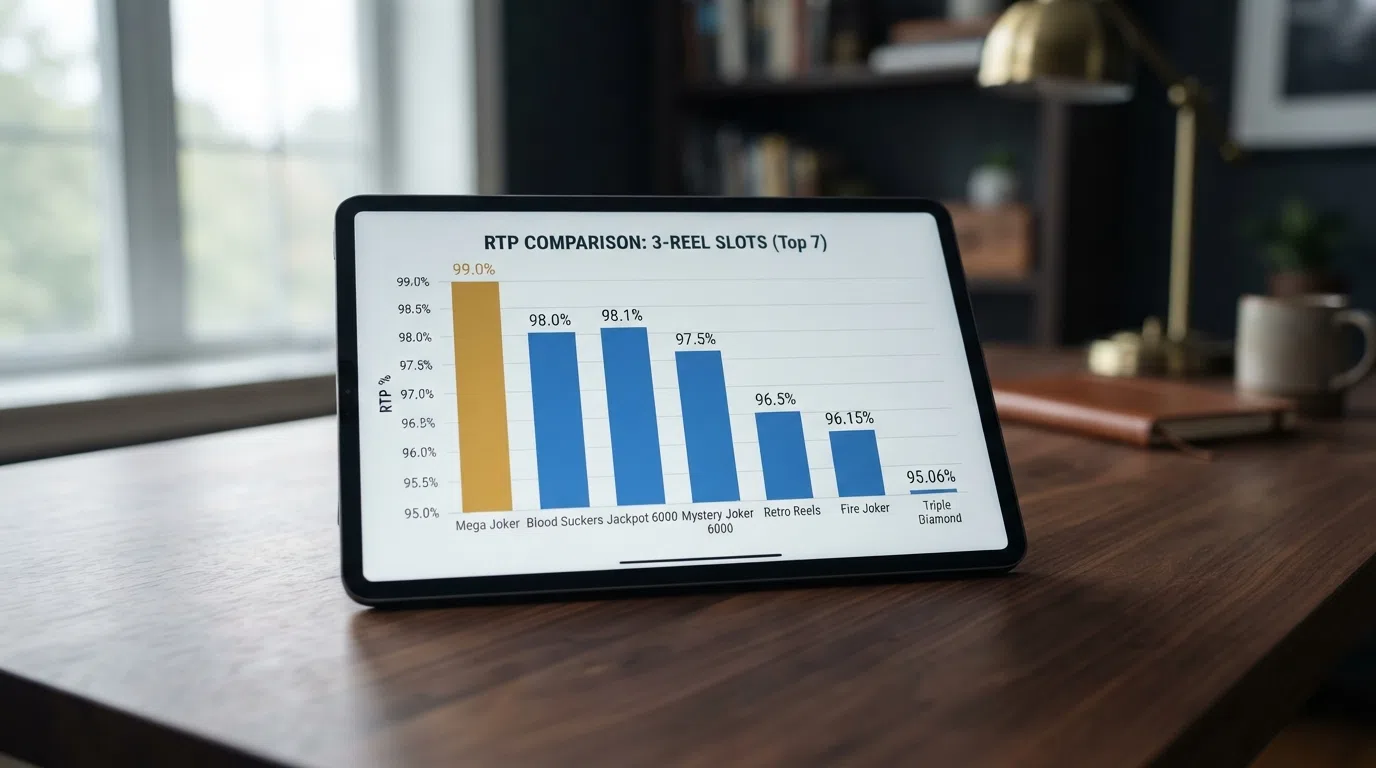
Volatility describes how that long-run return is distributed across spins. A high-volatility slot pays out less often but in larger chunks; a low-volatility slot pays out more often but in smaller chunks. The 3-reel titles in this guide split across the volatility spectrum: Money Maker is low, 777 Wheel Blitz is medium, Jackpot 6000 and Fire Joker and Gemstone Jam are high, and Temple of Three sits mid-to-high.
The cost of a session is the stat that ties RTP, stake and spin count together. A session of 100 spins at a £1 stake on a 96% RTP title is expected to cost £4 over the long run — that’s the £100 staked minus the £96 returned. The same session on a 99% RTP title costs £1. The same session on a 96% RTP title at a £5 stake costs £20. The house edge is a percentage of stake, not a fixed fee, which is why stake size is the lever the player fully controls and RTP is the lever the player chooses when picking a title.
How to Read an RTP Figure — and Why It Is Not a Guarantee
RTP is a long-run average. A 96% slot is built to return £96 for every £100 wagered across millions of spins, not across a single afternoon. Two players sitting at the same title for ten minutes can have wildly different outcomes and still be on a slot whose long-run return is exactly what the rules say it is.
The house edge sits on the other side of the same number. A 96% RTP slot carries a 4% house edge, which means the operator’s theoretical take is 4% of every pound staked over the long run. A 99% RTP slot carries a 1% house edge. The difference between a 1% edge and a 4% edge compounds: across 1,000 spins at £1 each, the gap is £30 in expected return — the same session, the same pace, a fundamentally different cost.
The UK’s Gambling Commission requires every licensed operator to display the RTP for every slot in its lobby. That single rule is what makes the British market the most transparent for slot players anywhere: the comparison between Mega Joker’s 99% and Money Maker’s 97.03% is a 1.97 percentage-point gap, fully visible on each game’s information page, with no marketing language layered over it. Few markets give their players that much to work with.
The Highest-RTP 3-Reel Slots Available to UK Players
The researched 3-reel titles cluster into three RTP bands, and each band has a different reader in mind. At the ceiling sit Mega Joker (99%) and Jackpot 6000 (98.9%), both NetEnt, both 5-line games, both with RTP figures that depend on the Supermeter mode being used. Money Maker follows at 97.03% — the highest-RTP single-payline stepper in the set, with no feature dependency. The 96%-96.50% cluster holds 777 Wheel Blitz (96.50%), Temple of Three (96.20%), Fire Joker (96.15%) and Gemstone Jam (96.0%), a band that represents the typical 3-reel standard and where most players will spend most of their time.
The Supermeter caveat on Mega Joker and Jackpot 6000 matters more than the headline RTP suggests. The base-game RTP on those titles sits below the Supermeter figure; the 99% and 98.9% numbers are reached only when the player actively feeds winnings into Supermeter play. A player who spins the base game and cashes out will see a lower return than the published RTP, and that gap is bigger than the difference between Money Maker and the 96% cluster. The honest reading is that the top two titles reward a particular style of play — feeding wins back into the gamble — while the 97% and 96% titles pay the headline figure on any spin.
How to Play 3-Reel Slots — and What a Strategy Can and Cannot Do
- Set a session budget before you open a slot. Pick the amount in pounds that you can afford to lose, divide it by the per-spin stake, and that is your spin ceiling. The number of spins in a session is more predictable than the number of wins, so planning by spins keeps the math honest.
- Pick a stake that fits the UK cap and your bankroll. The £5 cap for players aged 25 and over, and the £2 cap for 18–24-year-olds, set a hard ceiling. A stake of 1–2% of your session budget per spin is the standard bankroll practice.
- Read the paytable before you spin. The paytable is the only place the slot tells you what each symbol pays and which combinations trigger features. A 30-second read saves 30 minutes of guessing.
- Accept that no strategy changes the RNG. There is no spin pattern, no timing trick and no button-pressing sequence that moves the math. The strategy that matters is the choice of title and the size of the stake — the two decisions the player fully controls.
- Use reality checks when they appear. The UK-mandated reality check is the regulator’s way of ensuring the player sees how long they have been at the reels and what the net position is. Treat it as a pause to reconsider, not a notification to dismiss.
Free Play, Demos & No-Deposit Spins: Try Before You Stake
The cleanest way to learn what a 3-reel slot actually does is to spin it without risking real money. UK-licensed casinos and a wide range of third-party sites offer demo play, no-deposit free spins and practice modes that let a player run a session at zero cost before they ever touch a deposit button.
Demo mode is the industry standard: most providers and operators run a free-play version of every title on the same RNG, paying out fake credits. No-deposit free spins are an alternative: the casino credits a small number of spins (Paddy Power Games leads the featured set with 60, with Sky Vegas also offering a no-deposit batch) that pay real money subject to wagering terms. Wager-free spins — the strongest form of free play available — pay real money with no rollover at all, though the spin count is usually lower and the game choice narrower. Every bonus offer at a GB-licensed casino is subject to a 10x hard ceiling on wagering requirements under LCCP 5.1.1, in force from 19 December 2025, so no GB bonus requires more than ten times the bonus in turnover before withdrawal.
Free play is the most useful RTP research tool the player has. A session of 200 demo spins on Mega Joker or Money Maker is two minutes of work that surfaces the hit frequency, the volatility profile and the relative weight of the Supermeter for the high-RTP titles. Demo play strips the marketing away from the math, and that is what makes it valuable.
No-Download and No-Registration Play — What Is Actually Possible in the UK
“No download” is universal at UK-licensed casinos. Browser-based instant-play is the industry default; every operator on this page serves its games through a normal web page on desktop and mobile without a separate app or software package.
“No registration” is not possible at a UKGC-licensed site. Identity verification — name, address and date of birth — has been required before first deposit or any gambling since 7 May 2025. The rule means that even a free demo on a UK-licensed site may require an account, and a real-money session always will. Player-to-player gambling on credit is also banned, and credit cards have been prohibited for all remote gambling since 14 April 2020, extending to credit-card-funded e-wallet payments.
The workaround is straightforward: developer demo pages and third-party aggregators carry the same RNG-paired games without the registration step. The trade-off is that those sites do not pay real money — they exist to let players sample the titles before choosing where to deposit. A demo spin at a developer page is identical to the same spin on a UK-licensed casino lobby, which is exactly why the demo is the best RTP research tool a player has.
No-Deposit Free Spins and Wager-Free Offers at UK Casinos
The featured set breaks into two camps on free play: six operators offer wager-free spins as the headline offer, and four offer larger spin packages with 10x wagering. The 10x ceiling introduced under LCCP 5.1.1 applies to every GB-licensed offer.
The no-deposit offer is the cleanest entry point. Paddy Power Games leads with 60 no-deposit spins plus 200 more on a £10 stake, all wager-free — the strongest free-spin offer in the featured set. Sky Vegas also runs no-deposit spins alongside its larger stake-gated package.
The wager-free set includes William Hill Casino (200 spins, 0x), Betfred Casino (200 spins, 0x), Bet365 Casino (up to 500 spins, 0x) and Virgin Games (30 spins via the Mega Reel, 0x). Each pays any winnings as real cash with no rollover requirement, which is why this is the cleanest free-play route available: any money won on a wager-free spin is yours to keep or withdraw.
The 10x-wagering set covers the bigger packages. 32Red runs 320 spins on a £30 stake at 10x; Ladbrokes Casino runs 100 spins on a deposit-and-spend-£10 trigger at 10x; Coral Casino mirrors that structure with 100 spins. Betfair Casino splits the difference — 50 wager-free spins plus 100 more at 10x. The 10x multiplier is the upper bound the regulator allows; every one of these offers matches the ceiling, and no GB offer exceeds it.
Playing for Real Money: Stakes, Sites & What Is at Risk
Moving from demo to real money does not change the math of the slot — the RNG, the RTP and the volatility are the same. What it adds is capital at risk, which is where the UK regulatory framework earns its keep.
The £5 (25+) and £2 (18–24) per-spin stake caps are the most visible rule. The “game cycle” the cap applies to is the period from a spin’s initiation to its resolution — including feature rounds and bonus play — and the cap cannot be defeated by splitting a spin into smaller stakes across lines. At £5 per spin, a one-hour session of 1,200 spins is £6,000 in capital at risk before any RTP adjustment. At £2 per spin for an 18-24 player running the same session, the figure halves to £2,400.
The £150 net-deposit threshold for a financial vulnerability check (in force from 28 February 2025) is the second strand of player protection that runs underneath the stake cap. The check uses publicly available data — county court judgments, individual voluntary arrangements, bankruptcy orders — not a credit check on income, and it is a backstop rather than a barrier. Its purpose is to surface a small subset of players who need additional support before they reach higher loss thresholds.
Stakes, Betting Limits and How the UK Caps Shape Your Session
The £5 / £2 stake cap is the most concrete cap a British slot player experiences in a session. For players aged 25 and over, every spin at any UK-licensed casino costs no more than £5 per game cycle. For 18-24-year-olds, the cap is £2. The cap applies to online slots only — live casino, roulette, blackjack, bingo and sports betting sit outside it.
The cap also cannot be split. A “game cycle” is defined as the period from the moment a spin is initiated to the moment all staked money is lost or all winnings delivered, including any feature rounds triggered along the way. A player who bets £5 on a spin, lands a bonus round and wins another £10 in feature play has just completed one game cycle, and the £10 in feature winnings is not a separate stake.
The cap shapes the bankroll calculation in two ways. First, it is the maximum exposure per spin, so a player’s stop-loss number divides into the spin count by £5 (or £2) cleanly. Second, it interacts with multi-line play: a £5 stake on a five-line game is £1 per line, and a £5 stake on a nine-line game is roughly £0.56 per line. More lines means smaller per-line stakes, but the total capital at risk per spin stays at £5.
What the UK does not cap is also worth noting. There is no nationwide deposit, loss or spend ceiling set by the state. Britain caps the stake per spin and mandates that operators offer deposit limits, but the deposit limit level remains the player’s choice. That is a deliberate trade: the regulator has decided that hard caps on deposits drive players to offshore sites without the protections, so the GB framework caps the per-spin risk and educates rather than prescribes on the deposit side.
The 10 UK-Licensed Casinos for 3-Reel Slots — Rated & Compared (2026)
Every operator in the featured set holds a live Gambling Commission operating licence, verified against the Commission’s public register of licence holders. The welcome offers below are the headline packages each operator runs on this page’s subject; the wagering column reflects the LCCP 5.1.1 10x ceiling that binds every GB offer from 19 December 2025 forward. Provider lists cover the studios whose catalogues include classic and 3-reel slots.
| Casino | Welcome Offer | Wagering | Classic 3-Reel Providers | Slot Count |
|---|---|---|---|---|
| Sky Vegas | Up to 200 free spins (stake £10); no-deposit spins also available | 0x (wager-free) | Play’n GO, NetEnt, IGT, Light & Wonder | 1,500+ |
| 32Red | 320 free spins on Big Bass Splash (stake £30) | 10x on free-spin winnings | Microgaming (Games Global), NetEnt, Play’n GO | 1,200+ |
| Ladbrokes Casino | 100 free spins (deposit & spend £10) | 10x | Playtech, NetEnt, IGT, Blueprint | 3,000+ |
| Betfair Casino | 50 free spins no wagering + 100 more with £10 stake | 0x (50), 10x (additional 100) | Playtech, NetEnt, Blueprint | 2,000+ |
| William Hill Casino | 200 wager-free spins | 0x | Playtech, NetEnt, IGT, Evolution | 2,000+ |
| Betfred Casino | 200 wager-free spins (stake £10) | 0x | Playtech, IGT, Blueprint | 1,500+ |
| Paddy Power Games | 60 free spins no deposit + 200 more with £10 stake | 0x | Playtech, NetEnt, Blueprint, Red Tiger | 2,000+ |
| Coral Casino | 100 free spins (deposit & spend £10) | 10x | Playtech, NetEnt, IGT, Blueprint | 1,800+ |
| Bet365 Casino | Up to 500 free spins | 0x | Playtech, Blueprint, NetEnt, Pragmatic Play | 3,000+ |
| Virgin Games | 30 free spins (Mega Reel) | 0x | Games Global (Microgaming), NetEnt, IGT | 1,500+ |
The welcome-offer landscape is a split. Six of the ten operators run zero-wagering offers, and four offer 10x-wagering packages that max out the statutory ceiling. The 10x ceiling is the upper limit; no GB-licensed bonus exceeds it. Where a player values clean cash-out terms over spin count, the wager-free tier is the better pick. Where spin count matters more than the rollover cost, the 10x tier offers more spins at the cost of a small playthrough.
The 3-reel provider spread across the set is narrower than the headline suggests. NetEnt is on eight of the ten lobbies and underwrites Mega Joker and Jackpot 6000 — the two highest-RTP 3-reel titles at any of these casinos. Playtech and Blueprint appear on six, with classic play scattered across their respective lobbies. Games Global (the studio group that absorbed Microgaming) sits at 32Red and Virgin Games, where it anchors the mid-tier maths.
3-Reel vs 5-Reel Slots: The Mechanical Gap That Matters
The mechanical difference is the structure: three reels and one to nine paylines versus five reels and ten to several hundred paylines. A 3-reel title resolves a spin in less than five seconds because the symbol set is small and the win condition is direct. A 5-reel title carries more symbols per column and more combinations per spin, which means more time per spin and — typically — more features layered over the basic spin-and-resolve loop.
The RTP gap is the part worth taking seriously. The researched 3-reel titles cluster from 96.0% to 99.0% RTP, and a typical 5-reel video slot sits in a 94% to 97% RTP band. The 3-reel band is higher at every end, and the upper end (Mega Joker at 99% with a Supermeter caveat) sits above any five-reel video slot at the same casino. That is not an accident; it is a structural feature of a format that lets the house edge sit visibly on fewer outcomes.
The session pace mirrors the mechanical difference. Three reels resolve quickly, which means more spins per minute and more chances for the player to see the volatility profile play out. Five-reel titles with feature chains slow that resolution, which is sometimes the point (anticipation) and sometimes a tax on the session’s cost. Both formats sit inside the same 2.5-second minimum spin speed rule, so neither can out-spin the other; the gap is in how long the slot demands attention, not in raw spins per hour.
Classic Slots vs Video Slots: What You Trade at Each End
A classic slot’s appeal is the simplicity. Three reels, a handful of paylines, a paytable that fits on one screen and a math model a player can reconstruct in their head. The trade-off is that classic play carries less variety — no megaways, no cascading reels, no licensed-IP bonus rounds layered over the spin.
Video slots go the other direction. Five reels, dozens of paylines, expanding wilds, free-spin chains, feature buys, megaways and a math model that runs through a feature round the player must trigger to reach the headline RTP. The trade-off is that the headline RTP is lower on average and harder to evaluate, because the features that promise higher returns are gated behind combinations the player cannot fully predict.
Volatility works out differently across the two formats as well. A 3-reel classic slot tends toward high volatility: fewer outcomes, larger wins, longer spells without a payout between them. A 5-reel video slot spreads the same RTP across more outcomes and more features, so volatility is generally lower — the player pays per spin more often but in smaller amounts. Neither is better. The honest trade is that a high-volatility 3-reel slot is a worse fit for a player who wants long sessions and a better fit for a player who values the chance of a payout worth having, while a video slot’s lower volatility is a worse fit for a player who wants a meaningful max win and a better fit for a player who values steady, small returns.
UK regulation also affects the formats differently. The auto-play ban, the spin-speed floor, the loss-disguised-as-wins ban and the reverse-withdrawal ban shape the video slot more than the classic. A video slot that was designed with turbo spins, automatic reels and visual cues for wins is exactly what the rules target; a classic that never had those features is unaffected.
Sky Vegas — NetEnt Backbone, Keep What You Win
Sky Vegas is the featured set’s strongest combination of wager-free offers and the right provider mix for high-RTP 3-reel play. The headline package is up to 200 free spins on a £10 stake, plus a separate no-deposit spin allotment, all at 0x wagering. NetEnt and Play’n GO are both on the provider list, which means Mega Joker, Jackpot 6000 and Fire Joker all sit a search away. The slot library sits at 1,500+ titles with a £10 minimum deposit on the welcome offer.
For a player whose priority is keeping what they win without a playthrough, Sky Vegas is the cleanest read in the set. The provider mix is the second reason it ranks high: NetEnt is the studio behind both top-RTP 3-reel titles at any UKGC-licensed casino, and Play’n GO is the studio behind Fire Joker and Temple of Three.
32Red — Microgaming Depth and 320 Free Spins
32Red is a long-established UK brand with the Games Global (formerly Microgaming) catalogue behind it and the largest 10x-wagering spin package on this list. The headline is 320 free spins on Big Bass Splash with a £30 stake, all at 10x wagering. Providers include Microgaming (Games Global), NetEnt and Play’n GO; the slot library is 1,200+; the minimum deposit on the welcome offer is £10.
The trade-off is the 10x wagering on a comparatively high £30 stake. A player who plans to clear the bonus and withdraw within a session will feel the wagering tax. A player who plans to use the spins as a longer session sample — running the welcome package as an extended play rather than a withdrawal path — gets more spins per pound staked than any other operator on this list.
Ladbrokes Casino — 3,000+ Games and Playtech Muscle
Ladbrokes Casino is the largest slot library in the featured set, with 3,000+ titles. The welcome package is 100 free spins on a deposit-and-spend-£10 trigger at 10x wagering. Providers include Playtech, NetEnt, IGT and Blueprint, which covers the strongest 3-reel catalogues from any of these studios. The minimum deposit on the welcome offer is £10.
The library size is the headline feature: more titles means more breadth across the 3-reel bracket, including less common providers whose 3-reel releases sit alongside the NetEnt and Playtech standards. The 10x wagering is the price of admission — same as 32Red, same as Coral — but the per-spin stake at £10 keeps the entry cost lower than 32Red’s £30.
Betfair — A Split Welcome: Half Unlocked, Half Capped
Betfair Casino splits its welcome offer across two halves: 50 free spins with zero wagering and 100 more spins on a £10 stake at 10x wagering. Providers on the platform are Playtech, NetEnt and Blueprint, with 2,000+ slots and a £10 minimum deposit on the welcome offer.
A player who plans to use only the first half of the offer gets wager-free play with 50 spins; a player who stakes the £10 and uses both halves pays the 10x ceiling on the additional 100 spins. The split is unusual in the featured set and fits a player who wants both an immediate cash-out path and a longer spin-sample test in the same session.
William Hill — The High-Street Brand, Nothing to Clear
William Hill Casino runs a pure zero-wagering offer: 200 wager-free spins. Providers are Playtech, NetEnt, IGT and Evolution; the slot library is 2,000+; the welcome offer minimum deposit is £10.
William Hill’s offering is the cleanest zero-playthrough structure in the set alongside Betfred and Bet365: every winning spin pays out as real cash with no rollover. For a player who wants a recognisable high-street brand and a simple, no-clear withdrawal path, William Hill is the obvious pick.
Betfred — Zero-Rollover Package Across a Deep Catalogue
Betfred Casino carries 200 wager-free spins (0x) on a £10 stake. Providers on the platform are Playtech, IGT and Blueprint, with 1,500+ slots and a £10 minimum deposit on the welcome offer.
Like William Hill and Bet365, the headline structure is wager-free throughout. The provider mix is narrower than Sky Vegas or Bet365 — no NetEnt is a real gap, since NetEnt is the studio behind the two highest-RTP 3-reel titles — but IGT and Blueprint together carry enough classic 3-reel coverage for a session focused on the format.
Paddy Power — Spins Before You Put Down a Pound
Paddy Power Games is the featured set’s standout no-deposit free-spin offer: 60 no-deposit free spins plus 200 more on a £10 stake, all wager-free (0x). Providers include Playtech, NetEnt, Blueprint and Red Tiger; the slot library is 2,000+; the welcome offer minimum deposit is £10.
The 60 no-deposit spins are the strongest entry point on this list. A player who wants to try a 3-reel title without depositing anything at all gets 60 wager-free spins as the opening move; the additional 200 spins on a £10 stake extend the session for a player who decides to commit. NetEnt is on the provider list, so Mega Joker and Jackpot 6000 are both within reach.
Coral Casino — 100 Spins at 10x, Playtech and NetEnt Classics
Coral Casino carries 100 free spins on a deposit-and-spend-£10 trigger at 10x wagering. Providers are Playtech, NetEnt, IGT and Blueprint; the slot library is 1,800+; the welcome offer minimum deposit is £10.
The structure mirrors Ladbrokes, which makes sense given the shared parent. NetEnt on the provider list puts Mega Joker and Jackpot 6000 within reach, and Playtech anchors a wide range of classic 3-reel titles. The 10x wagering is the ceiling — same as 32Red and Ladbrokes — so Coral sits in the second tier of headline offers.
Bet365 Casino — Up to 500 Wager-Free Spins
Bet365 Casino runs the featured set’s largest wager-free ceiling: up to 500 free spins at 0x wagering. Providers on the platform are Playtech, Blueprint, NetEnt and Pragmatic Play; the slot library is 3,000+ — tied with Ladbrokes for the largest; the welcome offer minimum deposit is £10.
For a player who values both spin count and zero wagering, Bet365 sits at the top of the headline offer chart. The provider mix is broad: NetEnt for Mega Joker and Jackpot 6000, Blueprint for a range of classic 3-reel releases, Playtech for the wider Playtech catalogue. The 3,000+ slot count makes this the widest net in the featured set for any player who wants to explore the 3-reel format across providers.
Virgin Games — Mega Reel Free Spins, Zero Wagering
Virgin Games carries a lighter 30-spin wager-free offer through the Mega Reel mechanism. Providers include Games Global (Microgaming), NetEnt and IGT; the slot library is 1,500+; the welcome offer minimum deposit is £10.
The offer is the smallest in the featured set in pure spin count, but it is wager-free throughout and reaches the right provider mix for the highest-RTP 3-reel titles. A player who wants a short, low-commitment sample session with no rollover is well served; a player who wants more spins per pound will look at Paddy Power or Sky Vegas.
Playing Legally in Britain: Licences, Stake Caps & Your Rights
Every 3-reel slot session at a UK-licensed casino sits inside a regulatory framework that did most of its work long before the player opened the lobby. The Gambling Commission is the sole statutory regulator for Great Britain (England, Scotland and Wales), established under the Gambling Act 2005. The 2014 Gambling (Licensing and Advertising) Act closed the offshore loophole by making a GB operating licence compulsory for any operator serving GB customers, regardless of where the operator is based. Every featured operator on this page holds a live GB operating licence; verification was carried out against the Commission’s public register of licence holders.
The Commission’s three licensing objectives run underneath everything else in the framework: preventing crime and disorder, ensuring fair and open gambling, and protecting children and other vulnerable persons. The objectives are the legal test every licence applicant has to satisfy, and they are the basis for the LCCP and RTS conditions that govern day-to-day operations.
What a UKGC licence actually guarantees the player is a small but consequential bundle: an independently audited Random Number Generator, segregated player funds for some operator categories, mandatory alternative dispute resolution (ADR) coverage and GAMSTOP integration. None of these is decorative — together they are the difference between a regulated session and an unprotected one.
The UK Slot Stake Caps and Game-Design Rules — What They Mean for Every Spin
The £5 / £2 age-banded stake cap (SI 2025/215), in force 9 April 2025 for the £5 tier and 21 May 2025 for the £2 tier, is the headline player-protection rule for online slots and cannot be defeated by splitting a spin. The auto-play ban (31 October 2021) requires manual spin initiation, while the 2.5-second minimum spin speed sets a floor on game resolution. Features speeding up play or disguising losses as wins are banned, as is the practice of reversing a withdrawal. Operators must also prompt for financial limits before the first deposit, ensure the gross-deposit-limit requirement (RTS 12, 30 September 2026) is applied to limit labelling, and trigger the £150 net-deposit financial vulnerability check automatically.
Player Protection, Dispute Resolution and What Happens When Something Goes Wrong
GAMSTOP is the multi-operator self-exclusion scheme for every GB-licensed online site. Participation is mandatory for every Commission online operating licence, which means a player who has registered with GAMSTOP cannot open a new account at any of the ten operators on this list until the exclusion period ends. Exclusion periods run for six months, one year, five years or five years with auto-renewal; the period cannot be cancelled early.
Every UKGC licensee is required to subscribe to an approved Alternative Dispute Resolution (ADR) provider, which gives the player a route to escalate complaints that the operator’s own team cannot resolve. The Commission’s complaints process sits on top of that: a player who has exhausted the operator and ADR routes can refer the matter to the Commission, which can take enforcement action against the licensee.
The financial risk assessments — sometimes called “affordability checks” — are a separate regulatory track from the £150 vulnerability check. They were piloted, and the Commission’s Board confirmed a staged rollout on 7 July 2026, with final thresholds set at £1,000 (24-hour net deposit) and £3,000 (rolling 30-day net deposit) for players aged 25 and over, and £750 and £2,000 respectively for those under 25. The start date has not been confirmed; the £150 vulnerability check remains the only affordability-style intervention in live operation.
The statutory gambling levy took effect on 6 April 2025 under the Gambling Levy Regulations 2025. The levy sits at 1.1% of gross gambling yield for remote casino, remote bingo, remote general betting and gambling software licences. The proceeds split 50% treatment, 30% prevention and 20% research — meaning the levy is the funding mechanism behind the support services a player may end up needing, paid for out of operator GGY rather than central taxation.
A player who chooses an unlicensed offshore site loses the lot. No GAMSTOP coverage, no Commission complaints route, no ADR, no British consumer redress. The Commission’s enforcement against unlicensed operators is disruption-based rather than blocking-based — cease-and-desist notices, search-engine URL referrals, payment-provider referrals — which has produced results (3,140 disruption notices and 447,778 URL referrals between April 2024 and June 2025) without the statutory ISP blocking powers legislation has proposed but not enacted. The enforcement work is real; what the player does not get is the regulatory framework.
Safer Play: Limits, Self-Exclusion & Where to Get Help
Safer play at a UKGC-licensed casino is not a single button the player presses. It is a stack of tools — deposit limits, session time limits, reality checks, time-outs, self-exclusion — that the operator has to offer and the player has to use.
The problem-gambling prevalence numbers are worth keeping in mind when sizing the protective stack. The Gambling Survey for Great Britain (GSGB) for 2024/25 put the problem gambling rate at 2.7% of the adult population. The wider GOV.UK picture is that about 0.5% of adults in England experience problem gambling, 3.8% are at elevated risk of gambling harms, and an estimated 7% of the British population are negatively affected by someone else’s gambling. The growing short-session behaviour — sessions averaging fifteen minutes, with the share lasting over an hour down 12% year-on-year — is a separate story: it describes how the market is being played, not who needs help.
The help resources the framework funds are tangible. GamCare runs the National Gambling Helpline on 0808 8020 133 — a 24/7, free and confidential line. GamCare’s 2024/25 figures carry the demand: over 130,000 calls and online messages, 7,100 referrals into further treatment services and 8,100 treatment sessions delivered regionally, with an average wait time of 1.3 days. GambleAware provides self-assessment tools and free support, GAMSTOP is the self-exclusion route, and the NHS runs gambling harm clinics in England, Scotland and Wales.
Self-Exclusion, Deposit Limits and the Tools You Control
GAMSTOP is the nuclear option and the most consequential single tool. Registration blocks the player from every GB-licensed online casino for the chosen period, and the period cannot be undone early. Six months is the shortest standard term; one year and five years are mid and long; the five-year auto-renewal option is the practical equivalent of permanent exclusion for a player who is sure of their decision. The rule that the period cannot be cancelled is the protective edge: a player who chooses five years cannot talk themselves out of it on day ninety.
Per-operator deposit limits are the tool a player uses every day. The new gross-deposit-limit mandate under RTS 12 (in force 30 September 2026) makes those limits consistent across operators — only money-paid-in limits can be labelled “deposit limit”, and any decrease must be actioned immediately. A player who wants to drop a daily cap from £100 to £50 has the change take effect the moment they press save.
Reality checks and time-outs sit one level down. A reality check is the pop-up the operator must serve during a session to show time and net position — a pause that asks the player to actively continue. Time-outs (sometimes called cooling-off periods) run from 24 hours to six weeks, on a per-operator basis, and sit between a player’s daily play and the GAMSTOP decision.
The £150 net-deposit financial vulnerability check is the backstop. It runs in the background and uses publicly available data — county court judgments, individual voluntary arrangements, bankruptcy orders, debt relief orders — to surface a small subset of players for additional support. It is not a credit check, not a salary assessment, and not a hard block: a positive result leads to a conversation the operator has with the player, not a denial of service.
How We Picked the Best 3-Reel Slots and Casinos for 2026
The operator rankings are built on licence status first, then slot and offer fit for the 3-reel subject. Every operator was verified against the Gambling Commission’s public register of licence holders; this verification was repeated for the August 2026 cut and covered all ten operators in the featured set. The welcome-offer snapshots are taken from operator sites and third-party review sites as of August 2026, and the wagering column reflects the 10x hard ceiling introduced under LCCP 5.1.1 on 19 December 2025.
The slot rankings come from the providers’ own game pages (NetEnt, Play’n GO, BGaming, Yggdrasil) cross-checked against third-party slot-review sites — FruitySlots, CasinoWizard, BestSlots, Highbet and NewSlot among them. The verification step repeats the figures against a second source where one is available, on the basis that a single-source RTP number should not reach the reader without a cross-check.
What this ranking does not do is also worth saying. It does not weight market share, does not accept operator payment for placement, and does not use advertising spend as a signal of quality. The ranking reflects how well each operator fits the 3-reel subject — provider mix, slot count, welcome offer structure — rather than how visible the operator’s marketing is in the broader market.
Your 3-Reel Slots Playbook: What to Do Next in 2026
Three reader profiles the page has described, and a clear next step for each.
The RTP hunter should pick Mega Joker at 99% RTP and Jackpot 6000 at 98.9% — both as Supermeter figures rather than base-game figures — and play at a stake that lets them feed wins back into the Supermeter mode the titles are designed for. Money Maker at 97.03% is the single-payline alternative for a player who does not want the gamble mechanic. These three titles carry the highest long-run returns in the researched set; any other 3-reel pick is a paytable trade-off, not a return gain.
The feature-seeker should pick Fire Joker for its respin-of-fire and Wheel of Multipliers, 777 Wheel Blitz for its 34.6% hit frequency and 5,020x max win, and Gemstone Jam for the nudge-plus-multiplier-wild mechanic on a nine-payline grid. These three titles sit at the 96%-96.50% RTP band — lower than the Supermeter-heavy titles at the top, but the features do the volatility work that the bare single-line classics do not.
The free-play browser should start with Paddy Power Games (60 no-deposit spins plus 200 wager-free on a £10 stake) or Sky Vegas (no-deposit spins alongside up to 200 wager-free), both backed by NetEnt and Play’n GO. The free-play route is also where a session of demo spins at the provider’s own site is the right move: it strips the marketing layer away and leaves just the math.
The single decision every reader should make before opening a slot is to set a session budget in pounds, not in spins. The £5 / £2 stake cap makes that number turn cleanly into a spin count, and the rest of the framework — reality checks, deposit limits, GAMSTOP — sits underneath that decision rather than around it.
The UK regulatory framework is what closes this page. The stake caps, GAMSTOP, the mandatory RTP display and the 10x wagering ceiling give the British player more transparency and protection than any other regulated market. The job of this page was to show the format, the maths and the operators most worth the deposit; the framework gives the player the tools to use them.
Frequently Asked Questions
What are 3-reel slots and how do they work?
A 3-reel slot uses three columns of symbols and pays out when matching symbols land on one of a handful of paylines (typically one to nine). Every spin is independent and driven by a Random Number Generator. UK rules require manual play, a minimum 2.5-second spin speed, and a displayed RTP for every title at every licensed casino.
What is the difference between 3-reel and 5-reel slots?
A 3-reel slot has three columns and up to nine paylines; a 5-reel slot has five columns and from ten to several hundred paylines, often layered with features such as free spins, cascading reels and megaways. The researched 3-reel titles carry higher average RTPs (96.0% to 99.0%) than typical 5-reel video slots, which usually sit in the 94% to 97% RTP band.
Can I play 3-reel slots for free without downloading?
Browser-based play is standard at every UK-licensed casino, so no download is required. Demo mode on provider and aggregator sites lets you play without registering, but real-money play at a UKGC site requires identity verification before first deposit, so fully anonymous registration-free play is not possible at a licensed operator.
How do I choose a safe UK-licensed casino for real-money 3-reel slots?
Start with the Gambling Commission’s public register of licence holders and check any operator against it. From the licensed set, compare the welcome offer (look for 0x wagering if cash-out speed matters), the provider list (NetEnt and Play’n GO carry the strongest 3-reel catalogues), and the slot library size for the breadth of titles available.
Do 3-reel slots have bonus features?
Yes. Modern 3-reel titles carry respins (Fire Joker’s respin-of-fire), multiplier wheels (Fire Joker’s Wheel of Multipliers), Supermeter gamble modes (NetEnt’s Mega Joker and Jackpot 6000) and nudge-plus-multiplier-wild mechanics (Yggdrasil’s Gemstone Jam). The features sit on top of the basic three-reel structure rather than replacing it.
Where can I get help if I have a gambling problem in the UK?
GamCare’s National Gambling Helpline is on 0808 8020 133 (24/7, free and confidential). GAMSTOP at gamstop.co.uk provides multi-operator self-exclusion, GambleAware offers self-assessment tools and the NHS runs gambling harm clinics across England, Scotland and Wales. The problem gambling rate in Great Britain was 2.7% in the 2024/25 Gambling Survey for Great Britain.
Slots – Real Money Online Casinos UK
Content created by the «Real Money Online Casinos UK» team