
No ID Verification Casinos UK: What the Label Really Means
 Available in GB
The phrase “no ID verification casino UK” promises a frictionless signup: an account, a deposit, a spin, with no upload of a passport or a utility bill. The promise is real in one narrow sense and misleading in every other. Operators that deliver permanent no-document play exist, and UK players can reach them, but none of them hold a Gambling Commission licence. Every casino on this page sits outside the British regulatory framework. The trade that the marketing page skips is the entire subject: what you save in upload time, you pay for in lost consumer protection.
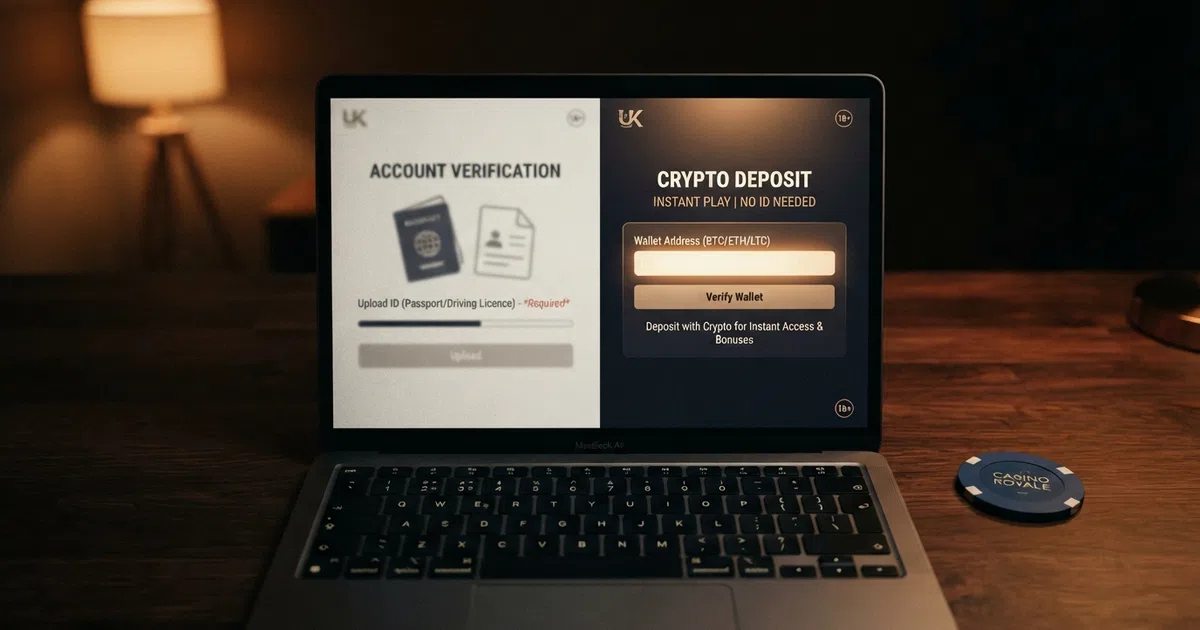
This guide reviews ten operators that actually let UK players deposit and play without upfront identity checks, and it sets each one against the regulation it bypasses. The ranking is built on the licence gap first, because that gap decides everything else: the complaints route that exists if a payout stalls, the self-exclusion scheme that blocks your next login, the dispute body that can order an operator to pay.
Last updated: 17 August 2026 · Licence claims verified against the Gambling Commission’s public register.
Why “No ID Verification” Rarely Means What It Says
The label covers two genuinely different products. The first is deferred KYC: the casino lets you register, deposit, and play, then asks for documents when you try to withdraw a meaningful amount. The second is genuinely absent KYC: no documents at signup, no documents at withdrawal, because the only identifier on file is a wallet address and an email. Most marketing copy uses the words interchangeably; the legal and practical consequences are not interchangeable at all.
The word “regulation” sits underneath both readings. An operator licensed by the UK Gambling Commission cannot, by the terms of its licence, let you deposit before it has verified your name, address, and date of birth. A site that offers permanent no-ID play is, by definition, not licensed in Great Britain. The promise and the British licence are mutually exclusive.
The Two Kinds of “No ID”: Deferred Checks Versus No Checks at All
Deferred verification is the model most “no-ID” sites actually run. You sign up with an email, deposit, and play. Documents are requested later, typically before a withdrawal above a certain threshold, or when the operator’s anti-fraud system flags a transaction. The first deposit clears in minutes; the first big withdrawal may take days while a passport scan is reviewed.
Genuinely absent verification is rarer. The operator asks for nothing that ties a real identity to the account: a wallet address for crypto, a throwaway email, no document at any stage. The account is portable in a way a deferred-KYC account is not.
The distinction decides everything downstream. A deferred-KYC site can still ask for your documents and freeze your funds while it waits. A truly no-KYC site cannot, because it never had the verification infrastructure to begin with. The latter is harder to find and harder to leave once you’ve found it.
Why Players End Up Searching for No-ID Casinos
The friction that creates the demand is inside the licensed market. Every GB-licensed site has, since 7 May 2019, verified a customer’s identity before accepting a first deposit. The pre-2019 grace period, which gave customers 72 hours to send documents, is abolished. Upload a passport, wait for the review, then play. For most players that is a one-time nuisance. For some it is a recurring intrusion: a shared computer, a privacy preference, a slow review that locks funds for a day.
GAMSTOP adds a second reason. The national self-exclusion scheme, mandatory for every GB-licensed online operator since 31 March 2020, lets a player bar themselves from every British site for six months, a year, or five years. The bar cannot be cancelled early. A player who excluded themselves in a difficult week and now wants to play has no British site to play on, because every one is plugged into GAMSTOP.
The transactional search query, “where can I play without uploading ID,” is the dominant intent behind this keyword. It is the question of someone who has hit one of those two walls, or who simply prefers not to send identity documents to a casino at all. The honest answer involves operators the UKGC cannot see.
What This Guide Does and Does Not Promise
The page ranks ten offshore operators that accept UK players without pre-deposit verification. It describes each one’s offer, its licence, and its verification model. It does not promise that any of them is safe, fair, or solvent; no external regulator is checking on the player’s behalf. It does not recommend one brand over another as a place to play. It does explain, for each operator, what it is worth and to whom, so the reader can make the call themselves.
Every operator on this list runs without a GB licence. That single fact shapes every other fact on the page. The reader who needs a UKGC-regulated site will find none here, and the reader who does not need one will find out what that choice actually costs.
No-ID Play Is Legal for You — But Every Casino Offering It Sits Outside the UKGC
The player’s position and the operator’s obligation are different questions, and they have different answers. It is not a criminal offence for a person in Great Britain to log on to an offshore casino and place a bet. It is a criminal offence, under section 33 of the Gambling Act 2005, for an operator to provide those facilities without a GB licence. The risk runs in one direction: the operator carries the legal exposure, the player carries the regulatory gap.

The 2014 point-of-consumption reform made the rule absolute. A licence issued in Curaçao, Malta, or Gibraltar is not a substitute for a Gambling Commission licence when the customer is in Great Britain. The licence has to be British, and a British licence is incompatible with permanent no-ID play. Those two statements produce every feature of the market this page describes.
What the Law Makes of a No-ID Casino in the UK
Section 33 of the Gambling Act 2005 creates a summary offence: providing facilities for gambling without the required GB licence, punishable by up to 51 weeks’ imprisonment and an unlimited fine. The Gambling (Licensing and Advertising) Act 2014 made the licence requirement apply at the point of consumption, so an operator based in Curaçao and serving a customer in Manchester is committing the offence just as clearly as one based in London would.
Enforcement against offshore operators does not look like criminal prosecution in most cases. Between April 2024 and June 2025 the Gambling Commission issued 3,140 disruption notices and referred 447,778 URLs to search engines; 287,961 of those URLs were removed, and engagement with the disrupted sites fell by an average of 32%. The strategy is to make the sites harder to find, not to chase every one through the courts.
The player is not the target. No traced sanction in the current enforcement record runs against a GB resident who merely gambles on an unlicensed site. The penalty the player pays is the absence of British protection: no GAMSTOP, no UKGC complaints route, no approved alternative dispute resolution body, and no British consumer law to fall back on if funds are withheld. That is the trade, and it is the one this page is built around.
The UKGC’s KYC Rule: Verification Before the First Deposit
The specific rule that makes “no ID” impossible at a licensed site is LCCP Condition 17.1.1. The operator must verify a customer’s name, address, and date of birth before that customer is permitted to deposit funds or gamble, with their own money or any free bet or bonus. A separate condition, LCCP 3.2.11, requires age verification before a customer can deposit, access free-to-play games, or gamble with any bonus.
Before 7 May 2019 the rule had a 72-hour grace period. A player could deposit, play, and then send documents within three days. The grace period was abolished. Verification now happens before the first deposit lands. An operator that wanted to offer a GB customer permanent no-document play would have to delete that step from its onboarding, and a GB-licensed operator cannot delete that step without losing its licence.
That is the structural reason the offshore market exists in its current form. The demand for no-ID play is real, and the British regulator has closed the only legal route to satisfying it. The supply has moved offshore.
The Regulated Route: The Caps and Protections a GB Licence Brings
The licensed market is not a no-rules market. It is a heavily capped one, and the caps are the reason a player might choose to leave it. The table below sets out the rules a GB-licensed operator must follow, and what each rule actually constrains.
| Rule / cap | What it sets | In force from |
|---|---|---|
| Slots stake cap (25+) | £5 maximum stake per game cycle | 9 April 2025 |
| Slots stake cap (18–24) | £2 maximum stake per game cycle | 21 May 2025 |
| Wagering requirement cap | Bonuses capped at 10× playthrough | 19 December 2025 |
| Credit card ban | No credit cards for any remote gambling, including credit-card-funded e-wallets | 14 April 2020 |
| Financial-limit prompt | Operator must prompt for a deposit limit before first deposit | 31 October 2025 |
| Financial vulnerability check | Triggered at £150 net deposit in rolling 30 days, using publicly available data | 28 February 2025 |
| GAMSTOP self-exclusion | Mandatory for all GB-licensed online operators | 31 March 2020 |
The caps are tight and they are specific. A 25-year-old cannot legally place a £10 spin on a British-licensed slots site. A bonus at a GB-licensed casino cannot carry a 40× playthrough. A credit card cannot fund a single deposit. Every one of these caps is a reason a player might want to be somewhere else, and every one of them stops at the British border.
What You Give Up Outside the UKGC: GAMSTOP, ADR, Fund Safety
GAMSTOP is the most concrete loss. The scheme offers self-exclusion periods of six months, one year, five years, or five years with auto-renewal, and none of them can be cancelled early. It is online-only, mandatory for every GB-licensed operator, and it does not reach a single offshore site. A player who has self-excluded through GAMSTOP can still register, deposit, and play at any operator on this page. That is sometimes the point. It is also sometimes a problem, which is why the responsible-gambling sections below matter.
The complaints route disappears too. A GB-licensed operator is signed up to an approved alternative dispute resolution (ADR) provider, and the Gambling Commission can order a payout if the ADR finds in the player’s favour. An offshore operator typically has its own ADR, often based in Curaçao, with enforcement capacity that sits below UKGC standards. If a payout is withheld, the player’s practical recourse is to complain, to escalate publicly, and to hope.
Fund segregation is the third loss. Licensed operators must keep customer funds in segregated accounts, audited and protected if the operator goes insolvent. Curaçao licence conditions include a segregation requirement, but the auditing is inconsistent, and the protection in practice depends on the operator’s solvency and on whatever local court will hear the case. It is not nothing, but it is not the British regime.
“No Photo ID,” “No ID Check,” “No Documents”: What the Variants Really Mean
Search variants of the keyword collapse into the same product. “No photo ID casino UK,” “no ID check casino UK,” and “casino no documents needed” all name the absence of pre-deposit verification, which is the same condition 17.1.1 bars at every GB-licensed site. The variation in wording reflects how people search, not how casinos are built. An operator either asks for documents before the first deposit or it does not. There is no third option inside the British licensing framework.
The 10 No-ID Casinos Reviewed — and the Licence Gap That Splits Them
The ranking below is built on the licence gap first, then on the verification model, then on the offer. Every operator here runs offshore. Five of them have researched bonus terms; five of them are referenced by reviewers without enough published detail to fill in the cells. The honest gaps are kept as gaps.
| Operator | Offshore licence / regulator | Verification model | Welcome bonus | Game library |
|---|---|---|---|---|
| Jackbit | Curaçao CGA (OGL/2024/1562/1139) | No ID at signup, no ID to withdraw (crypto-only) | 100 wager-free free spins, $50 min deposit, $100 spin cap | 6,000+ games, 70+ providers |
| BetPanda | Costa Rica corporate registration (not a gambling licence) | No ID at signup, no ID to withdraw | 100% up to 1 BTC, 40×–80× wagering, 7 days | 6,000+ games |
| BC.Game | Curaçao-licensed | No ID at signup; ID possible at $2,000–$3,000 withdrawal | 380% up to $4,000 + 400–460 free spins | Extensive library |
| Vave | No gambling licence confirmed | No ID at signup; reserves right to verify at any time | 150% up to 1.5 BTC + 100 spins, 50× wagering, 30 days | 7,000+ games, 100+ providers |
| Cryptorino | Costa Rica data-processing registration (not a gambling licence) | Fully no-KYC, email only at signup | 100% up to 1 BTC, 66× on deposit, 7 days | 6,000+ games, 70+ providers |
| Twinqo | Not confirmed | Email-only signup, skips documents for most withdrawals | Not confirmed | Not confirmed |
| LuckyRollers | Not confirmed | Wallet address only, no email verification | Not confirmed | Not confirmed |
| CoinCasino | Not confirmed | Wallet-only registration | Not confirmed | Not confirmed |
| Winorio | Costa Rica licence (AXENTRA LTD) | No KYC at signup; KYC before withdrawal | Not confirmed | 10,000+ titles |
| Kingdom Casino | Not confirmed | Referenced as “Best No KYC Casino Bonus” | Not confirmed | Not confirmed |
Five rows down the table, the cells thin out. That is the honest state of the public record for those brands: a reference here, a tag there, and not enough confirmed detail to fill the cells. Where research did not confirm a figure, this guide does not invent one. The reader is told the gap, not sold a guess.
Jackbit: Wager-Free Spins Behind a Curaçao Licence
Jackbit is the strongest researched operator on the page, on both the licence it holds and the terms it offers. The Curaçao CGA licence (OGL/2024/1562/1139) was issued to Data Link Digital B.V. in July 2025, and the offer is unusually clean for a crypto casino: 100 wager-free free spins on the first deposit, a $50 minimum deposit, a $100 cap on spin winnings, and a 24-hour validity window from activation. The deposit must be wagered once before any withdrawal.
The library is large: 6,000+ games from 70+ providers, including Pragmatic Play, Evolution, NetEnt, Play’n GO, Hacksaw Gaming, and Nolimit City. Withdrawals are crypto-only and run near-instant, reportedly under a minute, because the verification step that slows payouts at licensed sites does not exist here.
The free-spin game varies by promotion. One review names Hot Chilli Bells, another names Book of Dead, which carries a 96.21% RTP at high volatility. The 0× wagering on spin winnings is the standout feature: it is the only offer on the page where the bonus does not have to be cleared through a playthrough. For a player who values clean terms and a verifiable licence above all else, Jackbit is the cleanest of the ten.
BC.Game: The Biggest Welcome Package, but ID at the Big-Withdrawal Trigger
BC.Game runs the largest offer in the table. A four-deposit welcome package: 380% match up to $4,000 plus 400 to 460 free spins, depending on the deposit tier. The wagering varies by deposit tier and is not fully specified in the reviewed sources, which is itself a feature of the offer to read carefully. ID is possible at the big-withdrawal trigger; BC.Game may request documents on withdrawals above roughly $2,000 to $3,000.
The library is extensive, with the same top-tier providers a UK player would recognise. The Curaçao licence is in place. What BC.Game is selling is volume: a much larger headline bonus than the other operators here, balanced against a withdrawal threshold that brings identity verification back into the picture. A player planning a big win should expect to upload a passport at cashout; a player who never wins enough to trip the trigger plays the entire session without documents.
For a reader who wants the largest match on the page and is comfortable uploading documents at the moment a large withdrawal is processed, BC.Game offers the most bonus dollars in the set. For a reader who wants documents to stay out of the process entirely, the threshold is the point to know about before signing up.
BetPanda: A 100% BTC Match with No Gambling Licence at All
BetPanda is a 100% first-deposit match up to 1 BTC. The wagering is the contested figure: one review puts it at 40× on the deposit, another at 80×. The 7-day validity and the €10 minimum deposit are consistent across sources. There is no specific bonus cashout limit and no free spins attached to the standard offer.
The licence situation is the part to be precise about. BetPanda holds a Costa Rica corporate registration, which is not a gambling licence. Costa Rica does not issue remote gambling licences in the conventional sense; it registers corporations that happen to operate gaming sites. The “licence” column is honest only if it is read as “corporate registration, not a regulatory licence.”
For a player comfortable with crypto-only play, the offer is straightforward: a large match on a big unit, a short validity window, and a verification model that genuinely does not request documents. The reader who needs the protection of a regulatory licence will not find it here. The reader who values simplicity and large unit sizing will.
Cryptorino: Fully No-KYC, with 66× Wagering on Deposit Only
Cryptorino is the strictest no-KYC stance in the researched set. Email-only signup, no document upload at any stage, and the operator’s posture is reportedly that KYC is never required. The offer is a 100% match up to 1 BTC, with 66× wagering on the deposit (not on deposit plus bonus), a 7-day validity, a €10 minimum deposit, and a €10–€12 max bet per spin. Slots contribute 100% to wagering; live casino contributes 20%.
The library matches the other crypto-first operators: 6,000+ games from 70+ providers. Crypto payouts run in 1 to 3 hours, fee-free. The Costa Rica registration is, as with BetPanda, a data-processing registration rather than a gambling licence.
The 66× wagering is the part to weigh. The UK cap, in force since 19 December 2025, is 10×. Cryptorino’s 66× is more than six times that figure, and it applies to the deposit alone, not to deposit plus bonus. A reader who has self-excluded through GAMSTOP and now wants to play without documents, and who is comfortable with a heavy playthrough, finds the cleanest no-KYC posture on the page here.
Vave: Four Deposit Tiers, 50× Wagering, No Licence Confirmed
Vave’s welcome package is the largest by deposit count: four tiers totalling up to 4 BTC. The first deposit is 150% up to 1.5 BTC plus 100 free spins on Lady Wolf Moon Megaways (25 per day over 4 days); the second is 100% up to 1 BTC; the third is 50% up to 1 BTC; the fourth is 25% up to 0.5 BTC. Wagering is 50× on bonus funds, 30× on free spin winnings, with a 30-day validity. The max cashout on free or no-deposit spins is 50 USDT.
The library is the largest of the licensed-confirmed group: 7,000+ games from 100+ providers. The verification model is the one to watch: no ID at signup, but the operator reserves the right to verify at any time, and the practical trigger is withdrawal. The licence is not confirmed in the reviewed sources. One review explicitly notes “No License.”
For a reader who wants the largest tiered package on the page, Vave delivers. For a reader who needs a confirmed licence, Vave is not the right choice. The terms are clean; the regulatory cover is not.
Winorio: KYC Still Arrives Before Any Withdrawal
Winorio takes a different cut at the same product. Signup without KYC, then a document request at the moment of withdrawal: ID, proof of address, payment method. The operator holds a Costa Rica licence, is run by AXENTRA LTD, and launched in March 2025. The library runs to 10,000+ titles, the largest on the page.
The welcome offer is described as a “bumper welcome package stretching across three deposits” without confirmed specifics. The terms have not been published in a form the reviewed sources could verify. The honest read is that the catalogue is the strongest feature, the verification model is the trade-off, and the offer is not yet a known quantity.
For a reader who values game variety and is willing to upload documents at withdrawal, Winorio offers the deepest library. For a reader who needs no documents at any point, the pre-withdrawal KYC rule disqualifies it.
Twinqo: Email-Only Signup, Thin on Published Detail
Twinqo launched in 2025 with an email-only account creation flow and skips document upload for most withdrawal amounts. That is the extent of the verified record. Game count, welcome bonus, wagering multiplier, bonus validity, and payout speed are all unconfirmed in the sources reviewed. What is published describes the verification model, and stops there.
The honest read is that Twinqo offers the email-only entry the keyword is asking for, with not enough on the public record to characterise the offer, the catalogue, or the speed. A reader who chooses Twinqo is choosing the model, not the verified terms.
LuckyRollers: Wallet-Only Entry — No ID, No Email, No Other Detail
LuckyRollers registers an account from a wallet address alone. No ID, no email verification, no other identifier. That is the verified entry point. Licence, game library, welcome bonus, wagering, and payout speed are not confirmed in the reviewed record.
The pitch is radical: a casino account that is just a wallet address. The verification is the entire product. The reader who wants the maximum reduction in onboarding friction and accepts the absence of any published protection finds it here. The reader who needs to know what they are playing cannot tell from what is published.
CoinCasino: Wallet-Only Registration, Few Specifics on Record
CoinCasino runs the same wallet-only registration model as LuckyRollers, with no ID required at signup. The remainder of the offer, including licence, game library, welcome bonus, wagering, and payout speed, is not confirmed in the sources reviewed.
The model is the model. The reader who picks CoinCasino picks a wallet-only signup without an evident catalogue or offer behind it. The same caveat applies as to LuckyRollers: the choice is the verification model, with the rest of the picture not yet in the public record.
Kingdom Casino: A No-KYC Bonus Label, Little Else Verified
Kingdom Casino has been tagged “Best No KYC Casino Bonus” by one reviewed outlet, Europeangaming.eu. That is the only verified data point. Licence, games, bonus, wagering, and payout speed are unconfirmed.
The reader who lands on Kingdom Casino through that label is taking the label as a recommendation rather than a verified set of terms. The page is honest about that: the offer is a label, and the rest of the record is silent.
Getting Paid Without Documents: A Wallet Address Is the Only Rail That Clears
The reason crypto dominates this market is mechanical, not ideological. A bank account carries a name, and the name is the thing the verification process tries to bind to the player. A crypto wallet address carries no name, and there is nothing for the operator to verify. The rail clears because the rail does not carry identity.
Cards and e-wallets are different. A card payment runs through a card scheme that knows who the cardholder is, and the operator can request proof of card ownership as part of standard KYC. An e-wallet carries an account holder, and the same logic applies. Crypto is the only rail in the researched set that the operator can pay into without knowing whose wallet it is.
How a Payout Clears with Nothing but a Wallet Address on File
The mechanism is the wallet itself. A player deposits from a wallet they control; the operator credits the account against that wallet address; on withdrawal, the player provides a destination wallet address, and the operator sends the funds. The transaction is settled on-chain, the funds arrive in minutes, and no bank or card scheme is involved to demand an identity match. The operator does not need to know the player’s name to send the funds, because the rail does not require a name to clear it.
The rails that never skip ID are the ones that carry identity. A bank transfer carries a name. A card payment carries a cardholder. An e-wallet carries an account holder. None of those rails can be used to pay an unnamed recipient, which is why an operator that wants to skip identity verification runs on crypto.
Withdrawal Speed: From Sub-1-Minute to 1–3 Hours
Jackbit is the fastest in the researched set, with sub-1-minute crypto withdrawals reported across reviews. Cryptorino runs 1 to 3 hours, fee-free. The routine speed is fast because there is no document review to slow the payout down.
The exception is the big-winner clause. BC.Game reserves the right to request ID on withdrawals above roughly $2,000 to $3,000, and the processing delay while the review runs is the same kind of delay a GB-licensed site would impose. The “no ID” promise is a routine-play promise. A player who wins a sum large enough to trip the operator’s risk threshold is back to uploading a passport.
Deposit Methods That Skip ID — and the Card the UK Already Banned
Crypto is the no-ID deposit rail at every operator in the researched set. The licensed market banned the most common alternative, the credit card, on 14 April 2020. The ban covers all remote gambling and includes credit-card-funded e-wallet deposits, so a credit-card-funded Skrill or Neteller deposit at a licensed site is also out. The ban exists because the Gambling Commission judged credit gambling too harmful to the consumer to permit; an offshore operator is not bound by it.
The licensed market’s verification rule means that even a debit card, which is not banned, requires a pre-deposit ID upload. The two rules together (no credit cards, ID before deposit) leave the no-document player with crypto as the only rail. That is why the no-ID market is, in practice, the crypto market.
Pay-by-Mobile: Not the No-ID Shortcut It Sounds Like
Pay-by-mobile is a licensed rail. It deposits to a casino account through the player’s mobile phone bill, and the operator receives the funds from the phone network rather than from a bank. The model looks like it sidesteps the bank, and the verification step that comes with the bank.
It does not. The same pre-deposit verification rule applies regardless of the rail. A licensed operator cannot accept a pay-by-mobile deposit before it has verified the customer’s identity, because the rail does not change the LCCP condition. The verification step happens before the deposit, not at the deposit moment. Pay-by-mobile is a settlement rail, not an identity bypass.
No operator in the researched no-ID set runs pay-by-mobile as a no-ID route. The choice for the keyword the page is built around is crypto or nothing.
Real-Money Withdrawals Without Verification: The Big-Winner Clause
The cleanest no-ID posture is the routine-play posture. Deposit, play, withdraw small sums, and the documents never come up. The clause that brings them back is the big-winner clause, which is the trigger the operator writes into its terms for asking for documents at withdrawal.
BC.Game sets the trigger at roughly $2,000 to $3,000. Vave reserves the right to verify at any time, with the practical trigger at withdrawal. Winorio requests KYC before any withdrawal. Jackbit and BetPanda pay out crypto with no ID at any amount, which is the cleanest model in the set and the reason they sit near the top of the ranking.
The “no ID” promise is a routine-play promise. A reader who plans a big win should expect a document request, and should know the request may come from an operator with no ADR process the British regulator would recognise.
Thousands of Games Without ID — but None of the UK’s Stake Caps Apply
The offshore libraries are large. Jackbit, BetPanda, and Cryptorino each list 6,000+ games from 70+ providers. Vave lists 7,000+ from 100+ providers. Winorio lists 10,000+. The catalogue is not the constraint.

The constraint is the cap. The British regulator caps the stake per game cycle at £5 for players aged 25 and over, and at £2 for players aged 18 to 24. The cap is statutory, age-banded, and it does not exist at any operator on this page. A player at an offshore site can place whatever stake the site accepts, which can run into hundreds of pounds per spin on the high-volatility titles. The cap is one of the most concrete things a player leaves behind when they leave the British framework, and the marketing pages do not mention it.
How Big the Libraries Run: From 6,000 to 10,000 Titles
Jackbit, BetPanda, and Cryptorino each list 6,000+ games. Vave lists 7,000+ from 100+ providers. Winorio lists 10,000+. The providers are the names a UK player would recognise: Pragmatic Play, Evolution, NetEnt, Play’n GO, Hacksaw Gaming, Nolimit City, Push Gaming, BGaming. The catalogue at an offshore crypto casino is, in volume terms, larger than the catalogue at most GB-licensed sites.
The cap that does not travel with the catalogue is the £5 / £2 per-cycle stake limit. The cap is age-banded and statutory; it applies to GB-licensed operators and to no one else. At an offshore site, the stake is what the game and the player’s balance allow. The same slot, the same RTP, and a stake ten times higher than the licensed ceiling.
The Slots with Published RTP: Book of Dead to Sweet Bonanza
Four of the most common slots at the featured operators carry published RTP and volatility figures in the reviewed sources.
- Book of Dead (Play’n GO): 96.21% RTP, high volatility, 5,000× max win.
- Starburst (NetEnt): 96.09% RTP, low volatility, roughly 500× max win.
- Gates of Olympus (Pragmatic Play): 96.50% RTP, very high volatility, 5,000× max win.
- Sweet Bonanza (Pragmatic Play): 96.48%–96.51% RTP, very high volatility, 21,100× max win.
The RTPs are tight, all between 96.09% and 96.51%, and the volatility is the variable that matters more. A high or very high volatility slot returns less often, in larger amounts when it does; a low volatility slot returns more often, in smaller amounts. Sweet Bonanza’s 21,100× max win is a structural outlier; Gates of Olympus and Book of Dead both cap at 5,000×. The figure the house keeps is the same across the four: somewhere between 3.5% and 3.9% of every pound staked, on average, over a long session.
Real-Money Slots Without Verification: What the Cap’s Absence Costs
The licensed market’s stake cap is a brake. £5 per spin for the over-25s, £2 per spin for the under-25s, applied per game cycle. A 25-year-old cannot legally bet £20 on a single spin at a British-licensed site. At an offshore site, the same player can. The cap is the most direct loss of protection for a player who plays high-volatility slots, because the high-volatility slot is the one that benefits most from a large stake and harms most from a sustained losing run.
The offshore framework is also lighter on game-design rules. The British regime bans auto-play, sets a 2.5-second minimum spin speed, bans features that speed up play, and bans losses disguised as wins. The Curaçao framework is lighter on all of these. The player at an offshore site is playing a faster, less interrupted version of the same slot, with no stake cap, and no British regulator to complain to if a feature feels predatory.
The Specific Slots a Free-Spin Promo Actually Names
Free-spin promos are tied to particular titles, not to the whole library. Jackbit’s 100 free spins are reported on Hot Chilli Bells by one source and on Book of Dead by another; the variation is the promotion, not the operator. Vave’s 100 free spins on the first deposit run on Lady Wolf Moon Megaways, 25 per day over four days. BetPanda’s standard offer includes no free spins.
The slot a free-spin promo names is the only slot the bonus can be played on, and it is worth checking the RTP before the player claims. Book of Dead at 96.21% and high volatility is a different proposition from a low-volatility title at the same RTP. The bonus value is the same nominal amount; the realised return is not.
Demo Play: The One Route Even a Licensed Site Age-Gates
Free-to-play games at GB-licensed sites are age-gated, not identity-gated. The operator must verify the customer’s age before they can access demo play, but the verification can be lighter than the full name-address-DOB check the deposit requires. A GB-licensed site cannot offer demo play to a player whose age it has not confirmed, which is the closest the licensed market comes to an ID-free experience.
The offshore operators offer demo play without signup, because there is no signup to gate. A player can open the slot in a browser and play the demo without an account. The feature is not a no-ID play feature; it is a no-account play feature. It does not change the verification model for real-money play.
No-Deposit and Free-Spins Offers — with Wagering Far Above the UK Cap
The UK cap on wagering requirements is 10×, in force since 19 December 2025. The cap is the difference between a British bonus and an offshore one. A 10× playthrough on a £100 bonus is £1,000 of qualifying bets. A 66× playthrough on a €500 deposit is €33,000 of qualifying bets. The arithmetic is the trade.
The offers on this page run from 0× (Jackbit’s wager-free spin winnings) to 66× (Cryptorino’s deposit playthrough). BetPanda sits at 40× to 80× depending on the source; Vave at 50×; BC.Game varies by tier. None of the offers has the 10× cleanliness of a GB-licensed bonus, and the wager-free offer is the outlier, not the norm.
No-Deposit Bonuses: No Checked Operator Currently Offers One
The keyword includes a no-deposit variant, and the honest answer to the question is negative. None of the ten operators reviewed currently runs a no-deposit bonus. The closest equivalents are deposit-gated: Jackbit’s free spins on first deposit, BetPanda’s 100% match on first deposit, BC.Game’s four-deposit package, Vave’s tiered package, Cryptorino’s 100% match.
A player searching specifically for a no-deposit bonus at a no-ID casino will not find one in the researched set. The offers exist; the no-deposit version does not. The page says so plainly because the page is built on what the operators publish, not on what a reader might wish they published.
Free Spins Without ID: Wager-Free at Jackbit, Absent at BetPanda
Jackbit’s 100 free spins are wager-free on the spin winnings, with a $100 cap on those winnings and a 24-hour validity. The deposit must be wagered once before withdrawal, which is the cleanest playthrough structure in the set. Vave’s 100 free spins carry a 50 USDT max cashout and run on Lady Wolf Moon Megaways, with 30× wagering on the spin winnings. BetPanda’s standard offer has no free spins at all.
The wager-free structure is the outlier. The norm at offshore sites is a free-spin offer with a playthrough and a cap, and the cap is the figure that decides the real value of the offer. A 100-spin offer with a 30× playthrough and a 50 USDT cap is not a 100-spin offer in realised value; it is a 50 USDT offer that happens to come as 100 spins.
Wagering at No-ID Sites: 40× to 66× Against the UK’s 10× Cap
The multiples speak for themselves. BetPanda at 40× to 80×. Cryptorino at 66×. Vave at 50× on bonus funds, 30× on spin winnings. BC.Game varies by tier. The UK cap is 10×, in force since 19 December 2025, and it applies to GB-licensed operators only.
A worked example: a £100 deposit at 66× wagering on deposit means £6,600 of qualifying bets. At a 96.21% RTP slot, the expected return on those bets is £6,352, and the expected loss is £248, before any bonus value is factored in. The bonus itself is what the player is clearing, and the clearing cost is the gap. At 10× wagering, the same arithmetic gives a £1,000 playthrough, an expected loss of £38, and a bonus the player is far more likely to realise. The cap is not a technicality.
The Offers Compared: What Each Deposit Actually Unlocks
| Offer | Bonus value | Wagering | Validity |
|---|---|---|---|
| Jackbit 100 free spins | 100 spins, $100 max on spin winnings | 0× on spin winnings, 1× on deposit | 24 hours |
| BetPanda 100% match | Up to 1 BTC | 40×–80× on deposit | 7 days |
| BC.Game 4-deposit package | 380% up to $4,000 + 400–460 free spins | Varies by deposit tier | Not confirmed |
| Vave 4-deposit package | 150% / 100% / 50% / 25% up to 4 BTC total + 100 FS | 50× on bonus, 30× on FS | 30 days |
| Cryptorino 100% match | Up to 1 BTC | 66× on deposit | 7 days |
The table is the trade. Jackbit offers the cleanest terms; BC.Game offers the largest headline; BetPanda and Cryptorino sit in the middle on size and at the high end on wagering; Vave offers the most deposit tiers. The reader who values cleanliness picks Jackbit. The reader who values headline size picks BC.Game. The reader who wants the simplest match picks BetPanda or Cryptorino.
The calculation the page is built around is the expected loss on the BetPanda bonus, because BetPanda is the clearest worked example of what a high wagering multiplier costs in real money. At 40× wagering on a 1 BTC deposit, the required turnover is 40 BTC. At 96.21% RTP, the expected loss on that turnover is 40 × (1 − 0.9621) = 1.516 BTC, assuming only the deposit is wagered. At 80× wagering, the required turnover is 80 BTC and the expected loss is 3.032 BTC, on the same assumption. The bonus is large; the cost of clearing it is larger. The offer is a marketing headline over an arithmetic loss, and the arithmetic is the page’s point.
Crypto Casinos: The Only True No-ID Route, and No GB Licence Behind It
The British regulator has not granted a licence to any purely crypto-based casino. The reason is structural: a GB licence requires identity verification before the first deposit, and a crypto-only operator by definition does not collect the kind of payment data that would make that verification meaningful. A crypto casino that wanted a GB licence would have to integrate a fiat rail and a KYC process, at which point it would no longer be a purely crypto casino. The product the keyword is asking for is, by design, unlicensed in Great Britain.
The trade is the entire subject of this page, and the rest of the section makes it specific.
How Crypto Unlocks Signup-Less Casino Play
A crypto wallet is an identifier without a name. A player generates a wallet address, sends funds to the casino, and the casino credits the deposit to the account against that address. On withdrawal, the player provides a destination address, and the funds move on-chain. Neither step requires the casino to know who the player is, because the rail does not carry an identity.
The email-only fallback is the second model. The casino collects an email address for account recovery and bonus communication, and nothing else. The email is not an identity, in the sense that a passport is, and the operator cannot use it to verify anything. The combination of email-only signup and crypto payment is the routine-play configuration for the no-ID set.
Crypto-Only Platforms: Wallet-Only Registration, No Documents
LuckyRollers and CoinCasino register an account from a wallet address alone. No email, no document, no other identifier. Cryptorino registers from an email, with no documents at any stage. The three models are the cleanest no-ID postures in the researched set, and they share the same trade: a thinner regulatory cover, because the regulatory frameworks that license online gambling (Great Britain, Malta, Gibraltar, the Isle of Man) are built on the assumption that the operator knows who the customer is.
The trade is not subtle. The reader who picks a wallet-only platform is choosing the maximum reduction in onboarding friction, at the cost of every protection the British regime provides. The choice is the reader’s, and the page is honest about what it costs.
What Anonymity Actually Buys — and What It Costs
Anonymity buys privacy. A player who does not want a casino to hold a copy of their passport, who plays on a shared computer, or who is sensitive about gambling transactions appearing on a bank statement, gets the privacy at an offshore crypto casino. The privacy is real, and it is the legitimate reason a reader might be on this page.
Anonymity costs the protections the British regime provides. No GAMSTOP coverage. No UKGC complaints route. No approved ADR. No recourse to a British court if the operator withholds a payout. The fund segregation regime at Curaçao is real but inconsistently audited, and the self-exclusion scheme is operator-managed, not centrally enforced. A player who needs to set a hard limit on their own play has to set it themselves, at the casino, and the limit is only as strong as the operator chooses to enforce.
Accepting bets in Bitcoin from GB players without a GB licence is an offence under the Gambling Act 2005. The player is not the target of that offence, and no traced sanction runs against a player who merely gambles on an unlicensed site. The risk the player runs is not criminal. The risk is commercial: a casino with no British regulator has fewer reasons to pay a disputed withdrawal than a casino with one.
Staying Safe at a Casino the UKGC Cannot See
The gambling harm infrastructure in Great Britain is built on the assumption that the operator is licensed. The helpline, the treatment network, the self-exclusion scheme, and the financial vulnerability check are all anchored to GB-licensed operators. The infrastructure exists for a player who plays at a licensed site, and the player at an offshore no-ID casino is outside every piece of it.
The harm-minimisation that has to happen at an offshore site is the harm-minimisation the player arranges themselves. The tools are different, the limits are self-set, and the help resources are the same British help resources that exist for any player who needs them.
The Tools a No-ID Casino Offers — and the One GAMSTOP Cannot Reach
Offshore casinos offer their own self-exclusion tools. The player can request a cooldown at the casino, usually through customer support, and the casino can apply it to the account. The exclusion is operator-managed: the player has to ask, the casino has to honour it, and there is no central register to enforce it across other sites.
GAMSTOP does not reach offshore sites. A player who has self-excluded through GAMSTOP for five years can still open an account at any operator on this page. That is sometimes the reason a player is here. It is also sometimes a reason a player should not be here, and the self-exclusion decision is one a player has to make for themselves, with the British help resources a phone call away.
The self-exclusion and the deposit limit are both anchored to the licensed market. From 31 October 2025, GB-licensed operators must prompt customers to set a financial limit before their first deposit. From 28 February 2025, a financial vulnerability check runs at £150 net deposit in a rolling 30-day period, using publicly available data only. Neither rule applies to an offshore site. The player who wants the equivalent has to set a deposit limit at the casino, monitor it themselves, and rely on the casino to honour it.
Self-Exclusion and Deposit Limits: Where They Stop at the GB Border
The deposit-limit prompt and the financial vulnerability check are licence-bound. A player who sets a limit at a GB-licensed site has the limit enforced by a regulated operator, with a regulator to complain to if the enforcement fails. A player who sets a limit at an offshore site has the limit enforced by the offshore operator, with no British regulator to back the request. The mechanics are similar; the recourse is not.
The £150 vulnerability check is worth understanding as a worked example of what the British regime does that the offshore regime does not. The check is triggered at £150 net deposit in a rolling 30-day period, and it uses publicly available data (county court judgments, bankruptcy orders, IVAs, DROs). The check is a soft intervention: a prompt, a conversation, a chance to set a lower limit. An offshore site runs no equivalent check, because the data is not available, and because the operator is not regulated to run it.
How to Spot a Problem When No Regulator Is Watching
The UK help resources exist for any player who needs them, regardless of where they play. The National Gambling Helpline, run by GamCare, is available 24 hours a day, 365 days a year, on 0808 80 20 133. The helpline received 55,228 calls and online chats in 2023/24, up 25% on the prior year, which is the kind of demand figure that should quiet any hesitation about calling.
The National Gambling Support Network treated 11,960 clients between April 2024 and March 2025, up 11% on the prior year. The average waiting time from referral is under two weeks. NHS gambling harm clinics operate in England, Scotland, and Wales. Gamblers Anonymous runs peer support groups. GamCare offers an online self-assessment at gamcare.org.uk.
The prevalence figures behind these services are the reason the services exist. In 2024, 15.6% of GB adults scored PGSI 1+ (any level of gambling problems), up from 13% in 2023. The figure is for the adult population as a whole, not for offshore players specifically, and it is the backdrop against which the no-ID market operates. A player who feels their play is moving from entertainment into something else can call the helpline at any time, in confidence, and the call is free.
How We Chose and Ranked These Casinos
The ranking is built on three criteria, applied in order. The first is the licence gap: the operator is offshore, and the question is how clearly the licence is documented and how recent the documentation is. The second is the verification model: no ID at signup is the floor; no ID at withdrawal is the ceiling; the entries in between are ranked by how close the operator sits to the ceiling. The third is the offer: a verified welcome bonus with confirmed wagering and validity, in that order.
The sources reviewed include the Gambling Commission’s public register and guidance, the LCCP and Social Responsibility Code provisions, GamCare and GambleAware annual reports, and operator reviews on CryptoSlate, win.gg, coincasinohub.com, Krypto-casinos.com, and similar outlets. Every operator was checked for GB-licence status and for the verification model it publishes in its terms. Where the public record did not support a figure, the figure is absent from this page, and the gap is named in the operator’s entry.
The ten operators are the set that the reviewed record supports. The ranking is not a recommendation to play; it is an ordering by the criteria above. The reader who disagrees with the ordering is welcome to read the entries and reach a different conclusion; the page gives them the material to do so.
Play Without ID if You Must — but Know Exactly What You Give Up
The trade the page is built around is the trade the reader has to make. The British licensed market is the most consumer-protective gambling regime in the world, and it is also the regime that has closed the door on no-ID play. The offshore market is the door that stays open, and it is open precisely because the consumer protection is not there.
The maths on the offer makes the trade concrete. The UK cap on wagering is 10×. The offshore offers on this page run from 0× (Jackbit’s wager-free spins) to 66× (Cryptorino’s deposit playthrough), with most of the set sitting between 40× and 66×. A 1 BTC deposit at 40× wagering means 40 BTC of qualifying bets; at 96.21% RTP, the expected loss on those bets is 1.516 BTC, assuming only the deposit is wagered. The bonus is large; the clearing cost is larger. The marketing headline is the surface; the arithmetic is the substance.
The maths on the protection makes the other side of the trade concrete too. A GB-licensed site caps the stake at £5 for over-25s and £2 for under-25s, runs a financial vulnerability check at £150 net deposit in 30 days, and connects every account to GAMSTOP. An offshore site runs none of these. The player who leaves the British framework leaves every one of those brakes behind.
The honest position is that the choice is the reader’s, and the page has laid out the terms. A player who values privacy, who has self-excluded through GAMSTOP and now wants to play, who understands that no British regulator is watching the operator, and who is comfortable with the wagering and the licence gap, can pick from the ten operators above. A player who needs the British protection should not be on this page at all. The two choices are different products, and the page is built so the reader can tell which one they are making.
Frequently Asked Questions
Can I really start playing at a UK-facing casino without sending any documents?
Yes, at the offshore operators reviewed here. No, not at any GB-licensed site: LCCP Condition 17.1.1 requires name, address, and date of birth verification before the first deposit, in force since 7 May 2019. The two answers describe two different products, and the keyword collapses them.
Can I be fined or prosecuted for playing at an unlicensed no-ID casino?
No traced sanction in the current enforcement record targets players who gamble on unlicensed sites. Section 33 of the Gambling Act 2005 creates a summary offence for operators providing unlicensed facilities, with up to 51 weeks’ imprisonment or an unlimited fine. The player is not the target, but the player does lose every British protection, including GAMSTOP coverage and ADR recourse.
What happens to my GAMSTOP self-exclusion if I play at a no-KYC casino?
GAMSTOP does not reach offshore sites. The scheme is mandatory for GB-licensed online operators only, with exclusion periods of six months, one year, five years, or five years with auto-renewal. A self-excluded player can still register and play at any operator on this page, which is sometimes the point and sometimes a reason to call the National Gambling Helpline on 0808 80 20 133 before doing so.
Do no-ID casinos ask for documents later, once I try to withdraw?
Sometimes. Jackbit and BetPanda pay out crypto with no ID at any amount. BC.Game may request documents on withdrawals above roughly $2,000 to $3,000. Vave reserves the right to verify at any time, with the practical trigger at withdrawal. Winorio requests KYC before any withdrawal. The “no ID” promise is a routine-play promise; a big win can bring the document request back.
Are there really no-ID casinos that also give no-deposit bonuses?
No checked operator in the researched set currently offers a no-deposit bonus. The closest equivalents are deposit-gated: Jackbit’s first-deposit free spins, BetPanda’s 100% match, BC.Game’s four-deposit package, Vave’s tiered package, Cryptorino’s 100% match. The no-deposit version of the keyword does not match a published offer in this set.
Does a casino that only takes Bitcoin still need a UK licence?
Yes. The Gambling (Licensing and Advertising) Act 2014 made a GB licence compulsory at the point of consumption, regardless of where the operator is based or what currency it accepts. The UKGC has not granted a licence to any purely crypto casino, and accepting Bitcoin bets from GB players without a licence is an offence under the Gambling Act 2005. The player is not the target of that offence, but the regulatory gap is the entire reason the no-ID market exists offshore.
Account – Real Money Online Casinos UK
Content created by the «Real Money Online Casinos UK» team