
Non-UK-Regulated Casinos for UK Players: The Full Picture in 2026
 Available in GB
A casino outside the UK Gambling Commission’s rules is one that accepts UK customers without holding a Gambling Commission operating licence. It runs on a licence issued by another jurisdiction — Curaçao most commonly, sometimes Anjouan, Malta, or Costa Rica. To the player it looks like any other online casino. To the regulator it is unlicensed supply. That gap is the entire subject of this page.

The word “non-UK-regulated” does the work that “offshore” and “non-GamStop” also do, and the three terms are not synonyms. “Offshore” describes where the operator is based and where its licence was issued. “Non-GamStop” describes a specific feature — the absence of UK self-exclusion coverage at that site. “Internationally licensed” is the marketing-friendly framing, and it tends to imply legitimacy without naming the regulator or its quality. Each label is real. None of them is honest on its own.
Current as of September 8, 2026 against the UK Gambling Commission’s public register and the Curaçao Gaming Authority register.
UK players are searching for these sites in growing numbers. The UKGC reported 3,140 disruption notices, 447,778 URLs referred to search engines, and 287,961 URLs removed between April 2024 and June 2025, with an average 32% fall in engagement across 160 disrupted sites. That is the regulator’s enforcement footprint. It does not stop demand. The question this page answers is what the player is actually buying when demand wins.
What “Offshore,” “Non-GamStop” and “Internationally Licensed” Actually Mean
“Offshore” is the geographic and legal reality. The operator is incorporated outside Great Britain and holds a licence from a regulator that is not the UKGC. It accepts UK customers, markets to them, and processes their deposits in pound sterling, euros, or cryptocurrency. None of that requires a GB licence. The 2014 point-of-consumption reform made one compulsory, but the obligation is on the operator, not on the player who opens the account.
“Non-GamStop” is a narrower claim and a more honest one. GAMSTOP self-exclusion has been a mandatory condition of every UKGC online operating licence since 31 March 2020. Exclusion periods run six months, one year, five years, or five years with auto-renewal. The exclusion cannot be cancelled early. A player registered with GAMSTOP and landing at a Curaçao-licensed site will not be blocked by the scheme — because, in the Gambling Commission’s own words, “GamStop … does not capture overseas sites.” That bypass is precisely what some players are searching for. It is also a genuine risk for the player who registered with GAMSTOP for a reason.
“Internationally licensed” is the term that operators and affiliate sites prefer, because it sounds regulated. The licence may be real. Whether the regulator behind it does what the UKGC does is another question. Curaçao’s new LOK framework, direct OGL licences, six-month validity windows — that is a meaningful step up from the legacy sub-licence era, but enforcement reach does not extend to GB. Anjouan’s regime offers minimal player protection with no formal dispute resolution comparable to Tier 1 jurisdictions. The label is not false. It is incomplete.
Who Can Play — and Who Is Actually Being Targeted
UK residents are the explicit audience. Offshore casinos accepting GBP, advertising in En. . . . . . . . . . . . . . . . . . . . . . . . . . . . . . . . . . . . . . . . . . . . . . . . . . . . . . . . . . . . . . . . . . . . . . . . . . . . . . . . . . . . . . . . . . . . . . . . . . . . . . . . . . . . . . . . . . . . . . . . . . . . . . . . . . . . . . . . . . . . . . . . . . . . . . . . . . . . . . . . . . . . . . . . . . . . . . . . . . . . . . . . . . . . . . . . . . . . . . . . . . . . . . . . . . . . . . . . . . . . . . . . . . . . . . . . . . . . . . . . . . . . . . . . . . . . . . . . . . . . . . . . . . . . . . . . . . . . . . . . . . . . . . . . . . . . . . . . . . . . . . . . . . . . . . . . . . . . . . . . . . . . . . . . . . . . . . . . . . . . . . . . . . . . . . . . . . . . . . . . . . . . . . . . . . . . . . . . . . . . . . . . . . . . . . . . . . . . . . . . . . . . . . . . . . . . . . . . . . . . . . . . . . . . . . . . . . . . . . . . . . . . . . . . . . . . . . . . . . . . . . . . . . . . . . . . . . . . . . . . . . . . . . . . . . . . . . . . . . . . . . . . . . . . . . . . . . . . . . . . . . . . . . . . . . . . . . . . . . . . . . . . . . . . . . . . . . . . . . . . . . . . . . . . . . . . . . . . . . . . . . . . . . . . . . . . . . . . . . . . . . . . . . . . . . . . . . . . . . . . . . . . . . . . . . . . . . . . . . . . . . . . . . . . . . . . . . . . . . . . . . . . . . . . . . . . . . . . . . . . . . . . . . . . . . . . . . . . . . . . . . . . . . . . . . . . . . . . . . . . . . . . . . . . . . . . . . . . . . . . . . . . . . . . . . . . . . . . . . . . . . . . . . . . . . . . . . . . . . . . . . . . . . . . . . . . . . . . . . . . . . . . . . . . . . . . . . . . . . . . . . . . . . . . . . . . . . . . . . . . . . . . . . . . . . . . . . . . . . . . . . . . . . . . . . . . . . . . . . . . . . . . . . . . . . . . . . . . . . . . . . . . . . . . . . . . . . . . . . . . . . . . . . . . . . . . . . . . . . . . . . . . . . . . . . . . . . . . . . . . . . . . . . . . . . . . . . . . . . . . . . . . . . . . . . . . . . . . . . . . . . . . . . . . . . . . . . . . . . . . . . . . . . . . . . . . . . . . . . . . . . . . . . . . . . . . . . . . . . . . . . . . . . . . . . . . . . . . . . . . . . . . . . . . . . . . . . . . . . . . . . . . . . . . . . . . . . . . . . . . . . . . . . . . . . . . . . . . . . . . . . . . . . . . . . . . . . . . . . . . . . . . . . . . . . . . . . . . . . . . . . . . . . . . . . . . . . . . . . . . . . . . . . . . . . . . . . . . . . . . . . . . . . . . . . . . . . . . . . . . . . . . . . . . . . . . . . . . . . . . . . . . . . . . . . . . . . . . . . . . . . . . . . . . . . . . . . . . . . . . . . . . . . . . . . . . . . . . . . . . . . . . . . . . . . . . . . . . . . . . . . . . . . . . . . . . . . . . . . . . . . . . . . . . . . . . . . . . . . . . . . . . . . . . . . . . . . . . . . . . . . . . . . . . . . . . . . . . . . . . . . . . . . . . . . . . . . . . . . . . . . . . . . . . . . . . . . . . . . . . . . . . . . . . . . . . . . . . . . . . . . . . . . . . . . . . . . . . . . . . . . . . . . . . . . . . . . . . . . . . . . . . . . . . . . . . . . . . . . . . . . . . . . . . . . . . . . . . . . . . . . . . . . . . . . . . . . . . . . . . . . . . . . . . . . . . . . . . . . . . . . . . . . . . . . . . . . . . . . . . . . . . . . . . . . . . . . . . . . . . . . . . . . . . . . . . . . . . . . . . . . . . . . . . . . . . . . . . . . . . . . . . . . . . . . . . . . . . . . . . . . . . . . . . . . . . . . . . . . . . . . . . . . . . . . . . . . . . . . . . . . . . . . . . . . . . . . . . . . . . . . . . . . . . . . . . . . . . . . . . . . . . . . . . . . . . . . . . . . . . . . . . . . . . . . . . . . . . . . . . . . . . . . . . . . . . . . . . . . . . . . . . . . . . . . . . . . . . . . . . . . . . . . . . . . . . . . . . . . . . . . . . . . . . . . . . . . . . . . . . . . . . . . . . . . . . . . . . . . . . . . . . . . . . . . . . . . . . . . . . . . . . . . . . . . . . . . . . . . . . . . . . . . . . . . . . . . . . . . . . . . . . . . . . . . . . . . . . . . . . . . . . . . . . . . . . . . . . . . . . . . . . . . . . . . . . . . . . . . . . . . . . . . . . . . . . . . . . . . . . . . . . . . . . . .sh, and offering free spins in pounds do not appear by accident in UK search results. The marketing reaches UK players through affiliate sites, comparison pages, and offshore-friendly payment rails. The access itself is frictionless: no geo-blocking, no GB identity verification at the door.
The legal asymmetry is the part that surprises new arrivals. Providing gambling facilities without a licence is a criminal offence under section 33 of the Gambling Act 2005 — up to 51 weeks’ imprisonment, unlimited fine, or both. The offence is committed by the operator. No UK player has been prosecuted for gambling at an offshore casino. The risk sits where the supply sits, not where the click sits. That asymmetry is what makes the market work.
It also clarifies what enforcement actually does. The UKGC does not currently hold statutory ISP or DNS blocking powers — legislation has been proposed but not enacted. What the Commission does is disruption: cease-and-desist notices to operators, referrals to search engines for delisting, payment-provider referrals, and domain suspensions. The 160 disrupted sites saw an average 32% fall in engagement, but the disruption does not equal disappearance. New domains appear. Affiliate sites re-route. The supply is illegal. The demand is treated as the consumer’s choice.
Why UK Players Look Beyond the UKGC in 2026
The reasons are structural, not rebellious. Four forces are pushing UK players toward offshore sites, and each one is a specific UKGC rule that an offshore operator does not have to honour.
The stake cap is the most visible. Online slots at UKGC-licensed casinos carry a statutory maximum stake per game cycle: £5 for players aged 25 and over, in force from 9 April 2025, and £2 for players aged 18–24, in force from 21 May 2025, under SI 2025/215. A player who likes to spin at £10 or £20 per cycle cannot do that at a UKGC site. An offshore site has no statutory cap. The same £20 spin is the same £20 spin.
The bonus cap is the next one. From 19 December 2025, UKGC bonus rules cap wagering requirements at 10× and ban mixed-product promotional offers under LCCP SR Code 5.1.1. Offshore packages commonly apply 30× to 50× wagering on larger bonus amounts. The headline 300% match is unavailable at any UKGC site, because it would breach the 10× ceiling on the typical bonus-plus-deposit turnover. A UK player comparing offers sees the gap immediately.
The affordability framework is the friction layer. A financial vulnerability check is mandatory for UKGC-licensed remote operators when a customer’s net deposits exceed £150 in a rolling 30-day period, in force from 28 February 2025. The UKGC Board confirmed on 7 July 2026 it will proceed with a staged rollout of fuller financial risk assessments, with Stage 1 thresholds at £5,000 net deposits in 24 hours for those aged 25 and over, and £2,500 for under-25s, but the start date is still to be confirmed. None of that applies offshore. A £1,000 deposit on a Tuesday produces no check.
The tax lever is the structural pressure. Remote Gaming Duty for online casino operators rose from 21% to 40% with effect from 1 April 2026. The statutory levy took effect on 6 April 2025 at 1.1% of gross gambling yield for remote operators. Together they compress operator margin at UKGC sites, and that compression is most likely to show up in welcome-bonus generosity and promotional spend. The 40% figure is not a consumer charge. It is a reason a UKGC site’s offer is structurally smaller.
The Protections You Leave Behind When You Step Outside the UKGC
The protections a UKGC licence guarantees are not abstract. They are a set of rules with dates, statutory references, and concrete numbers behind them. The list is the player’s wrapper.
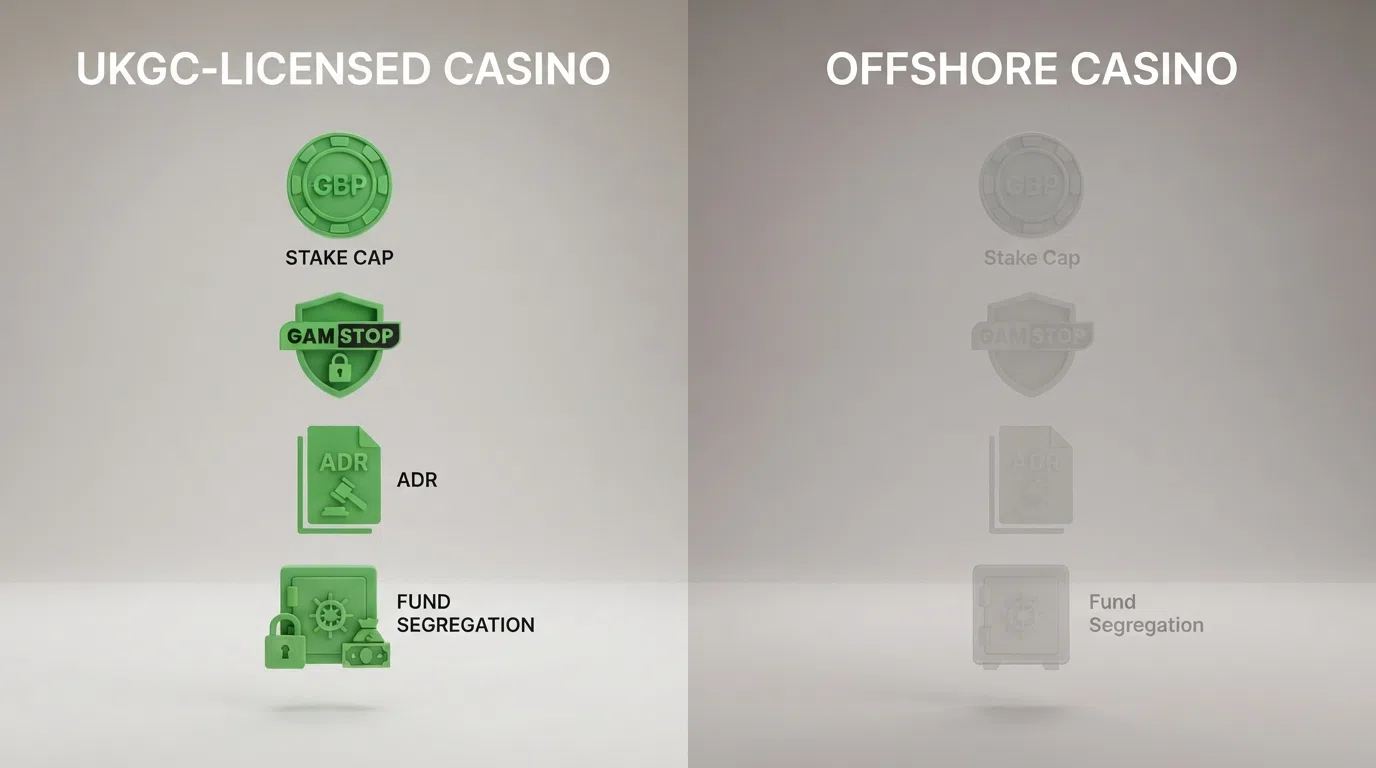
What the UK Gambling Commission Actually Regulates
The UKGC is an executive non-departmental public body sponsored by the Department for Culture, Media and Sport. The statute is the Gambling Act 2005. The 2014 point-of-consumption reform — the Gambling (Licensing and Advertising) Act 2014 — made a GB licence compulsory for any operator taking GB players, wherever it is based. Three licence classes exist: operating, personal, and premises. Online casino falls under operating. The LCCP — Licence Conditions and Codes of Practice — sets the binding conditions. RTS — Remote Technical Standards — sets the engineering requirements.
The Commission’s enforcement tools are real, but they have limits. The UKGC can issue disruption notices, refer URLs to search engines for delisting, suspend domains, and refer payment providers. It does not currently hold statutory ISP or DNS blocking powers — a gap that has been legislatively proposed but not enacted. Between April 2024 and June 2025, the Commission issued 3,140 disruption notices, referred 447,778 URLs to search engines, secured 287,961 URL removals, and recorded an average 32% fall in engagement across 160 disrupted sites. That is what disruption looks like at scale. It is not the same as a block.
GAMSTOP and What Leaving It Means
GAMSTOP is the UK’s national self-exclusion scheme. Registration is free. Once registered, a player is barred from every UKGC-licensed online gambling site for the chosen period. The scheme has been mandatory for every UKGC online operating licence since 31 March 2020. Periods run six months, one year, five years, or five years with auto-renewal. The exclusion cannot be cancelled early.
The scheme covers UKGC licensees. The scheme does not cover offshore sites. The Gambling Commission states plainly that “GamStop … does not capture overseas sites.” A player who registered with GAMSTOP, then opened an account at a Curaçao-licensed casino the following week, will not be stopped by the exclusion. That is the bypass that drives some of the search traffic to offshore sites. It is also the bypass that undermines the self-exclusion decision the player made in the first place.
The Licensed UK Route vs the Offshore Route — What Each Path Gives You
| Protection | UKGC-licensed casino | Non-UK-regulated casino |
|---|---|---|
| Stake cap (online slots) | £5 per game cycle (25+), £2 (18–24) | No statutory cap |
| Self-exclusion | GAMSTOP mandatory | Not covered by GAMSTOP |
| Bonus wagering cap | 10× maximum (from Dec 2025) | Typically 30×–50× |
| Mixed-product promos | Banned (from Dec 2025) | Permitted |
| Credit card deposits | Banned (since Apr 2020) | Commonly accepted |
| Financial vulnerability check | Mandatory at £150 / 30 days | Not required |
| Financial risk assessment | Announced, not yet in force | Not required |
| Mandatory deposit-limit prompt | Required before first deposit (Oct 2025) | Not required |
| Game design rules | Auto-play ban, 2.5 s spin minimum, LDW ban, reverse-withdrawal ban, session display | Not required |
| ADR / dispute resolution | Approved ADR provider required | Operator-dependent, often absent |
| Fund segregation | Mandatory | Not required |
| UKGC complaints route | Available | Not available |
| Crypto deposits | Not accepted at any UKGC site | Commonly accepted |
The trade-off is a consumer-protection decision, not a legal one. The UKGC path gives the player a full wrapper of mandatory safeguards. The offshore path gives the player higher bonus caps, unrestricted stakes, crypto deposits, and no affordability friction — and strips most of that wrapper away.
The Real Risks of Playing at Unregulated and Unlicensed Casinos
The most common player complaint at offshore sites is the simplest one: the withdrawal does not arrive. There is no UKGC complaints route. There is no approved ADR provider to escalate to. There is no British consumer redress. If the operator decides to withhold a withdrawal, the player’s options are chargeback through the payment provider — viable for cards, harder for crypto — and the regulator of the jurisdiction that issued the licence.
The second risk is operator insolvency without fund segregation. UKGC-licensed operators must segregate player funds from operating funds. Offshore sites are not required to. If the operator goes under, the player’s balance is part of the general estate, behind secured creditors.
The third is the gap on a self-excluded player. The GAMSTOP-registered player who lands at a Curaçao site is unprotected there. The site has no obligation to check, no obligation to intervene, and no UK mandate to do either.
The Curaçao LOK reform has improved the picture at the top of the market. The Curaçao Gaming Authority enforcement register recorded 31 entries between June 2024 and July 2026 — 30 revocations and one non-extension. Direct OGL licences carry six-month validity windows. Stake’s OGL/2024/1451/0918 and Cloudbet’s OGL/2024/328/0599 are verifiable on the public register. The framework is real, but its enforcement reach does not extend to GB. A Curaçao enforcement action does not give a UK player a UKGC complaints process.
Anjouan-licensed operators sit further down the quality curve. Tomcasino holds an Anjouan Gaming licence and is operated by Tom Limitada S.R.L. from Costa Rica. Casino Guru gives the site a 4.4/10 safety rating. The Anjouan regime offers minimal player protection with no formal dispute resolution comparable to Tier 1 jurisdictions.
How to Verify a Casino Licence — UKGC and Beyond
The UKGC public register is the first check. Every operator holding a GB operating licence appears there. If a casino claims to be UKGC-licensed and is not on the register, the claim is false.
For Curaçao, the new LOK framework introduced direct OGL licences. The CGA public register lists them. Stake’s OGL/2024/1451/0918 and Cloudbet’s OGL/2024/328/0599 are verifiable on the register. A legacy sub-licence reference — anything in the 8048/JAZ format — predates the LOK reform and is not the same instrument. A licence number that does not appear on the regulator’s own register is a red flag, however plausible the page looks.
For Malta, the MGA licence check is at the Malta Gaming Authority website. An MGA licence is a stronger signal than a Curaçao OGL but is still not a GB licence under the 2014 Act.
The practical test is whether the licence number resolves on the regulator’s own register, not whether the operator’s footer page displays a logo.
Crypto Casinos and Their Regulatory Status in 2026
No UKGC-licensed casino or betting operator accepts cryptocurrency as a deposit or withdrawal method. The position is clean: zero crypto at the GB-regulated end of the market. The AML rationale — traceability — is what keeps it that way.
The crypto gambling landscape sits entirely offshore. Curaçao, Anjouan, and Costa Rica are the common licensing homes. Velobet’s crypto track offers 160% up to €1,000 with 35× wagering. DonBet’s crypto track offers 170% up to £1,000 plus 100 free spins. These are the offers that UKGC sites cannot match, structurally. They are also the offers where chargeback recourse is weakest — a crypto deposit is, by design, the hardest to claw back.
Every Non-UK-Regulated Casino We Reviewed for UK Players
The ten operators below are the brands research identified as actively accepting UK players without holding a UKGC licence. None of them are endorsed. Each one is presented on its own terms, with the bonus structure it offers, the licence it claims to hold, and the complaints record it carries.
How We Rank Non-UK-Regulated Casinos
The ranking basis was not the size of the welcome bonus. Four criteria carried weight. Licensing jurisdiction quality came first: a Curaçao OGL under the LOK framework is a stronger signal than a legacy sub-licence, and both are stronger than an Anjouan licence with no Tier 1 dispute resolution. Bonus terms transparency came second: a 30× wagering multiple on bonus only reads differently from a 35× on deposit plus bonus with a 10× max cashout. Operator track record came third: Casino Guru black points, Trustpilot scores, and complaint patterns. Game-provider mix was a secondary factor.
The HighRoller carries 3,192 black points on Casino Guru and a Trustpilot profile dominated by delayed-withdrawal and locked-account reviews. Gransino scores 2.3/5 on Trustpilot from 170+ ratings, with 65% one-star. Tomcasino carries a Casino Guru 4.4/10 safety rating. Those numbers are part of the ranking, and they are part of why those three operators sit at the bottom.
The Bonus Terms That Actually Cost You — Wagering, Validity and Cashout Caps
A headline 300% match does not tell the reader what the bonus costs. Three numbers do.
The wagering multiple is the first. A 30× multiple on bonus only is the cheapest wagering structure in this set — Freshbet offers it. A 30× on deposit plus bonus is more expensive because the deposit also has to roll over. A 35× on deposit plus bonus is the typical structure at Goldenbet. Tomcasino’s 50× on bonuses is the highest in the set. The arithmetic is straightforward: required turnover equals the bonus multiplied by the wagering factor.
The validity window is the second. Goldenbet’s bonus gives 30 days; the free spins give seven days — the tightest FS clearing deadline in the set. 7Bit gives 14 days per bonus, the shortest deposit-bonus validity. MyStake gives 30 days. A short window raises the daily turnover required, which raises the chance the player runs out of time with bonus funds still locked.
The max-cashout cap is the third, and it is the most easily missed. Goldenbet applies a 10× bonus max cashout — a £1,500 headline bonus becomes a £150 ceiling on what the player can withdraw from bonus play. Velobet’s free spins winnings cap at £100. A 10× cap on a high-match bonus can flip the offer from generous to a token amount once the wagering clears.
Deposit-Free vs Deposit-Gated — What “No-Deposit” Actually Delivers
The genuinely deposit-free offers in this set are few. Freshbet offers 25 free spins on registration, no code, no deposit, at £0.10 per spin. 7Bit offers 75 free spins on Scroll of Adventure with no deposit required. DonBet offers 15 free spins on registration with a promo code. MyStake references 20 no-deposit free spins with a code.
The pattern is consistent. Where a deposit-free offer exists at an offshore site, it is free spins, not cash. No-deposit cash bonuses at this scale are not part of the picture. The spin value is small, the wagering on any resulting winnings applies, and the offer is best read as a way to inspect the platform rather than as a serious bankroll addition.
MyStake
MyStake’s welcome package is built across three deposits: 150% up to £750 on the first, 100% up to £500 on the second, 50% up to £250 on the third, totalling £1,500. Wagering is 30× on deposit plus bonus combined. The minimum deposit is £20. Bonus validity is 30 days from activation. The maximum bet during wagering is £5. A no-deposit free spins component is referenced with a promo code, although the standard welcome does not list free spins explicitly.
MyStake is Curaçao-licensed under Santeda International B.V. and is not UKGC-licensed. Licence details were not verifiable on the CGA register. Game providers include Pragmatic Play, NetEnt, Evolution, Hacksaw, and Push Gaming, with a reported 10,000+ games. The 30× on deposit plus bonus is the highest effective turnover in this set when the full £1,500 package is taken. A player clearing the full package at the stated terms will wager the deposit and bonus sums multiple times over; the operator’s terms set a £5 max bet during wagering, which is identical to the UKGC stake cap and is not a regulatory coincidence — it is a cap that offshore operators adopt voluntarily.
Verdict: MyStake suits a player who wants the largest combined package in the set and accepts the 30× on deposit plus bonus as the cost of getting there. The combination of Curaçao licence, 30-day window, and the absence of a verifiable OGL number on the public register is the trade the player is making.
DonBet
DonBet’s welcome offer is 150% up to £750 plus 50 free spins on the standard track. Wagering is 30× on deposit plus bonus combined. The minimum deposit is £20.
The operator is unlicensed. This brand features Pragmatic Play and Evolution games, with 7,000+ titles reported. Wagering consistency is maintained across standard and crypto tracks.
Verdict: DonBet suits a crypto-depositing player who wants the 170% match and 100 free spins on the crypto track, and a fiat-depositing player who wants a straightforward 150% with 30× on deposit plus bonus and no surprises. The trade is the same as MyStake’s: Curaçao licence, no UKGC oversight, same effective turnover structure.
Velobet
Velobet’s casino track is tiered: 150% up to £500 plus 70 free spins on deposits under £500, or 100% up to £1,000 plus 70 free spins on deposits of £500 and above. Wagering is 30× on the bonus amount (casino) and 35× on the crypto track. The crypto track offers 160% up to €1,000 with 35× wagering. Free spins winnings carry 35× wagering and a £100 maximum cashout.
The operator is unlicensed. Our research notes Pragmatic Play, Evolution, and NetEnt providers. The tiered structure provides competitive percentage matches on varying deposit sizes.
Verdict: Velobet suits a player depositing between £250 and £500 who wants the 150% match and the full 70 free spins without tripping the £100 cap on winnings being the binding limit. The 30× on bonus only is cheaper than the deposit-plus-bonus structures at MyStake and DonBet, but the free-spins cap is the structural ceiling on the offer.
Goldenbet
Goldenbet’s welcome package is 300% up to £1,500 across three deposits plus 100 free spins on Book of Witches by ThunderSpin. Wagering is 35× on deposit plus bonus combined. The minimum deposit is £20. Bonus validity is 30 days; the free-spin window is seven days — the tightest FS clearing deadline in the set. The maximum bet during wagering is £5. The maximum cashout from the bonus is 10× the bonus amount — the £1,500 headline bonus becomes a £15,000 ceiling on what can be withdrawn from bonus play.
The operator is unlicensed. Game providers include Pragmatic Play, ThunderSpin, and Evolution. The 300% match is the highest headline percentage in the set. The 10× max cashout is the most material constraint in the set. A player who clears the bonus and ends up with £2,000 in winnings from bonus play will withdraw £150, not £2,000, because the bonus cap is the binding limit, not the wagering completion.
Verdict: Goldenbet suits a player chasing a high headline match who understands that the 10× bonus cashout cap turns the headline upside into a fixed ceiling. The 35× on deposit plus bonus is the highest effective turnover in this part of the set; the seven-day FS window is the shortest. The arithmetic matters more than the match percentage.
Freshbet
Freshbet offers 25 no-deposit free spins on registration, no code required, at £0.10 per spin. The welcome package is 100% up to £500 on the first deposit, or a multi-deposit package up to £3,000 plus 200 free spins across three deposits, depending on the source. Wagering is 30× on the bonus amount only — not deposit plus bonus. The minimum deposit is £20.
The operator is unlicensed. Game providers include Pragmatic Play, Evolution, and Hacksaw, with 7,000+ games referenced. The 30× on bonus only is the structurally cheapest wagering in the featured set — the deposit is not part of the rollover. The 25 no-deposit free spins are the only genuinely deposit-free registration offer in the set.
Verdict: Freshbet suits the player who wants to inspect the platform before depositing, then take a 30× bonus-only package at a competitive effective turnover. The no-deposit FS is the entry point; the wagering on bonus only is the cost-saving structure that the rest of the set does not match.
7Bit Casino
7Bit’s welcome package covers four deposits: 100% up to €400 plus 100 free spins, 75% up to €600, 50% up to €400, and 100% up to €4,000 plus 50 free spins — a total of up to 325% plus 250 free spins. Wagering is 35× on the bonus amount. The clearing window is 14 days per bonus — the shortest deposit-bonus validity in the set. Live casino contributes 0% toward wagering. Seventy-five no-deposit free spins on Scroll of Adventure are available on registration.
7Bit is Curaçao GCB-licensed under Dama N.V. with licence OGL/2023/174/0082. Licence details were not verifiable on the CGA register. 7Bit is the only featured operator with a verifiable Curaçao licence number on the regulator’s register. Game providers run on the SoftSwiss platform and include Pragmatic Play, Evolution, and BGaming.
Verdict: 7Bit suits the player who wants a verifiable Curaçao licence number and the 75 no-deposit free spins, and who can clear bonus funds inside a 14-day window. The 0% live casino contribution means live-dealer play does not work down the wagering; the short window is the cost of the largest combined bonus in the set.
Emperia Casino
Emperia launched in 2026. The welcome package is up to £3,000 plus 325 free spins across four deposits. The lobby reports 12,000+ games, with specific provider names not confirmed in this research run. Licence details were not verifiable on the CGA register. No independent complaints data is available given the recency of the launch.
The verdict is necessarily provisional. Emperia suits a player willing to be among the first depositors at a 2026 launch and who is comfortable with a brand whose independent track record does not yet exist. The £3,000 + 325 FS headline is large, but every other number on this page comes from a brand that has been operating long enough for complaints data to accumulate. Emperia has not.
TheHighRoller
TheHighRoller’s specific welcome-bonus terms were not confirmed in this research run. Wagering is reported at 35×–40× on bonus funds. The complaints record is the material fact here: Casino Guru lists disputed-winnings complaints and 3,192 black points. Trustpilot reviews describe delayed withdrawals and locked accounts. The operator is Curaçao-licensed and is not UKGC-licensed.
Verdict: TheHighRoller is the cautionary example in this set. A 3,192 black-points record on Casino Guru, paired with Trustpilot reviews describing locked accounts, is the shape of what no ADR access looks like in practice. A player who values dispute resolution should treat the brand as a study in what goes wrong offshore, not as a serious option.
Gransino
Gransino’s specific offshore licence jurisdiction was not confirmed in this research run. Welcome-bonus details and the game-provider list were not confirmed. Trustpilot scores 2.3/5 from 170+ reviews, with 65% one-star. The operator is not UKGC-licensed, not subject to the UKGC 10× wagering cap, not required to segregate player funds, and not obligated to participate in any ADR scheme.
Verdict: Gransino sits at the bottom of the set on player-feedback evidence. 65% one-star reviews on Trustpilot from 170+ ratings is the strongest warning in the featured ten. The protection gap is the full gap, not a partial one. A player who reads the Trustpilot profile before depositing has done the one thing the operator’s marketing page will not do for them.
Tomcasino
Tomcasino holds an Anjouan Gaming licence from the Comoros Islands and is operated by Tom Limitada S.R.L. from Costa Rica. The welcome bonus is $500 with 50× wagering — the highest wagering multiple in the featured set. The lobby reports 21,000+ games, with specific providers not confirmed. Casino Guru’s safety rating is 4.4/10. The operator is not UKGC-licensed.
Verdict: Tomcasino suits a player who wants a large game lobby and accepts the Anjouan regime as the regulatory home. The 50× wagering is the highest in the set. Anjouan offers minimal player protection with no formal dispute resolution comparable to Tier 1 jurisdictions. The 4.4/10 on Casino Guru is the lowest safety rating in the featured set.
Why Slot Regulation Changes Everything About Your Play
The UKGC’s slot-specific rules rewire the slot experience in ways that go beyond the stake cap. Five design rules, all in force from 31 October 2021, changed the GB slot product: auto-play banned, 2.5-second spin speed minimum, losses disguised as wins banned, reverse withdrawals permanently banned, and session loss/win/time display mandatory. None of them apply at offshore sites.
How UKGC Slot Rules Reshaped the Game — and What Offshore Sites Still Allow
- Auto-play: banned at UKGC sites, freely available offshore.
- Spin speed: 2.5-second floor at UKGC sites, no minimum offshore.
- Losses disguised as wins (LDW): banned at UKGC sites, still present at offshore sites.
- Reverse withdrawals: permanently banned at UKGC sites, available offshore.
- Session tracking: mandatory loss/win/time display at UKGC sites, absent offshore.
The session at an offshore slot is structurally faster, higher-stakes, and unmonitored. The UKGC rules were introduced in 2021 because research showed that faster spins, LDW animations, and unmonitored sessions correlated with higher loss rates. The offshore slot experience is the pre-2021 UKGC experience, preserved.
Stake Caps by Age — Why Under-25s Cannot Bet More Than £2 a Spin
The age-banded stake cap is a 2025 innovation. The structure is two-tier: £5 per game cycle for players aged 25 and over, in force from 9 April 2025, and £2 for players aged 18–24, in force from 21 May 2025, under SI 2025/215. The policy rationale is that the under-25 cohort is identified as higher-risk. The 16% of GB adults experiencing any level of gambling problems (PGSI 1+) in 2024, up from 13%, and the 3.8% classified as problem gambling (PGSI 8+), up from 2.9%, anchor that risk classification in prevalence data.
The practical effect is the push factor that competitor pages have not addressed. A 25-year-old at a UKGC site is capped at £5 per spin. The same player at MyStake, Goldenbet, or Velobet faces no statutory cap. The £2 cap for 18–24-year-olds is the tightest in the set; the offshore alternative is the same as it is for everyone else — no cap. This is the structural reason an under-25 player ends up on this page.
RNG Fairness and RTP — Who Tests the Games and What the Results Mean
Both regimes require testing, but the testing differs in who enforces and what recourse the player has.
UKGC-licensed casinos must submit RNG and game test results from approved test houses under RTS 7, which requires RNG output to be “acceptably random.” Test reports and annual audits are reviewed by the Commission. The Commission does not perform its own independent technical testing.
Offshore operators may use recognized or equivalent test houses, but enforcement is less transparent and the player’s recourse on a contested result is the operator’s own dispute process — or the regulator of the licensing jurisdiction, where one exists. Anjouan’s process is minimal. Curaçao’s process exists under LOK but does not extend to GB.
An RTP figure is a long-run statistical return. It is not a session guarantee. A 96% RTP slot will, on average, return £96 for every £100 wagered across millions of spins. A session of 200 spins will not produce that average. The number is a regulator’s tool, not a player’s promise.
Where to Turn When Gambling Stops Being a Game
The gambling-harm infrastructure is the part of this page that matters most when the rest of it no longer applies.
The Help That Is Available — Helpline, NHS Clinics and Peer Support
The National Gambling Helpline is 0808 8020 133. It is free, confidential, available 24 hours a day, and run by GamCare. Live chat and WhatsApp channels also run. GamCare made 996 referrals to treatment and peer-based support services in January 2026, up 48% year-on-year from 674 in January 2025.
The NHS Primary Care Gambling Service is free and confidential, available to adults over 18, and delivered nationally through multidisciplinary teams. Gamblers Anonymous runs peer-support groups. GamCare’s self-assessment tool and the PGSI (Problem Gambling Severity Index) are the standard screening instruments used in Great Britain.
The number to save is 0808 8020 133. Save it before any of the offer details on this page start to matter.
Deposit Limits and Reality Checks — What UKGC Sites Must Offer and Offshore Sites May Not
UKGC-licensed sites must prompt customers to set a financial limit before their first deposit, from 31 October 2025. From 30 September 2026, only gross deposit limits — money paid into the account — may be called “deposit limits” under RTS 12. Reality checks, time-outs, and self-exclusion via GAMSTOP are mandatory.
Offshore operators may offer voluntary deposit limits and cool-off periods, but none of the UKGC obligations apply. There is no mandatory first-deposit prompt. There is no GAMSTOP coverage. There is no regulatory obligation to intervene at a loss threshold. The voluntary tools that exist at some offshore sites are operator-led, not regulator-led.
How Big the Problem Is — UK Gambling Harm in Numbers
The prevalence figures are the scale against which the rest of this page is read. 16% of GB adults experienced any level of gambling problems in 2024 (PGSI 1+), up from 13% in 2023. 3.8% were classified as problem gambling (PGSI 8+), up from 2.9% — approximately 2.2 million adults. The total population affected at any level is approximately 6.8 million adults.
81.5% of contacts to the National Gambling Helpline in 2026 cited online forms of gambling — a five-year high. GamCare referrals rose 48% year-on-year. The cohort the offshore offer is reaching is the cohort the helpline is hearing from.
How We Evaluate Non-UK-Regulated Casinos
The review process was guided by the top 10 search results for the target keyword, comparing operator bonus terms, licence status, and complaints records to build a comprehensive picture for the reader. Independent complaints data came from Casino Guru and Trustpilot.
| Operator | Welcome Offer | Wagering |
|---|---|---|
| MyStake | 150% up to £1,500 total | 30× deposit+bonus |
| DonBet | 150% up to £750 + 50 FS | 30× deposit+bonus |
| Velobet | 150% up to £500 + 70 FS | 30× bonus |
| Goldenbet | 300% up to £1,500 + 100 FS | 35× deposit+bonus |
| Freshbet | 100% up to £500 | 30× bonus |
The limits of this review are explicit. The CGA public register does not list every Curaçao-licensed operator; some appear under legacy sub-licences that predate the LOK transition, and the verification ran on the LOK register. Casino Guru and Trustpilot are not exhaustive. The bonus terms in this page are the bonus terms at the time of writing; operators revise them.
What You Should Actually Do About Non-UK-Regulated Casinos
The decision is a consumer-protection trade-off, not a legal one. No UK player has been prosecuted for gambling at an offshore casino. The player is not committing a criminal offence by opening an account. The player is, however, stepping outside the wrapper of protections that the UKGC mandates — GAMSTOP coverage, ADR access, fund segregation, the £5/£2 stake cap, the 10× bonus ceiling, the credit card ban, the affordability framework, and the game-design rules.
What an offshore site gives the player that a UKGC site cannot is a higher bonus cap, unrestricted stakes, crypto deposits, no affordability friction, and faster spin cycles. The 300% match at Goldenbet, the 160% crypto track at Velobet, the no-deposit free spins at Freshbet and 7Bit are the structural reason the offshore market exists. They are also the reason the UKGC’s rules are written the way they are.
Among the operators reviewed, Freshbet offers the clearest terms on the no-deposit entry path and the cheapest wagering structure in the set at 30× on bonus only. 7Bit offers the only verifiable Curaçao licence number on the CGA register, paired with a 14-day clearing window. Goldenbet offers the highest headline match percentage but with a 10× bonus cashout cap that limits the upside. MyStake, DonBet, and Velobet sit in the middle of the set on both terms and verification.
TheHighRoller, Gransino, and Tomcasino carry enough complaints data, weak ratings, or weak regulatory regimes to warrant caution. TheHighRoller’s 3,192 Casino Guru black points, Gransino’s 2.3/5 Trustpilot with 65% one-star, and Tomcasino’s 4.4/10 Casino Guru rating and 50× wagering are the three signals a reader should weight before depositing.
The action every player should take, regardless of where they play, is the same three-step one. Set a personal deposit limit before the first deposit, even where the operator does not require one. Use the responsible-gambling tools that exist — reality checks, time-outs, self-exclusion — even where they are voluntary. Save the National Gambling Helpline number, 0808 8020 133, before the marketing message starts to outrun the player’s own decision-making.
Frequently Asked Questions
Is it legal for UK players to gamble at casinos not licensed by the UKGC?
UK players are not prosecuted for gambling at offshore casinos. Providing gambling facilities without a UKGC licence is a criminal offence under section 33 of the Gambling Act 2005, but the offence is committed by the operator, not the player. Enforcement is disruption-based, not ISP-blocking.
Are non-GamStop casinos safe for UK players?
Non-GamStop casinos are not covered by the UK’s national self-exclusion scheme. A player registered with GAMSTOP can open an account at an offshore site because the scheme does not capture overseas operators. The bypass is the feature the player is searching for and the risk at the same time.
Do UK players pay tax on winnings from offshore casinos?
UK gambling winnings are not taxed, regardless of where the operator is licensed. Remote Gaming Duty is levied on operators, not on players, and rose from 21% to 40% on 1 April 2026. Players keep their winnings gross in both UKGC and offshore environments.
Can I use cryptocurrency to deposit at a non-UK-regulated casino?
Yes, at every offshore casino reviewed here. No UKGC-licensed casino or betting operator accepts cryptocurrency as a deposit or withdrawal method. The crypto gambling market sits entirely offshore, in Curaçao, Anjouan, and Costa Rica.
Why are online slots stake limits different for 18–24 year olds in the UK?
The UKGC identified the under-25 cohort as a higher-risk group based on prevalence data showing rising problem-gambling rates. The £2 cap for 18–24-year-olds and £5 cap for those 25 and over, in force from May and April 2025 respectively under SI 2025/215, reflects that risk classification. Offshore casinos carry no statutory stake cap.
How does the Curaçao LOK reform affect casino licensing in 2026?
The LOK framework replaced the legacy Curaçao sub-licence model with direct OGL licences carrying six-month validity windows. The CGA enforcement register recorded 31 entries between June 2024 and July 2026. Operators like Stake and Cloudbet hold verifiable OGL numbers. The reform improves oversight, but enforcement reach does not extend to Great Britain.
Account – realmoney-onlinecasinos-uk
Content created by the «realmoney-onlinecasinos-uk» team