
Casinos That Accept Instadebit UK — Why the Answer Is Settled
 Available in GB
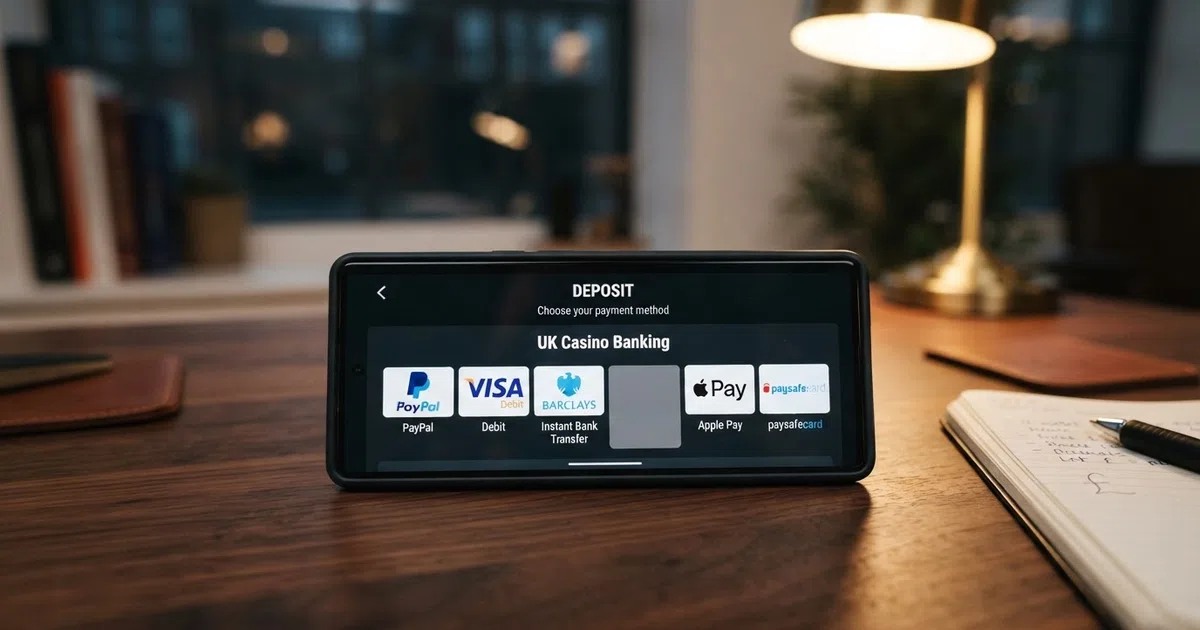
The short version comes first: no UK Gambling Commission–licensed casino accepts Instadebit, and the reason is not that operators have overlooked it. Instadebit is a Canadian bank-to-bank payment system built for Canadian bank accounts, registered in Malta, and designed around Interac infrastructure. It was never engineered for the UK, and the UKGC’s tightly curated payment-method list has not opened a door for it. The casinos UK players actually use run on Visa and Mastercard debit, PayPal, Trustly and Open Banking, Apple Pay, Skrill, Neteller, and Paysafecard. That is the list. The ten operators ranked later in this page all sit on it.
Current as of September 8, 2026; licence claims verified against the UK Gambling Commission’s public register.
What Instadebit Actually Is, and Why UK Players Cannot Use It
The Canadian Payment System Behind the Name
Instadebit was founded in 2003 by Instadebit International Solutions LTD, a company registered in Sliema, Malta. It operates as a bank-to-bank intermediary: a player with a Canadian bank account authorises Instadebit to move funds between that account and a merchant, in this case an online casino. The model depends on direct links to Canadian banks, and the entire system is built around Canadian banking rails rather than the card networks that dominate global e-commerce.
That architecture is the reason it functions as a genuine alternative to card payments in Canada, and it is the same reason it has no equivalent traction elsewhere. The closest analogues in the UK, Trustly and the broader Open Banking layer, work in similar bank-to-bank terms but against a different set of UK banks. Instadebit has not extended that integration. It remains, in practical terms, a Canadian product — one online industry source puts it plainly: “Instadebit is only available in Canada, which means that it may not be an option if you are playing at online casinos in other countries.”
This is not the same kind of product as PayPal or Skrill, which are e-wallets that can hold balances and are licensed to operate across many jurisdictions. Instadebit is closer to a thin routing layer between a bank and a merchant, and it only routes where the bank connections exist.
Why UKGC-Licensed Casinos Do Not Offer It
UKGC-licensed casinos are required to operate within a tightly defined payment-method framework. The Commission’s Licensing Conditions and Codes of Practice (LCCP) set the boundaries: which gateways are permitted, which payment types are banned, and what anti-money-laundering checks must accompany each transaction. The credit card ban of 14 April 2020, imposed under LCCP condition 6.1.2, is the clearest example. It removed one payment type entirely and pushed the market toward debit, e-wallets, and Open Banking.
Within that framework, there is no licence-conditioned reason to add a Canada-only bank-to-bank service. The demand side is also missing: UK player guides and payment-method catalogues (TODA Pay, IBTimes UK, the UK iGaming payment solutions pages) do not list Instadebit. It is simply absent from the conversation. A UKGC casino would gain nothing from integration and would add operational complexity for no commercial return.
The gap shows up clearly in the SERPs a UK player sees. Searches for “Instadebit casinos UK” surface mostly affiliate pages written for Canadian audiences, recycled for a UK keyword without adjusting for the fact that the method is not available here. The honest answer is the one most of those pages avoid: the casino does not exist in the form the keyword implies.
What UK Players Use Instead
The UK market has settled into a stable core of payment methods, and each has its own trade-off. Debit cards (Visa Debit and Mastercard Debit) are the default. They are universal, near-instant on deposit, and governed by the same UK consumer protections as any other card transaction. E-wallets — PayPal, Skrill, Neteller — layer an extra account between the bank and the casino, and in return they offer the fastest withdrawal times of any mainstream method. Trustly and the broader Open Banking category provide a direct bank-to-casino connection without a separate e-wallet account, and adoption is climbing fast. Apple Pay and Paysafecard serve specific niches: mobile-first deposits and prepaid spend control respectively.
The 2020 credit card ban shaped this landscape in a way that still defines it. As one industry summary puts it: “Credit cards are no longer permitted for gambling deposits at licensed operators, and the market has adjusted around debit cards, e-wallets, and, increasingly, Open Banking.” That is the adjustment. It is settled.
UK Casino Deposits, Withdrawals and Payment Speed — How Money Moves
How to Deposit at a UK Online Casino
The deposit flow at a UKGC-licensed casino is standardised by regulation as much as by convention. Before the first deposit, the operator must verify name, address, and date of birth, a rule in force since 7 May 2019. That verification is not a “withdraw your winnings” formality; it is a precondition for depositing at all. A new player will typically upload a photo of a government-issued ID, a proof of address (utility bill or bank statement, usually within the last three months), and in some cases proof of ownership of the payment method.

Once verified, the deposit itself is straightforward. The player opens the cashier, selects a payment method from the cashier’s list, enters an amount, and confirms. Funds appear instantly for debit cards and e-wallets. Open Banking deposits via Trustly redirect to the player’s bank, authenticate through the bank’s own flow, and land within seconds of approval.
There is one regulatory interruption that the player cannot skip. From 31 October 2025, every UKGC-licensed operator must prompt the player to set a financial deposit limit before processing the first deposit. The prompt is not a tick-box exercise: the limit is recorded against the account, and a player who later wants to raise it typically faces a cooling-off period. The intent is to make the budget decision conscious, not reflexive.
Withdrawal Times — What “Fast” Means
Withdrawal speed is the most common reason a UK player switches casinos, and it is also the most misunderstood. The number an operator advertises (“instant”, “same-day”) is the casino’s own processing time, not the time from clicking “withdraw” to money landing in the bank. The full timeline has two stages.
Stage one is the casino’s internal processing. Every operator runs a pending window during which withdrawals can be reviewed. This is where KYC re-checks happen, where bonus wagering is verified, and where anti-fraud flags are assessed. For reputable UKGC operators, the pending window ranges from a few hours to about 24.
Stage two is the payment-method transfer. Once the casino approves, the money enters the payment rail. PayPal completes this transfer within minutes, which is why it is the fastest mainstream withdrawal method in the UK market. Trustly follows closely, with funds appearing in the linked bank account within an hour or two in most cases. Debit card withdrawals via Faster Payments typically land in 1 to 4 hours after the casino releases them. Bank transfers outside Faster Payments can take a working day.
What changes the picture, and what a marketing page will not mention, is the reverse-withdrawal ban. Since 31 October 2021, UKGC-licensed casinos cannot offer players a “cancel withdrawal and play” button. The moment a withdrawal is submitted, it commits. That ban exists because allowing players to reverse a withdrawal is one of the cleanest design patterns for converting a withdrawal into a deposit. With it removed, the player who hits “withdraw” is paid.
Deposit Fees, Minimums and Limits
UKGC-licensed casinos rarely charge deposit or withdrawal fees. The business case for fees is weak: the Commission’s rules around fair and transparent terms make them a source of complaints, and the payment-method costs are small enough to absorb. The bigger variable is the minimum deposit.
The standard minimum across the UK market is £10. Bet365, William Hill, Sky Vegas, 888, Betfair, Paddy Power, LeoVegas, Virgin Games, and Unibet all sit at £10. MrQ is the outlier at £20, a deliberate positioning choice that targets a different player segment.
Statutory deposit limits add a layer the player should understand. A customer-set deposit limit is one thing: the player chooses a ceiling, and the operator enforces it. A gross deposit limit is the regulator-defined term, and from 30 September 2026, only that form may be called a “deposit limit” at UKGC-licensed operators. A gross deposit limit is based solely on money paid into the account, not on net of withdrawals. The distinction matters when a player is trying to budget by the money they have available to lose. Net-of-withdrawals ceilings, which some operators have used, can give the player more headroom than the £150 monthly figure sounds like.
The Best Instadebit Alternatives, Ranked by Speed
If the question is “how quickly can I get my money out?”, the ranking is clear. PayPal leads: approved withdrawals typically land in minutes. Trustly and Open Banking follow at 1 to 2 hours in most cases. Debit card via Faster Payments is third, usually 1 to 4 hours after the casino releases the withdrawal. Apple Pay on the deposit side does not change the withdrawal rail — it funnels to the card underneath. Skrill and Neteller are competitive with PayPal on speed for withdrawals, and the e-wallet category overall sits in front of cards for two reasons: the rail is designed for fast settlement, and the casino’s compliance burden is lighter because the wallet is already verified.
The trade-off for e-wallet speed is friction. Opening a PayPal, Skrill or Neteller account is a separate step from opening the casino account, and some bonuses exclude deposits made through particular e-wallets (Skrill and Neteller are the usual exclusions). Debit cards trade some speed for universality: every UKGC-licensed casino accepts them, no third-party account is needed, and the player is using a rail they already use for everything else.
Debit Card vs E-Wallet vs Open Banking
The three method categories compete on different axes. Debit cards win on acceptance — every operator in the UK supports Visa Debit and Mastercard Debit, no exceptions, and the deposit flow is the simplest. E-wallets win on speed, particularly for withdrawals, and on the reduced friction at checkout, since the wallet has already been verified. Open Banking via Trustly sits in between: it offers the direct-bank-to-casino flow that an e-wallet replaces with a third-party account, and its speed is competitive, but it is not yet supported by every operator in the featured set.
What the choice actually comes down to is what the player values. A player who wants the least friction and the fastest cashout will pick PayPal where the casino offers it and where the bonus allows it. A player who wants one payment method that works everywhere will stick with a debit card. Trustly is the ideal choice for those who prefer a direct bank-to-casino connection without needing a third-party e-wallet.
The Best UK-Licensed Casinos for Fast, Secure Deposits in 2026
| Operator | UKGC Licence | Payment Methods | Welcome Bonus | Wagering | Withdrawal Speed | Game Providers |
|---|---|---|---|---|---|---|
| Bet365 | Active | Visa Debit, MC Debit, PayPal, Skrill, Apple Pay, Trustly, Paysafecard, Bank Transfer | Up to 500 FS | 0× | 1–4 h | NetEnt, Microgaming, Playtech, Pragmatic Play, Evolution |
| William Hill | Active | Visa Debit, MC Debit, PayPal, Apple Pay, Paysafecard, Bank Transfer | 200 FS on Big Bass Splash | 10× on winnings | Same-day | Pragmatic Play, Evolution, NetEnt, Playtech |
| Sky Vegas | Active (Flutter) | Visa Debit, MC Debit, PayPal, Apple Pay, Trustly | 70 FS no deposit + 200 FS on £10 | 0× | 1–4 h | NetEnt, Pragmatic Play, Evolution, Blueprint |
| 888 Casino | Active (evoke plc) | Visa Debit, MC Debit, Apple Pay, Trustly, Paysafecard, Pay by Bank | 100% up to £100 or 100 FS | 10× | Under 24 h | NetEnt, Pragmatic Play, Evolution, Red Tiger |
| Betfair | Active (Flutter) | Visa Debit, MC Debit, PayPal, Skrill, Neteller, Apple Pay, Trustly | 50 FS no wagering + 100 FS on £10 | 0× | 1–4 h | NetEnt, Playtech, Evolution, Red Tiger |
| Paddy Power | Active (Flutter) | Visa Debit, MC Debit, PayPal, Skrill, Neteller, Apple Pay, Paysafecard | 60 FS no deposit + 200 FS on £10 | 0× (no-deposit) | 1–4 h | NetEnt, Playtech, Evolution, Pragmatic Play |
| LeoVegas | Active | Visa Debit, MC Debit, PayPal, Apple Pay, Trustly, Paysafecard | 50 wager-free FS on Big Bass Splash | 0× | 1–4 h | NetEnt, Evolution, Pragmatic Play, Microgaming |
| Virgin Games | Active | Visa Debit, MC Debit, PayPal, Apple Pay | 100 FS on Big Bass Splash | 0× (paid in cash) | 2–12 h | NetEnt, Evolution, Pragmatic Play, IGT |
| Unibet | Active | Visa Debit, MC Debit, PayPal, Apple Pay, Trustly, Paysafecard | 200 FS on Big Bass Bonanza | 10× on winnings | 1–4 h | NetEnt, Evolution, Pragmatic Play, Microgaming |
Key Regulatory Milestones for UK Players
| Regulation | Date | Impact | |
|---|---|---|---|
| Credit Card Ban | 14 April 2020 | Bans credit cards for gambling deposits | |
| Stake Caps (25+) | 9 April 2025 | Sets £5 limit per spin cycle | |
| Stake Caps (18-24) | 21 May 2025 | Sets £2 limit per spin cycle | |
| Mixed-Product Ban | 19 Dec 2025 | Prohibits cross-product bonus conditions | |
| Wagering Cap | 19 Jan 2026 | Caps wagering multipliers at 10× | |
| Remote Gaming Duty | 1 April 2026 | Increases operator duty to 40% | The 10× wagering cap that took effect on 19 January 2026 has re-shaped this list: the no-wagering free-spin offers (Bet365, Sky Vegas, Betfair, Paddy Power, LeoVegas, Virgin Games, MrQ) now sit at the top of the practical-value ranking, while the wagering-multiplied offers (William Hill, 888, Unibet) carry a real cost the headline does not reveal. The detail of each operator is in the sections that follow. |
Bet365 — 500 No-Wagering Free Spins and the Widest Payment Range
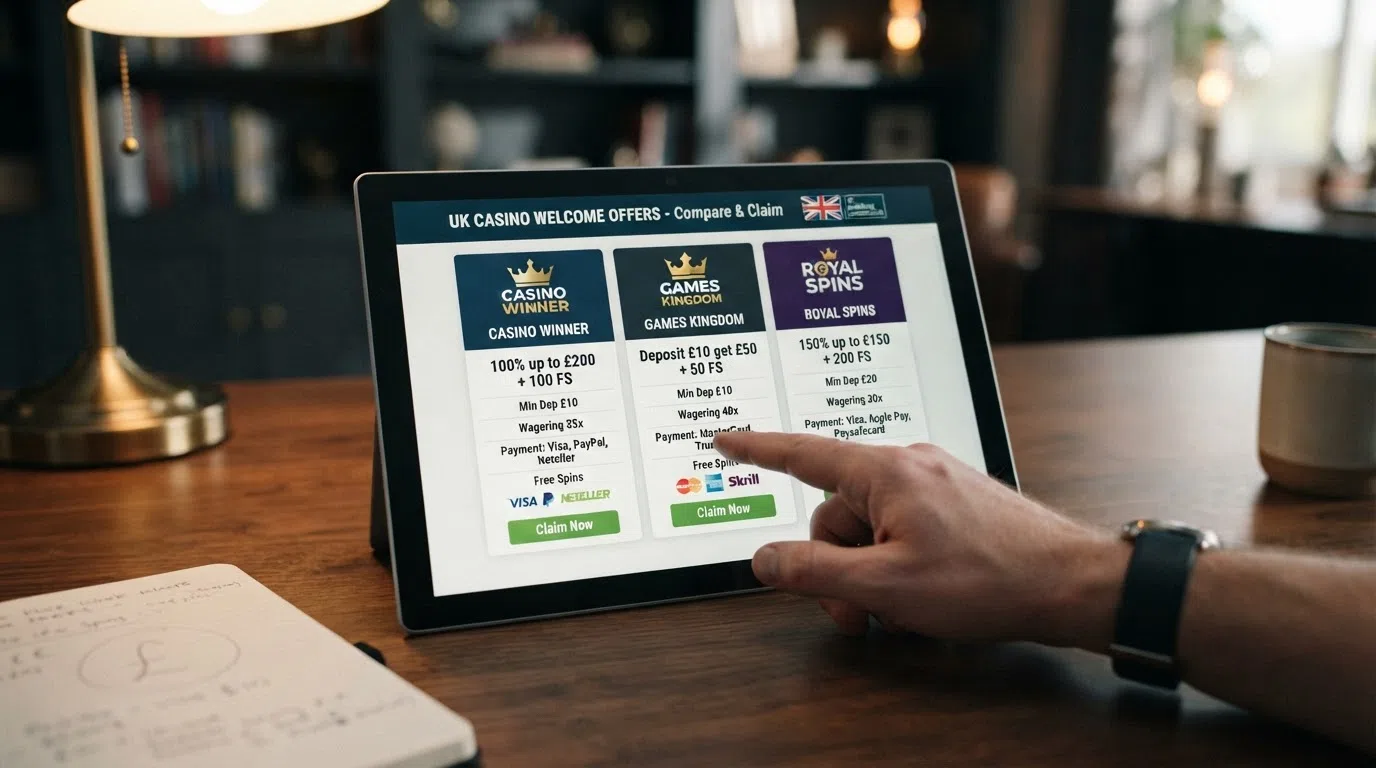
Bet365 carries the broadest payment-method set in the featured group: eight rails, including PayPal, Skrill, Trustly, Apple Pay, and Paysafecard alongside the standard Visa and Mastercard debit. The welcome offer runs up to 500 free spins with zero wagering, the per-spin value ranging from 5p to 50p depending on the selected game, with 30 days to use them. The withdrawal speed of 1 to 4 hours is typical for PayPal and other mainstream methods here, and the game library is the deepest in the set, drawing from NetEnt, Microgaming, Playtech, Pragmatic Play, and Evolution. Bet365 stands out as the most comprehensive option for players who want a single, versatile account.
William Hill — 200 Free Spins and Same-Day Withdrawals
William Hill is the high-street name on the list, and the offer leans on that brand recognition. The 200 free spins on Big Bass Splash require a £10 deposit-and-wager trigger, value at 10p per spin, and carry a 10× wagering requirement on winnings with a £30 max cap. The validity window is 72 hours from credit, which is the shortest non-LeoVegas window in the set. Withdrawal speed is the marketing point: same-day payouts via PayPal and Visa Direct. Six payment methods cover the standard UK set. Pragmatic Play, Evolution, NetEnt, and Playtech make up the games catalogue.
Sky Vegas — 270 Free Spins Including a No-Deposit Offer
Sky Vegas is one of two operators in the featured set that gives free spins before a player deposits. The 70 free spins with no deposit credit on registration, and 200 more spin when the player stakes £10. Both sets run at 10p per spin with zero wagering and 7 days validity. The payment set is five methods (Visa Debit, Mastercard Debit, PayPal, Apple Pay, Trustly), payouts generally process within 1 to 4 hours via PayPal, and the game catalogue covers NetEnt, Pragmatic Play, Evolution, and Blueprint. The no-deposit component is the practical headline here.
888 Casino — £100 Deposit Match or 100 Free Spins
888 is the closest the featured set comes to a traditional welcome bonus. The player chooses: a 100% deposit match up to £100, with 10× wagering on the bonus over 90 days and a £100 max winnings cap, or 100 free spins at 10p per spin with 10× wagering and a £300 max winnings cap. Six payment methods include Pay by Bank, the only such offering in the set alongside MrQ. Withdrawals clear in under 24 hours via PayPal. The longer 90-day bonus validity is useful for a player who plays slowly, but the 10× wagering makes the cash-match option more expensive to clear than the no-wagering alternatives.
Betfair — 150 No-Wagering Free Spins Across Seven Payment Methods
Betfair carries the same Flutter Entertainment licence that covers Sky Vegas and Paddy Power, but the offer and payment set are distinct. Seven payment methods include Skrill and Neteller alongside PayPal, Apple Pay, Trustly, and the debit cards. The welcome structure is 50 free spins with no wagering credited on registration, plus 100 more once the player stakes £10, all at 10p per spin with 7 days validity. Withdrawals clear in 1 to 4 hours via PayPal and Skrill. Betfair stands out as a top-tier choice for Skrill users.
Paddy Power — 260 Free Spins With a No-Deposit Starter
Paddy Power is the other no-deposit option alongside Sky Vegas. The 60 free spins on registration plus 200 free spins on a £10 deposit, all at 10p per spin, with zero wagering on the no-deposit spins and 7 days validity. Six payment methods include PayPal, Skrill, Neteller, and Paysafecard. PayPal payouts for these players typically arrive within the same 1-to-4-hour window. The no-deposit credit is the practical headline; a player who has not yet decided whether to commit cash to a casino can test the games and the cashier flow first.
LeoVegas — 50 Wager-Free Spins and a Mobile-First Experience
LeoVegas built its reputation on mobile play, and the operator’s design decisions still centre on that. The welcome offer is 50 wager-free spins on Big Bass Splash, valued at 10p per spin for a £5 total, with a 3-day validity window — the shortest in the featured set. Six payment methods include Trustly and Paysafecard. Withdrawals clear in 1 to 4 hours via PayPal and Trustly. The 3-day window is the primary friction point for casual players who might let the spins expire.
Virgin Games — 100 Free Spins Paid in Cash With Zero Wagering
Virgin Games runs the cleanest bonus structure in the set. The 100 free spins on Big Bass Splash credit after a £10 deposit-and-wager trigger, but the per-spin value is 1p across 10 lines for a £1 total, and the critical point is that the winnings are paid in cash with zero wagering. The validity window is 30 days. Four payment methods (Visa Debit, Mastercard Debit, PayPal, Apple Pay) cover the essentials. PayPal withdrawals take 2 to 12 hours, slightly behind the 1-to-4-hour set. For a player who prioritises payout transparency, this is the most straightforward option.
Unibet — 200 Free Spins With a £10 Stake Trigger
Unibet offers 200 free spins on Big Bass Bonanza for a £10 deposit-and-stake, at 10p per spin for a £20 total value. The 10× wagering on winnings is a real cost, and the spin window is 48 hours within a 30-day bonus period, which is a tight constraint. Six payment methods include Trustly and Paysafecard. Withdrawals clear in 1 to 4 hours via PayPal and Trustly. Unibet’s appeal is the depth of its broader sportsbook and casino ecosystem, but on the welcome bonus alone, the no-wagering competitors offer more practical value.
MrQ — Up to 200 No-Wagering Free Spins With a Higher Minimum
MrQ is the wagering-free specialist in the set. Up to 200 free spins with zero wagering is the headline, but the £20 minimum deposit is double the standard, and the validity window varies by promotion, which is a friction the other operators do not impose. Four payment methods (Visa Debit, Mastercard Debit, PayPal, Pay by Bank) cover the essentials. PayPal withdrawals take 2 to 12 hours. The £20 floor puts MrQ out of step with the £10 set, but for a player who would have deposited that amount anyway, the no-wagering structure is the strongest offer in the list.
Why Your 2026 UK Casino Bonus Is Smaller Than the Headline Suggests
Welcome Bonuses Under the 10× Cap
The 10× wagering cap that took effect on 19 January 2026 fundamentally changed the cost of a UK casino welcome bonus. Before the cap, wagering requirements at UK-licensed casinos routinely ran from 30× to 50×, sometimes higher. A £100 bonus at 35× required £3,500 in qualifying play before withdrawal, a meaningful grind. The cap brings the multiplier down to 10×, which is a structural change to how every UK bonus is priced and what a player can expect to walk away with.
Operators have responded by shifting the product mix. Large cash-deposit matches have become rarer; the deposit-match segment has narrowed toward offers like 888’s 100% up to £100, which is the closest the featured set comes to a traditional welcome bonus. Free-spin packages have become the dominant welcome format, and the share of those that carry zero wagering has grown. The economics of a free-spin package are different from a cash match: a casino can afford to give away 200 free spins at 10p each (£20 total value) with no wagering because the cost is a known marketing line, whereas a £100 deposit match at 10× wagering still carries a clearance cost the player must absorb.
The practical effect is that the no-wagering free-spin offers now offer the best pound-for-pound value in the UK market. A player who would otherwise have been drawn to a high-headline deposit match is better off taking the free spins, clearing them at whatever win level the games produce, and walking away.
To see the cost in concrete terms, take the 888 deposit match: a £100 bonus at 10× wagering means the player must place £1,000 in qualifying bets before withdrawing the bonus and any associated winnings. At a 10p stake per spin, that is 10,000 spins. At the 2.5-second minimum spin speed the UKGC mandates, that is 25,000 seconds of play, or roughly 6.9 hours of continuous spinning. That is the real time cost of clearing the £100 headline — nearly seven hours of uninterrupted play at the minimum legal spin rate, with no guarantee the bonus funds are still there at the end. The bonus’s real value depends on what the player wins during that 6.9 hours, and the house edge runs through every spin of it. The headline £100 is the ceiling, not the floor; what a player actually clears is whatever survives a 6.9-hour grind against a built-in house edge on every spin.
No-Deposit Free Spins — What They Are Worth
Two operators in the featured set offer free spins before a player deposits. Sky Vegas credits 70 free spins on registration; Paddy Power credits 60. Both run at 10p per spin with zero wagering and 7 days validity. The headline number is misleading: 70 free spins at 10p is a £7 nominal value, and 60 free spins is a £6 nominal value.
What a player actually walks away with depends on what the games pay. A slot’s return-to-player percentage is set by the game provider and varies by title, but the average across the games featured in the free-spin packages tends to land in the mid-90s. A £7 nominal value at a 96% return is £6.72 of expected return across all spins, which is the statistical average, not a guaranteed payout. The expected value is the ceiling: the realised payout can be higher or lower depending on the spin outcomes, and the no-wagering structure means whatever the player wins is theirs to withdraw. A no-deposit bonus is not free money, but it is a way to test the casino and the cashier without committing cash, and the realised payout, when it lands, is unrestricted.
No-Wagering Bonuses — The Offer the UK Market Built
The wagering-free free spin has become the dominant welcome format in the UK, and the featured set is the proof. Bet365 (up to 500 spins, 0×), Sky Vegas (270 spins, 0×), Betfair (150 spins, 0×), LeoVegas (50 spins, 0×), Virgin Games (100 spins, 0×), and MrQ (up to 200 spins, 0×) all carry zero-wagering spins. The cluster is not accidental: the 10× cap has made high-wagering offers harder to clear, and the cost of a no-wagering spin package is more predictable for the operator.
The distinction between “no wagering” and “paid in cash” is worth understanding. “No wagering” typically means the winnings from the free spins are credited as bonus funds that can be withdrawn without further play, but may carry other conditions (a max-winnings cap, a game eligibility list, a withdrawal-method restriction). “Paid in cash” means the winnings go straight to the withdrawable balance with no conditions attached. Virgin Games is the clearest example in the set: the 100 free spins are paid in cash with zero wagering, which is the most player-friendly end of the spectrum.
Bonus Terms Every UK Player Should Read
Five terms determine whether a UK bonus is worth claiming, and the differences across the featured set are wide enough to matter.
The wagering multiplier is the first check, and the 10× cap has narrowed the range: 0× is the best-case (Bet365, Sky Vegas, Betfair, LeoVegas, Virgin Games, MrQ), and 10× is the worst-case in the set (William Hill, 888, Unibet). The multiplier’s scope matters: at William Hill and Unibet, the 10× applies to winnings from free spins, not to a deposit match, which is a narrower base than the 888 10× on the bonus funds.
The validity window is the second check, and the range is brutal. LeoVegas at 3 days is the shortest. Sky Vegas, Betfair, and Paddy Power sit at 7 days. William Hill runs 72 hours. Bet365, Virgin Games, and Unibet allow 30 days, with Unibet imposing a 48-hour window on the spins themselves. 888 allows 90 days for the deposit match and 7 days for the free spins. MrQ’s validity varies by promotion, which is itself a flag.
The max-winnings cap is the third. William Hill’s £30 cap on the 200 free spins is the most restrictive in the set: 200 spins at 10p is a £20 nominal value, and the cap allows the player to convert that to a £30 maximum cash withdrawal, a small upside. 888’s £100 cap on the deposit match and £300 cap on the free spins is more generous on the free-spin side. The no-wagering offers (Bet365, Sky Vegas, Betfair, LeoVegas, Virgin Games, MrQ) impose no cap, or no cap beyond the bonus structure.
The minimum deposit to trigger the offer is the fourth. £10 is the standard. MrQ’s £20 is the outlier.
Game eligibility and contribution weightings are the fifth. A 10× wagering requirement that is cleared on slots may not clear at the same rate on table games or live dealer, and the operator’s terms page will list the contribution percentages. This matters most for the 888 deposit match, where a player who intended to clear the bonus at the blackjack table will find that blackjack contributes 10% or less.
Slots, Blackjack and Live Dealer — What You Can Play at UK Casinos
Online Slots Under the UK Stake Caps
Online slots are the dominant game type at every UKGC-licensed casino in the featured set, and they sit under the tightest regulatory framework. The stake limits, imposed by SI 2025/215, are age-banded: £5 per game cycle for players aged 25 and over, effective from 9 April 2025, and £2 per game cycle for players aged 18 to 24, effective from 21 May 2025. Two adults at the same casino, on the same slot, can face different maximum bets.
A “game cycle” is the technical unit the regulation defines, and it covers the full sequence of a single spin: the stake is set, the reels are spun, and the result is settled. The cap applies to that cycle, not to an hourly or session limit. A player can place as many £5 or £2 cycles as the game allows.
Beyond the stake cap, the game-design rules in force since 31 October 2021 shape the slot experience at every UKGC-licensed casino. Auto-play is banned: a player must physically initiate each spin. The minimum spin speed is 2.5 seconds, which prevents the turbo-spin and quick-spin features that some international slots use to compress play. Features that speed up play are banned. Losses disguised as wins — celebratory animations for spin outcomes that net a loss — are banned. The total losses and wins, along with time played, must be displayed on screen.
The provider mix across the featured set is broad. NetEnt, Pragmatic Play, Microgaming, Playtech, Blueprint, IGT, and Red Tiger all appear, often in combination. Pragmatic Play’s Big Bass Splash and Big Bass Bonanza recur across the welcome bonuses (William Hill, LeoVegas, Virgin Games, Unibet), which is a reflection of the title’s commercial position in the UK market. Other featured titles depend on the operator’s catalogue and the current promotional calendar.
Blackjack, Roulette and Table Games
Blackjack and roulette are the second pillar of the UKGC-licensed casino product. Every operator in the featured set carries both, typically in multiple variants. European roulette (single zero) is standard; American roulette (double zero) is rarer because the house edge is higher. French roulette, with the la partage or en prison rules that return half the stake on even-money bets, is the most player-friendly variant and is available at some operators.
The distinction between RNG (random number generator) table games and live-dealer table games is the practical one. RNG tables are software-driven: the cards or wheel are simulated, and the player plays at their own pace. Live dealer tables stream a real dealer from a studio, and the player bets against a real game in real time. Both formats are available across the set, with Evolution, Playtech, and NetEnt supplying the bulk of the table-game content.
Table games do not count toward bonus wagering at the same rate as slots, and a player clearing a 10× wagering requirement will find that blackjack contributes 10% or less at most operators. That detail is in the bonus terms and is worth checking before assuming a bonus is playable at the tables.
Live Dealer Casinos
Every operator in the featured set runs a live casino, and Evolution is the dominant supplier across the group. The format is the same: a real dealer runs a real game from a studio, the player streams the action, and bets are placed through the casino interface. Live blackjack, live roulette, and live baccarat are the staples. The game-show format — titles like Dream Catcher, Monopoly Live, Crazy Time — has grown into a substantial segment of its own.
The real-time nature of live dealer adds a constraint the RNG games do not have: the game runs at the dealer’s pace, and a player who wants a faster session cannot speed it up. That is one reason live dealer is treated differently in bonus wagering: the house edge and the play rate are both lower than at the slots, which means bonus clearance on live games is slower.
Playtech and Pragmatic Play Live supply the alternatives, and the set’s coverage is broad enough that a player who prefers a particular provider can find it at multiple operators. The quality of the live-dealer experience is consistent across the group; the practical differentiator is the table limits, which vary by operator and by VIP tier.
Bingo and Other Game Types
Bingo is the most common secondary product at UKGC-licensed multi-product operators. The 888, Virgin Games, and MrQ brands, in particular, sit within groups that run bingo rooms, and the 19 December 2025 mixed-product bonus ban affects how those rooms are promoted. The ban prohibits an offer that conditions a bonus on playing a different product type — a casino bonus that requires the player to also wager on bingo, for example, is now non-compliant. The result is that bonuses at multi-product operators are single-product, and the cross-selling that once connected a casino welcome to a bingo room is gone.
Scratch cards and instant-win games are secondary options at most operators. They tend to be slot-style products with simplified mechanics, and the stake caps and game-design rules apply to them in the same way as the main slot catalogue.
Playing on Your Phone — UK Casino Apps and Mobile Sites
Mobile-Optimised Casino Sites
Every UKGC-licensed casino in the featured set runs a responsive mobile site, and that is the baseline a UK player should expect. The mobile cashier handles deposits with PayPal, debit card, and Apple Pay using the same rail as the desktop cashier, with the interface rebuilt for smaller screens. The game-design rules — 2.5-second spin speed, auto-play ban, total losses and time-played display — apply identically on mobile.
A few practical differences are worth noting. The deposit-limit prompt is the same prompt, but the mobile screen makes it more likely that a player will set a limit without engaging with the numbers. The slot stake cap (£5 or £2) is displayed on the bet selector, and the smaller interface makes it easier to miss the cap when setting a stake quickly. The game catalogue on mobile is usually a subset of the desktop catalogue, with older or non-mobile-friendly titles filtered out.
Dedicated Casino Apps for iOS and Android
Several operators in the set maintain dedicated iOS and Android apps alongside their mobile sites. The app-install versus browser trade-off is a real one. An app offers push notifications (for bonus expiry, for example), a saved login, and occasionally app-specific features like biometric deposit authentication. The browser path offers no download, immediate access, and the same game catalogue the app carries, minus the platform-specific features.
Apple Pay integration on iOS apps is the most common app-specific feature. A player who deposits via Apple Pay on a dedicated app authenticates with Face ID or Touch ID, and the deposit completes in a few seconds. That speed is not matched on the browser path, where Apple Pay is available but the flow is longer.
Making a Deposit on Your Phone
The mobile deposit flow is a streamlined version of the desktop flow. The player opens the cashier, selects a payment method, enters the amount, and confirms. Apple Pay is the fastest path: a single Face ID or Touch ID authentication, and the deposit lands. Debit card entry on a mobile browser is slower because the card details are typed into the small-screen form, and many mobile cashiers now offer card-on-file or saved-card functionality to skip the re-entry. PayPal on mobile is competitive with desktop, and Trustly’s Open Banking redirect works in the mobile browser the same way it does on desktop.
The deposit-limit prompt on first mobile deposit is the same prompt as on desktop, and it cannot be skipped. A player who intends to deposit more than the prompt’s suggested default will need to actively raise the limit, and the operator may apply a cooling-off period before the change takes effect.
Bitcoin, Crypto and Instadebit — A Narrow Overlap for UK Players
Bitcoin Casinos That Also Accept Instadebit
The overlap between Bitcoin-accepting casinos and Instadebit-accepting casinos is narrow, and it is concentrated on offshore sites. The crypto-casino market is almost entirely Curaçao-licensed, and a small number of those operators list Instadebit because they serve Canadian players. No UKGC-licensed casino accepts either Bitcoin or Instadebit. The two are absent from the same list for different reasons — Instadebit because it is Canada-only, and Bitcoin because the UKGC’s framework has not approved crypto deposits at licensed operators.
A UK player who uses an offshore crypto casino that also lists Instadebit gains access to a payment system the UK market does not offer, and loses every protection the UK framework provides. The trade is straightforward to describe, and it is described in detail in the section on UK regulation. The short version: no GAMSTOP, no Commission complaints route, no ADR access, and the player takes on the full credit and compliance risk.
Privacy and Anonymity — What Crypto Actually Delivers
Crypto casinos market themselves on privacy and reduced payment trail, and the claim is real at the payment layer: a Bitcoin transaction does not name the casino, and the on-chain record is pseudonymous. What the marketing does not say is that UKGC-licensed casinos require identity verification before any deposit or play, a rule in force since 7 May 2019. A player who wants to remain anonymous cannot do so at a UK-licensed casino, and a player who goes to a crypto casino to preserve that anonymity is choosing the offshore route on purpose.
The tension for UK players is between anonymity-seeking behaviour and the safer-gambling protections the UK has built. GAMSTOP, deposit limits, financial vulnerability checks, the stake caps, the game-design rules — every one of those depends on knowing who the player is. A UK player who steps outside the licensed market to keep their gambling private is also stepping outside the supports designed to catch harmful play.
New UK Casino Sites Worth Your Attention in 2026
The Newest UK Casino Launches
The UKGC’s public register is the source of truth for which operators hold a current GB licence, and the register’s last update was 29 July 2026. The featured set is built from established names that have held their licences long enough to have a verifiable track record. New UKGC-licensed entrants appear on the register regularly, and they tend to follow a familiar pattern: a fresh welcome bonus, a modern mobile interface, and a standard payment-method set built around PayPal, Trustly, and the debit cards.
A player interested in new entrants should search the UKGC public register by licence status and look for operators with a recent first-licence date. The same regulatory floor applies to a new entrant as to an established name: the 10× wagering cap, the mixed-product ban, the stake caps, the KYC-before-deposit rule, the credit card ban. The new casino is not a workaround for any of those rules.
New vs Established
New casinos compete on bonus generosity and mobile user experience. The welcome offer is the marketing lever, and a new entrant will often price the bonus more aggressively than an established operator would, partly to build a player base and partly because the operator’s lifetime customer value model is different. The mobile experience at a new casino tends to be modern by construction, where an established operator’s mobile experience is often a retrofit of a desktop product.
Established operators offer withdrawal-speed track records and complaint-resolution history. The UKGC’s ADR (alternative dispute resolution) route is available at all licensed operators, and an operator with a long history has a longer paper trail of how it handles disputes. New entrants have less history to read.
The UKGC licence means both categories meet the same regulatory floor. Payment-method support is broadly equivalent: PayPal, Trustly, debit card, Apple Pay, and the standard e-wallet set. The financial vulnerability check at the £150 net-deposit threshold applies to every licensee, new or established. The choice between a new and an established casino is not a regulatory choice; it is a market choice, and it turns on what the player values.
Fresh Welcome Bonuses at New Casino Sites
The 10× wagering cap and the mixed-product bonus ban apply to new entrants from day one. A new casino cannot legally offer a 50× wagering requirement or a casino-plus-bingo bundled welcome, and the new-entrant welcome offer tends to look like the established operators’ offers by design. Free-spin packages, often with zero wagering, are the dominant format.
The benchmark for comparing a new casino’s welcome offer is the featured set’s offers. A new casino offering 200 no-wagering free spins is matching what Unibet, Betfair, and several others already provide. A new casino offering a £100 deposit match at 10× is matching 888. A new casino offering more — a larger match or a higher spin count — is competing on price, and the player should check the terms against the established benchmark.
Is It Legal and Safe? UK Gambling Regulation and Player Protections
UKGC Licensing — What It Means for Your Money and Your Rights
The UK Gambling Commission is the single statutory regulator for Great Britain (England, Scotland, and Wales), and a UKGC licence is the legal permission an operator needs to offer remote gambling to GB players. The framework is built on the Gambling Act 2005, extended to remote operators by the Gambling (Licensing and Advertising) Act 2014, which closed the previous loophole that allowed operators to base themselves offshore and serve UK customers.
Section 1 of the 2005 Act sets three licensing objectives: preventing gambling from being a source of crime or disorder, ensuring gambling is conducted fairly and openly, and protecting children and vulnerable persons from harm. Every condition the UKGC imposes traces back to one of those three objectives. The 10× wagering cap protects the vulnerable. The credit card ban protects the vulnerable. The KYC-before-deposit rule protects children. The stake caps protect the vulnerable. The pattern is consistent.
For the player, the licence means specific things they can rely on. Player funds are held in segregated accounts, separately from the operator’s operating funds. Games are independently tested for fairness by UKGC-approved testing houses. Disputes can be escalated to an ADR provider if the casino’s own process does not resolve them. The operator’s terms and conditions are subject to the UKGC’s fairness review.
The operator pays Remote Gaming Duty at 40% of gross gaming yield, effective from 1 April 2026, up from 21%. The duty is the operator’s cost, not the player’s: it is taken from GGY, which is the total stake minus the total payout. The player pays no tax on gambling winnings, regardless of amount, and the duty change does not affect payouts.
Gamstop, Self-Exclusion and the Tools That Block Access
GAMSTOP is the UK’s national self-exclusion scheme, and every GB-licensed online operator must be connected to it. The scheme has been mandatory for online operators since 31 March 2020. A player who registers with GAMSTOP is blocked from opening new accounts and from accessing existing accounts at every connected operator for the chosen exclusion period.
The available periods are six months, one year, five years, or five years with auto-renewal. None can be cancelled early. The decision to exclude is intended to be binding, and the design reflects that. When a fixed-period exclusion ends, the player is unsubscribed automatically and may request to gamble again, but the operator may apply additional checks before re-activating the account.
Operator-level self-exclusion is a separate layer. A player who wants a shorter break, or a break from a single operator rather than the whole market, can request operator-level exclusion directly. That exclusion does not require GAMSTOP registration. GAMSTOP is the cross-operator safety net; operator-level exclusion is the local switch.
KYC Verification — What You Need to Prove Before You Play
The rule in force since 7 May 2019 is that name, address, and date of birth must be verified before any deposit or gambling at a GB-licensed online operator. The rule is not a withdrawal formality; it is a precondition for opening the cashier.
The documents requested are usually a government-issued photo ID (passport or driving licence), a proof of address (utility bill or bank statement, typically within the last three months), and sometimes a proof of payment-method ownership. A player who has all three to hand usually completes verification within minutes. Delays happen when the documents are unclear, when the name on the ID does not match the account, or when the proof of address is too old.
The financial vulnerability check at the £150 net-deposit threshold, in force from 28 February 2025, is a separate but related layer. When a player’s net deposits in a rolling 30-day period reach £150, the operator runs a light-touch check using publicly available data only. The check is not a credit check; it is a public-data screen for indicators of financial vulnerability. The purpose is to catch players who are depositing more than they should before the harm escalates.
Offshore Casinos vs UK-Regulated
An offshore casino — one licensed in Curaçao, Malta, Gibraltar, or another non-GB jurisdiction — is not a substitute for a UKGC licence. The Gambling Act 2005 makes it a criminal offence under section 33 to provide gambling to GB players without a UKGC licence, and that applies to the operator, not the player. No criminal penalty has been traced for the player, but the player’s loss is the protection.
What the player gives up is concrete. No GAMSTOP: an offshore casino is not connected to the UK’s self-exclusion scheme, so a player who has registered with GAMSTOP can still open an account offshore. No Commission complaints route: the UKGC will not intervene in a dispute with an offshore operator, because the operator is outside its jurisdiction. No ADR access: ADR providers are commissioned for UKGC licensees. No statutory stake limits, no game-design rules, no credit card ban enforcement, no safer-gambling infrastructure.
The UKGC’s response to offshore operators is disruption, not blocking. The Commission has no power to compel UK ISPs to block access, and proposals to grant that power have not been enacted. What the Commission does is issue cease-and-desist notices, request search-engine delisting, suspend domains, and refer payment providers to the relevant regulator. Between April 2024 and June 2025, the UKGC issued 3,140 disruption notices and referred 447,778 URLs to search engines. The approach is aggressive but not airtight, and offshore sites continue to operate.
Safety Signals — How to Check a Casino Is Genuinely Licensed
The UKGC’s public register is the verification tool. A player can search by operator name or licence number, and the register will confirm the licence is active, the operator’s registered address, and any conditions attached. The register also lists suspended and revoked licences, which is the first place to check if an offer looks too generous or the operator looks unfamiliar.
A genuine licensed casino displays the UKGC logo on its site, and the logo is a clickable link to the relevant page on the Commission’s register. A static image of the logo, one that does not link, is a warning sign. The licence number should match the number on the register exactly.
Warning signs of an unlicensed site are not subtle. No UKGC logo, no licence number, a licence number that does not resolve on the register, terms and conditions written in broken English or copied from another operator, and bonus terms that are substantially more generous than the 10× wagering cap allows. A player who notices any of these should not deposit.
Staying in Control — Responsible Gambling Tools Every UK Player Should Use
Deposit Limits, Session Time-Outs and Reality Checks
The UK’s safer-gambling toolkit is built into every UKGC-licensed casino, and the tools are practical rather than aspirational. The deposit-limit prompt, mandatory from 31 October 2025, fires before the first deposit. The player sets a limit, and the operator enforces it. The gross deposit limit, mandatory from 30 September 2026, is a regulator-defined term that requires the limit to be based on money paid in, not on net of withdrawals.
Session time-outs and reality checks are configurable options at every operator. A session time-out logs the player out after a set period (typically 30 minutes to several hours) regardless of activity. A reality check is a pop-up that appears at a set interval, showing the player how long they have been playing and what they have won or lost. Both are opt-in, and a player who wants either should look in the responsible-gambling section of the account settings rather than waiting for a prompt.
The total losses and wins display, mandatory since 31 October 2021, must be visible during play. The display is a regulatory requirement, not a feature, and a casino that does not show it is non-compliant.
Self-Exclusion — Gamstop, Operator Blocks and Cooling Off
The self-exclusion architecture in the UK is layered. GAMSTOP is the cross-operator safety net for periods of six months to five years, and it cannot be cancelled early. Operator-level self-exclusion is for shorter breaks or for breaks at a single operator. Cooling-off periods, typically 24 hours to a week, are for players who want a brief pause without committing to a formal exclusion.
GamCare’s self-assessment tool is a separate, pre-exclusion resource. Those uncertain about their gambling habits can use the tool—based on the PGSI (Problem Gambling Severity Index)—to receive a referral for free counselling and professional support if harmful patterns emerge.
Where to Get Help — UK Support Organisations and Helplines
GamCare runs the National Gambling Helpline on 0808 8020 133. The helpline handled more than 130,000 calls and online messages in 2024/25, generated 7,100 referrals into treatment, and delivered 8,100 treatment sessions with an average 1.3-day wait. The January 2026 figures showed 996 referrals to treatment and peer-based support in a single month, up 48% year-on-year.
The National Gambling Support Network, funded by GambleAware, treated 11,960 clients in the year to March 2025, an 11% increase on the prior year. NHS gambling-harm clinics operate in England, Scotland, and Wales. Gamblers Anonymous runs peer-support groups across the country. GamCare also offers free counselling, money guidance, and self-assessment tools outside the helpline.
The funding model behind these services changed in 2025. From 6 April 2025, a statutory levy of 1.1% of gross gambling yield applies to remote casino, bingo, and betting licences, with the proceeds split 50% to treatment (NHS), 30% to prevention (OHID), and 20% to research (UKRI). The levy replaced the previous voluntary contributions model, and the split is set by regulation.
Frequently Asked Questions
Are casino winnings taxed in the UK?
Players pay no tax on gambling winnings in the UK, regardless of the amount. Operators, however, are subject to Remote Gaming Duty on their gross gaming yield, which is their cost to manage, not the player’s. This ensures that the full payout you see is exactly what you receive.
How do I verify my identity at a UK casino?
Every UKGC-licensed operator requires name, address, and date of birth verification before any deposit. Typically, you will upload a government-issued photo ID like a passport or driving licence, and a proof of address such as a utility bill or bank statement, usually dated within the last three months.
What is the maximum I can bet on online slots in the UK?
Stake limits for online slots are age-banded under SI 2025/215. Players aged 25 and over are capped at £5 per game cycle, while players aged 18 to 24 are limited to £2 per game cycle. These limits apply to the full sequence of a single spin from initiation to settlement.
What happens if I gamble on a site without a UKGC licence?
Gambling on an unlicensed site means you lose access to essential UK protections, including the GAMSTOP self-exclusion scheme, the Gambling Commission’s complaint procedures, and ADR access. Furthermore, offshore sites are not bound by UK stake caps, credit card bans, or rules requiring transparent and fair bonus terms.
Is it safe to deposit with PayPal at an online casino?
PayPal is one of the safest and fastest mainstream payment methods for UK players. It acts as an intermediary, meaning you do not share your bank or card details directly with the casino. Additionally, it offers some of the fastest withdrawal times in the market, often processing payments within minutes.
The featured set is drawn from the UKGC’s register of licensed operators, restricted to those that accept the payment methods actually available to UK players (PayPal, Trustly, debit cards, Skrill, Apple Pay, Paysafecard, Pay by Bank). Each operator’s licence status was verified against the UKGC public register, last updated 29 July 2026. The bonus terms, payment methods, and withdrawal speeds were drawn from the operators’ own published terms and from affiliate data aggregators (Bookies.com, Oddschecker.com, Gambleguru.org, Compare.bet), cross-referenced where the terms were ambiguous.
The ranking basis is payment-method breadth, withdrawal speed, and bonus terms under the 10× wagering cap. Game-provider quality is a secondary factor. The ranking does not incorporate user reviews or subjective ratings: the page is built on verifiable licence status and offer terms, and the conclusions follow from what the terms and the regulations actually say. Sources for the regulatory framework include the UKGC’s own publications, the Gambling Act 2005, SI 2025/215 (the stake-limit regulations), and the relevant LCCP conditions. The responsible-gambling data is drawn from the Gambling Commission’s GSGB 2024 survey, GambleAware’s annual treatment and support survey, and GamCare’s published service statistics.
What UK Players Should Actually Do — Choosing a Payment Method and a Casino
The Instadebit question is settled. It is not available at UKGC-licensed casinos, the reason is structural rather than incidental, and the alternatives are not equivalent substitutes but a different and faster payment layer altogether. PayPal leads on withdrawal speed. Trustly and Open Banking are gaining ground. Debit cards remain the universal fallback, accepted everywhere, with 1-to-4-hour payouts via Faster Payments once the casino releases the withdrawal.
The UK’s regulatory floor is the same at every licensed operator, and that floor has been raised sharply in 2026. The 10× wagering cap took effect on 19 January 2026. The mixed-product bonus ban took effect on 19 December 2025. The stake caps (£5 for 25+, £2 for 18–24) have been in force since April and May 2025. The credit card ban has stood since April 2020. The KYC-before-deposit rule has been in place since May 2019. The deposit-limit prompt has been mandatory since October 2025, and the gross deposit limit becomes mandatory in September 2026. The market that exists is the market the regulation produced, and the regulation has made it more expensive to be a bonus chaser and easier to be a player who knows what to check.
Three checks before depositing. First, the UKGC licence number against the public register, every time, on a site the player has not used before. Second, the bonus terms: the wagering multiplier, the validity window, the max-winnings cap, the minimum deposit, and the game contribution weightings. Third, the withdrawal method: whether the casino carries the player’s preferred rail, and whether the operator’s published payout time aligns with what the player actually needs.
The choice between the ten operators in the featured set turns on three variables: payment-method fit (does the casino carry PayPal, Trustly, or Pay by Bank if those matter), bonus type (no-wagering free spins dominate the practical-value ranking, with 888’s deposit match as the only serious cash-match option in the set), and withdrawal speed (1-to-4 hours is the cluster, with William Hill’s same-day claim and Virgin Games’ 2-to-12-hour window as the two outliers). The MrQ £20 minimum is the only one above £10, and it is the only reason a player would skip the no-wagering specialist for a different operator.
The UK market in 2026 is a regulated environment where the bonus has been reined in, the stake capped, the credit card banned, and the player who knows what to check can deposit with confidence. What it is not is an environment where Instadebit works. It never was, and it never will be unless the underlying payment product extends to UK banks, and there is no indication that it intends to.
Payments – realmoney-onlinecasinos-uk
Content created by the «realmoney-onlinecasinos-uk» team