
Tether USDT casinos accepting UK players: the offshore field in 2026
 Available in GB
The honest answer to “casinos that accept Tether USDT in the UK” has a single sentence at its centre: none of them hold a UK Gambling Commission licence. Every site on this page is offshore, every one sits outside the British self-exclusion scheme, and every one carries bonus terms that would be illegal under current GB rules. A reader who understands that before the first deposit has done most of the work this page demands.
*Data current as of September 8, 2026, verified against the UK Gambling Commission’s public register of operating licence holders.*
What a Tether Casino Actually Is — And Why No UK-Licensed Site Accepts USDT
Tether (USDT) is a stablecoin: a cryptocurrency whose value is pegged to the US dollar at one-to-one, issued by Tether Limited and circulating on several blockchain networks. It trades on every major exchange, sits in most non-custodial wallets alongside Bitcoin and Ethereum, and moves between addresses in minutes. A Tether casino is simply an online casino that lists USDT in its cashier — either as the only deposit currency, alongside other cryptocurrencies, or alongside both crypto and fiat.
The distinction that matters for a UK player is between two models. A crypto-only casino takes deposits in Bitcoin, Ethereum, USDT and a handful of altcoins, converts nothing to pounds, and runs the account in crypto from start to finish. A hybrid casino accepts crypto and fiat in the same cashier, displays balances in both, and often shows slot stakes in pounds while letting the deposit arrive in USDT. Either way, the cashier asks the player to choose a network — TRC-20, ERC-20, BEP-20 or one of the longer list at the more network-friendly operators — and the deposit and any later withdrawal travel that network.
How USDT Casino Deposits and Withdrawals Actually Work
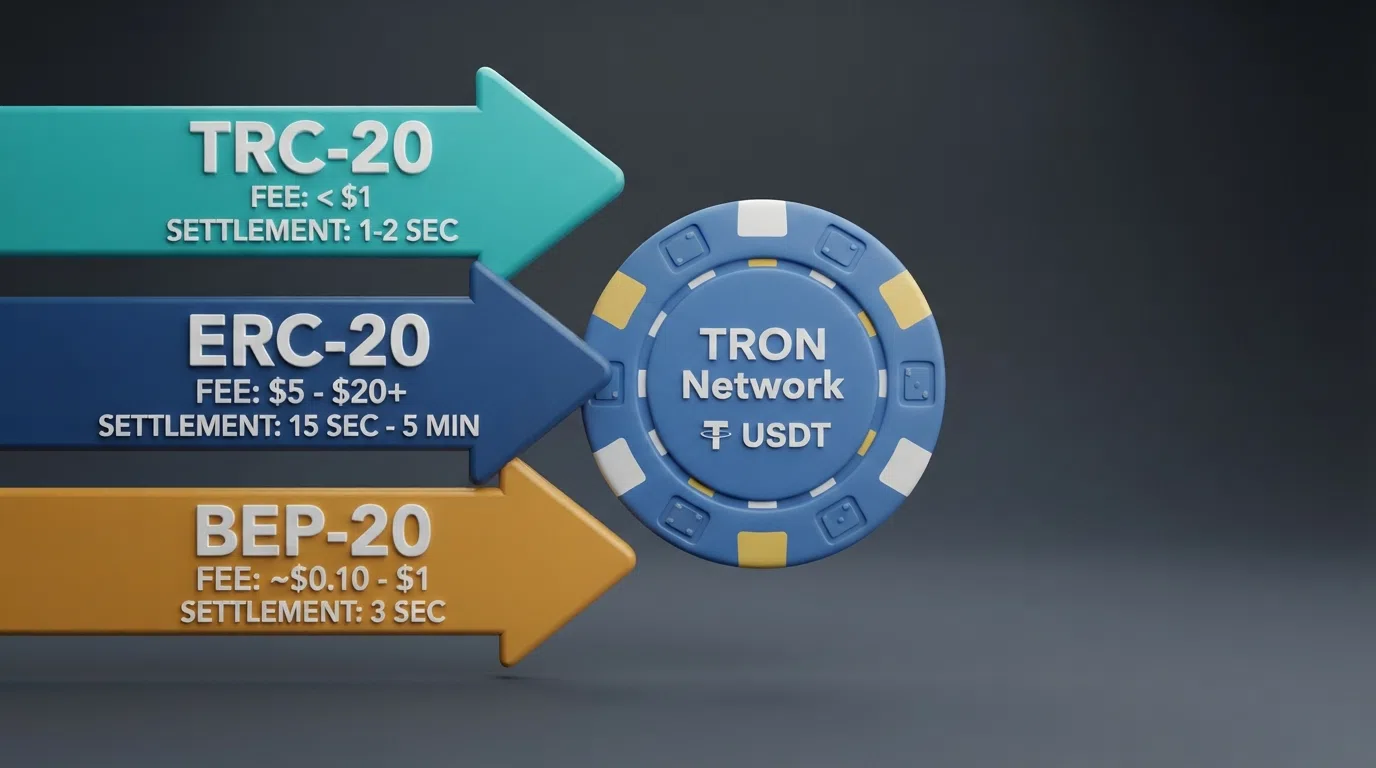
The deposit is a blockchain transaction: the player copies a deposit address from the casino cashier, pastes it into their wallet, sets the amount and the network, and confirms. On TRC-20 the transaction confirms in roughly one to three minutes with a fee of about fifty cents to a dollar; on ERC-20 the same transfer takes two to fifteen minutes and costs three to fifteen dollars in gas; on BEP-20 the fee is around fifty cents and settlement is one to two minutes. The casino’s balance updates once the required number of on-chain confirmations has passed — typically one for TRC-20 and BEP-20, several more for ERC-20.
A withdrawal reverses the flow. The player enters a wallet address in the cashier, picks a network, states the amount, and waits for the operator’s internal review. At the casinos on this page that review can be under twenty minutes. Once the operator releases the funds, the network does what it does — same timing and fees as the deposit.
UK Player Access: Why Every USDT Casino on This Page Is Offshore
The Gambling Act 2005, as amended by the Gambling (Licensing and Advertising) Act 2014, makes a Gambling Commission operating licence compulsory for any operator serving British customers — regardless of where the operator is based. A Curaçao permit, a Maltese licence, a Gibraltar registration: none of them substitute. The Commission has stated plainly that it will not consider an Operating Licence application from a business funding itself with crypto unless the applicant supplies a full and complete history of source of funds at the application stage. No GB-licensed casino accepts USDT in 2026.
UKGC chief executive Andrew Miller said in February 2026 that the Commission is exploring a regulated route for crypto payments, and the FCA crypto regime is expected to take effect on 25 October 2027 — but no formal change is in effect. Every casino on this page is offshore. That means every one sits outside the British protections a player at a GB-licensed casino takes for granted: GAMSTOP, the Commission’s complaints route, alternative dispute resolution (ADR), and the statutory deposit, stake and wagering limits that bound a GB-licensed product.
What to Look for in a Tether Casino: Licence, Games, Withdrawal Record
A licence is the first thing to check, but the jurisdiction shapes how much protection it confers. Curaçao GCB is the most common framework among the operators reviewed here; Anjouan and Costa Rica appear at the margins. None of these regimes match what the UKGC offers a British player.
Game providers are the second marker. Pragmatic Play, Evolution, NetEnt, Microgaming, Hacksaw Gaming, Play’n GO, Nolimit City and Push Gaming are familiar names from the European market, and their presence is a reasonable signal that the operator has a real game integration rather than a white-label shell. Withdrawal speed is the third, and the easiest to cross-check against player reports on Trustpilot, Casino Guru and the casino forums — Velobet’s Casino Guru rating of 8.4 out of 10 with 898 Trustpilot reviews and a largely positive payout record is the kind of footprint to look for. Bonus terms — wagering multiplier, validity, free-spin win cap, maximum bet during wagering — are the fourth, and the most consequential for the actual cost of playing.
The Best USDT Casinos Accepting UK Players in 2026
| Operator | Licence jurisdiction | Wagering requirement | USDT networks supported | Typical withdrawal time |
|---|---|---|---|---|
| Stake | Curaçao | 40× on deposit + bonus | TRC-20, ERC-20 | Within 2 hours, zero fees |
| BC.Game | Anjouan (UKGC licence revoked Dec 2024) | 40× on deposit + bonus | TRC-20, ERC-20, BEP-20, Solana, Polygon, Arbitrum | Minutes to 2 hours |
| Cloudbet | Curaçao | Zero-wagering rakeback | 7 networks (ETH, BSC, Avalanche, Solana, Polygon, TRON, TON) | 10–20 minutes on-chain |
| BitStarz | Curaçao | 40× on bonus | TRC-20, ERC-20 (via CoinsPaid) | Under 20 minutes on-chain |
| Velobet | Curaçao (Santeda International B.V.) | — | TRC-20, ERC-20 | Fast crypto processing reported |
| Rolletto | Curaçao GCB | — | TRC-20, ERC-20 | Minutes to 2 hours |
| Donbet | Curaçao GCB | — | TRC-20, ERC-20 | Minutes to 2 hours |
| FortuneJack | Curaçao | 40× referenced | TRC-20, ERC-20 | — |
| Wild.io | Curaçao | 40× | TRC-20, ERC-20 | — |
| Slottio | Costa Rica | — | TRC-20, ERC-20 | Minutes to 2 hours |
The ranking rewards three things: clarity of the bonus terms, breadth of USDT network support, and a withdrawal record that can be cross-checked. The first four — Stake, BC.Game, Cloudbet and BitStarz — carry documented bonus terms and stated payout times; Cloudbet’s zero-wagering rakeback model is the one that breaks from the 40× pattern at the rest of the set. Velobet lands fifth on the strength of its third-party reputation. The remaining five are credible operators with familiar provider lineups but less public data on bonus conditions, which is itself a finding: a reader comparing offers cannot evaluate what the operator has not disclosed.
Stake: The Highest-Volume Crypto Casino with a Straightforward Welcome Offer
Stake’s welcome offer is a 200 per cent deposit match up to $2,000, with 40× wagering applied to deposit plus bonus combined. The minimum crypto deposit is 0.01 USDT — small enough to test the cashier before committing. Withdrawals are advertised as processing within two hours with zero fees, and the casino supports USDT on both TRC-20 and ERC-20, alongside Bitcoin, Ethereum, Litecoin and a longer altcoin list. Stake Originals — provably fair in-house games including crash, dice and plinko — are the differentiator that has made Stake the highest-volume crypto casino by player count, and they sit alongside the third-party slots and Evolution live dealer tables rather than in place of them.
The combination worth weighing is the 200 per cent match against the 40× wagering. At a $1,000 deposit the bonus is $2,000; the combined balance is $3,000 and the turnover requirement is $120,000 — the subject of the calculation in the bonus section below. A 30-day validity window is on the generous end of what offshore casinos offer, and the two-hour withdrawal ceiling is on the fast end.
BC.Game: The Multi-Network Powerhouse with a Four-Tier Welcome Package
BC.Game runs the widest spread of USDT networks in the featured set: TRC-20, ERC-20, BEP-20, Solana, Polygon and Arbitrum. That is six networks, and the practical effect is that a player holding USDT on any major chain can deposit without first bridging or swapping. The welcome package is structured across four deposits — 120 per cent plus 100 free spins on the first, 100 per cent on the second, 80 per cent on the third, and 80 per cent plus a $5 free bet on the fourth — for a combined ceiling of $4,000 plus 400 free spins.
Each tier carries 40× wagering on deposit plus bonus combined. Free spin winnings are capped at $10 per batch, which means the 400-spin headline shrinks dramatically: $10 multiplied by 4 is the realistic ceiling on the free-spin side, even before wagering. A $5 maximum bet applies during wagering and the bonus carries 30-day validity. The BC.Game Originals library runs to 73 provably fair titles — the largest in-house crypto game catalogue in the set.
The significant history is that BC.Game’s UKGC licence was revoked in December 2024. The operator now runs under an Anjouan (Comoros) licence, which has limited enforcement capacity compared with either the UKGC or the Malta Gaming Authority. For a reader who weighed the brand precisely because it once held a British licence, that revocation matters.
Cloudbet: Zero-Wagering Rakeback — The Bonus That Pays in Cash
Cloudbet’s welcome package breaks from the deposit-match pattern. The headline is up to $2,500 (or 2,500 USDT) credited as rakeback rather than as a bonus balance, plus daily cash drops over 30 days. Rakeback is paid 30 per cent directly and 70 per cent through a rewards calendar in six instalments over 48-hour windows. Because it is rakeback rather than a bonus, there is no classic wagering rollover — the credited funds are cash, withdrawable once they land.
The trade-off is that a 30 per cent direct credit on a $2,500 ceiling is $750 paid at the outset, with the remaining $1,750 arriving across the next ten days. A player who wants the full headline in hand on day one has misunderstood the structure. USDT support runs across seven networks — Ethereum, BNB Smart Chain, Avalanche, Solana, Polygon, TRON and TON — the second-widest set in the field. Withdrawals are stated at ten to twenty minutes on-chain for verified accounts, with auto-approval on the operator side. The Cloudbet Originals section sits alongside Evolution and Pragmatic Play for live dealer, and Microgaming, NetEnt, Play’n GO and Red Tiger round out the slot library.
BitStarz: Award-Winning Casino with BTC-Scale Bonuses and USDT Support
BitStarz’s welcome package is denominated in Bitcoin rather than USDT — 5 BTC plus 180 free spins across four deposits — and is the one bonus in the set where the headline figure swings with the BTC price on the day of deposit. The dollar equivalent can reach around $2,000 at recent prices, but the BTC figure is the offer. Wagering runs at 40× on the bonus amount (not deposit plus bonus combined — a meaningful distinction when the calculation is run), with a $5 maximum bet during wagering, 7-day bonus validity and a 1-day expiry on the free spins.
USDT deposits and withdrawals run on TRC-20 and ERC-20 via the CoinsPaid processor. Withdrawals clear under twenty minutes on-chain once the operator has approved the request. The provider roster is broad — Pragmatic Play, Evolution, NetEnt, Microgaming, Play’n GO, Yggdrasil, Betsoft and BGaming — and BitStarz has accumulated multiple industry awards over its operating history. The combination worth weighing against Stake and BC.Game is the BTC denomination: a player who thinks in dollars will be recalculating the offer against the spot price every time they consider depositing.
Velobet: A Curaçao Operator with Strong Trustpilot Credentials
Velobet operates under a Curaçao licence held through Santeda International B.V., and the third-party footprint is the strongest part of its profile: Casino Guru rates it 8.4 out of 10 (High Safety) and 898 Trustpilot reviews show a largely positive payout record. The provider lineup — Pragmatic Play, Evolution, NetEnt, Microgaming, Play’n GO, Hacksaw Gaming and Nolimit City — is consistent with the rest of the upper tier. USDT is supported on TRC-20 and ERC-20 with fast crypto processing reported across the review footprint.
What is missing at review is the bonus shape. Welcome bonus terms, free-spin promotions, wagering multiples and validity windows are not documented in the sources available. A reader choosing on the basis of reputation rather than headline offer gets a different proposition from the rest of the upper tier, and the absence of the offer data is part of that.
Rolletto: Curaçao-Licensed, Wide Crypto Support, £20 Minimum Deposit
Rolletto holds a Curaçao GCB licence and accepts a broad crypto range — Bitcoin, Ethereum, USDT, Litecoin, XRP, Dogecoin, USDC, BNB, Dash and Monero — across TRC-20 and ERC-20. The minimum deposit is £20. The provider list mirrors the rest of the set: Pragmatic Play, Evolution, NetEnt, Microgaming and Play’n GO. Welcome bonus terms are not confirmed at the level of detail the upper-tier operators disclose, and the verification gap is the practical limit on what can be said about the offer.
Donbet: Curaçao GCB, £20 Minimum, Pragmatic Play and Evolution Titles
Donbet’s profile overlaps with Rolletto: Curaçao GCB, £20 minimum deposit, USDT on TRC-20 and ERC-20, the same familiar provider lineup. The crypto range is broader than the slot catalogue suggests — BTC, ETH, LTC, USDT, XRP, BCH, DASH, Monero, USDC and DOGE — and that breadth is the practical upside for a player who holds multiple coins. Bonus terms are not documented in available sources, and the write-up is constrained by what is publicly verifiable.
FortuneJack: Long-Running Crypto Casino with VIP Programme and 40× Wagering
FortuneJack has been operating under a Curaçao licence for longer than most of the set, and the standing is the asset — a long-running brand with a known operator behind it. The provider lineup is Pragmatic Play, Evolution, NetEnt, Microgaming, Betsoft, BGaming and Endorphina. Wagering at 40× is referenced in third-party reviews. USDT runs on TRC-20 and ERC-20. Withdrawal time and full bonus terms are not confirmed in available sources, and a no-deposit free spins promotion is referenced without the details attached.
Wild.io: A Newer Curaçao Brand with a 120% Match up to $5,000
Wild.io’s welcome offer is a 120 per cent match up to $5,000 plus 75 free spins at 40× wagering, with a $20 minimum deposit. The provider lineup — Pragmatic Play, Evolution, Hacksaw Gaming, BGaming and Push Gaming — sits in the familiar bracket. USDT support is TRC-20 and ERC-20. Withdrawal time is not confirmed in the sources available. The “newer” designation is relative — Wild.io is the most recently launched brand in the featured set, and the larger headline bonus is consistent with the launch-offer pattern at offshore casinos.
Slottio: Costa Rica-Registered, £25 Minimum, Familiar Provider Stack
Slottio is registered in Costa Rica, outside the Curaçao and Anjouan mainstream that dominates the rest of the set. The minimum deposit is £25. USDT runs on TRC-20 and ERC-20 alongside Bitcoin, Ethereum and Litecoin. The provider lineup — Pragmatic Play, Evolution, NetEnt, Microgaming and Play’n GO — is the familiar stack. Bonus terms and withdrawal details are not confirmed at the level the upper-tier operators disclose, and the Costa Rica registration sits at the lighter end of the offshore licensing spectrum in terms of player recourse.
How Tether Casino Payments Work — And Why Withdrawals Are Faster Than You Would Expect
The payment rail at a USDT casino is the same rail that runs on every blockchain — a transaction signed by the player’s wallet, broadcast to the network, included in a block, and credited to the recipient’s address after the casino’s confirmation threshold. The casino does not move the funds; the network does. What the casino controls is the time between the player’s withdrawal request and the operator’s release of the funds, and the verification stage that determines whether the request is approved at all.
How to Deposit with USDT at an Online Casino
- Acquire USDT on an exchange (Coinbase, Kraken, Binance) or through a swap in a non-custodial wallet, then transfer to the wallet the player controls.
- Open the casino cashier, select USDT, and pick the network the wallet already holds funds on — TRC-20 for cheap, ERC-20 for wallets already on Ethereum, BEP-20 for Binance Smart Chain users.
- Copy the casino’s deposit address, paste it into the wallet, enter the amount, and confirm the transaction.
- Wait for on-chain confirmation. The balance appears in the casino account once the required confirmations have passed — usually within minutes on TRC-20 and BEP-20, longer on ERC-20.
How to Withdraw Your Winnings Back to a Wallet
The withdrawal reverses the deposit. The player selects USDT in the cashier, enters the receiving wallet address, picks a network, and states the amount. Matching the deposit network matters: sending USDT on TRC-20 to an exchange that only credits ERC-20 deposits is a lost transaction. Once the request is in, the operator runs an internal review — automated at most of the featured operators, manual where a large win or a fresh account triggers a closer look. On approval the funds broadcast to the network. Stake’s stated ceiling is two hours; Cloudbet’s is ten to twenty minutes on auto-approved accounts; BitStarz’s is under twenty minutes on-chain once the operator has cleared the request.
TRC-20 vs ERC-20 vs BEP-20: Which USDT Network Costs Less and Clears Fastest
| Network | Typical fee | Settlement time | Best used for |
|---|---|---|---|
| TRC-20 (Tron) | ~$0.50–$1 | 1–3 minutes | Frequent smaller deposits and withdrawals; lowest fee |
| ERC-20 (Ethereum) | $3–$15 | 2–15 minutes | Large transfers where Ethereum security perception matters; wallets already on ERC-20 |
| BEP-20 (BNB Smart Chain) | ~$0.50 | 1–2 minutes | Binance users; practical middle ground on fee and speed |
The choice at the cashier is a fee-versus-speed-versus-tooling trade-off. TRC-20 wins on cost and clears fast enough that most players do not notice the wait. ERC-20 is the network a player is already on if they bought USDT on a major exchange, and the higher fee buys the deepest liquidity and the broadest wallet support. BEP-20 is the path of least resistance for anyone whose USDT is already on Binance. The casino does not charge for the network — the network charges — but the casino does set the minimum deposit, which varies: Stake takes 0.01 USDT, Rolletto and Donbet take £20 equivalent, Slottio £25, Wild.io $20.
Withdrawal Speed, Limits and the Fine Print Behind “Instant” Claims
The “instant withdrawal” claim at an offshore crypto casino refers to the operator’s processing time, not the on-chain settlement. Once the operator releases the funds, the network still has to confirm — and that confirmation is faster on TRC-20 and BEP-20 than on ERC-20. Where the operator’s stated time is “minutes to two hours,” the realistic end-to-end experience is the lower end of that range for repeat customers on TRC-20 or BEP-20 and the higher end for first withdrawals or ERC-20.
What is not in the marketing is the verification step. A first withdrawal, or a withdrawal significantly larger than the deposit pattern, triggers identity checks at most of the featured operators — even those marketed as “no KYC.” The time between request and approval can stretch to hours or days if the operator’s review queue is long, and the player who has not prepared documents in advance pays the delay.
Why Your 2026 USDT Casino Bonus Is Smaller Than It Looks
Take the Stake welcome offer at face value: 200 per cent up to $2,000, 40× on deposit plus bonus combined. A reader who stops at the headline is reading the wrong number. The real number is the turnover the bonus requires, and at a $1,000 deposit the calculation is straightforward: a $2,000 bonus on top of a $1,000 deposit gives a combined balance of $3,000, and 40× that is $120,000 of wagering to clear. At a $1 stake per spin, with 5 seconds between spins, that is 120,000 spins taking 600,000 seconds — 166 hours and 40 minutes of continuous play. Spread across 30 days, the bonus asks for five and a half hours of play every day, every day, with no break.
That arithmetic — the input numbers and the result, not the multiplication step by step — is what every 40× deposit-plus-bonus offer at an offshore casino costs a player who claims the maximum. The marketing word is “match.” The arithmetic says “turnover.” The player pays the gap.
Welcome and Deposit-Match Bonuses: The Headline vs the Real Cost
A deposit-match bonus combines the deposit and the bonus into a single balance, and the wagering multiplier applies to the combined figure. Stake and BC.Game use this structure at 40×. BitStarz applies 40× to the bonus alone — a meaningful distinction that halves the turnover at the same bonus size. Cloudbet’s rakeback model bypasses the calculation entirely: there is no turnover requirement, because the credited funds are cash rather than bonus balance.
The validity window is the second multiplier on cost. Stake and BC.Game give 30 days from crediting. BitStarz gives 7 days on the welcome bonus and 1 day on the free spins — a tight window that effectively forces the player to clear in a single concentrated session. A 7-day window at 40× is the boundary at which the calculation becomes achievable without the casino grinding the bonus into a time-tax.
No-Deposit Bonuses and Free Spins at USDT Casinos
A no-deposit bonus sounds free, and the price is in the ceiling. BC.Game’s no-deposit bonus carries 50× wagering with a maximum payout of 50 USDT — a hard cap that limits the upside regardless of how the wagering clears. BitStarz offers 50 no-deposit spins via code at 40× wagering with a maximum cashout of C$150. FortuneJack runs a no-deposit free spins promotion, the details of which are not fully documented in available sources.
Free spins attached to a welcome package carry their own erosion. BC.Game caps free-spin winnings at $10 per batch — meaning the 400-spin headline across the four deposits, even before the 40× wagering is applied, has a realistic ceiling of $40. BitStarz’s 1-day expiry on free spins means a player who claims and walks away forfeits the spins; the structure rewards immediate play. The headline number and the realised value are not the same number, and the audit here is to read the cap before claiming the spin.
Why Offshore Wagering Terms Are Four Times Harsher than GB-Licensed Rules
From 19 December 2025, wagering requirements at GB-licensed casinos are capped at 10× under LCCP Social Responsibility Code 5.1.1, and mixed-product promotional offers are banned. The standard offshore figure is 40× — at Stake, BC.Game, FortuneJack and Wild.io. BitStarz is 40× on the bonus amount. That is a fourfold gap, and the player pays it in turnover.
The structural pressure is visible on the operator side. Remote Gaming Duty rose from 21 per cent to 40 per cent from 1 April 2026. The statutory levy at 1.1 per cent of gross gambling yield from April 2025 sits on top. A GB-licensed operator cannot run a 40× bonus at the post-April-2026 duty rate and stay viable; the GB market’s 10× cap is the regulation, and the offshore market’s 40× is the escape valve. The cost to the player at an offshore casino is partly a function of the operator’s tax saving.
The Games You Can Actually Play with Tether — And What Offshore Casinos Do Better
The slot libraries at the featured operators draw from the same provider pool a GB-licensed casino would use: Pragmatic Play, Hacksaw Gaming, Push Gaming, Nolimit City, NetEnt, Microgaming, Play’n GO, Betsoft, BGaming. Live dealer comes from Evolution and Pragmatic Play Live — the same studios the GB market runs. The differences are in what those games can do and what surrounds them.
Slots at USDT Casinos: Thousands of Titles, No Stake Cap
GB-licensed slots are capped at £5 per game cycle for players aged 25 and over, £2 for players aged 18 to 24, with auto-play banned and a maximum spin interval of 2.5 seconds. None of these limits apply offshore. A USDT casino player can sit at a £20 spin, run auto-play for an hour, and clear wagering in a fraction of the time a GB-licensed player can — at the cost of the stake cap’s protective effect on the bankroll.
The provider count at the featured operators runs into the thousands. Pragmatic Play and Hacksaw Gaming recur across every operator in the upper tier. Nolimit City and Push Gaming appear at Stake and Wild.io. The RTP figures are not always displayed in the same way as on a GB-licensed site, where the UKGC mandates visibility; offshore casinos vary, and the player who wants the figure checks the in-game information panel before staking.
Live Dealer Tables: Blackjack, Roulette and Baccarat with Evolution and Pragmatic Play
Live dealer at a USDT casino is the same Evolution and Pragmatic Play Live catalogue that runs at GB-licensed sites: blackjack, roulette, baccarat, game-show titles like Crazy Time and Monopoly Live. The cashier converts USDT to a fiat display for betting-limit purposes — a £10 table minimum reads as 10 USDT at the current rate. What is absent is the GB-mandated reality-check pop-up at set intervals and the deposit prompts at the financial vulnerability threshold. A live session offshore runs without those interruptions.
Crash Games and Provably Fair Originals: The Crypto-Native Edge
Crash, Plinko, dice and the wider family of multiplier-and-cash-out games are the category GB-licensed casinos do not carry, and the category the offshore crypto-native operators have built in-house. Stake Originals, BC.Game Originals (73 titles) and Cloudbet Originals are the three proprietary libraries in the featured set. The “provably fair” label refers to a cryptographic verification step: each round’s outcome is generated from a server seed, a client seed and a nonce, and the player can check the hash after the round to confirm the result was not altered mid-play.
The verification step is real. The games are not on the GB-licensed market because the certification regime for random number generation at the UKGC does not accommodate the provably fair model, and the game cycle rules (stake caps, spin speed, auto-play) were not designed with crash in mind.
New Tether Casinos Worth a Look in 2026
The newest-feeling brand in the featured set is Wild.io — a Curaçao-licensed operator with a 120 per cent match up to $5,000 plus 75 free spins at 40× wagering and a $20 minimum deposit. Newer offshore brands tend to launch with aggressive welcome offers because the player base does not yet exist; the offer is the recruitment. The pattern is consistent across the offshore crypto market, and the question for a reader is whether the launch offer compensates for the absence of a withdrawal track record.
The honest answer is that an offshore casino’s licence is rarely dated to the brand’s public launch. A “new” operator may hold a reissued Curaçao sub-licence from a parent company that has run other brands. Wild.io’s branding is new; the underlying corporate structure may not be. The verification step is to check the licence holder’s name against the Curaçao GCB register where the brand’s site discloses it.
The Newest USDT Casinos Accepting UK Players
Beyond Wild.io, the rest of the featured set consists of established brands at varying ages. Stake, Cloudbet, BitStarz, FortuneJack and BC.Game are long-running; Velobet, Rolletto, Donbet and Slottio sit in the middle. The absence of a public “licensed since” date on most of these operators makes a clean age ordering impossible without a register check the sources do not cover.
New vs Established: What to Check Before You Deposit at a Fresh Casino
- Verify the licence on the Curaçao GCB register or via the operator’s own licence disclosure page. A missing or opaque licence is the strongest negative signal in the set.
- Search payout complaints on Trustpilot, Reddit, AskGamblers and the casino forums. A pattern of unresolved withdrawal complaints is the next-strongest signal.
- Check the provider list. Familiar names (Pragmatic Play, Evolution, NetEnt) point to a real integration; an unrecognised provider list points to a thin operation.
- Deposit the minimum, play briefly, and withdraw early. The first withdrawal is the test of the payout pipe, and a casino that pays promptly on the first withdrawal is more likely to pay promptly on the second.
Offshore vs UK-Licensed: What GamStop, KYC and the Law Actually Mean for Your Money
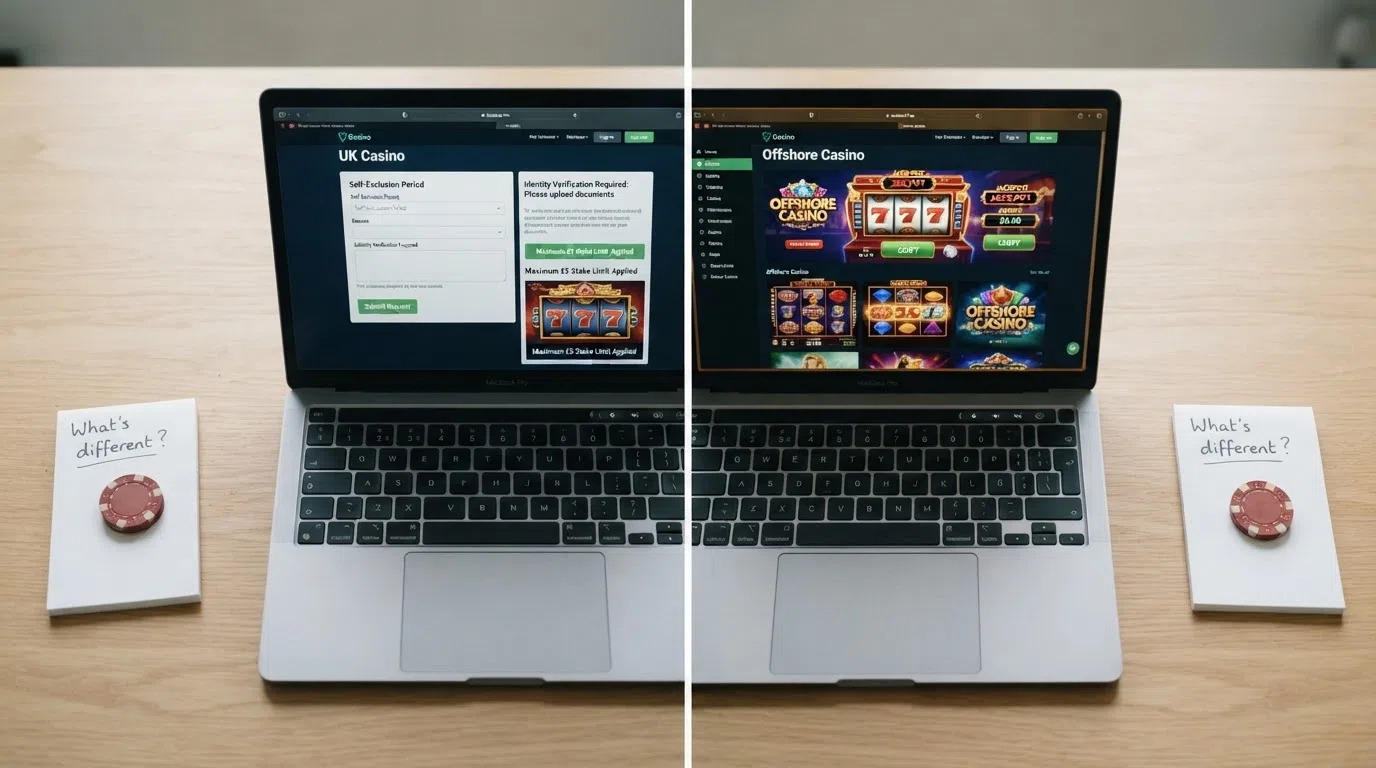
A British player at a GB-licensed casino sits inside a protection framework that took a decade to build. The same player at one of the offshore casinos on this page sits outside that framework. The differences are not abstract — they touch the deposit, the spin, the dispute and the self-exclusion request.
GamStop and Self-Exclusion: Why These Casinos Sit Outside the Net
GAMSTOP has been mandatory for every GB-licensed online operator since 31 March 2020. Exclusion periods run six months, one year, five years, or five years with auto-renewal, and cannot be cancelled early. A British player who has registered with GAMSTOP and then signs up at an offshore USDT casino has no blocking mechanism. The offshore operator is not part of the scheme, and the registration at GAMSTOP is irrelevant to the offshore account.
The risk is straightforward. The GAMSTOP registration is a statement of intent to stop. The offshore account is a way around it. The combination is the gap the GB framework cannot close without a power it does not have — there is no statutory ISP or DNS blocking regime in place, and the legislation that would introduce one has been proposed but not enacted.
KYC and Verification: What Offshore Casinos Actually Ask For
At a GB-licensed casino, identity verification (name, address, date of birth) is mandatory before the first deposit — in force since 7 May 2019. Anonymous play is not possible. At an offshore USDT casino, the picture is uneven. Some operators marketed as “no KYC” allow crypto deposits without documents and trigger verification only at withdrawal — typically after a large win or a withdrawal that exceeds the deposit pattern. The verification request, when it comes, asks for ID, proof of address and sometimes a selfie, and the time it takes to clear varies.
The trade-off is the point. A player who values privacy gets it on the deposit. The same player loses the protection that comes with verified status if a dispute arises — a casino that can claim anonymous play was a one-off accommodation has more room to argue than one that verified the player at the door.
Is It Legal? What UK Law Actually Says About Playing at an Offshore Crypto Casino
Section 33 of the Gambling Act 2005 makes providing facilities for gambling without a GB licence a criminal offence — up to 51 weeks’ imprisonment, an unlimited fine, or both. The offence is committed by the operator, not the player. There is no confirmed penalty for a UK resident who gambles on an unlicensed site; every sanction the Commission has traced is aimed at operators, advertisers and intermediaries.
Enforcement is disruption, not blocking. The Commission issues cease-and-desist notices with a 48-hour deadline, refers illegal URLs to search engines for delisting, and pressures GB-based advertisers and affiliates. Between April 2024 and June 2025: 3,140 disruption notices, 447,778 URLs referred, 287,961 removed. What the Commission does not have is statutory ISP or DNS blocking power. The practical result for the player is that the offshore site can disappear overnight — a cease-and-desist, a registrar suspension, a payment-processor withdrawal — and there is no UK legal route to recover funds that were sitting in the casino balance at the time.
What You Lose: The Protection Gap Between a GB Licence and an Offshore One
A GB-licensed casino must provide: GAMSTOP self-exclusion coverage; ADR — a free ombudsman if the casino refuses to pay; a Gambling Commission complaints route; mandatory financial vulnerability checks at £150 net deposit in a rolling 30-day period; statutory slot stake caps of £5 (£2 for 18–24); an auto-play ban and a 2.5-second spin-speed limit; a 10× wagering cap; and pre-deposit identity verification. None of these binds an offshore USDT casino. The casino may offer some of them voluntarily — most offer deposit limits, some offer self-exclusion at the account level — but the obligation does not exist, and the regulator to enforce it does not exist.
The single protection an offshore USDT casino offers that a GB-licensed casino does not is privacy on the deposit, where the operator skips KYC. That is the trade. Everything else moves in one direction.
Staying in Control: Responsible Gambling Tools Every Crypto Casino Player Should Use
The prevalence data sits behind this section. The Gambling Survey for Great Britain Year 3 (2025) estimates 2.4 per cent of GB adults aged 18 and over score PGSI 8 or higher — approximately 1.3 million adults. GambleAware’s 2024 survey found 13.1 per cent of adults who gamble score PGSI 1 or higher — approximately 6.8 million adults — and 30 per cent of those experiencing problems wanted treatment, almost double the 17 per cent recorded in 2020. These numbers are the reason the tools below matter.
Deposit Limits, Loss Limits and Reality Checks: What Offshore Casinos Offer
Offshore casinos vary. Some offer deposit caps that a player can set at the account level; some offer loss limits and session time-outs; some run reality-check pop-ups. None of these are mandatory in the way the GB regime mandates them — from 31 October 2025, GB-licensed operators must prompt a customer to set a financial limit before the first deposit, with decreases actioned immediately. The gap at an offshore casino is the absence of a regulator enforcing the tools; the player who sets a limit sets it voluntarily, and the casino is not obligated to maintain the setting under audit.
Self-Exclusion Options When GamStop Cannot Reach the Casino
A British player who has decided to stop gambling and is registered with GAMSTOP has covered the GB-licensed market. The offshore casino is not covered. Operator-level self-exclusion at the offshore casino is the per-site equivalent — most operators will action an account closure or a self-exclusion request, but it is voluntary and site-specific. Device-level blocking software (Gamban, BetBlocker) works across licensed and unlicensed sites, and is the practical second layer. The combination — self-exclude at the operator, install blocking software, register with GAMSTOP for GB-licensed coverage — is the realistic strategy.
Where to Get Help: UK Services for Gambling Harm
The National Gambling Helpline (0808 8020 133) is free, confidential and runs 24 hours a day, operated by GamCare. NHS gambling harm clinics operate in England, Scotland and Wales — referral via GP or self-referral. GambleAware commissions research, prevention and treatment. Gamblers Anonymous runs peer-support meetings across the UK. GAMSTOP is the self-exclusion scheme for GB-licensed online operators. None of these services distinguishes between a player who gambled at a GB-licensed casino and a player who gambled offshore. The help is the same; the access is unconditional.
How We Evaluated and Ranked These Tether Casinos
The operator data was drawn from third-party review sites — CryptoSlate, BetRank, iGamingFuture, Krypto-Casinos, CasinoBuddies, Webopedia, Ibebet, CoinCodex and others — and cross-checked where multiple sources carried the same figure. The licence status was verified against the UK Gambling Commission’s public register of operating licence holders: every operator on this page is absent from the register. The 2,663 records on the register as of the run date include every active GB online casino licence; none of the ten featured brands is among them.
The evaluation criteria were: licence jurisdiction and the regulatory credibility it confers; wagering fairness, including whether the multiplier applies to deposit plus bonus combined or bonus alone; USDT network breadth; stated withdrawal time and third-party payout reports (Trustpilot and Casino Guru); game provider quality. The ranking rewards clarity on the first three and reliability on the fourth; provider quality is the tie-breaker at the upper tier. What the ranking does not do is endorse any operator, award a “safest” label, or imply GB regulatory approval. None of these operators has GB regulatory approval, and no framing on this page should be read as conferring it.
What a UK Player Should Actually Do About USDT Casinos in 2026
Three paths exist for a UK player who wants to play online with USDT.
The first is to play at an offshore USDT casino accepting the protection gap. Every site on this page sits in this category. The upside is the bonus scale, the network breadth, the withdrawal speed and the privacy on the deposit where the operator skips KYC. The cost is the eight protections left behind: no GAMSTOP, no ADR, no Commission complaints route, no financial vulnerability check at £150, no statutory slot stake caps, no auto-play or spin-speed rules, no 10× wagering cap, no guaranteed pre-deposit verification.
The second is to wait. The UKGC has signalled that it is exploring a regulated route for crypto payments, and the FCA crypto regime is expected to take effect on 25 October 2027. A regulated GB-licensed USDT casino may exist by the end of 2027, and the protections the player leaves behind today would reattach at that point. Until the regime is in effect, however, no GB-licensed casino accepts USDT.
The third is to use a GB-licensed fiat casino with full protections. The player trades payment flexibility and bonus scale for the entire GB protection framework, including the 10× wagering cap, the GAMSTOP self-exclusion, the ADR route and the Commission’s complaints procedure.
The decision factors in choosing between paths one and three are concrete. A 40× offshore bonus versus a 10× GB bonus means a fourfold turnover difference on the same deposit size. A withdrawal in minutes versus a withdrawal in hours to days, against a dispute route that exists at one and not the other. A game catalogue that includes crash games and Stake Originals, against a game catalogue bound by slot stake caps and spin-speed limits. A privacy trade on the deposit at the offshore casino, against a verified account at the GB-licensed casino.
The bottom line is the trade the player is making. A UK player who chooses an offshore USDT casino is trading regulatory protection for payment flexibility, and the trade is real — eight specific protections on one side, network breadth and bonus scale on the other. The arithmetic that motivates the trade is the same arithmetic that motivates the cost. The player who understands both before the first deposit has done what this page was written to enable.
Frequently Asked Questions
Can someone registered with GAMSTOP still play at these casinos?
Yes. GAMSTOP covers GB-licensed online operators only and cannot reach an offshore casino. A person registered with GAMSTOP is not blocked from registering and depositing at any of the casinos on this page, because none holds a GB licence. That is also why device-level blocking software (Gamban, BetBlocker) exists alongside GAMSTOP — the registration alone does not cover the offshore market.
Does HMRC tax my winnings from a USDT casino?
No. UK players pay no tax on gambling winnings from any source — onshore or offshore, fiat or crypto. Player-side betting duty was abolished in 2001. The operator pays Remote Gaming Duty (40 per cent from 1 April 2026); the player side is untouched. Crypto disposals may have capital gains tax implications if treated as a disposal of an asset, but gambling winnings themselves are not taxable income in the UK.
What is the lowest amount I can deposit with Tether at these sites?
The minimum varies by operator. Stake takes 0.01 USDT, the lowest in the featured set. Rolletto and Donbet set £20. Wild.io sets $20. Slottio sets £25. The casino’s stated minimum is in fiat or USD equivalent; the actual USDT amount depends on the wallet’s display unit. The blockchain itself imposes no minimum — the casino does.
What recourse does a UK player have if an offshore casino refuses to pay out?
Limited. There is no UK statutory recourse — the Commission does not have jurisdiction over an unlicensed operator, and ADR (alternative dispute resolution) is not available because the operator is not bound by a GB-licensed ADR scheme. The practical routes are: contact the operator directly, escalate via the Curaçao GCB if the operator holds a Curaçao licence (limited enforcement capacity), pursue a chargeback if the deposit was made via a card or e-wallet, and post on Trustpilot or a casino forum to surface the dispute publicly. None of these routes has the force of a Commission adjudication.
How do these USDT casino bonuses actually stack up against a GB-licensed welcome offer?
The headline figures are larger offshore. A 200 per cent match up to $2,000 at 40× (Stake) is a bigger nominal offer than any GB-licensed casino can run under the 10× cap. The realised cost is also larger — $120,000 of turnover at a $1,000 deposit, versus $5,000 of turnover on the same deposit at a GB-licensed casino running a 100 per cent match at 10× bonus-only. The offshore bonus buys speed and scale; the GB bonus buys regulatory recourse and a turnover ceiling the player can actually clear.
Which crypto wallet should I use to fund a USDT casino account?
A non-custodial wallet the player controls the keys to — Trust Wallet, MetaMask or Phantom for software; a Ledger or Trezor for hardware. The wallet must hold USDT on the network the casino supports (TRC-20, ERC-20, BEP-20, or one of the longer lists at BC.Game and Cloudbet). Custodial exchange wallets work for the deposit but limit control over the network choice and add an intermediary step. A hardware wallet adds the signing step but removes the exchange as a custodian of the funds.
What Is a Tether Casino, and How Does USDT Work for Gambling?
The “casino” half of a Tether casino is the same software stack the player would find at any online casino: a slot library from Pragmatic Play, Hacksaw Gaming or NetEnt; live dealer tables from Evolution; a sportsbook or a crash game section; a cashier that takes deposits and pays withdrawals. The “Tether” half is the payment rail. USDT does not change the games. It changes the speed, the fee and the paperwork.
A crypto wallet — software like Trust Wallet, MetaMask or Phantom, or a hardware device like a Ledger — holds the player’s USDT and signs the transactions. The casino does not need the player’s bank details, which is one reason crypto deposit methods exist at all. Some offshore casinos market themselves as “no KYC” precisely because the payment rail does not require the same intermediary verification a bank transfer does.
Payments – realmoney-onlinecasinos-uk
Content created by the «realmoney-onlinecasinos-uk» team