
Where to Play Live Dealer Blackjack for Real Money in the UK
 Available in GB
Live dealer blackjack sits at the intersection of two things players care about: the lowest house edge on the casino floor and the highest production value an online operator can offer. A real dealer, real cards, an HD stream and a betting interface that lets you hit, stand, double or split without leaving the chair. Every casino on this page holds an active GB operating licence, verified against the UK Gambling Commission’s public register as of September 8, 2026.
What a Live Dealer Blackjack Site Actually Delivers (and What It Does Not)
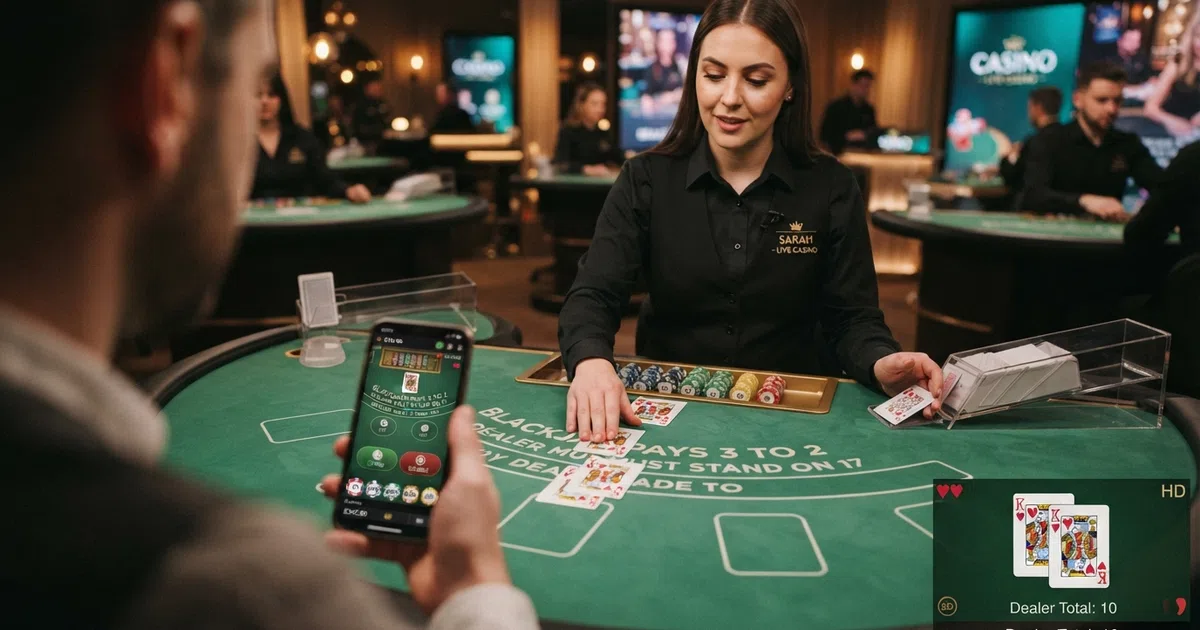
A live blackjack online casino is a licensed GB operator that streams real-dealer blackjack tables over the internet. The dealer is a person. The cards are physical. The shoe is a shoe. What the player sees is a multi-camera HD feed from a studio floor or — at one notable UK brand — an actual Grosvenor venue. What the player does is click to place a chip, click to hit, click to stand, watch the dealer turn the cards and get paid at 3:2 on a natural. That is the whole product, and that is what separates it from every other form of online blackjack.
The category exists because players who walk into a casino and play £5 a hand on a 3:2 table do not, as a rule, want to trade that for a digital animation of a dealer. The live format keeps the texture and drops the queue at the bar. Evolution Gaming dominates the supplier side of the UK market — its live blackjack portfolio covers Infinite Blackjack (unlimited seats), Free Bet Blackjack, Power Blackjack, Bet Stacker Blackjack and the niche Fun Fun 21 Live variant. Operators package those studio feeds into their own branded lobbies; bet365’s “Bet365 Live” tables are one example, built on Evolution plus Playtech plus Pragmatic Play Live, with branded studio backdrops and the same rules as every other Evolution table underneath.
The distinction matters because the UK Gambling Commission’s public register holds 2,663 licensed gambling business records, and every one of those records is a venue where this product is offered legally. The regulator’s register, last updated 29 July 2026, is the single most reliable way to confirm whether a site holds a GB licence — a check that takes about thirty seconds and eliminates every offshore operator in one pass.
Online vs Land-Based Blackjack: What Changes When the Dealer Is on Screen
The rules are the same. The shoe, the payouts, the soft-seventeen policy — all of it is configured by the operator on the studio side and runs identically at a Grosvenor table in London and at a Grosvenor-branded live stream from the same venue’s floor. What changes is the rhythm and the social texture.
A land-based casino deals somewhere around 60 to 80 hands per hour at a full table. Online live dealer blackjack moves slightly faster, because the dealing cadence is tighter and decision times are clocked, but the difference is not as large as many players assume — the dealer still shuffles, still deals physical cards, still waits on the slowest player. RNG blackjack is the only version that moves at machine speed, and that is part of why it feels different.
The other difference is social. A physical table has tells — a dealer who fidgets when the count is good, a player who breathes differently after a double. None of that survives a video feed. What replaces it is the chat box and the betting patterns of the other seats. The chat box is a small but real feature: a polite “well played” after a winner, a quick joke about a busted 15. It does not change the math. It does change the feel.
The stake range is wider online than in any single land-based venue. Bet365’s live blackjack runs from £1 per hand at the standard tables to £20,000 per hand in the VIP rooms — that bracket, from a fiver at the felt to five figures behind closed doors, simply does not exist at any one bricks-and-mortar UK casino. The HD stream and multi-camera setup, with picture-in-picture close-ups on the dealer’s upcard and on the player’s split hands, are studio-quality production that a land-based table cannot match.
Getting Started: What You Need Before Your First Live Blackjack Hand
Three steps stand between a UK player and the first dealt hand. Identity verification must complete before any deposit, and before any gambling, under the rule in force since 7 May 2019. The operator will ask for name, address and date of birth and verify them against public records; this is the same light-touch check that the regulator has made mandatory at the £150 net deposit mark and the same identity layer that the 2019 reform ended the 72-hour grace period for. There is no anonymous play at any GB-licensed casino.
Then a deposit. The credit card ban is now six years old — since 14 April 2020 no remote gambling operator in Britain can accept credit card payments, including credit-card-funded payments through e-wallets. The realistic options are debit cards, PayPal, Neteller, Skrill and bank transfer; Skrill and Neteller are excluded from several welcome offers, and PayPal and Paysafe are excluded from Grosvenor’s. The minimum deposit across the featured set is £10.
Then, before that first deposit clears, the operator must prompt the player to set a financial limit. This has been mandatory since 31 October 2025, and from 30 September 2026 a standardised gross deposit limit must be offered with equal prominence in the cashier. The prompt is not a marketing tactic — it is a regulator-mandated consumer protection, and taking it seriously is the first piece of real-money discipline a player builds.
After the deposit, the lobby opens. Live blackjack sits under “Live Casino” or “Live Dealer” in the navigation, and the lobby typically lists tables by stake range and variant. Pick a table whose minimum bet fits the bankroll, click to take a seat and the round begins. The dealer will greet the table, the betting window will open and the shoe will start moving.
The Best Live Blackjack Casinos for UK Players in 2026
Every operator in this table holds an active GB operating licence. The ranking reflects three weighted criteria: live-blackjack product depth (table count, provider quality, stake range), welcome-bonus fairness (wagering multiplier, contribution rate, cashout caps) and regulatory track record. Where a bonus row is empty, the current terms were not confirmed in this research run — the operator is on the list because its licence and product justify its place, and the live terms should be checked on the operator’s own site before signing up.
| Operator | UKGC Licence | Welcome Bonus | Wagering | Live Dealer Provider |
|---|---|---|---|---|
| bet365 | Active (Hillside) | Up to 500 free spins, no wagering on winnings | 0x (free spins) | Evolution + Playtech + Pragmatic Play Live |
| Betway | Active (Betway Limited) | 100% up to £50 + 125 free spins on Big Bass Bonanza | 10x (deposit match); 0x (spins) | Evolution |
| 888 Casino | Active (888 UK Limited) | 100% up to £100 OR 200 free spins | 10x (match); 0x (spins) | Evolution + Playtech + Pragmatic Play + proprietary |
| Paddy Power | Active (PPB GE / Flutter) | 60 no-deposit free spins (no wagering) | 0x | Evolution + Playtech |
| Grosvenor Casinos | Active (Rank Digital Gaming) | Deposit £20, get £20 | 10x on combined £40 | Evolution (streams from Grosvenor venues) |
| Ladbrokes | Active (LC International / Entain) | — | — | Evolution + Playtech + Pragmatic Play |
| Betfair | Active (PPB Entertainment / Flutter) | — | — | Evolution + Playtech + NetEnt |
| William Hill | Active (WHG / evoke-888) | — | — | Evolution + Playtech |
| Sky Vegas | Active (Bonne Terre / Flutter) | — | — | Evolution + Playtech + Pragmatic Play |
| PartyCasino | Active (Entain plc) | 100% deposit match | 10x (bonus + deposit) | Evolution + NetEnt + Microgaming |
Blackjack Game Performance Indicators
| Game Variant | House Edge (Basic Strategy) | Typical RTP | Variance Profile |
|---|---|---|---|
| Standard Blackjack | 0.40% – 0.50% | 99.54% | Low |
| Infinite Blackjack | 0.53% | 99.47% | Low |
| Free Bet Blackjack | 1.04% | 98.96% | Medium |
| Power Blackjack | 0.75% | 99.25% | Medium |
What the table shows at a glance: free spins with no wagering requirement are now the headline offer at half the featured set, and only Paddy Power puts a no-deposit offer on the table. Three operators (bet365, Betway, Paddy Power) run wager-free bonus structures that effectively cancel the cost of clearing, and a fourth (PartyCasino) sets the cleanest match-bonus terms in the set at 10x on bonus and deposit combined with no cap on winnings. The remaining six are here on licence and product, not on bonus strength.
Bet365: The Deepest Live Blackjack Range and Wager-Free Spins
Bet365 is the market leader for live blackjack breadth in the UK, and the structure of its welcome offer is the cleanest in the featured set. The site runs 20+ live blackjack tables across Evolution, Playtech and Pragmatic Play Live, branded as Bet365 Live with studio backdrops, and the stake range runs from £1 at the standard tables to £20,000 per hand in the VIP rooms — that £1 to £20,000 bracket is the widest at any UK-licensed live blackjack site and a useful proxy for how broad the bankroll accommodation actually is.
The welcome offer is up to 500 free spins on selected games, with no wagering requirement on winnings. The mechanics matter: the spins are released in 10 daily batches over 20 days, each spin is worth £0.10, the spins are valid for 7 days from credit and a minimum £10 lifetime deposit is required to claim. The 0x wagering on spin winnings is what makes this the headline offer of the set — a player keeps everything they win from the spins, with no playthrough requirement, no game-weighting drag and no cap on cashout stated in the offer terms.
The live blackjack product is the deepest in the UK: branded Bet365 Live tables, the full Evolution portfolio including Infinite Blackjack, multiple Playtech tables and Pragmatic Play Live content. The minimum bet of £1 is the lowest in the featured set and the right entry point for a player who wants to learn basic strategy at minimum cost.
Verdict: the market-leading option for UK blackjack enthusiasts needing deep product variety, with the wager-free spins offering genuine and immediate value.
Betway
Betway’s live casino is the volume leader on table count — 70+ live tables overall, Evolution-powered, covering Infinite Blackjack, Lightning Blackjack and the full classic blackjack suite. The £50 deposit match has a 10x wagering multiplier with game weighting applied, and live casino contributes 0% to 10% to that wagering depending on the game. The contribution rate is the catch: a player who clears a £50 match on live blackjack alone would need to generate roughly ten times the slot-equivalent turnover, because only one-tenth of every live blackjack pound counts.
The 125 free spins on Big Bass Bonanza are the better half of the welcome package, credited 25 per day over 5 days at £0.10 per spin with no wagering requirement on spin winnings. Big Bass Bonanza carries an RTP of approximately 96.71%, which is a slot figure that does not apply to live blackjack and should be treated as bonus-side context only. The 7-day validity window from registration is short — players who delay the welcome claim lose it.
Verdict: a strong selection for volume players who prefer to treat the £50 match as a secondary benefit while focusing on the free-spin allocation.
888 Casino
888 Casino runs a two-track welcome offer — a 100% deposit match up to £100 at 10x wagering on selected slots within 90 days, with winnings capped at £100, or 200 free spins at £0.10 per spin with a maximum withdrawable £50. The 90-day validity is double the industry norm and a meaningful concession to players who cannot grind out a bonus in a single week. Skrill and Neteller are excluded from the welcome offer.
The live blackjack product sits at 15 tables with an exclusive VIP room, powered by Evolution plus Playtech plus Pragmatic Play plus 888’s own proprietary content. Live casino contributes 10% to bonus wagering — the same contribution rate that most UK operators apply and the structural reason that any deposit-match bonus is a slow grind on live blackjack specifically.
The £100 cashout cap on the match bonus is the hard edge: even a player who turns the bonus into a large slot win walks away with £100. The free-spin alternative caps at £50 on winnings. Neither cap is unusual for a UKGC-licensed welcome offer, but it is the figure to know before accepting.
Verdict: an excellent pick for slot-focused players who enjoy live dealer games on the side; the 10% contribution makes it less efficient for dedicated blackjack grinding.
Paddy Power
Paddy Power is the only featured operator with a genuinely deposit-free welcome offer: 60 no-deposit free spins split 50 on selected slots and 10 on an exclusive live roulette title called Mansion Heist, at £0.10 per spin, with no wagering on winnings. No deposit required. UK and Ireland customers only. A further 100 free spins land on a £10 deposit, completing the welcome structure.
The offer is the standout in the featured set because it removes the deposit friction entirely. A new player can register, claim the 60 spins, watch the wager-free winnings land in the cash balance and decide whether to deposit on the strength of the experience. Mansion Heist is a live roulette title rather than a live blackjack table, which is the only mismatch — a player who arrives looking for live blackjack spins will find roulette in the live-dealer allocation.
The Evolution-and-Playtech-powered live casino runs the standard live blackjack suite, though precise table numbers are not publicized.
Verdict: the only operator in the featured set where a player can sit at a live table with zero deposit and zero wagering on the welcome; the catch is that the no-deposit spins are split between slots and a live roulette title, not blackjack, so a blackjack-first player is taking the offer as a registration sweetener.
Grosvenor Casinos
Grosvenor is the land-based giant that streams live blackjack from its actual UK venues — 200+ live dealer blackjack tables with Evolution running the technology and Grosvenor’s casino floors providing the studio backdrop. That stream-from-the-venue setup is unique in the featured set and is the product feature a player picks Grosvenor for.
The welcome offer is the smallest headline in the set by design: deposit £20, get £20, with 10x wagering on the combined £40 and a maximum cashable from bonus winnings of £2,000. Thirty days validity. PayPal and Paysafe are excluded. Game contribution is slots 100%, jackpots 50% and live casino 10% — the same contribution structure that every UK operator runs and the same reason that live blackjack clears bonus wagering slowly.
The product is the verdict. 200+ tables, real UK venues, Evolution technology and a 10x bonus with a £2,000 cap that converts slot play but is expensive to grind through live blackjack. A player who wants to play blackjack from a Grosvenor floor without travelling is the audience.
Verdict: the premier choice for players valuing the authentic stream-from-venue experience, despite the bonus requiring a significant grind through blackjack tables.
Ladbrokes
Ladbrokes is an Entain-owned heritage betting brand with Evolution plus Playtech plus Pragmatic Play on the live-dealer side. The live casino product is extensive — it sits inside the Entain group portfolio alongside Coral, PartyCasino and bwin — but specific welcome-bonus terms and a confirmed live blackjack table count were not surfaced in this research run.
The operator is in the ranking because the licence is active, the group is a major UK live-dealer customer and the product fit is real. Bonus details should be checked directly on the Ladbrokes site before signing up; Entain-group brands have historically run deposit-match plus free-spin structures.
Verdict: a credible heritage pick for a player who already has a Ladbrokes account for sports or elsewhere in the Entain group; the live blackjack product is at the same Evolution-and-Playtech standard as every other Entain brand, but the welcome terms need a direct check on site.
Betfair
Betfair sits in the Flutter Entertainment portfolio alongside Paddy Power and Sky Vegas, with Evolution plus Playtech plus NetEnt powering the live casino. The exchange product is what most players know Betfair for, but the live-dealer offering is at the same Flutter-group standard and the welcome bonus sits inside the Flutter pattern.
Specific welcome-bonus terms and exact live blackjack table numbers are not public on the site. The Flutter-group pattern is to run a deposit match plus a free-spin element, but current terms should be checked on Betfair’s own site.
Verdict: the right Flutter-group pick for a player who wants the exchange product alongside the live casino; the live blackjack offering sits inside the same Flutter portfolio as Paddy Power and Sky Vegas, so a player who already has an account in the group can route through Betfair without re-verifying.
William Hill
William Hill is a legacy high-street name now under evoke/888 ownership, with Evolution plus Playtech powering the live casino inherited from the WHG legacy platform. The brand recognition is the asset. The live-dealer product is at the same Evolution-and-Playtech standard as every other major UK brand.
Verdict: the high-street-name pick for a player who values the brand recognition; the live casino product is the same Evolution-and-Playtech stack as every other major UK operator, but the welcome offer is not confirmed and should be checked on site.
Sky Vegas
Sky Vegas is the Flutter-owned brand that utilizes the same provider infrastructure as Paddy Power and Betfair. Its inclusion in this list reflects its strong Flutter-group pedigree.
Verdict: the TV-and-digital pick for a player who is already inside the Sky ecosystem; the live casino is at Flutter-group standard but the welcome terms need a direct site check.
PartyCasino
PartyCasino runs the cleanest deposit-match bonus in the featured set: a 100% match with 10x wagering on bonus and deposit combined, no cap on winnings, 30-day validity. Slots contribute 100%, table games 10% and live casino 10%. Skrill and Neteller are excluded.
The 10x on bonus plus deposit is the figure to understand. A £100 deposit plus £100 bonus means £200 subject to wagering; at 10x that is £2,000 of qualifying turnover, of which live blackjack contributes only 10% — so a live-only player is grinding through £20,000 of blackjack turnover to clear the bonus. The no-cap-on-winnings policy is what sets PartyCasino apart from every other match-bonus operator in the set; the £100 cap at 888 and the £2,000 cap at Grosvenor are both tighter.
The live casino is powered by Evolution plus NetEnt plus Microgaming inside the Entain group portfolio. The specific live blackjack table count was not confirmed in this research run, so the product depth should be checked on PartyCasino’s own site before signing up.
Verdict: the standout option for players who value uncapped potential, though those playing only blackjack should be prepared for a long road to clearing the wagering.
Inside the Live Dealer Studio: Tables, Variants & the Side Bets Worth Your Money
The live-dealer category is not one product. It is a studio ecosystem of tables, game variants and side bets, each with its own odds and its own appeal. A player who walks in knowing only “blackjack with a live dealer” is leaving the better part of the product on the lobby screen.
Evolution’s UK portfolio covers the spectrum. Infinite Blackjack is the most accessible variant — unlimited seats, so a player never waits for a chair, with four side bets and a Six Card Charlie rule that pays out on a six-card hand that does not bust. Free Bet Blackjack changes the economics: the house funds the player’s double-downs and splits on certain hands, in exchange for a small push on naturals. Power Blackjack rewrites the doubling rules entirely — unlimited double, triple and quadruple down, no splitting. Bet Stacker Blackjack is a niche variant for players who want to layer side stakes across outcomes. Fun Fun 21 Live is the most experimental of the set, with rule changes that move the house edge in unfamiliar directions.
Bet365’s branded live tables are a useful case study in the multi-provider setup. Evolution, Playtech and Pragmatic Play Live all feed into the Bet365 Live lobby, and the result is a wider range of game types, table limits and rule variations than a single-provider studio can offer. The branded tables sit alongside the standard Evolution tables, and the player chooses which lobby to enter.
The side-bet menu is where the casino’s margin engine lives. Perfect Pairs pays on the player’s first two cards forming a pair — mixed, coloured or suited, with payouts scaling up the rarer the match. 21+3 forms a poker hand from the player’s two cards and the dealer’s upcard, with payouts on straights, flushes and three-of-a-kind. Both bets carry a house edge several times higher than the main blackjack hand; both are popular because they pay out dramatically when they hit and cost only a chip or two to place.
Understanding the 3:2 versus 6:5 payout is critical for managing side-bet exposure. A 3:2 payout is standard, but the 6:5 variant adds about 1.39% to the house edge. That margin exceeds what basic-strategy players sacrifice at a 3:2 table, meaning side-betters on a 6:5 table suffer compounded losses from both poor main-game odds and high side-bet margins.
How a Live Dealer Blackjack Table Actually Works
The studio is the product. A live dealer blackjack table is set up as a working casino table — a real shoe, real cards, a real dealer, a felt layout — with a multi-camera rig mounted above and around the action. The standard feed is a wide shot of the table, a picture-in-picture close-up of the dealer’s upcard and a third angle that follows split hands or side-bet resolution. Lighting is set for the cameras, not for atmosphere, and the dealer’s movements are calibrated to read clearly on screen.
The shoe runs at the dealer’s pace. A standard six- or eight-deck shoe is shuffled, often by an automatic shuffler between rounds, and the dealer draws cards from it for each hand. Continuous-shuffle setups are common in online live-dealer blackjack, and they are the structural reason that card-counting strategies that work in land-based casinos do not transfer to the live online product — the shoe never reaches the kind of penetration a counter needs.
The betting interface sits on top of the video feed. The player places a chip from a chip-rail display, sees the chip land on the betting box, and the dealer acknowledges the bet before dealing. Decisions come through button clicks — hit, stand, double, split, surrender — with a decision clock counting down on each player’s turn. The clock typically runs five to ten seconds; a player who lets it run out automatically stands on whatever total they hold.
The chat function runs alongside the betting interface. The dealer reads the chat between hands and responds to comments and questions, and the social texture it builds is part of what the live format sells. A polite chat is welcome; a hostile or slow chat is grounds for the dealer to mute the player at the operator’s discretion.
Live Dealer vs RNG Blackjack: Odds, Pace & Trust
The same rules produce the same RTP. A standard six-deck blackjack game with dealer stands on soft 17 and the player using perfect basic strategy has a theoretical return of approximately 99.54% — and that figure does not change whether the cards are dealt from a physical shoe in a studio in Riga or generated by a random number generator in a server rack. The math is identical; the difference is everything around the math.
RNG blackjack is faster. The algorithm deals instantly, the betting window is open continuously and the player can play several hundred hands per hour without waiting on a shuffle, a dealer or a chat. The pace is the feature for some players and the bug for others. RNG blackjack also tends to cost less per hand — minimum bets on RNG tables often start lower than live tables because the operator’s marginal cost per hand is near zero.
Live dealer blackjack is slower. The dealing cadence is the dealer’s cadence, the decisions are clocked but the round still takes 30 to 45 seconds end to end, and the social layer through the chat box adds time. Hand volume per hour is closer to 70 to 100 than to several hundred, and the minimum bets are higher because the studio cost per hand is real.
Trust is the third axis. RNG blackjack asks the player to trust a random number generator that they cannot see; live dealer blackjack shows them the cards being dealt. The regulatory frame is the same — UKGC-licensed RNG games are independently tested and the theoretical RTP is published — but the perception of fairness is different, and that perception is what the live format sells.
The Live Blackjack Variants Worth Knowing: Infinite, Free Bet, Power & More
Infinite Blackjack is the variant that solves the seat-availability problem. Every other Evolution table has a fixed number of seats — typically seven — and a player who arrives when all seven are occupied waits in the lobby or picks another table. Infinite Blackjack removes the cap and lets every player who has placed a bet play the same hand with their own decisions. The dealer’s hand is one; the players’ decisions are independent. Six Card Charlie is a rule that pays out when a player’s hand reaches six cards without busting — a small edge case but a real one when it hits. Four side bets sit on the Infinite table: any pair, 21+3, hot 3 and bust it, each with its own payout table.
Free Bet Blackjack changes the cost structure. On certain hands — typically hard doubles and splits on 9, 10 and 11 — the house funds the additional bet, so the player doubles or splits without committing extra stake. The trade-off is in the naturals: a blackjack pays 6:5 instead of 3:2 at most Free Bet tables, which adds roughly 1.39 percentage points to the house edge on the main hand and offsets the free-bet concession.
Power Blackjack strips out the splitting and changes the doubling. The player can double, triple or quadruple down on any two-card hand, including after a hit, but splits are not allowed. The rule change shifts the optimal strategy chart and the house edge in directions that experienced players will recognise and casual players will not.
Bet Stacker Blackjack is the variant for side-bet stackers. The player can place multiple side bets across the hand — for example, a Perfect Pairs bet on top of a 21+3 bet on top of a main blackjack bet — and the side stakes layer up across the round. Fun Fun 21 Live is the experimental variant: the rule changes are substantial enough that basic-strategy charts do not transfer cleanly and the house edge is different from the standard game.
Every variant shares a common thread: main-hand payouts, splitting rules, and side-bet options dictate the house edge. While basic-strategy players master standard 3:2 tables, adapting to unconventional rules requires re-evaluating the optimal decision charts for each variant.
Side Bets: Perfect Pairs, 21+3 & Why They Cost More Than They Pay
Side bets are a structural feature of live blackjack. They pay flashily — a suited Perfect Pairs bet typically returns 25:1, a suited 21+3 returns 100:1 — and the payouts look large because the events they cover are rare. The house edge on Perfect Pairs runs around 4% to 6% depending on the pay table; 21+3 sits in a similar range. Compare that to the main blackjack hand’s house edge of roughly 0.5% under basic strategy and the gap becomes obvious.
The trap is that the side bet is cheap to place — typically £1 or £5 — and the payout is large enough to feel meaningful when it lands. The frequency of meaningful payouts is low enough that the side bet bleeds bankroll over a session. A player who places a £1 Perfect Pairs side bet on every hand at a table dealing 80 hands per hour is committing £80 per hour to a bet with a 4% to 6% house edge — an expected loss of £3 to £5 per hour on top of the main-hand edge.
The surrender rule is the strategic option that gets confused with the side bets. Surrender — available at some live blackjack tables and not others — lets the player forfeit half their bet after the deal and before any further decisions, on hands where basic strategy says the expected loss is higher than 50% of the stake. Early surrender (before the dealer peeks for blackjack) is the player-friendlier version; late surrender (after the dealer peeks) is the standard. A live table that offers surrender is offering a small structural edge to the basic-strategy player; a table that does not is removing that edge.
How to Play Blackjack at a Live Casino Table — Rules, Signals & Table Etiquette
Blackjack is the lowest-house-edge game on the casino floor. It is also a game where the rules of the table determine how low the edge actually is. A player who sits down at a live dealer blackjack table without knowing the basic rules and the dealer rules is paying for the privilege of guessing.
The basics are short. Cards 2 through 9 count face value. Tens, jacks, queens and kings all count as 10. The ace counts as 1 or 11, whichever helps the hand more. The player aims to beat the dealer’s hand without exceeding 21. Three outcomes: a win (payout at 1:1, or 3:2 on a natural), a loss (the bet is collected), or a push (the hand ties and the bet is returned). A natural — an ace plus a ten-valued card on the first two cards — pays 3:2 at standard tables, which means a £10 bet returns £15 on a natural. A 6:5 table pays £12 on the same natural. The 1.39-percentage-point difference that creates is the hill worth dying on, and it is the first thing a basic-strategy player checks before sitting down.
The Basic Rules of Blackjack: Card Values, Aims & How a Hand Ends
The card values are fixed. Two through nine are worth their number. Ten, jack, queen and king are all worth 10. Ace is worth 1 or 11, at the player’s discretion. The aim is not “get as close to 21 as possible” — it is “beat the dealer’s hand without going over 21”. A hand of 12 against a dealer 6 does not need another card; standing is the correct play because the dealer is more likely to bust than to make a pat hand. A hand of 16 against a dealer 10 is in a different position: standing risks losing to a dealer’s made 17 through 21, hitting risks busting. The decision is a probability call, and basic strategy is the lookup table that resolves it.
A hand ends in one of three ways. Win: the player’s hand beats the dealer’s without busting, and the bet is paid at 1:1. Natural: the player’s first two cards are an ace and a ten-valued card, and the bet is paid at 3:2. Loss: the player’s hand busts (exceeds 21) or ends lower than the dealer’s, and the bet is collected. Push: the player’s hand ties the dealer’s, and the bet is returned. The 3:2 natural payout is the structural feature of standard blackjack; the 6:5 variant adds roughly 1.39 percentage points to the house edge and is the table a basic-strategy player walks past.
Step by Step: Your First Hand at a Live Blackjack Table
A hand runs in a fixed order. The betting window opens; the player places a chip inside the betting box, sized to fit the table’s minimum and maximum. The dealer acknowledges the bet. The deal: two cards face-up to each player, one card face-up and one card face-down to the dealer. The dealer peeks at the down-card if the up-card is an ace or a ten-valued card, to check for a natural.
Player decisions, in order: hit (take another card), stand (keep the current total), double down (double the stake, take one card, end the turn), split (if the two cards are a pair, separate them into two hands with equal stakes), surrender (forfeit half the bet, end the turn — available at some tables). Each decision runs against a clock; a player who lets the clock run out automatically stands on whatever total they hold.
The dealer’s turn begins after every player has decided. The dealer flips the down-card and draws according to the table rules: stand on all 17s at an S17 table, hit on soft 17 at an H17 table. The S17 rule cuts roughly 0.21 percentage points off the house edge compared to H17 — a real difference over hundreds of hands. Settlement follows the dealer’s stand: every player’s hand is compared against the dealer’s, winning hands are paid, losing hands are collected, pushing hands are returned.
Dealer Rules, Splitting, Doubling Down & Surrender Explained
The dealer’s rules are fixed and published. Stand on 17 or higher; draw on 16 or lower. The S17 versus H17 question is whether the dealer stands or hits on a soft 17 — a hand containing an ace counted as 11, plus any other cards that bring the total to 17. S17 stands on a soft 17; H17 hits. The difference is roughly 0.21 percentage points of house edge, with S17 the player-friendlier rule. Standard six-deck S17 blackjack with perfect basic strategy has a house edge around 0.40%; H17 raises it to around 0.61%.
Splitting pairs is a player option on most live blackjack tables. The player separates a pair into two hands, doubles the stake, and plays each hand independently. Re-splitting rules vary: some tables allow re-splitting up to three or four hands, others cap at one re-split. Splitting aces typically comes with a one-card-only rule — the player gets one card on each ace and the hand ends.
Doubling down lets the player double the stake on a two-card hand in exchange for receiving exactly one additional card. The classic doubling hands are 9, 10 and 11 against weak dealer upcards; basic strategy extends the doubling opportunity to soft hands in some configurations. Power Blackjack removes the splitting rule and extends doubling to triple and quadruple, but the trade-off shifts the optimal strategy.
Surrender lets the player forfeit half the bet after the deal and before any further decisions. Early surrender — available before the dealer peeks for a natural — is the player-friendlier version. Late surrender — after the dealer peeks — is the standard. A table that offers surrender gives the basic-strategy player a small structural edge; a table that does not removes it. Insurance, offered when the dealer’s up-card is an ace, is not the same as surrender — it is a side bet that the dealer has a natural, paying 2:1, with a house edge high enough that basic strategy says never take it.
Live Table Etiquette: What the Dealer Expects From You
The live dealer table is a social space with its own unwritten code. The chat box replaces the hand signals that a land-based dealer would read across a felt, but the rhythm of play is the same: bet on time, decide on time, accept the outcome without comment.
Hand signals matter in a land-based casino — a tap on the felt for hit, a wave for stand, chips placed beside the original stack for double or split. In a live online setting, those signals are button clicks. The interface displays the available actions, the player clicks, and the dealer’s screen registers the decision. There is no ambiguity for the dealer to resolve; there is no fellow player to second-guess.
The chat box is the social layer. A polite “well played” after a winner is welcome. A long comment that delays the next hand is grounds for the dealer to move on without waiting. A hostile or abusive comment is grounds for the dealer to mute the player at the operator’s discretion. The chat is a feature, not a forum.
Decision timing is real. The clock runs and the table waits for no one. A player who lets the decision clock run out stands on whatever total they hold — the system does not pause. Multitabling — playing multiple live blackjack tables at once — is possible at most operators, but each table runs at its own pace and the player’s attention is split. The session-timer and loss display that UKGC rules have required since October 2021 are the player’s ally here: the time and money spent are visible on every screen.
Tipping is not part of online live-dealer play. There is no envelope to pass the dealer and no tip button on the interface. The dealer is paid by the operator and the studio, and the social gesture that exists at a land-based table does not translate.
Why Your Blackjack Strategy Matters More Than the Casino Wants You to Think
Blackjack is the lowest-house-edge game on the casino floor, but only if you play it correctly. The gap between correct play and intuitive play is roughly 1.5 percentage points of house edge — small in the abstract, large over a session of several hundred hands. Basic strategy is the lookup table that closes the gap, and it is the single most valuable thing a blackjack player can learn.
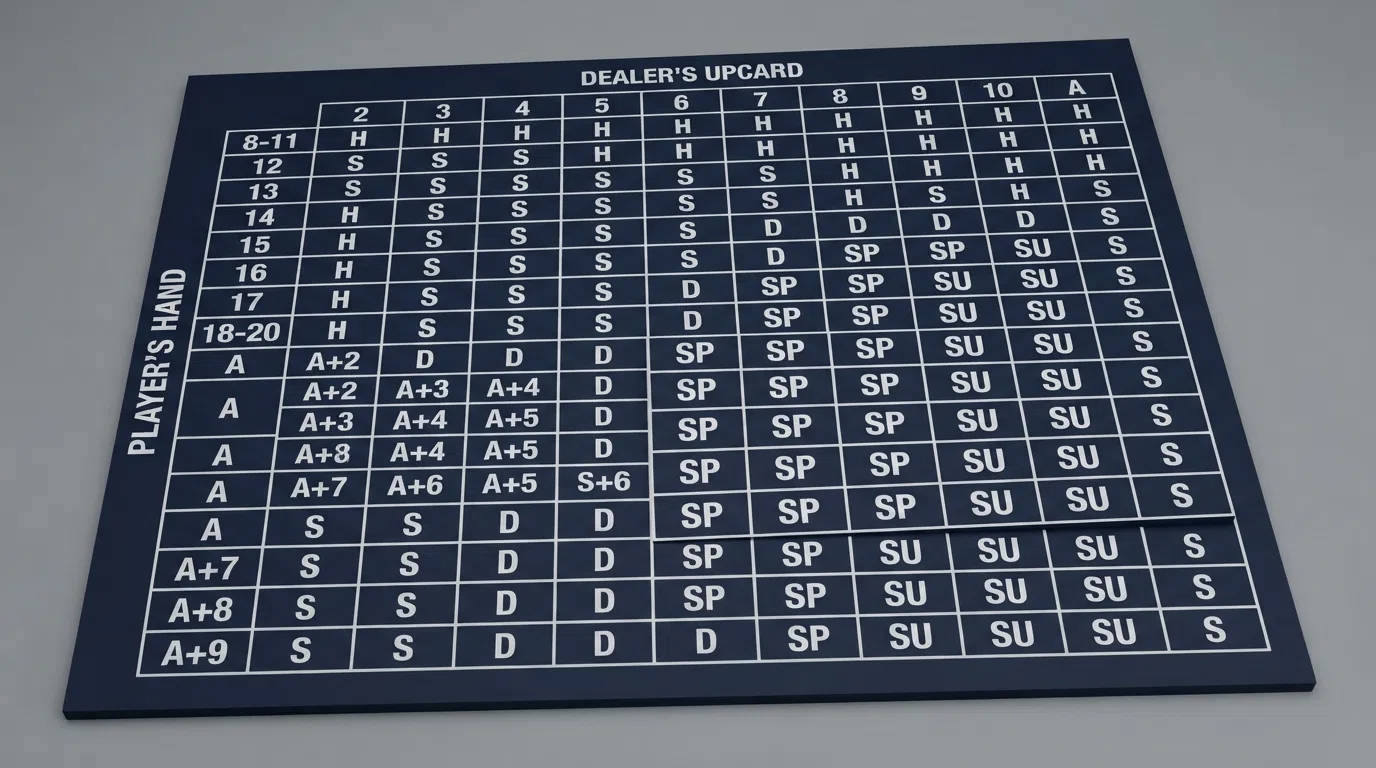
The figure is well-established. Playing every hand mathematically correctly cuts the house edge to roughly 0.5% or lower — better odds than almost any other game on the casino floor. Without basic strategy, the house edge on a standard six-deck S17 game rises to around 2% or higher, depending on how poorly the player deviates from optimal. The difference is structural, not motivational: basic strategy is the lookup table that tells the player the single correct play for every combination of player hand and dealer upcard, derived from combinatorial analysis of every possible draw sequence.
The second-most-important number is the 3:2 versus 6:5 payout ratio. A natural at 3:2 pays £15 on £10, whereas 6:5 yields only £12. This 1.39% increase in house edge dwarfs the value of any strategic concession at a 3:2 table, and the losses aggregate significantly over hundreds of hands.
Basic Strategy: The Chart That Cuts the House Edge Below 0.5%
Basic strategy is not a system, a belief or a hunch. It is a lookup table derived from millions of simulated hands, telling the player the single correct play for every combination of player hand and dealer upcard. The rows are the player’s hand — hard totals, soft totals, pairs — and the columns are the dealer’s upcard. The cell at each intersection is the action: hit, stand, double down, split or surrender. The table is colour-coded in print versions for quick reading at the felt.
The derivation is combinatorial. Every possible hand composition is enumerated, every possible dealer draw sequence is computed, and the action that maximises expected value is the action the chart prescribes. There is no judgment, no hunch and no “feeling” about the dealer’s next card — the chart is the math, frozen into a lookup table.
Using the chart at a live online table is legal and encouraged. There is no pit boss to confiscate the card and no rule against referencing a strategy chart. A player who opens a basic strategy chart on a second screen and consults it on every decision is playing closer to the theoretical edge than a player who plays from memory, and the time taken to consult the chart costs nothing — the decision clock at most live blackjack tables runs longer than the time it takes to read one cell.
The house edge with perfect basic strategy on a standard six-deck S17 game is around 0.40% to 0.50%. Without basic strategy, the edge rises to 2% or higher depending on the deviations. The gap between the two is the value of the chart — and it is real money at every stake level.
Blackjack Odds, Payouts & Why 3:2 Is the Hill Worth Dying On
A standard six-deck blackjack game with dealer stands on soft 17, the player using perfect basic strategy, has a theoretical RTP of approximately 99.54%. The 0.46% house edge is the lowest of any standard casino table game on the floor. The edge comes from the dealer’s turn order — the player acts first and busts before the dealer draws — and from the natural’s 3:2 payout that gives the player a structural advantage on the first two cards.
The 3:2 payout is the figure that holds the edge together. A natural pays £15 on a £10 bet at a 3:2 table; the same hand pays £12 on a £10 bet at a 6:5 table. The difference is £3 on every natural, and naturals occur roughly once every 21 hands. The cumulative loss over a session of several hundred hands is several hundred pounds at typical stakes, which is why a 6:5 table is the table a basic-strategy player walks past.
The deck count and dealer rule shift the edge. Eight-deck shoes have a slightly higher edge than six-deck. S17 has a slightly lower edge than H17. The standard six-deck S17 game is the configuration a basic-strategy chart is derived against, and deviations from that configuration require the chart to be re-derived for the specific game being played.
The expected loss per hour is the practical figure. A player dealing 80 hands per hour at £5 per hand on a 0.5% edge is committing £400 per hour to wagering, with an expected loss of £2 per hour. The same player at £25 per hand on a 1.5% edge at a 6:5 table is committing £2,000 per hour to wagering, with an expected loss of £30 per hour. The stake level and the table rules together determine the cost of the session.
Can You Beat the Casino at Blackjack? Card Counting, Myths & the Reality in 2026
Card counting works in principle. A counter tracks the ratio of high cards to low cards remaining in the shoe, raises the stake when the ratio favours the player and drops the stake when it favours the dealer. The edge from a well-executed count at a favourable game is real but small — typically 0.5% to 1.5% over the house edge — and the bankroll required to ride the variance is several hundred times the average bet.
Card counting does not work in online live-dealer blackjack. The shoe is reshuffled between rounds or replaced by a continuous-shuffle machine, and the penetration — the proportion of the shoe that is dealt before a reshuffle — is too shallow for the count to reach significance. The structural features that make live dealer blackjack trustworthy for the player — the physical shoe, the visible cards — are the same features that make it unviable for the counter. The game is unbeatable in any long-run sense at any stake level a casual player can afford.
Betting systems — Martingale, Fibonacci, Labouchere — do not change the house edge. They change the distribution of outcomes: a Martingale player experiences more small wins and occasional catastrophic losses; a flat-betting player experiences a steady drip of expected loss. The expected value is the same; the variance is different. A player who believes a betting system beats the house is confusing the variance profile with the edge, and the distinction matters when the bankroll runs out.
What actually works is game selection and discipline. A basic-strategy player at a 3:2 S17 table is playing the lowest-edge game in the casino. Walking away when ahead, refusing to chase losses and declining side bets are the three behavioural disciplines that protect the bankroll. None of them beat the house edge, but all of them keep the player at the table long enough to enjoy the session.
UK Blackjack Casino Bonuses in 2026: What the 10x Cap Means for Your Welcome Offer
The December 2025 wagering cap rewrote every UK casino bonus. Before 19 December 2025, 30x and 40x wagering on bonus funds was standard; after that date, the LCCP Social Responsibility Code 5.1.1 hard-capped wagering at 10x and banned mixed-product promotions entirely. The cap cut the cost of clearing a bonus by more than two-thirds at the headline level, but the live casino contribution rate — typically 0% to 10% — still makes any deposit-match bonus a slow grind on blackjack.
The commercial context is the Remote Gaming Duty rise. From 1 April 2026, RGD doubled from 21% to 40% on operators’ gross gambling yield, announced at Autumn Budget 2025 on 26 November 2025. Operators have less margin to fund generous bonuses, and the headline sizes on welcome offers have shrunk accordingly. The trade-off is fairer terms: a 10x wagering requirement with no cap on winnings, as PartyCasino runs, is a structurally better offer than a 40x wagering requirement with a £100 cap, even though the headline match amount is smaller.
Welcome & Deposit-Match Bonuses: What UK Blackjack Players Actually Get
A deposit match looks generous on the landing page and shrinks fast when the player reads the game-weighting table. Slots contribute 100% to wagering at every UK operator; table games contribute 10%; live casino contributes 0% to 10% depending on the operator and the specific game. A £100 deposit match at 10x wagering requires £1,000 of qualifying turnover; a live-only player clearing the same bonus at a 10% contribution rate is committing £10,000 of live blackjack turnover to the same goal.
The cashout caps are buried in the terms. 888 caps bonus winnings at £100; Grosvenor caps at £2,000; PartyCasino sets no cap. The cashout cap is the figure that determines what a player can actually walk away with, and the difference between £100 and “no cap” is the difference between a tightly-bounded offer and an open-ended one.
The validity windows run 30 to 90 days. 888 runs 90 days; PartyCasino and Grosvenor run 30 days; Betway runs 7 days from registration. The shorter the window, the faster the player must grind the bonus out — and the more likely the bonus becomes a cost rather than a benefit.
No-Deposit Offers & Free Spins: What Is Actually Available at UK Live Blackjack Casinos
Genuinely deposit-free offers exist. Paddy Power’s 60 no-deposit free spins are the standout — 50 on selected slots plus 10 on an exclusive live roulette title called Mansion Heist, with no wagering on winnings and no deposit required. The offer is open to UK and Ireland customers and is the only no-deposit entry point in the featured set.
Free spins that require a deposit are more common. Bet365 offers up to 500 spins released in 10 daily batches over 20 days at £0.10 per spin, no wagering on winnings, on a minimum £10 lifetime deposit. Betway offers 125 spins on Big Bass Bonanza (RTP approximately 96.71%) over 5 days at £0.10 per spin, no wagering on spin winnings, on a minimum £10 deposit. 888 offers 200 spins at £0.10 per spin with a £50 cap on withdrawable winnings, on a minimum £10 deposit.
Free spins target slots, not blackjack. Every free-spin welcome offer in the featured set runs on slot titles; Mansion Heist is the only non-slot allocation, and Mansion Heist is a live roulette title, not a blackjack table. A blackjack-first player taking a free-spin welcome is taking the offer as a small sweetener rather than as a primary reason to sign up.
Free spins with no wagering requirements represent a competitive leap forward. By eliminating playthrough mandates, operators ensure that winnings from these spins are yours to keep immediately, creating a transparent benefit without hidden game-weighting barriers.
The 10x Wagering Cap: How the 2026 Rules Changed Every Bonus You See
Before 19 December 2025, 35x and 40x wagering requirements on bonus funds were standard at UK-licensed casinos. A £100 bonus at 35x wagering required £3,500 of qualifying turnover; the same bonus at 40x required £4,000. A player clearing the bonus on live blackjack at a 10% contribution rate was committing £35,000 to £40,000 of live blackjack turnover — a figure that no reasonable session would ever cover.
The LCCP Social Responsibility Code 5.1.1 change on 19 December 2025 set the wagering cap at 10x and banned mixed-product promotions. The £100 bonus at 10x requires £1,000 of qualifying turnover; the live-only player at 10% contribution commits £10,000. The improvement is real but still substantial — a live-only player is still grinding out an order of magnitude more wagering than a slots player to clear the same bonus.
The Remote Gaming Duty rise from 21% to 40% from 1 April 2026, announced at Autumn Budget 2025 on 26 November 2025, is the commercial context. Operators have less margin to fund generous bonuses; the headline match sizes have shrunk accordingly. The 10x cap is the regulator’s ceiling on player cost; the RGD rise is the Treasury’s floor on operator margin. The two together explain the current bonus landscape — smaller headline offers, fairer terms.
Free Blackjack & Demo Mode: Practise Before You Deposit a Penny
Free-play blackjack is the cheapest education in the casino. It costs nothing, teaches basic strategy and exposes the variants without risk. The one thing it cannot teach is the emotional weight of a real-money decision — and that is the gap the player closes with a small first deposit, not with another thousand demo hands.
Demo mode runs at UK-licensed casino sites on the RNG blackjack tables, not the live dealer tables. The studio cost per hour of running a live dealer table is real, and most operators reserve live blackjack for real-money play. The RNG demo tables — typically in the table-games lobby under a “demo” or “play for free” toggle — give the player the same rules, the same interface and the same theoretical RTP as the real-money tables, with a play-money balance that resets on reload.
The rules and RTP transfer. A standard six-deck S17 blackjack game has a theoretical RTP of approximately 99.54% with perfect basic strategy, and that figure is the same whether the cards are dealt by a random number generator or by a dealer in a studio. The strategy a player learns in demo mode is the strategy they will use in real-money play; the decision chart is portable.
Where to Find Free Live Blackjack Tables in the UK
Free live dealer blackjack is rare. The studio cost is real, the dealer wages are real and the camera infrastructure is fixed; operators who run live tables run them for real-money play. Most Evolution, Playtech and Pragmatic Play Live tables at UK-licensed casinos are real-money only, and the player who wants to practise live blackjack specifically without spending money is looking at a very short list of options.
Free RNG blackjack is widely available. The same UK-licensed casino sites that run live dealer tables for real money typically run RNG blackjack tables in demo mode, accessible from the table-games lobby without registration on many sites. The rules, interface and theoretical RTP are identical to the real-money RNG tables — the only difference is whether the stakes are real or play-money.
The strategy transfer is complete. A player who learns basic strategy on a free RNG blackjack table can apply the same strategy at a live dealer table with no loss of edge. The differences are in pace and social texture — RNG is faster, live is slower and chat-enabled — not in the math. The player who wants to practise the math practises on RNG; the player who wants to practise the feel plays one session at a live table with a small stake.
What Practice Can (and Cannot) Teach You About Real-Money Blackjack
Demo mode drills the mechanics. Basic strategy recall — the player’s hand on one axis, the dealer’s upcard on the other, the action at the intersection — becomes automatic after 200 or 300 hands. Variant rules become familiar — Infinite Blackjack’s unlimited seats, Free Bet Blackjack’s house-funded doubles, Power Blackjack’s unlimited doubling — and the interface buttons become muscle memory. Decision speed improves. The chart is consulted less often. The decisions happen.
Demo mode does not teach the emotional layer. Loss aversion — the feeling of a losing hand at stake — does not exist in play-money mode. Tilt — the chasing of losses with bigger bets — does not manifest because the bets are not real. Bet-sizing under pressure — the discipline of holding the stake constant across sessions — does not develop because there is no bankroll to manage. Session management — the decision to walk away when ahead or when the time limit expires — is not exercised because the demo session has no end condition beyond the player’s patience.
The recommended practice routine is short. Twenty to thirty hands of basic strategy drill before the first deposit is enough to lock in the chart’s most common cells — the standing and hitting decisions that come up on roughly two-thirds of hands. The remaining one-third — the doubles, splits and surrenders — comes up less often and benefits from a longer drill, but the player’s bankroll covers more practice at a £1 minimum table than at a demo table.
The GamCare National Gambling Helpline received 55,228 calls and online chats in 2023–24, a 25% year-on-year increase. In January 2026, 996 referrals to treatment were made, up 48% from a year earlier. The figures are the context for why real-money discipline matters — the helpline exists because the gap between what players think they will do and what they do under real-money pressure is real, and the player who takes the gap seriously is the player who sets a deposit limit before the first deposit and walks away when the time limit expires.
How to Pay at UK Live Blackjack Sites: Deposits, Withdrawals & Why Crypto Is Not an Option
UK blackjack banking is straightforward by design. Cards, e-wallets and bank transfers cover the practical needs; credit cards are banned; crypto is absent from the licensed market; and the deposit-limit prompt is now mandatory before the first deposit clears. The constraints are consumer protections, not limitations on the player’s choice.
The credit-card ban has been in force since 14 April 2020. LCCP licence condition 6.1.2 prohibits credit card payments for any remote gambling transaction, including credit-card-funded payments through e-wallets. A player who tries to fund a deposit with a credit card is declined; a player who tries to fund a Skrill account with a credit card and then deposit from Skrill is also declined. Debit cards, PayPal, Neteller, Skrill and bank transfer are the realistic options at every GB-licensed operator.
The deposit-limit prompt is mandatory before the first deposit. Since 31 October 2025, operators must prompt customers to set a financial limit before the first deposit; from 30 September 2026, a standardised gross deposit limit must be offered with at least equal prominence in the cashier. A decrease in the deposit limit takes effect immediately; an increase has a 24-hour cooling-off period.
The ID verification requirement is in force before any deposit. Since 7 May 2019, a remote licensee must verify the customer’s name, address and date of birth before any deposit or gambling can take place. The 72-hour grace period that previously allowed anonymous play has been removed; the verification step is now the first thing a new player completes.
Deposit Methods: Debit Cards, PayPal & E-Wallets at UK Blackjack Casinos
Debit cards are universal. Every featured operator accepts Visa and Mastercard debit; deposits are instant, no fees from the casino side, and the funds clear into the cash balance within seconds. The minimum deposit across the featured set is £10, set at every operator except Grosvenor (£20) and Paddy Power’s £10 threshold on the deposit-triggered welcome offer.
PayPal is widely accepted. The added layer between the bank account and the casino — PayPal acts as an intermediary wallet — means withdrawals route back through PayPal rather than to the debit card, and the withdrawal speed is typically faster than card-based withdrawals. PayPal is excluded from Grosvenor’s welcome offer but accepted for general deposits and withdrawals.
Other e-wallets are narrower. Neteller and Skrill are accepted at most operators but excluded from the welcome offers at 888 Casino, Grosvenor Casinos and PartyCasino. The exclusion is bonus-specific — a player can deposit via Skrill and play real-money blackjack, but the welcome bonus will not credit on a Skrill deposit. Bank transfer is the slow option, used for larger deposits that exceed card or e-wallet limits, with minimums typically higher and processing times measured in days.
Debit cards offer a straightforward, secure deposit method that avoids the complications and welcome-offer exclusions associated with specific e-wallets like PayPal, Skrill, or Neteller.
Bitcoin, Crypto & Blackjack: Why UK-Licensed Casinos Do Not Offer It
No GB-licensed casino accepts cryptocurrency. The UKGC’s licence conditions require fiat-currency transactions with anti-money-laundering and know-your-customer compliance that cryptocurrency cannot satisfy at scale, and no operator has built a regulated crypto-on-ramp that satisfies the regulator. A player searching for “Bitcoin blackjack UK” or “crypto blackjack UK” lands on offshore sites operating outside the GB licence regime — sites that the UKGC has no jurisdiction over and that the player has no UKGC protection on.
What a player gives up at an unlicensed crypto blackjack site is the entire GB consumer protection stack. No GAMSTOP — the national self-exclusion scheme is integration-bound to GB-licensed operators, and an offshore site does not appear in the system. No UKGC complaints route — the regulator’s enforcement powers stop at the GB border. No ADR — the alternative dispute resolution providers are licensed by the regulator and do not cover unlicensed operators. No deposit-limit protections — the mandatory financial-limit prompt is an LCCP condition, not a universal rule. No financial-vulnerability checks — the £150 net deposit trigger is also an LCCP condition.
The criminal status sits with the operator. Providing facilities for gambling without the required licence is a criminal offence under section 33 of the Gambling Act 2005, carrying up to 51 weeks’ imprisonment, an unlimited fine, or both. The player has not been prosecuted for using an unlicensed site, but the absence of GB protection is the risk a player accepts when signing up.
The UKGC’s enforcement figures underline the regulatory posture. Between April 2024 and June 2025, the regulator took 208,088 enforcement actions against illegal online gambling and referred 447,778 URLs to search engines for delisting. Across 160 disrupted sites, engagement fell by an average of 32%. The regulator is actively pursuing unlicensed operators; the player’s protection is to stay inside the licensed market.
Mobile Live Blackjack: Apps, Browsers & Playing on the Move
Live blackjack on a phone is not a compromise. The same Evolution tables, the same stakes, a touch-optimised interface, and no download required unless the player wants the app. The stream is HTML5 and works on iOS and Android in the mobile browser without any installation.
The two paths to mobile play are the browser and the app. The mobile browser loads instantly, requires no download, always runs the latest version of the operator’s site, and gives access to every game the desktop site offers. The native casino app — installed from the App Store, Google Play or in some cases as a direct-download APK due to Play Store restrictions on real-money gambling apps — adds biometric login, push notifications for promotions and live-table openings, and sometimes faster stream loading.
Bet365’s app and browser both support the full live blackjack product, including the branded Bet365 Live tables and the full Evolution portfolio. A player who plays live blackjack on the train can switch between the two without losing the seat or the session.
How to Choose a Safe UK Blackjack Casino: Trust, Stakes & What Reviews Miss
A casino can be licensed and still be a bad fit. The licence is the floor, not the ceiling, and beyond it sit table limits, game selection and withdrawal terms that determine whether the player stays. A review that does not check those three things has described a casino without judging it.
The non-negotiable safety checks are three. UKGC licence verification against the public register, GAMSTOP registration as the litmus test for an unlicensed site, and HTTPS / PCI compliance for data and payment security. The first two checks take two minutes and eliminate every unlicensed operator in one pass.
The review landscape is a structural problem. Affiliate incentives and undisclosed commercial relationships drive many of the comparison sites that rank highly in search results, and the rankings they produce often reflect revenue share rather than product fit. A reader who takes a comparison site at face value is taking the site’s word for the operator’s merits, and the site’s word is not independent.
The Non-Negotiables: UKGC Licence, GAMSTOP & Data Safety
The UKGC public register is the first check. The register at gamblingcommission.gov.uk lists 2,663 licensed gambling business records, last updated 29 July 2026. Search by operator name or licence number; confirm the licence is active and covers remote casino; confirm the licence holder matches the trading name on the site footer. The check takes thirty seconds and is dispositive — a site that is not on the register is unlicensed.
GAMSTOP registration is the second check. A site that does not appear in the GAMSTOP system is operating without a GB licence. GAMSTOP has been mandatory for every GB-licensed online operator since 31 March 2020; a site that does not enforce the GAMSTOP blocks is a site without a GB licence, and the player leaves immediately. The Gambling Commission logo on a site footer means nothing without the register check — unlicensed sites fake it routinely.
Data safety is the third check. HTTPS in the address bar, PCI compliance for card payments, and two-factor authentication availability for account login are the standard. A site that fails on any of these is a site that fails on consumer protection, and the player does not need to investigate further to decide.
The UKGC’s enforcement posture is the context. The regulator’s 208,088 enforcement actions against illegal online gambling, the 447,778 URLs referred to search engines for delisting, and the 32% engagement drop across 160 disrupted sites are the figures that describe what the regulator is doing about unlicensed operators. The player who stays inside the licensed market is protected by all of it.
Stakes, Bankroll & Table Limits: Finding the Right Blackjack Table for Your Budget
The table the player can afford and the table the player should play are two different things. A £1 minimum on a 6:5 table costs more long-term than a £5 minimum on a 3:2 S17 table. The stake level sets the session cost; the table rules set the edge; the combination sets the expected loss.
Bet365’s stake range — £1 minimum at the standard tables to £20,000 maximum in the VIP rooms — is the widest in the featured set and a useful bracket for the spectrum. A casual player with a £100 session bankroll plays the £1 tables; a serious player with a £1,000 bankroll plays the £5 or £10 tables; a high roller with a £10,000+ bankroll plays the £100+ tables and routes into the VIP rooms.
The 50-to-100-hand rule is a useful bankroll sizing benchmark. A session bankroll should cover at least 50 minimum bets at the chosen table, and ideally 100. A player with a £100 bankroll on a £1 table has 100 hands of buffer; the same player on a £5 table has 20 hands of buffer and is at risk of busting the bankroll before the variance has played out.
The table rules matter more than the stake level. A 3:2 S17 table at £5 is a better long-term proposition than a 6:5 S17 table at £1. The 1.39 percentage point edge difference between 3:2 and 6:5 is larger than the entire basic-strategy discount on the 3:2 table, and the difference compounds over hundreds of hands. A player who walks past a 6:5 table to find a 3:2 table is making the right move regardless of stake level.
UK Licensing, GAMSTOP & the Rules That Protect Every Blackjack Player
The UK has the most regulated online gambling market in the world. Every rule on this page exists because the Gambling Commission wrote it, and every one of them protects the player, not the operator. The framework is dense, and the density is the point — consumer protection in gambling is built out of overlapping obligations, not single safeguards.

The Gambling Commission is the single statutory regulator for Great Britain (England, Scotland and Wales). It licenses operators, personnel and software under the Gambling Act 2005, extended to remote operators by the Gambling (Licensing and Advertising) Act 2014 point-of-consumption reform. A GB licence is compulsory for any operator serving GB customers, wherever the operator is based. The three licensing objectives under section 1 of the Act are preventing crime, ensuring gambling is fair and open, and protecting children and other vulnerable persons.
The working instruments are the LCCP (Licence Conditions and Codes of Practice) and the RTS (Remote Technical Standards). The LCCP sets the social responsibility codes and licence conditions; the RTS sets the technical standards for remote gambling. Both are updated regularly, and the updates land as numbered codes — SR Code 5.1.1 for the wagering cap, SR Code 3.4.4 for the vulnerability checks, RTS 12 for the deposit-limit regime. A player who wants to verify a specific rule can find it on the UKGC’s website by code number.
Northern Ireland is separate. The Gambling Act 2005 does not cover Northern Ireland; the regime is older and different. A player in Belfast faces a different regulatory framework than a player in Birmingham. The distinction matters for cross-border licensing but does not change the GB-licensing requirement for any operator serving GB customers.
What a GB Operating Licence Actually Means for You
A UKGC licence is not a certificate on a wall. It is a living set of conditions that governs every deposit the player makes, every hand the player plays and every withdrawal the player requests. The conditions sit in the LCCP and the RTS and are enforced through ongoing compliance checks, mystery shopping, financial reporting and player-complaints investigation.
The three licensing objectives are the test. Every licence condition and code of practice traces back to one of the three objectives: preventing crime, ensuring fair and open gambling, and protecting children and vulnerable persons. A condition that does not serve one of the three objectives is not in the LCCP; a condition that does is enforceable.
The operator obligations are substantive. Segregated player funds — the requirement that customer balances be held in accounts separate from the operator’s operating funds — protect the player’s money if the operator becomes insolvent. Fair-game RTP verification — the requirement that every published RTP be independently tested — protects the player from rigged games. Complaints handling via ADR — the requirement that unresolved complaints route to an alternative dispute resolution provider — gives the player a path when the operator’s customer service fails. The minimum age of 18 and the pre-deposit ID-verification requirement since May 2019 close the anonymous-play loophole.
The point-of-consumption reform is the structural change. Before the Gambling (Licensing and Advertising) Act 2014, a remote operator could serve GB customers from Malta, Gibraltar or the Channel Islands without a GB licence. After 2014, a GB licence is compulsory for any operator serving GB customers, wherever the operator is based. The reform closed the offshore loophole for the licensed market; the unlicensed market continued, and the regulator’s enforcement figures describe the ongoing pursuit.
GAMSTOP, Self-Exclusion & Deposit Limits: The Safety Net
GAMSTOP is the emergency brake. The national self-exclusion scheme has been mandatory for every GB-licensed online operator since 31 March 2020. Registration is free, online and available to anyone living in the UK (Great Britain and Northern Ireland). The blocks take up to 24 hours to become effective across all integrated operators, and the exclusion cannot be cancelled early.
The four exclusion periods are 6 months, 1 year, 5 years or 5 years with auto-renewal. A player who registers for 6 months and changes their mind at month 3 cannot cancel the exclusion — the period runs to completion. A player who registers for 5 years with auto-renewal extends the exclusion indefinitely until they choose to opt out at the end of the period. The no-early-cancellation rule is the structural feature; it is what makes the exclusion an effective brake rather than a paper commitment.
The operator-side obligation is integration. Every GB-licensed online operator must be integrated with GAMSTOP and must check every customer against the GAMSTOP database before allowing gameplay. An operator that does not integrate is operating without a GB licence; a customer who tries to play on an unlicensed site is unprotected by GAMSTOP because the site is not part of the system.
The deposit-limit regime is the other safety net. The financial-limit prompt before the first deposit has been mandatory since 31 October 2025; the standardised gross deposit limit with at least equal prominence in the cashier takes effect from 30 September 2026. Decrease requests take effect immediately; increase requests have a 24-hour cooling-off period. The financial-vulnerability check at the £150 net deposit mark in a rolling 30-day period has been mandatory since 28 February 2025, using publicly available data on County Court Judgments, Individual Voluntary Arrangements and bankruptcy orders.
Financial risk assessments — affordability checks — are announced but not yet commenced. The UKGC Board on 7 July 2026 confirmed a staged rollout with Stage 1 thresholds of £5,000 net deposits in 24 hours for players aged 25 and over and £2,500 for players under 25. Final thresholds are £1,000 to £3,000 for the over-25s and £750 to £2,000 for the under-25s. The start date has not been confirmed in formal consultation; reports that the checks are “in force” are premature.
Problem Gambling: The Numbers, the Helplines & Where to Get Help
- GamCare National Gambling Helpline — 55,228 calls and online chats in 2023–24, a 25% year-on-year increase. In January 2026, 996 referrals to treatment and peer-based support were made, up 48% from a year earlier. 81.5% of contacts cited online gambling, a five-year high.
- GambleAware Annual Treatment and Support Survey — 13.1% of GB adults (approximately 6.8 million) classified as experiencing any level of gambling problems under the Problem Gambling Severity Index (PGSI 1+).
- Gambling Survey for Great Britain Year 3 (2025) — 47% of adults gambled in the past four weeks (27% excluding lottery draws), with 38% gambling online and 28% in person. The PGSI breakdown: 8.8% PGSI 1–2, 3.1% PGSI 3–7, 2.7% PGSI 8+.
- NHS gambling harm clinics — available in England, Scotland and Wales. Referral through GP or self-referral through the NHS website.
- Gamblers Anonymous — peer-support meetings across the UK, modelled on the 12-step recovery framework.
- Operator-side session time and loss display — mandatory since 31 October 2021 under RTS, showing every player their session time, total staked, total won or lost in real time on screen.
- Marketing opt-ins unticked by product and channel — mandatory since 1 May 2025 under LCCP SR Code 5.1.12. Operators must present marketing choices as unticked opt-ins, separated by product (betting, bingo, gaming) and by channel.
How We Evaluated and Ordered the Top Live Blackjack Sites
Every operator on this page passed the same filter. Active GB operating licence, verified against the UK Gambling Commission’s public register; live-dealer blackjack product depth, measured by table count, provider quality and stake range; welcome-bonus fairness, measured by wagering multiplier, game contribution rate and cashout caps. Operators without an active GB licence, without a live blackjack product or without verifiable bonus terms were excluded from the ranking by design.
The ranking reflects live-blackjack product depth first, welcome-bonus fairness second and regulatory track record third. Where two operators sit at similar positions on the first two criteria, the third breaks the tie. The UKGC public register — 2,663 licensed gambling business records, last updated 29 July 2026 — was the verification source for licence status on every operator in the ranking.
The 10x wagering cap under LCCP SR Code 5.1.1 was the bonus-fairness benchmark. Any bonus with a wagering multiplier above 10x would have been excluded; every bonus in the ranking sits at 10x or below, with the free-spin offers at 0x. The bonus-fairness filter is what excludes the older 30x and 40x wagering offers that some affiliate pages still list for operators whose terms have since updated.
The sources used were the UKGC public register, the operators’ own websites for live blackjack product details, and a curated set of affiliate and editorial sources for cross-verification. GamCare and GambleAware provided the responsible-gambling statistics; HMRC and the UKGC provided the regulatory facts. No commercial relationship existed between this page’s authors and any operator in the ranking.
What was not weighted: market share, brand recognition or heritage. William Hill and Ladbrokes have larger brand recognition than bet365 and Betway on the high street, but the live blackjack product depth is the same or smaller, and the ranking reflects product depth rather than brand history. A player who values brand recognition can find those operators in the ranking; the order is not a brand-prominence ordering.
The Table Is Open: What You Should Actually Do Next
The single most important action is small. Pick one GB-licensed operator from the comparison table. Register. Set a deposit limit before the first deposit clears. Open a basic strategy chart on a second screen. Play one session of low-stakes blackjack — £1 a hand at bet365 is the lowest-cost entry point in the featured set — and stop when the time limit or the loss limit expires.
The reason the action is small is that the strategy is learned in hands, not in articles. Twenty to thirty hands of basic strategy drill before the first deposit is enough to lock in the most common cells of the chart. Another hundred hands at a £1 minimum table buys the rest. A player who has read the chart once and played fifty hands at £1 per hand has invested £50 in a skill that pays off for the rest of their blackjack-playing life.
The deposit-limit discipline is non-negotiable. The prompt is there because the regulator mandated it; taking it seriously is the first piece of real-money discipline a player builds. A decrease takes effect immediately; an increase has a 24-hour cooling-off period; the limit sits as a ceiling the player cannot exceed by accident. The session-timer and loss display mandated since October 2021 are the player’s ally during the session itself — every minute and every pound is visible on the screen.
The session boundary matters more than the stake level. A player who decides in advance to walk away after 60 minutes or after losing £50 is a player who controls the session rather than the session controlling them. The decision is made before the first hand, when the bankroll is intact and the variance has not yet played out. After the first losing streak is not the time to decide the stop-loss; that is the time the stop-loss has already done its job.
Pick a licensed operator, set your limits, open a basic strategy chart and play one session. The rest is experience.
Frequently Asked Questions
How do I start playing live dealer blackjack online for real money?
Choose one GB-licensed operator from the comparison table and register with your real name, address and date of birth — UKGC rules require identity verification before any deposit since 7 May 2019. Set a deposit limit when prompted, deposit at least £10 via debit card or PayPal, open the live casino lobby, and take a seat at a table whose minimum bet fits your bankroll. The first hand deals within a minute of the betting window opening.
How much does the house edge actually cost — and can basic strategy reduce it?
A standard six-deck blackjack game with dealer stands on soft 17 carries a house edge of around 0.40% to 0.50% under perfect basic strategy. Over a session of 200 hands at £5 per hand, that is roughly £4 to £5 of expected loss. Without basic strategy, the edge rises to around 2% — a £20 expected loss over the same session. The chart is the difference, and it is downloadable as a one-page reference for use at the table.
What is GAMSTOP and what happens if I self-exclude from online blackjack?
GAMSTOP is the UK’s national online self-exclusion scheme, free to register and mandatory for every GB-licensed operator since 31 March 2020. You choose an exclusion period of 6 months, 1 year, 5 years or 5 years with auto-renewal; the blocks take up to 24 hours to activate across all integrated operators; and the exclusion cannot be cancelled early. The 24-hour delay and the no-early-cancellation rule are the structural features that make GAMSTOP an effective brake.
How have the 2025–2026 UK wagering rule changes affected blackjack bonuses?
The 19 December 2025 LCCP Social Responsibility Code 5.1.1 hard-capped wagering requirements at 10x on bonus funds and banned mixed-product promotions entirely. Pre-cap welcome offers at 30x to 40x wagering have been replaced by offers at 10x or below, with the wager-free free-spin welcome now standard at half the featured set. The 40% Remote Gaming Duty rise from 1 April 2026 is the commercial context for the smaller headline sizes that accompanied the fairer terms.
How does live dealer blackjack compare to computer-dealt RNG blackjack?
The rules and theoretical RTP are identical — both versions of a standard six-deck S17 blackjack game return approximately 99.54% with perfect basic strategy. The differences are in pace and texture: RNG blackjack deals instantly and runs several hundred hands per hour with no social layer, while live dealer blackjack moves at the dealer’s pace with chat interaction and a typical 70 to 100 hands per hour. The live format costs more per hand in studio time, which is why minimum bets tend to be higher; the trust the cards are physically dealt is what the live format sells.
What Is a Live Blackjack Online Casino?
The setup is three pieces. A physical studio (or, at Grosvenor, an actual casino floor) with cameras mounted above and around a blackjack table. A dealer standing behind the table running the shoe, paying winners and chatting with players in the live text box. A betting interface overlaid on the video feed where the player places chips, makes decisions and watches the round settle. The shoe is real, the cards are real and the dealing happens in real time — no algorithm in the loop.
The provider builds and runs the studio. Evolution Gaming is the dominant UK supplier, with Playtech and Pragmatic Play Live as the secondary options; operators like bet365, Betway and 888 Casino wire those feeds into their own branded lobbies and add the cashier, the verification flow and the bonus terms. The split between supplier and operator is invisible to the player but matters commercially — a casino cannot build a live-dealer studio on its own, so its live blackjack product is, in practice, a license of someone else’s infrastructure.
How a hand plays out, end to end: the player logs in, opens the live casino lobby, picks a blackjack table whose stake range fits the bankroll, places a chip, waits for the deal, clicks hit or stand as the cards come up and watches the dealer settle the round. There is no pause button. The shoe moves at the dealer’s pace and the table’s decision clock — typically a few seconds per player — governs the rhythm of play.
Blackjack Casino Apps vs Mobile Browser: Which Works Better?
The browser loads instantly and plays every table. No storage, no install, no updates, no compatibility issues — the HTML5 stream that Evolution, Playtech and Pragmatic Play Live all use is built for the mobile browser and runs natively on iOS and Android. Every game the operator offers on desktop is available on mobile browser, with a touch-optimised interface that places the betting controls and the decision buttons within thumb reach.
The app remembers the login and sends a notification. Biometric login — fingerprint or face — removes the password entry step. Push notifications alert the player to promotions and live-table openings that the browser does not surface. Offline account access — viewing the transaction history and the bonus balance without an active session — is a small but useful feature. The app sometimes loads the live stream faster than the browser, because the cache is local.
The download process varies. App Store and Google Play are the standard paths on iOS and Android, but Google Play’s restrictions on real-money gambling apps mean some operators distribute their Android apps as direct-download APK files from their own sites. The direct download requires the player to enable installation from unknown sources in Android settings — a friction point the browser path does not have.
The practical recommendation: try the browser first. A player who finds themselves logging in three or four times a week can install the app; a player who logs in once a month has no reason to give up the storage space. The browser is the lower-commitment option, and the live blackjack product is identical on both paths.
Live – realmoney-onlinecasinos-uk
Content created by the «realmoney-onlinecasinos-uk» team