
Best Offshore Casino Sites for UK Players Compared in 2026
 Available in GB
A UK player typing “best offshore casino sites” is usually trying to get past something. Past the £5 maximum stake that landed in April 2025. Past the GAMSTOP exclusion that the casino on the high street now enforces. Past the 10× wagering cap that took effect in December 2025 and the row of features — auto-play, fast spin, loss-disguised-as-wins — that the British regulator removed from the product on 31 October 2021. The offshore casino exists because the British one has been progressively pared back, and the comparison on this page sits inside that gap: ten operators, nine licensed in Britain, one under Curaçao, and the question of what is actually gained and given up at each.

Updated against current Gambling Commission and operator terms as of September 8, 2026.
What an Offshore Casino Is — and Why UK Players Use Them
An offshore casino is, in plain terms, a gambling site that takes UK customers without holding a British licence. The distinction is jurisdictional, not geographical: a company can be headquartered in London and still be offshore if it lacks the Gambling Commission’s operating licence, just as a company on the Dutch Antilles can be “British-facing” if it is licensed in Britain. The test is whether the Gambling Commission lists the operator on its public register. If it does not, the casino is offshore for the purposes of a UK player. That single fact governs everything else on this page: which protections apply, which do not, and where a complaint can be sent when something goes wrong.
What “Offshore Casino” Actually Means
The framework is the Gambling Act 2005, extended to remote operators by the Gambling (Licensing and Advertising) Act 2014. The 2014 reform introduced a point-of-consumption rule: any operator serving customers in Great Britain needs a UKGC licence, wherever the company is incorporated. A casino licensed in Curaçao, Gibraltar, Anjouan or Costa Rica can still be legitimate in its own jurisdiction; it is not legitimate in Britain. The word “offshore” and the word “illegal” are not quite synonyms. The Commission’s own framing distinguishes unlicensed operators from unlicensed *trading* — the former is a regulatory category, the latter a criminal offence under section 33 of the Gambling Act 2005. In practice the line is fuzzy, and an unlicensed casino serving British customers is treated as operating illegally even when its own paperwork is in order somewhere else.
The common offshore jurisdictions are Curaçao, Anjouan (part of the Union of the Comoros), Costa Rica, and to a lesser extent Malta and Gibraltar. None of them is a like-for-like substitute for the UKGC. Curaçao is the most established of the four: the Curaçao Gaming Control Board now operates under the National Ordinance on Games of Chance, and operators carrying an OGL/2024/ licence number have at least passed a fit-and-proper test. Stake.com, for instance, runs under Curaçao GCB licence OGL/2023/174/0082. Anjouan and Costa Rica sit further down the consumer-protection ladder: Anjouan licences are cheaper to obtain and the regulator is less interventionist, while Costa Rica does not licence casinos at all in the conventional sense — operators register a data-processing or financial-services entity and conduct gambling business outside any gambling-specific statute. Saying a casino is “licensed” is therefore close to meaningless without naming the licence.
Why UK Players Look Beyond GB-Licensed Sites
Three reasons dominate search behaviour, in roughly this order of frequency. The first is GAMSTOP. Since 31 March 2020, every GB-licensed online operating licence has included a GAMSTOP condition, and exclusion periods run to five years with the option of auto-renewal. A player who has self-excluded and reached for an offshore site is, by a wide margin, the largest single group searching for one. The second reason is stake size. The statutory maximum online slot stake (SI 2025/215) — in force 9 April 2025 for players aged 25 and over, and 21 May 2025 for players aged 18–24. Offshore casinos are not bound by this cap. Two adults at the same slot can sit at different maximum bets, and high-stakes players who once staked £20 or £50 a spin on a GB site now find a hard ceiling where there was none. The third reason is the bonus landscape. Until 19 December 2025, wagering requirements of 40×, 50× and 60× were common at British casinos; from the same date, the Commission capped wagering at 10× and banned mixed-product offers, and the bonus head at GB sites compressed. Offshore operators were not bound by the cap and continued to offer 30×–60× packages, which is the higher headline number the marketing copy was built around. None of this is a secret, and the GB framework is not pretending the trade is invisible. It has simply decided, through statute and licence condition, that the player the cap protects is worth more to it than the player the high-wagering bonus attracts.
The Games and Slots You Will Find at Offshore Casinos
The studios are the same. NetEnt, Pragmatic Play, Reel Kingdom, Play’n GO and the rest of the major suppliers hold multi-jurisdictional certifications and ship the same titles to both GB-licensed and offshore sites. Starburst, the NetEnt staple, sits at 96.10% RTP and low volatility at every reputable casino that carries it. Big Bass Bonanza from Pragmatic Play / Reel Kingdom returns 96.71% at its standard configuration, with 95.18% and 94.21% variants in the wild; volatility is high, max win 2,100× stake, and the game structure is five reels and ten paylines. What changes between a GB-licensed casino and an offshore one is not the catalogue but the configuration: the offshore site can run the same slot at the higher RTP variant, can offer the same title with auto-play and a faster spin floor, and can present a session without a mandated display of total losses, wins and time played. The GB site has been told, since 31 October 2021, that auto-play is banned, that a spin may not complete faster than 2.5 seconds, that features accelerating play are banned, that losses dressed up as wins (a small coin shower over a net loss) are banned, and that reverse withdrawals are permanently banned. None of these restrictions binds an offshore operator. The same reel, the same maths, a different cockpit.
The Law Is Clear: Offshore Casinos Operate Illegally in Britain
No UK player has been prosecuted for using an offshore casino. The legal risk sits with the operator. That is the practical legal position, and it is also the limit of what it does for the player who finds their withdrawal blocked. The state has decided to police the supply side and the marketing, not the customer, and the consequences for a player who has a dispute with an offshore operator are stark: no UK regulator can help recover funds, no approved ADR body can compel payment, and the only realistic routes are a chargeback through the card issuer or a complaint to the offshore licence-holder’s home regulator — a regulator with no British consumer-protection mandate and a thin enforcement record in this corner of its portfolio.
The UK Legal Position — No Player Prosecution, No Player Protection
The relevant offence is section 33 of the Gambling Act 2005: providing facilities for gambling without the required licence. The penalty sits with the operator, not the customer — up to 51 weeks’ imprisonment, an unlimited fine, or both. The 2014 point-of-consumption reform closed the door on the previous arrangement, under which a casino licensed anywhere could serve British customers; the door is now closed, and the offshore operator serving UK players is committing the offence by opening it. The enforcement model is disruption rather than prosecution: cease-and-desist notices with a 48-hour deadline, test purchases, referrals of illegal URLs to Google and Bing for delisting, work with domain registrars and hosting providers, and payment-channel referrals to choke off deposit routes. The model is calibrated to the operator and to the intermediary, not to the player. A player who logs in, deposits, plays and withdraws without incident will never hear from the Commission. A player who is then denied a payout finds that the same body has no instrument to help, because no instrument was ever built to.
Offshore Licences Compared — Curaçao, Anjouan, Costa Rica
Curaçao is the most developed of the three. The Curaçao Gaming Control Board now issues licences under the National Ordinance on Games of Chance, and 7Bit Casino carries OGL/2023/174/0082, run by Dama N.V. on the SoftSwiss platform. Anjouan (the Autonomous Island of Anjouan, part of the Union of the Comoros) operates a lighter regulatory regime: licensing costs are lower, the application process is faster, and the consumer-protection infrastructure is thinner. Several mainstream crypto-facing operators hold Anjouan licences. Costa Rica does not issue gambling licences at all; operators register a corporate entity under a different activity code, and “licensed in Costa Rica” usually means the operator has a registered company, not that a regulator has approved a gambling product. The honest ranking of these three, on consumer protection alone, places Curaçao first by a margin, Anjouan second, and Costa Rica third — but all three sit a long way below the UKGC, and the ranking is the kind of distinction a reader ought to know and not the kind that will rescue a disputed withdrawal.
What You Lose — Every UKGC Protection That Disappears Offshore
The table below sets out the protections a UKGC-licensed casino must provide, and what an offshore operator does instead. It is the practical answer to the question this page keeps coming back to: what does the licence actually buy you.
| Protection | UKGC-Licensed Casino | Offshore Casino (Curaçao / Anjouan / Costa Rica) |
|---|---|---|
| GAMSTOP self-exclusion (since 31 March 2020) | Mandatory; exclusion periods 6 months, 1 year, 5 years, or 5 years with auto-renewal | Not covered; offshore sites do not participate in GAMSTOP |
| Online slots stake cap (£5 for 25+; £2 for 18–24) | Statutory maximum per game cycle | No cap; stake is set by the operator |
| Auto-play ban; 2.5-second spin speed floor | In force since 31 October 2021 | Not applicable offshore |
| Wagering cap on bonuses (10× since 19 December 2025) | Statutory cap on bonus wagering; mixed-product offers banned | Offshore norm 30×–60× or higher; not capped by statute |
| Credit card ban (since 14 April 2020, including e-wallet funding) | Cards and credit-funded e-wallets blocked | Cards commonly accepted; e-wallet funding unrestricted |
| Deposit-limit prompt (since 31 October 2025) | Operator must prompt before first deposit; decreases immediate | Prompt not mandated; limit-setting is at the operator’s discretion |
| Approved ADR | Available via an ADR body approved by the Commission | No UK-approved ADR; recourse to the operator’s own complaints process |
| Commission complaints route | Yes, via the Gambling Commission | No UK regulator can help recover funds |
| Fund segregation | Customer funds held in segregated accounts per Commission rules | Segregation standards set by the offshore licence, not by UK statute |
| Identity verification before first deposit | Mandatory since 7 May 2019 | Operator’s discretion; many offshore sites do not require verification at deposit |
| Affordability / financial vulnerability checks | Mandatory at £150 net deposit in a rolling 30-day period | Not a feature of offshore play |
The column on the right is the practical consequence of the licence column on the left being absent. None of these protections is decorative. GAMSTOP exists because self-exclusion does not, on its own, survive the proximity of a casino app on a phone. The stake cap exists because a £20 spin on a slot is a different product to a £2 spin, regardless of the RTP. The ADR route exists because a casino that owes a player money will, occasionally, be told by an external body to pay. None of these is in place offshore, and the list is not a collection of nice-to-haves. It is the answer to a question a player asks only when something has already gone wrong.
Enforcement Reality — 447,000 URLs and Counting
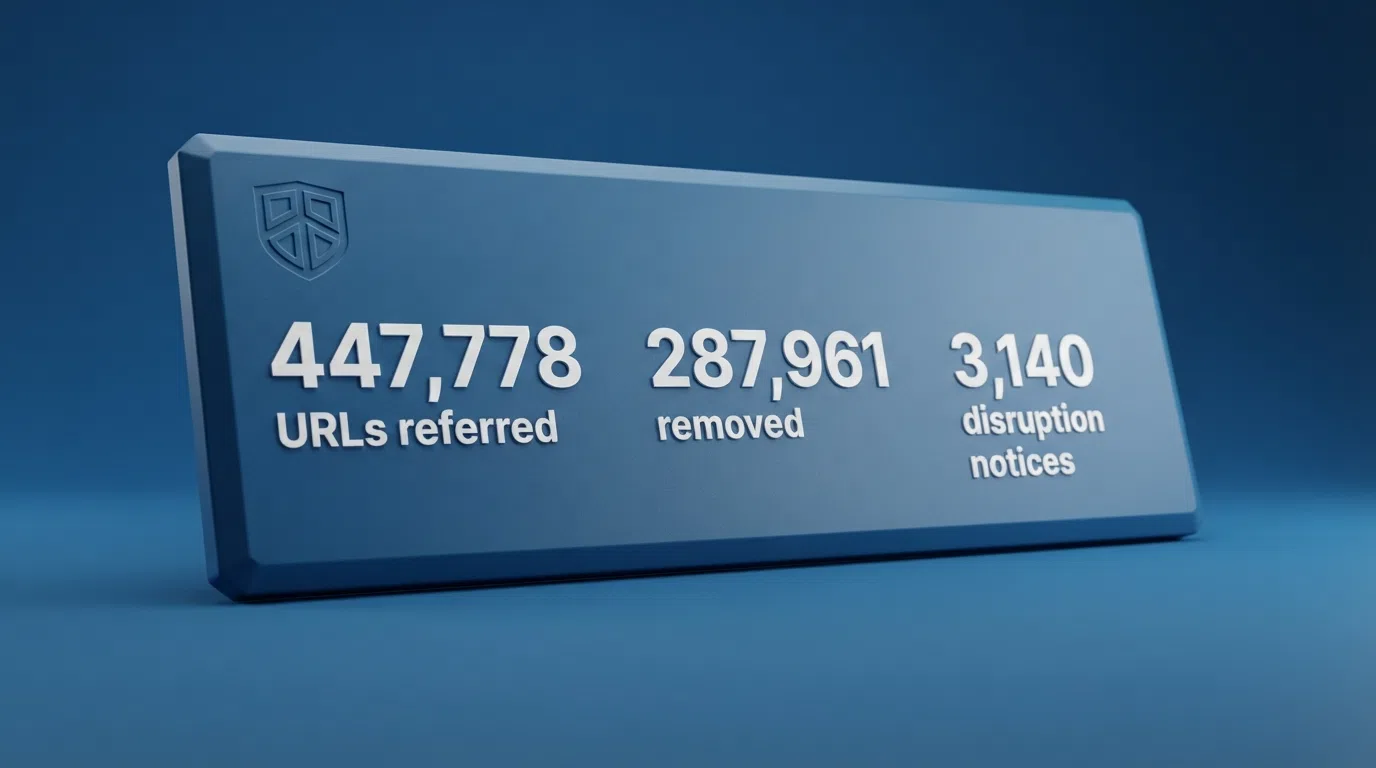
The Commission’s enforcement footprint is, in the most literal sense, large. Between April 2024 and June 2025, the UKGC issued 3,140 cease-and-desist and disruption notices, referred 447,778 URLs to search engines (Google and Bing) for delisting, and achieved 287,961 removals — a 64% takedown rate on a vast pool. The average effect of a disruption action across 160 measured sites was a 32% fall in engagement. In the year to September 2025, the Commission reported 208,088 enforcement actions on illegal online gambling, the largest category being search-engine referrals. In 2025–26 (April–March), 397,527 URLs were reported to search engines with 266,667 removed, a 67% takedown rate.
None of this is a block. The Commission does not currently hold statutory ISP or DNS blocking powers; legislation to grant them has been proposed but not enacted, and the writing of this page treats that as a proposal, not a fact. What the Commission does hold is the power to make an offshore casino harder to find, harder to advertise, and harder to process payments through the British banking system. The model is friction at scale, and the scale is genuinely large. It is also, deliberately, not a wall.
Chargebacks, Disputes and Getting Your Money Back
The most common scenario in which a UK player tries to recover money from an offshore casino is a denied withdrawal — a wins figure that was visible on the player’s balance until it was not, a bonus term applied retroactively, a “verification” process that never concludes. A chargeback is the obvious route: contact the card issuer, dispute the transaction, cite “services not provided as described” and supply the evidence. The route is real, and a chargeback against a MasterCard or Visa transaction is often decided in the cardholder’s favour when the merchant has no defensible record. The route is also limited. Crypto deposits are not chargebackable at all: once the on-chain transaction confirms, the funds are at the casino’s address and outside the card network’s reach. E-wallet disputes run through the e-wallet’s own arbitration process, which is faster than a court and slower than a chargeback. The complaint to the offshore regulator exists in name: the Curaçao Gaming Control Board will accept a complaint and may correspond with the operator, but the body has no UK consumer mandate and its enforcement bandwidth for individual player disputes is thin. A reader who wants a meaningful answer to “where do I complain” already has the answer in the comparison: the only route with a British statutory footing is the British one, and it does not exist for offshore play.
Responsible Gambling Resources That Still Work for Every UK Player
The help infrastructure is British, and it works regardless of where a player gambles. GamCare runs the National Gambling Helpline on 0808 8020 133. In 2024/25 the helpline received more than 130,000 calls and online messages, delivered 8,100 treatment sessions with an average wait of 1.3 days, and made 7,100 referrals into further treatment. In January 2026 alone, 996 referrals were made, a 48% increase on the same month a year earlier. The NHS reported 4,355 referrals to specialist gambling treatment clinics in 2024/25, up from 2,284 in 2023/24, with 15 specialist clinics now operating across England, Scotland and Wales. The Gambling Survey for Great Britain 2025 found 47% of adults had gambled in the past four weeks (27% excluding National Lottery) and that 14.5% of adults were experiencing some level of problem with gambling on the PGSI scale, with 2.5% classified as problem gamblers (PGSI 8+). An estimated 2.2 million children are growing up in households where an adult is experiencing problem gambling.
GAMSTOP itself is the one resource that follows the licence, not the player. Exclusion periods run to six months, one year, five years, or five years with auto-renewal, and cannot be cancelled early. The exclusion binds every GB-licensed site. It does not bind an offshore casino. A player who has self-excluded via GAMSTOP and then opens an offshore account has not bypassed a help line; they have stepped outside the one mechanism that is built to enforce the decision they made. That is the single most important sentence on this page for the reader who arrived here because of a self-exclusion.
Nine GB-Licensed Giants and One Offshore Challenger — Side by Side
The table below sets the ten featured operators against each other on the dimensions the bonus terms actually move on. The offshore entry is Stake.com, the only true non-GB licence in the set; the other nine are GB-licensed and the comparison is what the licence costs the player in bonus value and what it pays them in protection.
| Operator | GB Licence | Welcome Offer | Free Spins | Wagering on Winnings | Bonus Validity |
|---|---|---|---|---|---|
| bet365 | Yes (UKGC) | Up to 500 free spins over 10 days (5–50 random per day) | Up to 500 | 0× | 7 days per batch |
| William Hill (evoke) | Yes (UKGC) | 200 free spins on Big Bass Splash (£10 deposit + £10 stake) | 200 at £0.10 | 10× | 72 hours from credit |
| Sky Vegas (Flutter) | Yes (UKGC) | 50 no-deposit free spins + 200 on £10 stake | Up to 250 at £0.10 | 0× | 7 days |
| Paddy Power (Flutter) | Yes (UKGC) | 60 no-deposit free spins (50 selected + 10 Paddy’s Mansion Heist) + 200 on £10 deposit & wager | Up to 260 at £0.10 | 0× | 7 days |
| Ladbrokes (Entain) | Yes (UKGC) | 100 free spins + 300 LadBucks on £10 deposit & spend | 100 | 0× on free spins | 7 days; accept within 48 hours |
| Betfair (Flutter) | Yes (UKGC) | 50 no-deposit free spins + 100 on £10 deposit & play (Jackpot King titles) | Up to 150 at £0.10 | 0× | 7 days |
| Coral (Entain) | Yes (UKGC) | £10 slot bonus + 100 free spins on £5+ slot bet | 100 at £0.10 | 10× on £10 bonus; 0× on spins | 30 days |
| Betfred | Yes (UKGC) | 200 wager-free spins on £10+ stake | 200 | 0× | 7 days |
| Gala Bingo (Entain) | Yes (UKGC) | 100 free spins on £10 deposit & spend on slots | 100 at £0.10 | 0× | 7 days; claim within 7 days of registration |
| Stake.com | No — Curaçao (OGL/2023/174/0082) | VIP / rakeback structure (no standard welcome offer) | — | — | — |
The arithmetic of the table is the answer to most of what readers came for. A GB-licensed player depositing £10 and wagering it on a 0× wagering offer is paying, in expected loss, the slot’s edge over the wagering turnover — nothing more. A player at an offshore casino accepting a 35× bonus is paying the slot’s edge over a turnover thirty-five times the bonus face value, and the headline figure that looked generous on the banner is doing the opposite job in the maths. The protection column the table does not show is the second half of the comparison: GAMSTOP, ADR, the stake cap, the credit card ban, the 2.5-second spin floor. Both halves matter, and the GB-licensed operators on this page are the half where the bonus figure can be read at face value because the regulatory framework is doing the discounting for the player.
Stake.com — Crypto-Only, Curaçao-Licensed and Outside the UKGC Framework
Stake.com is the one true offshore operator in the set, and it is the case the comparison is built around. The casino runs under a Curaçao GCB licence (OGL/2023/174/0082) and accepts eight cryptocurrencies: Bitcoin, Ethereum, Litecoin, Tether, Dogecoin, Ripple, Tron and BNB. There are no fiat rails. A tested payout — $525 in Litecoin — cleared in 8 minutes. The welcome structure is not a spins package; it is a VIP and rakeback arrangement, weighted towards high-volume crypto play. None of the GB consumer protections apply: no GAMSTOP coverage, no UK-approved ADR, no Commission complaints route, no credit card ban (the question does not arise because no cards are accepted), no £5/£2 stake cap, no 2.5-second spin floor.
The value proposition is real, and it sits in two places. The first is speed: a withdrawal that lands in eight minutes is faster than any GB-licensed casino can offer, because the underlying rails are not the GB banking system. The second is bonus economics for high-volume play: a rakeback structure pays a percentage of house edge back to the player over time, and for a player running large turnover the maths is genuinely different from a fixed welcome package. The cost is in the column the licence table does not show. A player who has self-excluded via GAMSTOP will not be stopped at Stake.com. A player in a financial-vulnerability situation is not screened. A player who wins a large amount and finds the withdrawal blocked has no British instrument of recourse. The brand is well-run, the licence is real, the payments are fast, and the protections are absent. For a UK player who can take that trade knowingly and has no use for the protections the GB framework provides, Stake.com is a defensible choice. For a player who needs any of those protections, the choice is not defensible at all.
bet365 — The UK Market Leader and the Benchmark for Bonus Value
bet365’s 2026 welcome offer runs up to 500 free spins over ten days — between 5 and 50 spins per day on a random allocation — on a minimum £10 lifetime deposit. Wagering is 0×. The eligible games are Book of Horus, Curse of the Bayou, Magic Forge and Wrath of the Deep, with each batch valid for 7 days. The headline number, 500 free spins, is the largest in the set; the 0× wagering is the part that makes the headline honest. A player who lands 50 spins a day at £0.10 is taking £5 of free-play value per day for ten days, and none of that £5 carries a turnover multiple behind it. The expected loss is the slot’s edge over a £50 stake, not over a £50 stake multiplied by 35. For a UK player who is shopping on bonus value alone, bet365 is the benchmark the rest of the page is comparing against.
William Hill — 200 Spins on Big Bass Splash, 10× Wagering
William Hill Vegas 2026 welcome offer: deposit £10, stake £10 on Big Bass Splash, receive 200 free spins at 10p each. Winnings subject to 10× wagering (capped at £30). Expires 72 hours from credit. Big Bass Bonanza is the same family of title — Pragmatic Play / Reel Kingdom, 96.71% RTP at the standard configuration, high volatility, 2,100× max win — and the slot’s variance profile means a small spin base (£20 of stake at 10p) can produce a wide outcome range. The package is best read as a short-window shot at a high-volatility title, not as a steady-state bonus.
Sky Vegas — 50 No-Deposit Free Spins Plus 200 More
Sky Vegas runs 50 no-deposit free spins plus 200 on a £10 stake, all at 0× wagering, with spins credited at £0.10 each and valid for 7 days from credit. The no-deposit element is the differentiator: 50 spins at £0.10 is £5 of free-play value before a player has paid anything into the account, and 0× wagering means a win on those spins is paid in cash. The first eligible game loaded is the assignment mechanism, so a player choosing which slot to open effectively chooses the title. For a player who wants to test a casino’s withdrawal process and game performance with no initial outlay, the no-deposit tier is the cleanest version of that test in the set.
Paddy Power — 60 No-Deposit Spins, the Highest Deposit-Free Count
Paddy Power runs 60 no-deposit free spins (50 on selected slots plus 10 on Paddy’s Mansion Heist) and 200 additional free spins on a £10 deposit and wager, all at 0× wagering, £0.10 per spin, 7-day validity. The 60-spin no-deposit count is the highest in the set, and the 260 total at the deposit-gated tier is also the highest. The Paddy Power bonus is the one a bonus-comparison reader should look at first when the question is how much free-play value is on the table before any of the player’s own money is exposed.
Betfair — 50 No-Deposit Spins on Jackpot King Games
Betfair runs 50 no-deposit free spins plus 100 on a £10 deposit and play, all at 0× wagering, £0.10 per spin, 7-day validity, on selected Jackpot King titles including Crabbin’ For Cash. The Jackpot King series is the differentiator: a player taking these spins is buying (or being given) entries into progressive jackpots, which is a different product from a standard slot spin because the upside distribution is bimodal — long periods of small losses punctuated by very large wins. A 50-spin no-deposit entry into a progressive jackpot network is a higher-variance proposition than the same number of spins on a standard slot, and a reader who treats it as a straight comparison will misread the value.
Ladbrokes — 100 Free Spins Plus LadBucks on a £10 Spend
Ladbrokes runs 100 free spins plus 300 LadBucks on a £10 deposit and spend, with 0× wagering on the free-spin winnings, 7-day validity, and a 48-hour accept window. The LadBucks are the bonus’s secondary currency — a loyalty token redeemable inside the Ladbrokes / Entain product, with its own terms. A player should treat the free spins as the cash-equivalent value and the LadBucks as a smaller side bet, not as a parallel offer of the same weight. The 48-hour accept window is a second timing constraint layered on top of the 7-day spin validity: a player who does not click “accept” inside 48 hours of the offer being credited forfeits the package.
Coral — A £10 Slot Bonus Plus 100 Wager-Free Spins
Coral is the only operator in the set running a cash bonus alongside free spins: a £10 slot bonus at 10× wagering, max stake £2, accept within 14 days, use within 30 days, plus 100 free spins at £0.10 each, 0× wagering, valid 7 days, on a £5+ slot bet. The eligible titles are Fishin’ Frenzy, King Kong Cash and Eye of Horus. The £2 max stake on the bonus is the GB cap applied at 18–24 — Coral is enforcing the lower band by default on the bonus, which is conservative and aligns with the safer-gambling direction the Commission has been moving in. The 30-day bonus window is the longest in the set and gives the wagering playthrough room to breathe. The free spins are the cleaner value component; the £10 bonus is a slower-burn tail with the lower stake ceiling attached.
Betfred — 200 Wager-Free Spins for a £10 Stake
Betfred runs 200 wager-free spins on a £10+ stake, 0× wagering, 7-day validity. The fine print matters: debit card deposits qualify, and e-wallet and prepaid card deposits may be excluded. A player funding via Skrill or Neteller, or via a prepaid card such as Paysafecard, should check the qualifying-method list before staking, because a spin allocation is not retroactively corrected when the deposit route is wrong. The straightforward reading of the offer — 200 spins at the standard £0.10 on a debit-card-funded account — is the realistic best case, and on that case the value is competitive with anything else in the set.
Gala Bingo — 100 Free Spins on a £10 Deposit and Spend
Gala Bingo runs 100 free spins at £0.10 on a £10 deposit and spend on slots, 0× wagering, 7-day validity, claim within 7 days of registration. The offer is the cleanest entry-level package in the set: 100 spins, no wagering, a single deposit-and-spend trigger, no accept window inside the validity window. A player who has just registered and is being asked whether to opt in should opt in within 7 days and stake the qualifying £10, because missing either window forfeits the package. There is no no-deposit tier, no bonus currency, and no game-restriction complication beyond the standard selected-games list.
Why Your 2026 Bonus Is Smaller Than It Looks
A bonus is not a gift. It is a turnover contract: a player receives face value in bonus funds or spins, and in return commits to wagering that face value some number of times before withdrawing. The number — the wagering multiple — is the entire economic content of the offer. At a UKGC-licensed casino since 19 December 2025, the multiple is capped at 10×, and the same headline number — “100% up to £100” — sat behind very different maths depending on which side of the cap the casino was operating. Offshore, the typical range remains 30×–60×, and the higher headline figures the marketing tends to feature are higher precisely because the wagering behind them is heavier. The bonus looks bigger because it costs more to clear.
Welcome and Deposit Bonuses — Higher Headlines, Longer Strings Offshore
The shape of a typical offshore welcome package is a multi-deposit match — 100% on the first deposit up to a high ceiling, 50% on the second, 25% on the third — paired with a high wagering multiple and a long list of excluded games. The headline is “up to £/$/€ X across your first three deposits”; the actual cost is the sum of the match amounts multiplied by the wagering multiple, played through at the slot edge. At a 35× multiple, a £500 package requires £17,500 of wagering turnover to clear. At a 96% RTP slot, the expected loss on that turnover is roughly £700, against a headline bonus of £500. The player is paying more in expected loss than the bonus is worth in face value, and the gap is the casino’s margin. The same calculation at 10× wagering on a £10 bonus at Coral requires £100 of turnover and an expected loss of about £3.84. The headline numbers are not comparable because the wagering behind them is not comparable.
No-Deposit Bonuses and Free Spins — Rare Offshore, Standard at UKGC Sites
The paradox of the no-deposit offer is that it is common at GB-licensed casinos and rare at offshore sites targeting UK players. Three of the nine GB-licensed operators in the set run a no-deposit spin tier: Sky Vegas (50), Paddy Power (60), Betfair (50). All three are 0× wagering, all three carry a 7-day validity, all three are credited on registration before any deposit. The mechanism is partly competitive — three of the largest UK-facing brands competing for the same registration cohort — and partly regulatory: the 10× cap on bonus wagering combined with the Commission’s transparency direction has pushed operators towards spin-based, no-wagering acquisition offers where the cost is legible. Offshore sites, where the same regulatory pressure does not exist, have not adopted the same shape, and the typical no-deposit offer offshore (when one exists at all) carries a high wagering multiple and a low maximum cashout.
The 10× Wagering Cap — What It Does to the Bonus Arithmetic
Below the cap, a bonus costs the player roughly its face value in expected loss, plus the slot’s edge on the qualifying deposit. Above the cap — anywhere offshore, and at every British site before December 2025 — the cost multiplies. The mechanics are the same: expected loss equals required turnover multiplied by (1 − RTP). The required turnover is the bonus multiplied by the wagering factor. At 10× and a 96% RTP, a £10 bonus costs about 40p in expected loss. At 35× and the same RTP, a £500 bonus costs about £700. The reform does not make bonuses disappear; it makes the offers the British market will run legible, by removing the higher multiples that turned headline figures into arithmetic traps.
The operator economics behind the divergence matter too. From 1 April 2026, Remote Gaming Duty for online casino is 40%, up from 21%. From 6 April 2025, the statutory levy on remote casino licences is 1.1% of gross gambling yield, hypothecated to NHS treatment (50%), prevention (30%) and research (20%). An offshore operator pays neither, and the gap is the reason the headline numbers offshore can sit where they do. The British operator is running a 41.1% effective tax load on GGY before any other cost; the offshore operator is running something close to zero. The cost is real, and the Commission’s wagering cap is a partial redistribution of it from the player to the operator, with the player kept whole by the lower required turnover.
Getting Money In and Out — Payment Reality at Offshore Casinos
The payment story is the offshore pitch in concentrated form. Cards that a British casino cannot touch are routinely accepted offshore. Crypto routes that no GB-licensed casino can match for speed are the default at the offshore end. The “fast payout” claim that every affiliate page repeats is at its most literal offshore, and at its least automatic at the GB-licensed end — though the gap has narrowed substantially since the major UK brands rebuilt their cashier flows.
Deposit Methods — Cards, E-Wallets and the Credit Card Divide
The single biggest payment difference between GB-licensed and offshore casinos is the credit card. Since 14 April 2020, GB-licensed operators have been prohibited from accepting credit cards for gambling, including via e-wallets funded by credit cards. The Commission’s stated ground was a 22% problem-gambler rate among online credit card users — more than double the rate among non-credit users. The ban extends to e-wallet funding: a player who tops up Skrill or Neteller with a credit card cannot then deposit from that e-wallet at a GB-licensed casino, because the source of the funds is what is regulated, not the rail that delivers them. Offshore casinos, which are not bound by LCCP condition 6.1.2, accept credit cards as a matter of course. The 22% figure is the reason a British player who can no longer use a credit card to fund a deposit on a GB site can still do so on an offshore site, and the same figure is the reason the British regulator reached for the ban.
Withdrawal Times — Crypto Clears in Hours, Bank Transfers Take Days
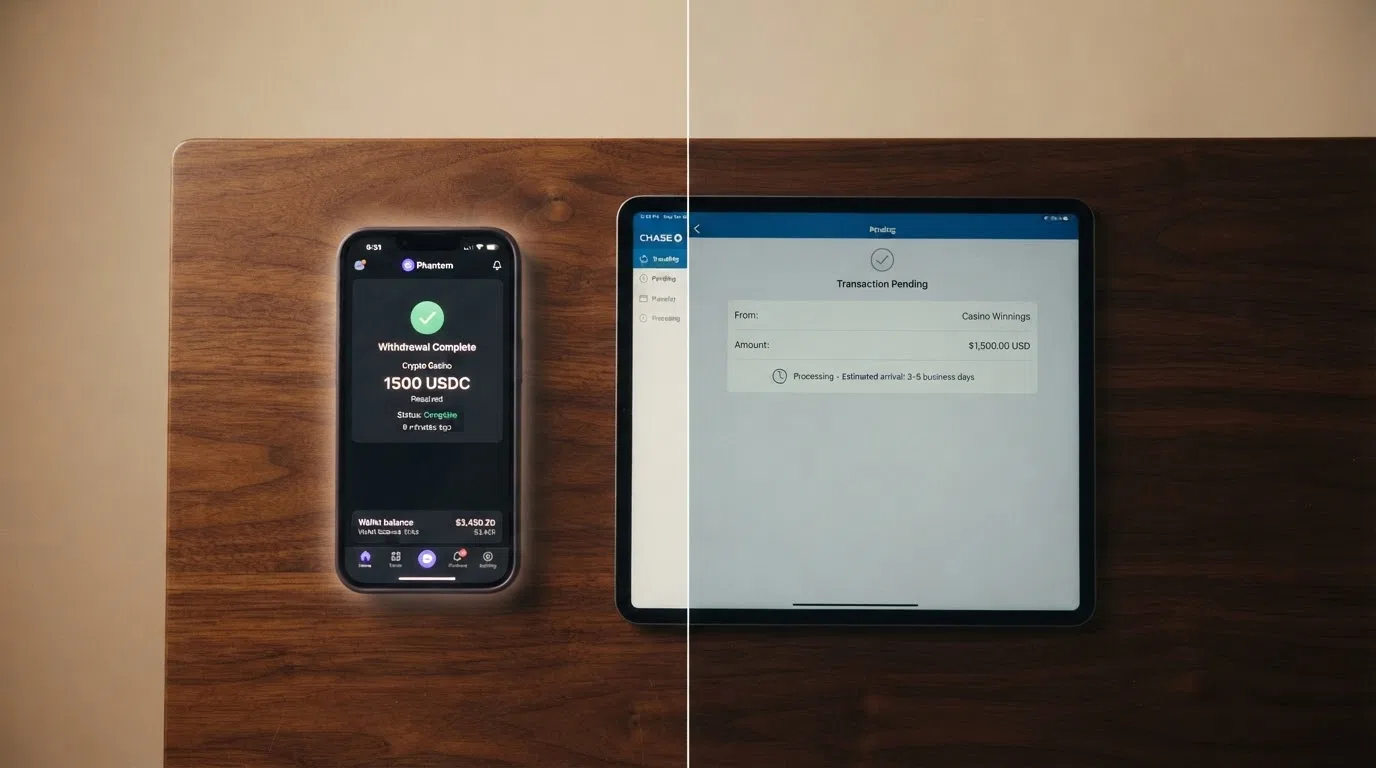
The speed spectrum runs from 8 minutes to several days. Stake.com processed a tested $525 Litecoin withdrawal in 8 minutes in May 2026. 7Bit Casino, also Curaçao-licensed, clears Bitcoin withdrawals in 1–3 hours per testing. At a GB-licensed site, the same withdrawal on the same Tuesday afternoon will usually be processed in under 24 hours and arrive via faster payments the same day or the next, with bank transfers running 2–5 business days and e-wallets somewhere in between. The crypto advantage is not in dispute: a Litecoin or Bitcoin transaction that confirms in minutes is faster than anything the British banking system can offer, and the speed is the entire reason a player who cares about payout time looks offshore in the first place. The cost is the chargeback’s absence, which is the topic the section on disputes covers, and the cost is the identity-verification ceiling, which the section on crypto covers.
What “Fast Payout” Actually Means at an Offshore Casino
The phrase is marketing, and the checklist that separates a genuine fast-payout casino from a claim is short. First, processing time is not the same as funds-arrival time: a casino can process a withdrawal in 24 hours and still take three days to release the funds, because the bottleneck is usually the payment rail. Second, KYC verification is the hidden delay: an offshore casino that does not verify identity at deposit will often verify it at first withdrawal, and a player who has not prepared documents (passport, proof of address, sometimes source-of-funds) is looking at a 48–72 hour verification queue before the payment is even initiated. Third, the asymmetry of “fast” is worth testing: a casino that takes a deposit in seconds and a withdrawal in days is fast only on the side of the transaction that benefits the operator. The honest test is to make a small deposit, request a small withdrawal before playing, and see how the round trip actually behaves. Affiliate review sites publish numbers from exactly this kind of test; the published number is more useful than the marketing claim.
Crypto Casinos Trade Your Protections for Speed and Anonymity
The crypto casino model offers three things the GB-licensed market does not: speed, lower transaction costs, and the absence of identity verification at deposit. The same three features are the reason every protection the GB framework is built on is missing. The trade is real, and it is not a small one.
Bitcoin and Multi-Crypto Casinos — What Is Available Offshore
The shift over the last three years has been from Bitcoin-only to multi-coin platforms. Stake.com’s roster runs to eight: Bitcoin, Ethereum, Litecoin, Tether, Dogecoin, Ripple, Tron and BNB. 7Bit Casino’s minimum Bitcoin deposit is 0.22 mBTC, with the casino otherwise focused on the same coin. Velobet, another Curaçao-licensed brand, runs fast e-wallet and crypto processing across its cashier. The multi-coin structure matters for two reasons. The first is transaction cost: a player moving small amounts in and out of a casino wants the lowest network fee per confirmation, and the choice between Bitcoin (high fee, slow confirmation), Litecoin (low fee, fast confirmation) and Tron (near-zero fee, near-instant confirmation) is the choice the cashier is making available. The second is liquidity: a player who holds USDT and wants to play without converting to fiat and back has a real reason to be at a multi-coin platform rather than a Bitcoin-only one. The downside is that the convenience of eight coins is also the convenience of no chargeback, no card network and no bank intermediary — once the funds are at the casino’s address, the player is inside the casino’s own complaints process, full stop.
No-KYC Play — Privacy vs the Loss of Every Identity-Based Safeguard
Since 7 May 2019, every GB-licensed remote casino has been required to verify name, address and date of birth before a player makes a first deposit. The verification is the entry point to age checks, anti-money-laundering controls, source-of-funds scrutiny at higher spend, GAMSTOP enforcement and financial vulnerability screening. An offshore casino that does not require identity verification at deposit removes the entire chain. The player is anonymous to the casino, which is a feature for a player who values privacy. The player is also anonymous to the casino’s age-verification, AML and source-of-funds processes, which is not a feature for the same player the day a withdrawal is held and the casino’s compliance team asks, late, for documents the player does not want to provide.
The pitch the no-KYC casino makes is freedom. The pitch the GB regulator would make, by way of contrast, is that every protection in the framework is downstream of identity, and that removing the verification step is the same move as removing the protections. Both pitches are correct; the question is which set of consequences the player can carry.
Provably Fair Gaming — A Genuine Offshore Innovation
One area where the offshore crypto casino genuinely leads is cryptographic fairness verification. A provably fair system publishes a hashed server seed before the player bets, takes a client seed from the player (often automatically), uses both with a nonce to determine the outcome, and lets the player verify the hash after the round. The mechanic is a real improvement on a third-party audit, because the player is checking the round they actually played, not a statistical sample audited weeks earlier. The innovation is real and the cryptographic primitives are sound. The limit is equally real: provably fair proves the game was not rigged, and proves nothing about whether the casino will pay. A player who wins provably and is then denied the withdrawal still has no recourse, because the casino’s payment behaviour is not on the blockchain. The complaint that provably fair was designed to solve — a hidden manipulation of outcomes — is solved. The complaint it does not solve — an operator that takes deposits and refuses to release winnings — is the one the player is more likely to meet.
How We Selected and Ranked the Operators on This Page
The ten operators on this page are the ones the research identified as the comparison this subject demands: nine GB-licensed brands (bet365, William Hill, Sky Vegas, Paddy Power, Ladbrokes, Betfair, Coral, Betfred and Gala Bingo) plus Stake.com as the representative offshore entry. The GB-licensed brands were drawn from the top of the UK market by share, and each one was checked against the Gambling Commission’s public register for current licence status. The offshore entry was chosen because it is the one offshore operator UK players most actively search for, and the comparison between it and the nine GB-licensed brands is the comparison the subject is built around.
The ranking criteria, in order of weight, are licence status, bonus value (measured by free-spin count, wagering multiple, and bonus accessibility through the deposit threshold and validity window), and payment flexibility (with crypto support as the differentiator for the offshore entry). No invented weightings sit behind the order: the GB-licensed operators are presented in the order their parent groups are typically associated with, and the offshore entry sits last because the comparison it offers is the one the page is asking the reader to weigh. Sources used for the figures on the page are the UKGC’s public licence register, the legislation.gov.uk text of the Gambling Act 2005 and the secondary instruments cited in the research, the Commission’s own enforcement reports, GamCare’s published statistics, the operator terms pages, and affiliate testing data from Offshoreonlinecasinos.com and casinobuddies.co.uk. The qualitative nature of the ranking is the point: a reader who wants a precise quantitative score can build one, but a single-number ranking of casino offers compresses more than it reveals, and this page is built to let the comparison speak in the columns it actually has.
What UK Players Should Actually Do About Offshore Casinos
The arithmetic of this page lands in one place. A 0× wagering welcome offer at a GB-licensed casino costs the player, in expected loss, the slot’s edge over the qualifying stake and nothing more. A 35× wagering offshore bonus on the same slot costs the player the slot’s edge over thirty-five times the face value, and the headline figure is doing the opposite of what the banner suggests. The two offers are not in the same conversation, and the GB market after the December 2025 cap has collapsed the headline gap in a way that leaves most offshore welcome packages looking like worse deals at higher real cost. On payment speed the comparison flips: crypto is faster than any British rail, and a player whose reason to be offshore is that reason, and only that reason, can name the trade out loud. On protection, the comparison is one-sided: GAMSTOP, the £5/£2 stake cap, the 2.5-second spin floor, the 10× wagering cap, the credit card ban, the deposit-limit prompt, the ADR route, the Commission complaints process and the fund-segregation requirements are not luxuries; they are the architecture that makes the rest of the framework work, and the offshore casino is built outside it.
The honest use case for an offshore site in 2026 is narrow. A crypto-native player who has weighed the protection gap, is not self-excluded via GAMSTOP, has no affordability concern, and values payout speed over every other dimension can take the trade knowingly. A player who arrived here via a GAMSTOP exclusion and is looking for a way around it has not found a casino; they have found the harm-amplification vector this page has flagged. A player who wants the largest free-spin headline available can get it at bet365 under a 0× multiple in a GB-licensed setting, and the protection column comes with the bonus. A player who wants the most generous no-deposit spin offer can get it at Paddy Power or Sky Vegas, also under 0×, also under a British licence. A player who has a budget to set and wants the casino to help them set it can get a deposit-limit prompt at any of the nine GB-licensed operators in the set; no offshore site in the comparison is required to do the same.
The action the page supports is straightforward. Pick on the column the licence row in the comparison table actually shows, not on the column the marketing would prefer to show. A 0× offer is the offer; a 35× offer is a different product with a different cost. The British market after the December 2025 reform is, on the evidence in the table above, the better-value end of the comparison for the reader who arrived here to find the offshore one. The offshore end exists, the comparison is honest, and the column the licence does not show is the column the rest of this page is written around.
If gambling is affecting you or someone close to you, GamCare’s National Gambling Helpline is 0808 8020 133 (24 hours). NHS specialist gambling treatment clinics are available across England, Scotland and Wales without a GP referral. GAMSTOP self-exclusion covers every GB-licensed online operator.
Frequently Asked Questions
Are offshore casinos legal for UK players in 2026?
Operating an offshore casino serving UK customers without a GB licence is a criminal offence under section 33 of the Gambling Act 2005, punishable by up to 51 weeks’ imprisonment and an unlimited fine. No UK player has been prosecuted for using an offshore casino. The legal risk sits with the operator and the intermediary. What the player loses is the entire British protection framework, including GAMSTOP coverage, the Commission’s complaints route, approved ADR and any practical route to recover funds if a withdrawal is denied.
Can I still use GamStop at an offshore casino?
No. GAMSTOP is a condition of every GB-licensed online operating licence and binds only the operators on the Commission’s public register. An offshore casino is, by definition, not on the register, and the exclusion does not extend. A player who has self-excluded via GAMSTOP and then opens an offshore account has stepped outside the mechanism built to enforce the decision they made. The exclusion periods — six months, one year, five years, or five years with auto-renewal — apply only on the GB-licensed side.
What is the fastest way to withdraw winnings from an offshore casino?
Cryptocurrency is the fastest route by a wide margin. A tested Stake.com withdrawal of $525 in Litecoin cleared in 8 minutes in May 2026. 7Bit Casino’s Bitcoin withdrawals clear in 1–3 hours per testing. Fiat withdrawals at offshore casinos run through the same rails as British ones — card refunds, e-wallet payouts, bank transfers — and the speed differential is much smaller. The trade for crypto speed is the loss of chargeback rights: once the on-chain transaction confirms, the funds are at the casino’s address and outside the card network.
Are there any no-deposit bonuses available at offshore casinos for UK players?
No-deposit bonuses are rare at offshore casinos targeting UK players, and common at GB-licensed ones. Sky Vegas runs 50 no-deposit free spins plus 200 on a £10 stake, all at 0× wagering. Paddy Power runs 60 no-deposit spins plus 200 on a £10 deposit and wager, also at 0×. Betfair runs 50 no-deposit spins plus 100 on a £10 deposit and play, restricted to Jackpot King titles. All three are GB-licensed and all three carry 0× wagering on winnings.
What licence should a reputable offshore casino hold?
Curaçao is the most developed of the common offshore jurisdictions: the Curaçao Gaming Control Board now operates under the National Ordinance on Games of Chance, and operators carrying a current OGL/2024/ number have at least passed a fit-and-proper test. Stake.com runs under OGL/2023/174/0082 and 7Bit under the same licensing regime. Anjouan and Costa Rica sit lower on the consumer-protection ladder. None of the three is a substitute for a UKGC licence, and the question to ask of an offshore operator is not whether it is licensed but whether the licence does anything for a UK player in a dispute.
Will the UK government block offshore casino sites?
The Gambling Commission does not currently hold statutory ISP or DNS blocking powers. It uses cease-and-desist notices, search-engine URL referrals, payment-channel disruption and registrar/host coordination. Between April 2024 and June 2025 the Commission referred 447,778 URLs to search engines and achieved 287,961 removals; in 2025–26 the figures were 397,527 and 266,667. Legislation to grant blocking powers has been proposed but not enacted, and this page treats it as a proposal rather than a fact. Enforcement at the scale the figures show is real; a national block is not.
Licence – realmoney-onlinecasinos-uk
Content created by the «realmoney-onlinecasinos-uk» team