
The Best Cashback Casinos in the UK: Where Real Money Returns Every Week
 Available in GB
Cashback is the bonus type that outlasts every welcome offer on a UK-licensed casino, and in 2026 the market has finally caught up with what players have always wanted from it: real money, paid weekly, with no wagering attached. Six of the ten operators compared below run a standing 10% weekly rebate on net losses and pay it as withdrawable cash; two more run cashback on a rolling or VIP basis; the remaining two offer periodic rebates that suit a different kind of player. The Gambling Commission’s January 2026 wagering cap changed the playing field overnight — and the comparison that follows is what that change looks like in practice.

*Current as of September 8, 2026 · verified against the Gambling Commission public register.*
What Casino Cashback Actually Means for Your Balance
A casino cashback bonus is a rebate on money you have already lost. Most UK operators calculate it on net losses over a fixed window: deposits minus withdrawals, summed across the period, with a percentage of any shortfall returned to you. The standard rate is 10% weekly; Duelz, All British Casino and Quinn all run that rate on this model. PlayOJO takes a different approach through OJOplus, crediting a small percentage of every real-money spin regardless of whether the session ends in profit. Mr Vegas runs Rainbow Fridays as a weekly wager-free rebate with a £0.50 minimum and a £300 daily cap.
Two statutory rules shape how much cashback a UK session can actually earn. The slot stake cap, enforced from April and May 2025 under SI 2025/215, limits every spin to £5 for players aged 25 and over and £2 for players aged 18 to 24. The UKGC’s 10× wagering cap, in force from 19 January 2026 under LCCP Social Responsibility Code 5.1.1, sets a hard ceiling on playthrough requirements attached to any bonus credit. Cashback paid as withdrawable cash sits outside that cap entirely — which is why the leaders in this ranking pay zero wagering rather than the legal maximum.
How Cashback on Net Losses Works
The dominant UK model works like this: the casino tallies everything you deposited over the calculation window, subtracts everything you withdrew, and applies the cashback percentage to any positive balance that remains. A player who deposits £100 and withdraws £70 has a £30 net loss; at 10% cashback, that player receives £3 credited on the payout date.
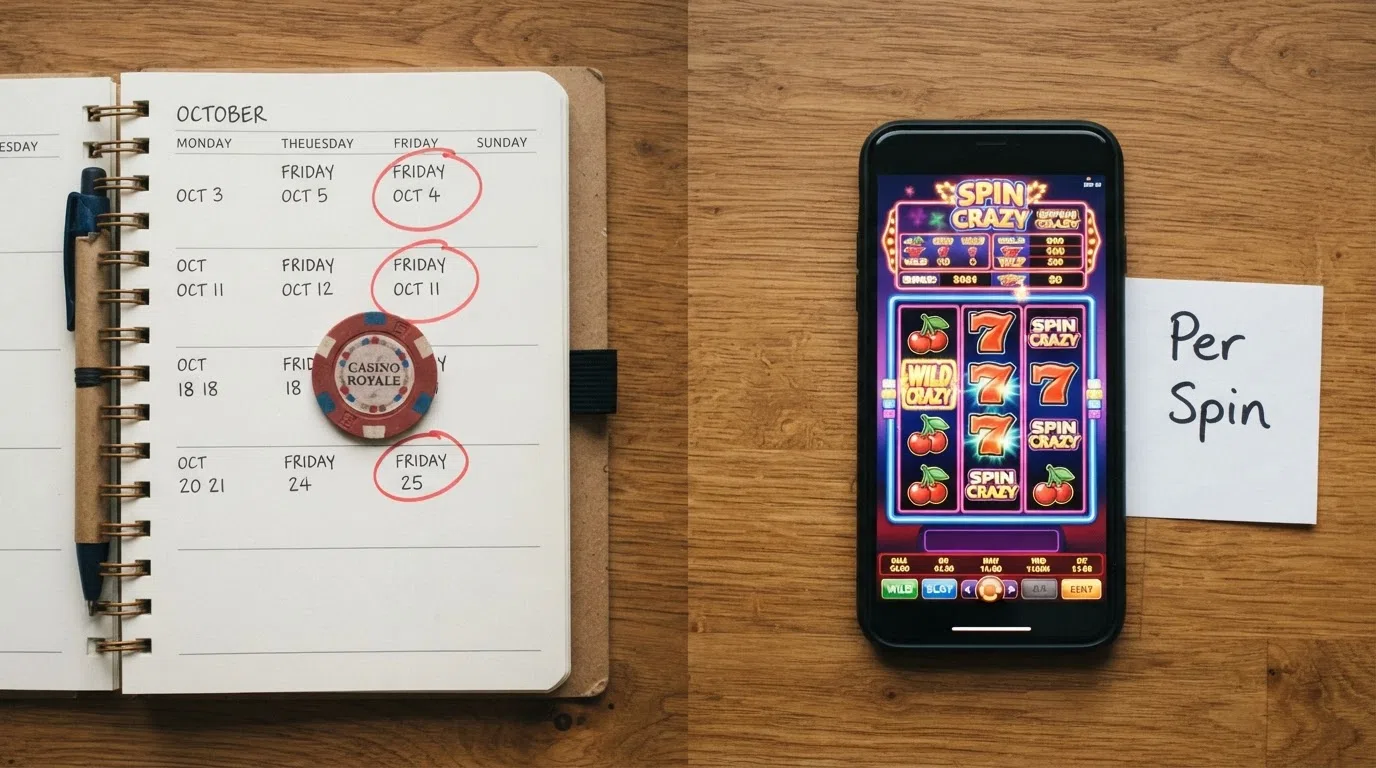
Duelz calculates Friday 00:00 to Thursday 23:59 and credits the rebate every Friday at noon, with a minimum cashback of £0.10 — a floor so low that even a £1 net loss earns a 10p rebate. All British Casino applies the same 10% rate but uses a different trigger: the account balance must fall below £10 before the cashback becomes claimable, which means the rebate sits waiting until the player’s session has actually cost them money. The weekly window lines up neatly with UK payday cycles, which is why most operators have settled on it: the player gets a rebate before the next pay cheque lands.
The net-loss calculation is not a measure of how much you wagered. It is a measure of how much you actually lost after withdrawals. A player who deposits £200, wins £400 and withdraws £350 has zero net loss and earns no cashback — even though they wagered hundreds of pounds through the week. That is the cost of the model: winning weeks produce no rebate. PlayOJO’s per-spin structure is the workaround, and the section below explains how.
Cashback on Every Bet vs Weekly Rebates: The Difference That Shapes Your Return
- Per-spin cashback (PlayOJO) — credits 0.06% to 10% of every wager to a separate balance with 0× wagering, paying out even on a winning week
- Weekly net-loss rebate (Duelz, All British Casino, Quinn) — credits 10% of the week’s shortfall every Friday, requires a net loss to trigger
- Periodic promotional cashback (Betfair) — runs through promotional windows rather than as a standing programme, frequency not guaranteed
- Stake-threshold cashback (Bet365) — pays 2% in Golden Chips for every £50 staked on Playtech Live Roulette, capped at £10 total
The per-spin model is structurally different because it rewards volume rather than outcome. A casual player running 200 spins at £0.10 per spin through a week earns PlayOJO’s OJOplus on every spin regardless of whether the session ended up or down. The weekly rebate works the opposite way: it only triggers on a losing week, but the percentage is much higher — typically 10% versus PlayOJO’s 0.06% to 10% range, which bottoms out well below the weekly benchmark.
The player type each model suits is straightforward. A frequent small-stake player benefits from per-spin cashback because volume drives their rebate; a weekend session player depositing £100 on a Saturday and withdrawing whatever remains on Sunday benefits from a weekly net-loss model because their losses concentrate into one window. The two structures answer different deposit patterns, and choosing the wrong one means leaving a meaningful percentage of rebate value on the table.
Instant and Daily Cashback: Fast Returns on Short Sessions
Some programmes credit cashback within hours rather than at the end of a weekly cycle. Daily cashback calculates the rebate on the previous 24 hours of play; instant cashback triggers at a loss threshold within a single session. PlayOJO’s per-spin structure functions as near-instant credit: a fraction of every wager lands in the OJOplus balance the moment the spin completes, available as cash immediately.
Short-cycle models suit players who deposit small amounts in single sessions. A £20 deposit played through in an hour and ending £15 down earns its rebate the same day, not seven days later. The trade-off is that per-spin rates rarely match the 10% weekly benchmark — 0.06% to a few percent is typical — so a player chasing the highest possible return on a single losing session may find a daily programme better than a weekly one, but a player whose sessions stretch across the week will earn more under the weekly structure.
The improvement short-cycle programmes represent over older models is real. Before the January 2026 wagering cap, UK operators could attach 30× or higher playthrough to bonus-credit cashback, and a daily cycle meant a daily grind through that wagering. The 10× cap made all bonus-credit cashback usable; the prevalence of 0× cashback among the top operators made the question largely academic.
Real-Money Cashback vs Bonus Credit: Why the Payout Type Decides Whether You Keep It
The single most important term on any UK cashback offer is whether the rebate is paid as withdrawable cash or as bonus funds. Cash is worth its face value; bonus credit carries wagering requirements that erode it. Duelz, PlayOJO, All British Casino, Mr Vegas, Quinn and Fitzdares all pay cashback as withdrawable money with 0× wagering. The UKGC’s 10× cap applies to bonus-credit cashback elsewhere — meaning the worst case is £100 in turnover to clear a £10 rebate.
The pre-cap reality was considerably worse. Some operators applied 30× or higher wagering to cashback credits, which meant a £10 rebate required £300 in turnover to clear and an expected loss exceeding the rebate itself. The Gambling Commission’s stated rationale for the cap was direct: “Capping the wagering requirement to ten decreases the likelihood of harm, reduces complexity, and improves transparency while maintaining consumer choice.” The market response was immediate — zero-wagering cashback became the competitive standard among the leading operators almost overnight.
For a reader comparing offers, the rule is simple. A 10% cashback with 0× wagering paid as cash is worth exactly 10% of net losses. A 10% cashback with 10× wagering paid as bonus credit is worth less than that once the cost of clearing the credit is factored in. The £10 cashback bonus at 10× wagering costs roughly £3.50 in expected loss to clear on a 96.5% RTP slot, leaving about £6.50 of net value. The choice between cash and credit is the choice between keeping the full rebate and keeping roughly two-thirds of it.
The Best Cashback Casinos in the UK: 10 Compared
| Operator | Cashback Rate | Wagering on Cashback | Frequency | Payout Type |
|---|---|---|---|---|
| Duelz Casino | 10% | 0× | Weekly (Friday) | Real cash |
| PlayOJO | 0.06%–10% per spin | 0× | Per spin | Real cash |
| All British Casino | 10% | 0× | Weekly | Real cash |
| Mr Vegas | Varies | 0× | Weekly (Friday) | Real cash |
| Grosvenor Casinos | 10% (blackjack) | Varies | Weekly (Thursday) | Real cash |
| Quinn Casino | 10% | 0× | Weekly | Real cash |
| Fitzdares Casino | 10% | 0× | Weekly | Real cash |
| Betfair Casino | Varies | Varies | Periodic | Real cash |
| 32Red Casino | Tier-based | Varies | Weekly (VIP) | Real cash |
| Bet365 Casino | 2% | 0× | Per £50 stake | Golden Chips (cash) |
Eight of the ten operators carry standing cashback programmes with weekly or rolling payouts. The split the ranking reveals is structural rather than percentage-driven: the top three cluster at 10% weekly with 0× wagering paid as cash, while the lower half splits between game-specific rebates (Grosvenor, Bet365) and conditional programmes (Betfair’s periodic model, 32Red’s VIP-gated structure). Every operator on this list is verified against the Gambling Commission’s public register, which was last updated on 29 July 2026 and lists 2,665 licensed gambling businesses searchable by name, trading name, domain or account number.
Duelz Casino
Duelz runs the most-referenced cashback structure on UK affiliate lists. The rebate is 10% of weekly net losses, calculated from Friday 00:00 to Thursday 23:59, credited every Friday at noon as withdrawable cash with no wagering requirement and no maximum cap. The minimum threshold is £0.10 — low enough that a player down by a single pound still earns a 10p rebate.
The welcome structure runs alongside it: up to 140 free spins for a £25 deposit, released at 20 spins per day over seven days at £0.10 per spin. Free spin winnings carry 10× wagering under the UKGC’s January 2026 cap, with a maximum of £100 per day from free spins and a seven-day expiry. The game library spans Play’n GO, NetEnt, Microgaming, Evolution, Pragmatic Play and Red Tiger. Duelz is operated by SuprNation Limited, verified on the UKGC public register.
The combination of standing 10% weekly cashback and a low minimum threshold makes Duelz the benchmark every other operator is measured against. There is no structural friction in claiming the rebate, and the payout type matches the standard the top of this list sets.
PlayOJO
PlayOJO’s OJOplus is the only featured programme paying cashback on every real-money spin regardless of outcome. The rate varies from 0.06% to 10% depending on the game, with the credit landing in a separate cash balance that carries 0× wagering and is withdrawable at any time. A session that ends in profit still earns its rebate — which is the structural advantage of the per-spin model and the reason it appears alongside weekly programmes in any honest comparison.
The welcome offer is 50 free spins on Big Bass Bonanza, which carries an RTP of approximately 96.71%, for a £10 minimum deposit at £0.10 per spin with no wagering on winnings. The game library spans NetEnt, Microgaming, Play’n GO, Evolution, Pragmatic Play, Red Tiger and Blueprint. PlayOJO is operated by SkillOnNet Limited, verified on the UKGC public register.
The catch with per-spin cashback is that low-rate games keep the percentage low. A slots session earning 0.06% per spin on a quiet title returns pennies on the pound compared to a 10% weekly rebate. The trade-off favours PlayOJO when a player runs enough volume to push the rate up, and favours weekly programmes when the player’s sessions are infrequent and the rate needs to be high on the sessions that count.
All British Casino
All British Casino runs 10% weekly cashback on net losses paid as withdrawable cash with zero wagering and no maximum cap. The rebate becomes claimable once the account balance falls below £10 — meaning the cashback sits waiting in the account until the player’s session has actually cost them money. The programme is available 24 hours after the first deposit, and Skrill and Neteller deposits are excluded from eligibility.
The welcome structure is 100 Cash Spins on Le Bandit, which carries an RTP of approximately 96.34%, for a £10 deposit and wager at £0.10 per spin with zero wagering on winnings. The provider mix includes NetEnt, Microgaming, Evolution, Pragmatic Play, Novomatic and Blueprint. All British Casino is operated by L&L Europe Ltd, verified on the UKGC public register.
The Skrill and Neteller exclusion is the single most material term on this offer. Players who fund through e-wallets should know that the rebate will not apply to those deposits — a fact that quietly removes the programme from consideration for a meaningful slice of UK players who prefer e-wallet payment.
Mr Vegas
Mr Vegas’s Rainbow Fridays pays wager-free cashback on weekly play, credited every Friday as cash. The minimum rebate is £0.50 and the maximum is £300 per day. The library is the widest on this list at over 8,000 games from more than 100 studios, including NetEnt, Microgaming, Play’n GO, Evolution and Pragmatic Play.
The welcome structure is a 100% deposit match up to £200 subject to 10× wagering — within the UKGC’s January 2026 cap. Mr Vegas is operated by Videoslots Limited, verified on the UKGC public register.
The £300 daily cap on the rebate is the material term here. A high-volume player whose weekly net losses would earn more than £300 will find the programme paying out less than 10% of their loss in practice. For most players, the cap is irrelevant; for the high-volume segment, it changes the comparison with the uncapped 10% programmes at Duelz, All British Casino and Quinn.
Grosvenor Casinos
Grosvenor’s online cashback is narrower than the digital-first brands. The headline offer is 10% on blackjack losses, restricted to Blackcard VIP members and specific promotional windows. To qualify, the player must stake at least £50 between Thursday 01:00 and Wednesday 00:59. The rebate is credited weekly on Thursdays.
The welcome structure varies by promotion; deposit and stake £20 to receive £30 in bonus funds is typical. The provider mix spans IGT, NetEnt, Evolution, Playtech and Pragmatic Play. Grosvenor is operated by Rank Digital Gaming (Alderney) Limited, verified on the UKGC public register.
Grosvenor’s cashback is the only game-specific programme in the featured set, and the £50 weekly stake threshold places it firmly in the VIP-gated category. A casual blackjack player will not qualify; a high-volume blackjack player at Grosvenor land venues who has earned Blackcard status will.
Quinn Casino
Quinn Casino runs a straightforward 10% weekly cashback on net losses paid as withdrawable cash with zero wagering. There are no promotional gates, no VIP tier requirements and no game exclusions — the structure matches the top three on the list with fewer frills. The welcome offer varies by promotion; free spins or a deposit match is typical. The provider mix includes NetEnt, Microgaming, Evolution, Pragmatic Play and Red Tiger. Quinn is operated by QuinnBet, verified on the UKGC public register.
The lack of a stated maximum cap puts Quinn alongside Duelz, All British Casino and Fitzdares on the headline terms. The comparison between Quinn and the leaders comes down to the rest of the offering — game library, payment options, welcome structure — rather than the cashback itself.
Fitzdares Casino
Fitzdares runs 10% weekly cashback on net losses paid as withdrawable cash with zero wagering. The brand is better known for its heritage sportsbook, but the casino product carries the same clean rebate structure as the digital-first operators at the top of the list. The provider mix includes NetEnt, Evolution, Pragmatic Play and Microgaming. Fitzdares is operated by Fitzdares Limited, verified on the UKGC public register.
The welcome bonus details were not confirmed this research run. Players should consult the operator’s current promotions page for the active offer rather than relying on outdated affiliate summaries — a useful habit for any operator whose welcome structure rotates frequently.
Betfair Casino
Betfair is a Flutter-owned heavyweight, but its cashback is promotional and periodic rather than a standing programme. The brand carries the licence and the game library, but the cashback hunter gets no guaranteed weekly rebate — which is the single most material fact about this operator on a list of cashback casinos. The casino library spans Playtech, NetEnt, Evolution, IGT and Red Tiger. Betfair is operated by PPB Counterparty Services Limited, part of Flutter Entertainment, verified on the UKGC public register.
The sportsbook welcome offer of Bet £10 Get £50 in Free Bets is well documented, but casino-specific terms vary and the cashback structure does not match what Duelz, PlayOJO or All British Casino run as a standing offer. A player seeking predictable recurring cashback will find a more reliable structure at the operators ranked above.
32Red Casino
32Red’s cashback is gated behind VIP tier status. The percentage and maximum cashout both scale with tier level, making the rebate a loyalty reward rather than a universal programme. VIP membership is required; this is not an open-to-all structure. The welcome offer is a 150% deposit match up to £150 subject to terms with the UKGC 10× wagering cap applied. The provider mix is Microgaming-heavy, anchored on a Kindred Group licence. 32Red is operated by the Kindred Group, verified on the UKGC public register.
The VIP gating means a player evaluating 32Red on cashback terms alone is comparing a conditional programme against standing offers at Duelz, PlayOJO and All British Casino. For a player already at 32Red’s VIP tier, the cashback is meaningful; for everyone else, it is not on the table.
Bet365 Casino
Bet365’s offering is structurally different from the rest of the list. The Stake and Get Golden Chips mechanism pays £1 in Golden Chips for every £50 staked on Playtech Live Roulette — effectively a 2% return with no wagering on Golden Chip winnings, capped at 10 Golden Chips for a maximum return of £10. The library is Playtech-primary, spanning NetEnt, Evolution, Microgaming and Pragmatic Play. Bet365 is operated by Hillside (New Media) Limited, verified on the UKGC public register.
The 2% rate and £10 cap make this a niche rebate rather than a cashback programme in the conventional sense. A player focused on Playtech Live Roulette will find it useful; a player looking for the 10% weekly net-loss rebate that the rest of this list offers will not.
Why a Cashback Bonus Outlasts a Welcome Offer
Cashback pays every week for the life of the account; a welcome bonus pays once and typically expires within seven days. The structural difference matters more than the headline number. A £50 weekly depositor earning 10% cashback on a £35 average net loss takes roughly £180 in rebates over a year — recurring value that no one-off welcome match delivers, regardless of how large the match is on day one.
The UKGC’s 10× wagering cap applies to both welcome bonuses and bonus-credit cashback, but the typical cashback amount is much smaller per cycle, so it clears faster in practice. A £200 welcome match at 10× wagering requires £2,000 in turnover; a £3.50 cashback rebate at 10× wagering requires £35. The smaller per-cycle figure means even a bonus-credit cashback programme clears within a single session for most players, while a welcome bonus locks bankroll for days.
The January 2026 reforms removed one more structural advantage from welcome bonuses. The mixed-product promotion ban means no casino welcome bonus can be conditioned on the player also betting on sports — a practice that previously inflated headline welcome values by tying them to cross-product behaviour. Cashback programmes are unaffected by the ban, which leaves them structurally simpler and unaffected by cross-product friction that complicates welcome offers.
No-Deposit Cashback: When the Casino Pays Before You Do
A genuine no-deposit cashback bonus — a rebate credited to a player who has not funded an account — is absent from the UK licensed market in 2026. The UKGC’s bonus framework, mandatory identity verification before any gambling (in force since May 2019), and the 10× wagering cap together make deposit-free cashback structurally difficult for GB-licensed operators. No operator in the featured set of ten currently offers a no-deposit cashback bonus.
The nearest equivalent is PlayOJO’s OJOplus, which credits cashback from the first real-money spin on a £10 deposit — but the £10 deposit is the trigger, so it is deposit-gated rather than deposit-free. Players searching for no-deposit cashback should understand that the structural protections built into the GB licensing regime make this category largely unavailable from licensed operators. Offshore sites that advertise no-deposit cashback without GB licensing sit outside every UK consumer protection.
Low-Wagering and Zero-Wagering Cashback: The Terms That Keep the Money Yours
Zero-wagering cashback means the rebate is withdrawable immediately with no playthrough requirement. Duelz, PlayOJO, All British Casino, Mr Vegas, Quinn, Fitzdares and Bet365’s Golden Chips all sit at 0×. The 10× wagering scenario for bonus-credit cashback — clearing a £10 rebate at 10× wagering requires £100 in turnover, consuming roughly £3.50 of the bonus in expected loss on a 96.5% RTP slot — leaves about £6.50 of net value, which is materially less than the £10 a 0× cash programme delivers.
The January 2026 cap was transformative because the pre-cap alternative was far worse. Before the reform, operators applied 30× or higher wagering to cashback credits, and a £10 rebate at 30× demanded £300 in turnover with an expected loss exceeding the rebate itself. The cap imposed a ceiling that made all bonus-credit cashback usable, and the competitive response was for leading operators to drop wagering entirely.
Cashback vs Deposit Matches and Free Spins: Where the Value Actually Lives
A 100% deposit match up to £200 doubles the first deposit as bonus funds, but the bonus amount carries 10× wagering under the January 2026 cap and the match is a one-time event. Free spins at £0.10 per spin on a single slot title produce winnings that may carry wagering unless specified as wager-free — PlayOJO’s 50 spins on Big Bass Bonanza are wager-free, while most other operators’ free-spin winnings are not.
Cashback works differently because it is a cost-reduction tool rather than a bankroll boost. A 10% rebate on net losses effectively lowers the cost of playing by that proportion on losing weeks. Over six months of weekly play, a medium-volume player earning £3.50 per week in cashback takes roughly £90 in rebates — more than the headline value of a typical free-spin welcome and recurring rather than one-off. The crossover point where cashback overtakes a welcome bonus in cumulative value sits within the first quarter of regular play for most players depositing £50 or more per week.
Where Cashback Pays Most: Slots, Blackjack and Live Casino
Cashback eligibility is not uniform across game types. Most UK cashback programmes apply the same rate to all eligible games, but operators can and do exclude or cap table-game contributions. Slots dominate the rebate value in this market for three reasons: higher house edge, faster play cycles, and the statutory stake caps that keep session volume predictable. Blackjack cashback is rare and typically VIP-gated. Live casino sits in the middle, with Evolution-powered tables sometimes carrying their own promotional rebate windows.
Regulatory Constraints on Cashback
| Regulation | Limit / Rule | Scope |
|---|---|---|
| Slot Stake Cap | £5 (25+) / £2 (18–24) | Per spin |
| Wagering Cap | 10× Bonus Amount | Bonus credit |
| Vulnerability Check | £150 net deposits | 30-day window |
| Credit Card Ban | Prohibited | All payments |
PlayOJO’s per-spin structure demonstrates game-dependent rates — the OJOplus percentage sits at the higher end for slots compared to table games, which is why slots are the volume engine for that programme too. A player who treats slots as their primary category will earn more cashback per pound wagered than a player who splits time across slots and table games at any operator whose rate varies by game.
Blackjack Cashback: Why Table Games Get Less
Blackjack at roughly 0.5% house edge with basic strategy leaves almost no margin for a cashback rebate without the operator losing money on the player. Grosvenor’s 10% blackjack-specific programme is the workaround — it gates the rebate behind Blackcard VIP status and a £50 weekly stake threshold, restricting eligibility to high-volume players whose overall activity produces operator margin despite the blackjack rebate.
No other featured operator publishes a standalone blackjack cashback rate. A player focused on blackjack should look at VIP programmes — Grosvenor and 32Red both offer tier-gated cashback that becomes meaningful at higher volumes — rather than expecting an open-to-all cashback rate. The structural reason is the math: blackjack’s low house edge means a 10% rebate on net losses at open eligibility would cost operators money on most qualifying accounts.
Live Casino Cashback: Evolution-Powered Tables and Promotional Rebates
Live casino sits between slots and blackjack in the cashback landscape. Evolution dominates the UK live casino supply chain, powering the live-dealer offering at most featured operators. Live casino games are typically eligible for general cashback programmes — Duelz, PlayOJO and All British Casino all include live-dealer play in their standing rebates.
Bet365’s Golden Chips for Playtech Live Roulette is the only live-casino-specific rebate on the list — 2% return, £10 cap, no wagering on winnings. The absence of a standing live casino cashback programme among the rest of the featured set means players should treat live cashback as a promotional bonus to watch for rather than a reason to choose one operator over another. The general cashback programmes already cover live play, and the rates are higher than 2%.
Crypto Cashback Casinos: Bigger Percentages, Zero UK Protection
Offshore crypto casinos advertise cashback rates from 14% to 80%, figures no GB-licensed operator can match. FortuneJack, BC Game, Casinobet, Rakebit, Whale and Velobet operate under Curaçao or equivalent offshore licences and offer tiered cashback structures designed to compete on headline percentage. Every point above the UK-licensed rate is paid for with the loss of every regulatory protection a British player relies on.
The protection gap is comprehensive. No GAMSTOP coverage means a self-excluded player can still access the site. No UKGC complaints route means disputes over cashback calculations have no independent adjudicator. No ADR means no alternative dispute resolution. No British consumer redress means the player cannot rely on UK consumer law. No mandatory identity verification means anonymity is possible at the cost of losing the safer-gambling protections the UK framework provides. No credit card ban enforcement means the offshore site can accept payment methods the UK has ruled out.
The headline rate is not the whole story either. Offshore cashback is typically paid in casino credit with wagering requirements that frequently exceed the UK’s 10× cap. The UKGC’s disruption model — 3,140 notices issued, 447,778 URLs referred to search engines and 287,961 removed between April 2024 and June 2025 — does not block access but makes these sites harder to find. The disruption mechanism works at the search and advertising level rather than the network level, because no statutory ISP or DNS blocking powers currently exist.
Why Crypto Casinos Can Offer 14%–80% Cashback — and What That Hides
The mathematics that let an offshore casino advertise 80% cashback are the same mathematics that make the offer uneconomical to honour without terms that claw most of it back. Tiered loyalty structures where the headline rate applies only to the highest tier after significant volume are the standard model. GGPoker’s Ocean Rewards, which replaced the Fish Buffet programme on 30 January 2026, raised the maximum cashback to 80% at Shark tier — but reaching Shark tier requires volume most players will not sustain.
Wagering requirements at offshore casinos are not capped at 10×. Thirty times, forty times or higher playthrough on cashback credits is common and erases the apparent advantage. A 40× wagering requirement on a $50 cashback credit means $2,000 in turnover before withdrawal — with an expected loss at standard slot RTPs that exceeds the rebate.
No statutory UKGC complaints route means a player who disputes a cashback calculation has no independent adjudicator. The tax position is the only structural advantage that accrues to the player — no Remote Gaming Duty is paid on offshore gross gambling yield, so the operator’s cost base is lower, but none of that saving funds player protection.
Bitcoin Cashback Casinos: The Offshore Reality
Bitcoin cashback casinos are not a separate category — they are the same offshore operators, denominating their offers in BTC or USDT. The legal position for a UK player is identical: no GB licence means no GB protection. Using an unlicensed gambling site is not a criminal offence for the player, but the player loses access to GAMSTOP, the UKGC complaints process, ADR and all British consumer law protections.
The currency risk layer is real. A cashback amount credited in BTC fluctuates in sterling value between credit and withdrawal — a rebate worth £50 when credited could be worth £45 or £55 by the time the player converts. The volatility cuts both ways, but it is a risk a player at a GB-licensed operator does not have to manage.
Loyalty Rewards and Cashback at Crypto Casinos: Tiered Programmes Without a Safety Net
Offshore loyalty programmes bundle cashback with rakeback, reload bonuses and VIP perks into tiered structures that reward volume above all else. GGPoker’s Ocean Rewards is the most transparent example — 80% at Shark tier, replacing the Fish Buffet programme in January 2026. The tiered model creates an incentive to chase the next tier through volume the operator defines, and the operator can change the tier thresholds or the percentage at any tier without notice or appeal.
The absence of the UK’s responsible-gambling framework is the cost. No mandatory deposit-limit prompt, no reality checks, no £150 vulnerability check, no GamCare integration. A UK player considering an offshore crypto casino for its cashback rate is trading every statutory protection for a percentage the operator can change or withdraw without notice. The trade is real, the trade is one-sided, and the comparison with a GB-licensed 10% weekly cashback programme is not close.
How to Choose a Cashback Casino That Puts Money Back in Your Pocket
Four numbers determine whether a cashback offer is worth claiming, and most of them sit in the small print rather than the headline rate. The cashback percentage sets the headline. The wagering requirement on the rebate determines how much of the rebate is real money versus bonus credit that must be cleared. The payout type — cash or bonus credit — decides what the player actually receives. The frequency determines how often the rebate lands in the account.
A 10% cashback with 10× wagering paid as bonus credit is worth materially less than a 10% cashback with 0× wagering paid as cash. The UKGC’s 10× cap is a floor, not a target — zero wagering is the standard the top seven featured operators set. The minimum-threshold question changes who the programme works for: a £0.10 floor at Duelz means every losing session earns something, while a balance-below-£10 trigger at All British Casino delays the rebate until the player’s session has actually cost them money.
The Four Numbers That Define a Cashback Offer
- Cashback percentage — the headline rate; 10% is the UK benchmark, anything below 5% warrants a closer look at the other three numbers
- Wagering on the cashback — 0× is the standard among the leaders; 10× is the legal maximum and means £100 in turnover to clear a £10 rebate
- Payout type — cash (withdrawable immediately) versus bonus credit (must be wagered before withdrawal)
- Frequency — weekly (most operators), per-spin (PlayOJO), periodic (Betfair), per-stake-threshold (Bet365)
The four numbers work together. A 10% rebate at 0× in cash every Friday at Duelz is the benchmark; every other offer is a variation on those four dimensions. The shortest path to a comparison is to write the four numbers down for each operator and read them across.
Questions to Ask Before Signing Up
Five questions the reader should answer from an operator’s cashback terms page before depositing. Is the cashback paid as cash or bonus credit, and if bonus credit, what is the wagering multiple? What is the calculation window — weekly, per-spin or periodic — and does it match the player’s deposit pattern? Is there a minimum loss threshold before cashback triggers — £0.10 at Duelz is trivial, a £50 stake requirement at Grosvenor is not. Are any deposit methods excluded — Skrill and Neteller are ineligible at All British Casino. Does the programme exclude any game types the player prefers — Grosvenor’s cashback is blackjack-only, Bet365’s is Playtech Live Roulette only.
The answers live in the comparison table above. A player whose deposits run through Skrill should cross All British Casino off the list. A blackjack player should look at Grosvenor and 32Red rather than the top three. A slots-focused player with small weekly deposits fits Duelz, PlayOJO or Quinn. The matching takes a minute once the four numbers are written down.
How to Compare Two Cashback Offers When the Rates Look the Same
Two operators can both advertise 10% cashback and deliver radically different value. The comparison method that isolates the real difference is to normalise to the same session scenario: deposit £100, play 200 spins at £5 on a 96.5% RTP slot, end the week at £65 (a £35 net loss), and calculate the cashback each operator would actually pay.
Under the Duelz structure, the £35 net loss earns 10% in real cash with zero wagering — the full £3.50 lands in the account withdrawable immediately. Under a hypothetical bonus-credit 10% structure at 10× wagering, the same £3.50 must clear £35 in turnover, costing roughly £1.23 in expected loss at the slot’s house edge, leaving £2.27 in real value. The frequency effect is the second dimension: a weekly programme credits the rebate within days; a periodic programme may not credit it at all in a quiet promotional month.
The £5 slot stake cap governs the scenario because the player is aged 25 or over. For a player aged 18 to 24, the cap is £2 per spin, which halves the session volume and roughly halves the cashback earned from a net-loss structure. The age-banded cap is a statutory floor that no cashback programme can overcome.
UK Cashback Rules: What the Regulator Allows in 2026
The UKGC’s January 2026 bonus reforms rewrote the cashback landscape. The 10× wagering cap under LCCP Social Responsibility Code 5.1.1, the mixed-product promotion ban and the mandatory deposit-limit prompt together define what a compliant cashback programme looks like in 2026. The earlier credit card ban under LCCP 6.1.2 has shaped the payment landscape since April 2020. The Gambling Commission’s public register, listing 2,665 licensees and last updated 29 July 2026, is the definitive verification tool for any operator a reader is considering.

The three licensing objectives under section 1 of the Gambling Act 2005 frame the entire regulatory approach: preventing crime, ensuring fair and open gambling, and protecting children and vulnerable persons. Every bonus reform traces back to one or more of these objectives. The 10× cap serves the harm-prevention objective by limiting the bankroll-locking effect of high wagering. The credit card ban serves the same objective by removing a payment method associated with harmful gambling patterns. GAMSTOP, mandatory since March 2020, serves the protection objective through self-exclusion.
The UKGC 10× Wagering Cap: How One Rule Reshaped Cashback
Before January 2026, a casino could attach 30× wagering to a cashback credit and effectively give nothing. A £10 cashback bonus at 30× required £300 in turnover with an expected loss exceeding the rebate itself on any game with a house edge above zero. The cap, in force from 19 January 2026 through LCCP Social Responsibility Code 5.1.1, imposed a ceiling of 10× on all bonus wagering — meaning a £10 cashback bonus at 10× requires £100 in turnover and costs roughly £3.50 to clear, leaving £6.50 of net value rather than zero.
The market response was swift. Zero-wagering cashback became the competitive standard among the leading operators within weeks of the cap taking effect. The Gambling Commission’s stated rationale was direct: the cap “decreases the likelihood of harm, reduces complexity, and improves transparency while maintaining consumer choice.” The combination of the cap and the competitive response is what makes the post-January 2026 cashback landscape genuinely different from what preceded it.
Cashback and Safer Play: When the Rebate Works Against You
Cashback is marketed as player-friendly, and a 0× cash rebate genuinely is. The psychological mechanism that makes a rebate feel like free money is the same one that can keep a player depositing past their limit. A player down £50 who knows a 10% rebate is coming may deposit another £50 to “earn” £5 back, losing £45 more in the process.
The prevalence context is real. Forty-seven per cent of GB adults gambled in the past four weeks according to the Gambling Survey for Great Britain Wave 4, covering September 2025 to January 2026 — 27 per cent excluding lottery-only players. The National Gambling Support Network treated 11,960 clients between April 2024 and March 2025, an 11% increase on the prior year, with over 52,000 calls to the National Gambling Helpline in the same period. In 2026, 81.5% of Helpline callers disclosed online gambling — a five-year high.
The UK’s help infrastructure is concrete. The National Gambling Helpline (0808 80 20 133) is free, confidential and available 24/7, run by GamCare. GambleAware funds prevention and treatment. NHS gambling harm clinics operate in England, Scotland and Wales. Gamblers Anonymous runs peer support groups. The infrastructure exists and is reachable from any point in the UK.
When Cashback Encourages More Play: Recognising the Pattern
The cashback-reload cycle is well-documented. The rebate lands on Friday, the player sees what looks like free money and deposits for the weekend, depositing more than the cashback amount in the process. The UK’s mandatory tools interrupt the cycle. Deposit limits, which operators must prompt before first deposit from 30 September 2026 under RTS 12, set a ceiling the player controls. Reality checks displaying session total losses, wins and time played — mandatory since October 2021 — surface the cost of play in real time. Time-outs and self-exclusion provide escalating breaks.
The £150 net deposit vulnerability check (LCCP 3.4.4, from February 2025) is a light-touch assessment using publicly available data — county court judgments, bankruptcy orders and similar — that cashback credits do not offset. The check triggers on net deposits, meaning money paid in minus money withdrawn. A cashback credit does not count as a deposit, but a rebate withdrawn to a bank account does count against any subsequent deposits the player makes.
The forthcoming financial risk assessment thresholds (£5,000 net deposits in 24 hours for players aged 25 and over, £2,500 for under 25s at Stage 1) are a separate mechanism not to be confused with the £150 check. The Stage 1 thresholds are not yet live. Both mechanisms sit alongside cashback without the cashback changing the trigger amounts.
Deposit Limits, Reality Checks and the Tools That Keep Cashback Safe
The deposit-limit mandate requires every operator to offer a gross deposit limit — based solely on money paid in — and give it at least equal prominence to any other limit from 30 September 2026. Reality checks displaying session total losses, wins and time played have been mandatory since October 2021. The statutory levy funding treatment (50%), prevention (30%) and research (20%) at 1.1% of remote casino GGY from April 2025 means every pound wagered at a GB-licensed cashback casino contributes to the harm-prevention system.
GamCare’s Helpline took 996 referrals to treatment in January 2026 alone, up 48% year-on-year. The infrastructure is active, the demand is rising, and a player who feels their cashback habit drifting toward the loss-chasing pattern should call the number on the screen in front of them.
How We Chose and Ranked the Best Cashback Casinos
Every operator on this list holds a GB licence verifiable on the Gambling Commission’s public register, carries a published cashback programme, and was assessed on the four factors that determine whether a rebate puts real money back in the player’s pocket. The licence requirement is non-negotiable — offshore operators are described separately for context but are not ranked alongside GB-licensed brands because they operate under a fundamentally different framework.
The cashback programme requirement means we ranked only operators with a published, verifiable cashback programme rather than one-off promotional rebates. Betfair appears on the list because the periodic structure is documented, even though it is the weakest standing offer on the ranking. Bet365 appears because the Golden Chips mechanism is documented, even though it functions as a niche rebate rather than a cashback programme. The ranking criteria — cashback rate, wagering on the rebate, payout type and frequency — were applied qualitatively rather than through invented weightings or scores.
The source material consists of operator terms pages, UKGC licence records, the LCCP and published affiliate reviews cross-checked against operator websites. Where research did not confirm a figure — the welcome bonus at Fitzdares, for example — the article states the absence qualitatively rather than substituting an estimate.
What the Best Cashback Casino Means for Your Play — and Whether to Chase It
Cashback is worth factoring into an operator choice but not worth changing playing habits for. A 10% rebate on a £35 weekly net loss returns £3.50, which is real money but does not turn a losing session into a winning one. The zero-wagering litmus test is straightforward: if the cashback is not paid as withdrawable cash with 0× wagering, it is not competing with the top of this list. The GB-licence requirement is equally straightforward: no cashback percentage justifies gambling at an unlicensed site that operates outside GAMSTOP, the UKGC complaints framework and British consumer law.
The one decision the reader should make after this page is to pick an operator from the top of the comparison table whose cashback frequency matches the reader’s own deposit pattern, set a deposit limit before the first deposit, and treat the cashback as a discount on the cost of playing rather than as a profit centre. The cashback is a feature of the operator, not a strategy. The strategy is the deposit limit, the session length and the decision to stop — and those decisions belong to the player, not the bonus terms.
Frequently Asked Questions
How does the UKGC’s 10× wagering cap affect cashback bonuses in 2026?
The cap, in force from 19 January 2026 under LCCP Social Responsibility Code 5.1.1, limits all bonus wagering to 10× the bonus amount. Cashback paid as bonus credit can therefore require at most £100 in turnover to clear a £10 rebate, but most leading UK operators now pay cashback as withdrawable cash with 0× wagering, which sits outside the cap entirely. The cap made all bonus-credit cashback usable and triggered the shift toward zero-wagering rebates at the top of the market.
Can I claim cashback bonuses if I am registered with GAMSTOP?
No. GAMSTOP registration blocks access to every GB-licensed operator for the chosen exclusion period — six months, one year, five years, or five years with auto-renewal — and cannot be cancelled early. A self-excluded player cannot access any GB-licensed casino account and therefore cannot claim cashback from one. The Helpline (0808 80 20 133) is the right contact for anyone whose self-exclusion feels wrong in hindsight.
Are crypto casinos offering cashback bonuses legal for UK players?
Using an unlicensed gambling site is not a criminal offence for the player, but the player loses access to GAMSTOP, the UKGC complaints process, alternative dispute resolution and British consumer law protections. Crypto casinos advertising 14% to 80% cashback operate under Curaçao or equivalent offshore licences and are not GB-licensed. The headline percentage is typically paid in bonus credit with wagering that exceeds the UK’s 10× cap, eroding the apparent advantage.
How do cashback bonuses compare to traditional welcome bonuses and free spins?
Cashback is recurring and scales with weekly play; a welcome bonus pays once and expires. A £50 weekly depositor earning 10% cashback on a £35 average net loss takes roughly £260 in rebates over a year — recurring value that no one-off welcome match delivers. Free spins on a single slot title produce winnings that may carry wagering unless specified as wager-free. Cashback as a cost-reduction tool outlasts both for any player who plays regularly.
Do cashback bonuses count toward the £150 UK vulnerability check?
No. The £150 net deposit vulnerability check under LCCP 3.4.4 triggers on net deposits — money paid in minus money withdrawn — and cashback credits are not deposits. A cashback credit does not push a player toward the £150 threshold, but withdrawing the rebate to a bank account and depositing it back would count as a subsequent deposit. The check is separate from the forthcoming financial risk assessment thresholds (£5,000/£2,500 at Stage 1), which are not yet live.
GAMSTOP, Self-Exclusion and Cashback: Can You Claim Both?
A player registered with GAMSTOP cannot access any GB-licensed casino, cashback or otherwise. The self-exclusion blocks access to every GB-licensed operator for the chosen period — six months, one year, five years, or five years with auto-renewal — and cannot be cancelled early. During self-exclusion no cashback can be claimed because no account can be accessed.
The offshore loophole is the structural risk. GAMSTOP does not cover Curaçao-licensed casinos, so a self-excluded player who turns to an offshore site for cashback loses the very protection they activated. A player considering an offshore casino to circumvent GAMSTOP is acting against the purpose of the scheme. The National Gambling Helpline (0808 80 20 133) is the right next call for anyone in that position.
Promotions – realmoney-onlinecasinos-uk
Content created by the «realmoney-onlinecasinos-uk» team