
Progressive Jackpot Slots in the UK — Every Title, RTP and Site Worth Your Money
 Available in GB
A progressive jackpot slot is the only casino game where the headline prize is measured in months of mortgage payments, and the ticket costs the same as a regular spin. That tension is the entire subject. The maths underneath is unforgiving: base-game returns on the biggest progressive titles run roughly eight percentage points below the standard slot, and the odds of the seven-figure Mega jackpot sit somewhere between one in five million and one in fifty million per spin. Both numbers come from the same place. Every spin routes a slice of its return into a growing pool, and what you gain in prize you lose in expected value.

This page works through that trade in full. It explains the mechanics, ranks the ten progressive titles with verifiable data, sets the ten UKGC-licensed operators that carry them against each other, addresses the crypto-progressive market that operates outside the licence net, and lays out the regulatory framework that decides what you can stake, how you pay, and what protections you keep. Every figure traces back to manufacturer data, the Gambling Commission’s public register, or independent trackers. Where a number is missing, the cell is empty rather than guessed.
September 8, 2026 data — current operator offers, licence status and game RTP figures verified against the Gambling Commission public register, manufacturer game pages (NetEnt, Playtech, Games Global, Blueprint, Relax Gaming) and independent slot-data trackers.
How Progressive Slots Work — and Why Their RTP Is Lower Than You Think
A progressive slot is built on a simple idea: a small fraction of every stake feeds a shared prize pool, and that pool grows until someone triggers it. Once won, the jackpot resets to a seed amount and starts climbing again. The visible counter at the top of the game screen is the entire pitch — it shows real money, accumulating in real time, paid out by a real network.
What the counter does not show is the cost. The slice feeding the jackpot comes out of the return the base game would otherwise pay. A standard online slot returns around 96% of wagers to players over the long run; a progressive slot like Mega Moolah returns 88.12%, and roughly 8% of that is the jackpot contribution. The base game on its own would pay out closer to 96%, so the difference is the price of the lottery ticket. On a 200-spin session at the £5 maximum stake for players aged 25 and over, the expected loss on Mega Moolah comes to roughly £119, against around £40 on a standard 96% slot. That gap is the headline prize amortised across the millions of losing spins it takes for someone to win it.
Standalone, Linked and Networked Progressive Slots Explained
Progressive jackpots are not all built the same way. The architecture determines how fast the pool grows and how many players are feeding it.
A standalone progressive is a single machine with its own pool. Only players on that one title contribute, so the prize grows slowly and stays small. These are rare in the UK online market because the prize totals cannot compete with the networked alternative.
A linked progressive sits within a single operator — multiple machines or titles inside one casino feeding the same pool. Payouts are more frequent than standalone, but the player base is still limited to one site’s customers.
A networked progressive spans many operators, and this is where the headline figures come from. Mega Moolah operates on the Games Global network, drawing contributions from every casino that hosts the title. The Dream Drop network, run by Relax Gaming, works the same way across multiple operators. Playtech’s Age of the Gods series uses a four-tier networked structure spanning Power, Extra Power, Super Power and Ultimate Power, with every title in the series feeding the same four pools. Networked jackpots grow fastest and produce the largest prizes because the contribution base is the entire player pool of every participating operator.
Mystery, Must-Drop and Must-Hit-By Progressive Jackpots
The trigger condition is a separate dimension from the architecture. A mystery progressive pays out at a randomly selected amount between a floor and a ceiling, with no visible condition that a player can watch for. The prize simply hits. The Dream Drop network operates a must-drop variant of this idea — the jackpot must pay out before it reaches a published ceiling, so the meter carries an implicit deadline.
A must-hit-by or must-drop progressive is a jackpot that guarantees a payout before a stated upper limit. The player knows the ceiling, the meter climbs toward it, and once it crosses, the prize triggers. This changes player behaviour because the deadline is visible: a jackpot sitting at 80% of its ceiling is closer to paying out than a fresh one, even though the underlying RNG has no memory and the odds are identical on every spin. The Dream Drop mechanic is the clearest example in the UK market, paying out approximately every four to six weeks at a €2 million seed. Most networked progressives in the UK are either mystery or must-drop — the older “land a specific combination” style is increasingly rare.
Why Progressive Slots Carry Lower Base-Game RTP — the Jackpot Contribution Trade-Off
The RTP gap is the single most important number on this page. Mega Moolah returns 88.12% over the long run, against roughly 96% for a non-progressive slot of comparable quality. Dream Drop sits at around 94% with a 12% contribution; Gladiator Jackpot at 91.46% with a 1% contribution. The range across the researched progressive set runs from 88.12% at the low end to 96.59% at the high end, and most of that spread is the contribution slice rather than differences in base-game design.
Translated to pounds, the gap is concrete. On a 200-spin session at £5 per spin, the expected loss on Mega Moolah is 200 × £5 × (1 − 0.8812) = £118.80. On Divine Fortune at 96.59% RTP, the same 200 spins cost 200 × £5 × (1 − 0.9659) = £34.10. The difference — £84.70 over eight minutes of play — is the cost of buying a ticket to a £1,000,000+ jackpot from a session that, in expected-value terms, will almost certainly not pay one out. The expected value of the jackpot contribution per individual spin is a tiny fraction of a penny. The aggregate is what builds the prize.
The £5 maximum stake applies to players aged 25 and over; players aged 18 to 24 face a £2 cap, which roughly halves the contribution per spin and lengthens the time to clear any given bankroll. Both caps are imposed by SI 2025/215. The minimum 2.5-second spin speed mandated under RTS 14D means a 200-spin session takes at least 500 seconds — just over eight minutes — even if the player never pauses.
Progressive vs Regular Slots — RTP, Volatility and What You Trade for a Jackpot Ticket
The non-progressive slot benchmark is around 96% RTP. Every title below that figure is paying for something other than base-game returns, and on a progressive slot the “something” is the jackpot. The researched progressive set ranges from 88.12% (Mega Moolah) to 96.59% (Divine Fortune), and that spread is mostly contribution rate rather than base-game generosity.
Volatility on progressive titles tends toward medium-low in the base game because the contribution slice smooths the return profile. Mega Moolah is classified as low volatility; Divine Fortune, Mega Fortune, Mega Fortune Dreams and the Age of the Gods titles sit at medium. Hall of Gods falls in the low-to-medium range. The “volatility” a player feels, however, is dominated by the jackpot trigger, which is the only outcome that swings the session result by a meaningful amount. A title with 37.19% hit frequency (Hall of Gods) and one with 53% (Mega Fortune) feel similar in the base game; what separates them is how often a base-game win lands, not how often the progressive triggers.
The structural trade-off is plain. You pay a higher house edge on every spin for a lottery ticket to a seven-figure prize. The ticket is real, the prize is real, and the cost is real — and the rest of this page is about deciding which end of that trade you want to sit on.
Playing Progressive Slots for Real Money in the UK — Stakes, Caps and Mobile Access
Real-money play is the only path to a progressive jackpot. Demo spins and bonus-funded spins are excluded at virtually every UKGC-licensed operator — progressive jackpot slots are functionally real-money-only products, because most licensed casinos bar them from welcome-bonus wagering entirely. The wagering requirements that apply to other casino bonuses (capped at 10× from 19 December 2025) do not reach the progressive jackpot, so the bonus is irrelevant to the chase.
The statutory stake caps set the ceiling. Players aged 25 and over can wager up to £5 per game cycle; players aged 18 to 24 are limited to £2. The cap applies to the total staked within one spin, not a per-line limit, so a 20-line slot with a £0.25 line stake is within the cap for the 25+ band. Some progressive titles require the maximum bet (or a stake above a stated threshold) to qualify for the top jackpot tier, and the £2 cap may lock younger players out of that tier on certain games. The cap is a hard rule; no operator can override it regardless of what a bonus term says.
The credit-card ban has been in force for all remote gambling since 14 April 2020, including credit-card-funded e-wallet deposits. UK players fund real-money sessions through debit cards, bank transfers, or non-credit e-wallets. Mobile play runs on the same RTP, the same jackpot access, and the same stake caps as desktop — the progressive pool is network-wide, so the device does not change the prize you are chasing.
The Best Progressive Jackpot Slots to Play in the UK in 2026
RTP matters more than the current jackpot total when choosing a progressive title. A pool sitting at £3 million is not “due” to pay out — the RNG has no memory, and every spin has the same probability regardless of the meter’s position. What does change is the expected value of the jackpot contribution per spin as the pool grows, and that is a calculation most players do not run. What you can run is the base-game RTP, and the higher it is, the longer your bankroll lasts while you wait for a trigger that statistically will not come.
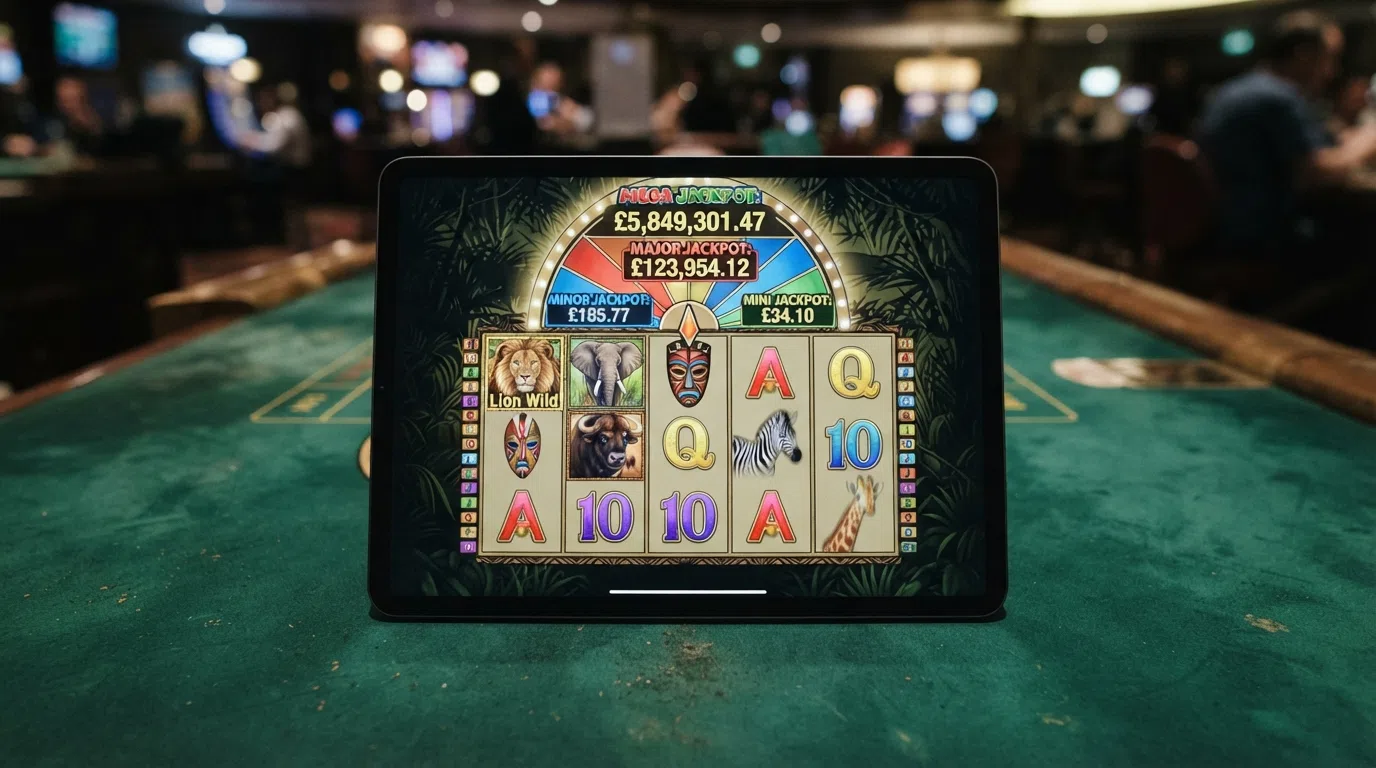
The ten titles below all have published RTP figures from the manufacturer or an independent tracker, verifiable jackpot structures, and active availability at UKGC-licensed operators. Volatility is stated where the manufacturer publishes a class; max base-game win is included where the figure is available.
| Slot Title | RTP | Provider | Volatility | Max Base-Game Win | Jackpot Type / Network |
|---|---|---|---|---|---|
| Mega Moolah | 88.12% | Games Global | Low | — | Networked, four tiers (Mega seeds at £1,000,000) |
| Divine Fortune | 96.59% | NetEnt | Medium | 1,000× | Standalone progressive |
| Mega Fortune | 96.6% | NetEnt | Medium | 1,700× | Networked, three tiers |
| Hall of Gods | 95.5% | NetEnt | Low–Medium | 4,314× | Networked, three tiers |
| Mega Fortune Dreams | 95.9% | NetEnt | Medium | 80,000× | Networked, three tiers |
| Age of the Gods | 95.02% | Playtech | Medium | 10,000× | Networked, four tiers (Power through Ultimate Power) |
| Age of the Gods: King of Olympus | 95.98% | Playtech | Medium | 18,000× | Networked, Grand Jackpot seeds at £100,000 |
| Fishin’ Frenzy Jackpot King | ~93.32% | Blueprint Gaming | — | — | Jackpot King progressive tiers |
| Dream Drop | ~94% | Relax Gaming | — | — | Networked, must-drop, seeds at €2,000,000 |
| Gladiator Jackpot | 91.46% | Playtech | — | — | Standalone progressive (~1% contribution) |
Mega Moolah — The Games Global Record-Breaker
Mega Moolah is the most-cited progressive slot in the world, and the citation is earned. The published RTP of 88.12% sits well below the non-progressive benchmark, and the base game carries low volatility — small, frequent wins that keep a session alive while the jackpot contribution does its work. The Mega tier seeds at £1,000,000 and pays out roughly every eight to ten weeks on the Games Global network, with Major, Minor and Mini tiers underneath it for more frequent but smaller hits. The Mega jackpot odds are estimated at approximately one in fifty million spins.
The record is what makes it famous. Mega Moolah holds multiple Guinness world records for online slot payouts, and the headline figures run into eight digits. The cost of buying a ticket is paid in base-game RTP — the 88.12% return, the £5 maximum stake, the 2.5-second minimum spin — and the prize is paid in lottery-scale lump sums. The structural trade is the cleanest in the market: the lowest base-game return for the largest jackpot pool.
NetEnt’s Progressive Heavyweights — Divine Fortune, Mega Fortune and Hall of Gods
NetEnt’s progressive catalogue is the high-RTP end of the market. Divine Fortune runs at 96.59% with medium volatility and a 1,000× maximum base-game win — a rarity among progressives for sitting within a percentage point of the non-progressive benchmark. Mega Fortune returns 96.6% at medium volatility with a 53% hit frequency, a 1,700× max win, and a history of eight-figure payouts on its top tier. Hall of Gods sits at 95.5% RTP (95.7% on some configurations) with low-to-medium volatility, a 37.19% hit frequency and a 4,314× max win, all wrapped in a Norse-mythology theme that has been a fixture of NetEnt’s catalogue for over a decade. Mega Fortune Dreams, the 2015 successor, runs at 95.9% RTP with medium volatility and an 80,000× max win across three progressive tiers.
The NetEnt set is the right place to start for a player who wants the progressive experience with a base-game return that does not punish every spin. Divine Fortune is the standout for RTP, Mega Fortune for hit frequency, Hall of Gods for theme and max-win potential, and Mega Fortune Dreams for the headline max-win figure.
Playtech’s Age of the Gods Series — Multi-Tier Jackpot Slots
The Age of the Gods series is Playtech’s flagship progressive suite. The core title runs at 95.02% RTP with medium volatility, a 10,000× max base-game win, and four jackpot tiers — Power, Extra Power, Super Power, and Ultimate Power — all feeding the same network. Every Age of the Gods title contributes to the same four pools, so a session on any game in the series is a session on the jackpot.
Age of the Gods: King of Olympus is the higher-RTP variant at 95.98%, with medium volatility, an 18,000× max base-game win and a Grand Jackpot that seeds at £100,000. The four-tier structure means more frequent smaller-jackpot hits than a single-pool networked game, because the Power and Extra Power tiers trigger more often than the Ultimate Power pool at the top. The series covers Greek mythology across multiple titles, all sharing the jackpot network — a session on one is a session on all of them.
Jackpot King, Dream Drop and Gladiator — Other Progressive Networks Worth Knowing
Three newer or specialist networks round out the UK market. Fishin’ Frenzy Jackpot King is Blueprint Gaming’s Jackpot King system layered onto a popular base game, sitting at roughly 93.32% RTP with multiple progressive tiers. The Jackpot King structure adds a wheel-of-fortune-style trigger to a familiar fishing theme, and the title remains a fixture at UK-facing casinos.
Dream Drop is Relax Gaming’s must-drop network, sitting at approximately 94% RTP with a 12% jackpot contribution, a €2 million seed, and a must-drop mechanic that pays out roughly every four to six weeks. The shorter payout cycle compared to Mega Moolah’s eight to ten weeks makes Dream Drop the more frequent trigger, and the must-drop ceiling gives the meter a visible deadline that players respond to.
Gladiator Jackpot is a Playtech film-licensed title with a 91.46% RTP and roughly 1% progressive contribution — a lower contribution rate than the major networked pools, sitting closer to a standalone progressive with a single pool. The base game carries the Gladiator film licence, and the prize grows more slowly than the major networks but pays out on a more accessible cycle.
How to Choose a Progressive Slot — RTP, Jackpot Size, Volatility and What Actually Matters
- RTP is the single most important number. A difference of 8 percentage points between Mega Moolah (88.12%) and Divine Fortune (96.59%) costs £80 more per £1,000 wagered on the lower-RTP title. Over a session of any length, that gap compounds.
- The current jackpot size is not predictive. A pool far above its average payout point may feel overdue, but the RNG has no memory. Every spin carries the same probability regardless of the meter’s position.
- Volatility affects session length, not jackpot odds. A medium-volatility progressive will keep your bankroll alive longer than a low-volatility title on a smaller base-game return, but neither changes the probability of the jackpot trigger.
- Provider reputation matters for the jackpot, not just the game. Established networks — Games Global, NetEnt, Playtech — have audited payout histories and the operational track record to pay seven-figure sums. Newer networks have less data behind them.
- Higher hit frequency means more base-game entertainment. Mega Fortune’s 53% hit frequency lands a base-game win more often than Hall of Gods’ 37.19%, which matters for session-to-session enjoyment even though it does not move the jackpot odds.
Where to Play Progressive Jackpot Slots in the UK — 2026 Operator Comparison
Every operator below holds an active UKGC remote casino licence verified against the Gambling Commission public register. The welcome-offer landscape is dominated by free spins, wagering is now 0× at most featured operators following the 19 December 2025 cap, and no operator lets bonus funds contribute to progressive jackpot wagering. The two operators whose welcome offers were not confirmed from published sources are marked in the table; check their promotions page for current terms.
| Operator | UKGC Licence Status | Welcome Free Spins | Wagering on Winnings | No-Deposit Spins |
|---|---|---|---|---|
| bet365 Casino | Active (Hillside, account 38721) | Up to 500 (prize reveal over 20 days) | 0× | No |
| Sky Vegas | Active (Flutter Entertainment) | 50 no-deposit + 200 on deposit | 0× | Yes (50) |
| Paddy Power Games | Active (Flutter Entertainment) | 60 no-deposit + 100 on deposit | 0× | Yes (60) |
| Coral Casino | Active (Entain) | 100 on deposit & wager | 0× (paid in cash) | No |
| Ladbrokes Casino | Active (Entain) | 100 on deposit | 10× (UKGC cap) | No |
| 888 Casino | Active (888 UK Limited, account 39028) | — | — | — |
| Virgin Games | Active (Bally’s / Gamesys) | 100 on Game of Thrones | 0× | No |
| 32Red Casino | Active (Kindred Group) | 320 on £30 slot play | 0× | No |
| JackpotJoy | Active (Bally’s / Gamesys) | 30 on Double Bubble or £50 bingo | 0× | No |
| Betfair Casino | Active (Flutter Entertainment) | — | — | — |
bet365 Casino
bet365’s progressive-slot welcome runs through a prize-reveal mechanic: ten reveals over twenty days, each producing between 5 and 50 free spins, for a headline maximum of 500 spins. Every winning reveal pays in cash with 0× wagering. The trigger is a £10 lifetime deposit, and the entire offer has a 30-day window from registration. Spin value sits at 10p.
The provider roster covers major networks including Games Global, NetEnt, Playtech, and Blueprint. The licence is held by Hillside (UK Gaming) ENC on the Gambling Commission register (account 38721). The only structural limit is the deposit trigger: there are no no-deposit spins, and the prize-reveal mechanic means the headline 500 figure is a ceiling rather than an expected outcome.
Sky Vegas
Sky Vegas is the only featured operator offering genuine no-deposit free spins as the headline offer: 50 spins claimable on opt-in with a 7-day validity window, and a further 200 spins unlocked after depositing and spending £10 with a 30-day window. Every spin’s winnings are paid in cash with no wagering.
The eligible game roster includes Fishin’ Frenzy and The Goonies among others. The provider lineup — including Games Global, NetEnt, and Blueprint — covers the full progressive network spectrum. Sky Vegas sits inside Flutter Entertainment under Sky Betting and Gaming, with an active UKGC licence. Fifty no-deposit spins offer a genuine path to test the catalogue before you deposit.
Paddy Power Games
Paddy Power Games offers the largest no-deposit spin count among the featured operators: 60 spins claimable on registration across Fishin’ Frenzy, Eye of Horus, King Kong Cashpots, Deal or No Deal Megaways and Paddy’s Mansion Heist, with a further 100 spins unlocked after depositing and wagering £10. Every winning spin pays in cash at 0× wagering, and the 7-day validity window covers the no-deposit tranche.
The licence is held by PPB Counterparty Services Limited within the Flutter Entertainment group, and the provider roster covers major networks such as Games Global, NetEnt, Playtech, and Blueprint. The combined 160-spin total is the highest headline figure from a featured operator that includes a no-deposit tranche, and the spread of eligible games makes the no-deposit spins genuinely playable rather than locked to a single title.
Coral Casino
Coral’s offer is a single-tier structure: 100 free spins across a range of eligible games after depositing and wagering £10, with winnings paid in cash and no wagering requirement. The 30-day validity window is standard, and the 10p spin value matches the rest of the Entain group.
The licence is held by LC International Limited within the Entain group, and the provider lineup covers Games Global, NetEnt, Playtech, Blueprint, Pragmatic Play and IGT. There are no no-deposit spins, and the 100-spin total is the straightforward deposit-triggered structure. This offer is the most standard choice for a player who wants clean, no-wagering terms on a deposit.
Ladbrokes Casino
Ladbrokes is the only featured operator that applies a wagering requirement to bonus winnings. The offer is bet £10, get 100 free spins on Big Bass Bonanza, Sweet Bonanza and Starburst, with 10× wagering on bonus winnings — the maximum permitted under the UKGC cap that took effect 19 December 2025. The 30-day validity is standard, and the 10p spin value matches the rest of the Entain group.
The licence and provider lineup match Coral’s (LC International Limited, Entain), but the 10× wagering requirement changes the effective value of the offer. A player who values clean cash-out terms should look elsewhere in the table; a player happy to clear the 10× turnover on a bonus title can take the spins on the same provider roster.
888 Casino
888 Casino is a long-standing UKGC-licensed operator (account 39028, active since 1 November 2014) with a provider roster covering every major progressive network: Games Global, NetEnt, Playtech, Blueprint, Pragmatic Play, Red Tiger and IGT. Visit the 888 Casino promotions page for the latest offers, including details on free-spin counts, eligible titles and wagering terms. The site’s licence standing and provider depth make 888 a viable option for any progressive title on the researched list.
Virgin Games
Virgin Games’ welcome offer is locked to a single title: 100 free spins on the Game of Thrones slot (Microgaming/Games Global, approximately 95.07% RTP), unlocked by a £10 deposit and a £10 wager. Spin value sits at 1p per coin across 10 lines, and the 30-day validity window is standard. Every winning spin pays in cash at 0× wagering.
The licence is held by Gamesys Operations Limited within the Bally’s group, and the provider lineup covers Games Global, NetEnt, Blueprint, Red Tiger and IGT. The single-title lock to Game of Thrones is the structural limit; players looking for wider title choice will find more flexibility at the no-deposit offers elsewhere.
32Red Casino
32Red carries the highest entry threshold in the featured set: 320 free spins on Big Bass Splash (Pragmatic Play, approximately 95.67% RTP), unlocked by staking £30 on slots within a 48-hour qualifying window. Spin value is £0.10, and the winnings are paid in cash at 0× wagering. Spins expire 30 days after claim.
The licence is held within the Kindred Group, and the provider roster covers Games Global, NetEnt, Playtech, Blueprint, Pragmatic Play and Red Tiger. The payment restriction is the structural limit: 32Red accepts debit card or instant bank transfer only, so no e-wallet funding. For a player funding from a bank account and willing to stake £30 to clear the threshold, the 320-spin total is the largest single deposit-triggered offer in the table.
JackpotJoy
JackpotJoy’s welcome offer is an either-or structure: 30 free spins on Double Bubble (approximately 96.02% RTP) or £50 in bingo tickets, unlocked by a £10 deposit and a £10 wager. Spin value is 1p per coin, and the 30-day validity window is standard. Every winning spin pays in cash at 0× wagering.
The licence is held by Gamesys Operations Limited within the Bally’s group, and the provider roster covers Games Global, NetEnt, Blueprint, Red Tiger and IGT. The 30-spin total is the smallest in the table, and the bingo-ticket alternative makes sense for a player who would otherwise play bingo. For a slots-only player, the headline is modest — but the Double Bubble RTP is the highest bonus-title figure in the featured set.
Betfair Casino
Betfair Casino holds an active UKGC licence under PPB Counterparty Services Limited within the Flutter Entertainment group. The provider roster covers Games Global, NetEnt, Playtech, Blueprint, Pragmatic Play, Red Tiger and IGT — every major progressive network.
Check the Betfair Casino promotions page for the latest offers, including free-spin count, eligible titles, wagering terms and any deposit or wagering threshold. The licence standing and the Flutter group backing make Betfair a credible option across the full progressive catalogue.
Free Progressive Slots — What Demo Play Teaches You (and What It Doesn’t)
Demo play on a progressive slot is a useful tool for learning what the game does, and a useless tool for winning the jackpot. The two facts sit in the same sentence because they describe the same product from two sides.
A demo spin runs on the same RNG and displays the same base-game RTP behaviour as a real-money spin. The hit frequency, the bonus-round trigger mechanics, the bet structure, the reel behaviour — all identical. What the demo spin does not do is contribute to or qualify for the progressive jackpot. Any jackpot symbol combination in demo mode either pays nothing or awards a fixed nominal prize; the real progressive pool is fed by real-money wagers only. Welcome-bonus free spins are also excluded from progressive-jackpot wagering at most UKGC-licensed operators, so a bonus-funded spin and a demo spin share the same ceiling: you can play the game, you cannot win the prize.
Free vs Real-Money Progressive Slots — What You Can and Cannot Win
The line between practice and jackpot eligibility is bright. Demo-mode spins run on the same RNG and show the same RTP curve, but the jackpot trigger is disabled. A player who lands the bonus combination on a Mega Moolah demo spin sees a fixed prize; on a real-money spin, the same combination enters the jackpot wheel. Bonus-funded spins and free spins from welcome offers are excluded from progressive-jackpot wagering at most licensed operators, which means the only route to a progressive jackpot is a real-money spin at the required stake level, funded from cash, at a UKGC-licensed operator.
What the demo mode is good for: testing volatility feel, learning the bonus-round trigger sequence, understanding the bet structure, and seeing how often the base game pays. What it is not good for: predicting the jackpot, qualifying for it, or practising a strategy to win it. The strategy does not exist — the trigger is RNG.
No-Download Free Progressive Slots — Instant Browser Play Without Registration
Most UKGC-licensed casino sites offer browser-based demo play with no download and, on many titles, no registration required. The same HTML5 client that serves real-money play serves demo play, with the jackpot contribution and trigger disabled. Mobile access works identically — a progressive slot in demo mode on a smartphone browser behaves the same as on desktop.
The practical limit is site policy. Some operators restrict demo access to registered and verified players, or to UK IP addresses, which means a player testing games from outside the UK may not see the demo option. Within the UK, the default at every featured operator is browser-based, no-download demo access across the progressive catalogue.
The Best Free Progressive Slot Games to Try Before You Stake
The case for demo play on a progressive slot is the case for testing the title whose base-game RTP is the furthest from the standard. Mega Moolah at 88.12% is the most important title to feel in demo mode before staking real money — the low base-game return is the cost of the jackpot ticket, and a player who has not felt the difference between an 88% and a 96% slot will not understand what they are paying. A 200-spin demo session on Mega Moolah versus Divine Fortune makes the gap visible in a way that no RTP number can.
Divine Fortune and Mega Fortune are the fairer practice sessions at 96.59% and 96.6% RTP, and they give a player a sense of how a near-standard progressive title behaves in the base game. Dream Drop titles are the cleanest demonstration of the must-drop mechanic — the countdown clock and the approaching ceiling are visible in demo mode, and seeing the rhythm without risking money is the point.
Crypto Progressive Slots and UK Players — Why You Lose Every UKGC Protection
A crypto casino offering progressive slots to UK players is operating outside the UK regulatory framework. The cleanest way to state it: no crypto casino holds a UKGC licence, and none can lawfully offer progressive slots to UK customers. What they offer instead is access under offshore licences — Curaçao, Anjouan, Costa Rica — that provide no UK player protections, no UKGC complaints route, and no guarantee of payout.
The progressive slot itself does not change. A Mega Moolah clone running on a Curaçao-licensed platform uses the same base game, the same RTP figure, and the same RNG math. What changes is everything around it. The licence that backs the payout is not the UK Gambling Commission. The ADR provider is not on the UKGC’s approved list. The self-exclusion scheme is not GAMSTOP. The financial vulnerability checks mandated under LCCP 3.4.4 are not run. The stake caps under SI 2025/215 do not apply. None of the consumer protections that make a UK-licensed progressive slot a regulated product extend to a crypto-licensed alternative.
Why No UKGC-Licensed Casino Accepts Cryptocurrency
The regulatory barrier is structural. UKGC anti-money-laundering and source-of-funds requirements make cryptocurrency incompatible with the licensed framework. The identity-verification mandate in force since 7 May 2019 requires every player to be verified before the first deposit, and an anonymous crypto wallet cannot satisfy the pre-deposit KYC obligation. The Gambling Commission’s position is unambiguous: no licence has been granted for crypto-funded gambling, and the credit-card ban of 14 April 2020 (including credit-card-funded e-wallets under LCCP 6.1.2) set the precedent for payment-method regulation that crypto does not meet.
A UKGC-licensed operator accepting cryptocurrency would breach its licence conditions on payment processing, source-of-funds verification and customer due diligence. The reason no UKGC-licensed casino accepts Bitcoin, Ethereum or any cryptocurrency is that doing so would mean surrendering the licence.
The Offshore Crypto Casino Landscape — Curaçao, Anjouan and What That Means for UK Players
The dominant offshore licences for crypto progressive-slots sites are Curaçao, Anjouan and Costa Rica. The player-protection frameworks under each are minimal compared to the UKGC’s LCCP and RTS, and none of them extend the Gambling Commission’s oversight to UK customers. These sites market progressive jackpot slots to UK players regardless of their legal basis to do so, because the marketing reach is global and the enforcement gap is real.
The UKGC’s enforcement approach is disruption-based, not blocking-based. Between April 2024 and June 2025, the Commission issued 3,140 disruption notices, referred 447,778 URLs to search engines, and saw 287,961 URLs removed, with an average 32% fall in engagement across 160 disrupted sites. The Commission does not hold statutory ISP or DNS blocking powers — legislation has been proposed, not enacted. Payment-provider blocks, cease-and-desist notices and search-engine referrals are the current tools, and none of them reach a UK player who has already signed up and deposited.
What UK Players Risk at Unlicensed Crypto Casinos
The protections a UK player loses at an unlicensed crypto casino are not abstract. There is no UKGC-approved ADR provider, so a disputed withdrawal has no independent resolution path. GAMSTOP does not cover offshore operators, so a self-excluded player can register and play without any barrier. The operator penalty under section 33 of the Gambling Act 2005 — up to 51 weeks’ imprisonment, an unlimited fine, or both — applies to the operator, not the player, but the player has no legal recourse if the operator withholds a progressive jackpot payout.
The practical outcome is the one that matters. If a UK player wins a seven-figure progressive jackpot at an unlicensed crypto casino, they have no enforceable right to be paid. The offshore licence may provide a complaints route within its own jurisdiction, but the route is not the UKGC’s, the enforcement is not the UKGC’s, and the payout is at the operator’s discretion. The cost of a progressive slot is the same either way; the chance of being paid the prize is not.
How UK Regulation Keeps Progressive Slots Fair — Licensing, Testing and Stake Caps
The UK regulatory framework is the reason a progressive slot at a licensed operator is a different product from the same title at an offshore site. Three layers stack on top of each other. The Gambling Act 2005 sets the primary legislation and the three licensing objectives — preventing crime, ensuring fairness, and protecting children and vulnerable persons. The LCCP (Licence Conditions and Codes of Practice) sets the day-to-day obligations every licensee must meet. The RTS (Remote Technical Standards) sets the technical requirements for game design, RNG certification, and player interaction.
Together, they govern every aspect of a progressive slot session at a UKGC-licensed operator: the stake caps, the spin speed, the bonus wagering cap, the credit-card ban, the financial vulnerability checks, the deposit-limit prompt, the reality-check requirements, and the RNG certification that backs every spin.
UKGC Licensing — What It Means for Progressive Jackpot Slots
A UKGC licence is the non-negotiable entry ticket. The Gambling (Licensing and Advertising) Act 2014 made point-of-consumption licensing compulsory — any operator serving GB customers must hold a UKGC licence regardless of where it is based. A Curaçao, Maltese or Gibraltar licence is not a substitute.
All ten featured operators on this page hold active remote casino licences on the Gambling Commission’s public register. bet365 operates via Hillside (UK Gaming) ENC, account 38721; 888 Casino is held by 888 UK Limited, account 39028, active since 1 November 2014. The three licensing objectives apply to progressive jackpot games specifically: crime prevention covers money-laundering risk on jackpot payouts, fairness covers RNG certification and published RTP, and vulnerable-person protection covers stake caps, reality checks and self-exclusion.
RNG Fairness Testing — What eCOGRA, Gaming Laboratories International and iTech Labs Actually Check
Independent testing houses verify that progressive jackpot RNGs are truly random and that the published RTP is accurate. The approved testing bodies for the UK market include eCOGRA, Gaming Laboratories International and iTech Labs. A certification covers the RNG algorithm, the published RTP, the jackpot contribution rate, and the trigger mechanism — the four numbers that define the game’s mathematical behaviour.
The RTS requirement is that RNGs must be “random, fair and cannot be influenced or interfered with.” The testing-house seal at the footer of a UKGC-licensed casino site is a live link to the certificate, and a player can verify a title’s certification by following it. A progressive slot at a UKGC-licensed operator has been independently tested to a published standard; a progressive slot at an offshore site has not been tested to any standard the UKGC recognises.
The £5 and £2 Stake Caps — How They Changed Progressive Slots Play in the UK
The statutory stake caps split the UK player base into two bands. Players aged 25 and over face a £5 maximum per game cycle (in force 9 April 2025); players aged 18 to 24 face a £2 maximum (in force 21 May 2025). Both are imposed by SI 2025/215, and the cap applies to the total staked within one game cycle — it is the spin’s aggregate stake, not a per-line limit.
The age band means two adults at the same casino face different maximum bets on the same progressive title. The impact on jackpot eligibility is real: some progressive slots require a minimum stake (often the maximum bet) to qualify for the top jackpot tier, and the £2 cap may lock 18–24 players out of that tier on certain games. The cap is a hard ceiling, set in statute, and no operator can override it regardless of what a bonus term says.
Player Protection Under UK Law — Deposit Checks, Credit Card Ban and Bonus Caps
The UKGC-mandated protections apply to every progressive-slot session at a licensed operator. The credit-card ban has been in force since 14 April 2020, covering credit-card-funded e-wallet deposits as well as direct credit-card payments. Financial vulnerability checks at the £150 net deposit threshold (rolling 30-day) became mandatory from 28 February 2025 under LCCP 3.4.4, using publicly available data only. Wagering requirements on bonuses are capped at 10× from 19 December 2025, with mixed-product promotions banned under the same LCCP code.
Every UKGC operator must offer a customer the chance to set a gross deposit limit before the first deposit, with decreases immediate and increases delayed, in force from 31 October 2025. Reality checks — pop-up reminders showing time elapsed and net spend — interrupt play at set intervals during every session. The auto-play ban (in force 31 October 2021) and the 2.5-second minimum spin speed (RTS 14D) keep the pace of play within bounds that the regulator considers compatible with player safety.
Chasing Progressive Jackpots Safely — Responsible Play Tools That Work
Progressive slots are designed to make the jackpot feel close. The visible counter is real, the prize is real, and the gap between “almost” and “won” is the design. Responsible play is the set of tools that keeps the chase within a budget the player set before they started, and the UK regulatory framework is built around making those tools mandatory.
The prevalence data backs the framing. The National Gambling Support Network treated 11,960 clients in Great Britain from April 2024 to March 2025, an 11% year-on-year increase. Among online gambling types, casino slots was the most common activity at 46% of clients, up from 41% the year before. Progressive slots are a subset of that figure, but the structural features — lower base-game RTP, longer jackpot odds, a prize designed to feel attainable — make them a particular case for pre-set limits.
Deposit Limits, Session Controls and Reality Checks — Practical Tools for Progressive Slots Players
Every UKGC-licensed operator must prompt a player to set a financial limit before the first deposit, in force from 31 October 2025. A gross deposit limit must be offered, and decreases are immediate while increases are delayed. The prompt is the operator’s obligation, not the player’s — the limit is offered, set, and the operator enforces it.
Session-time limits and reality checks are built into the slot client itself. Reality checks are pop-up reminders showing time elapsed and net spend that interrupt play at set intervals, and they apply to every licensed slot session including progressive titles. The 2.5-second minimum spin speed and the auto-play ban mean a session is naturally paced, but the jackpot display is designed to encourage one more spin. The reality check is the structural answer to that pull. A player who sets a deposit limit, a session time limit, and reads the reality-check alerts is operating within the framework the regulator considers safe; a player who overrides each one is operating outside it.
GAMSTOP Self-Exclusion — How It Works and Why It Matters for Jackpot Chasing
GAMSTOP is the mandatory national self-exclusion scheme covering every GB-licensed online gambling site. One registration blocks access to every licensed operator, including all ten featured on this page. The four exclusion periods — six months, one year, five years, or five years with auto-renewal — cannot be cancelled early.
For a progressive-slot player, the pattern that drives self-exclusion is specific. The near-miss on a bonus wheel, the increased stake after a losing session, the deposit made to chase a jackpot that “feels close” — these are the behavioural flags that lead to a GAMSTOP registration. The scheme is the single most effective barrier a UK player can put between themselves and a progressive slot, because it operates at the operator level rather than the session level. The limit a player can override; the GAMSTOP block the operator cannot.
Offshore and crypto casinos are not enrolled in GAMSTOP, which is one of the protections a UK player loses by gambling outside the licensed market. A self-excluded UK player can register and play at an unlicensed crypto casino with no barrier at all.
Recognising When the Chase Becomes a Problem — Signs, Prevalence Data and Where to Get Help
The behavioural flags specific to progressive-jackpot play are well-defined. Depositing again immediately after a session to chase a jackpot that “feels close.” Increasing stake size beyond a pre-set limit. Playing through reality-check alerts without reading them. Borrowing to fund a session. Lying about time or money spent. The 46% slots figure in NGSN treatment data is the context: lower base-game RTP means losses accumulate faster, and the visible jackpot is the emotional hook that keeps the session running.
Help is free, confidential and available 24/7. The GamCare National Gambling Helpline (0808 8020 133) operates around the clock. NHS gambling harm clinics run in England, Scotland and Wales. Gamblers Anonymous holds peer-support meetings across the UK. GambleAware’s National Gambling Support Network is the treatment provider behind the prevalence data quoted on this page. The statutory levy of 1.1% of GGY (in force from 6 April 2025) funds treatment (50%), prevention (30%) and research (20%) — the system is publicly funded, and a player who needs it can access it without cost.
How We Chose and Ranked the Operators on This Page
The operator selection on this page is built on a single criterion: every featured operator holds an active UKGC remote casino licence, verified against the Gambling Commission’s public register. bet365 operates via Hillside (UK Gaming) ENC, account 38721; 888 Casino is held by 888 UK Limited, account 39028. The remaining eight operators were each checked against the register at the time of writing, and their licence status is stated in the operator table.
The evaluation basis for ranking is three-fold. Welcome-offer terms — free-spin count, wagering requirements, deposit thresholds, validity windows — are quoted from operator terms pages. Progressive-slot provider rosters — Games Global, NetEnt, Playtech, Blueprint, Pragmatic Play, IGT, Red Tiger coverage — are stated where confirmed. Licence standing is the floor, not the ceiling: every featured operator is licensed, and the ranking within the table is by offer terms rather than licence tier.
The progressive-title selection follows the same discipline. Every slot title recommended on this page carries a published RTP from its manufacturer or an independent tracker, and volatility, max base-game win and provider data are stated only where verifiable. The table of ten titles includes cells where the underlying data was not available from published sources; those cells are empty rather than guessed.
The sources used are: the Gambling Commission public register, operator terms pages, manufacturer game sheets (NetEnt, Playtech, Games Global, Relax Gaming, Blueprint), and independent slot-data trackers. The ranking does not weight commercial relationships — no operator paid for inclusion or placement, and the page carries no promotional codes.
What the Numbers Say — Should You Actually Play Progressive Slots?
The verdict sits in the arithmetic. On Mega Moolah at the £5 maximum stake, a 200-spin session (roughly 8.3 minutes at the 2.5-second minimum spin speed) carries an expected loss of 200 × £5 × (1 − 0.8812) = £118.80. On a standard 96% RTP slot over the same session, the expected loss is 200 × £5 × 0.04 = £40.00. The £78.80 difference is the price of the jackpot ticket, paid by every player who does not win the Mega.
The odds put that ticket in perspective. One in fifty million per spin on the Mega jackpot means a player running 200 spins per session would need roughly 250,000 sessions — about 35 years of daily play at eight minutes per session — to expect a single Mega trigger. The lifetime odds of being struck by lightning in the UK are around one in 15,300, more than three thousand times more likely than a single Mega Moolah spin. The lottery framing is the right one: someone does win, every eight to ten weeks on the Mega, but the probability that the next spin is yours is not meaningfully different from zero.
What the numbers do not capture is why anyone plays. The entertainment value of watching the jackpot meter rise, the genuine possibility — however small — that this is the spin, the social fact that a real person wins a real seven-figure sum roughly every two months. The numbers say the chase is a bad expected-value bet. The experience says it is the only slot game where a £5 spin can plausibly change a life.
The practical bottom line is three rules. Treat a progressive slot as a lottery ticket attached to a slot machine. Set a loss limit before you open the game, and stop when you reach it. Never chase a jackpot with money you cannot afford to lose — the base game will take it, and the jackpot will not give it back. If you want the longest session for your money, pick the highest-RTP progressive title on this page: Divine Fortune at 96.59% is the closest a progressive slot gets to the non-progressive benchmark, and the difference between 96.59% and 88.12% is the difference between an entertainment budget that lasts the evening and one that does not last the hour.
Frequently Asked Questions
What are the chances of winning a progressive jackpot on a slot machine?
Progressive jackpot odds on major networked titles run from approximately one in five million to one in fifty million per spin, with Mega Moolah’s Mega jackpot at the long end of that range. A player running hundreds of spins in a session is buying a ticket to a prize the vast majority of players will never see paid out.
Do I need to bet the maximum stake to win a progressive jackpot?
Many progressive titles require a minimum stake — often the maximum bet — to qualify for the top jackpot tier, and the £5 statutory cap (players aged 25+) or £2 cap (18–24) sets the ceiling. Below the qualifying stake, lower-tier jackpots may still be available, but the headline prize typically requires max-bet play.
How often do progressive jackpots like Mega Moolah pay out?
Mega Moolah’s Mega jackpot pays out approximately every eight to ten weeks on the Games Global network, with the prize reseeding at £1,000,000 after each win. The Dream Drop network pays out more frequently — roughly every four to six weeks — at a €2,000,000 seed. Lower-tier jackpots on multi-tier titles trigger more often than the top prize.
Can I use a welcome bonus to play progressive jackpot slots at UK casinos?
No. Most UKGC-licensed operators exclude progressive jackpot slots from welcome-bonus wagering entirely, so bonus funds and free-spin winnings cannot be used on progressive titles. Progressive jackpot play is functionally a real-money-only product at licensed UK casinos, regardless of how generous the welcome offer is on other games.
Can I try progressive jackpot games without depositing money in the UK?
Yes — most UKGC-licensed casino sites offer browser-based demo play on progressive slots with no download and often no registration required. Demo spins run on the same RNG and show the same RTP behaviour as real-money play, but the jackpot trigger is disabled. A demo spin cannot win the progressive prize; only real-money spins qualify.
Are progressive jackpot slots fair and tested for randomness in the UK?
Yes. Every progressive slot at a UKGC-licensed operator has been independently tested by an approved testing house — eCOGRA, Gaming Laboratories International or iTech Labs — for RNG randomness, published RTP accuracy, and jackpot-trigger integrity. The testing-house certificate is linked from the operator’s site footer and can be verified directly.
What Is a Progressive Jackpot Slot and How Does the Prize Pool Build?
Every progressive slot has three moving parts. The seed amount is the floor: the value the jackpot resets to after a win, guaranteeing that even a freshly triggered pool pays out a meaningful sum. The Mega jackpot on Mega Moolah seeds at £1,000,000; the Dream Drop network seeds its top tier at €2 million; Age of the Gods: King of Olympus seeds its Grand Jackpot at £100,000. The contribution is the percentage of each wager that flows into the pool, and it varies by title — around 8% on Mega Moolah, roughly 12% on Dream Drop, about 1% on Gladiator Jackpot. The trigger is the condition that releases the prize, which can be a randomly generated amount (mystery), a published ceiling (must-drop), or a symbol combination on a bonus wheel.
These three components are what separate a progressive from a fixed-jackpot slot, where the top prize is a static multiple of the stake and never grows. The visible prize meter is the one design choice that distinguishes progressive titles at a glance. The number is real, it moves in real time, and it is what every marketing image of a progressive slot is built around.
Slots – realmoney-onlinecasinos-uk
Content created by the «realmoney-onlinecasinos-uk» team