
The Highest RTP Slots UK Players Can Actually Play in 2026
 Available in GB
Return to player is the single number that decides how much of every pound a slot eventually gives back. The UK online slots market averaged roughly 96% RTP in the year to March 2026, against 25.1 billion spins in the first quarter of 2026 alone — a market that turned over £773 million in gross gambling yield in those three months. Against that scale, the gap between a 96% slot and a 99% slot is not academic. It is a halving of the house edge, applied to billions of pounds in stakes.

This page ranks the highest-RTP slots confirmed for UK players, names the licensed casinos that carry them, and walks through the regulatory framework that decides what the figure on the screen actually means. The numbers below come from provider data and UK Gambling Commission guidance, not from a round-up of unverified claims. Where a figure is the highest tier a provider offers, the page says so — and the section on configurable RTP explains why that distinction matters when you sit down to play.
Data current as of September 8, 2026, verified against the UK Gambling Commission public register.
What RTP Actually Means — And Why a Percentage Point Matters to UK Players
Return to player is the long-run share of every pound staked that a slot pays back to players. A 96% RTP slot returns £96 for every £100 wagered across millions of spins. The remaining £4 is the house edge — the operator’s margin, baked into the maths of the game before it ever reaches a casino lobby.
That figure is always theoretical. It is measured over millions of simulated spins, not over your Tuesday evening. In a session of a few hundred spins, variance dominates and the actual return can swing from a total loss to a large win. The Gambling Commission applies the same rigour to prevalence estimates in its gambling surveys, citing confidence intervals because point estimates over small samples mislead — the same statistical caution applies to RTP. The headline percentage is what the game does on average, not what it owes you tonight.
The difference between 96% and 98% RTP looks like two percentage points. It is not. It is a halving of the house edge — from 4% to 2%. Over 1,000 spins at £1 each, the expected loss falls from £40 to £20. The gap compounds with stake volume, and the UK market runs at 25.1 billion spins a quarter, so even a small shift in the average RTP across the games people actually play moves real money.
The Commission’s own approach to confidence intervals applies here. Where the actual data sits between 1.9% and 2.8% on problem-gambling prevalence, the Commission names the range rather than the headline figure. RTP figures on slot review pages should be read the same way: the percentage is an estimate with a range, and a slot running at 96% in one location may run at 94% somewhere else. The section on configurable RTP explains how that happens.
The Highest-RTP Slots Confirmed for UK Players — Five Titles Backed by Verified Data
The five titles below carry the highest verified RTPs available to UK players, each sourced to provider data or independent test-house results. Every percentage is the highest tier the provider offers, not necessarily the tier a specific casino has deployed. The section on configurable RTP later in this page explains how to check the figure at the casino where you play.
| Slot | RTP | Provider | Volatility | Max Win |
|---|---|---|---|---|
| Ugga Bugga | 99.07% | Playtech | Low | — |
| Book of 99 | 99.00% | Relax Gaming | High | 10,000x |
| Mega Joker | 99.00% | NetEnt | High | 2,000x |
| 1429 Uncharted Seas | 98.60% | Thunderkick | Low | 500x |
| Blood Suckers | 98.00% | NetEnt | Low | 900x |
Three caveats before you read further. First, Ugga Bugga’s headline figure of 99.07% makes it the highest-RTP slot commercially available, but it is an older Playtech title with a 2004 release and a multi-reel layout that differs from a standard five-reel slot — the experience does not match a modern release. Second, Book of 99 ships at a fixed 99.00% RTP from Relax Gaming, a studio that chose to release a title at the ceiling rather than offer a tiered range. Third, Mega Joker’s 99.00% is conditional: it applies at the maximum coin setting with wins moved through the Supermeter, the second set of reels stacked above the base game. Casual low-stakes spins return less.
Blood Suckers and 1429 Uncharted Seas sit below 99% but carry fixed RTPs that do not vary by bet size or operator — both studios ship a single figure and stick to it. Blood Suckers runs at 98.00% across all stakes with a 45% hit frequency and a 900x max win, and 1429 Uncharted Seas runs at 98.60% across 25 paylines with a 500x max win. For a player who wants the highest theoretical return without the conditional fine print, those two are the cleanest options on the list.
The table omits max win for Ugga Bugga because Playtech’s published data for that title does not specify a single multiplier in the same format as the others — a small gap that is more honest than a fabricated number. Always check the RTP figure in the game’s own rules panel at your casino before you play. The percentage there is the one the operator has actually deployed.
Highest RTP by Format — Online, Mobile and Where They Differ
Online slots dominate UK play, accounting for 25.1 billion spins in the first quarter of 2026 alone. That is where the highest-RTP titles are found and where the rest of this page focuses. Mobile play runs the same game files as desktop at any UKGC-licensed operator — the RNG, the maths model, and the RTP are identical across devices. A slot at 98% on your laptop is the same slot at 98% on your phone, because the licensed operator serves the same game client to both.
Retail casino-floor machines sit under a different regulatory regime. The UKGC’s stake-cap and RTP-disclosure rules apply to remote operators, and the gaming-machine technical standards that govern pub and arcade machines run through a separate framework with typically lower RTP ranges and a smaller catalogue of titles. A UK player looking for the highest-RTP experience will find it online, not on the floor.
The format distinction matters less than the configurable-RTP distinction — the same slot can return differently at two online casinos. That point is developed in the section on configurable RTP. For now, the takeaway is that mobile and desktop are equivalent, and the highest-RTP titles are online.
Beyond Slots — The Highest RTP Casino Games for UK Players
Slots cluster around 96% on average, and the table above shows the top titles pushing past 98%. Table games and video poker routinely beat that. Blackjack with optimal basic strategy sits comfortably above 99%, and full-pay video poker variants can reach into the 99.5% range. Single-zero roulette runs at roughly 97.3% — a full percentage point above the slot average.
The reason is structural. Slots are random per spin with no decision point for the player. Table games reward decisions, and a player who knows basic strategy shrinks the house edge to its mathematical minimum. Video poker does the same through hand selection on a fixed-paytable machine.
And yet slots dominate. The UK market ran 25.1 billion slot spins in a single quarter — the format overwhelms everything else in volume. Players choose slots for the no-skill barrier, the progressive jackpots, the visual variety, and the bonus-round anticipation. The arithmetic favours the table-game player. The convenience favours the slot player. Both can be true at once, and a player who splits sessions between a high-RTP slot like Blood Suckers and a basic-strategy blackjack hand is doing what the maths rewards.
How RTP Percentages Are Tested and Verified — The UKGC Standard
Every slot released at a UK-licensed casino must be independently tested against the Remote Technical Standards by a UKGC-approved test house before it goes live for British players. The approved list includes eCOGRA, Gaming Laboratories International (UK) Limited, and Gaming Associates Europe Ltd, with BMM Testlabs also recognised. The test house certifies the RNG, the maths model, and the advertised theoretical RTP — none of which the operator can change without re-testing.
Testing is the start, not the end. The Commission requires operators to monitor live (actual) RTP against the theoretical figure the test house certified, with tolerances that narrow as play volume increases. A new slot can deviate more from its theoretical RTP in its first weeks because the sample is small; the same slot running millions of spins a month must hew closer to the certified figure or the operator’s compliance team has questions to answer.
A player can check two things. First, the in-game rules panel — required by RTS 3C to display the average theoretical RTP — is the definitive source for what the operator has deployed. Second, the operator’s published RTP reports, where available, show the live performance of individual games against theoretical. Neither replaces the in-game panel for the specific game you are about to play, but the published reports show whether the operator’s catalogue is performing as certified.
The test-house list is the floor, not the ceiling. A UKGC-licensed casino is one whose games have passed independent certification. An unlicensed casino has no such requirement, and the figure on the screen may be invented. The section on what you lose at an unlicensed casino develops that point.
Why RTP Figures Change — Freshness and Where to Find Today’s Numbers
RTP is not static. Major studios run configurable RTP tier systems that let operators choose the margin they want from a range the provider offers. NetEnt’s system spans 6 to 8 tiers, with Tier 1 — 96.09% for Starburst — the most common at UK-licensed casinos. Pragmatic Play runs a 3-tier system, with the highest tier for Gates of Olympus at 96.50% and lower tiers at approximately 95% and 94.50%. Play’n GO runs a 5-tier system spanning roughly 84% to 96%, with Book of Dead at 96.21% on the highest tier and as low as 84.51% on the lowest.
That is a 12-percentage-point spread on the same game title at different UK casinos. Book of Dead at 96.21% returns £96.21 per £100 wagered over the long run; the same slot at 84.51% returns £84.51. The two games have the same name, the same reels, and the same features. The maths model the casino chose to deploy is different, and the in-game rules panel will show the figure.
The implication is that any slot RTP quoted on a review page — including this one — is the highest tier the provider offers, not a promise of what your casino runs. Always check the in-game rules panel. The figure displayed there is the one the operator has actually deployed, and it is the one that decides your expected return. The configurable-RTP section later in this page covers the practical implications in detail, including what a player should do when a casino offers a familiar title at a noticeably lower percentage than the headline figure.
UK Casinos for High-RTP Slots — Welcome Offers Compared
Ten UKGC-licensed casinos ranked by their high-RTP slot catalogues and welcome-offer value. Every operator below holds an active licence confirmed against the public register (last updated 29 July 2026). The table compares free-spin count, wagering on winnings, and bonus validity. Eight of the ten offer zero-wagering free spins; 32Red carries 10× wagering on its 320-spin offer, and 888 Casino is the only operator offering a deposit match rather than free spins.
| Casino | Welcome Free Spins | Wagering on Winnings | Bonus Validity |
|---|---|---|---|
| bet365 | 500 | 0× | 30 days to claim; 7 days per batch |
| Ladbrokes | 200 | 0× | 48 hours to accept; 7 days |
| Sky Vegas | 200 | 0× | 30 days to deposit; 7 days |
| Betfred | 200 | 0× | 30 days to stake; 7 days |
| William Hill | 200 | 0× | 7 days; 72 hours from issue |
| Paddy Power | 260 (60 no-deposit + 200 on deposit) | 0× | 7 days |
| Betfair | 150 (50 no-deposit + 100 on deposit) | 0× | Standard expiry |
| Coral | 100 | 0× | 48 hours to accept; 7 days |
| 32Red | 320 on Big Bass Splash | 10× | 7 days to claim; 48 hours to use |
| 888 Casino | — (100% deposit match up to £100) | 10× on bonus funds | 90 days; 48 hours to accept |
Free-spin count alone is not the whole story. A 500-spin offer at zero wagering from a casino with a 1,500-title catalogue is a different proposition from a 320-spin offer at 10× wagering on a Microgaming-primary catalogue. Wagering requirements, slot catalogue breadth, and provider access all shape what a welcome package is actually worth. The regulation section explains why the wagering cap matters — from 19 December 2025, the LCCP Social Responsibility Code 5.1.1 caps wagering at 10× on bonus funds and bans mixed-product promotions. The two operators on this list carrying wagering are at the cap, not above it.
The £5/£2 per-spin stake cap applies to all online slots at every UKGC-licensed operator. The section on the stake cap explains how it interacts with high-RTP slots whose best return is conditional on a max bet.
bet365 — The 500 Free Spins Leader With Zero Wagering
bet365 runs the largest free-spin welcome offer in the featured set: 500 spins over 20 days with zero wagering on winnings, at 10p per spin on selected titles. The qualifying deposit is £10, and the spins reveal in batches — 5, 10, 20 or 50 per reveal — with a 7-day expiry on each batch and 30 days from registration to claim. Slots on the offer include Book of Horus, Curse of the Bayou, Magic Forge, and Wrath of the Deep. Paysafecard deposits are excluded from the promotion.
The slot catalogue runs to 1,500+ titles from NetEnt, Pragmatic Play, Play’n GO, Big Time Gaming, Hacksaw Gaming, Blueprint, Microgaming, Evolution, and 40+ additional vendors via the EveryMatrix SlotMatrix aggregation deal. That breadth matters for a player hunting the highest-RTP titles: the catalogue carries NetEnt’s Blood Suckers and Mega Joker, Relax Gaming’s Book of 99, Thunderkick’s 1429 Uncharted Seas, and the full Pragmatic Play range at whatever tier the operator has deployed.
bet365 operates under a UKGC licence held by Hillside (UK Gaming) ENC, account 55149, with active Casino Remote and Betting Host Remote permissions. The licence is current against the public register. With a massive 1,500+ title library, this is the most direct destination for those seeking the deepest catalogue alongside the 500-spin offer.
32Red — 320 Free Spins With the Set’s Only Wagering Requirement
32Red offers 320 free spins on Big Bass Splash at 10p each, requiring a £30 deposit and stake. The offer carries 10× wagering on free-spin winnings — the only wagering-carrying free-spin offer in the featured set. The 10× figure is the UKGC cap, not an outlier, but every other operator on this list offers free-spin winnings at zero wagering. Claim window is 7 days; spin expiry is 48 hours; debit card or instant bank transfer deposits only.
The slot catalogue is Microgaming-primary, with NetEnt, Evolution, IGT, and Big Time Gaming alongside. Big Bass Splash itself is a Pragmatic Play title, hosted via 32Red’s integration rather than a Pragmatic-led catalogue. The Microgaming focus means the catalogue runs deep on legacy titles and progressive-jackpot networks (Mega Moolah and the wider Games Global network), with the highest-RTP shortlist partially covered.
32Red operates under a UKGC licence held by 32Red Plc, part of the Kindred Group, with active Casino Remote status. For a player who values the Microgaming catalogue and the 320-spin count is more important than the zero-wagering alternative, 32Red delivers. The wagering requirement is the trade-off, and it is the largest single drag on the offer’s real-world value in the featured set.
Paddy Power — 260 Free Spins Including 60 No-Deposit
Paddy Power is the only operator on the list offering a substantial no-deposit free-spin allocation: 60 spins on registration (50 on eligible slots plus 10 on the exclusive Paddy’s Mansion Heist) plus 200 more after a £10 deposit and wager, for 260 spins total. All carry zero wagering on winnings, with a 7-day expiry.
The slot catalogue is broad across NetEnt, Pragmatic Play, Play’n GO, and Evolution, with exclusive Paddy Power branded titles alongside. The no-deposit block matters for a player who wants to test the catalogue before committing — 60 spins is enough volume to feel a slot’s volatility profile and confirm the RTP figure shown in the rules panel.
Paddy Power operates under a UKGC licence held by PPB Counterparty Services Limited, part of Flutter Entertainment, with active Casino Remote status. The 260-spin offer is the standout no-deposit angle in the featured set, making this a logical first step for testing the catalogue volatility before committing funds.
Sky Vegas — 200 Free Spins, No Wagering, Broad Catalogue
Sky Vegas offers 200 free spins with zero wagering on winnings, triggered by a £10 deposit and stake. The spins load on the first eligible game with a 7-day expiry, and the qualifying deposit and stake window is 30 days. The slot catalogue runs extensive across NetEnt, Pragmatic Play, Play’n GO, Big Time Gaming, Evolution, Red Tiger, and Blueprint, with exclusive Sky-branded titles alongside.
The Flutter Entertainment backing places Sky Vegas in the same group as Paddy Power and Betfair, with shared platform infrastructure and overlapping but distinct promotional calendars. The exclusive Sky-branded slots add titles that do not appear at non-Flutter casinos.
Sky Vegas operates under a UKGC licence held by Sky Betting & Gaming, part of Flutter Entertainment, holding active Casino Remote status. As a Flutter brand, it provides a stable environment and a polished platform that aligns well with the 200-spin welcome offer.
Ladbrokes — 200 Free Spins, 1,800+ Slots, Zero Wagering
Ladbrokes pairs a 200-free-spin zero-wagering offer with the largest slot catalogue in the featured set at 1,800+ titles. The qualifying trigger is a £10 deposit and stake, with 48 hours to accept the offer and 7 days to use the spins at 10p each. The catalogue spans NetEnt, Pragmatic Play, Big Time Gaming, Play’n GO, Hacksaw Gaming, Microgaming, and Blueprint via Entain’s network.
Catalogue depth matters for a player who wants the highest-RTP shortlist in full. A 1,800-title library is more likely to carry every title on the verified shortlist than a smaller catalogue, and the Entain relationship with Blueprint Gaming and Big Time Gaming brings Megaways variants and Jackpot King progressive titles into the mix.
Ladbrokes operates under a UKGC licence held by Entain Operations Limited, account 57408, with active Casino Remote and Betting Host Remote permissions, active since 2 February 2021. With 1,800+ titles available, this is the choice for volume players needing extensive access to Blueprint and Megaways variants.
Betfred — 200 Free Spins, Zero Wagering, 30 Days to Stake
Betfred offers up to 200 free spins with zero wagering on winnings, triggered by staking £10 or more on slots. The 30-day window to complete the qualifying stake is the longest in the featured set, giving a player more time to find the right moment to trigger the offer. Spins credit within 48 hours of the qualifying stake, with a 7-day expiry on the spins themselves. Debit card deposits are required — e-wallets may be excluded.
The slot catalogue runs extensive across NetEnt, Pragmatic Play, Play’n GO, Red Tiger, Blueprint, and IGT. The 30-day trigger window is the differentiator: every other operator requires the stake within 7 days, and a player who wants to time the offer around a specific slot release or a scheduled session has more flexibility at Betfred.
Betfred operates under a UKGC licence held by Petfre (Gibraltar) Limited, with active Casino Remote status. The 30-day trigger window is the primary advantage, offering flexibility to time your qualifying stake around specific game releases or sessions.
William Hill — 200 Free Spins on Big Bass Splash, Zero Wagering
William Hill offers 200 free spins at 10p each on Big Bass Splash with zero wagering on winnings, triggered by opting in, depositing, and wagering £10. The spin expiry is 72 hours from issue — the tightest expiry in the featured set — and debit card deposits are required.
The slot catalogue is extensive across NetEnt, Pragmatic Play, Play’n GO, Evolution, Red Tiger, Blueprint, and IGT, with exclusive William Hill titles. Big Bass Splash is a Pragmatic Play title, and the catalogue is wide enough to carry the full highest-RTP shortlist alongside.
William Hill operates under a UKGC licence held by William Hill Organization Limited, account 2752, active from 1 January 2009. One of the industry’s longest-standing brands, it offers a focused 200-spin introduction that is highly efficient for those targeting Big Bass Splash.
Betfair — 150 Free Spins, 50 No-Deposit, Zero Wagering
Betfair offers 50 no-deposit free spins on sign-up plus 100 deposit-triggered spins at a £10 deposit, for 150 spins total with zero wagering on all winnings. The no-deposit block gives a player 50 spins to test the catalogue before committing — useful for verifying the RTP figures in the in-game rules panel against the headline values. Spins are 10p each.
The slot catalogue runs broad across NetEnt, Pragmatic Play, Play’n GO, Evolution, Blueprint, and Red Tiger. The Flutter Entertainment backing means shared infrastructure with Paddy Power and Sky Vegas, though the promotional calendar is distinct.
Betfair operates under a UKGC licence held by PPB Entertainment Limited, part of Flutter Entertainment, and maintains active status. For a player who wants a no-deposit entry point and a Flutter catalogue, Betfair’s 150-spin offer is the most direct fit.
Coral — 100 Free Spins, Zero Wagering, Blueprint-Strong Catalogue
Coral offers 100 free spins at 10p each with zero wagering on winnings, triggered by depositing and playing £10 or more on slots. The 48-hour acceptance window and 7-day spin expiry are standard for the set. The 100-spin count is the smallest in the featured set, but the slot catalogue compensates: 1,700+ titles with a particularly strong Blueprint Gaming integration and Jackpot King progressive network coverage, alongside NetEnt, Pragmatic Play, Big Time Gaming, and Microgaming.
The Blueprint strength matters. Jackpot King titles and Megaways variants from Blueprint expand the high-RTP selection beyond the core shortlist, and a player who values progressive-jackpot coverage alongside high-RTP play will find more at Coral than at operators with smaller catalogues.
Coral operates under a UKGC licence held by Entain Operations Limited, account 39225, with valid Casino Remote permissions. For a player who values Blueprint Gaming coverage and Jackpot King access, Coral’s 100-spin offer sits in front of the strongest catalogue in the set for that specific priority.
888 Casino — The Deposit-Match Outlier, 10× Wagering
888 Casino is the only operator in the featured set offering a deposit-match bonus rather than free spins: 100% up to £100 on a minimum £10 deposit, with 10× wagering on bonus funds on selected slots within 90 days, winnings capped at £100, and a 48-hour acceptance window.
The structure is fundamentally different. Bonus funds give flexibility to play across more games and at stake levels the player chooses, but the 10× wagering and the £100 winnings cap are constraints the zero-wagering free-spin offers do not carry. The 90-day wagering window is the longest in the set, giving time to clear the requirement, but the cap on winnings limits the upside.
The slot catalogue runs broad with NetEnt, Playtech, Evolution, Pragmatic Play, Red Tiger, and Blueprint, alongside proprietary 888 titles. Playtech’s inclusion means Ugga Bugga — the highest-RTP slot in the table — is available here, and the proprietary 888 titles are exclusive to the brand.
888 Casino operates under a UKGC licence held by 888 UK Limited, part of evoke plc, with active Casino Remote status. For a player who prefers bonus funds to free spins and wants a Playtech-heavy catalogue, 888 is the only match in the set — but the wagering and the winnings cap make it the highest-friction offer in the featured ten.
The Studios Behind the Percentages — Which Providers Build the Highest-RTP Slots
RTP is a provider decision before it is a casino one. Each studio designs its RTP ceiling, its configurable-tier range, and its house style, and knowing who builds what tells a player where to look. The provider identity matters more than the casino choice in many cases: a slot with a fixed 99% RTP behaves the same at every operator, while a slot with a 5-tier range can return 96% at one casino and 84% at another.
Pragmatic Play — High-RTP Titles in a 3-Tier System
Pragmatic Play runs a 3-tier configurable RTP system in the UK. The highest tier for flagship titles like Gates of Olympus sits at 96.50%, with lower tiers at approximately 95% and 94.50%. The 3-tier structure is the tightest range among major UK-facing providers — a Pragmatic slot at the lowest tier still returns close to 95%, which limits the downside relative to providers with wider tier systems.
The highest-RTP Pragmatic slots available to UK players are the flagships at the top tier: Gates of Olympus, Sweet Bonanza, and the Big Bass series. Pragmatic does not ship a fixed-99% title in the way Relax Gaming did with Book of 99, and the ceiling for the studio sits at 96.50% even at the top tier. The studio’s house style favours high-volatility bonus-buy features, and the RTP ceiling reflects a balance between player return and the cost of the feature design.
A player who wants to know which tier their casino is running should open the in-game rules panel. The figure displayed there is the deployed tier, and the difference between 96.50% and 94.50% is 2 percentage points of house edge — meaningful over volume.
NetEnt — The 6-to-8-Tier Giant and the Mega Joker Condition
NetEnt operates the most granular configurable RTP system in the UK market, with up to 8 tiers per title. Tier 1 — 96.09% for Starburst — is the most commonly deployed at UK-licensed casinos. The 99% and 98% tiers are rarely deployed in practice, which means a NetEnt slot’s headline RTP at the top of a review page is almost never the figure a player actually sees in the game.
NetEnt’s two highest-profile high-RTP titles are Mega Joker at 99.00% and Blood Suckers at a fixed 98.00%. Mega Joker’s 99% is conditional on max-stake Supermeter play, and casual low-stakes spins return less. Blood Suckers runs at a fixed 98.00% across all bet sizes with low volatility and a 45% hit frequency, making it the cleaner high-RTP option in the NetEnt catalogue.
The configurable-RTP implications are sharpest for NetEnt. A NetEnt slot at one UK casino can return meaningfully less than the same slot at another, and the in-game rules panel is the only reliable check. A player who sees a familiar NetEnt title at a noticeably lower percentage than the review-page headline is not looking at a wrong figure — they are looking at a different tier.
Megaways — The Highest-RTP Big Time Gaming and Megaways-Licensed Slots
Megaways is the Big Time Gaming mechanic licensed to multiple studios, with dynamic paylines reaching up to 117,649 ways per spin. The mechanic’s extreme volatility means the RTP plays out over very long stretches — a high-RTP Megaways slot can deliver long losing streaks punctuated by large hits, and the variance is more punishing than a fixed-line equivalent at the same RTP.
The highest-RTP Megaways titles include White Rabbit Megaways and Blood Suckers Megaways as the most commonly cited options, with the caveat that exact UK-casino RTP depends on the operator’s chosen tier. Megaways titles are rarely deployed at the very top of a provider’s tier range, so a Megaways slot advertised at 97% may be running at 95% or lower at a specific casino.
The volatility interaction is the practical issue. A high-RTP high-volatility slot gives a player a worse experience over 200 spins than a slightly lower-RTP low-volatility slot, because variance dominates at short horizons. A player who wants the Megaways experience should expect dry spells and size their bankroll accordingly.
Other Major Studios — Play’n GO, Hacksaw, Microgaming, Red Tiger, PG Soft, BGaming, Jili
Play’n GO runs a 5-tier system spanning approximately 84% to 96% — the widest range among major UK-facing providers. Book of Dead sits at 96.21% on the highest tier and falls to 94.25%, 91.25%, 87.25%, and 84.51% on the lower tiers. The 12-percentage-point spread is the largest single risk in the configurable-RTP landscape: a player who lands on a 84.51% tier is playing a game with a 15.49% house edge, which is closer to a lottery than a slot. The in-game rules panel check is not optional at Play’n GO casinos — it is the only defence.
Hacksaw Gaming, Microgaming, Red Tiger, PG Soft, BGaming, and Jili round out the major UK-facing studios. Each carries its own RTP ceiling and house style, with Hacksaw known for high-volatility scratch-card-style slots, Microgaming for the Mega Moolah progressive network and a deep legacy catalogue, and Red Tiger for daily-drop jackpots. Configurable tiers are increasingly standard across the industry, and the headline figure in a review may not match what a casino has loaded.
The pattern is clear. Studios targeting the UK market increasingly operate configurable RTP, and the headline figure in a review is the ceiling, not the deployed rate. The in-game rules panel is the only source that always matches what a player is actually playing.
Why Provider RTP Ranges Differ — House Style and What It Means for Your Choice
The RTP ceiling a studio sets is a commercial decision, not a technical one. Relax Gaming shipped Book of 99 at a fixed 99.00% — a studio choosing to release a title at the ceiling, accepting a thinner margin in exchange for a market-positioning asset. Thunderkick keeps 1429 Uncharted Seas at a fixed 98.60% across all operators. NetEnt’s highest tier is almost never deployed in practice, suggesting the studio offers the tier for marketing purposes while operators choose lower-margin configurations. Pragmatic Play’s 3-tier system is tighter than Play’n GO’s 5-tier spread, reflecting a different commercial calculus on how much room to give operators.
What this means for the player is that the studio identity carries information beyond the headline RTP. A player who prioritises ceiling RTP should look at fixed-RTP titles from studios that ship at the top — Relax Gaming’s Book of 99, Thunderkick’s 1429 Uncharted Seas, NetEnt’s Blood Suckers. A player who prioritises consistency across operators should favour titles from studios with tight tier ranges (Pragmatic Play) or fixed rates. A player who wants the broadest choice should accept that the headline figure is a ceiling and build the in-game check into their routine.
Why Low Volatility + High RTP Is Your Bankroll’s Best Friend
High RTP tells a player how much comes back over millions of spins. Volatility tells them how bumpy the ride is. Pairing low volatility with high RTP is the combination that stretches a UK bankroll furthest — the math is straightforward, and the practical difference is large.
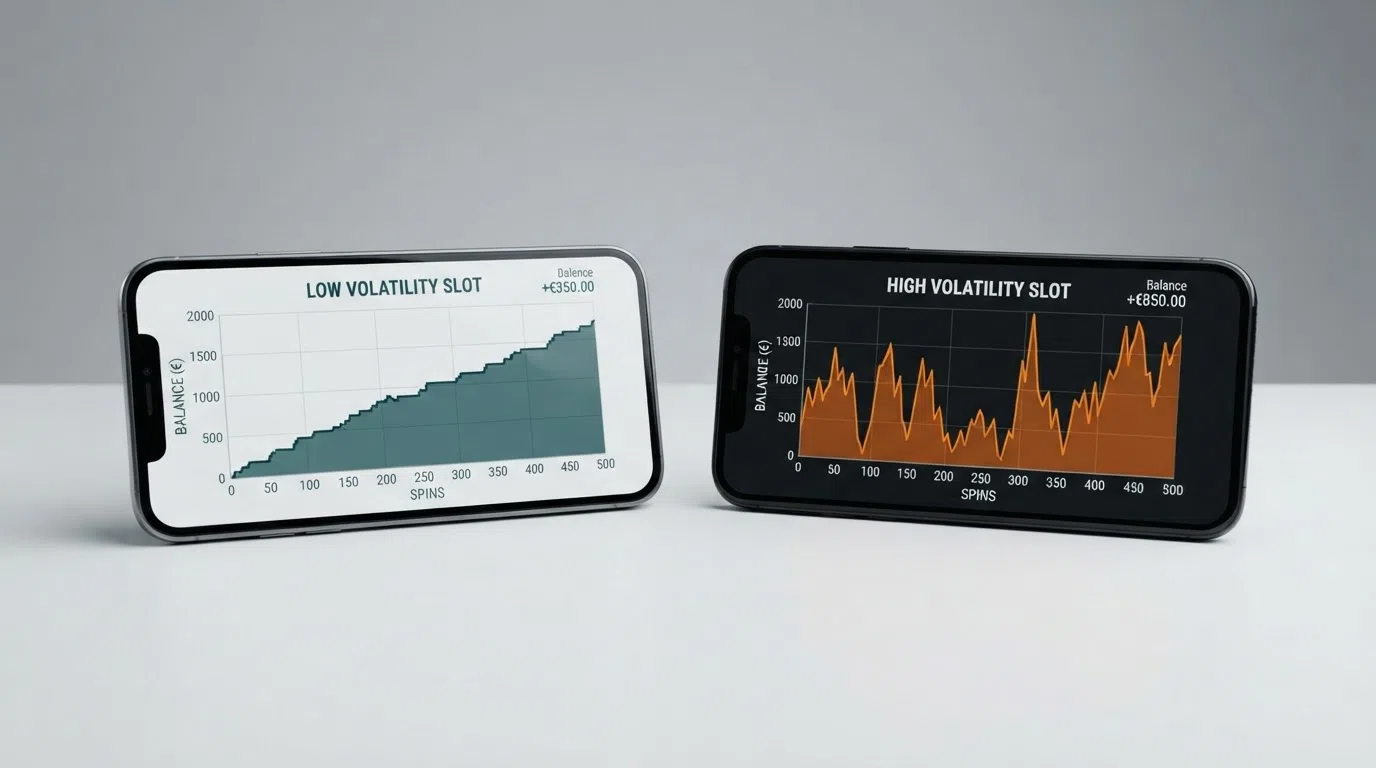
What Volatility Means for Your Slot Session
Volatility — also called variance — is a measure of win-size dispersion. Low volatility delivers frequent small wins; high volatility delivers rare large wins. The same 98% RTP can sit on either end of the volatility spectrum, and the player experience over 200 spins looks completely different.
Blood Suckers runs at 98.00% RTP with low volatility and a 45% hit frequency — nearly half of all spins produce a win. Book of 99 runs at 99.00% RTP with high volatility, meaning the higher-RTP slot can feel worse in a short session. Over millions of spins, Book of 99 returns more. Over 200 spins on a Tuesday evening, Blood Suckers keeps the balance line steadier and the session longer.
RTP only asserts itself over a large sample. In a short session, variance dominates. A player chasing the highest-RTP title without considering volatility is choosing a long-run asset on short-run criteria — the wrong frame for the way most people actually play.
Why Low Volatility + High RTP Is the Sweet Spot for Bankroll Longevity
The arithmetic of bankroll survival favours frequent small returns. A slot that returns a high percentage in small increments keeps a player recycling winnings into more spins, extending play time and total volume. The UK’s £5/£2 per-spin stake cap amplifies the point: with a fixed stake budget, the way to increase play duration is to stretch each pound across more spins, and low volatility does that by reducing the variance drain.
A worked illustration. At 100 spins with a £1 stake, a 98% RTP low-volatility slot returns close to £98 in expectation with small wins along the way; the balance line stays in a tight band. The same 100 spins on a 99% RTP high-volatility slot have the same expected return of £99, but the distribution is wider — the player may be up significantly or down significantly, and the session ends faster in either case.
For a player whose priority is extending play time on a fixed budget, low volatility plus high RTP is the correct combination. Blood Suckers is the canonical example: 98% RTP, low volatility, 45% hit frequency, fixed across all bet sizes.
The Best Low-Volatility High-RTP Slots — A Ranked Shortlist for UK Players
Three titles deliver both high RTP and low volatility, each backed by verified provider data.
Ugga Bugga by Playtech sits at the top with 99.07% RTP and low volatility — the highest-RTP low-volatility slot available. The 2004 release date and unusual multi-reel layout mean the experience differs from a modern five-reel slot, and availability varies across UK casinos. A player who finds it at a licensed operator and enjoys the format gets the best of both metrics in one game.
1429 Uncharted Seas by Thunderkick runs at 98.60% RTP with low volatility across 25 paylines, a 500x max win, and a £0.10 minimum bet. The fixed RTP means the figure does not vary by operator — what the rules panel shows is what you get. The maritime-exploration theme and the painterly art style have made it a long-running favourite among UK players.
Blood Suckers by NetEnt runs at a fixed 98.00% RTP with low volatility, a 45% hit frequency, a 900x max win, and a €0.25 to €50 bet range. The vampire theme and the bonus-round features have kept the title in active rotation at UK casinos for over a decade. The fixed RTP across all bet sizes makes it the most predictable of the three — no configurable tiers, no conditional fine print.
The configurable-RTP caveat applies to Ugga Bugga and 1429 Uncharted Seas in the same way it applies to every other slot: the figures above are the highest tier the provider offers. Always check the in-game rules panel at the casino where you play.
How to Balance RTP Against Volatility When Choosing a Slot
RTP and volatility are two dials on the same machine, and the right combination depends on what kind of session the player wants. High RTP paired with low volatility gives bankroll longevity — the best fit for extended sessions on a fixed budget. High RTP paired with high volatility gives rare big wins at the cost of long dry spells, the right fit for a player hunting a large hit and willing to absorb variance. Medium RTP with low volatility gives steady play with a slightly higher house take, a reasonable middle ground.
The UK’s £5/£2 per-spin stake cap adds a constraint. For a player aged 18 to 24 capped at £2 per spin, each spin consumes a larger share of a typical session budget, and the volatility drag is amplified. A low-volatility slot that returns frequent small wins is more valuable at the £2 cap than at the £5 cap, because the recovery from a dry spell is harder when the stake is lower.
A practical framework: define the session budget first, then choose the volatility to match. A £20 session at £1 per spin is 20 spins; the player who picks a high-volatility title is gambling the entire budget on a small number of outcomes. The same £20 at a low-volatility high-RTP slot plays out over 20 chances with frequent small returns along the way — a more sustainable session and the reason the combination matters.
Where to Find Updated RTP and Volatility Data — Tools and Sources
RTP and volatility data change. Configurable tiers, new releases, and operator choices mean today’s figure may not be tomorrow’s. The in-game rules panel is the definitive source — mandated by UKGC Remote Technical Standard 3C at every UK-licensed casino — and it is the only figure that always matches what the player is actually playing.
Independent slot-data sites and provider databases report the headline RTP from the provider’s documentation, not the tier the operator has deployed. A figure on a third-party site is useful for comparison and for tracking the ceiling, but it should not be the basis for a staking decision at a specific casino. The in-game rules panel is the only number that reflects the deployed tier.
The UKGC public register and approved test-house reports (eCOGRA, Gaming Laboratories International, Gaming Associates) provide verification of the certification process — the figure on the in-game panel was tested and signed off by an independent body before the game went live. The register itself confirms the operator’s licence status but does not catalogue individual game RTPs.
No single third-party source is definitive for UK-tier RTP. The in-game panel is the only source that always matches what is being played, and building the check into the routine — open the rules panel before the first spin of every session — is the single most practical habit a player can adopt.
What UK Regulation Means for Your RTP — And What It Doesn’t
The UK Gambling Commission’s rules shape every aspect of how RTP is disclosed, tested, and delivered to British players. The framework has gaps, and understanding them is the difference between trusting a headline figure and knowing what is actually being played.

What the UKGC Actually Requires — RTP Display, Testing, and Enforcement
Three layers of UKGC RTP oversight apply. Pre-release testing: every game and its RNG must be certified by a UKGC-approved test house — eCOGRA, Gaming Laboratories International (UK) Limited, Gaming Associates Europe Ltd, or BMM — before it goes live for British players. The test house signs off on the maths model, the RNG output, and the advertised theoretical RTP. None of those change without re-testing.
In-game disclosure: Remote Technical Standard 3C requires the average theoretical RTP percentage to be displayed in the game rules accessible to the player at every UK-licensed casino. The rules panel is the location, and the figure shown is the one the operator has deployed — the highest tier, or a lower tier, depending on what was activated.
Live performance monitoring: operators must track actual RTP against the advertised theoretical figure with tolerances that narrow as play volume increases. A new game with a small sample can deviate more from theoretical; the same game running millions of spins a month must hew close to the certified figure. The compliance team reviews deviations, and persistent gaps trigger regulatory engagement.
The framework is solid at the certification and disclosure layers. The gap is at the transparency layer — the Commission requires the figure to be displayed, but it does not require the operator to publish which tier from a configurable range is deployed, and the lobby does not show it.
Configurable RTP — When the Same Slot Pays Differently at Different Casinos
Configurable RTP is the most important practical RTP insight for a UK player. A slot’s headline RTP is a ceiling, not a promise, and the casino chooses which tier to deploy from a range the provider offers. NetEnt offers 6 to 8 tiers, with the 99% and 98% tiers rarely deployed. Pragmatic Play offers 3 tiers, with the highest at 96.50% for Gates of Olympus. Play’n GO offers 5 tiers spanning from approximately 84% to 96%, with Book of Dead at 96.21% on the highest tier and 84.51% on the lowest.
The practical consequence is significant. Book of Dead at 96.21% returns £96.21 per £100 wagered over the long run; the same slot at 84.51% returns £84.51. The two games share a name, a theme, a feature set, and a provider. The maths model is different, and the difference is 12 percentage points of house edge — the largest single risk in the configurable-RTP landscape.
The only reliable check is the in-game rules panel. Open the rules before the first spin of every session at a new casino, read the RTP figure displayed there, and treat that as the operative number. The lobby does not tell you which tier is active. The review page does not tell you which tier is active. The rules panel is the only source that always tells you.
The £5/£2 Stake Cap — What It Means for High-RTP Play
The UK’s online slot stake cap is set by SI 2025/215: £5 per game cycle for players aged 25 and over (in force 9 April 2025), and £2 per game cycle for players aged 18 to 24 (in force 21 May 2025). A game cycle runs from initiation to when all money staked is lost or all winnings delivered, and the cap applies to the total staked within that cycle — it cannot be defeated by splitting a spin across multiple transactions.
The cap directly limits the classic high-RTP strategy of betting max stake. Mega Joker is the case study. Its 99.00% RTP applies at the maximum coin setting with wins moved through the Supermeter — the second set of three reels stacked above the base game. A UK player aged 25 and over can bet at most £5 per spin; a player aged 18 to 24 is capped at £2. The max-stake condition that unlocks the 99% headline is unreachable for any UK player under the cap, and the casual low-stakes spins return meaningfully less.
The broader implication extends beyond Mega Joker. Any high-RTP slot whose best return is conditional on a max-bet condition is effectively nerfed for younger UK players, and partially constrained for older players whose usual stake is below the max. The cap is a consumer-protection measure, not a gaming-quality measure, and the interaction with conditional-RTP titles is an unintended consequence.
What You Lose Playing at an Unlicensed Casino
A casino operating without a UKGC licence targeting British players offers no RTP guarantee, no regulatory recourse, and no player protection. The RTP figure displayed may be fabricated — no test house verified the maths model, no regulator required the figure in the rules panel, and no compliance team monitors live RTP against theoretical. The slot may not be the slot it claims to be.
No GAMSTOP coverage means self-exclusion does not reach the site. A player who has registered with GAMSTOP to take a break from gambling can still create an account at an unlicensed casino, because the scheme is licence-bound and only covers GB-licensed operators. The protection the player thought they had does not apply.
No alternative dispute resolution or Commission complaints route exists. If the operator withholds winnings, closes an account, or refuses to pay a verified win, the player has no British consumer redress. The Malta Gaming Authority or Curaçao eGaming routes exist in theory but are not designed for UK consumer protection and are not always responsive.
A GB licence has been compulsory at point of consumption since 2014 under the Gambling (Licensing and Advertising) Act. A Curaçao, Maltese, or Gibraltar licence is not a substitute for UK play, and the Commission enforces this as a disruption regime rather than ISP blocking — 3,140 disruption notices and 447,778 URLs referred to search engines between April 2024 and June 2025, with 287,961 URLs removed and a 32% average engagement fall across 160 disrupted sites. Unlicensed sites remain reachable. The player bears the risk.
Providing gambling facilities to British players without a GB licence is a criminal offence under section 33 of the Gambling Act 2005 — up to 51 weeks’ imprisonment, an unlimited fine, or both. The penalty is on the operator, not the player. The player loses protection, not liberty.
RTP Won’t Save You — The Responsible Side of Return Percentages
RTP is a long-run statistical measure, not a session guarantee. Framing high-RTP play inside responsible-gaming habits is what turns a percentage on a screen into a sustainable pastime rather than a trap.
RTP Is a Long-Run Measure — Why Your Session Will Vary
Return to player is calculated over millions of simulated spins. The UK market ran 25.1 billion spins in the first quarter of 2026 — the scale at which RTP becomes measurable. A typical session runs a few hundred spins. At that volume, variance dominates and the actual return can swing from a total loss to a large win.
A worked illustration. At 100 spins with a £1 stake on a 98% RTP slot, the expected loss is £2. The actual outcome can range across the full distribution. Blood Suckers, with its 45% hit frequency, gives frequent small returns that smooth the experience — but even a player-favourable slot shows session-level variance.
Chasing a high-RTP slot on the assumption that it will pay back in a session is a misunderstanding of what the percentage means. The slot does not “owe” anything in any given session. Over millions of spins, the return converges toward the theoretical figure. Over 200 spins, the result is closer to a random draw from the variance distribution than to the long-run average.
Using RTP Knowledge to Set Realistic Expectations
RTP can inform a session budget, but only as an estimate. The session-loss calculation in this page walks through the arithmetic: expected loss = spins × stake × (1 − RTP). For 100 spins at £1 on a 96% RTP slot, the expected loss is £4. On a 98% slot, it is £2. On a 99% slot, it is £1.
Those figures are estimates, not predictions. A session budget informed by the expected loss should be set to absorb variance beyond the average — if the expected loss is £4, a £20 budget gives room for the variance, and a £100 budget gives much more. The right budget depends on what the player can afford to lose, not on what the maths says the average outcome will be.
The psychological trap is the belief that a run of losses on a 99% RTP slot means the game is “due” to pay. It is not. Each spin is independent of the previous one, and the long-run average is unaffected by short-run outcomes. A player who doubles their stake to chase a perceived “debt” from a high-RTP slot is responding to a pattern that does not exist in the maths. That response is the mechanism by which high-RTP knowledge becomes harmful.
UK Responsible-Gambling Tools and Where to Get Help
GAMSTOP is the national multi-operator self-exclusion scheme mandatory at all GB-licensed online gambling sites since 31 March 2020. Exclusion periods run six months, one year, or five years, with a five-year auto-renewal option. The exclusion cannot be cancelled early, and if the player does not make contact after expiry, the exclusion continues for up to a further seven years. GAMSTOP is online-only and licence-bound — it does not reach unlicensed sites, which is one of the reasons the section on unlicensed casinos matters.
The National Gambling Helpline, run by GamCare, is free, confidential, and available 24/7 on 0808 8020 133. The helpline received over 52,000 calls in 2024–25, and in January 2026, 996 callers were referred to treatment and peer-based support — a 48% increase year-on-year from 674 in January 2025.
Deposit-limit tools have been mandatory since 31 October 2025: operators must prompt customers to set a financial limit before first deposit. Decreases to the limit action immediately; increases may not. A gross deposit limit must be offered with at least equal prominence under RTS 12.
NHS gambling harm clinics operate in England, Scotland, and Wales, providing treatment for gambling disorder. GamCare’s online self-assessment tool is a starting point for players who want to understand their own patterns. The problem-gambling rate in Great Britain was 2.4% of adults (PGSI 8+) in 2025, stable over the survey’s three years. The most affected age group is 25 to 34, which is also the most active online slots demographic.
The right order is the deposit limit first, the slot choice second. Set the financial boundary before the first deposit, register with GAMSTOP if a break is needed, and call the helpline if play stops feeling like a choice. RTP knowledge is a tool for choosing between games, not a substitute for the boundaries that keep play sustainable.
How We Picked and Ranked the Highest RTP Slots for UK Players
The slots on this page are drawn from provider-published RTP data, UKGC-approved test-house reports, the Gambling Commission public register, and independent slot-data platforms. Every percentage in the main shortlist is sourced to a named provider or test-house record. The UKGC public register was checked for every operator on the list (last updated 29 July 2026), and active licences are confirmed.
Ranking criteria: verified RTP percentage (highest first), with volatility, provider, max win, and UK-casino availability as secondary dimensions. The five-slot shortlist in the comparison table is ordered by RTP. The operator table is ordered by free-spin count for the free-spin offers, with the deposit-match offer (888 Casino) listed at the bottom because it is a different proposition.
The configurable-RTP caveat applies throughout. Every RTP figure quoted is the highest tier the provider offers; the rate at a specific casino may be lower. The in-game rules panel is the only source that always reflects the deployed tier, and the page instructs readers to check it at every operator.
Your High-RTP Slot Strategy — What to Remember Before You Spin
Five things to check, and one thing to never forget.
Open the in-game rules panel and read the RTP at your casino. Never rely on a review’s headline figure — it is the ceiling the provider offers, not a promise of what your casino has loaded. The rules panel is required by UKGC Remote Technical Standard 3C, and the figure there is the one the operator has actually deployed.
Pair high RTP with low volatility if bankroll longevity is the goal. Ugga Bugga at 99.07% RTP, 1429 Uncharted Seas at 98.60%, and Blood Suckers at 98.00% are the data-backed shortlist for that combination.
Know your age-band stake cap. £5 per game cycle if you are 25 or over, £2 if you are 18 to 24. If a slot’s best RTP is conditional on a max bet the cap blocks — Mega Joker at 99% in Supermeter mode is the case study — the headline figure is unreachable, and the casual play return is lower.
Use the UK’s responsible-gambling infrastructure. Set a deposit limit before depositing. Register with GAMSTOP if you need a break. Call the National Gambling Helpline on 0808 8020 133 if play stops feeling like a choice — the helpline received over 52,000 calls in 2024–25, and treatment referrals rose 48% year-on-year in January 2026.
Treat RTP as a long-run guide, not a session promise. Over 100 spins, variance dominates. A 99% RTP does not mean you walk away with 99% of your stake. The session-loss calculation in this page gives the expected cost, and the right budget absorbs variance beyond the expected figure.
The one thing to never forget: the highest-RTP slot at an unlicensed casino has no verified RTP, no GAMSTOP coverage, and no British consumer redress if funds are withheld. A GB licence is the first filter, the RTP percentage is the second. A 99% figure from an unlicensed operator is not the same product as a 99% figure from a UKGC-licensed casino. It is a different game entirely.
Frequently Asked Questions About RTP Slots in the UK
What is RTP in slots and how does it affect my chances of winning?
RTP, or return to player, is the long-run percentage of every pound staked that a slot pays back to players. A 96% RTP slot returns £96 for every £100 wagered across millions of spins; the remaining £4 is the house edge. In a short session of a few hundred spins, the actual return can swing well above or below that figure, because variance dominates at small sample sizes. Over the long run, the slot converges toward its theoretical RTP, and the higher the percentage, the less the player loses on average per pound staked. The UK market averages around 96% RTP, and the highest-RTP titles push past 99%.
How can I check or verify a slot’s RTP at a UK-licensed casino?
Open the game’s rules panel before the first spin. UKGC Remote Technical Standard 3C requires every slot at a British-licensed casino to display its average theoretical RTP in the rules accessible to the player. The figure shown is the one the operator has actually deployed, which may differ from the highest tier the provider offers. Independent slot-data sites report the provider’s headline RTP, not the tier your casino has loaded, so the in-game rules panel is the only source that always matches what you are playing.
Does the UKGC require casinos to display the RTP of every slot game?
Yes. Remote Technical Standard 3C requires the average theoretical RTP percentage to be displayed in the game rules accessible to the player at every UK-licensed casino. The rules panel — usually accessed via an “i” or question-mark icon inside the game — is the location, and the figure must be present before the player places a real-money stake. The Commission does not require the operator to publish which tier from a configurable range is deployed, so the lobby may not show the difference between a 96% and a 94% configuration, but the in-game panel does.
Can a casino change the RTP setting on a slot game?
Yes, within the range the provider offers. Major studios run configurable RTP tier systems: NetEnt offers 6 to 8 tiers, Pragmatic Play offers 3, and Play’n GO offers 5 spanning approximately 84% to 96%. The operator chooses which tier to activate, and the same slot title can return meaningfully more or less at different casinos. The deployed tier is shown in the in-game rules panel, and a player who sees a familiar title at a noticeably lower percentage than the provider’s headline is looking at a lower-tier configuration. The Commission requires the figure to be displayed but does not require the lobby to flag which tier is active.
How do the 2025 UK online slot stake limits (£5 / £2) affect playing high RTP slots?
The stake cap, imposed by SI 2025/215, limits online slot bets to £5 per game cycle for players aged 25 and over (in force 9 April 2025) and £2 for players aged 18 to 24 (in force 21 May 2025). A game cycle runs from initiation to when the stake is lost or winnings delivered, and the cap cannot be defeated by splitting a spin. The cap directly affects high-RTP slots whose best return is conditional on max-stake play — Mega Joker at 99% RTP in Supermeter mode is the clearest example, because the max-stake condition is unreachable for any UK player under the cap, and the casual low-stakes return is lower.
Limits – realmoney-onlinecasinos-uk
Content created by the «realmoney-onlinecasinos-uk» team