
Lightning Roulette Casinos UK: Where to Play and What the Bonus Is Really Worth
 Available in GB
Data current as of September 8, 2026, verified against the UK Gambling Commission’s public register and operator promotions pages.
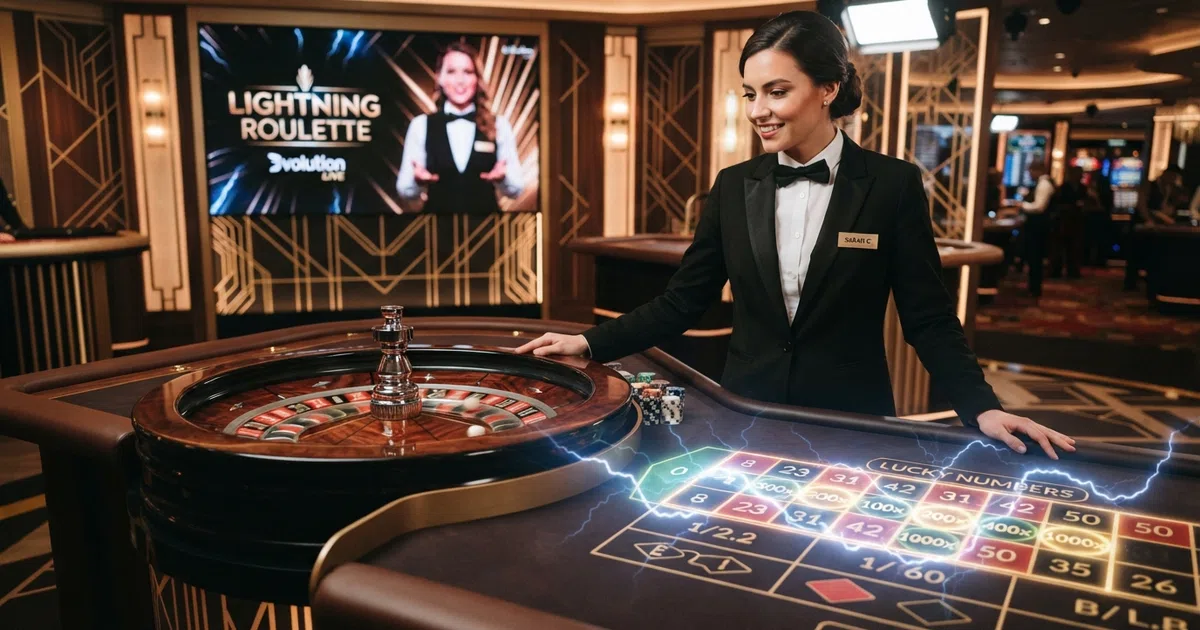
Lightning Roulette sits in an odd place in the UK market. It is the most-watched live dealer game Evolution has ever shipped, and it is the game where the gap between a casino’s marketing and what a player actually pockets is widest. A welcome offer that looks generous on the headline often becomes a turnover grind once live casino’s 10% contribution rate is applied. The £0.20 minimum bet disguises a multiplier system that pays 500x on a straight-up but only 29:1 on the same bet if the lightning misses. UK regulation in 2026 has rewritten the bonus economics completely — a 10× wagering cap and a ban on mixed-product promotions both landed in January, and a 40% Remote Gaming Duty arrived in April. The result is a market where the players who do best are the ones who read the small print before the wheel spins.
This guide ranks the ten UKGC-licensed casinos that carry Lightning Roulette, ordered by what their welcome offer is genuinely worth to a live roulette player. The game itself is explained on its own terms — the multiplier mechanic, the RTP split, the demo-versus-live distinction. A regulatory section covers the rules that govern every spin, from the slots stake cap that does not apply to live roulette to the 10× wagering ceiling that does. The closing pages set out what the numbers actually mean for a player choosing where to play, and the safer-gambling infrastructure that every UK-licensed casino must provide.
Best Lightning Roulette Casinos for UK Players in 2026
The ranking below is ordered by live-casino bonus usability, not by headline bonus size. A 0× wagering live-casino bonus with no contribution-rate trap beats a £50 deposit match whose live-game contribution turns a 10× requirement into 100× of live turnover. The table that follows lays the ten operators side by side on the columns that matter; the sections under it explain why each one sits where it does.
Lightning Roulette Casino Comparison: At a Glance
| Operator | UKGC Licence | Welcome Offer | Wagering Requirement | Bonus Validity |
|---|---|---|---|---|
| Sky Vegas | 39439 (Flutter Entertainment) | £10 Live Bonus on £10 live stake + 250 free spins | 0× (winnings paid as cash) | 30 days to claim; 7 days for free spins |
| Paddy Power | 39426 (Flutter Entertainment) | 60 no-deposit + 100 deposit spins + 50 Golden Chips on Live Roulette | 0× on all offers | 7 days from issue |
| Betfair | 39435 (Flutter Entertainment) | 50 no-wager + 100 deposit spins; Prize Pinball live bonuses | 0× on spins; 1× on Prize Pinball live bonuses | 7 days from issue; 24 hours on Prize Pinball |
| Betfred | Petfre (Gibraltar) Limited | 200 wager-free spins + 5 Golden Chips (£25 value) | 0× on spins | 7 days on live chips |
| bet365 | 55148/55149 (Hillside UK Gaming ENC) | Up to 500 no-wager free spins via daily reel | 0× (winnings paid as cash) | 20 days, 24h between reveals |
| William Hill | 39225 (WHG International) | 200 free spins on £10 deposit/wager | 10× on free spin winnings | 72 hours from issue |
| Grosvenor Casinos | 39372 (Rank Group) | 100% match up to £20 + 100 free spins | 10× on deposit+bonus; live casino 10% contribution | 30 days |
| Betway | Betway Limited | 100% match up to £50 + 150 free spins | 50× on bonus | 7 days from registration |
| BetVictor | BV Gaming Limited | £30 split across product offers | Varies by offer | Varies by offer |
| BetMGM UK | LeoVegas Gaming plc / MGM | Welcome bonus available (see promotions page) | Varies | Varies |
The table rewards close reading. The first four rows all sit at 0× wagering on their core offer, which is the only figure that genuinely matters for a live roulette player. The next two are no-wager free-spin packages with no live-specific bonus at all. The last four are bonus structures that either treat live casino as an afterthought (BetVictor, BetMGM UK) or apply wagering terms whose live-game contribution rate either punishes live play (Grosvenor, Betway) or stay neutral on it (William Hill). The ranking is built around that distinction.
What We Looked For: How These Rankings Were Built
Three criteria ordered the list. The first, and the one that overrides everything else, is live-casino bonus usability — whether a player claiming the welcome offer can actually clear it playing Lightning Roulette, and at what cost in turnover. The second is the wagering multiple and its companion, the live-game contribution rate: a 10× requirement sounds manageable until the contribution rate reveals that live tables only count 10% of every pound staked, multiplying the effective turnover by ten. The third is operator reputation, in the narrow sense of UKGC licence standing, payment reliability, and live-casino game-provider breadth.
A 0× wagering live-casino bonus beats a 50× slots match for this page’s reader because the player is here to play live roulette, not to grind a slots offer they will never redeem. The 10% live-casino contribution rate — typical across UK operators for table games — is the second-order trap. A £40 deposit-match bonus at 10× wagering sounds like £400 of turnover. At a 10% live contribution, the player must stake £4,000 on live tables to clear it. The calculation further down the page runs that figure end to end: roughly 20,000 spins at minimum stake, around 28 hours of continuous play. That is what a “10× bonus” actually costs on a live table.
UKGC licensing is a baseline, not a differentiator. Every operator on this list holds an active licence on the Commission’s public register. The differentiator is what each operator does within that licence — whether it offers a live-casino-specific bonus, whether the wagering is zero, whether the live lobby carries Evolution alongside Playtech, Pragmatic Play, or OnAir Entertainment.
Sky Vegas: The Standout Live Casino Welcome Offer
Sky Vegas is the only featured operator with a dedicated live casino bonus carrying zero wagering. Stake £10 on eligible live games and the casino returns £10 as a Live Bonus; whatever the bonus produces is paid as cash, not bonus funds. The structure is the cleanest on this list: a live-casino-specific offer, a wagering requirement of zero, and a withdrawal path that does not require a turnover grind. The slots allocation runs in parallel — 50 free spins no deposit required, plus 200 more on a £10 deposit and spend, also at 0× wagering.
The offer’s character is what separates it from a generic welcome package. Most UK welcome bonuses are built for slots: a deposit match with free spins, wagering applied to both, and live tables either excluded or contributing a fraction of their stake. Sky Vegas sidesteps the trap by building a live-casino bonus that is wager-free at its core. A player claiming the £10 Live Bonus and staking it on Lightning Roulette keeps every straight-up win that lands, multiplier or not, as withdrawable cash. The 30-day registration window and 7-day free-spin expiry are the only time pressures; neither constrains a player who plans to claim the offer and use it within the first week. The operator is licensed under Flutter Entertainment with UKGC account 39439.
Paddy Power: Golden Chips on Live Roulette with Zero Wagering
Paddy Power is the only featured operator offering dedicated Live Roulette Golden Chips alongside a deposit-free free-spin allocation, both at 0× wagering. The structure: 60 free spins no deposit required upfront, then 100 more free spins and 50 Golden Chips on a £10 deposit and wager. The Golden Chips are the live-casino-specific element — each chip is worth £0.10, usable on Live Roulette tables including Lightning Roulette, and any winnings they produce are cash. There is no wagering requirement on either the chips or the free spins.
The “golden chip” mechanic is worth pausing on. In a standard live-casino bonus, a player is given bonus funds that must be wagered before withdrawal. The Golden Chip flips that: it is a stake the casino has already paid for, and whatever it wins is the player’s. Staking £5 in Golden Chips on Lightning Roulette and landing a non-multiplied straight-up at 29:1 returns £145 cash, withdrawable. The 7-day validity window is tight but workable; the absence of a max-cashout cap on the Golden Chips is the structural advantage over Grosvenor’s deposit-match offer, where winnings are capped at £2,000. Paddy Power operates under PPB Entertainment Limited, a Flutter Entertainment company, with UKGC account 39426.
Betfair: Prize Pinball Live Bonuses and No-Wager Free Spins
Betfair’s structure splits in two. The free-spin allocation is clean: 50 genuinely deposit-free no-wager spins on registration, plus 100 more on a £10 deposit and spend, all at 0× wagering with a 7-day validity. The live-casino-specific element is the Prize Pinball — a mechanic that awards live casino bonuses rather than handing them out as a flat credit. The pinball ball lands on a prize and the player receives a live bonus token that carries 1× wagering, usable within 24 hours of issue.
The 1× wagering on Prize Pinball live bonuses is the closest the featured set comes to “almost no wagering on a live offer” once Sky Vegas and Paddy Power are set aside. A £20 live bonus token with 1× wagering is £20 of live turnover — nothing close to the £4,000 the same bonus would demand under Grosvenor’s 10× cap with 10% live contribution. The 24-hour use window is the sharp edge: a player who claims the token but does not stake it within a day loses it. The free-spin side is unconditional and the pinball side is conditional; the player chooses which side of the offer they are taking on. Betfair is licensed under Betfair Casino Limited, Flutter Entertainment, with UKGC account 39435.
Betfred: Live Golden Chips and Wager-Free Spins
Betfred pairs a slots allocation with a live-casino-specific offer, the way Paddy Power does, but with a higher qualifying stake on the live element. The structure: 200 wager-free spins on staking £10 on casino or games; then 5 Golden Chips worth £5 each (a £25 total) on staking £20 on live dealer tables. The free spins carry 0× wagering; the Golden Chips run on Betfred’s standard live-chip terms with a 7-day validity.
The asymmetry is the interesting feature. A £20 live stake to claim £25 in Golden Chips is a more demanding trigger than Paddy Power’s £10 deposit-and-wager for £5 in chips, and the per-chip value is higher (£5 versus £0.10). What the player trades off is the deposit-gate: Betfred’s Golden Chips require a £20 live stake before they unlock, so the chips are not a free ride but a return on a real-money session. The free-spin side of the offer is wager-free in the same way Paddy Power’s is, and a player who fancies the slots allocation can clear it with no turnover obligation. The operator is licensed under Petfre (Gibraltar) Limited with an active UKGC licence.
bet365: Up to 500 No-Wager Free Spins via Daily Reel
bet365 offers the largest no-wager free-spin pool of the featured set, with no live-casino-specific bonus to balance it. The structure: up to 500 free spins awarded across 10 daily Free Spins Reel reveals, with a minimum 24-hour gap between reveals and a 20-day window to complete the reveals. Every winning is paid as cash. The minimum qualification is a £10 lifetime deposit, not a fresh deposit — a player who has ever deposited £10 on the account qualifies.
The offer is not built for live roulette. There is no live-casino bonus, no Golden Chip, no Prize Pinball — just a large free-spin pool whose value to a Lightning Roulette player is indirect (the player can use the free spins on a slots side game and bring whatever they win to the live table). The 0× wagering on the free spin winnings is genuine, and the absence of a stated cap is the structural advantage over William Hill’s £30 cap. A player who is here for the live game and wants a slots warm-up finds it; a player who wants a live-specific welcome is looking elsewhere. The operator is licensed under Hillside (UK Gaming) ENC with UKGC accounts 55148 and 55149.
William Hill: Free Spins with a Low Cap and Tight Window
William Hill Vegas runs a straightforward free-spin offer with the most restrictive parameters in the featured set. The structure: 200 free spins at 10p each on a £10 deposit and stake, 10× wagering on free spin winnings, a £30 cap on winnings, and a 72-hour expiry from issue. There is no live-casino-specific bonus.
The cap is what makes this the least generous free-spin allocation in the set. A 10p spin at 200 spins is £20 of stake; landing a 500x multiplier (impossible on Big Bass Splash, but taking the slot’s own payout ceiling) returns a fraction of the £30 cap before wagering is applied. The 72-hour expiry is the tightest window among the featured operators — a player who does not use the spins within three days loses them. The 10× wagering on free spin winnings is a slots contribution (slots typically contribute 100%), so the requirement is genuinely 10× rather than the effective 100× that live games would carry. The operator is licensed under WHG (International) Limited with UKGC account 39225.
Grosvenor Casinos: A Traditional Match Bonus — With a Live-Casino Catch
Grosvenor is the only featured operator offering a classic deposit-match bonus. The structure: a 100% match up to £20 on a £20 deposit, plus 100 free spins on Big Bass Splash, with 10× wagering on deposit and bonus, a £2,000 maximum cashable winnings cap, and 30-day validity. The catch for a Lightning Roulette player is the 10% live-casino contribution rate.
The maths is worth running. A £20 deposit produces a £20 bonus; the 10× wagering on the combined £40 demands £400 of qualifying turnover. On slots, that is £400 at 100% contribution. On live tables, the same £400 demands £4,000 of live turnover, because every £10 staked on live games counts as £1 toward the requirement. At the £0.20 minimum bet, that is 20,000 spins. At a 5-second interval, that is roughly 28 hours of continuous play. The £2,000 cap on cashable winnings is the second-order ceiling — even if a player clears the wagering, anything beyond £2,000 is forfeit. The structure is not built for live roulette players; it is a slots offer with a live-casino game attached. The operator is licensed under the Rank Group with UKGC account 39372.
Betway: A High-Wagering Match Bonus Built for Slots
Betway’s structure is the most live-unfriendly of the featured set. A 100% match bonus up to £50 on a first deposit of £10 or more, with 50× wagering on the bonus alone, debit card deposits only, and 7-day validity from registration. The free-spin allocation is 150 spins on a £10+ deposit and stake on Big Bass Bonanza, separate from the match bonus. The 50× wagering predates the January 2026 cap and would not be legal under the current LCCP; it represents the pre-cap market and is included as a reference point.
The offer is a holdover. A 50× wagering requirement is six times the current UK cap; for a live roulette player it is also effectively 500× of live turnover at the 10% contribution rate, a figure that is not practically clearable in the 7-day window. Debit card deposits only excludes the e-wallet and prepaid routes a player might prefer for bankroll isolation. Betway’s 150 free spins on £10+ deposit and stake are the more useful element of the welcome for a slots warm-up. The operator is licensed under Betway Limited with an active UKGC licence.
BetVictor: A Multi-Product Welcome Package Without Live-Casino Specifics
BetVictor’s welcome package splits £30 across product-specific offers — bingo, casino, sports — with free spins included as part of the broader package. Wagering terms vary by the specific offer claimed rather than attaching to the package as a whole. There is no dedicated live-casino bonus; the live-casino value depends on which product offer the player activates.
The practical effect is that a Lightning Roulette player claiming BetVictor’s welcome must navigate several product-specific terms rather than a single live-casino bonus. The live casino lobby itself is a strength: Evolution sits alongside Pragmatic Play and Playtech, giving the player more live-dealer tables than a single-provider lobby. A player choosing BetVictor for the live game library, rather than for a specific welcome offer, makes the more defensible case. The operator is licensed under BV Gaming Limited with an active UKGC licence.
BetMGM UK: A Live-Casino-Rich Lobby with a Variable Welcome Offer
BetMGM UK carries the strongest live-casino game portfolio in the featured set, with four live providers — Evolution, Playtech, OnAir Entertainment, and Pragmatic Play — all streaming from the same lobby. A Lightning Roulette player here has Evolution’s flagship, but also Playtech’s live roulette tables, OnAir’s smaller-stake variants, and Pragmatic Play’s live roulette. The breadth is the reason to look at BetMGM UK even though the welcome bonus terms are not fixed in the same way the other operators’ are.
The variability is the trade-off. Welcome bonus terms at BetMGM UK change with promotional cycles rather than sitting at a single published figure. A player choosing BetMGM UK on the strength of its lobby should check the operator’s promotions page for the current offer before claiming. The licence is held by LeoVegas Gaming plc under the MGM joint venture, with active UKGC status.
What Is Lightning Roulette — and Why It’s Not Standard Roulette
Lightning Roulette is Evolution Gaming’s flagship live-dealer roulette variant, built on a single-zero European wheel and dressed with a random multiplier system that pays up to 500x on straight-up bets. It looks like a roulette table and behaves like one in most respects — the same betting layout, the same outside bets, the same red-black-odd-even structure — but the moment the betting window closes, the game departs from the European roulette canon. Between one and five numbers on the grid are struck by a CGI lightning animation, each receiving a multiplier of 50x, 100x, 200x, 300x, 400x, or 500x. The wheel spins. If the ball lands on a number that was struck, straight-up bets on that number are paid at the multiplied rate; if the ball lands on an unstuck straight-up, the bet is paid at 29:1, not the standard 35:1.
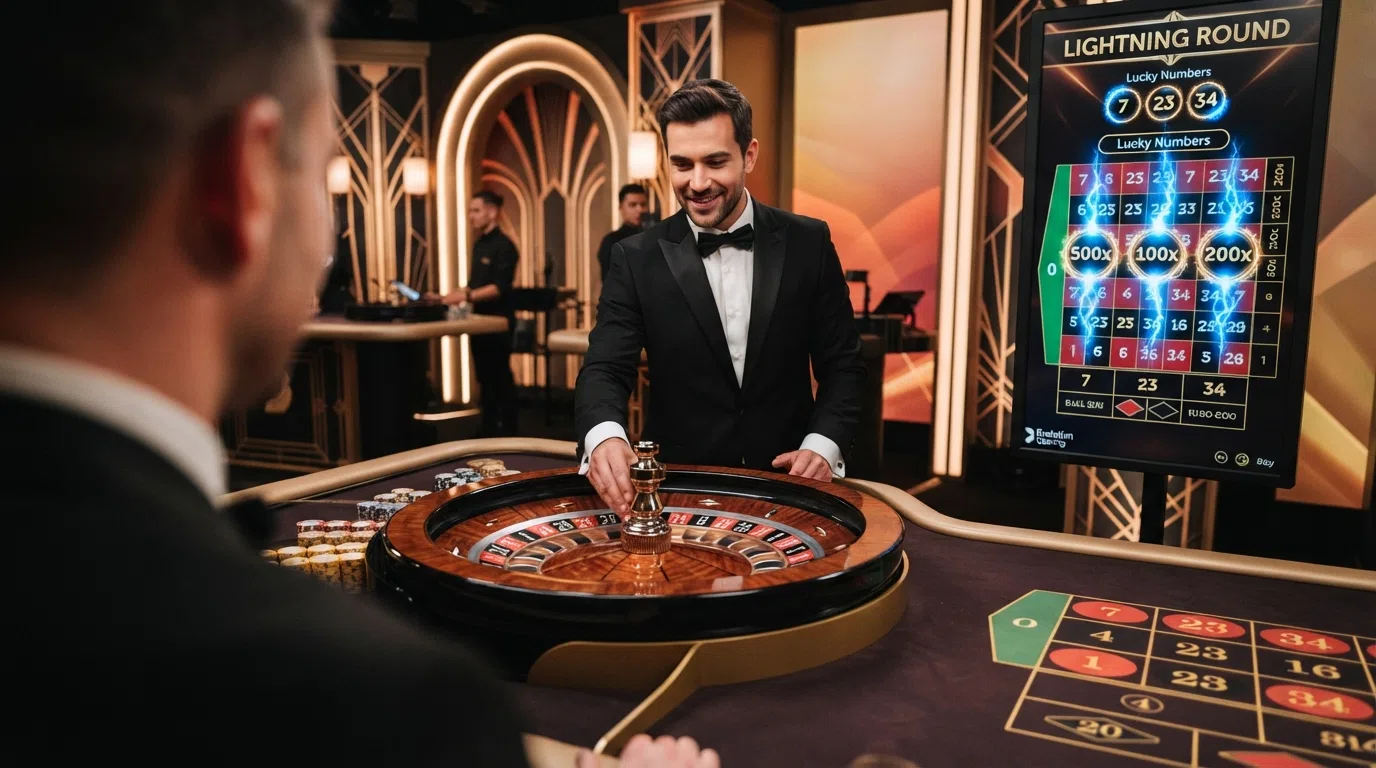
The trade is the heart of the game. A standard European roulette straight-up pays 35:1 with a 2.70% house edge. Lightning Roulette’s non-multiplied straight-up pays 29:1, with a 2.90% house edge on the base bet. The “lost” payout funds the multiplier pool: the difference between 35:1 and 29:1 is the money that the random 50x-to-500x payouts are paid from. On aggregate, the house edge on a straight-up that never gets struck is slightly worse than standard roulette; on a straight-up that does get struck, the player can win multiples that no standard roulette table offers. Outside bets — red/black, columns, dozens, splits, corners — pay standard European odds with no multiplier exposure, and they pay it at the 97.30% RTP that standard European roulette carries.
This is not a game for a player who wants to grind the outside bets. Outside bets ignore the multiplier entirely; they pay exactly the same as a standard European roulette wheel. The multiplier only touches straight-up bets, which is also where the base payout is reduced. A player who wants the multiplier action is staking on single numbers and accepting the lower non-multiplied payout; a player who wants the standard European odds is playing the same outside bets at the same return, with a host in a tuxedo and a lightning animation that does nothing for them.
The Lightning Multiplier Mechanic: 50x to 500x on Every Spin
Between one and five numbers are struck per round. The number of strikes is random — sometimes one, sometimes two, sometimes five — and the multiplier assigned to each struck number is drawn from the set {50, 100, 200, 300, 400, 500}. The animation is part of the broadcast: a CGI lightning bolt crosses the betting grid, the struck numbers light up with their multiplier, and the wheel is spun. Multipliers apply to straight-up bets only. A split, a corner, a line, a column, a dozen, an outside bet — none of these see the multiplier, no matter what the strike lands on.
The non-multiplied straight-up payout is 29:1, six units lower than the standard 35:1 European payout. That reduction is the funding mechanism for the multiplier pool. Across millions of spins, the house collects the difference and pays it out as the 50x-to-500x prizes on the spins where the ball lands on a struck straight-up. The 500x ceiling is hard: it is the maximum multiplier the game will pay, and it has been since launch. The player staking £1 on a struck 500x straight-up receives £500, before any other consideration. The same £1 on a struck 50x straight-up receives £50. The same £1 on an unstuck straight-up receives £29.
The frequency of strikes is the lever a player cannot see. The 1-to-5 range and the 50-to-500 multiplier range are visible; the underlying probability distribution of both is not published. The aggregate house edge is 2.90% on straight-up bets, which is the only figure that captures the joint probability of being struck, being multiplied, and the ball landing on the player’s number. A player who treats the multiplier as “free upside” is misreading the math; the multiplier is funded by the 6-unit reduction in the base payout, and over thousands of spins the two balance to the published house edge.
RTP and House Edge: The Numbers Behind the Game
The theoretical return on Lightning Roulette is split. Straight-up bets return 97.10%, with a house edge of 2.90%. Every other bet type — splits, corners, lines, columns, dozens, red/black, odd/even, high/low — returns 97.30%, with a house edge of 2.70%. The split exists because the multiplier pool is funded by the straight-up payout reduction; outside bets pay at the standard European rate and are not drawn into the multiplier funding.
A 2.90% house edge on straights is steeper than the 2.70% on standard European roulette. Over a session of 1,000 spins at £1 per straight-up (£1,000 in total stake), the expected loss is £29, compared to £27 on a standard European wheel. The extra £2 is the price of the multiplier eligibility. A player who treats Lightning Roulette as standard European roulette with a bonus feature is paying for a feature they may not use: only the spins where the ball lands on a struck straight-up produce the multiplied payout, and the bulk of spins end at 29:1 on the player’s stake.
The 97.30% RTP on outside bets is the same as standard European roulette. A player staking on red or black at Lightning Roulette is mathematically playing a standard European wheel with a host and a lightning animation. The expected loss over 1,000 spins at £1 per outside bet is £27. The difference between staking straight-up and staking outside bets is the price the player pays for multiplier access: 0.20 percentage points of RTP, or about 7% more house edge on the straight-up bet. Over a long session, that is the multiplier pool’s entrance fee.
The Live Dealer Experience: Evolution’s Art-Deco Studio
The Lightning Roulette studio is a purpose-built Evolution set, art-deco in its visual language, with a physical single-zero European wheel in the centre of the frame and a digital betting grid as the broadcast overlay. The hosts are professional live dealers — trained for the camera, mic’d up, running the game cycle in real time. The atmosphere is closer to a television game show than a casino floor: the wheel is real, the bets are real, the dealer is real, and the CGI lightning animation is a layer painted over the broadcast feed.
The game cycle is the rhythm a player learns. The betting window opens, players place chips on the grid, the betting window closes, the dealer triggers the lightning strike, the CGI animation lands on between one and five numbers, the wheel is spun, the ball lands, the result is resolved, the betting window reopens. The full cycle runs in around 30 to 45 seconds, depending on the dealer’s pace and the broadcast delay. The chat sidebar runs throughout: players can message the dealer, message each other, and the dealer responds in voice. It is a social product as much as a gambling product, which is part of why it has stayed at the top of the live-casino charts since launch.
The live-chat and multi-camera production are the pieces a First Person demo does not replicate. A player who has only played the RNG version is missing the host interaction, the chat sidebar, the betting-window pressure, and the pace of a real table. These are not minor details for a game whose session length depends on how a player reacts to a 1-in-37 chance on every spin.
First Person Lightning Roulette: RNG Meets Multipliers
First Person Lightning Roulette is Evolution’s RNG-based 3D variant — the same multiplier mechanics, the same 97.30% RTP, the same 1-to-5 Lucky Number system, but rendered in 3D animation with no live dealer and no broadcast. It is the version every UK-licensed casino offers as a free demo, and it is the only Lightning Roulette variant a player can try before staking real money. The “Go Live” button at the top of the screen transitions the player from the RNG table to the live table in one click, depositing any active balance and reopening the betting layout in the live studio.
The free demo is the structural advantage of the RNG version. Live Lightning Roulette is real-money only across every UK-licensed operator — there is no free-play mode, no demo credit, no practice balance. First Person Lightning Roulette is a free-to-play game with the same betting layout and the same multiplier mechanic, which makes it the on-ramp for a new player who wants to learn the rules, see the lightning strike, and understand the 29:1 non-multiplied payout before staking cash. The Go Live button closes the gap between demo and real money in a single click for any player who has registered and deposited.
The 97.30% RTP figure is the one that travels. First Person Lightning Roulette publishes its RTP as 97.30% across the game, which is the outside-bet figure on the live version. The 97.10% on straight-up bets is a live-version-specific data point; the RNG version sits at 97.30% because the multiplier pool is implemented in a way that smooths the base-bet return. For most purposes, the practical difference is negligible: a player learning the game in demo mode is learning the right game.
How to Play: Bet Types, Payouts and the Strategy That Does Not Exist
The betting layout is the standard European roulette grid: 37 numbers (0 to 36), the outside bets arrayed around them, the dozen and column sections above and below. Inside bets are the single-number, split, street, corner, and line bets; outside bets are red/black, odd/even, high/low, dozen, and column. The minimum bet at UK casinos is £0.20 per spin. The maximum depends on the operator and the table, but live roulette caps in the UK market tend to be generous compared to the £5 statutory cap on slots.
The multiplier exposure is limited to straight-up bets. A player staking on red sees no multiplier, regardless of which numbers are struck; the ball landing on a struck red number still pays 1:1. A player staking on a corner, a split, or a line sees no multiplier. A player staking on a single number sees the multiplier if the ball lands on that number and the number was struck. This is the only game mechanic that matters for a player deciding where to place chips.
The progressive system does not exist. Martingale, Fibonacci, d’Alembert, Labouchère — none of these survive contact with the multiplier mechanic. The multiplier is allocated after the betting window closes, and its allocation is independent of the player’s stake. A martingale player doubling on a loss cannot time the multiplier to land on their number, because the multiplier lands on a randomly chosen number, not on a doubled-up one. A flat-stake player staking the same number across spins has the same multiplier exposure as a progressive one. The only way to manage a Lightning Roulette bankroll is to set a session stake, set a stop-loss, and stop.
Lightning Roulette vs XXXtreme Lightning Roulette: Double the Multipliers, Double the Risk
XXXtreme Lightning Roulette is Evolution’s higher-volatility sequel, raising the maximum multiplier from 500x to 2,000x and adding more strike possibilities per round. The base game is the same single-zero European wheel with the same multiplier eligibility on straight-up bets. The differences are at the top end: more numbers can be struck, the multiplier ceiling is higher, and the base-game return adjusts to fund the larger prizes.
The trade-off is on the bottom end. A higher maximum multiplier and more frequent strikes mean a larger multiplier pool to fund, which the base payout reduction carries. The 29:1 non-multiplied straight-up payout is the same in both versions; the underlying probability distribution of strikes and multipliers is what shifts. A player who wants the 2,000x ceiling plays XXXtreme; a player who wants the standard 500x ceiling plays Lightning Roulette. Both games are available at every UK-licensed casino that carries Evolution’s live-dealer catalogue.
Can You Play Lightning Roulette for Free? The Demo Dilemma
Live Lightning Roulette has no free-play mode at any UK-licensed casino. First Person Lightning Roulette does. The split is the only practical learning path a new player has, and understanding why the split exists is the difference between a wasted session and a deliberate one.
Why Live Lightning Roulette Has No Free-Play Mode
The economics of live dealer streaming do not support free play. Every seat at a live table is a real-money seat, every spin is a real-money spin, the dealer is on the clock, the studio is on the broadcast, and the operator’s cost per spin is fixed. A free-play live table would carry the same cost per spin as a real-money table but produce no revenue, which is a proposition no operator can sustain indefinitely. The structure is the same across every live-dealer product Evolution ships: no demo, no practice, no free credits.
A player who searches for “Lightning Roulette demo” at a UK casino will find First Person Lightning Roulette in the same lobby. The RNG version is the demo, and it is the only demo that exists. The transition from First Person to live is one click away on the Go Live button, but the player’s balance does not transfer from demo to real money; the player must register, deposit, and claim any welcome offer before staking on the live table.
First Person Lightning Roulette: The Free Demo That Teaches the Game
The demo path is straightforward. A player opens a UK-licensed casino, navigates to the live casino or table games section, finds Lightning Roulette in the Evolution lobby, and selects the First Person version. The game opens in demo mode with a virtual balance, the same multiplier mechanic, the same betting layout, and the same 5-second-or-so spin cycle. A player can run hundreds of demo spins in a session, learning the rhythm of the betting window, the 29:1 non-multiplied payout, the strike frequency, and the overall pace of play.
The Go Live button is the bridge. When the player is ready to stake real money, the Go Live button transfers them to the live table, where the demo balance is replaced by their real-money balance and the same betting layout is presented by a live dealer. The transition is one click; the difference is real money on the line.
What the Demo Cannot Teach You
The demo teaches the rules, the layout, and the multiplier mechanic. It does not teach the live-table pace, the betting-window pressure, the social dynamics of a live chat, or the psychological difference between demo credits and real money. A player who has run 1,000 demo spins still has not felt the weight of a £20 stake on a straight-up that misses by one number, or the discipline required to walk away from a winning session. The First Person demo is the right first step. A small real-money session — minimum bets, short duration, a hard stop — is the second step. The third step is the regular play a player commits to once they have felt both.
Is Lightning Roulette Legal in the UK? The Rules That Protect You
Lightning Roulette is fully legal at UKGC-licensed casinos. The Gambling Commission licenses online casino products, the Gambling Act 2005 governs remote gambling, and every operator on this list holds an active licence on the Commission’s public register. The regulatory framework around Lightning Roulette is the strongest player-protection regime in the online gambling world, and the rules that govern it have tightened materially in 2026.
UKGC Licensing: What It Actually Means for Your Money
A UKGC licence is a hard legal obligation. The Commission’s three licensing objectives — preventing crime, ensuring fairness, and protecting the vulnerable — are written into the Gambling Act 2005 and enforced through the Licence Conditions and Codes of Practice (LCCP). Every operator serving GB customers must hold a GB licence, a requirement that has been in force since the point-of-consumption reform of 2014. Operating without a GB licence is a criminal offence under section 33 of the Act, carrying up to 51 weeks’ imprisonment and an unlimited fine.
The practical effect for a player is that every casino on this list has been vetted, audited, and is required to verify the player’s identity before the first deposit. Anonymous play is not possible. The Commission’s public register at gamblingcommission.gov.uk lists every licensed operator by name and account number, and a player can check any operator’s standing in under a minute. The account numbers on the featured operators’ table above are confirmed against that register.
The Commission’s enforcement reach is broader than licensing. It issues cease-and-desist notices to unlicensed operators, refers domains for search-engine delisting, and refers payment providers for blocking. In the 15 months from April 2024 to June 2025, the Commission issued 3,140 disruption notices and referred 447,778 URLs, with 287,961 URLs removed and a 32% average fall in engagement across 160 disrupted sites. The numbers are a measure of how seriously the Commission takes the point-of-consumption rule.
Why the £5 Slots Stake Cap Does Not Apply to Live Roulette
The most widely reported UK gambling reform of 2026 — the age-banded slots stake cap — does not extend to live casino products. The statutory instrument, SI 2025/215, sets a £5 maximum stake per game cycle for slots players aged 25 and over (in force from 9 April 2025) and £2 for players aged 18 to 24 (in force from 21 May 2025). The instrument attaches exclusively to remote casino slots provision. No statutory stake cap has been established for live casino products, and Lightning Roulette carries no per-spin cap beyond the operator’s own table limits.
The distinction matters for a player budgeting a session. A £5 cap on slots means a player cannot stake more than £5 on a single spin of a slot game; a Lightning Roulette player can stake whatever the table accepts, often £100 or more per spin at the higher-tier tables. The regulator’s reasoning is that the £5 cap is a harm-minimisation measure for slots, where spin speed and game-design features can compress harm into short sessions; live roulette’s slower pace, lower game-cycle frequency, and higher stake-per-bet structure are treated differently. A player who is comparing the two products should not assume the £5 cap applies across the casino floor.
The 10× Wagering Cap: The Rule That Rewrote UK Bonus Value
From 19 January 2026, no UKGC-licensed operator can attach more than 10× wagering to a bonus. LCCP Social Responsibility Code 5.1.1 sets the ceiling at 10× the bonus amount for every promotional offer. Before the cap, a £50 bonus might carry 40× or 60× wagering, demanding £2,000 to £3,000 in turnover before withdrawal. After the cap, the same £50 bonus can demand at most £500.
The cap is the structural reason Betway’s 50× offer stands out as a pre-cap holdover. Most UK welcome bonuses now sit at 10×, with a handful of zero-wagering offers (Sky Vegas, Paddy Power, Betfair) below the cap and one or two legacy offers above it. The cap also explains the rise of 0× wagering offers — when the cap is low, the competitive pressure to drop to zero is high. A player comparing bonuses in 2026 should expect 10× as the ceiling, 0× as the floor, and very little in between for the major UK brands.
The cap applies to the stated requirement, but live casino contribution rates create an effective multiple far higher. Grosvenor’s £40 combined-deposit-and-bonus at 10× wagering is a £400 turnover requirement on slots; on live tables, with a 10% contribution rate, the same bonus demands £4,000 of live turnover. The table below runs the figure through end to end.
How Live Casino Contribution Rates Dilute Your Bonus: The Numbers
A £40 welcome bonus at 10× wagering with a 10% live casino contribution rate demands ten times the turnover at the live table that it would at the slots. The numbers below are the practical cost of clearing a single bonus on Lightning Roulette, and they are the reason a 0× wagering live-casino bonus is so much more valuable than the headline number suggests.
| Contribution Rate | Effective Wagering on a £40 Bonus (10×) | Spins at £0.20 Stake | Approximate Time at 5 Seconds per Spin |
|---|---|---|---|
| 100% (slots) | £400 | 2,000 spins | ~2.8 hours |
| 50% | £800 | 4,000 spins | ~5.6 hours |
| 20% | £2,000 | 10,000 spins | ~13.9 hours |
| 10% (live casino) | £4,000 | 20,000 spins | ~27.8 hours |
The 10% contribution rate is the standard at most UK casinos for live table games, and the 20,000-spin figure is the price a player pays for clearing a £40 deposit-match bonus on Lightning Roulette. The 27.8 hours of continuous play assumes a 5-second interval per spin and no breaks, which is a working day and a half at minimum wage. The 0× wagering live-casino offers at the top of the ranking exist precisely to avoid this arithmetic.
The same calculation can be run on a £10 live bonus at 0× wagering. The required turnover is zero, the spins are zero, the time is zero. The bonus is cash the moment it lands. That is the structural advantage of a 0× live-casino offer over a 10× slots-style offer applied to a live game.
Mixed-Product Promotions Are Banned: What Changed in 2026
Since 19 January 2026, mixed-product promotional offers are banned under LCCP SR Code 5.1.1. An operator can no longer require a player to play slots in order to unlock a live casino bonus, or vice versa. The four product types defined by the Commission — bingo, lottery, casino, and betting — must be promoted separately. A live-casino bonus must be claimable and clearable on live casino games alone.
The change is meaningful for a Lightning Roulette player. Before the ban, a common offer tied a live-casino bonus to a slots wagering requirement: deposit £20, wager £400 on slots, receive a £20 live-casino bonus. The slots play was the cost of admission. The ban closes that route; an operator who wants to offer a live-casino bonus must let the player clear it on the live casino, and an operator who wants to offer a slots bonus must let the player clear it on the slots. The player is no longer funnelled into games they did not choose.
Credit Cards, Deposits and Payment Protections
Credit cards have been banned for UK gambling since 14 April 2020 under LCCP licence condition 6.1.2. The ban covers all remote gambling, including credit-card-funded e-wallet payments — a player cannot load a credit card into PayPal or Skrill and use the balance for gambling. The rule is enforced at the operator level: every UK-licensed casino runs a credit-card check on every deposit.
The deposit-limit regime is the second protection. From 31 October 2025, operators must prompt a customer to set a financial deposit limit before the first deposit. From 30 September 2026, a gross deposit limit must be offered with at least equal prominence under RTS 12. Decreases in a deposit limit take effect immediately; increases may be delayed. The regime is built around the player’s own choice: the operator offers the limit, the player sets the level, and the operator enforces it. A Lightning Roulette player who sets a £100 weekly deposit limit cannot exceed it without an explicit, delayed change request.
Identity verification is the third protection. Every UK-licensed casino must verify a player’s identity before the first deposit or first bet — name, address, date of birth, and a proof-of-identity document. The check is mandatory under the Commission’s anti-money-laundering rules. Anonymous play is not possible. A player who cannot complete verification cannot deposit or stake.
What the 40% Remote Gaming Duty Means for Players
Remote Gaming Duty rose from 21% to 40% effective 1 April 2026, applied to accounting periods beginning on or after that date. The duty is an operator-side tax, charged on operator GGY (gross gambling yield) rather than player winnings, and players pay no tax on gambling winnings in the UK. The change is enacted in section 86 of the Finance Act 2026.
The player-relevant effect runs through operator behaviour. A 40% RGD rate is a step change from the prior 21%: nearly double the operator-side tax burden on every pound of GGY. Combined with the 1.1% statutory levy on remote casino operators (in force from 6 April 2025, with proceeds split 50% treatment, 30% prevention, 20% research), the total operator burden is now 41.1% of GGY. The downstream effects on bonus generosity and market competition are not yet fully visible, but the direction is clear: operators under heavier tax pressure tend to offer less generous welcome bonuses, run tighter promotional cycles, and apply sharper risk management on player accounts. A player comparing bonuses in 2026 and into 2027 should expect the high-water mark of the pre-April-2026 offers to recede.
The 40% RGD does not change the player-side protections. The wagering cap, the mixed-product ban, the credit-card ban, the deposit-limit regime, and the GAMSTOP requirement all stand. The RGD is a tax on operator revenue, not on player deposits or withdrawals.
Staying Safe: The Responsible Gambling Tools Every Lightning Roulette Player Should Know
The UK treats gambling harm as a public health issue, and the responsible-gambling infrastructure built around every UK-licensed casino reflects that framing. The tools are not optional extras; they are mandatory features of every Gambling Commission licence, and they are the first thing a player should set up before the first spin.
Deposit Limits, Reality Checks and Time-Outs: The Tools Built Into Every UK Casino
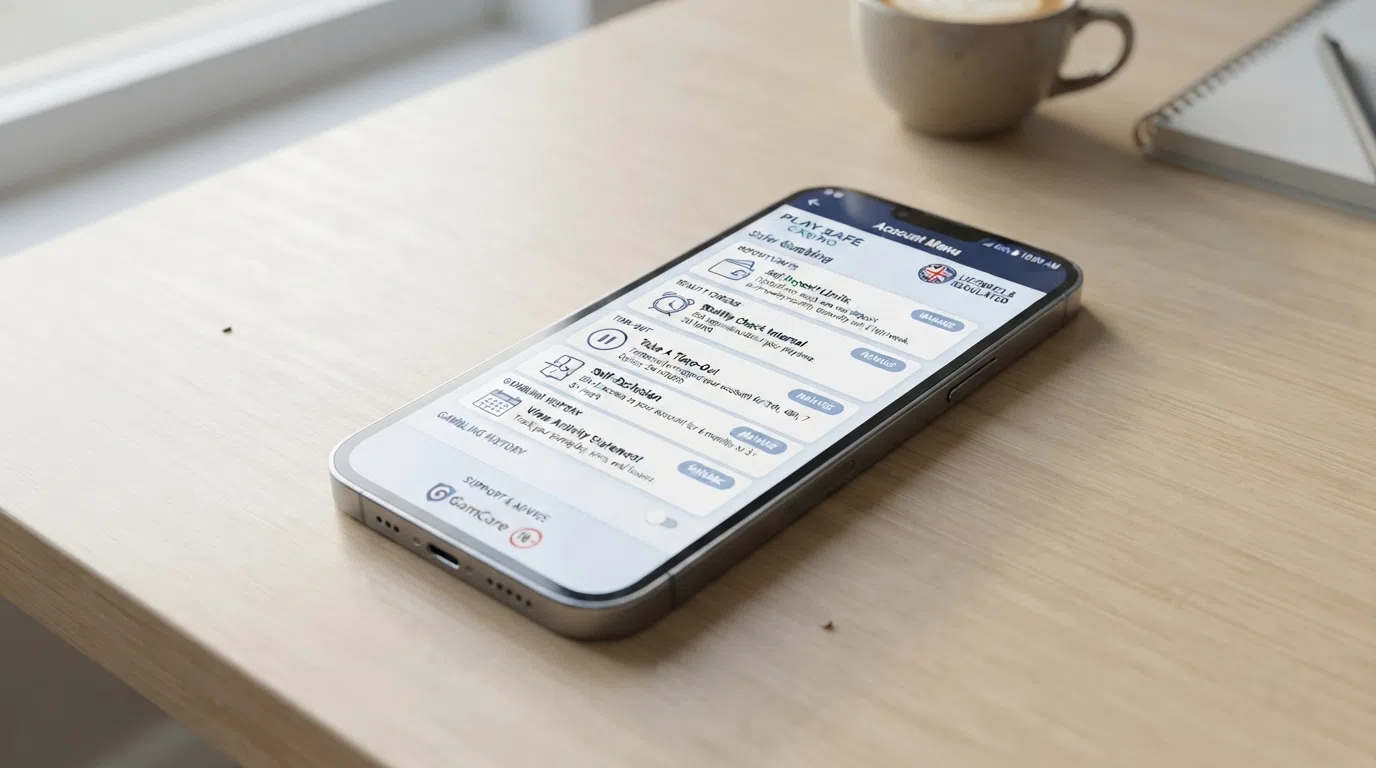
Every UK-licensed casino offers a deposit limit, a reality check, and a time-out. The deposit limit is the most-used tool: a player sets a daily, weekly, or monthly ceiling on deposits, the operator enforces it, and the limit is reviewed on the player’s request. From 31 October 2025, the operator must prompt the player to set the limit before the first deposit. Decreases take effect immediately; increases may be delayed by 24 hours or more, depending on the operator’s policy.
The reality check is the second tool. The player sets a session interval — 15 minutes, 30 minutes, 60 minutes — and a pop-up appears at each interval showing the time elapsed and the net position (wins minus losses). The check is mandatory across all UK-licensed slots and live casino products, and a player who ignores the pop-up for too long may be logged out automatically. The tool is a brake on the session, not a stop; it surfaces the player’s position at a regular cadence so the player can choose to continue or stop.
The time-out is the third tool. A short cooling-off period — 24 hours, 48 hours, one week, up to six weeks — locks the account from play without triggering a full self-exclusion. The player sets the time-out, the account is locked for the period, and the player cannot reverse the time-out mid-period. The tool is for players who want a break without the longer commitment of self-exclusion.
Beyond these three, a UK-licensed casino may offer session loss and win limits (a hard cap on the day’s net loss or net win), product-specific time-outs (locking the live casino while leaving the slots accessible), and access to the operator’s responsible-gambling team. The tools are in the account dashboard under “Safer Gambling” or “Responsible Gambling”; a player who has not found them should contact customer support before staking.
GAMSTOP: The National Self-Exclusion Safety Net
GAMSTOP is the national multi-operator self-exclusion scheme for Great Britain. One registration — at gamstop.co.uk, free, under five minutes — blocks the player from every UKGC-licensed online gambling operator for the chosen exclusion period. Participation in GAMSTOP is a mandatory condition of every UKGC online operating licence, which means every operator on this list checks new registrations against the GAMSTOP database. A registered player cannot open an account, deposit, or stake.
The exclusion periods are six months, one year, five years, or five years with auto-renewal. The exclusion cannot be cancelled early once active. A player who has registered and changed their mind must wait out the period; there is no cooling-off, no appeal, and no early reversal. The auto-renewal option is the most restrictive: a five-year exclusion that renews for another five years unless the player takes an active step to end it.
GAMSTOP covers online gambling only. It does not reach land-based casinos, betting shops, or unlicensed offshore sites. A player who has self-excluded through GAMSTOP and then attempts to open an account at an unlicensed operator is not protected by the GAMSTOP registration; the player must separately exclude from any land-based venues through the operator’s own self-exclusion scheme. The split is the limit of the national scheme.
Where to Get Help: GamCare, BeGambleAware and NHS Clinics
The UK operates a three-tier support system for gambling harm. The first tier is the National Gambling Helpline, run by GamCare, available 24/7, free, and confidential. In January 2026 alone, the helpline made 996 referrals to treatment and peer-based support services — a 48% year-on-year increase from 674 in January 2025. The helpline is the front door: a player who is worried about their own or someone else’s gambling can call, message, or use the webchat and be referred into the rest of the system.
The second tier is the National Gambling Support Network (formerly the National Gambling Treatment Service), which provides free counselling across Great Britain. In 2024/25, the network treated 11,960 clients — an 11% increase on the prior year — and 93% of clients who completed treatment saw improvement in their presenting condition. The counselling is structured, time-limited, and free at the point of use; a player can self-refer or be referred through the helpline.
The third tier is the NHS. Fifteen specialist NHS gambling treatment clinics operate across England, Scotland, and Wales as of December 2024, with service use up 130% over the preceding year. The NHS clinics treat more complex cases, including co-occurring mental health conditions, and accept referrals from the helpline and from GPs. BeGambleAware operates alongside the three tiers, providing self-assessment tools, information, and signposting to the rest of the system.
How Many People Are Affected? The Prevalence Data
The Adult Psychiatric Morbidity Survey 2023–24, published by NHS England Digital, found that 0.4% of adults in England experienced problem gambling (defined as a PGSI score of 8 or more) and 1.6% experienced at least moderate risk (PGSI score of 3 or more). Translated to a 50-million-adult population, that is roughly 200,000 problem gamblers and 800,000 at-risk adults in England alone. The figures are the empirical basis for the regulatory intensity — the £150 net-deposit financial vulnerability check, the deposit-limit prompt, the affordability-assessment thresholds announced for 2026.
The £150 net-deposit financial vulnerability check has been mandatory since 28 February 2025. Operators must run a check using publicly available data when a player’s net deposits reach £150 in a rolling 30-day period. The check is a soft intervention: a flag, not a block. A higher tier of financial risk assessment has been announced with Stage 1 thresholds of £5,000 in 24 hours or £2,500 in 24 hours, confirmed 7 July 2026, but the start date has not yet been set. A Lightning Roulette player who is depositing in volume will see these checks surface in their account.
How We Chose and Ranked These Lightning Roulette Casinos
The ten featured operators were selected for fit to the Lightning Roulette live casino topic and verified against the UK Gambling Commission’s public register for active licence status. Each operator’s UKGC account number is published in the table earlier in this guide and confirmed against the register. Operators that did not carry Evolution’s live-dealer catalogue, or that operated primarily in a non-live product (bingo, lottery, sports), were excluded regardless of bonus value.
The ranking criteria, in order of weight, are:
- Live-casino bonus usability — whether the welcome offer can be cleared playing Lightning Roulette, and at what cost in turnover. A 0× wagering live-casino bonus ranks above a 10× deposit match with a 10% live contribution, which ranks above a 50× bonus built for slots.
- Wagering terms and live-game contribution rate — the 10% live contribution is the standard at most UK operators, and the calculation earlier in this guide shows what it costs a player in practice.
- Operator reputation — UKGC licence standing, payment reliability, and live-casino game-provider breadth (a wider live lobby gives the player more tables to move to if Lightning Roulette is busy).
The sources consulted were Evolution Gaming’s official game page, the UK Gambling Commission’s public register and LCCP, operator promotions pages, and independent casino comparison databases. The research captures a snapshot; operator bonus terms change, and a player claiming any offer should check the operator’s own site for the current terms before depositing. The featured operator set is not the whole UK market; the Commission licenses many more brands than this guide ranks, and a player looking beyond the ten should consult the public register directly.
What UK Lightning Roulette Players Should Actually Do
The page’s verdict, in one sentence: a player who claims a 0× wagering live-casino bonus, runs a First Person demo session to learn the multiplier mechanic, and sets a deposit limit before the first real-money spin, is making a more informed choice than the marketing suggests is possible. The rest of this section unpacks the reasoning.
The demo-to-live path is the lowest-risk on-ramp. First Person Lightning Roulette is a free-to-play RNG version of the live game, with the same multiplier mechanic, the same 1-to-5 Lucky Numbers, and the same 50x-to-500x range. A player who has run 200 demo spins knows the betting layout, the rhythm of the betting window, the 29:1 non-multiplied payout, and the visual cue of the lightning strike. The Go Live button transitions to the real-money table in one click; the only thing the demo does not prepare the player for is the psychological weight of real money on a 1-in-37 chance.
A 0× wagering live-specific bonus beats any deposit-match offer once the contribution-rate maths is applied. The calculation above shows a £40 deposit match at 10× wagering with 10% live contribution demanding £4,000 of live turnover — roughly 20,000 spins at minimum stake, around 28 hours of continuous play. A £10 live bonus at 0× wagering demands zero turnover, zero spins, and zero hours. The headline number on the deposit match is larger; the value a player can actually realise is smaller.
UKGC licensing is the baseline every operator on this page meets. The differentiators are wagering terms, live-casino game-provider breadth, and the operator’s own standing. A player who has checked the Commission’s public register, read the welcome offer’s small print, and run a demo session has done what is reasonably possible before staking.
No statutory stake cap applies to live roulette. The £5 cap on slots (£2 for 18–24-year-olds) does not extend to live casino products, and Lightning Roulette carries no per-spin cap beyond the operator’s table limits. The limit the player faces is the one the player sets through the deposit-limit tool. The reality check, the time-out, and the GAMSTOP registration are the rest of the safety net; a player who has not set them up has not used the regulatory framework the Commission has built around them.
The single most important habit is to set a deposit limit before the first spin and to treat the bonus as a secondary factor to the game experience itself. The bonus is a small financial input compared to the deposit that funds the session; the game is the product the player is paying for. A bonus that costs more in turnover than the player would have wagered without it is a loss, not a gain. A player who reads the contribution rate, calculates the effective wagering, and chooses the offer with the lowest turnover cost — ideally zero — is the player who keeps the most of what the bonus nominally offers.
Frequently Asked Questions
Do wagering requirements apply differently to live casino games like Lightning Roulette?
Yes. Most UK casinos apply a 10% wagering contribution rate to live casino games, against 100% for slots. A 10× wagering requirement on a £40 bonus therefore demands £400 of slot turnover but £4,000 of live turnover to clear. The 10% contribution rate is the standard across the major UK operators and is the reason a 0× wagering live-casino bonus is so much more valuable than the same headline number on a slots offer.
How does the UKGC’s 10× wagering cap affect Lightning Roulette bonuses?
The 10× cap, in force from 19 January 2026 under LCCP Social Responsibility Code 5.1.1, is a hard ceiling on the wagering multiple any UK-licensed operator can attach to a bonus. Before the cap, 40× to 60× was common; after the cap, 10× is the legal maximum and 0× is increasingly the competitive norm. The cap applies to the stated requirement; the live-game contribution rate then determines the effective turnover on live tables, which can run 10× higher than the stated number.
What is the maximum multiplier I can win on Lightning Roulette?
The maximum multiplier in standard Lightning Roulette is 500x, applied to straight-up bets on a struck Lucky Number. XXXtreme Lightning Roulette, Evolution’s higher-volatility sequel, extends the maximum to 2,000x with more strike possibilities per round. Both versions are available at every UK-licensed casino that carries Evolution’s live-dealer catalogue.
What is the RTP of Lightning Roulette for straight-up bets and other bet types?
Straight-up bets return 97.10% (2.90% house edge) and every other bet type returns 97.30% (2.70% house edge). The split exists because the multiplier pool is funded by the 6-unit reduction in the straight-up non-multiplied payout (29:1 versus the standard 35:1). Outside bets are not drawn into the multiplier funding and pay at the standard European rate.
What is the difference between Lightning Roulette and standard European roulette?
Lightning Roulette is built on a single-zero European wheel and adds a random multiplier system — between one and five numbers are struck per round with multipliers of 50x to 500x — that applies only to straight-up bets. Standard European roulette pays 35:1 on straight-up bets; Lightning Roulette pays 29:1 on non-multiplied straights and the multiplied rate on struck straights. Outside bets pay identically in both games.
What responsible gambling tools are available when playing Lightning Roulette online?
Every UK-licensed casino offers deposit limits, reality checks, and time-outs as standard, with GAMSTOP registration providing multi-operator self-exclusion. The National Gambling Helpline (GamCare, 24/7) offers immediate support, the National Gambling Support Network provides free counselling, and 15 specialist NHS gambling treatment clinics operate across England, Scotland, and Wales. A player who sets a deposit limit and a reality-check interval before the first spin has used the regulatory framework as intended.
Live – realmoney-onlinecasinos-uk
Content created by the «realmoney-onlinecasinos-uk» team