
MGA Casinos and the UK Player: What the Malta Licence Really Buys You
 Available in GB
The Malta Gaming Authority licence is one of the most recognised credentials in online gambling. Operators proudly display it in their footers, affiliate sites list “MGA-licensed” as a quality marker, and a British player searching for an international casino will see the acronym more than almost any other. What the marketing rarely explains is that the MGA mark on a UK-facing casino tells you something quite different from what it tells a player in Berlin, Helsinki or São Paulo.
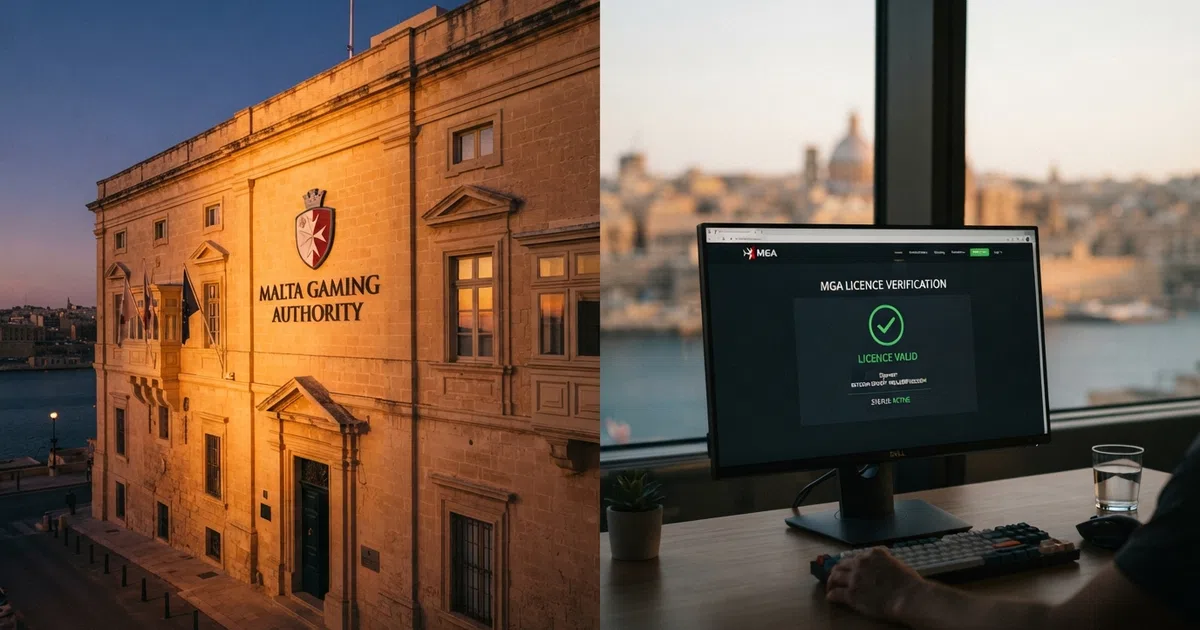
This page is built around that distinction. It is written for a player based in Great Britain who is weighing up an MGA-licensed casino, has heard that Malta licensing carries weight, and wants to understand what that weight actually delivers once a deposit goes in. The picture has three layers: what an MGA licence requires of an operator, what it does not require of an operator serving British customers, and where the gap between the two becomes a cost the player pays.
September 8, 2026 data checked against the UK Gambling Commission’s public licence register and the Malta Gaming Authority’s licence-holder register.
Malta: The Tiny Island That Powers Global Online Gambling
Malta is not a large country, but the cluster of online gambling companies registered in Valletta is unusually dense. The figure most often cited puts more than 500 online gambling companies on the island, accounting for over 10% of the world’s virtual casinos. That concentration did not happen by accident. It is the result of decades of regulatory infrastructure, a tax regime designed to attract iGaming operators, and a workforce that has built deep expertise across compliance, payments, game testing and platform engineering.
For a British player, however, the important fact about that cluster is what it does not do. The UK Gambling Commission, the regulator that authorises any operator taking GB customers, treats the MGA as a recognised jurisdiction. Recognition matters for compliance reviews and for handling disputes, but it is not the same as authorisation. An MGA-licensed operator still needs a UKGC operating licence to lawfully serve British players, and the requirement to hold that licence sits in statute rather than in any negotiation between regulators. The Gambling (Licensing and Advertising) Act 2014 made a GB licence compulsory for any operator taking GB players, regardless of where the operator is based. The 2014 Act closed the loophole that had allowed operators registered elsewhere in Europe to serve British customers without British oversight.
The MGA mark in a casino footer, then, is a credential about the operator’s international standing. It tells a player that the operator has met the MGA’s standards for game fairness, fund segregation, identity verification, dispute resolution and responsible-gambling messaging. It does not tell the player that the operator is regulated to serve them in Britain. That second claim requires a separate UKGC licence number, issued under the Gambling Act 2005, and verifiable on the Commission’s public register.
Why Hundreds of Casinos Register in Valletta
The pull factors are practical. Malta’s iGaming ecosystem offers a regulatory framework the MGA has refined since the early 2000s, a workforce fluent in compliance, a tax structure that, until recently, exempted gambling activities from VAT, and a community of service providers, game studios, payment firms and legal advisers that has grown alongside the operators themselves. For an operator building a multi-jurisdiction business, Malta is operationally convenient.
The tax arithmetic is part of the picture. The MGA’s gaming tax on revenue from Malta-based players sits at 5%, a far lower headline rate than the UK’s Remote Gaming Duty, which rose from 21% to 40% in April 2026. The comparison is not direct: RGD applies to gross gaming yield from GB customers, MGA gaming tax to Malta-resident customers, and the bases differ. The rate gap is real nonetheless, and it explains why operators route international business through Maltese entities while maintaining a separate UKGC arm for British customers. The same group often holds both licences for the same brand, with the UKGC licence governing the GB-facing site and the MGA licence governing the international-facing site. The two licences cover different customers, and neither is a substitute for the other.
That dual-licence model is the standard for serious operators. Seven of the ten brands featured further down this page confirm MGA dual-licence status through a Malta-registered parent entity or international arm. Three do not, and their international operations run through non-Malta jurisdictions, Gibraltar in the case of one well-known name. For a player, dual-licence status is a signal that the operator has invested in regulatory compliance across markets, not a guarantee of any particular UK experience.
One change is worth flagging. From 1 October 2026, Malta’s VAT exemption for gambling activities narrows under amendments to the Gaming Tax Regulations. The change tightens Malta’s tax advantages for operators, and it is one reason some operators may look more carefully at their jurisdictional mix over the coming years. The change does not affect the licences themselves or the standards operators must meet, but it does reshape the commercial calculation.
What “Best Malta Casino” Means When You Are in the UK
The phrase “best Malta casino” gets used heavily in affiliate marketing. The lists it appears on are ranked by bonus size, by number of free spins, by game library depth, by payout speed, and by any combination of the above. These are real quality markers, and the MGA’s regulatory framework enforces a baseline beneath them: game fairness testing, RTP verification, fund segregation, dispute resolution through approved alternative dispute resolution providers, and the responsible-gambling machinery set out in Directive 2 of 2018.
The phrase stops being straightforward when a British player is choosing from one of these lists. The single most important fact is that an MGA-licensed casino topping a “best Malta” list may hold no UKGC licence at all. The MGA does not authorise transactions with British consumers; the UKGC does. A casino that is “best Malta” in the international sense may be operating outside the British regulatory framework entirely, which is the situation the UKGC describes in its enforcement data as “unlicensed” and acts against through disruption notices, search-engine referrals and payment-provider referrals.
The position the material supports is simple: for a player in Britain, the only “best Malta casino” worth ranking is one that holds both licences, an MGA licence for international credibility and a UKGC licence for the protections that apply on this side of the regulatory border. A casino with the MGA mark alone offers MGA-standard protections, which are real, but they are not the protections the UKGC mandates for British players. A player who picks an MGA-only casino trades away GAMSTOP coverage, the Commission complaints route, the £150 financial vulnerability check, the £5/£2 slot stake cap, and the 10× bonus wagering ceiling. None of those can be reconstructed from the MGA framework.
New Malta Casinos Worth Watching in 2026
The MGA licence pipeline is not closed to new entrants. New licensees continue to launch, and the MGA has been tightening its supervisory framework in parallel. The 2026 supervisory priorities signal a regulator watching crypto asset internal controls more closely, reviewing enhanced player-protection oversight, and scrutinising esports and athlete betting integrity. For a player, that is the regulator raising the bar, which is the direction you want the bar to move.
A new MGA casino typically offers a welcome package designed to attract first-time depositors: a deposit match with a percentage ceiling, a free-spin allocation, or a combination. Against established brands with large customer bases, a new licensee has to compete on offer value, and that often means larger headline numbers or more permissive terms. The trade-off is that the operator has no track record with this customer base, and the regulatory relationship is newer.
The defensive step, and a thirty-second one, is licence verification before any deposit. Every MGA licensee appears on the Authority’s public register, searchable by name or licence number. The number is usually printed in the casino’s footer alongside other regulatory disclosures. Cross-check it against the register before depositing. If the register returns no result, or the licence is held by a different entity than the one named in the footer, the credential is not what it appears to be.
Real-Money Play and Free Demos: What Malta Casinos Offer
MGA casinos run two modes. Real-money play requires a registered account with verified identity, a payment method, and a funded balance. Free-play or demo mode lets a player test the games without an account or a deposit, though access to demo mode varies by operator and by jurisdiction.
Identity verification sits upstream of the first deposit. MGA Directive 2 of 2018 requires verification before any deposit, and the UKGC has required the same since 7 May 2019. The two regulators arrive at the same point from different rulebooks, and a British player at a dual-licensed casino experiences one verification process that satisfies both. At an MGA-only casino, the verification satisfies the MGA standard, which is robust, but it does not bring the player into the UKGC framework.
Demo play is the low-cost way to test an unfamiliar site. Game quality, site speed, navigation and the actual feel of the platform are things the welcome offer cannot tell you. A new site deserves ten minutes of demo time before any money goes in, and the MGA framework does not restrict this. Where a casino disables demo mode or buries it, the absence is itself a signal.
The Malta Gaming Authority Licence: What It Covers for a UK Player — and Where It Falls Short
The MGA licence is a strong international credential, and the reason it reads as one is the substance behind it. The MGA operates under Malta’s Gaming Act, with Directive 2 of 2018 as the player-protection backbone. A B2C gaming service licence authorises an operator to offer online gaming to customers, subject to the conditions the MGA enforces. Those conditions are not advisory: they include identity verification before deposit, deposit and session limits available to customers, self-exclusion processes, mandatory responsible-gambling messaging, and access to an approved ADR provider for dispute resolution. Fund segregation is required, meaning customer balances are held separately from operating funds, and game fairness testing is verified by independent laboratories before titles go live.
What the MGA licence does not do, for a player in Britain, is bring the UKGC framework with it. Section 33 of the Gambling Act 2005 makes it a criminal offence to provide gambling facilities without the required licence, and the required licence for GB customers is a UKGC operating licence. The 2014 Act’s point-of-consumption reform made the position unambiguous: jurisdiction of incorporation does not determine jurisdiction of authorisation. An MGA-licensed operator serving British customers without a UKGC licence is not in a grey area; the operator is unlicensed for that activity.
The practical protections the MGA does enforce, game fairness, fund segregation, ADR, self-exclusion, are real, and they are not nothing. For a player who values MGA standards in their own right, an MGA-only casino delivers those standards. What it does not deliver is the UKGC’s prescriptive layer: the £5/£2 slot stake cap, the £150 financial vulnerability check, the GAMSTOP integration, the 10× bonus wagering ceiling, the credit card ban, the statutory levy-funded treatment infrastructure, and the Commission complaints route. These are not interchangeable. The MGA’s principles-based approach is a different regulatory philosophy, and the difference is visible in the product.
Inside the Malta Gaming Authority: How MGA Licensing Works
The MGA is Malta’s single gaming regulator, and it issues licences for both B2C and B2B activity. A B2C gaming service licence is what an online casino holds to offer gaming to end customers; a B2B licence covers suppliers of platform technology, game content and related services. The distinction matters when verifying a casino’s credentials, because a platform provider’s B2B licence is not the same as a casino’s B2C licence, and some sites blur the line.
The application process includes fit-and-proper tests for principals, system and platform audits, and capital requirements. The MGA’s share capital requirements are being raised, with the threshold for certain licence classes moving from €100,000 to €500,000 in 2026, a substantial increase that signals tighter financial scrutiny of licensees. Once licensed, operators face ongoing compliance obligations: regular reporting, AML checks, technical audits, and adherence to the MGA’s player-protection and technical standards.
The 2026 supervisory priorities tell a player where the regulator is looking. The thematic review of crypto asset internal control frameworks is the most visible. The MGA permits cryptocurrency as a payment method under its standard licence framework, but permission is conditional on wallet screening, chain analysis and source-of-funds processes. The thematic review is the regulator checking that operators are actually running those processes rather than treating the requirement as paperwork. Enhanced player-protection oversight and integrity reviews of esports and athlete betting complete the priority list, and each one tightens the regime a licensed operator works within.
Two Regulators, Two Playbooks: MGA vs UKGC Side by Side
The table below sets the two regulators against each other on the dimensions that change a British player’s experience. Where the UKGC sets a hard cap or mandates a feature, the MGA’s approach is principles-based. Where the MGA sets a minimum standard, the UKGC’s standard is more prescriptive. The differences are not small.
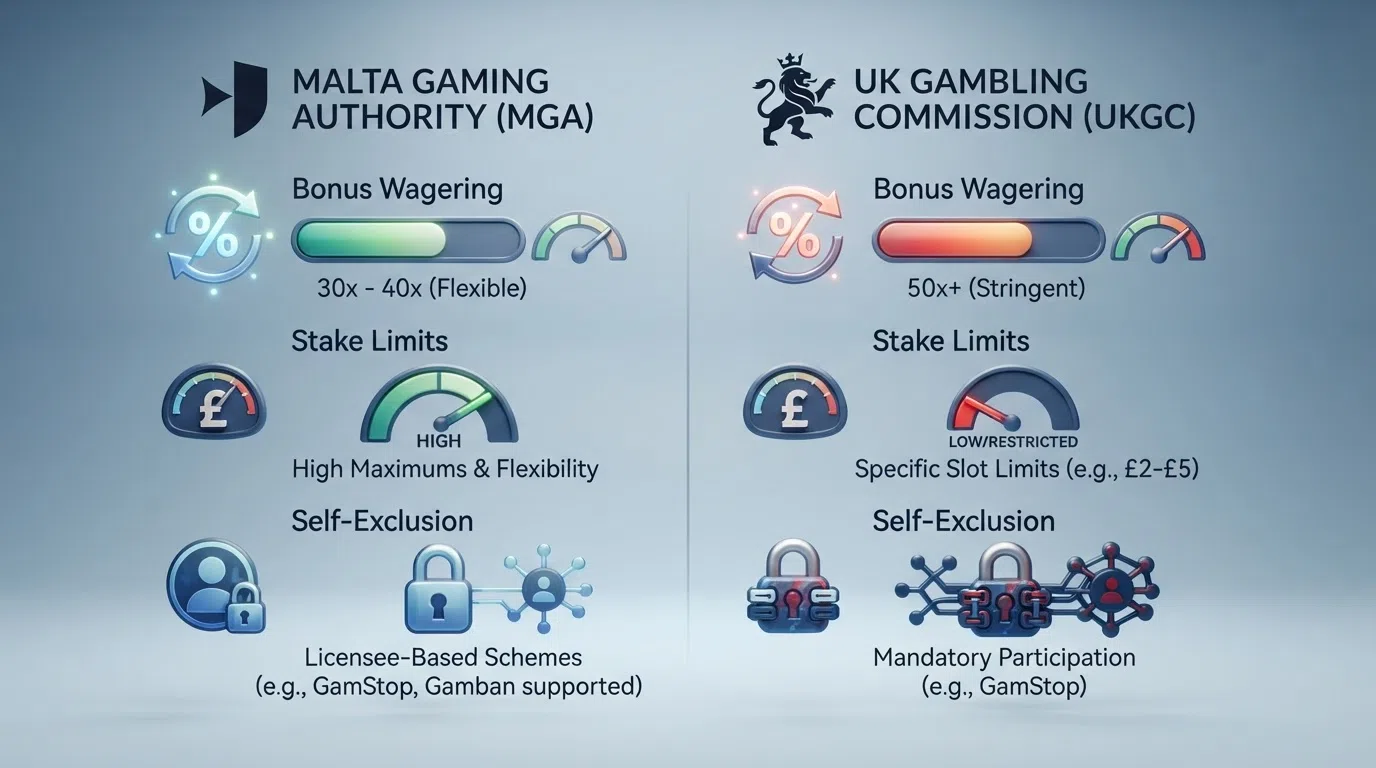
| Dimension | UKGC (GB) | MGA (Malta) |
|---|---|---|
| Bonus wagering | 10× cap on bonus amount (since 19 December 2025); mixed-product offers banned | No statutory cap on wagering requirements |
| Slot stake cap | £5 per spin (25+); £2 per spin (18–24) since April/May 2025 | No statutory per-spin cap |
| Self-exclusion | GAMSTOP mandatory for all UKGC online licences since 31 March 2020 | Operator-level self-exclusion under Directive 2 of 2018; no central cross-operator register |
| Affordability checks | £150 net-deposit financial vulnerability check in rolling 30 days (since 28 February 2025); staged financial risk assessments with announced thresholds (start date not yet confirmed) | Lighter-touch regime; operators must offer limit-setting tools |
| Spin speed and auto-play | Auto-play banned; minimum 2.5-second spin speed; losses disguised as wins banned; reverse withdrawals banned (in force October 2021) | Technical standards set under Directive 2; auto-play and spin-speed rules less prescriptive |
| Credit cards | Banned for all GB-licensed gambling since 14 April 2020; extends to credit-card-funded e-wallet payments | No equivalent ban at the regulator level |
| Crypto | No current permit or prohibition rule; proposed White-Listed Crypto Assets pilot expected Q3 2026 | Permitted under standard licence framework with wallet screening, chain analysis, source-of-funds AML |
| Remote Gaming Duty | 40% on GGY from GB customers (since 1 April 2026) | 5% gaming tax on Malta-resident player revenue |
| Statutory levy | 1.1% of GGY for remote casino (since 6 April 2025) | No equivalent statutory levy |
| Bonus cross-sell | Mixed-product promotional offers banned since 19 December 2025 | No equivalent ban; an MGA casino may cross-sell sports betting through a casino bonus |
| Dispute resolution | Commission complaints route plus ADR | ADR access required under Directive 2; no Commission equivalent |
The pattern in the table is clear once you step back. The UKGC prescribes specific numbers; the MGA sets principles and trusts operators to meet them. Both approaches have defenders, and both produce real player protection. They are not the same protection, and a British player choosing between them is choosing which regulatory philosophy applies to their money.
How to Verify a Casino’s MGA Credentials in 60 Seconds
- Navigate to the MGA’s official licence-holder register on the Authority’s website. The register is public and searchable by operator name or licence number.
- Locate the casino’s MGA licence number in the site footer, usually near other regulatory disclosures. The number is a string of digits, sometimes prefixed.
- Cross-check the number against the register. Confirm the licence class is B2C gaming service, not a B2B supplier licence, and confirm the licensee entity matches the operator.
- Check the licence status and effective dates. An active licence with current dates is what you want; a suspended or expired entry is a red flag.
- Treat the absence of an MGA licence number as a red flag in itself. A casino displaying only a Malta company registration number, with no MGA licence number, has not shown you its gaming credential.
The register does not tell you whether a casino is licensed to serve British players, only whether it holds a valid MGA licence. The second question, whether the casino is licensed for GB, is answered by the UKGC’s public register. A dual-licensed casino appears on both. An MGA-only casino appears on the MGA register only, and that is the position from which a UK player is unprotected by UKGC rules.
The verification is fast, and the cost of skipping it is asymmetric. A player who verifies and finds a mismatch has lost a minute. A player who skips it and deposits at an unlicensed operator has lost every UKGC protection on the money in that account. The 60-second check is not a formality.
MGA Casinos and UK Players: The Cross-Border Legal Reality
The legal position is unambiguous, and it is worth stating in plain terms. The Gambling Act 2005, as amended by the 2014 Act, makes a GB operating licence compulsory for any operator taking GB customers. Section 33 of the 2005 Act creates a criminal offence for providing gambling facilities without the required licence, punishable by up to 51 weeks’ imprisonment, an unlimited fine, or both. An MGA-licensed casino accepting GB customers without a UKGC licence is operating in breach of that statute.
The UKGC’s response to unlicensed operators is disruption, not blocking. The Commission does not hold statutory ISP or DNS blocking powers; legislation to grant such powers has been proposed but not enacted. What the Commission does is issue cease-and-desist notices, refer URLs to search engines for delisting, work with domain registrars, and refer cases to payment providers. Between April 2024 and June 2025, this machinery produced 3,140 disruption notices, referred 447,778 URLs to search engines, saw 287,961 of those URLs removed, and recorded an average 32% fall in engagement across 160 disrupted sites. The numbers are large, and the drop in engagement is real, but the machinery does not make an unlicensed casino disappear. It reduces its visibility.
For the player, the practical consequences are easier to describe than the legal architecture. A British player using an MGA-only casino is gambling on a site that is, for the GB market, unlicensed. The MGA protections still apply in the sense that the operator is MGA-regulated, and the MGA’s standards are enforced. The UKGC protections do not apply, and the player has no route to the Commission for complaints, no GAMSTOP coverage, no access to the ADR provider through the UKGC framework, and no £150 vulnerability check protecting their deposits. The player also faces no traced penalty for gambling on such a site, which is the one point where the asymmetry softens, but no penalty for the player does not convert the site into a licensed one.
The honest summary: a genuine MGA licence held by an operator taking UK players almost always comes paired with a UKGC licence, and UKGC-licensed sites are legally required to connect to GAMSTOP. When both are present, the player has the full British protection framework plus MGA international standards. When only the MGA licence is present, the player has MGA standards and nothing else.
GamStop at MGA Casinos: Why Self-Exclusion Stops at the Border
GAMSTOP has been mandatory for every UKGC online operating licence since 31 March 2020. A player who self-excludes through GAMSTOP is blocked from every UKGC-licensed online operator for the chosen exclusion period: six months, one year, five years, or five years with auto-renewal. The exclusion cannot be cancelled early. The system is comprehensive within the UKGC perimeter.
The MGA does not require casinos to participate in GAMSTOP. The MGA’s Directive 2 of 2018 mandates operator-level self-exclusion, which is real, but it is per-operator. A player who self-excludes at one MGA casino can still register and deposit at another. There is no MGA central register that blocks access across all MGA licensees, and the MGA’s regulatory architecture does not provide for one. The gap is structural, and the gap is the reason MGA-only casinos appear in searches for “casinos not on GamStop.”
This page presents the gap factually because the gap is the honest consequence of different regulatory jurisdictions. The MGA’s player-protection framework is not weaker in absolute terms; it is structured differently, and the difference includes the absence of a cross-operator self-exclusion register. A player who has chosen to self-exclude through GAMSTOP, and who then registers at an MGA-only casino, has not found a loophole. They have stepped outside the system that was designed to enforce the choice they made. The player-protection tools at the MGA casino itself, deposit limits, session limits, operator-level self-exclusion, are still available, and the MGA requires them. The protection the player loses is the cross-operator block, which is the protection GAMSTOP exists to provide.
Top 10 UK Casino Brands and Their Malta Licence Status
The table below lists the ten featured brands, all of which hold active UKGC operating licences, and shows their MGA dual-licence status, welcome offer and key bonus terms. Seven are confirmed dual-licensees through a Malta-registered parent or international arm. Three are not confirmed, and their international operations route through non-Malta jurisdictions.
| Operator | MGA licence | Welcome offer | Free spins | Wagering | Bonus validity | Deposit-free spins |
|---|---|---|---|---|---|---|
| bet365 | Held (Malta-registered entity) | Up to 500 Free Spins on stake | 500 | 0× | 30 days to claim; 7 days per batch | No |
| William Hill | Not confirmed (Gibraltar-registered) | 200 Free Spins on Big Bass Splash | 200 | 10× on spin winnings | 72 hours | No |
| 888 Casino | Held (evoke plc Malta-headquartered) | 100% deposit match up to £100 OR 100 Free Spins | 100 (alt. offer) | 10× | 90 days (match); 7 days (spins) | No |
| Sky Vegas | Held (Flutter international) | 50 No-Deposit Spins + 200 on deposit | 250 total | 0× | 7 days; 30 days to claim deposit offer | Yes — 50 spins |
| Paddy Power | Held (Flutter international) | 50 Free Spins + 100 on deposit | 150 total | 0× | — | Yes — 50 spins |
| Coral | Held (Entain international) | Bet £10+, get 100 Free Spins | 100 | 10× | 7 days; 48 hours to accept | No |
| Betfred | Not confirmed | Up to 200 Free Spins on stake | 200 | 0× | 7 days; 30 days to stake | No |
| Ladbrokes | Held (Entain international) | Bet £10+, get 100 Free Spins | 100 | 10× | 7 days; 48 hours to accept | No |
| Grosvenor | Not confirmed (Rank Group) | Deposit £20, play with £40 + 100 Free Spins | 100 | 10× on deposit + bonus | 7 days | No |
| 32Red | Held (Kindred/evoke) | 320 Free Spins on £30 slots play | 320 | 0× | 30 days to claim | No |
The pattern in the table is the headline: zero-wagering offers are no longer rare. The UKGC’s 10× cap has reshaped the competitive landscape, and operators are using 0× as a differentiator. Of the ten brands, five offer 0× wagering on free-spin winnings, three sit at the 10× cap, and two are at the 10× cap on combined deposit and bonus. The 10× cap is the regulatory ceiling, and the brands above it are the ones pushing back toward the player.
How We Evaluated These Casino Brands
Every brand in the table holds an active UKGC operating licence, confirmed against the Commission’s public register, which contained 2,663 business records as at August 2026. UKGC licence standing is the entry requirement, not a ranking criterion. A casino without a GB operating licence is not eligible for inclusion on a page about MGA licensing as it affects UK players, because the legal framework the page describes assumes the player is gambling with UKGC protection.
MGA dual-licence status is a relevance signal for this page specifically. A brand that holds both licences demonstrates that it has invested in regulatory compliance across the two regimes, and its international arm operates to MGA standards. Where MGA status is not confirmed, the international arm may hold a Gibraltar licence, a Curaçao licence, or a different credential. The page notes this where it occurs.
Bonus evaluation weighed the wagering multiplier first, because the multiplier is the number that determines what a player actually has to do to clear the offer. Zero-wagering offers sit at the top. The 10× UKGC cap is the ceiling, and offers at the cap are competitive rather than differentiated. Validity window length matters: a 90-day window gives a player time to clear a bonus at a reasonable pace; a 72-hour window does not. Maximum cashout caps are flagged where research provides them, because a £30 cap on a 200-spin offer is the difference between a generous bonus and a marketing exercise. Game-provider breadth is the proxy for game-library quality, and the MGA framework’s game fairness testing means provider reputation is a fair proxy.
The evaluation is not a ranking of which casino is “best.” It is a description of what each casino offers, with the comparative columns showing where each one sits. The decision between them belongs to the player, and the page aims to make that decision easier, not to make it for the reader.
bet365: 500 Wager-Free Spins and a Dual MGA-UKGC Setup
bet365 operates a UKGC licence through Hillside (UK Gaming) ENC, account 38721, and holds an MGA licence for its international operations through a Malta-registered entity. The welcome offer is up to 500 Free Spins with 0× wagering on winnings, qualifying on a £10 deposit and stake within 30 days. The spins are released in batches: 10 reveals of 5, 10, 20 or 50 spins, with 4 minutes between each reveal, on bet365 exclusive titles including Book of Horus, Curse of the Bayou, Magic Forge and Wrath of the Deep. The game-provider list spans NetEnt, Playtech, Microgaming, Pragmatic Play, IGT and Evolution, alongside bet365’s own Originals.
The 0× wagering is the standout. With no turnover requirement, free-spin winnings are withdrawable as cash, and the value of the offer is the value of the spins themselves. The 30-day window to claim is generous. The seven-day window per batch is the constraint: once a batch drops, the player has a week to use the spins. For a player who can log in regularly, the structure works. For one who cannot, the unclaimed batches are lost.
bet365 is the market leader for a reason, and the casino welcome offer reflects the broader brand position: scale, breadth, and terms that respect the player’s time. The dual-licence status means a UK customer is protected by both regimes, which is the position the rest of this page argues for.
William Hill: A Gibraltar Giant With 200 Spins and an MGA Question Mark
William Hill’s UKGC licence, held by William Hill Organization Limited, account 2752, has been active since 1 January 2009. The international arm routes through WHG International, a Gibraltar-registered entity, rather than a Malta-registered one, and MGA status was not confirmed this run. The welcome offer is 200 Free Spins on Big Bass Splash (Pragmatic Play, RTP 96.71%, high volatility, max win 5,000×), requiring a £10 deposit and a £10 stake, with 10× wagering on free-spin winnings and a 72-hour validity from credit. The maximum cashout is capped at £30, and each spin is valued at £0.10.
The £30 cashout cap is the clause that defines the offer. Two hundred spins at 10p each is a £20 spin-value base, and £30 in winnings is a 50% uplift before the cap kicks in. The cap is unusual on a UK-facing offer of this size, and it converts what reads as a generous headline into a tightly bounded one. The 72-hour validity adds pressure: a player who logs in 73 hours after credit has nothing to use.
The RTP on Big Bass Splash is 96.71%, which is in the upper band for high-volatility slots, and the 5,000× max win is the game’s headline figure. The math favours occasional large outcomes over frequent small ones, and that profile interacts with the £30 cap in a particular way: a single large hit is the only way to approach the cap’s neighbourhood, and the cap itself ensures no single hit pays out much beyond it.
For a player who can clear 200 spins at 10p in 17 minutes, the offer is worth taking. For a player who cannot, the validity window acts as the primary constraint.
888 Casino: Malta-Headquartered With a Deposit-Match or Free-Spin Choice
888 Casino is the casino brand of 888 UK Limited, UKGC account 39028, with a Casino Remote licence active since 1 November 2014. The parent company, evoke plc, is Malta-headquartered and holds an MGA licence for international markets, which makes 888 Casino the clearest dual-licence story on this page: the same group, headquartered in Malta, with both licences for the same brand.
The welcome offer comes in two tracks. The first is a 100% deposit match up to £100 with 10× wagering on the bonus and 90-day validity, capped at £100 maximum cashout. The second is 100 Free Spins, requiring a £10 deposit and a £10 wager on slots, with 10× wagering on free-spin winnings, 7-day validity, and a £300 maximum cashout. The player picks one track at registration.
The 90-day validity on the deposit match is the longest in the table, and it is the structural advantage of this offer. A 100% match at 10× wagering means a £100 deposit and £100 bonus need £1,000 of slot turnover to clear, which at 10p per spin is 10,000 spins, or roughly 14 hours of continuous play. Spread over 90 days, that is nine minutes a day, and the offer is genuinely clearable for a player who plays a little each day. The 7-day validity on the free-spin track is tighter.
Game providers include NetEnt, Pragmatic Play, Evolution, Playtech, Red Tiger and Play’n GO, which is the standard breadth for a major UKGC-MGA dual-licensed casino. The Malta-headquartered parent is the structural advantage, because the group’s compliance infrastructure is built around both regimes from the ground up.
Sky Vegas: 50 No-Deposit Spins and Zero Wagering Across the Board
Sky Vegas is the only featured brand offering a genuinely deposit-free welcome. The first 50 Free Spins require no deposit, with 0× wagering on winnings, credited as cash. A further 200 Free Spins drop when the player deposits and spends £10, also at 0× wagering. The deposit offer has 7-day validity on the spins and 30 days to claim the deposit-and-spend condition. The UKGC licence is held by Flutter Entertainment, and Flutter holds MGA licences for its international operations.
The 50 no-deposit spins are the entry point. A player who has never deposited at Sky Vegas can register, verify their identity, and receive 50 spins with no money changing hands. The winnings are cash, not bonus funds, and there is no turnover requirement. For a player comparing welcome offers, this is the cleanest free play in the table.
The 200 deposit spins at 0× wagering close the gap between Sky Vegas and the other zero-wagering brands (bet365, Betfred, 32Red). The headline is that Sky Vegas offers 250 spins in total, 50 of them with no deposit at all, and all of them with no wagering. The 7-day validity on the spins and the 30-day window to claim the deposit condition are the constraints.
Game providers include NetEnt, Pragmatic Play, Evolution, Blueprint, Inspired and Playtech. The Flutter group also owns Paddy Power, and the shared parent means similar game libraries, similar responsible-gambling infrastructure, and the same MGA international arm.
Paddy Power: Deposit-Free Spins From Flutter’s Irish Arm
Paddy Power mirrors Sky Vegas on the no-deposit side. The first 50 Free Spins are deposit-free, with 0× wagering on winnings. A further 100 Free Spins drop on a £10 deposit and bet, placed via debit card or Apple Pay, also at 0× wagering. The UKGC licence is held through Flutter Entertainment, the same group as Sky Vegas, and Flutter’s MGA licences cover the international arm.
The 150 total spins sit between Sky Vegas’s 250 and the other zero-wagering brands’ figures. The deposit method restriction is a constraint: debit card or Apple Pay only, and a player who prefers e-wallets or bank transfer for the qualifying bet will not qualify. The exclusion is not a regulatory requirement; it is a bonus-term choice, and the choice narrows the qualifying population.
Paddy Power’s brand sits on the sports side of the Flutter portfolio, and the casino welcome offer is positioned to bring sports bettors into the casino product rather than to compete with casino-first brands. The 0× wagering structure still applies, and a sports bettor who fancies a casino session gets the same clean terms a casino-first player would.
For a player with a debit card and a willingness to register at a sports-first brand, the offer is worth taking. The game-provider list (NetEnt, Pragmatic Play, Evolution, Blueprint, Inspired) is the Flutter standard.
Coral: 100 Free Spins at the UKGC’s 10× Wagering Cap
Coral’s welcome is the simplest in the table. Bet £10 or more on slots, receive 100 Free Spins at £0.10 each, with 10× wagering on free-spin winnings and 7-day validity, with 48 hours to accept the spins once credited. The UKGC licence is held through Entain Group, which holds an MGA licence for its international operations.
The 10× wagering multiplier sits at the UKGC’s hard cap, which is the ceiling any UKGC-licensed casino can offer. There is no headroom above 10× at a UKGC-licensed site, and Coral is at the ceiling, not below it. The 7-day validity is the standard window, and the 48-hour acceptance window is the operational detail: a player who logs in on day three and accepts the spins has four days to use them.
Coral’s high-street heritage and Entain’s international footprint place the brand in the dual-licence column. For a player who values brand familiarity and the high-street presence, Coral is the bet-and-get structure done at the regulatory ceiling, with no surprises in the small print beyond the cap itself.
Betfred: 200 Wager-Free Spins With No Strings Attached
Betfred offers up to 200 Free Spins when the player stakes £10, with 0× wagering on free-spin winnings. The 7-day validity applies to the spins, and 30 days to stake the qualifying £10. The UKGC licence is active; the MGA dual-licence status was not confirmed this run.
The 200 wager-free spins at £0.10 each (assuming the standard spin value) are a £20 base value, and with no turnover requirement, every penny won is withdrawable. The structure is simple, the offer is clean, and the constraint is the qualifying stake: a single £10 bet on any eligible slot.
For a player who wants a wager-free welcome without the 500-spin or 320-spin headline that bet365 and 32Red offer, Betfred sits in the middle. The absence of confirmed MGA status is a gap in the international story, and a player who specifically wants the dual-licence signal should look at confirmed dual-licensees. For a UK player who only cares about UKGC status, Betfred’s offer stands on its own.
Ladbrokes: 100 Spins on Big Bass Bonanza, Sweet Bonanza and Starburst
Ladbrokes names its spin titles, which is a transparency feature the table highlights. The 100 Free Spins run on Big Bass Bonanza, Sweet Bonanza and Starburst, with 10× wagering on free-spin winnings, 7-day validity and 48 hours to accept. The UKGC licence is held through Entain, and Entain holds an MGA licence for international operations.
The named titles are a player-friendly touch. A player who knows Starburst and Big Bass Bonanza knows what to expect, and a player who prefers one over the others can plan their qualifying bet around the game they want to play. The 10× wagering is at the UKGC cap, and the validity structure matches Coral’s, which is the Entain house style.
Ladbrokes shares Coral’s high-street heritage, and the two brands sit in the same group with the same regulatory position. Ultimately, the choice between them comes down to personal preference regarding specific titles and library depth, rather than a material difference in the bonus structure.
Grosvenor: A £40 Bankroll Boost Plus 100 Spins on Big Bass Splash
Grosvenor is the only featured brand offering a deposit match, and the structure is different. The player deposits £20, plays with £40, and receives 100 Free Spins on Big Bass Splash (RTP 96.71%, high volatility, max win 5,000×). Wagering is 10× on the deposit plus bonus, the validity is 7 days, and the maximum cashout is £2,000. PayPal and Paysafecard are excluded from the qualifying deposit. The UKGC licence is held through Rank Group; the MGA status was not confirmed this run.
The £2,000 maximum cashout is the highest cap in the table, and it is the structural reason a player might choose Grosvenor over the 10× wagering peers. A player who can clear the wagering on a high-volatility slot has room to win beyond the standard cashout caps. The combination of deposit match and free spins is unique in the table, and it is the closest thing to a traditional casino welcome package (deposit match plus free spins) that the featured set offers.
Grosvenor’s high-street casino presence is a quality signal, and the game-provider list (NetEnt, Pragmatic Play, Evolution, IGT, Novomatic, Play’n GO) is broader than most. The 10× wagering on deposit plus bonus, rather than bonus alone, is a structural choice: a player depositing £20 and playing with £40 has £60 in qualifying funds, and 10× on that sum is £600 of turnover, which is more demanding than 10× on the bonus alone.
32Red: 320 Wager-Free Spins From Kindred’s Malta-Licensed Platform
32Red is the spin-count leader among the wager-free brands, with 320 Free Spins on a £30 slots play, 0× wagering on winnings, 30 days to claim, and £0.10 per spin on Big Bass Splash (RTP 96.71%, high volatility, max win 5,000×). The qualifying deposit must be made via debit card or instant bank transfer. The UKGC licence is active, and the MGA licence is held through Kindred Group, now part of evoke plc.
The 320-spin count at £0.10 each is a £32 base value, and the 0× wagering means every winning spin is cash. The 30-day claim window is generous. The £30 qualifying play is a higher entry threshold than the £10 most other brands require, but the 320 spins versus the 200 at Betfred or the 500 at bet365 make the trade-off defensible.
32Red’s Microgaming-rooted library is distinctive. The brand has long association with Microgaming content, and the provider list (Microgaming, NetEnt, Evolution, Pragmatic Play, Red Tiger) reflects that heritage. The evoke plc parent, formed through the Kindred acquisition, has integrated the MGA licence into the group structure, and 32Red’s international operations run through that MGA framework.
For a player who values spin count and provider depth, 32Red is the wager-free pick. For one who values lower entry thresholds, bet365’s 500 spins at £10 qualify more easily. The difference is whether 320 wager-free spins on Big Bass Splash is the right profile, and the answer depends on the player’s preference for high-volatility slots.
Why Your 2026 MGA Casino Bonus Is Smaller Than It Looks
A welcome offer’s headline number is the start of the calculation, not the end. The bonus amount is what the casino advertises. The real cost to the player is the wagering requirement, the time limit, the game restrictions and any maximum cashout cap, all of which shrink the headline number before any of it becomes withdrawable cash.
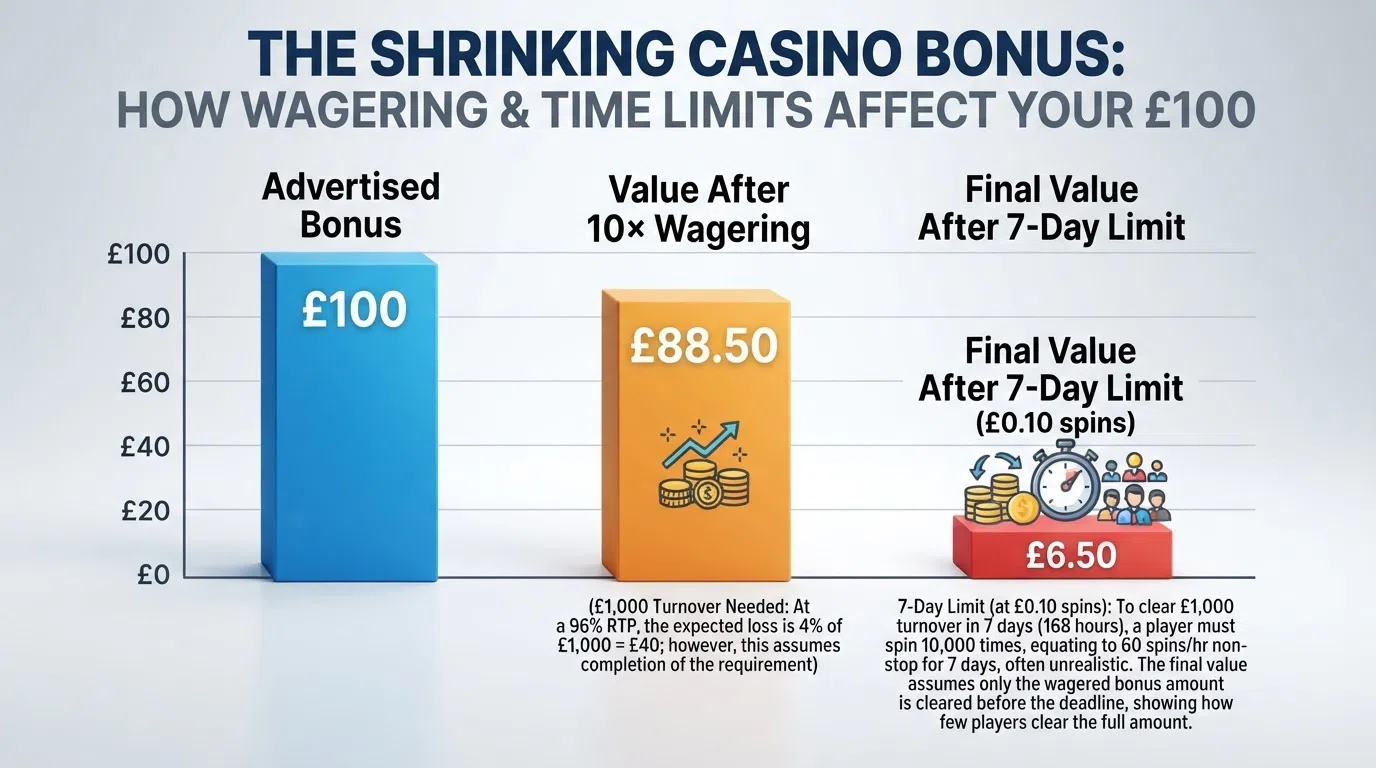
The arithmetic is straightforward in principle. Wagering is the multiplier applied to the bonus amount to determine the required turnover. At the UKGC’s 10× cap, a £100 bonus needs £1,000 of qualifying bets before the bonus and any associated winnings become withdrawable. At an MGA-only casino, the same offer might carry 35× or 40× wagering, and the same £100 bonus needs £3,500 or £4,000 of turnover. The UKGC cap is the player-friendly end of the range, and it is the reason the brands in the table cluster at or below 10×.
Time limits compound the effect. A bonus that expires in 7 days demands far higher daily play than one valid for 90 days, and the daily volume required to clear a high-multiplier bonus in a short window can push a player into longer sessions or larger bets than they intended. Game restrictions determine how much of a player’s normal play counts toward wagering. Slots typically contribute 100% of each bet to the turnover requirement; table games and live casino contribute less, sometimes nothing. A player who normally plays blackjack will find their usual bets not counting toward a slots-focused bonus. Maximum cashout caps cap the upside regardless of how much the player wins, which is the clause that turns a generous-looking offer into a bounded one.
The worked example, using the prescribed calculation: a £100 bonus at the UKGC’s 10× wagering cap, on slots at £0.10 per spin with a 5-second interval between spins, requires £1,000 of qualifying turnover. At 10p per spin, that is 10,000 spins, taking 50,000 seconds, or roughly 13.9 hours of continuous play. At a higher multiplier an MGA-only casino might require, the same calculation scales linearly: 35× wagering on a £100 bonus needs £3,500 of turnover, 35,000 spins, and roughly 48.6 hours of play. The UKGC cap compresses that to a 14-hour clear, which is the difference between a weekend project and a part-time job.
The wagering multiplier is the single most important number in any welcome offer, and it is the number a player should look at before the headline. The UKGC’s 10× cap, in force since 19 December 2025, has reset the competitive baseline. Brands that previously advertised 35× bonuses have moved to 10× to compete, and brands that want to differentiate have moved to 0×. The brands offering 0× wagering in the table are the new competitive frontier, and the brands at 10× are at the regulatory ceiling rather than above it.
Welcome Bonuses and Deposit-Match Offers at MGA Casinos
A deposit-match bonus is the traditional casino welcome structure: the casino matches a percentage of the player’s first deposit up to a ceiling, with a wagering requirement applied to the bonus. A 100% match up to £100, the structure at 888 Casino, doubles a £100 deposit to £200 in playable funds, with 10× wagering on the £100 bonus. The player needs £1,000 of qualifying turnover to convert the bonus to withdrawable cash.
Grosvenor’s structure is different, and it is the only deposit-match in the table. The player deposits £20 and plays with £40, a 100% match on a smaller base, with 10× wagering applied to the deposit plus bonus. The £60 in qualifying funds means £600 of required turnover, which is more demanding than £1,000 from a pure perspective but lower in absolute bonus value.
The MGA framework does not cap deposit-match percentages or maximum bonus amounts, and an MGA-only casino can offer a 200% match or a 500% match with no statutory ceiling. The wagering requirement on those offers is the trade-off: a 200% match at 40× wagering sounds generous, but the real cost is the £8,000 turnover required on a £200 bonus. The UKGC’s 10× cap, by contrast, holds the worst-case wagering at a known ceiling, which is the structural advantage of gambling at a UKGC-licensed site regardless of the MGA credential.
No-Deposit Bonuses and Wager-Free Spins: Free Play With Real Value
The two offer types with the cleanest value are no-deposit bonuses and wager-free spins. A no-deposit offer, like the 50 Free Spins at Sky Vegas and the 50 Free Spins at Paddy Power, requires no deposit at all. The player registers, verifies their identity, and receives the spins. Wager-free spins, like the 500 at bet365, the 200 at Betfred, the 320 at 32Red, and the deposit-gated spins at Sky Vegas and Paddy Power, carry 0× wagering on winnings. In both cases, the winnings are cash, not bonus funds, and there is no turnover requirement to clear.
The difference matters. A no-deposit offer costs the player nothing to receive, and the winnings are withdrawable. A wager-free offer requires a deposit, but the winnings are also withdrawable without turnover. The common feature is the absence of a wagering requirement, which is the clause that determines whether a bonus is worth claiming.
These offers are rare because they cost the operator more per player acquired. A 35× wagering bonus recycles the bonus amount through the wagering requirement, generating play that may not produce a withdrawal. A 0× wagering offer pays out winnings immediately, and the operator’s cost is the spin value plus any winnings, with no play recapture. The UKGC’s 10× cap has compressed the range at which operators can compete on wagering, and 0× has become the differentiator. Of the ten brands in the table, five offer 0× wagering on at least part of the welcome, and that is the structural shift of the past twelve months.
MGA Bonus Terms: Wagering, Time Limits and the Small Print
The terms beneath the headline determine the offer’s real value. Wagering contribution by game type is the first variable: a slot that contributes 100% to wagering is fully qualifying, while a blackjack hand that contributes 10% requires ten times the play to clear the same bonus. The maximum-bet-while-bonus-is-active rule is the second: a player who bets more than the maximum (typically £5) during the bonus period can have their winnings voided, and the rule is enforced through bet-tracking.
Time-pressure is the third variable. William Hill’s 72-hour validity is the tightest in the table, and it requires the player to use 200 spins within three days of credit. 888 Casino’s 90-day validity on the deposit match is the most generous, and it spreads the required play over three months. The pressure difference is not a marketing detail; it is the difference between an offer a player can clear at their own pace and an offer that dictates the pace.
The UKGC’s ban on mixed-product promotional offers, in force since 19 December 2025, is the structural change that affects MGA-licensed offers directly. A UKGC-licensed casino cannot offer a “bet £10 on football, get free spins” cross-sell, because the cross-sell is banned. An MGA-only casino can still offer that structure, and the absence of the ban is part of the broader MGA offer set. For a UK player gambling at a UKGC-licensed site, the ban is the rule; for a player at an MGA-only casino, the offer might be more flexible but the UKGC protections are absent.
Payments at MGA Casinos: Why Your UK Card Might Not Work
The UKGC’s credit card ban, in force since 14 April 2020, applies to all GB-licensed gambling and extends to credit-card-funded payments routed through e-wallets such as Skrill, Neteller or PayPal. The ban does not distinguish between casino and sports betting, and it does not distinguish between UK-issued and foreign-issued cards. A UK player depositing at a UKGC-licensed site cannot use a credit card, period, and the Commission’s ground for the ban is the statistic that 22% of online gamblers who used credit cards were classified as problem gamblers.
MGA-licensed casinos, including those that are not UKGC-licensed, can offer a broader payment set. Credit cards may be available at MGA-only casinos, although the MGA’s framework is shifting toward tighter affordability and source-of-funds checks. Cryptocurrency is permitted under the MGA’s standard licence framework, with wallet screening, chain analysis and source-of-funds AML processes, and several MGA-licensed casinos accept Bitcoin and other digital currencies.
For a UK player at a dual-licensed casino, the payment options are the UKGC-regulated set: debit cards, bank transfers, e-wallets (where not credit-card-funded), and Apple Pay. The MGA-side payment options, including crypto, are generally not available on the UKGC-regulated arm, even when the operator is the same group. The reason is regulatory: the UKGC has not yet permitted or prohibited crypto, and the proposed White-Listed Crypto Assets pilot is expected from Q3 2026, but the default is that crypto is not offered to GB customers.
The practical reality is that a UK player at an MGA-only casino may find their UK-issued card blocked by the acquiring bank. UK banks have implemented blocks on credit card gambling transactions, and many have extended the block to certain MGA-licensed sites operating outside the UKGC framework. A player who tries to deposit at an unlicensed site may find the transaction declined, not because the casino rejected it but because the bank did.
E-Wallets, Instant Banking and Pay N Play at MGA Casinos
E-wallets are widely accepted at MGA-licensed casinos. Skrill, Neteller, MuchBetter and MiFinity are common, and the payment set at any individual casino depends on the operator’s commercial arrangements. The UKGC’s credit card ban catches e-wallet transactions funded by credit cards, so a player who funds a Skrill account with a credit card and then deposits to a UKGC-licensed casino is in breach of the ban. Funding the e-wallet from a debit card or bank account is fine.
Instant bank-transfer methods, including Trustly, are available at MGA-licensed casinos and at some UKGC-licensed ones. Pay N Play, the Trustly-powered deposit-without-registration model, is more common at MGA-licensed casinos than at UKGC-licensed ones, because the model requires the operator to handle KYC through the bank rather than through a registration process, and the UKGC’s verification requirements (since 7 May 2019) add steps that the Pay N Play model skips. Revolut and other digital-banking apps are accepted at some operators and not at others, and acceptance depends on the operator’s payment integration.
PayPal is the case study in payment-method availability. PayPal requires its own compliance checks, and PayPal casino availability is higher at UKGC-licensed operators than at MGA-only operators. The reason is that PayPal’s UK gambling transactions are subject to PayPal’s own regulatory review, and PayPal is more comfortable working with UKGC-licensed operators. Operators with only an MGA licence are less likely to integrate the payment service.
Debit Cards, Apple Pay and Bank Transfers: What a UK Player Can Rely On
The methods that always work at UKGC-licensed casinos are the methods every UK player already has: Visa debit, Mastercard debit, bank transfer, and Apple Pay on supporting apps. The credit card ban does not affect debit cards, and these are the universal deposit methods at every brand in the table.
Some operators restrict the qualifying deposit to specific methods. 32Red requires the qualifying deposit to be made via debit card or instant bank transfer, excluding e-wallets. Paddy Power’s qualifying bet must be placed via debit card or Apple Pay, excluding other e-wallets. These restrictions are bonus terms, not payment bans, and they apply to the qualifying transaction for the welcome offer rather than to deposits generally.
Bank transfer is the slowest deposit method, and the withdrawal method tends to be slower than e-wallets. The MGA framework requires operators to pay out within a defined period, and UKGC-licensed operators face the same requirement under the LCCP. The 32Red and Paddy Power restrictions matter because they shape which methods count for the welcome offer, and a player who prefers PayPal or Skrill will need to check whether those methods qualify.
For a UK player, the practical advice is simple: use a debit card for the qualifying deposit unless the operator specifies otherwise, and use an e-wallet or bank transfer for ongoing play. The credit card ban is a hard rule, and the method restrictions on specific offers are term-level details to check before depositing.
The Games Malta Casinos Actually Stock: Slots, Live Tables and Beyond
The game libraries at MGA-licensed and dual-licensed casinos share a common backbone. The major providers, NetEnt, Pragmatic Play, Evolution, Playtech, Microgaming, Red Tiger, Play’n GO, IGT and Blueprint, supply most major UK-facing and international-facing casinos, and the MGA’s game fairness and RTP verification requirements ensure that titles from these providers meet the regulator’s standards before they go live. A player at a dual-licensed casino is playing the same games a player at an MGA-only casino would see, with the same RTPs, the same volatility profiles, and the same max-win figures.
The slot that recurs across the featured offers is Big Bass Splash, by Pragmatic Play, with an RTP of 96.71%, high volatility, and a 5,000× max win. The game appears at William Hill, Grosvenor and 32Red, and the choice is not accidental: Big Bass Splash is the operator-friendly high-volatility slot that combines an engaging theme with a headline max win, and it is the kind of title operators build welcome offers around. The 96.71% RTP is in the upper band for high-volatility slots, and the 5,000× max win is the figure that lets a marketing team write a “win up to 5,000× your stake” line.
Live casino at MGA-licensed casinos is dominated by Evolution and Playtech, both of which have major studio operations in Malta. The two providers offer European and French roulette, speed variants, classic and VIP blackjack, and the game-show category (Dream Catcher, Crazy Time, Monopoly Live) that has become the headline live product. For a UK player, the live casino experience is largely the same at dual-licensed and MGA-only casinos, because the studios, the games and the dealers are shared.
The difference lies in the regulatory framework around the games. UKGC casinos apply the same game-design rules to live casino (no auto-play, minimum spin intervals where relevant, mandatory display of session time and net position), while MGA-only casinos operate under Malta’s own technical standards. The framework difference is invisible during normal play, and it becomes visible only when a player wants a feature the MGA allows but the UKGC has banned, or vice versa.
Online Slots at Malta Casinos: RTPs, Providers and the Stake Cap Divide
MGA-licensed casinos typically carry slots in the 94–97% RTP range, with the average sitting around 96%. Big Bass Splash at 96.71% is in the upper half, and a player who wants a high-RTP slot will find it at both MGA-only and UKGC-licensed casinos. The RTP is set by the game provider and verified by the MGA’s testing regime, and the figure does not change between an MGA-only casino and a UKGC-licensed casino offering the same game.
The UKGC’s slot stake cap, £5 per spin for players aged 25 and over (in force 9 April 2025) and £2 per spin for players aged 18–24 (in force 21 May 2025), applies only at UKGC-licensed casinos. An MGA-only casino has no statutory per-spin cap, and a player at an MGA-only site can place a £10 spin or a £50 spin if the operator allows it. The cap is one of the UKGC’s most visible prescriptive measures, and it is one of the structural differences a British player experiences between a UKGC-licensed site and an MGA-only site.
Auto-play and spin-speed rules are another area of divergence. The UKGC banned auto-play and set a 2.5-second minimum spin speed from 31 October 2021, alongside bans on features that speed up play, losses disguised as wins, and reverse withdrawals. An MGA-only casino may still offer auto-play, faster spin speeds, and features the UKGC has banned, because the MGA’s technical standards are principles-based rather than prescriptive. The features are part of why a player might seek out an MGA-only casino, and they are part of why the UKGC has banned them: faster play correlates with higher losses, and the prescriptive rules are designed to slow the rate at which a player spends.
Provider quality is the proxy for slot fairness at MGA-licensed casinos. NetEnt, Pragmatic Play, Playtech and Microgaming titles are independently tested, and the MGA’s verification regime checks the RTPs and the random number generators before a game goes live. A player who sticks to titles from these providers is playing tested games, and the MGA framework is the assurance.
Live Dealer, Roulette and Blackjack at MGA Casinos
The live-casino experience at MGA-licensed casinos is built around Evolution and Playtech, and the studios are based in Malta and other European locations. The game spread covers the standard casino floor: European and French roulette (single zero, lower house edge than American roulette), blackjack in classic and VIP variants, baccarat, and the game-show category that has driven live casino growth over the past five years.
For a UK player, the live-casino experience at a dual-licensed casino is the experience the UKGC regulates, with auto-play banned where applicable, session time and net position displayed during play, and the same responsible-gambling prompts the slots product carries. At an MGA-only casino, the same providers run the same tables, but the regulatory framework around the game is Malta’s rather than the UKGC’s, and the differences are the principles-versus-prescription split visible across the product.
Table limits and VIP access at MGA live tables are not capped by a UKGC-style affordability threshold, although the MGA’s framework requires operators to monitor play and intervene where play suggests harm. A player who wants a £10,000-per-hand blackjack table will find it more easily at an MGA-only casino than at a UKGC-licensed site, where affordability checks may intervene well below that level. The accessibility is the point of the MGA-only product for high-volume players, and it is the trade-off against the protections the UKGC provides.
Crypto at MGA Casinos: What the Malta Licence Allows That the UKGC Does Not
The MGA permits cryptocurrency as a payment method under its standard licence framework. The permission is conditional: operators accepting crypto must run wallet screening, chain analysis, and source-of-funds processes as part of their AML compliance. The framework is not a hands-off approval, and the MGA’s 2026 supervisory priorities include a thematic review of internal control frameworks around crypto asset use, which is the regulator checking that operators are running the processes rather than treating the requirement as a checkbox.
The UKGC has no current rule permitting or prohibiting cryptocurrency at GB licensees. The Commission’s proposed White-Listed Crypto Assets pilot, expected to begin in Q3 2026, is a supervised pilot rather than an open-door policy, and the pilot will test how crypto deposits can be integrated into the UKGC’s affordability and AML frameworks without weakening them. Until the pilot runs and the Commission evaluates, crypto at GB-licensed sites is in a regulatory grey zone, and most dual-licensed operators do not offer crypto to their UK customers even when their MGA arm supports it.
For a UK player, the practical position is that crypto gambling is available at MGA-only casinos, where the MGA’s framework governs, and not at UKGC-licensed sites, where the UKGC’s silence on crypto means operators do not offer it. A player who wants to use Bitcoin or Ethereum to deposit will find the option at MGA-only casinos, and the trade-off is the loss of UKGC protections. The crypto option is part of the MGA’s broader payment set, and it is one of the structural features that distinguishes the MGA-only experience from the UKGC experience.
The 2026 MGA supervisory priorities signal both acceptance and tighter oversight. The MGA is not reconsidering its position on crypto; it is tightening the implementation. A player who chooses an MGA-licensed crypto casino should expect the operator to run source-of-funds checks, to ask for documentation on wallet ownership, and to apply the same AML standards a fiat-depositing casino would apply. The absence of those checks at a particular operator is a red flag, and the MGA’s thematic review is the regulator looking for exactly that absence.
Staying in Control: Player Protection Across Two Regulatory Worlds
Player protection at MGA-licensed casinos is governed by Directive 2 of 2018, which mandates identity verification before deposit, deposit limits, session limits, self-exclusion processes, mandatory responsible-gambling messaging and ADR access. The framework is principles-based, meaning operators are required to deliver the outcomes rather than to follow specific product rules, and the MGA assesses compliance against the outcomes. A dual-licensed casino delivers both the MGA’s principles-based protections and the UKGC’s prescriptive layer, and the combination is the most comprehensive protection available to a UK player.
The UKGC’s prescriptive regime adds the £5/£2 slot stake cap, the £150 financial vulnerability check in a rolling 30-day period (in force since 28 February 2025), the deposit-limit prompt before first deposit (mandatory from 31 October 2025), and the upcoming gross deposit limit requirement (now scheduled for 30 September 2026). The financial risk assessment, with announced thresholds (£5,000 for 25+ and £2,500 for under 25 in 24 hours at Stage 1, and £1,000/£3,000 for 25+ and £750/£2,000 for under 25 at the final stage), is moving toward a staged rollout, with the start date not yet confirmed.
The help infrastructure is available to every UK player regardless of which licence the casino holds. GamCare runs the National Gambling Helpline on 0808 8020 133, free, confidential, 24/7. GambleAware commissions treatment and prevention services. The NHS runs 15 specialist gambling treatment clinics across England, Scotland and Wales, with referrals up 130% year-on-year and nearly 2,000 referrals between April and September 2024 compared with 800 in the same period of 2023. Gamblers Anonymous provides peer support. The Malta Responsible Gaming Foundation operates a helpline (1777) for Malta-licensed operators’ customers, and the foundation’s services are available to international players who reach out.
The prevalence data tells a steady story. Five per cent of adults in England had PGSI scores of 1 or more, indicating at-risk or problem gambling, according to the Health Survey for England 2024, and the figure has been stable since 2012. 0.4% of adults had PGSI 8+, indicating problem gambling. The National Gambling Support Network treated 11,960 clients between April 2024 and March 2025, an 11% increase on 2023/24, and 93% of clients completing treatment saw improvement. The help works, and the numbers of people seeking help are rising, which is the direction the public-health approach wants to see.
Deposit Limits, Reality Checks and Time-Outs: Tools Both Regulators Require
Deposit limits are the most universal player-protection tool. The UKGC mandates operators prompt every customer to set a financial limit before their first deposit, with the requirement in force from 31 October 2025. A decrease in the limit applies immediately, and an increase may not apply with the same immediacy, which is the structural feature that prevents a player from raising a limit in the heat of a session. The MGA requires operators to offer deposit-limit facilities under Directive 2 of 2018, and the requirement has been in place longer than the UKGC’s prescriptive prompt.
Reality checks and session timers are required by both regulators. The UKGC’s rules require operators to display time played and net position during a session, and the requirement is one of the game-design rules in force from 31 October 2021. The MGA’s framework requires session-time display and the offer of session limits, and the principle is the same: a player who knows how long they have been playing and what they have spent is better placed to make decisions than one who does not.
Time-out and self-exclusion are where the regulators diverge structurally. The MGA requires per-operator self-exclusion, which means a player who self-excludes at one MGA casino can still register at another. The UKGC requires GAMSTOP integration, which means a player who self-excludes through GAMSTOP is blocked from every UKGC-licensed online operator for the chosen exclusion period. The cross-operator block is the protection GAMSTOP exists to provide, and it is the protection the MGA framework does not match.
A player who wants to set deposit limits, reality checks and time-outs can do so at any MGA-licensed or UKGC-licensed casino. The tools are available, and the regulatory frameworks require them. The cross-operator self-exclusion gap is the one area where the two regimes do not overlap, and the gap is the reason the section on GAMSTOP is its own block earlier in this page.
Where UK Players Can Get Help: Helplines, Clinics and the Malta Foundation
- GamCare National Gambling Helpline: 0808 8020 133, free, confidential, 24/7. The first port of call for any UK player experiencing gambling harm, regardless of which licence the casino holds.
- NHS gambling harm clinics: 15 specialist clinics across England, Scotland and Wales, with referrals up 130% year-on-year (nearly 2,000 referrals April–September 2024 vs 800 in the same period of 2023). Referral is through a GP or through self-referral via the NHS website.
- GambleAware: the commissioning body for prevention and treatment services, with online resources and a directory of local support.
- Gamblers Anonymous: peer-support meetings, online and in person, for people in recovery from gambling harm.
- Malta Responsible Gaming Foundation: operates helpline 1777 and provides player-support services for Malta-licensed operators’ customers, available to international players who reach out.
The 11,960 clients treated by the National Gambling Support Network between April 2024 and March 2025, an 11% increase on the previous year, and the 93% improvement rate among those completing treatment, are the figures that justify the infrastructure. The help is available, it works, and the rising number of people using it is the trend the public-health approach wants to see.
How We Researched and Ranked These MGA Casino Operators
The operators in the table were drawn from the UK’s major licensed casino brands and checked against the UK Gambling Commission’s public register, which contained 2,663 business records as at August 2026. Every brand holds an active GB operating licence, confirmed by the register entry. A brand without an active UKGC licence is not eligible for this page, because the page is about MGA licensing as it affects UK players, and UK players at a UKGC-licensed site are the population the page addresses.
MGA dual-licence status was checked for each operator. Where the parent entity is Malta-registered and holds an MGA licence, the dual-licence status is confirmed. Where the international arm is registered in Gibraltar or another non-Malta jurisdiction, MGA status is not confirmed and is noted in the table. The check is not a guarantee of MGA status; it is a confirmation based on the operator’s corporate structure, and operators can change structure without notice.
The evaluation criteria for ranking ordered the table as follows. UKGC licence standing was the entry requirement, not a ranking criterion. MGA dual-licence status was a relevance signal for this page, with confirmed dual-licensees marked as such. Bonus fairness was assessed on the wagering multiplier (lower is better, 0× is best), the validity window length, the maximum cashout cap where research provided one, and the spin value where research provided it. Game-provider breadth was the proxy for library quality. Transparency of offer terms was assessed through the structure of the offer itself, and brands that name their slot titles (Ladbrokes) or specify their wagering conditions clearly (Sky Vegas) scored higher on transparency.
The sources used to assemble this page were the UKGC public register, the MGA licence-holder register, the operators’ own websites and bonus terms, the Gambling Act 2005 and the Gambling (Licensing and Advertising) Act 2014, the LCCP and RTS, and industry analysis from Gamingcompliance.io, Softswiss.com and other compliance resources. The research did not include any operator-side marketing materials beyond the operators’ own terms and conditions pages, and it did not include player-side reviews except where the reviews cited verifiable data.
What British Players Should Actually Do About MGA Casinos in 2026
The honest conclusion is the one the material supports. A dual-licensed casino, holding both a UKGC operating licence and an MGA licence, gives a British player the full UKGC safety net, including GAMSTOP, the Commission complaints route, ADR, the £5/£2 slot stake cap and the 10× bonus wagering ceiling, while still offering the game libraries and provider quality the MGA licence enables internationally. An MGA-only casino costs a UK player every one of those protections, and the UKGC’s enforcement data shows the regulator is actively disrupting unlicensed operators serving GB consumers through cease-and-desist notices, search-engine referrals and payment-provider referrals.
The best offer is not the one with the biggest headline number. It is the one with zero or low wagering, a realistic validity window and no hidden cashout cap. The brands that meet that test in the table are bet365 (500 wager-free spins, 30-day claim), Sky Vegas (50 no-deposit spins plus 200 deposit spins, all 0×), Paddy Power (50 no-deposit plus 100 deposit, 0×), Betfred (200 wager-free) and 32Red (320 wager-free, 30-day claim). These are the offers where the headline is also the value, and where a player who meets the qualifying condition walks away with cash winnings rather than a bonus to clear.
The page takes no position on which single operator to choose. That decision depends on the player’s game preferences, deposit method, and appetite for spin count versus spin value. What the page has done is lay out the relevant facts: the MGA credential, the UKGC requirement, the bonus terms, the payment options, and the player-protection tools available. A player who reads the table and the operator write-ups has the information needed to make that choice, and the choice itself is theirs.
For a player who specifically wants the MGA experience without the UKGC layer, an MGA-only casino is available, and the player should know the cost. The cost is GAMSTOP, the Commission complaints route, the £150 vulnerability check, the slot stake cap, the 10× wagering ceiling, and the credit card ban’s protective effect. The MGA standards are not nothing, and the MGA-only casino is not a scam. It is a different regulatory regime, and the trade-off is the trade the player is making by choosing it. The verification step, 60 seconds on the MGA register, is the basic check that should happen before any deposit, at any casino, regardless of which licence the player is optimising for.
Frequently Asked Questions
Is it lawful for someone in Britain to gamble on a Malta-licensed site?
A casino licensed by the Malta Gaming Authority can lawfully operate, and the MGA enforces robust player-protection standards. For a player in Britain, the additional point is that any operator taking GB customers must also hold a UK Gambling Commission operating licence under the Gambling Act 2005 and the 2014 Act. An MGA-only casino serving GB customers without a UKGC licence is operating outside the GB regulatory framework, and the player at such a site has no access to UKGC protections like GAMSTOP, the Commission complaints route or the £150 financial vulnerability check.
Does an MGA casino have to connect to the GamStop register?
No. GAMSTOP participation is a condition of every UKGC online operating licence and has been mandatory since 31 March 2020. The MGA does not require its licensees to connect to GAMSTOP, and MGA casinos do not appear on the GAMSTOP database. A player who has self-excluded through GAMSTOP can still register and deposit at an MGA-only casino, because the MGA’s player-protection framework mandates operator-level self-exclusion rather than a central cross-operator register. A dual-licensed casino (UKGC + MGA) does connect to GAMSTOP through its UKGC arm.
What deposit options can British customers use at Malta-regulated casinos?
At a dual-licensed casino, the payment set is the UKGC-regulated one: Visa debit, Mastercard debit, bank transfer, Apple Pay on supporting apps, and e-wallets such as Skrill, Neteller, MuchBetter, MiFinity and PayPal where supported. Credit cards are banned for all GB-licensed gambling since 14 April 2020, and the ban extends to credit-card-funded e-wallet payments. At an MGA-only casino, the payment set is broader and may include cryptocurrency, but the broader set comes with the absence of UKGC protections. The UKGC’s proposed White-Listed Crypto Assets pilot is expected from Q3 2026.
Can I claim a welcome package without making a first deposit at an MGA casino?
Yes, in some cases. Sky Vegas offers 50 Free Spins with no deposit required, and Paddy Power offers 50 Free Spins with no deposit required; both carry 0× wagering on winnings. These are the only two no-deposit offers in the featured set. Other welcome offers in the set require a qualifying deposit, typically £10 or £20, before the bonus or free spins are credited. No-deposit offers are the cleanest free play available, and they are the most useful way to test an unfamiliar casino before committing funds.
How do Malta’s safer-gambling rules measure up against the British system?
The MGA’s Directive 2 of 2018 mandates identity verification before deposit, deposit limits, session limits, operator-level self-exclusion, mandatory responsible-gambling messaging and ADR access. The UKGC’s framework is more prescriptive: GAMSTOP integration, the £5/£2 slot stake cap, the £150 financial vulnerability check, the deposit-limit prompt before first deposit, the 10× bonus wagering ceiling, the credit card ban, and the staged rollout of financial risk assessments. Both regimes protect players, and the MGA’s standards are real, but the UKGC’s prescriptive layer covers more product ground and the cross-operator self-exclusion is more comprehensive.
Do Malta-licensed casinos accept Bitcoin and other digital currencies?
The MGA permits cryptocurrency as a payment method under its standard licence framework, subject to wallet screening, chain analysis and source-of-funds AML processes. The UKGC has no current rule permitting or prohibiting crypto at GB licensees, and the proposed White-Listed Crypto Assets pilot is expected from Q3 2026 as a supervised pilot. In practice, dual-licensed operators generally do not offer crypto to their UK customers, while MGA-only casinos that accept crypto are available to UK players who accept the loss of UKGC protections. The MGA’s 2026 supervisory priorities include a thematic review of crypto asset internal controls, signalling tighter oversight rather than a relaxation.
Licence – realmoney-onlinecasinos-uk
Content created by the «realmoney-onlinecasinos-uk» team