
The UKGC banned bonus buy. The slots stayed. Here is where to play them.
 Available in GB
Bonus buy slots were once the fastest-growing mechanic in British online casinos, and then they were not. The UK Gambling Commission removed the buy button from every slot on every GB-licensed site by May 2021, and it has not come back. What the reader who typed “bonus buy casino UK” into a search engine is actually looking for is a contradiction: the titles still exist at every major UK casino, the lobbies look almost identical to what they looked like five years ago, and the feature that defined the category is gone. This page is an honest account of what that means — which slots are still worth playing, which casinos carry the deepest line-up, how the buy-in mechanic actually worked, and what the regulatory change cost the player in exchange for the protections it bought.

Data current as of September 8, 2026 and checked against the UK Gambling Commission’s public register of licence holders.
What Bonus Buy Slots Are — and Why You Cannot Buy the Feature at Any UK Casino
Bonus buy is a one-shot payment that takes a player directly into a slot’s bonus round, skipping the base game entirely. Before May 2021, the feature sat beside the spin button on hundreds of UK-facing slots, and a player who wanted to skip the wait for scatter symbols could pay a fixed multiple of their base stake to land inside the feature round on the very next spin. The cost varied by title and provider but commonly ran 50 to 100 times the base stake; on a 20p spin that meant paying £10 to £20 for one ticket into the bonus round. The appeal was certainty: the player exchanged a long, possibly fruitless wait on the base game for an immediate shot at the game’s headline payout, and the slot got a faster, more dramatic experience. The most recognisable titles built around the mechanic came from Pragmatic Play, Big Time Gaming and Nolimit City — three studios that built their post-2018 reputations on games where the bonus round was the point and the buy-in was the shortcut.
The UKGC’s intervention landed in two stages. In 2020 the Commission contacted six operators about feature buy-in facilities that allowed very large single-stake purchases, and by May 2021 the ban was fully enforced across every GB-licensed site. The legal hook is RTS clause 14a of the Remote Technical Standards, which prohibits any slot feature that encourages a player to increase their stake or the amount they had decided to gamble. Bonus buys were never named in the Gambling Act 2005 itself; they fell under clause 14a because the defining mechanic of the feature is paying a multiple of the base stake to skip the base game, and that is, by design, an incentive to stake more than a single spin would cost. Online slots remained a growth category through and after the ban: in Q1 2026 the online slots segment’s gross gambling yield was up 12% year-on-year, even without the buy button on a single one of them.
What the Bonus Buy Feature Actually Does
The mechanic is simple to describe and harder to grasp without seeing it. In a bonus buy slot the player sees two buttons at the bottom of the reels: the standard spin button and a second button that reads something like “Buy Feature” or shows a price. Pressing the buy button does not start a normal spin. It deducts the buy-in cost from the player’s balance immediately and lands the reels directly in the bonus round — usually a free-spins feature, sometimes a pick-and-click game or a wheel — without waiting for three or more scatter symbols to land during ordinary play.
The cost is the central design choice. Providers set the buy-in at a multiple of the base stake, and that multiple is calibrated to roughly match the bonus round’s expected payout. A typical 50x to 100x multiplier means a 10p base-stake player pays £5 to £10 for a single bonus-round entry; a £1 base-stake player pays £50 to £100. The trade the player is making is between the long-run mathematics of base-game play and the concentrated variance of one bonus round. The base game pays out slowly and often; the bonus round pays out rarely and heavily. The buy-in collapses the wait. Pragmatic Play’s Gates of Olympus, Big Time Gaming’s Bonanza Megaways and Nolimit City’s heavier-volatility titles all built their commercial identity around this trade, and they are the names UK players most often associate with the feature.
The Slot Titles Behind the Bonus Buy Label
The titles the reader came looking for are the ones research names with real RTP, volatility and maximum-win data. They all still appear in UK casino lobbies; the buy button does not.
| Slot Title | RTP | Volatility | Max Win | Provider |
|---|---|---|---|---|
| Gates of Olympus | 96.50% | High | 5,000× bet | Pragmatic Play |
| Big Bass Splash | 96.71% | Very high | 5,000× bet | Pragmatic Play |
| Sweet Bonanza | 96.49–96.51% | Medium | 21,100–21,175× bet | Pragmatic Play |
| Bonanza Megaways | 96.00% | High | 26,000× stake | Big Time Gaming |
| The Dog House Megaways | 96.55% | High | 12,305× bet | Pragmatic Play |
| Buffalo King Megaways | 96.52% theoretical; 94.49–94.51% deployed at UK operators | High | — | Pragmatic Play |
Two details in that table matter more than the rest. Bonanza Megaways is the only title in the set that UK casinos deploy at its theoretical 96.00% with no reduced configuration available; the others may run lower at certain sites. Buffalo King Megaways is the cautionary case: a theoretical 96.52% that drops to 94.49% at Sky Vegas and 94.51% at Paddy Power, Betfair Casino, MrQ and PlayOJO when checked in May 2026. The same game, the same title screen, a materially different return. The deployed RTP is what actually plays, and the gap between theoretical and deployed is wide enough to matter over a session of any length.
Bonus Buy vs Ante Bet — Two Paths to the Same Bonus Round
The other mechanic that industry commentators discuss constantly is the ante bet, and the two are routinely conflated by sites that do not distinguish between their mechanics. They are not the same thing. An ante bet raises the cost of a normal spin — typically by 25% to 50% — and in exchange the slot doubles the chance of the bonus round triggering naturally through scatter symbols landing. The player is still spinning the base game; they are just paying extra per spin to see scatters more often. The bonus round, when it arrives, arrives the same way it always would.
The bonus buy is the opposite design. The player pays a much larger lump sum, gets no spin at all, and lands directly in the bonus round. There is no scatter trigger because there is no base game. That structural difference is exactly why the UKGC’s clause 14a catches the bonus buy but not the ante bet: the ante bet still places the player on the reels, the stake is still a stake rather than a feature purchase, and the bonus round still depends on symbol outcomes rather than payment. Ante bet features remain legal at every UK-licensed casino. Bonus buy does not.
What UK Players Actually See When They Open These Slots
A UK player who loads Gates of Olympus, Sweet Bonanza or Bonanza Megaways at any of the ten casinos ranked in the next section gets a game that is mechanically identical to the version available in 2019, minus one button. The slot loads, the reels spin, the scatter symbols either land or they do not, the bonus round triggers on the same combination it always did, and the maximum win on the paytable is the same number it was before the ban. The only visible change is the absence of the buy button.
The less visible change is the stake ceiling. From 9 April 2025, the maximum stake per game cycle for players aged 25 and over is £5; for players aged 18 to 24, the cap is £2 and came into force on 21 May 2025. Both caps were imposed by SI 2025/215. They apply to every spin on every slot at every GB-licensed site, regardless of whether the slot is a former bonus buy title, a Megaways game, a classic three-reel or anything else. A player who used to spin Sweet Bonanza at £10 per spin now spins it at £5. The slot itself does not know the difference; the regulator does, and the operator’s platform enforces it.
The Best UK Casinos for Former Bonus Buy Slot Titles
All 10 operators listed below hold an active GB operating licence, which is verified on the UKGC public register (last updated 29 July 2026). The ranking below is based on our qualitative review of their slot catalogues and player-friendly terms.
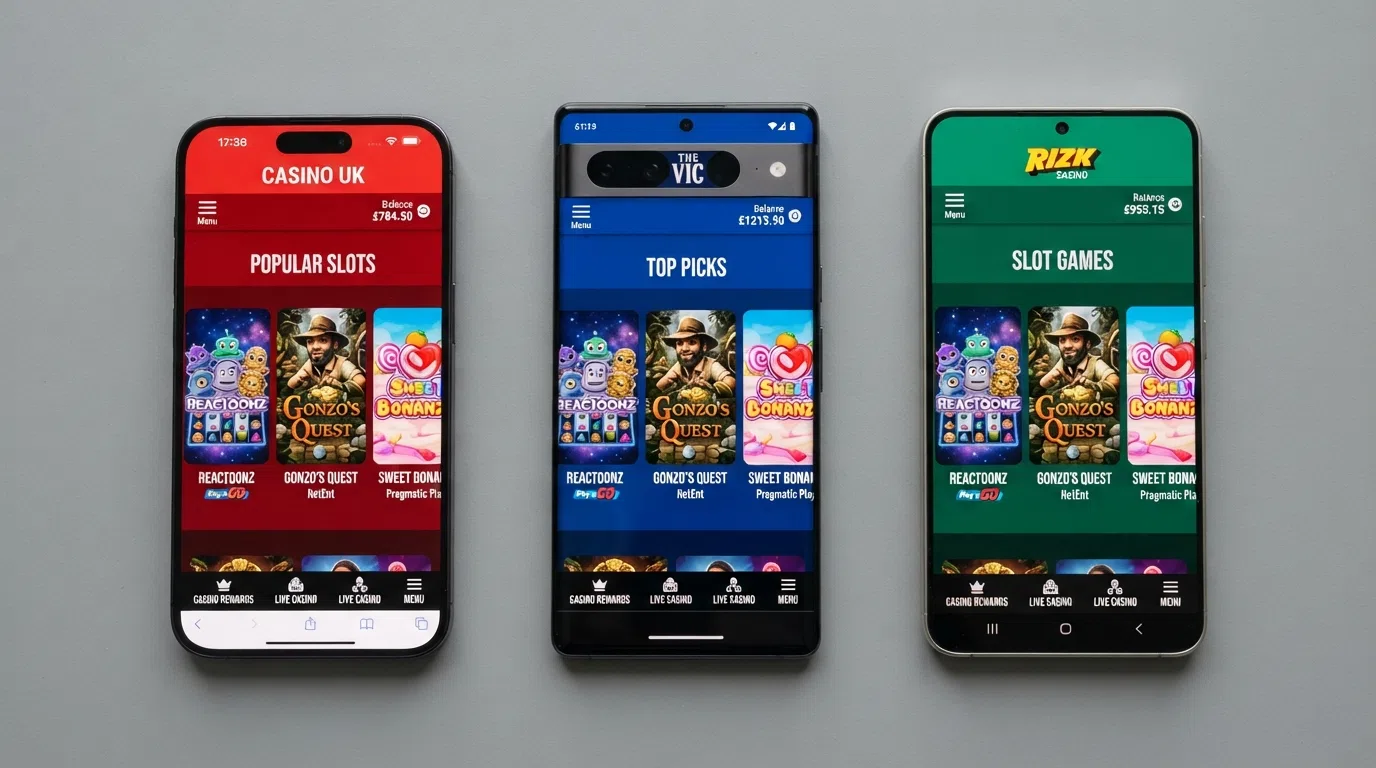
The ranking is qualitative. No percentage weights, no composite score: catalogue breadth first, then the presence of a no-wagering welcome offer, then the transparency of the offer terms. The 10x wagering cap that came into force on 19 January 2026 (LCCP 5.1.1) sets a hard ceiling that every operator in this section operates beneath — none of them charge more than 10x on free-spin winnings, and several charge zero.
| Operator | Free Spins | Wagering on Winnings | Bonus Validity | Slot Count |
|---|---|---|---|---|
| PlayOJO | 80 on Big Bass Bonanza | 0× (no wagering) | Per T&Cs | 3,000+ |
| bet365 | Up to 500 (selected games) | 0× (no wagering) | 30 days to claim | 2,000+ |
| Ladbrokes | 100 at £0.10 | 10× (at cap) | 30 days offer; 7 days spins | 2,000+ |
| Coral | 100 at £0.10 | 10× (at cap) | 30 days offer; 7 days spins | 2,000+ |
| Sky Vegas | 50 no-deposit + 200 after £10 stake | 0× (no wagering) | 7 days per batch | 1,500+ |
| Betfair | 50 no-deposit + 100 after £10 play | 0× (no wagering) | Per T&Cs | 1,500+ |
| William Hill Vegas | 200 on Big Bass Splash | 10× (per majority report) | 72 hours from issue | 1,500+ |
| 32Red | 320 on Big Bass Splash | 0× (no wagering) | 30 days after claim; 7 days to register | 1,000+ |
| Betfred | 200 at £0.10 | 0× (no wagering) | 7 days after credit | 1,000+ |
| Virgin Games | 30 on Big Bass Splash | 0× (no wagering) | 30 days to qualify | 500+ |
What the table cannot show is what each offer is worth to a specific reader, which is what the individual reviews below are for.
PlayOJO — 3,000+ Slots, No-Wagering Free Spins
PlayOJO runs the largest slot catalogue in the featured set at over 3,000 titles, covering Pragmatic Play, Big Time Gaming, NetEnt, Play’n GO, Red Tiger and Blueprint. The welcome offer is 80 free spins on Big Bass Bonanza with zero wagering on winnings and no cashout cap — every penny won from those spins is withdrawable cash from the moment it lands. The minimum deposit is £10. The brand’s active GB licence was confirmed on the UKGC public register, last updated 29 July 2026.
bet365 — 2,000+ Slots, Up to 500 Free Spins With Zero Wagering
bet365 runs over 2,000 slots from Pragmatic Play, Big Time Gaming, NetEnt, Playtech, Microgaming, Red Tiger and Blueprint, and its welcome offer is the deepest free-spin allocation in the set: up to 500 spins delivered as 10 daily selections of 5 to 50 spins each across Book of Horus, Curse of the Bayou, Magic Forge and Wrath of the Deep. Minimum lifetime deposit is £10, players have 30 days to claim, and winnings are paid as cash with no wagering requirement. The breadth of the provider list is what sets bet365 apart — the Microgaming and Playtech content is rarer in the ranking — and the 500-spin ceiling is the largest free-spin offer any GB-licensed casino currently publishes on a former bonus buy title. The catch is structural: spins arrive in tranches, and a player who wants all 500 has to log in daily for 20 days.
Ladbrokes — 2,000+ Slots, 100 Free Spins at the UKGC Wagering Cap
Ladbrokes’ catalogue runs to over 2,000 slots from major studios like Pragmatic Play and Big Time Gaming, alongside titles from NetEnt, Playtech, Red Tiger and Blueprint. The welcome offer is 100 free spins at £0.10 each on a rotating selection of Big Bass Bonanza, Sweet Bonanza and Starburst, awarded after a £10 bet, with 10x wagering on winnings — the maximum now permitted under the LCCP 5.1.1 cap that came into force on 19 January 2026. Spins are valid for 7 days and the offer window is 30 days. The operator’s GB licence is verified.
Coral — 2,000+ Slots, 100 Free Spins With Standard UKGC-Compliant Terms
Coral is Ladbrokes’ sibling brand under the Entain umbrella, and the slot catalogue is nearly identical: over 2,000 titles from Pragmatic Play, Big Time Gaming, NetEnt, Playtech and Red Tiger. The welcome offer mirrors Ladbrokes almost exactly — 100 free spins at £0.10 on rotating qualifying slots after a £10 bet, 10x wagering, 7-day spin validity, 30-day offer window. The brand is fully licensed and compliant with UKGC regulations. Coral is the practical answer for a player who already has a Ladbrokes account, or who prefers Coral’s mobile product. The two brands do not compete on catalogue; they compete on which one the player has a wallet with.
Sky Vegas — 1,500+ Slots, No-Deposit and Deposit Free Spins With Zero Wagering
Sky Vegas runs over 1,500 slots from Pragmatic Play, Big Time Gaming, NetEnt, Playtech, IGT and Blueprint, and it is one of only two operators in the set offering a no-deposit free-spin tranche: 50 spins before any deposit, then a further 200 spins after depositing and staking £10. All winnings are paid as cash with no wagering requirement. Spin batches expire 7 days from issue. The operator is fully licensed in Great Britain.
Betfair — 1,500+ Slots, No-Deposit Free Spins Plus Deposit Bonus With Zero Wagering
Betfair is the second of the two no-deposit operators, running over 1,500 slots from developers such as Pragmatic Play and Big Time Gaming, with further titles from NetEnt, Playtech and Red Tiger. The welcome structure is 50 no-deposit free spins plus a further 100 spins after depositing and playing £10, with zero wagering on all winnings. Spin value is £0.10. The site’s GB licence status is verified via the UKGC public register (most recent data from 29 July 2026).
William Hill Vegas — 1,500+ Slots, 200 Free Spins on Big Bass Splash
William Hill Vegas runs over 1,500 slots from Pragmatic Play, Big Time Gaming, NetEnt, Playtech, Blueprint and Red Tiger, and the welcome offer delivers 200 free spins on Big Bass Splash after a £10 deposit and stake, with opt-in required. Wagering is reported as 10x on winnings by the majority of sources, though at least one source reports 0x — the majority figure is the one this page carries, with the conflict flagged. Maximum cashout is capped at £30, and spins expire 72 hours from issue, the tightest validity window in the ranking. This brand maintains an active licence with the UKGC.
32Red — 1,000+ Slots, 320 Free Spins on Big Bass Splash
32Red is the highest free-spin allocation in the ranking: 320 spins on Big Bass Splash at £0.10 each, with zero wagering on winnings. The catch is the qualifying spend — the player must stake £30 on slots to unlock the spins, three times the standard £10 threshold. Spins must be claimed within 7 days of registration and expire 30 days after claim. The slot catalogue runs to over 1,000 titles from Pragmatic Play, Microgaming, NetEnt and Big Time Gaming. This brand is licensed in Great Britain.
Betfred — 1,000+ Slots, 200 Free Spins With Zero Wagering
Betfred runs over 1,000 slots from Pragmatic Play, Big Time Gaming, Playtech, Blueprint and Red Tiger, and the welcome offer is 200 free spins at £0.10 each on rotating selected titles after staking £10 or more on slots. There is no wagering on winnings, and the 7-day validity window after credit is standard for the ranking. This brand is licensed in Great Britain.
Virgin Games — 500+ Slots, 30 Free Spins With Zero Wagering
Virgin Games carries the smallest slot catalogue in the ranking at 500+ titles from Pragmatic Play, Big Time Gaming, NetEnt and IGT, and the welcome offer is the smallest in spin count: 30 free spins on Big Bass Splash (or a £50 bingo bonus as an alternative) after depositing and wagering £10. Winnings are credited as cash with no wagering requirement, and the player has 30 days to complete the qualifying requirements. This brand is licensed in Great Britain.
How to Try Bonus Buy Mechanics for Free Without Breaking UK Rules
A UK player who wants to see what the bonus buy feature does has one route that does not require a deposit, a stake or even a registered account: demo mode. Demo play is a free version of the slot hosted either on the provider’s own website or on a casino site, running on virtual credits that the player cannot cash out. The mechanic, the reels, the bonus round, the bonus buy button — every part of the game behaves the same way it would on a real-money spin, except that the balance is unlimited pretend money. Demo mode exists to let players test a slot before committing real funds, and it is the only way a UK resident can see the bonus buy button working in 2026.
The complication is the UKGC ban, which extends to demos hosted by GB-licensed operators. A casino registered with the Commission must remove the buy button from its demo versions of the same titles, because the licensed environment is subject to the same RTS clause 14a regardless of whether real money is at stake. The result is a split landscape: a player who opens Gates of Olympus on PlayOJO’s demo will see the same RTP, the same volatility, the same bonus round triggers, but no buy button. A player who opens the same game on Pragmatic Play’s own website, where the provider is not a GB-licensed gambling operator, may still see the buy button — because the provider’s site is not bound by clause 14a.
What Demo Mode Lets You Test — and What It Cannot Tell You
Demo play is a laboratory for game design, not a predictor of real outcomes. What it reveals is rhythm: how often the bonus round triggers on a given title, what the base game looks like during the dead spells between features, how the free-spins round plays out, whether the volatility feels heavy or light relative to a player’s tolerance. A player who runs 200 demo spins on Bonanza Megaways will see a representative sample of the game’s hit frequency and bonus-round frequency, and they will form a qualitative sense of whether the title suits them. They will also see the bonus buy button in action on a provider-hosted demo, which is the only way to experience that mechanic in a UK-accessible context.
What demo play cannot do is replicate the weight of a real-money decision. The volatility of a slot feels different when every spin is a pretend credit than when every spin is £5, and the difference is not academic. A title that plays comfortably on demo can feel brutal at the £5 stake cap because the loss per spin is real, the time between bonus rounds is real, and the chasing-losses impulse that the base game invites is real. The RTP a player experiences in a 200-spin demo session also tells them nothing reliable about what they will experience over 2,000 real-money spins; short sessions are dominated by variance, and the game’s long-run return only emerges over a sample size most players will never reach.
Demo Play vs Real-Money Play at UK Casinos
The structural differences between demo and real-money play at a GB-licensed site are wider than the buy-button question. Real-money play at a UK casino adds the statutory stake cap, the identity verification requirement, the mandatory reality-check prompts and the session-timer display. A player who moves from Pragmatic Play’s demo to a UK casino’s real-money version of the same game enters an environment where the spin costs up to £5 (age 25+) or up to £2 (age 18–24), where identity must be verified before the first deposit is even possible, where a pop-up will appear at intervals to show the player their total losses and time played, and where every spin is logged against a self-exclusion check, a financial-vulnerability threshold and a deposit limit the player set when they registered.
Anonymous play is not possible at any GB-licensed site. Credit cards are banned for all remote gambling payments. The slot lobby the player sees in real-money mode is the slot lobby the regulator has approved: the same titles, the same RTP ranges, the same providers, but stripped of the buy button. The trade is the trade the regulator made on the player’s behalf: the feature is gone, and the safety net is in.
Where UK Players Can Access Bonus Buy Demos Today
The practical route to a working bonus buy button in 2026 is the provider-hosted demo. Pragmatic Play, Big Time Gaming and Nolimit City all maintain free-play versions of their titles on their own corporate websites, and those versions are not subject to UKGC licensing because the providers themselves are software suppliers, not gambling operators. A player who visits one of those sites can load Gates of Olympus or Bonanza Megaways in demo mode, see the buy button, click it and watch the bonus round trigger on the next spin — all without registering, depositing or staking. The provider demo is not gambling, requires no real money, and is the only way to experience the feature in the UK-accessible market.
The casino demo is the second route, and it is the one the player will encounter if they go looking for a bonus buy slot through a UK casino. The slot is there, the game is there, the bonus round works, and the buy button is not. The two experiences are deliberately different: the provider demo shows the full feature set as the studio designed it, the casino demo shows the same game with the feature the regulator removed. Neither is a substitute for real-money play, and neither tells the player what they will actually experience on a real session. They are testing tools, not predictors.
Why the UK Gambling Commission Banned Bonus Buy Features
The UKGC’s three licensing objectives under section 1 of the Gambling Act 2005 are preventing crime, ensuring fairness and protecting children and other vulnerable persons. The bonus buy ban sits inside the third. The Commission’s reasoning, in the language of the 2020 enforcement action, was that a feature allowing a player to spend a single stake of hundreds or thousands of pounds in one action — to pay 50x, 100x or more of the base stake to skip directly to the highest-variance part of the game — was structurally incompatible with protecting vulnerable customers from the harm that concentrated, high-speed gambling produces. The six operators the Commission contacted in 2020 were the ones running the largest buy-in facilities; the follow-up enforcement action by May 2021 extended the position to every GB-licensed site.
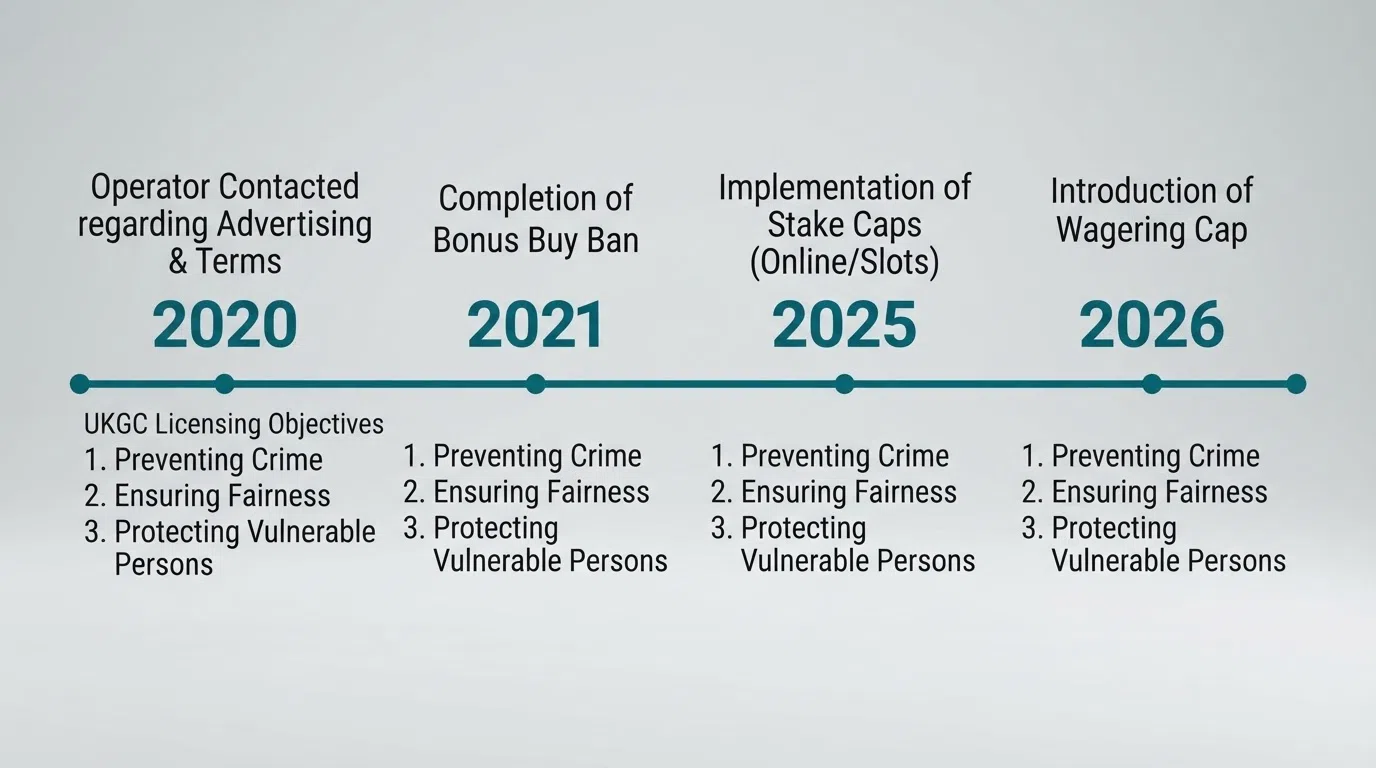
The legal mechanism is RTS clause 14a, which prohibits any slot feature that encourages a player to increase their stake or the amount they had decided to gamble. Bonus buys were never named in the Gambling Act 2005 or in the original RTS text; they fell under clause 14a because the buy-in mechanic is, by definition, an invitation to stake more than the base game would otherwise cost. The regulatory language is broad; the application to bonus buy is exact. A feature that takes a player’s pre-set per-spin budget of 20p and converts it into a £10 or £100 single payment for a bonus-round entry is the clearest possible example of “increasing the amount they decided to gamble” in a single transaction.
The Regulatory Framework — RTS Clause 14a in Plain Terms
Clause 14a in plain English reads: a slot may not include a feature whose design is to push the player toward spending more per play than they would otherwise spend. The bonus buy’s defining mechanic — paying a multiple of the base stake, commonly 50x to 100x, to skip the base game entirely and enter the bonus round — is precisely that design. The player is not being offered a better version of a spin; the player is being offered a different product, priced at a multiple, that delivers the highest-variance segment of the game on demand. That is the feature clause 14a was written to catch, and the Commission confirmed in 2020 that it did catch it.
The 2020 intervention was not a sudden escalation. The Commission had been signalling discomfort with feature buy-in mechanics for some time, and the contact with six operators was the first formal step. The follow-up enforcement action completed by May 2021 was the closing of the door: every GB-licensed operator was required to remove the buy button from every slot that carried one, and any operator continuing to offer the feature after that date risked licence action. The position has not shifted since. There is no public consultation on reintroducing bonus buy, and no indication that the Commission views the 2021 position as anything other than settled.
What Else the UKGC Banned — The Full Set of Slot Restrictions
The bonus buy ban is one piece of a wider consumer-protection programme that has reshaped UK online slots in stages. The full set, in order:
- Auto-play banned from 31 October 2021 — no slot may auto-spin on the player’s behalf.
- Spin speed capped at a minimum of 2.5 seconds per spin from the same date.
- Features that speed up play banned from 31 October 2021.
- Losses disguised as wins banned from 31 October 2021 — celebratory animations on net-loss outcomes are prohibited.
- Reverse withdrawals permanently banned from 31 October 2021 — once a player requests a withdrawal, it cannot be reversed.
- Statutory stake caps of £5 (age 25+) and £2 (age 18–24) per game cycle, from 9 April 2025 and 21 May 2025 respectively, imposed by SI 2025/215.
- 10x wagering cap on bonus funds from 19 January 2026 (LCCP 5.1.1) — no UK welcome offer may require more than 10x playthrough on bonus winnings.
- Mixed-product promotional offers banned from 19 January 2026 (same provision) — a “bet £10 on football, get free spins” structure is no longer permitted.
Each of these rules is a separate intervention, and each one tightened the slot environment relative to where it was five years earlier. The combined effect is a UK slots market where the buy button is gone, the spin is slower, the stake is capped, the bonus is shallower, the withdrawal is one-way, and the player is prompted at every stage to be aware of what they are spending. The bonus buy ban is the most visible of these changes; it is not the only one, and a reader who understands the full list understands the regulatory philosophy better than a reader who only knows the buy button is missing.
GamStop, Self-Exclusion and What the Ban Means for Player Protection
The UKGC’s regulatory programme does not stop at the slot itself. GamStop has been mandatory on every GB-licensed online operating licence since 31 March 2020, and a player who registers with GamStop is excluded from every GB-licensed online operator for the chosen period — six months, one year, five years, or five years with auto-renewal. The exclusion cannot be cancelled early. The scheme is the national multi-operator backstop, and it sits beneath the operator-level time-out and self-exclusion tools every GB-licensed site also offers.
Two further financial-protection layers have come into force since. The financial vulnerability check, in force from 28 February 2025 under LCCP 3.4.4, triggers when a player reaches £150 net deposit in a rolling 30-day period; the operator runs a light-touch check against publicly available data (bankruptcy, county court judgments, individual voluntary arrangements, debt relief orders) and acts on what it finds. The financial risk assessment (“affordability check”) is a separate, more thorough process; the Commission confirmed staged rollout thresholds on 7 July 2026 — Stage 1 at £5,000 (age 25+) or £2,500 (under 25) net deposits in 24 hours, with final thresholds of £1,000 to £3,000 (age 25+) and £750 to £2,000 (under 25) — but the start date for the final phase is not yet confirmed. The combined effect is a layered protection system: a player who escalates their spend first hits a light-touch check, then a deeper assessment, then a self-exclusion backstop that covers the entire licensed market.
Offshore and Non-GamStop Operators — The Trade-Off the Reader Must Understand
The bonus buy button still exists on the internet, because it exists on sites that do not hold a GB licence. An operator licensed in Curaçao, Malta or any other jurisdiction that does not prohibit feature buy-ins can offer the feature to UK residents without breaking its own rules, and many do. The UKGC has no statutory power to block UK residents from accessing these sites at the ISP or DNS level — the legislation has been proposed but never enacted — so the only tools the Commission has are disruption notices (3,140 issued between April 2024 and June 2025), search-engine delisting (447,778 URLs referred, 287,961 removed) and payment-provider referrals.
What an unlicensed site does not offer is anything the GB system offers. There is no GamStop coverage. There is no UKGC complaints route. There is no alternative dispute resolution (ADR) provider. There is no British consumer redress. There is no statutory stake cap — a player can spin at whatever the site accepts. There is no mandatory reality check, no session-loss display, no deposit-limit prompt, no financial vulnerability check. The player faces no criminal penalty for gambling on an unlicensed site; the loss is the safety net, not the liberty. The trade is binary and one-sided: the buy button comes back, and every protection the reader has read about in this section goes with it.
The Safer Gambling Tools Every UK Slot Player Should Use
The UK slots market in 2026 carries more built-in player protection than at any point in its history, and a player who understands the toolset is a player who can use it. The starting point is the prevalence data: 2.7% of GB adults scored 8+ on the Problem Gambling Severity Index in 2024, a statistically stable figure year-on-year, with the 2025 GSGB Year 3 estimate at approximately 2.4%. NHS gambling treatment referrals in England rose to 4,355 in 2024/25, up from 2,284 in 2023/24 — a 91% increase. 46% of online gambling treatment clients in 2024/25 reported casino slots as their primary activity, up from 41% the year before. These are not marginal numbers, and the segment this page covers is the segment most affected.
Deposit Limits, Loss Limits and Reality Checks — The Tools Built Into Every UK Casino
Every GB-licensed operator is required to prompt a customer to set a financial limit before their first deposit; the rule has been in force since 31 October 2025 under RTS 12. From 30 September 2026, a gross deposit limit (based solely on money paid into the account) must be offered and given at least equal prominence to other financial limits. The customer can set the limit at any level, can change it, and the operator must honour it. The financial vulnerability check, in force from 28 February 2025 under LCCP 3.4.4, runs at the £150 net-deposit threshold in a rolling 30-day period, using publicly available data only — bankruptcy, county court judgments, individual voluntary arrangements and debt relief orders. It is not a credit check and it does not require a credit-reference agency; it is a light-touch screen against public records.
Reality checks and session-loss displays are mandatory during every slots session at every GB-licensed site. A pop-up will appear at intervals to show the player how long they have been playing and how much they have won or lost in net terms. Reverse withdrawals are permanently banned — once a withdrawal is requested, it cannot be undone. The combined effect is an environment in which the player’s spend, time and outcomes are visible to the player throughout the session, not aggregated into a balance that the player checks only when they log out.
Self-Exclusion — GamStop and Operator-Level Options
GamStop is the national multi-operator online self-exclusion scheme, mandatory on every GB-licensed online operating licence since 31 March 2020. A player who registers with GamStop is excluded from every GB-licensed online operator for the chosen period — six months, one year, five years, or five years with auto-renewal. The exclusion cannot be cancelled early; it runs to the end of the chosen period regardless of what the player requests. The scheme covers online operators only, and it covers only GB-licensed operators — an unlicensed offshore site is not bound by GamStop, and registering with GamStop does not exclude a player from those sites.
Beneath GamStop, every GB-licensed operator offers its own time-out and self-exclusion tools. A time-out is a short break (24 hours, 48 hours, a week) from a single site; a self-exclusion is a longer or permanent block from a single site. The operator-level tools are useful for a player who wants a break from one specific site without affecting the rest of their play, and they are the appropriate level of intervention for a problem that has not escalated to the multi-operator scale that GamStop addresses.
Recognising When Slot Play Becomes a Problem
The data tells a clear story about which players seek treatment and why. Slots are the most common primary activity among online gambling treatment clients — 46% in 2024/25, up from 41% the year before. Sessions lasting longer than one hour accounted for 8.9 million slots sessions in Q1 2026, down 12% year-on-year but still representing 4.4% of all online sessions. The longer the session, the more concentrated the spend, and the harder the loss to walk away from.
The behavioural signs are not a diagnostic checklist, and no list can substitute for honest self-assessment, but the patterns treatment providers most often describe are recognisable: chasing losses by increasing the stake or extending the session, playing longer than the player intended to when they sat down, staking more than the player planned to, hiding play or its cost from family or friends, and returning to play after a self-imposed break because the urge did not pass. Any one of these is a signal. Two or more, recurring, is a pattern that the help infrastructure on the next page exists to address.
Where to Get Help — The UK Support Infrastructure
- GamCare — runs the National Gambling Helpline on 0808 8020 133, available 24 hours a day, every day.
- GambleAware — funds treatment and publishes research on gambling-related harm in Great Britain.
- NHS gambling treatment clinics — 15 specialist NHS gambling treatment clinics operating in England as of December 2024, with NHS England taking commissioning responsibility from 1 April 2026.
- National Gambling Support Network (NGSN) — treated 11,960 clients in Great Britain between April 2024 and March 2025, an 11% increase on the prior year.
- Gamblers Anonymous — peer-support groups meeting in person and online across the UK.
The statutory gambling levy, in force from 6 April 2025 at 1.1% of gross gambling yield for remote casino, bingo and betting licences, funds this infrastructure. The split is 50% to treatment, 30% to prevention and 20% to research, and the total annual yield is approximately £100 million. From 1 April 2026, NHS England took over commissioning responsibility for gambling-related harms treatment in England, funded by the levy. The infrastructure is publicly funded, professionally staffed, and free at the point of use.
How We Selected and Ranked the Best Bonus Buy Casino Sites
Every operator in this ranking was verified against the UK Gambling Commission’s public register of licence holders, which was last updated on 29 July 2026 and contains 2,661 licensed businesses. The register is the single source for whether a brand holds an active GB operating licence, and every licence claim on this page is drawn from it. The ten operators were selected because research carries a complete field set for each one across slot count, provider mix, welcome-offer free-spins terms, wagering requirements and bonus validity windows.
The ranking itself is qualitative. Slot catalogue breadth was prioritised first, because a player looking for former bonus buy titles is a player looking for the deepest possible Pragmatic Play and Big Time Gaming library. The presence of a no-wagering welcome offer was prioritised second, because no-wagering offers are the most player-friendly structure the UK market now permits under the 10x cap. The transparency of the offer terms was prioritised third — operators whose terms are clear and whose conditions are spelt out on the offer page ranked above those whose terms require a deeper read. No composite score, no percentage weights, and no mathematical adjustment was applied to the order. The ranking reflects the editorial judgment of which operator a typical player looking for former bonus buy slots should consider first.
What the Bonus Buy Ban Means for UK Slot Players in 2026
The bonus buy button is gone from every GB-licensed casino, and the position is settled. The UKGC’s enforcement action in 2020 and 2021 closed the door, and the Commission has given no public indication that the door will reopen. The slot titles the reader came looking for — Gates of Olympus, Sweet Bonanza, Bonanza Megaways, Big Bass Splash, The Dog House Megaways, Buffalo King Megaways and the rest — are available at every operator ranked in this article, and the experience of playing them is the experience of playing any other slot: spin, wait for scatters, trigger the bonus round, hope the math breaks your way. The buy-in shortcut is not coming back.
The slot category is richer in player protections than at any point in British gambling history. The statutory stake cap of £5 (age 25+) or £2 (age 18–24) limits what a single spin can cost. The 10x wagering cap that came into force on 19 January 2026 limits what a bonus can demand in return. The deposit-limit prompt is mandatory before the first deposit, the financial vulnerability check runs at £150 net deposit, the financial risk assessment is staged for a future start date, and GamStop is the multi-operator backstop for anyone who needs a complete break. The treatment infrastructure is publicly funded, professionally staffed and free at the point of use. None of this existed in the form it takes today five years ago.
The trade the reader faces is binary. Play the same titles without the buy button inside a regulated system that carries every one of those protections, or seek the buy button on an unlicensed site that carries none of them. The first option is what this page is about. The second option is real, accessible, and structurally cheaper for the player in ways that the marketing copy does not mention. ## Frequently Asked Questions
Frequently Asked Questions
What is the difference between bonus buy slots and ante bet slots?
Bonus buy slots allow players to pay a lump sum to skip directly to a bonus round, which the UKGC banned under RTS clause 14a. Ante bet features are different; they allow players to increase their per-spin stake in exchange for a higher frequency of scatter symbols appearing during natural gameplay.
Do bonus buy slots have a higher RTP than regular slots?
Not necessarily. While some bonus buy mechanics are designed to offer a concentrated bonus experience, the RTP remains a theoretical return based on the game’s overall design. When played in the UK without the buy button, these titles function with the exact same RTP ranges as they did previously.
Can I play bonus buy slots in demo mode for free in the UK?
Yes, but with a restriction. You can play demo versions of these slots at most UK-licensed casinos, but the buy button will be removed to comply with UKGC regulations. To see the full buy-in feature, you would need to visit a provider-hosted demo site that is not GB-licensed.
What alternatives to bonus buy features are available at UK-licensed casinos?
Players can use legal alternatives like ante bet features, which remain permitted at all UK-licensed casinos. Alternatively, many players choose games with high volatility or mechanics like Megaways, which provide excitement through dynamic reel structures and frequent symbol cascades, offering a comparable entertainment value without needing to purchase the bonus feature directly.
How do the UK’s online slots stake limits affect bonus buy slot gameplay?
The stake limits of £5 (for players 25+) or £2 (for players 18-24) cap the amount any player can wager on a single spin. Because bonus buy features were already banned, these limits provide an additional layer of protection, ensuring that even on titles that were once high-stakes, the total cost per game cycle remains strictly capped.
Promotions – realmoney-onlinecasinos-uk
Content created by the «realmoney-onlinecasinos-uk» team