
WebMoney casinos UK: the alternatives that actually pay out
 Available in GB
A UK player searching for “casinos that accept WebMoney” will find pages that confidently list ten, fifteen, twenty names. Every one of those sites is licensed in Curaçao, not the UK. None of them appears on the Gambling Commission’s public register. The reason is a regulatory change that happened three years before this article was written and that almost no affiliate page mentions: WebMoney Europe Ltd’s FCA e-money registration was discontinued in 2022, and the UKGC-licensed market stopped integrating WebMoney as a direct consequence. The “WebMoney casinos UK” market exists. It is just not the licensed one. And the difference between those two things — a regulated product and an unlicensed one — is exactly what this article is about.
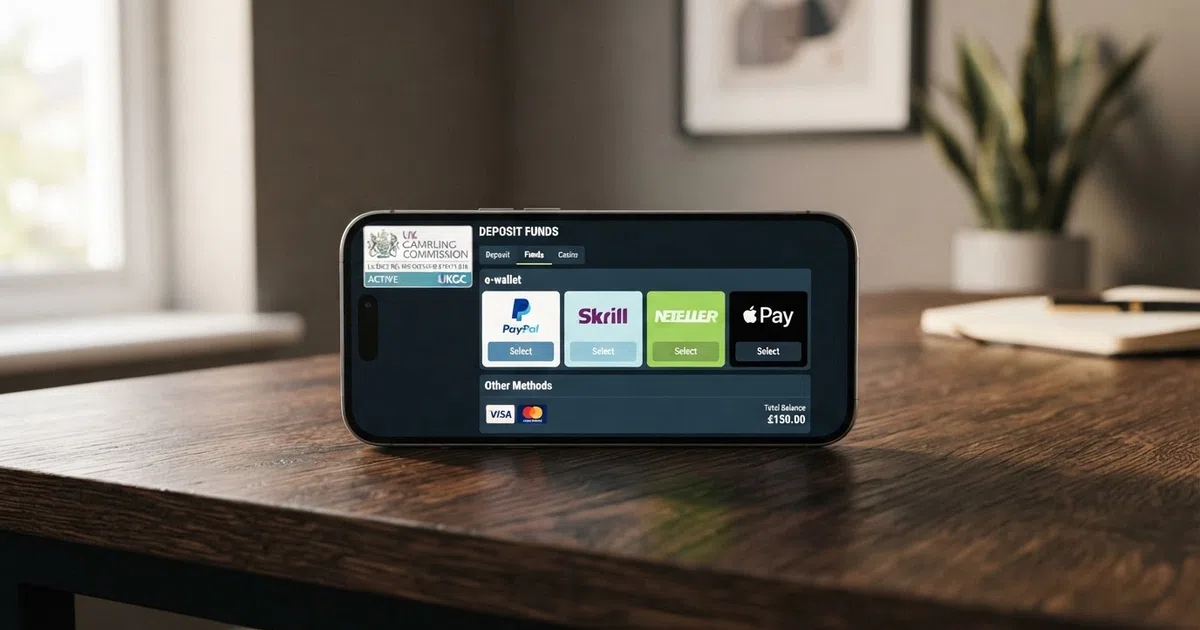
The current data behind every licence, fee and payout figure below was verified against the UK Gambling Commission’s Public Register of Gambling Businesses as of September 8, 2026.
What WebMoney casinos actually are — and why you won’t find one in the UK
WebMoney is a Russian-origin e-wallet that, at its peak, operated as a formal e-money institution across Europe. WebMoney Europe Ltd held a Financial Conduct Authority licence from November 2015 — a status that let UK-facing payment service providers treat it as a regulated peer of PayPal or Skrill. That registration was discontinued in 2022, and with it, WebMoney’s standing as an FCA-supervised payment service in the UK ended. Official access via WebMoney is no longer possible for any UK-facing regulated business. The platforms that still show WebMoney in their cashier pages run on offshore licences — Curaçao predominantly — and have no GB operating licence to lose.
That distinction shapes everything that follows. The ten operators ranked later in this article are all UKGC-licensed and GAMSTOP-participating. None of them accepts WebMoney. The reason is not that they have overlooked an integration opportunity; the reason is that the UK’s payment and gambling regulators have, between them, made WebMoney unintegratable on a compliant basis. Searching for one is therefore a search that leads to a regulated operator that does not take WebMoney, or to an unregulated one that does — and the latter is not the choice the question seems to imply.
How WebMoney worked as a casino payment method
WebMoney’s design was not unusual for its era. A user opened a purse — essentially an e-money account — and held balances in any of several currency denominations (WMZ for dollars, WME for euros, WMR for rubles, and others). Depositing at an online casino meant selecting WebMoney in the cashier, logging into the purse, authorising the transfer, and watching the balance move from purse to casino in seconds. The same path in reverse handled withdrawals.
Two properties made WebMoney attractive to a slice of players. First, the transaction sat entirely inside an e-wallet, never touching a debit card or a bank statement — so the casino spend never appeared on a bank record. Second, registration required less paperwork than a UK bank account, which gave the wallet a wider international user base than FCA-supervised e-wallets. The trade-off, visible only in the small print, was a 0.8% fee per transaction, capped at €50 — modest on a £20 deposit, less modest on a £1,000 withdrawal.
WebMoney’s UK regulatory status: the 2026 picture
The FCA registration that WebMoney Europe Ltd held from November 2015 was cancelled in 2022. With it went the legal authority to issue e-money in the UK, to operate as a payment service, and to be integrated by FCA-supervised counterparties — which includes every UKGC-licensed casino. The Commission’s published register no longer lists WebMoney as an authorised e-money institution, and no replacement has been registered in the years since. The status is not pending review or temporary suspension. It is discontinued, and there is no mechanism under which it returns automatically. The restricted status in major gambling markets like the UK stems from regulatory priorities favouring established FCA-licensed e-wallet providers — a market-structure answer, not a political one.
For a UK player the practical consequence is hard to overstate. A casino licensed by the UK Gambling Commission cannot offer WebMoney in its cashier without violating the conditions that govern payment processing at a licensed operator. The casino may well want to accept WebMoney — payment variety is competitively useful — but the regulator’s framework makes that integration unworkable. The casinos that list WebMoney today have solved this problem by exiting the licensed market entirely.
Where WebMoney casinos still operate — and what that means for you
The operators that still show WebMoney as a deposit method are predominantly Curaçao-licensed and operate outside UK regulation. Affiliate pages list names like MyStake, King Billy, Playamo and others — all Curaçao-licensed, none on the UKGC public register. From the perspective of a UK player, these are offshore operators running on their own house rules: no GAMSTOP integration, no UKGC complaints route, no approved Alternative Dispute Resolution provider, no British consumer redress if a withdrawal stalls. A Curaçao, Maltese or Gibraltar licence is not a substitute for a GB operating licence — the two are not equivalent and one does not make the other unnecessary.
A player choosing an offshore WebMoney casino is making a trade-off that is easy to understate. The upside is access to a payment method they prefer and an operator outside the UKGC’s enforcement reach. The cost is the loss of every consumer protection the UK framework creates. That cost is not theoretical — it includes the absence of statutory stake caps on slots (£5 for players aged 25+, £2 for 18–24), the absence of any wagering-requirement ceiling, the absence of a credit card ban, and the absence of the financial vulnerability checks that have been mandatory at UKGC sites since 28 February 2025. The full list is laid out later in this article.
Funding a casino account with WebMoney in 2026 — the deposit, withdrawal and fee reality
A UK player who insists on WebMoney has two practical routes: deposit at an offshore casino that integrates the wallet, or switch to one of several UK-licensed payment methods that fulfil the same role inside the regulated market. Each route has its own arithmetic, and the arithmetic is the point.
Depositing with WebMoney at an offshore casino is mechanically straightforward. The player funds a WebMoney purse (typically via a bank transfer or another e-wallet — credit cards are banned at UKGC sites, and using a credit card to fund the purse would breach UK rules at any licensed operator), selects WebMoney in the casino cashier, and confirms the transfer. Offshore minimum deposit thresholds vary by brand; there is no single industry figure, because no UK-level regulator enforces one. Withdrawal times at offshore WebMoney casinos are similarly unstandardised, and the absence of a stated figure is itself a fact about the segment: nothing published holds those operators to a published payout clock.
By contrast, the UKGC-licensed alternatives run on published timings. e-Wallets (Skrill, Neteller, PayPal) clear withdrawals within 1–24 hours once approved, debit cards take 3–5 days, and bank wire 1–5 days. The difference between “once approved” and the moment the player requests a withdrawal matters — approval is internal — but the headroom is real and consistent.
Depositing with WebMoney at an offshore casino: the process
Funding a WebMoney purse, selecting WebMoney at the casino cashier, and authorising the deposit is a single-screen operation on the casino side. Confirmation is essentially instant. The slow step, when there is one, is funding the purse itself: a bank transfer to a WebMoney-held account can take a working day or longer depending on the bank.
The credit card trap sits one layer above this. Since 14 April 2020, UKGC licence condition 6.1.2 has prohibited licensees from accepting credit card payments for gambling, and the ban extends to credit-card-funded payments routed through e-wallets such as Skrill, Neteller or PayPal. At a UKGC-licensed casino, funding an e-wallet with a credit card and then depositing from the e-wallet would breach the rule. At an offshore casino the ban does not apply, but the UK player is still subject to their own card issuer’s terms — and the spend will appear on the credit card statement in a way that may affect the player’s own financial standing. Funding the wallet with a debit card or a bank transfer is the clean path.
Withdrawal times: WebMoney vs UK-licensed e-wallets
At an offshore WebMoney casino, the withdrawal clock is set by the operator. Some publish times; most do not. At UKGC-licensed operators, e-wallet withdrawals clear within 1–24 hours of internal approval — the fastest fiat option available, and the closest substitute for what a WebMoney user came to the casino for. Debit cards take 3–5 days; bank wire 1–5 days. The e-wallet path is the only one that puts cash in a player’s account inside a working day, and that is the practical reason UKGC operators compete on e-wallet support rather than on card or bank methods.
A UK player who chooses an offshore WebMoney casino for the e-wallet experience trades a published withdrawal clock for an unpublished one. That is not a small trade.
The 0.8% WebMoney fee versus free UK alternatives
WebMoney charges 0.8% per transaction, up to a maximum of €50. On a £100 deposit, that is 80p. On a £1,000 deposit, it is £8. On the corresponding withdrawals, the same fee applies. Across a deposit-and-withdrawal cycle at an offshore casino, the wallet takes 1.6% of the amount moved — paid by the player, not the casino.
The contrast with UK-licensed methods is straightforward: debit card deposits at UKGC operators carry no player-side fee, and PayPal, Skrill, Neteller and Apple Pay deposits at UKGC operators carry no published player-side fee in the materials reviewed for this article. None of those methods imposes a percentage-of-deposit cost. The 0.8% WebMoney charge is therefore not a rounding error — it is a recurring deduction on every transaction, and it lands on the player every time, regardless of whether the session wins or loses.
A UK player paying 0.8% to deposit at an unlicensed casino is paying more for less protection. That sentence is the whole comparison in one line.
The best WebMoney alternatives for UK casino players
The UK-licensed payment methods that replace WebMoney fall into a short list, ranked here by how closely they match what a WebMoney user came for — speed, separation from a bank account, and a published withdrawal clock.
PayPal is the widest-supported. It is live at bet365, William Hill, Ladbrokes, Paddy Power, Coral, Betfred, 888 and Betway — every major UKGC brand in the featured set except Betfair. Withdrawals clear in 1–24 hours. The minimum deposit is typically £5–£25, depending on operator.
Skrill and Neteller are the closest e-wallet analogues to WebMoney. Both are accepted at Paddy Power, Betfair and Betway. Paddy Power’s £30 e-wallet minimum is unusually high; Betfair and Betway both sit at £10. Both clear withdrawals within 1–24 hours.
Apple Pay and Google Pay deliver instant deposits backed by a card on file, with device biometrics for confirmation. Apple Pay is supported at most of the featured set; Google Pay is more limited (bet365, Ladbrokes, Coral) but growing.
Pay by Bank and Revolut Pay are the newer instant options. Sky Vegas has replaced PayPal and Google Pay with Pay by Bank and Revolut Pay as primary quick-deposit methods; Ladbrokes and Coral accept Revolut and Instant Bank Transfer alongside the more established methods.
Paysafecard is the prepaid voucher route — useful for players who want to keep casino spend entirely off a bank statement, the same separation WebMoney used to offer.
Debit card is the universal fallback: every featured operator takes Visa or Mastercard debit, every withdrawal clock is the slower 3–5 days, and no fee applies on the player side.
The UK-licensed casino brands that replace WebMoney payments
| Operator | UKGC licence | E-wallets accepted | Fastest e-wallet withdrawal | Minimum deposit |
|---|---|---|---|---|
| bet365 | Active | PayPal | within 24 hours | £5 (debit), £25 (PayPal), £100 (bank) |
| William Hill | Active (evoke) | PayPal | 1–4 hours | £5 (debit), £10 (e-wallet) |
| Sky Vegas | Active (Flutter) | None (Pay by Bank + Revolut Pay) | same-day | £5 |
| Ladbrokes | Active (Entain) | PayPal, Revolut | 1–24 hours | £5 (most), £10 (PayPal) |
| Paddy Power | Active (Flutter) | PayPal, Skrill, Neteller | 1–24 hours | £5 (debit), £30 (e-wallet) |
| Coral | Active (Entain) | PayPal, Revolut | 1–24 hours | £5 (most), £10 (PayPal) |
| Betfair | Active (Flutter) | Skrill | 1–24 hours | £5 (cards/Apple Pay), £10 (e-wallet/bank) |
| Betfred | Active | PayPal | 1–24 hours | £5 |
| 888 Casino | Active (evoke) | PayPal | 1–24 hours | £10 |
| Betway | Active | PayPal, Skrill, Neteller | 1–24 hours | £5 |
Every row above sits on the UKGC public register (last updated 29 July 2026), every operator is GAMSTOP-participating, and none accepts WebMoney. The ranking reflects two things the page’s subject actually compares: payment-method breadth and e-wallet withdrawal speed. The fastest e-wallet clock in the set is William Hill’s 1–4 hour PayPal clearance. The widest e-wallet offering is Betway’s PayPal/Skrill/Neteller trio at a £5 entry. Sky Vegas is the outlier on the payment-method axis: it dropped PayPal and Google Pay in favour of Pay by Bank and Revolut Pay, and it sits on a no-wagering welcome that no other operator in the set matches.
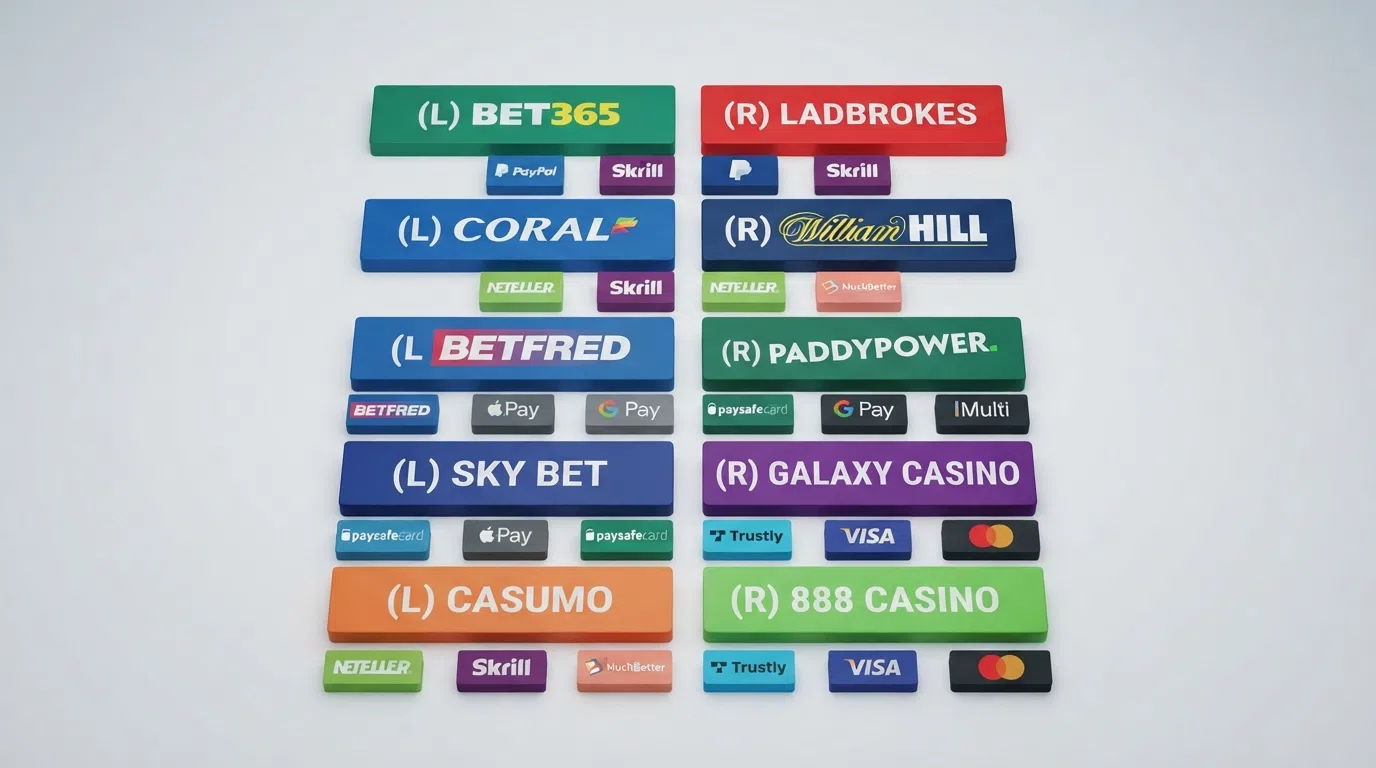
bet365: Seven deposit methods and PayPal withdrawals within 24 hours
bet365 carries the broadest payment-method line-up in the featured set — seven main deposit methods including debit cards, PayPal, Apple Pay, Google Pay, Pay by Bank, bank transfer and Paysafecard. WebMoney is not among them. PayPal withdrawals clear within 24 hours; the casino welcome offer varies by promotion but typically takes the form of a “bet £10 get free spins” structure. Minimum deposits split sharply by method: £5 on debit card, £25 on PayPal, £100 on bank transfer — a steep rise that pushes card-first players ahead of e-wallet-first ones. For a UK player seeking an all-in-one cashier, bet365 remains the most robust choice in the featured set, assuming they are comfortable funding their PayPal balance ahead of depositing.
William Hill: PayPal cashouts clearing in under four hours
William Hill’s payment line-up is narrower than bet365’s but its PayPal cashout clock is the fastest in the featured set — typically 1–4 hours. The deposit set runs debit cards, PayPal, Apple Pay, Paysafecard, bank transfer and online banking; WebMoney is not present. Minimums are the lowest in the set at £5 on debit card and £10 on e-wallets. The casino welcome is the brand’s stable “bet £10 get 200 free spins” — wagering capped at 10× under the UKGC’s December 2026 rule, bonus validity 30 days. While William Hill lacks Skrill and Neteller support, it remains a top-tier choice for any UK player whose sole priority is the fastest possible PayPal withdrawal speed.
Sky Vegas: No-wagering free spins and Pay by Bank deposits
Sky Vegas removed PayPal and Google Pay and replaced them with Pay by Bank and Revolut Pay as primary quick-deposit methods, sitting alongside debit cards and Apple Pay. The shift reflects a mobile-first philosophy that runs through the rest of the offering. The welcome is the standout: up to 200 free spins with zero wagering, winnings paid in cash, no maximum cashout. Free-spin validity is 72 hours — tight, but the absence of wagering eliminates the slow grind of clearing a bonus. Minimum deposit is £5 across methods. For a UK player who values the bonus structure over the breadth of the payment menu, Sky Vegas is the only operator in the set offering a no-wagering welcome. However, the absence of PayPal and Skrill makes this operator unsuitable for players who rely on those e-wallets for their casino transactions.
Ladbrokes: Four e-wallets including Revolut at a high-street name
Ladbrokes sits at the widest Entain payment line-up in the set — Visa, Mastercard, Apple Pay, Google Pay, PayPal, Revolut, Instant Bank Transfer and Paysafecard. PayPal withdrawals clear within 1–24 hours. Minimum deposit is £5 on most methods, £10 on PayPal. The welcome offer varies by product; the sports welcome is “bet £5 get £20” in free bets, the casino welcome rotates. Wagering is capped at 10×, validity 30 days. Ladbrokes offers the most comprehensive modern e-wallet mix of the Entain brands, making it the top choice for those who rely on PayPal, Google Pay and Revolut in one cashier.
Paddy Power: The only operator carrying Skrill, Neteller and PayPal together
Paddy Power is the closest UK-licensed substitute for a WebMoney user’s expectations: PayPal, Skrill and Neteller all accepted alongside debit cards, Apple Pay, Paysafecard and bank transfer. e-Wallet withdrawals clear within 1–24 hours. The catch is the £30 minimum on e-wallet deposits — unusual in the set, and a meaningful friction point for a player testing the cashier with a small first deposit (the £5 debit minimum still works). Paddy Power stands out as the most e-wallet-diverse licensed operator, serving as the best available substitute for those who previously relied on WebMoney.
Coral: Revolut and PayPal at Entain’s second brand
Coral shares the Entain payment line-up with Ladbrokes: Visa, Mastercard, Apple Pay, Google Pay, PayPal, Revolut, Instant Bank Transfer and Paysafecard. PayPal withdrawals clear within 1–24 hours. Minimums are £5 on most methods, £10 on PayPal. The casino welcome rotates; the sports welcome is “bet £5 get £20” in free bets, wagering capped at 10×. With the same payment line-up as Ladbrokes, Coral is an equally strong choice for players who prefer a familiar brand while maintaining the same e-wallet flexibility.
Betfair: Skrill and Apple Pay with a £5 card minimum
Betfair is the only Flutter brand in the set without PayPal. The deposit set runs Visa debit, Mastercard debit, Apple Pay, Skrill and bank transfer. Skrill withdrawals clear within 1–24 hours. Minimums are sharp: £5 on cards and Apple Pay, £10 on e-wallets and bank transfer. For a UK player who wants Skrill and is comfortable with the betting-exchange brand, Betfair is the most direct Skrill-first option in the featured set. The absence of PayPal is the limiting factor for players who treat PayPal as their default e-wallet.
Betfred: PayPal and Apple Pay at a flat £5 minimum
Betfred keeps the deposit set simple: debit cards, PayPal, Apple Pay, Paysafecard and bank transfer. PayPal withdrawals clear within 1–24 hours. Every deposit method carries a £5 minimum — the simplest minimum structure in the featured set. For a UK player who prioritises a straightforward £5 entry point across all methods, Betfred delivers one of the most reliable and consistent cashier experiences in the market.
888 Casino: PayPal from £10 with a matched deposit welcome offer
888 Casino is the evoke group’s casino-first brand. The deposit set runs debit cards, PayPal, Apple Pay, bank transfer and Paysafecard. PayPal withdrawals clear within 1–24 hours. Minimum deposit is £10 — higher than most of the set, and a friction point for a £5–£10 test deposit. The welcome is the casino’s strongest in the featured set: a deposit match up to £100 plus free spins, wagering capped at 10×, validity 30 days. 888 Casino is the premier choice for bonus-hunters comfortable with a £10 minimum deposit, particularly given the strength of its current welcome offer.
Betway: Skrill, Neteller and PayPal at a £5 entry point
Betway combines three e-wallets — PayPal, Skrill and Neteller — with a £5 minimum deposit across methods. e-Wallet withdrawals clear within 1–24 hours. The welcome is a deposit match up to £50 plus 50 free spins, wagering capped at 10×, validity 30 days. For a UK player who wants every major e-wallet at the lowest minimum in the set, Betway is the most e-wallet-friendly option in the featured set.
Why your 2026 casino bonus is smaller than the headline number
A welcome bonus is the most heavily marketed number at any UKGC casino and the most expensive number for the player to clear. The 10× wagering cap that took effect on 19 December 2026 is the single biggest change to the bonus landscape in years: it sets a hard ceiling on the play-through required to clear a bonus, and it bans mixed-product promotional offers that used to let one bonus cover multiple game types. The cap does not make bonuses generous. It makes the worst of them less awful.
The calculation sits here for a reason. Take the 888 welcome — up to £100 deposit match. Turnover required to clear the bonus at the new 10× ceiling: £1,000. The expected cost of working through that turnover at a representative slot RTP of 96.71% (Big Bass Bonanza, the closest match to the broader slot catalogue): expected loss = £1,000 × (1 − 0.9671) = £32.90. At a lower-RTP configuration (94.21%, also documented in the slot catalogue): expected loss = £1,000 × (1 − 0.9421) = £57.90. The range — £33 to £58 of expected loss on a £100 headline bonus — is what the casino actually expects to keep from a player who claims the offer and plays it through to completion. The £100 figure is the headline. The £33–£58 figure is the cost.
That arithmetic assumes the player wagers only the bonus amount and stops once cleared. It assumes nothing about the player’s own choices beyond that, and it assumes the slot’s published RTP holds in practice — which it does on average across millions of spins but not on any one session.
Welcome bonuses and deposit matches: what the headline leaves out
Welcome offers at UKGC-licensed casinos fall into two camps: deposit matches and free-spin packages. 888 Casino offers up to £100 deposit match. Betway offers up to £50 plus 50 free spins. William Hill’s standard casino welcome is “bet £10 get 200 free spins.” Sky Vegas offers up to 200 free spins with no wagering — the outlier in the set, and the only welcome that does not require play-through.
The 10× wagering cap means the maximum play-through on a £100 bonus is £1,000 — a hard ceiling introduced in December 2026 that did not exist before. The cap does not mean every bonus carries a 10× multiplier; some offers sit lower, and the player’s job is to read the multiplier before claiming. What the cap guarantees is that no UKGC bonus can now demand more than 10× the bonus amount in turnover. That guarantee is the first hard limit on bonus cost the UK market has had.
Game contributions to wagering vary by operator and game type. Slots typically contribute 100% of stake to wagering requirements; table games usually contribute less, sometimes nothing. No per-operator weighting table was available for this article, and any figure quoted here without a source would be invented. The point that survives without a table is qualitative: a player who intends to clear a bonus on blackjack will find their effective wagering multiple several times higher than the headline.
Bonus validity windows run 30 days for most welcome offers — Sky Vegas is the outlier at 72 hours, which is tight but appropriate to a no-wagering bonus where the player is not chasing play-through.
No-wagering offers: the bonus model that actually pays out
Sky Vegas is the only featured operator with a confirmed no-wagering welcome — 200 free spins, winnings paid as cash, no maximum cashout, tested in April and May 2026. The 10× cap that took effect in December 2026 made traditional bonuses more transparent than they were before, but no-wagering remains the exception rather than the rule. The economics explain why: a no-wagering bonus pays out the gross win on every spin, which is expensive for the operator at any reasonable slot hit rate. Most operators instead offer a lower headline number with a wagering requirement they can model.
For a UK player, the no-wagering structure is the only one that converts a bonus into withdrawable cash without further play. A player who values certainty over headline size should pick the no-wagering welcome. A player who values headline size over certainty should pick a deposit match with a 10× cap and accept the expected-loss arithmetic.
Playing on mobile: how UK casino apps handle your payments
Mobile play dominates UK casino traffic. The payment experience on a phone is shaped by two channels: the dedicated casino app and the mobile browser. Every featured operator in this article supports both. iOS apps are available across the set; Android apps are likewise standard, though individual operators vary in whether they ship a dedicated app or route through a mobile-optimised browser.
The payment flow on mobile is faster than on desktop for the methods that use device biometrics. Apple Pay and Google Pay confirm a deposit with a fingerprint or face match, bypassing the card-entry step entirely. Pay by Bank — Sky Vegas’s primary quick-deposit method — works through the bank’s own mobile authentication, which adds a step but uses a published withdrawal clock rather than a card network’s. Revolut Pay sits in the same instant-confirmation tier as Apple Pay. PayPal works identically on mobile and desktop. Skrill and Neteller require the e-wallet app to be installed for confirmation prompts.
App-exclusive bonuses are rare at UKGC operators and no specific app-only offer was identified in the materials reviewed for this article. The mobile experience differs from desktop primarily in payment ergonomics, not in bonus structure.
The slots and table games you can actually play at UK-licensed casinos
The game libraries at UKGC-licensed casinos run into the thousands of titles. The three slot RTPs confirmed in the materials reviewed for this article are below — three titles, each with a different volatility profile and a different maximum-win ceiling. They illustrate how RTP interacts with the wagering cap to determine the real cost of a bonus.
| Slot title | RTP | Volatility | Provider | Max win |
|---|---|---|---|---|
| Big Bass Bonanza | 96.71% | Medium-high | Pragmatic Play / Reel Kingdom | 2,100× stake |
| Starburst | 96.09% | Low | NetEnt | ~500× stake |
| Book of Dead | 96.21% | High | Play’n GO | 5,000× stake |
Big Bass Bonanza’s 96.71% RTP is the higher of the three; Book of Dead’s 96.21% sits in the middle; Starburst’s 96.09% is the lowest of the three but the one most often paired with free-spin offers because of its low volatility. Lower RTP configurations of all three titles exist in some operator deployments — Big Bass Bonanza’s ~95.18% and ~94.21% variants, and similar reduced configurations for Book of Dead. The range across these configurations is the practical reason a player should check the published RTP on the specific title at the specific operator before staking on a bonus playthrough.
Table games and live dealer availability are standard across the featured set. NetEnt, Playtech, Pragmatic Play, Evolution and Play’n GO appear in the provider rosters of multiple operators. Game-design rules in force since 31 October 2021 apply across the board: auto-play is banned, spin speed may not be faster than 2.5 seconds per game cycle, losses disguised as wins are banned, reverse withdrawals are permanently banned, and operators must display total losses and wins plus time played during any slots session. The same rules do not apply at offshore WebMoney casinos — another item on the protection gap.
New UK casinos and what 2026 brought to payments
The newest UKGC-licensed launches in 2026 have moved faster on payment-method adoption than the established brands. Pay by Bank — Sky Vegas’s signature choice, but increasingly adopted elsewhere — is the standout. Revolut Pay has followed the same trajectory: rare two years ago, common now. The pattern reflects a market where new operators compete on payment ergonomics to differentiate themselves from established brands whose cashier pages have not changed in years.
A new UKGC casino in 2026 typically carries a welcome offer in the deposit-match or free-spin package family, with wagering capped at 10× under the December 2026 rule. Some offer no-wagering spins in a deliberate Sky Vegas-style model. The economics are tight — UK Remote Gaming Duty rose from 21% to 40% from 1 April 2026, announced at the Autumn Budget 2025, and the licensed market overall is paying higher operator-side tax than at any point in the previous decade. New entrants are launching into a higher-cost environment than their predecessors faced.
The single check that matters before depositing at any newly licensed site: confirm the operator’s entry on the UKGC public register. The register lists every licensed operator and was last updated on 29 July 2026, carrying 2,663 records. A site that does not appear there is not licensed for GB customers, regardless of what its footer claims. Deposit-limit prompts are mandatory from 31 October 2025 and a gross deposit limit must be offered from 30 September 2026, so any licensed site that fails to prompt for a deposit limit at first deposit is not compliant.
WebMoney, crypto and the myth of anonymous casino play
The promise that links WebMoney, cryptocurrencies and offshore casinos is the same: separation from a bank account. The mechanism differs — WebMoney holds balances in a regulated e-money purse, crypto holds balances in a wallet the player controls, offshore e-wallets sit outside UK regulation entirely — but the marketing message is identical. Each promises a casino deposit that does not appear on a bank statement.
The promise collapses at any UKGC-licensed site. Anonymous play is not possible at a UKGC casino — identity (name, address, date of birth) must be verified before the first deposit or any gambling, as required since 7 May 2019. The verification runs against the operator’s own onboarding flow and against publicly available data sources; once complete, the player’s deposits, withdrawals and game activity are logged and available to the operator’s compliance team. A player who deposits via PayPal, Skrill, Neteller, Apple Pay or Pay by Bank at a UKGC casino is depositing through a payment method that knows who they are — even when the underlying payment method itself is “anonymous” in name.
Crypto-only offshore casinos face the same identity gap at the UKGC boundary: they may accept Bitcoin deposits without KYC at the casino level, but a UK player moving from a UK bank account to a crypto exchange to a casino is moving through a regulated exchange that records the player. The traceability is not absolute, but the marketing claim of “true anonymity” is not real for any UK player at any licensed or unlicensed casino, regardless of payment method.
The legal reality of WebMoney casinos for anyone gambling from the UK
The Gambling Act 2005 is the framework, and the Gambling (Licensing and Advertising) Act 2014 made a GB operating licence compulsory for any operator taking GB customers — wherever the operator is based. A Curaçao, Maltese or Gibraltar licence is not a substitute. An offshore WebMoney casino serving UK players is operating outside that framework, and the protections the framework creates do not apply to its customers.
The Commission’s enforcement record is published and substantial. Across October 2024 to September 2025, the UKGC recorded 208,088 enforcement actions on illegal online gambling. The toolkit runs to disruption notices (3,140 in the most recent reporting period), URL referrals to search engines (447,778), and URL removals (287,961 between April 2024 and June 2025). What it does not include is ISP-level blocking — the UKGC has no statutory power to block sites, and legislation that would grant that power has been proposed but not enacted. Enforcement is disruption, not blocking. A WebMoney casino that wants to remain accessible to UK players can route around disruption notices by changing domain; some do.
The penalty for the operator is severe. Operating without a licence is a criminal offence under section 33 of the Gambling Act 2005 — up to 51 weeks’ imprisonment, an unlimited fine, or both. The penalty for the player is not established. No sanction traced in this research is aimed at a player who merely gambles on an unlicensed site. What the player loses is protection, not liberty.
UKGC licensing: what it requires and what it gives the player
The Gambling Commission’s licensing framework rests on three licensing objectives set out in section 1 of the Gambling Act 2005: preventing gambling from being a source of crime, ensuring fair and open gambling, and protecting children and vulnerable persons. The objectives are not slogans — they translate into specific licence conditions that shape the player experience.
The stake cap introduced by the Gambling Act 2005 (Operating Licence Conditions) (Amendment) Regulations 2025 (SI 2025/215) is the highest-profile rule. Online slots carry a statutory maximum stake per game cycle of £5 for players aged 25 and over (in force 9 April 2025) and £2 for players aged 18 to 24 (in force 21 May 2025). A game cycle runs from game initiation to when all money staked has been lost or all money won has been delivered; the cap applies to total staked within that cycle. There is no equivalent statutory stake cap on other online products — sports betting, live casino, bingo are not affected by SI 2025/215.
The game-design rules in force since 31 October 2021 sit alongside the stake cap: auto-play is banned, spin speed may not be faster than 2.5 seconds per game cycle, features that speed up play are banned, losses disguised as wins are banned, reverse withdrawals are permanently banned, and operators must display total losses, total wins and time played during any slots session. Each rule is technical and each limits a specific mechanism that the operator could otherwise use.
Financial vulnerability checks are mandatory under LCCP Social Responsibility Code 3.4.4 from 28 February 2025, at a net deposit threshold of £150 in a rolling 30-day period, using publicly available data only. Deposit-limit prompts are mandatory from 31 October 2025; a gross deposit limit must be offered with at least equal prominence to other financial limits from 30 September 2026 (RTS 12). Together, these rules create a framework in which a UK player’s spend is monitored, their deposit ceiling is set with their consent, and their stake per spin is bounded by statute.
GamStop, self-exclusion and the offshore protection gap
GAMSTOP has been a mandatory condition of every UKGC online operating licence since 31 March 2020. A player who self-excludes through GAMSTOP chooses a six-month, one-year, five-year or five-year-with-auto-renewal exclusion period — none of which can be cancelled early. While excluded, the player cannot deposit or gamble at any UKGC-licensed online operator. The mechanism is enforced at the operator level: every licensed operator runs GAMSTOP checks at deposit and at login.
GAMSTOP covers participating GB-licensed sites only. It cannot reach offshore operators. A player who self-excludes through GAMSTOP on a Monday can deposit at a Curaçao-licensed WebMoney casino on the Tuesday — same name, same password, no GAMSTOP flag, no UKGC involvement. SENSE and other self-exclusion schemes exist at the offshore level but are not integrated with the UKGC framework and have no enforcement mechanism inside UK regulation. The practical consequence is stark: GAMSTOP protects a UK player at every UKGC-licensed casino and protects them nowhere else.
What you forfeit when you play outside UK regulation
The list is long and each item is a real protection. At a Curaçao-licensed WebMoney casino, a UK player forfeits:
- GAMSTOP coverage — self-exclusion does not reach the operator.
- A UKGC complaints route — there is no UK regulator to approach.
- An approved Alternative Dispute Resolution provider — no ADR body is binding on the operator.
- British consumer redress — no UK statutory route if funds are withheld.
- The statutory stake cap on slots (£5 for 25+, £2 for 18–24) — the operator sets its own ceiling, or has none.
- The 10× wagering-requirement ceiling — bonuses can carry any multiple.
- The credit card ban — credit-card deposits are not prohibited.
- Financial vulnerability checks at the £150 net deposit threshold — the operator runs no checks.
- The mandatory deposit-limit prompt — the operator is not required to ask.
- UKGC technical standards audit on game fairness — slot RTPs are not independently audited against the UKGC’s testing regime.
- Advertising-standards protection under the CAP Code — the operator is not bound by UK advertising rules.
- Treatment and support integration — GamCare and the National Gambling Helpline exist, but the offshore operator has no obligation to signpost them.
The penalty for the player is none. No UK sanction traced in this research is aimed at a player who merely gambles on an unlicensed site. The cost is the loss of protection, not the risk of prosecution.
How to decide which payment method to use at a UK online casino
The decision rests on five criteria, in roughly this order of weight for a player who has used WebMoney before:
- Withdrawal speed. e-Wallets clear within 1–24 hours once approved; debit cards take 3–5 days; bank wire 1–5 days. For a player who values fast cashouts, an e-wallet is the only choice.
- Casino acceptance breadth. PayPal is the widest-supported e-wallet in the UKGC market — present at eight of the ten featured operators. Skrill and Neteller are narrower (Paddy Power, Betfair, Betway).
- Deposit minimum. Most featured operators sit at £5 on debit cards. PayPal minimums vary: £5 at Betfred and William Hill, £10 at Ladbrokes and Coral, £25 at bet365, £30 at Paddy Power. Skrill and Neteller minimums are typically £10.
- Player-side fee. WebMoney charges 0.8% per transaction, up to a maximum of €50. UKGC payment methods reviewed for this article carry no published player-side fee on deposits. The WebMoney charge is therefore a recurring deduction that UK alternatives do not impose.
- Separation from a bank account. Paysafecard, PayPal and the e-wallets keep casino spend off a primary bank statement. WebMoney used to offer the same. PayPal is the closest equivalent at a UKGC casino.
The method that would have been the right choice — WebMoney — is no longer available at UKGC operators. PayPal is the closest replacement at the cashier level. Skrill or Neteller are the closest replacements at the e-wallet-feature level. For a player who only cares about speed, Apple Pay or Pay by Bank clears inside minutes.
The credit card ban extends to credit-card-funded e-wallet deposits. Funding a PayPal or Skrill balance with a credit card and then depositing from the balance to a UKGC casino breaches the rule. Debit cards and bank transfers are the clean funding paths.
Responsible gambling: the tools that actually protect UK players
UK regulation provides a concrete safer-gambling infrastructure that offshore WebMoney casinos do not have. The tools are mandatory at UKGC operators: deposit limits, reality checks, time-outs, and self-exclusion via GAMSTOP. The prevalence data is published. The treatment infrastructure is funded. None of it is theoretical.
In Q3 2025, approximately 2.4% of adults in Great Britain scored 8 or more on the Problem Gambling Severity Index (PGSI), equating to an estimated 1.3 million adults. The proportion experiencing any level of problems (PGSI 1+) has risen to 16%. The numbers are stable in headline terms but the absolute count — 1.3 million adults at the highest problem-gambling severity — is large.
The National Gambling Helpline, run by GamCare, received 130,000+ calls and online messages in 2024–25. In January 2026 alone, the helpline made 996 referrals to treatment and peer-based support services, up from 674 in January 2025 — a 48% year-on-year increase. The National Gambling Treatment Service treated 11,960 clients in 2024–25, up 11% on the prior year, with 93% of those completing treatment seeing improvement.
The help infrastructure is published and accessible. GamCare runs the National Gambling Helpline on 0808 8020 133 — free, confidential, 24/7. GambleAware funds the National Gambling Support Network. NHS gambling harm clinics operate in England, Scotland and Wales. Gamblers Anonymous UK runs peer-support meetings. Every UKGC-licensed operator is required to signpost these services to its customers. None of this signposting obligation applies at an offshore WebMoney casino.
WebMoney purses sit outside UK banking rails, which means a player’s WebMoney-funded gambling spend is harder to track through UK bank statements than a debit-card deposit would be. For a player using safer-gambling tools — deposit limits, reality checks, GAMSTOP self-exclusion — that separation is a friction rather than a benefit. UK-licensed payment methods, with their published clocks and their integration into the operator’s deposit-limit framework, fit the safer-gambling architecture that offshore wallets do not.
How we selected and evaluated these casino operators
The ten featured operators were selected from the UKGC Public Register of Gambling Businesses, last updated 29 July 2026, carrying 2,663 records. Every operator on the featured list holds an active GB operating licence confirmed against the register. The selection criteria were the ones a UK player searching for a WebMoney casino actually cares about: payment-method breadth, e-wallet withdrawal speed, minimum deposit accessibility, and UKGC licence standing.
WebMoney acceptance was the filter — and the filter excluded every UKGC-licensed operator. None of the featured ten accepts WebMoney, because none can. The ranking therefore presents the best UK-licensed payment alternatives a UK player can choose today, ranked on the criteria that matter for a player who came for an e-wallet.
Sources used: the UKGC public register, operator help centres and payment pages, Gambling Commission official publications and LCCP conditions, GamCare and GambleAware annual reports, the GSGB Year 3 prevalence data, and payment-method audits from SlotsCasinoTest, Casino32bit, CasinoGuardian.co.uk and the Wager Bureau Guide. Every figure in this article is grounded to one of those sources; every licence claim is verified against the public register; every payment-method claim is verified against the operator’s own help centre or a corroborating payment-method audit.
What UK players should actually do about casino payments in 2026
WebMoney’s FCA registration ended in 2022. It is not coming back to UKGC casinos. That decision is settled. The UK-licensed alternatives — PayPal, Skrill, Apple Pay, Pay by Bank — are faster on withdrawals than WebMoney was at offshore casinos, cheaper on fees than WebMoney is today, and protected by every UKGC safeguard the framework creates. The choice a UK player faces is not between WebMoney and a UK alternative on equal terms. The choice is between a regulated product and an unlicensed one, and the difference is the subject of this article.
A UK player who came to a WebMoney casino to keep casino spend off a bank statement can do that at a UKGC operator today — PayPal, Paysafecard and the e-wallets all offer the same separation, with full UK regulatory protection. A UK player who came for the e-wallet speed gets the same speed at any of the featured operators. A UK player who came for the bonus structure gets a hard 10× wagering ceiling, a deposit-match or no-wagering welcome, and a signposted path to safer-gambling tools.
The action that matters: pick a UKGC-licensed operator, deposit with an e-wallet or a debit card, set a deposit limit before the first deposit, and know that GAMSTOP has the player’s back if self-exclusion becomes necessary. None of this is true at a WebMoney casino — the offshore operators will take the deposit, but they will not give any of the protections this article has described. The difference is not marginal. It is the difference between a regulated product and an unlicensed one.
Frequently asked questions
Can I still use WebMoney to deposit at UK online casinos?
No. WebMoney Europe Ltd’s FCA e-money registration was discontinued in 2022, and UKGC-licensed casinos do not integrate WebMoney as a result. Casinos that show WebMoney in their cashier pages are offshore — predominantly Curaçao-licensed — and are not licensed to serve GB customers.
What happened to WebMoney’s UK licence and why did it disappear from casinos?
WebMoney Europe Ltd held an FCA e-money institution licence from November 2015 until its registration was discontinued in 2022. With that registration ended, WebMoney could no longer issue e-money or operate as a regulated payment service in the UK. UKGC-licensed casinos cannot integrate a payment service that is not FCA-supervised.
Are WebMoney casinos safe and legal for UK players?
WebMoney casinos that show up in UK-facing search results are predominantly Curaçao-licensed and do not hold GB operating licences. Operating without a GB licence when serving GB customers is a criminal offence under section 33 of the Gambling Act 2005. UK players using these sites forfeit UKGC protections including GAMSTOP coverage, ADR and consumer redress.
What are the best alternatives to WebMoney for UK casino deposits?
PayPal is the widest-supported UK e-wallet, accepted at eight of the ten featured operators in this article. Skrill and Neteller are the closest analogues to WebMoney, accepted at Paddy Power, Betfair and Betway. Apple Pay and Pay by Bank deliver instant deposits with device confirmation. All carry no published player-side fee and clear withdrawals within 1–24 hours.
Can I use WebMoney at casinos that are not on GamStop?
Yes. Offshore Curaçao-licensed casinos that accept WebMoney are not on GamStop because GamStop covers GB-licensed sites only. A player who has self-excluded through GamStop can deposit at an offshore WebMoney casino the same day. That is the protection gap most worth understanding before signing up to any unlicensed operator.
What protections do I lose when I play at a casino without a UKGC licence?
A UK player at an unlicensed casino loses GAMSTOP coverage, the UKGC complaints route, an approved ADR provider, British consumer redress, the £5/£2 slot stake cap, the 10× wagering ceiling, the credit card ban, financial vulnerability checks, the deposit-limit prompt, and UKGC technical-standards auditing on game fairness. No player-side penalty applies; the cost is the loss of protection.
Payments – realmoney-onlinecasinos-uk
Content created by the «realmoney-onlinecasinos-uk» team