
Payforit Casinos UK 2026: Phone-Bill Deposits Tested Against the Rules
 Available in GB
Every Payforit deposit lands in your casino balance in seconds. The charge on your phone bill arrives days later, often in a sum you did not quite track at the cashier. That timing gap is the whole story behind this deposit method, and it is why a guide that treats Payforit as just another banking option misses what makes it different from a debit card. The deposit is fast and the spending ceiling is built into the network, but the money comes out through a completely separate door, and the bonuses, fees and stake caps that surround it reshape what “fast” and “easy” actually mean when you sit down to play.
Data current as of September 8, 2026 and verified against the Gambling Commission’s public register and operator cashier pages.
Payforit Casino UK: Money That Enters by Text and Exits by a Different Door
The phrase “Payforit casino” still does heavy lifting in UK search results, and it is worth getting the term right before any ranking makes sense. Payforit was the consumer-facing name for a phone-bill payment rail operated by a handful of UK mobile networks. That brand was retired in 2019, but the underlying technology, the one that lets a casino debit your mobile bill or pre-pay credit when you enter your number and confirm by SMS, is very much alive. It now runs under the names Boku, Fonix and Siru, depending on which provider the casino has integrated. UK players, reviewers and even some operators still say “Payforit” as shorthand for the whole category. This article follows that convention, so any reference to Payforit should be read as pay-by-phone deposits generally, not a specific product still in active marketing.
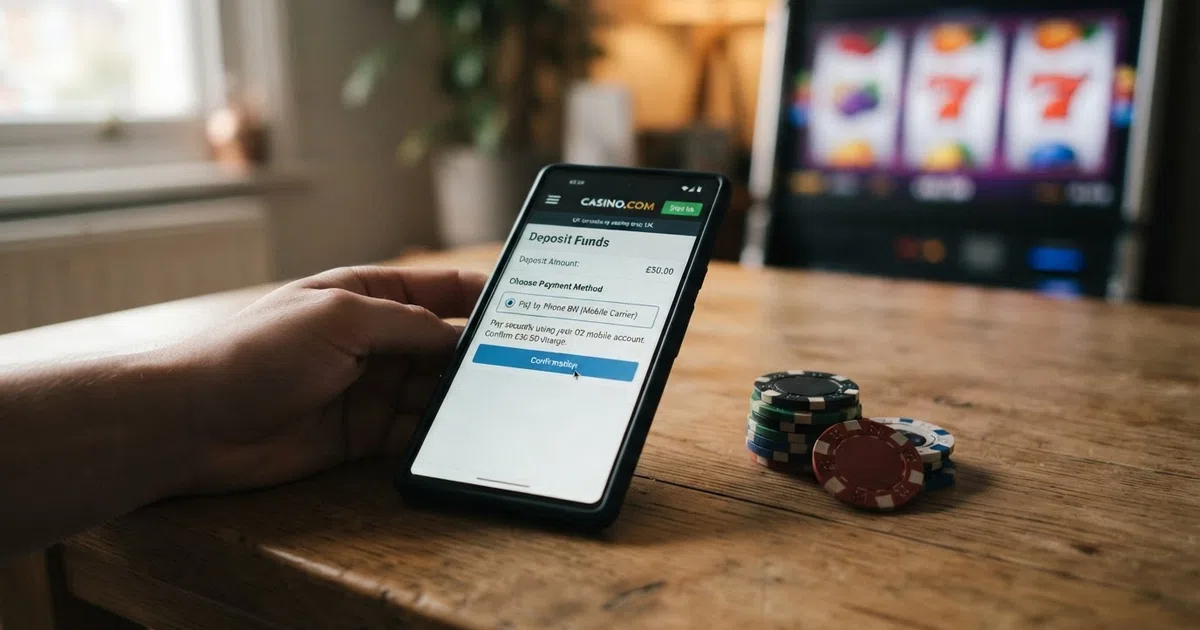
A phone-bill deposit works in four steps that take less time than reading them. You choose Payforit or pay-by-phone at the casino cashier, type in your mobile number, and receive an SMS asking you to confirm. Reply “Y” or tap a one-click link, and the deposit lands in your casino balance immediately, with the funds available to play within seconds. The charge is added to your next mobile bill if you are on pay-monthly, or deducted from your pre-pay credit if you are on pay-as-you-go. The settlement with your network happens later in the billing cycle, which is why the deposit feels instant at the casino end but the money leaves your bank account (or your airtime balance) on a different schedule.
Payforit is a mobile-native service by design. The flow depends on your handset receiving the SMS, so the experience is seamless on a phone and awkward on a desktop where you still need your mobile nearby for verification. Most UK Payforit casinos optimise their cashier for mobile browsers and apps first, and the games are built for portrait-mode touch play. Once the funds arrive, real-money play is identical regardless of how the money got there, and the deposit method has no influence on which slots or tables you can access. The slot you spin and the table you sit at do not know whether you paid by phone or by Visa.
Your Payforit Deposit Landed in Seconds — Getting Your Money Out Takes Longer
The fastest part of the Payforit experience is the deposit. The slowest part is everything that comes after. UK Payforit casinos set minimum deposit floors in the £3 to £10 range, which is well below what most debit-card casinos ask for. The trade-off is the per-transaction cap: a Payforit deposit is hard-capped at around £30 by the network, regardless of which casino you are playing at. A monthly cap of around £240 sits on top, resetting with each billing cycle. These are network infrastructure limits, not casino policy, and they apply uniformly to every UK Payforit casino.

Withdrawal is a different conversation. Payforit is deposit-only. The network does not allow money to flow back to a phone bill, and no UKGC-licensed casino can route winnings to your mobile account. To cash out, you must register a separate withdrawal method, almost always a Visa or Mastercard debit card, or an e-wallet such as PayPal, Skrill or Neteller. That requirement is the single biggest adjustment for players used to one-method banking, and it is also the reason KYC verification must be completed before your first deposit, since the casino needs to know who you are before it can pay anyone.
The four major UK mobile networks, Vodafone, EE, O2 and Three, all support carrier-billing casino deposits through the same underlying rail. Smaller MVNOs do not always carry the service, so players on Giffgaff, Tesco Mobile or similar networks should check their network’s policy before assuming Payforit will work. The caps themselves vary by provider, and the same casino can show slightly different limits depending on whether you are billing to Vodafone or EE.
Against debit cards and e-wallets, Payforit wins on deposit speed and built-in spending caps, and loses on fees and withdrawal access. A debit card deposit is usually instant but can occasionally stall for bank approval; Payforit never stalls because the network confirms the charge in one SMS round-trip. On fees, some Payforit casinos charge up to 15% on top of the deposit, which no debit card or e-wallet operator does as standard. On withdrawal access, Payforit offers none, while debit cards and e-wallets handle both directions. On deposit ceiling, Payforit is capped at around £30 per transaction, while a debit card will accept a £500 or £1,000 deposit without blinking. The choice is not which method is better in the abstract, it is which trade-off matches the kind of player you are.
Best Payforit Casinos UK: 2026 Compared
The ten operators below were selected because they accept Payforit or pay-by-phone deposits and hold (or are widely understood to hold) UKGC licensing. The ranking is built on confirmed welcome-offer value where research supplied specifics, and on the operating profile of the brand where it did not. Four of the ten had welcome-offer data confirmed this research run; the other six are included because their presence in the UK Payforit market is well established, but their current free-spin and bonus terms were not verified in time for this article, and that gap is shown in the table rather than papered over. Readers should treat the unconfirmed rows as a starting point for their own check at the cashier.
| Operator | Welcome Free Spins |
|---|---|
| Bet365 | Up to 500 (0× wagering) |
| Betway | 150 (wager £10) |
| Betfred | 200 (0× wagering) |
| PlayOJO | 50 on Big Bass Bonanza (0× wagering) |
| Sky Vegas | — |
| Paddy Power | — |
| Ladbrokes | — |
| Coral | — |
| Jeffbet | — |
| Winissimo | — |
The four confirmed offers sit at very different points on the value curve. Bet365’s 500-spin package is the largest by count, but it is the zero-wagering structure that determines what those spins are actually worth, not the number itself. PlayOJO offers a tenth of the spin count and is, on the math of expected value, competitive with anything else on the list. The table is a starting point; the operator write-ups that follow say what each offer is worth and to whom.
Bet365
Bet365’s New Player Offer credits up to 500 free spins in stages after a qualifying £10 deposit. The headline number is the largest in this ranking, and the wagering structure is the part that makes it land. Free-spin winnings carry 0× wagering, meaning every prize that is eligible for withdrawal is paid as cash, with no playthrough requirement and no maximum cashout cap stated in the offer terms. The spins expire 7 days after each batch is credited, and the entire offer must be claimed within 30 days of registration. The £10 qualifying deposit is comfortably within Payforit’s ~£30 per-transaction cap, so phone-bill players can trigger the full offer on a single deposit. The bet365 free-spins terms state explicitly that “there is no wagering requirement attached to the winnings, which are added straight to your withdrawable balance.” That single sentence is what separates this offer from the standard 10×-wagered package most UK players are used to. Bet365 provides a strong balance here, combining a high-volume spin package with 0× wagering, making it the primary choice for those seeking a large, low-friction welcome offer.
Betway
Betway takes a different route: wager £10 on selected games to receive 150 free spins, rather than triggering a spin credit on deposit. The mechanic is unusual and worth understanding. You are not depositing to get the spins, you are staking real money, and the spins are awarded once the wagering condition is met. The 7-day expiry applies once the spins are credited. The wagering multiplier on the free-spin winnings was not confirmed in this research run, which is the single biggest unknown about this offer. Until Betway’s own terms page confirms the multiplier, the 150 spins should be treated as a conditional value, not a guaranteed cash equivalent. For a player who already plans to play £10 of real-money slots at Betway, the offer is essentially a free side bet. For a player who would not otherwise wager at Betway, the £10 stake is the real cost.
Betfred
Betfred’s 200 wager-free spins for a £10 stake is a cleaner offer than Betway’s on the same general shape. The 0× wagering is the point: winnings are withdrawable cash as soon as the spin settles, with no playthrough and no cap on cashout. The bonus validity period was not confirmed in this research run, which is a meaningful gap for a time-limited promotion, and players should check the Betfred site for the current expiry window before depositing. The £10 stake requirement keeps the offer inside Payforit’s per-transaction cap. For a player who wants a mid-sized spin batch with no wagering friction, Betfred is the more transparent of the two stake-to-spins models in this ranking.
PlayOJO
PlayOJO is the no-wagering model applied to a smaller spin count: 50 free spins on Big Bass Bonanza for a £10 deposit, with 0× wagering on the winnings and no maximum cashout cap. OJO pays all winnings as cash, period, and the brand explicitly markets that as its core proposition. A 50-spin package looks modest next to Bet365’s 500, but the comparison is misleading. Fifty spins at zero wagering, paid as cash, are worth more than 100 spins at 10× wagering once the turnover requirement is applied to the winnings. The expected value of the offer is a function of the slot’s RTP and the absence of friction, not the spin count. PlayOJO offers a focused, transparent package where the absence of wagering requirements is the core proposition, providing clarity that larger but more complex offers often lack.
Sky Vegas
Sky Vegas is a well-known UKGC-regulated casino brand with a strong slots catalogue, and its presence in the Payforit-accepting set is established. Welcome-offer specifics, including free-spin counts, wagering terms and Payforit deposit compatibility, were not confirmed in this research run. Before depositing with a phone bill, check the Sky Vegas cashier to confirm Payforit appears as a payment option, read the current welcome terms directly on the promotions page, and verify the wagering multiplier on any free-spin offer. The brand carries a strong regulatory profile and is a reasonable place to start; the terms on any specific promotion, however, need to be checked at source.
Paddy Power
Paddy Power’s UK market presence is built on its sportsbook, but the casino operation sits alongside it and accepts Payforit-style deposits at the cashier. Welcome-offer details for casino play via Payforit were not confirmed in this research run. Verify directly on the Paddy Power casino page that phone-bill deposit is supported on the casino cashier (not just the sportsbook cashier), check the current welcome terms for free-spin count and wagering multiplier, and confirm the minimum qualifying deposit. The brand is familiar enough that most UK players will not need an introduction; the welcome offer, on the other hand, needs to be read before any deposit.
Ladbrokes
Ladbrokes is a long-established UK gambling name with a retail estate and an online casino running in parallel. The online casino accepts pay-by-phone deposits, and specific welcome-offer terms were not confirmed in this research run. The due-diligence steps are the same as for any other unconfirmed offer in this list: check the cashier for Payforit support, read the current bonus terms on the Ladbrokes site, and verify the wagering multiplier on any free-spin component. The brand’s regulatory standing is not in question, but the welcome offer is not a known quantity until the player checks the terms at source.
Coral
Coral is another familiar UK betting and casino brand with a long operating history. Welcome-offer and Payforit compatibility details were not confirmed in this research run. Before funding an account with a phone bill, confirm the cashier lists Payforit or pay-by-phone, read the current welcome promotion terms, and check the wagering requirements on any free-spin offer. The Coral brand carries weight in the UK market; the specific welcome terms need to be verified before any deposit, and the same caveat applies to the free-spin structure if one is offered.
Jeffbet
Jeffbet is a newer-entrant brand in the Payforit-relevant set, and its inclusion here reflects its presence in the UK pay-by-phone market rather than a long operating history. Welcome-offer and free-spin specifics were not confirmed in this research run, which is a meaningful gap for a brand newer players may not already know. Verify the UKGC licence status on the public register before registering, confirm the cashier lists Payforit, and read the welcome terms in full. The brand is in the ranking because it serves the phone-bill deposit flow; the welcome offer needs to be checked at source.
Winissimo
Winissimo appears in the Payforit casino landscape as a featured operator, and its presence is established enough to include here. Welcome-offer terms and Payforit deposit specifics were not confirmed in this research run, so the same verification steps apply: check the UKGC register, confirm the cashier, read the bonus terms. Winissimo is a known quantity in the pay-by-phone space, and the brand itself is not the unknown. The current welcome offer, like the six preceding operators, needs to be checked on-site before any deposit decision is made.
Why Your Payforit Welcome Bonus Looks Bigger Than It Really Is
The headline number on a UK welcome offer is the spin count, the bonus amount or the “up to” figure. None of those are what the offer is worth. The worth of a casino bonus lives in the wagering multiplier and the maximum cashout cap, and both have been reshaped by the UK Gambling Commission’s January 2026 rules. Effective 19 January 2026, wagering requirements attached to casino incentives may not exceed 10× the incentive amount. The cap is a ceiling, not a floor, and several of the offers in this ranking sit at 0×, which is the most generous position a bonus can occupy. The same regulatory change banned mixed-product promotional offers, so a sports bet cannot unlock casino spins, and vice versa. The result is a UK bonus market where the worst clearance cost is 10× the bonus, and where the best offers carry no wagering at all.
Payforit’s ~£30 per-transaction cap interacts with this in a specific way. A bonus that requires a £50 or £100 qualifying deposit to trigger is, for a phone-bill player, structurally harder to claim than for a debit-card player who can load £200 in a single transaction. The £10 minimums common to the confirmed offers in this ranking (Bet365, Betway, Betfred, PlayOJO) sit well inside the Payforit cap, which is one reason the ranking skews toward low-deposit triggers. A bonus that demands a £50 deposit is not impossible with Payforit, but it requires two top-up transactions and two SMS confirmations rather than one.
The difference between wager-free spins and standard wagered spins is where the real-value gap lives. Wager-free spins, as Bet365, Betfred and PlayOJO all offer, pay winnings as cash with no playthrough. Standard wagered spins apply a multiplier (capped at 10× under current UK rules) to the winnings, which the player must turn over before cashing out. A 10× multiplier on £10 of free-spin winnings means wagering £100 of real money before that £10 becomes withdrawable. Over a session, that turnover requirement can swallow a meaningful slice of any subsequent wins. The bet365 example is instructive: its terms state that winnings are “added straight to your withdrawable balance.” That single sentence is the difference between a bonus that is worth its headline number and a bonus whose real value is eroded by the playthrough behind it.
No-deposit Payforit bonuses are rare for a structural reason. A no-deposit bonus pays real money (or real bonus money) to a player who has not funded their account, and the deposit-only nature of Payforit means the operator has no way to claw back the bonus funds through the deposit rail. A debit card or e-wallet gives the operator a chargeback route and a withdrawal clawback option; Payforit gives neither. That asymmetry is why most no-deposit offers are tied to deposit methods that allow two-way settlement, and why the Payforit welcome offers in this ranking all carry a deposit or stake trigger.
Which Casino Welcome Offers Accept a Payforit Deposit
Most UK casino welcome offers are triggered by any qualifying deposit method, and Payforit counts. The offer’s terms will state the minimum deposit (almost always £10 across the confirmed offers in this ranking) and the eligible payment methods. Where the terms list exclusions, phone-bill deposits sometimes appear on the excluded list, so this needs to be checked before depositing, not after. The £10 minimums common to the confirmed Bet365, Betway, Betfred and PlayOJO offers sit comfortably inside the ~£30 Payforit per-transaction cap, which means a single phone-bill deposit can trigger the full welcome package at those four operators. The offer is not “phone-bill exclusive” or “phone-bill restricted” at any of them, but the small qualifying deposit is what makes Payforit a natural fit for these specific welcome structures.
Free Spins on Payforit: Wager-Free vs Standard — the Real Difference
Wager-free spins pay winnings as cash, immediately, with no playthrough. The slot lands, the win is recorded, and the cash is in the withdrawable balance. Standard wagered spins apply a multiplier to the winnings, and the player must turn that amount over before it becomes withdrawable. Under current UK rules, the multiplier cannot exceed 10×, which is the worst case in the market and still better than the 30× or 40× multiples that were standard in some segments before the cap came in.
The real-value gap is sharp. Fifty wager-free spins on a 96% RTP slot have an expected return of roughly £48 on a £1 spin value (50 × £1 × 0.96), all of it cash. One hundred spins at 10× wagering on the same slot have an expected return of roughly £96 of bonus money, but the player must turn over the winnings ten times before cashing out. A session that yields £50 in winnings on the wagered package means £500 of subsequent wagering to clear, and that turnover has its own expected cost against the house edge. The wager-free offer is not just cleaner, it is mathematically worth more per spin, because none of the return is consumed by the clearance wagering.
Three of the four confirmed offers in this ranking carry 0× wagering: Bet365, Betfred and PlayOJO. Betway’s multiplier was not confirmed. The skew toward wager-free offers in the current UK market is a direct consequence of the 10× cap, which compressed the difference between 0× and 10× enough that operators offering 0× gained a clear marketing edge. For a player using Payforit, the implication is that the best-value welcome offers are also the most friction-free, which lines up naturally with the small-deposit, fast-session profile that phone-bill play invites.
Low-Deposit and No-Wagering Offers: What the UK Rules Actually Allow
The Payforit deposit model (£3 to £10 minimums, ~£30 per-transaction cap) pairs naturally with low-deposit welcome triggers. The offers in this ranking that carry £10 minimums (Bet365, Betway, Betfred, PlayOJO) are all reachable in a single Payforit transaction. The UKGC’s 10× wagering cap means that even a wagered bonus has a defined and modest clearance cost: 10× the bonus amount, no more. Genuinely no-wagering offers exist in the UK market and are legal under current rules, and the three confirmed in this ranking (Bet365, Betfred, PlayOJO) all sit at 0×. “No wagering” in the terms means exactly what it says: no playthrough, winnings paid as cash, no maximum cashout cap applied to the bonus. The marketing language around “no wagering” is not an exaggeration, and it is not a trick; it is the structural reality of the offer, and the player’s job is to read the terms to confirm it before claiming.
Reload Bonuses and Ongoing Promotions for Payforit Players
Reload bonuses, cashback and free-spin drops exist at UK Payforit casinos, and the specifics change frequently enough that no single list stays current for long. The structural point is that phone-bill deposits qualify for most reload promotions at the operators in this ranking, but the terms of each specific promotion should be checked rather than assumed. A reload offer that excludes e-wallet deposits may also exclude phone-bill deposits, and the only reliable way to know is to read the eligible-methods list in the terms. Loyalty schemes and VIP programmes track all deposits regardless of method, so the phone-bill funding route does not, on its own, exclude a player from loyalty progression.
From 1 May 2025, UK marketing opt-ins are required on a per-product and per-channel basis. A player who consents to casino marketing has not necessarily consented to sportsbook marketing, and a player who opts in to email has not necessarily opted in to SMS. The practical effect is that a player who wants to receive free-spin drops and reload offers by SMS will need to opt in specifically to that channel, and the operator must capture that opt-in separately. This is a small but real change in how ongoing promotions reach a player, and it is worth knowing that the absence of a promotional SMS is not necessarily an absence of offers, it may be a channel-consent issue.
The Slots Worth Playing With a Payforit Deposit
UK Payforit casinos carry full slot catalogues from major providers. The deposit method has no influence on which games are available. NetEnt’s Starburst, Play’n GO’s Book of Dead, and Pragmatic Play’s Big Bass Splash (developed with Reel Kingdom) are all available at phone-bill casinos, and none of them are restricted by the funding route. The slot catalogue is not the variable in this equation; the per-title RTP and the statutory stake caps are.

| Slot Title | RTP | Provider | Volatility | Max Win |
|---|---|---|---|---|
| Starburst | 96.09% | NetEnt | Low | x500 |
| Book of Dead | 96.21% (94.25% in UK deployments) | Play’n GO | High | 5,000× |
| Big Bass Splash | 96.71% | Pragmatic Play / Reel Kingdom | High | 5,000× |
Three titles carry confirmed per-title RTP data. RTP, or return to player, is the share of total wagered money that a slot returns to players over the long term. A 96% RTP means the house keeps roughly £4 of every £100 wagered, averaged across millions of spins. The figure is not a session promise, and it does not predict what any individual spin will pay. It is a structural property of the slot, and the higher the RTP, the smaller the house’s long-term edge on each pound wagered.
The Book of Dead figure deserves particular attention. The theoretical RTP is 96.21%, but UK deployments of the game often run at 94.25%, a difference of nearly two percentage points. Over a long session, that gap is meaningful: on £1,000 of wagering, a 96.21% slot returns £962.10 and a 94.25% slot returns £942.50, a difference of £19.60. The lower UK figure is a regulatory and operator choice, not a property of the game itself, and it is the figure that matters for a UK player. The version running at the specific casino should be checked in the game’s information panel before any extended play.
RTP matters more on a small Payforit deposit than on a large debit-card deposit for a structural reason. A £10 phone-bill deposit is, for many players, the entire session bankroll, and every spin’s expected cost is a larger share of that balance than it would be on a £200 debit-card session where individual spin losses are a smaller fraction of the total. The expected cost of a 96% RTP slot on a £10 deposit is roughly £0.40 per £1 wagered over the long term, which sounds small but compounds across a session. Choosing a higher-RTP slot does not eliminate the house edge, it reduces it, and on a small balance, even a small reduction matters.
Mobile Slots and Phone-Bill Spins: A Natural Fit
The structural fit between mobile slot design and phone-bill deposit is not an accident. Slots are built for portrait-mode touch play with thumb-tap spin controls, and the phone-bill deposit flow ends in the same handset that runs the game. The two are designed for the same session, and the result is a play experience where funding and play happen on the same device without a context switch. The UK Gambling Commission’s regulations reinforce the pacing: spin speed may not exceed 2.5 seconds per game cycle, auto-play is banned, and features that disguise losses as wins are prohibited. The combined effect is a session structure that is inherently paced, where the player makes each spin decision consciously and where the next spin is never automatic.
Free-spin-eligible titles across the featured operators include Big Bass Bonanza at PlayOJO, and selected games at Bet365 and Betway. The specific games that qualify for the welcome free-spin package are named in each operator’s terms, and the slot catalogue at each casino carries far more games than any welcome offer covers. The free-spin titles are the entry point, and the broader catalogue is what a returning player explores.
UK Gambling Law and Payforit: What the Licence Actually Covers
The Gambling Commission is the regulator for online gambling in Great Britain, operating under the Gambling Act 2005 as extended to remote operators by the Gambling (Licensing and Advertising) Act 2014. A UKGC licence is the only route to legally offer online casino play to GB residents, and operating without one is a criminal offence under section 33 of the Act, carrying up to 51 weeks’ imprisonment, an unlimited fine, or both. The licence is the legal floor; what it guarantees in practice is the substance of this section.
The Commission’s three licensing objectives are to prevent crime and disorder, to ensure gambling is fair and open, and to protect children and other vulnerable persons. Those objectives translate into a set of player-protection rules that shape every UK Payforit casino experience. Identity verification (name, address, date of birth) must be completed before the customer can deposit or gamble, a rule in force since 7 May 2019 and one that applies to Payforit deposits exactly as it does to debit cards. The deposit method is irrelevant to the KYC obligation; the rule is about the player, not the funding route. GAMSTOP self-exclusion has been mandatory for all UKGC-licensed online operators since 31 March 2020, and the exclusion periods run for 6 months, 1 year, 5 years, or 5 years with auto-renewal, none of which can be cancelled early. Credit cards have been banned for gambling since 14 April 2020, so any deposit method that touches a credit card (directly or via an e-wallet funded by credit) is out of bounds. The statutory maximum stake per online slot game cycle is £5 for players aged 25 and over, and £2 for players aged 18 to 24, introduced by SI 2025/215 and in force from 9 April 2025 (25+) and 21 May 2025 (18 to 24). These caps apply regardless of how the deposit was funded, and a Payforit deposit does not exempt the player from them.
A financial vulnerability check is triggered at £150 net deposit in a rolling 30-day period, using publicly available data only, and the rule has been in force from 28 February 2025. The deposit-limit naming rule under the updated Remote Technical Standards requires that only a gross deposit limit may be labelled a “deposit limit,” and the compliance deadline was extended from 30 June 2026 to 30 September 2026. None of these rules is a suggestion; they are licence conditions, and a UKGC-licensed Payforit casino is bound by all of them.
Non-GAMSTOP casinos exist and accept UK players. They typically hold MGA or Curaçao licences, neither of which substitutes for UKGC protection for GB residents. What a player loses at a non-GAMSTOP casino is the substance of the protection: no GAMSTOP coverage, no UKGC complaints route, no approved alternative dispute resolution (ADR) provider, and no recourse to the Commission if the operator fails to pay. The enforcement regime in Britain is disruption-based rather than ISP/DNS blocking, so a non-GAMSTOP site is not automatically shut down, but the player’s protection is real-money thinner than at a UKGC-licensed casino. For a player who has registered with GAMSTOP, the non-GAMSTOP route is also the route that bypasses the self-exclusion commitment, and that bypassing is the reason the alternative is marketed at all.
UKGC Licensing: What It Requires and What It Protects
A UKGC licence obliges the operator to verify customer identity before deposit or play, to participate in GAMSTOP, to honour self-exclusion requests, to display safer-gambling tools prominently, to offer an approved ADR provider for dispute resolution, to comply with the statutory stake and deposit limits, to apply the 10× wagering cap on all promotional incentives, and to maintain segregated player funds. Each of these obligations is a rule the operator can be held to. The Commission’s enforcement record (fines, licence suspensions, and revocations) is the mechanism that turns the rules from a marketing claim into a binding constraint, and it is the reason a UKGC licence is a different thing from an offshore one.
The financial vulnerability check at £150 net deposit in a rolling 30-day period is a softer layer of protection. It does not block the deposit, it triggers a check using publicly available data to identify customers who may be in financial difficulty. A check that flags concern does not automatically trigger a deposit block, but it does create an obligation on the operator to interact with the player about the flagged risk, and a player who has opted out of those interactions remains entitled to refuse them. The rule is an early-warning system rather than a hard limit, and it sits alongside the player’s own deposit-limit settings as a second line of defence.
The deposit-limit naming rule is a different kind of intervention. From 30 September 2026, only a gross deposit limit may be labelled “deposit limit” in the cashier. A net deposit limit (a cap that excludes winnings being withdrawn) cannot use that label, on the grounds that the label is misleading about what is actually capped. The rule is narrow, and the effect on a phone-bill player is small, but it is the kind of consumer-protection detail that the Commission is willing to write into the technical standards to prevent operators from obscuring the actual spending ceiling.
GAMSTOP and Self-Exclusion: How It Works and What Happens Outside It
GAMSTOP is a free, online-only self-exclusion service, and it is mandatory for every UKGC-licensed online operator. Registration takes a few minutes, requires name, address and date of birth, and triggers a real-time check against the operator’s customer database. A player who is already registered and tries to open a new account at a UKGC-licensed casino will be blocked at registration, and an existing account will be deactivated at the next login. The exclusion periods are 6 months, 1 year, 5 years, or 5 years with auto-renewal, and none of them can be cancelled early. The commitment is the point, and the inability to reverse it is what gives the system its protective value.
What a player loses at a non-GAMSTOP casino is straightforward to state. There is no GAMSTOP coverage, so the self-exclusion does not extend to that operator. There is no UKGC complaints route, so a dispute that cannot be resolved with the operator’s customer service has no Commission-mediated resolution. There is no approved ADR provider, so the alternative dispute resolution route that every UKGC-licensed operator must offer is not available. The MGA and Curaçao licences that non-GAMSTOP casinos typically hold are not equivalent to UKGC protection for GB residents, and they do not provide the same recourse when an operator fails to pay. The non-GAMSTOP route is, structurally, the route that bypasses every layer of protection the UK regulatory system has built, and that bypassing is the reason the marketing exists.
KYC and ID Checks: What You Must Verify Before Your First Payforit Deposit
KYC, or know-your-customer verification, must be completed before any deposit or any gamble at a UKGC-licensed casino, including a Payforit deposit. The rule took effect on 7 May 2019 and applies to every UKGC remote licensee. The verification checks name, address and date of birth, and the operator uses electronic verification (typically against credit-reference-agency data) and, where that fails, document upload (passport, driving licence, utility bill). The deposit method does not change the obligation. A Payforit player who has not completed KYC will be blocked at the cashier, exactly as a debit-card player would be.
The practical experience is that electronic verification resolves most cases within seconds, and a player who passes the electronic check never sees the document-upload flow. A player who fails the electronic check (because of a recent move, a name change, or thin credit-file history) is asked to upload documents, and the review typically takes 24 to 48 hours. Anonymous play is not possible at a licensed GB site, and the verification gate is the mechanism that prevents it.
Safe Operator Checklist: Seven Signs a Payforit Casino Is Legitimate
- Check the UKGC public register for a valid licence number, not an MGA or Curaçao badge presented as equivalent.
- Verify GAMSTOP participation; it is mandatory for GB licensees.
- Confirm the site displays the GamCare logo or equivalent safer-gambling tools.
- Look for an approved ADR provider named in the complaints section.
- Check that terms state KYC must be completed before depositing.
- Confirm the deposit-limit prompt appears before the first deposit as required under the Remote Technical Standards.
- Verify that wagering terms on any bonus do not exceed 10×.
New Payforit Casinos 2026: Same Deposit Method, New Welcome Offers
Genuinely new UKGC-licensed casino launches accepting Payforit are relatively few in any given year. The UKGC licensing process is rigorous, and a new licence requires the operator to demonstrate financial fitness, technical compliance, social-responsibility capability, and a clean fit-and-proper test for the people running the business. The bar keeps new-entrant numbers low compared to offshore jurisdictions where the application process is faster and the bar is lower.
The welcome packages at new UKGC-licensed launches in 2026 are shaped by the same regulatory ceiling that applies to existing operators. Spin counts are modest, wagering terms do not exceed 10×, and mixed-product offers (a sports bet unlocking casino spins, for example) are banned from 19 January 2026. The result is that new launches look broadly similar to established operators on bonus structure, and the differentiation tends to come from game catalogue, mobile experience, and customer-service quality rather than from headline bonus size.
A player considering a brand-new Payforit casino should run a few specific checks. Confirm the UKGC licence number against the public register and check the date it was granted; a licence issued within the last 12 months carries less operational track record than one issued five years ago. Confirm Payforit or pay-by-phone appears in the cashier before registering. Check that the terms name a UK-approved ADR provider. Look for independent player reviews covering withdrawal processing times, and test that the deposit-limit prompt appears before the first deposit. The structural indicators matter more than the brand name, because a new brand is, by definition, an unknown quantity on operational track record.
What to Check Before Depositing at a Brand-New Payforit Site
The five checks named above (UKGC register, cashier listing, ADR provider, player reviews, deposit-limit prompt) are the practical filter. Beyond those, the welcome terms should be read in full before any deposit, because a new launch sometimes carries a promotional structure that looks generous on the headline but contains exclusions in the small print. The due-diligence cost of a few minutes of reading is small; the cost of depositing at a problematic new site is not. The Payforit deposit-only limitation is also worth keeping in mind: a player who deposits by phone bill at a new casino and then finds the withdrawal process unsatisfactory is committed to a separate withdrawal method to get the funds back, and that separate method is the only route out.
When the Phone Bill Lands: Staying in Control With Payforit Deposits
The most underappreciated feature of Payforit is what it does not let you do. The ~£30 per-transaction cap and the ~£240 monthly network cap create a hard spending ceiling that no debit card offers at the casino cashier. A player who decides to chase a loss with a £500 debit-card deposit can do so in one transaction; a player who tries to do the same with Payforit is stopped by the network before the second deposit clears. The caps are not a responsible-gambling tool by design; they are a payments-rail constraint that happens to do what responsible-gambling limits do. The effect on a player who would otherwise overspend is real, and it is the closest thing to a built-in safety net in the UK phone-bill deposit flow.
GAMSTOP is the formal self-exclusion route for any player who wants a hard stop. Registration is free, takes a few minutes, and covers every UKGC-licensed online operator. The exclusion periods (6 months, 1 year, 5 years, or 5 years with auto-renewal) cannot be reversed early, which is the structural feature that gives the system its protective value. A player who has registered cannot talk themselves out of it during a difficult session, because the system does not allow that conversation.
GamCare’s National Gambling Helpline is available free, 24 hours a day, on 0808 8020 133. The helpline is the front line of the UK support infrastructure, and the demand for it is rising: GamCare reported 996 referrals to treatment and peer-based support services in January 2026, up from 674 in January 2026, a 48% year-on-year increase. The number is a measure of harm, not of marketing, and it is the reason the helpline exists. GambleAware offers a self-assessment tool and a service finder for players who want to gauge their own situation or locate local support. NHS gambling harm clinics operate in England, Scotland and Wales, providing specialist treatment for gambling-related harm at no cost to the patient. The support infrastructure is in place; the player’s job is to use it.
The scale of gambling harm in GB is the backdrop to all of this. GambleAware’s 2024 Annual GB Treatment and Support Survey reports that 13.1% of GB adults, approximately 6.8 million people, were classified as experiencing any level of gambling problems (PGSI 1+). That figure includes everyone from low-risk to problem-gambling classifications, and the very large absolute number reflects the breadth of harm, not the severity. The figure is a reason the regulatory framework exists in its current form, and it is a reason the support infrastructure is funded the way it is.
How Phone-Bill Deposit Caps Act as a Built-In Spending Limit
The ~£30 per-transaction cap and the ~£240 monthly cap are network infrastructure, not casino design. The casino cannot raise them, the player cannot override them, and the network applies them uniformly across every UK Payforit casino. The caps reset per billing cycle for pay-monthly customers and per top-up cycle for pre-pay customers, and the cycle timing is set by the network, not the player. The practical effect is that a player cannot load more than around £240 of casino funds in a calendar month from a phone bill, regardless of how many top-up transactions they make.
These caps sit below several of the UKGC’s other protection thresholds. The £5 and £2 per-spin stake caps are per-spin limits that apply regardless of deposit method, so a Payforit player is bounded by both the per-spin cap and the per-transaction deposit cap. The £150 net-deposit financial-vulnerability check is a softer trigger that prompts a check at a much lower threshold than the Payforit monthly cap, so a phone-bill player who deposits steadily through the month may trigger the vulnerability check well before hitting the network ceiling. The layered structure of caps (per-spin, per-transaction, per-month, vulnerability-check) is what makes a phone-bill session at a UKGC-licensed casino structurally different from a debit-card session at the same casino. The player can override a casino-set deposit limit; they cannot override a network cap.
Where to Get Help: GamCare, GAMSTOP, and NHS Gambling Clinics
The support infrastructure for UK players who need it sits across three main services. GamCare operates the National Gambling Helpline on 0808 8020 133, free and available 24/7, and runs the GamCare network of treatment and peer-support services across GB. The helpline is the immediate-access front door; the treatment network is the longer-term route. GAMSTOP is the self-exclusion registry, mandatory for UKGC licensees, with exclusion periods that cannot be reversed early. NHS gambling harm clinics operate in England, Scotland and Wales, providing specialist clinical treatment at no cost to the patient, and they are the appropriate route for severe or complex gambling harm that needs clinical care rather than counselling.
The 13.1% PGSI 1+ figure from GambleAware’s 2024 survey is the population context. Approximately 6.8 million GB adults were classified as experiencing some level of gambling problems, a figure that includes everyone from low-risk to problem-gambling classifications. The very large number reflects the breadth of gambling harm across the population, and the support infrastructure is designed to meet players at every level of that range. The helpline, the self-exclusion registry, the self-assessment tool, and the clinics exist because the harm is real and the demand is rising. The 48% year-on-year increase in GamCare referrals to January 2026 is the trend line.
How We Picked and Ranked the Best Payforit Casinos
The ten operators in this ranking were selected from UK-facing casinos that accept Payforit or pay-by-phone deposits, hold (or are widely understood to hold) UKGC licensing, and have a working welcome offer for new players. The ranking order is built on confirmed welcome-offer value where research supplied specifics, and on the operating profile of the brand where it did not. The evaluation criteria were: confirmed Payforit or pay-by-phone deposit support at the cashier, UKGC licence status as a binary filter, welcome-offer value (free-spin count, wagering terms, expiry windows, maximum cashout), and the structural features of the offer (whether it is deposit-triggered or stake-triggered, whether the spins are wager-free or standard).
Operator data that was not confirmed in this research run is marked in the comparison table rather than guessed. The gaps are not an oversight; they are the honest representation of what was verifiable at the time of writing, and they are the reason the unconfirmed operators carry a clear instruction to check the cashier and the terms before depositing. The limitations of this ranking are the limitations of the research: welcome-offer specifics change frequently, the UKGC public register is the verification source of record, and the 10× wagering cap is the benchmark for bonus-value assessment across the UK market. A reader who treats this ranking as a starting point rather than a final answer, and who checks the cashier and the terms at the operator they choose, will avoid the gaps that the table shows.
Is Payforit Right for Your Casino Play? The 2026 Verdict
Payforit’s strengths are real and specific. The deposit lands in seconds, the SMS confirmation takes one reply, no bank details are shared with the casino, and the network caps create a spending ceiling that no debit card replicates at the cashier. The mobile-native design matches a portrait-mode slot session in a way that a desktop-first payment method does not. For a casual mobile slot player making small, controlled deposits, the experience is friction-light in a way that no other UK deposit method matches.
The weaknesses are equally specific. The deposit is one-way; withdrawals cannot go back to the phone bill, and a separate method (debit card or e-wallet) is required to cash out. The ~£30 per-transaction cap limits any high-deposit play, and the ~£240 monthly cap limits total monthly volume. Some Payforit casinos charge up to 15% processing fees, which no debit card or e-wallet operator charges as standard. Not all welcome bonuses are claimable with a phone-bill deposit, and the small qualifying deposits that do qualify (typically £10) sit at the lower end of the bonus-trigger range. The deposit-only nature is the central trade-off, and it is the one that defines which player profile the method suits.
The player Payforit suits is the casual mobile slot player who makes small, controlled deposits, who values the built-in spending cap as a feature rather than a limitation, and who is comfortable setting up a separate withdrawal method. The player who should use a debit card instead is anyone prioritising fast withdrawals, larger deposits, fee-free transactions, or two-way banking at the cashier. The choice is not between “good” and “bad”; it is between two different methods that solve two different problems. Payforit solves the small-deposit, mobile-native, capped-spending problem. The debit card solves the two-way, large-deposit, fee-free problem. A player who needs both at the same time will not find it in one method.
The final verdict, grounded in the figures on this page, is that Payforit is a convenient small-deposit tool for UK mobile casino play in 2026, not a complete banking solution. The deposit-only limitation is structural, the spending caps are network-enforced, and the fees and bonus eligibility vary by operator. The decision a UK player makes turns on whether the speed and spending-control advantages of Payforit matter more than the deposit-only limitation, and the answer depends on the kind of session the player actually plans to run. For a £10 phone-bill session on a wager-free welcome offer, Payforit is hard to beat on convenience. For a £500 monthly volume with fast withdrawals, a debit card is the better tool. The ranking above shows where each operator in this set sits, and the rest of the decision is the player’s.
Frequently Asked Questions
Can I withdraw my casino winnings back to Payforit in the UK?
No. Payforit and the underlying pay-by-phone rail are deposit-only in the UK. The network does not allow money to flow back to a phone bill, and no UKGC-licensed casino can route a withdrawal to your mobile account. To cash out, you must register a separate withdrawal method, typically a Visa or Mastercard debit card or an e-wallet such as PayPal, Skrill or Neteller, and complete KYC verification before the first withdrawal is processed.
How much can I deposit per day and per month using Payforit at UK casinos?
UK pay-by-mobile deposits are network-capped at around £30 to £40 per transaction, depending on the provider, with a typical monthly ceiling of around £240 that resets per billing cycle. The exact figures vary by mobile network, and smaller MVNOs may not support the service at all. These caps are network infrastructure, not casino policy, and they apply uniformly across every UK Payforit casino.
Do Payforit deposits qualify for welcome bonuses and free spins at UK casinos?
Most UK casino welcome offers are triggered by any qualifying deposit method, and Payforit counts at the majority of operators. A minority of casinos exclude phone-bill deposits from bonus eligibility, so the eligible-methods list in the offer terms should be checked before depositing. The £10 minimums common to the confirmed offers in this ranking sit comfortably inside the ~£30 Payforit per-transaction cap, so a single phone-bill deposit is enough to trigger the welcome package at those operators.
Are Payforit casino deposits safe and covered by UK Gambling Commission rules?
Yes, at any UKGC-licensed casino. The Gambling Commission regulates all online gambling offered to GB residents, and a UKGC licence obliges the operator to verify customer identity, participate in GAMSTOP, honour self-exclusion requests, and offer an approved ADR provider for dispute resolution. The deposit method does not change those obligations. At a non-UKGC casino, those protections are not available, regardless of the deposit method used.
Which UK mobile networks support Payforit deposits for online casinos?
The four major UK networks—Vodafone, EE, O2, and Three—fully integrate carrier-billing deposits using standard underlying technology. Smaller MVNOs, such as Giffgaff and Tesco Mobile, sometimes offer different or limited support, so verifying your specific provider’s policy at the cashier before attempting a deposit is recommended for any player.
What is the fastest withdrawal method if I deposited with Payforit?
A Visa or Mastercard debit card linked to the same account holder is typically the fastest route after a Payforit deposit, with most UKGC-licensed casinos processing debit-card withdrawals within 24 to 48 hours once KYC is complete. E-wallets (PayPal, Skrill, Neteller) are usually faster on the operator side but require a separate account and may carry their own verification step. The withdrawal method must be set up in advance, since Payforit cannot receive funds back.
Payments – realmoney-onlinecasinos-uk
Content created by the «realmoney-onlinecasinos-uk» team