
UK Online Casino Payment Methods Compared: What Works, What Doesn't, and What Each One Costs You
 Available in GB
Most UK casino payment guides hand you a list of methods and call it analysis. The interesting question is not which methods exist — most players already know the names — it is which ones actually deliver what they advertise, which ones quietly disqualify you from the welcome offer, and which one matches how you actually play. The credit card ban of April 2020 reshaped this market more than any change since online gambling went mainstream. Open banking has done the same to bank transfers. And the spread of welcome-offer fine print has created a bonus-eligibility trap that costs players the free spins they thought they were claiming.
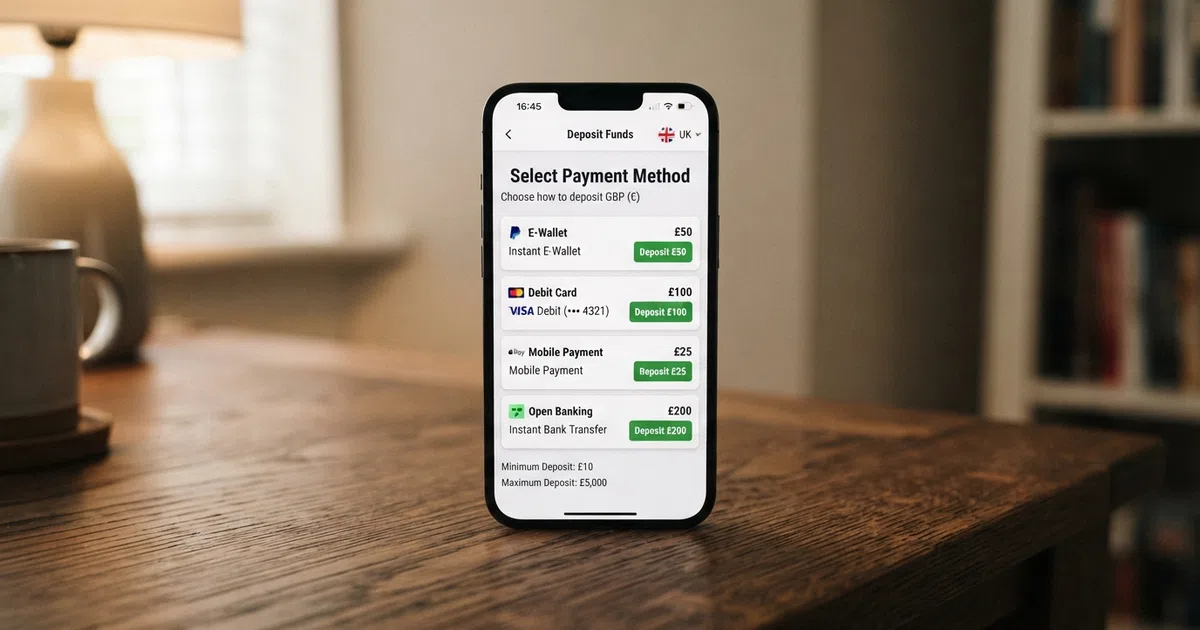
The UK market in 2026 runs on a tighter set of rails than it did five years ago. Debit cards remain universal. PayPal, Skrill and Neteller still process withdrawals in hours rather than days. Apple Pay and Google Pay have become near-default on mobile. Open banking through TrueLayer, Trustly and Volt has turned the slowest payment category into one of the fastest. Pay-by-mobile survives, but as a small-stakes convenience rather than a primary deposit method. And at least one major operator has actively retreated from e-wallets entirely, reshaping which casino accepts what.
This page ranks the ten UKGC-licensed casinos that offer the broadest, fastest and most bonus-friendly cashiers, breaks down every payment rail from PayPal to Boku, and explains the regulatory architecture — the credit card ban, the £150 financial vulnerability check, the GAMSTOP self-exclusion register — that determines what a UK player can actually do with their money at an online casino.
*Current as of 17 August 2026 — verified against the UK Gambling Commission’s public register.*
Payment Methods at UK Online Casinos: What Is Actually Available in 2026
The UK casino payment market in 2026 sits on five broad rails: debit cards, e-wallets, bank transfer (now including open banking), pay-by-mobile, and prepaid vouchers. Each rail carries different speed, different friction, and — the bit most pages skip — different treatment at the welcome-offer stage. Choosing the wrong rail for what you actually want is a common mistake a UK player makes at the cashier.
Debit cards are the default. Every UKGC-licensed casino accepts them, they are always bonus-eligible, and Visa Direct is cutting withdrawal times to under an hour at supported banks. E-wallets — PayPal, Skrill, Neteller, and a smaller tier of MuchBetter, MiFinity, ecoPayz and AstroPay — process withdrawals in one to three hours for verified accounts, but several major operators now exclude them from welcome-offer qualification. Open banking has converted the slowest payment category, traditional bank transfer, into a same-day or instant settlement through TrueLayer and Trustly. Pay-by-mobile is deposit-only with statutory caps of £40 per transaction and £240 per calendar month. Paysafecard lets you fund a casino without sharing bank details, but winnings must be withdrawn elsewhere.
The withdrawal tier is where the differences become sharp. PayPal, Skrill and Neteller clear in one to three hours. Trustly and instant bank transfers settle the same day. Standard debit card withdrawals take one to three business days, and Visa Direct cuts that to thirty to sixty minutes at banks that support it. Traditional bank transfers remain the slowest option at three to seven business days. The house has an edge on every spin, and a multiday wait for your winnings is not, on its own, a complaint — but it sits oddly beside an e-wallet that takes ninety minutes. The mechanism is the same money, the same casino, the same regulator. The rail is what changes.
The Most Popular Payment Methods at UK Casinos Right Now
Debit cards remain the dominant deposit method at every UK-licensed casino, accepted at every one of the ten operators reviewed on this page. PayPal runs a close second in operator coverage, present at eight of the ten featured brands. Apple Pay and Google Pay have quietly become the default mobile deposit, with nine of the ten featured operators carrying at least one of them and the only holdout being 888casino. The fastest-growing category, though, is open banking.
Pay by Bank — open banking rails delivered by TrueLayer, Trustly and Volt — has transformed bank transfers from the slowest kind of withdrawal into one that can reach a user’s account within the same day. Bet365 partnered with TrueLayer Pay by Bank to deliver instant deposits and withdrawals across its UK operations. Paddy Power carries Trustly, LeoVegas carries Open Banking via TrueLayer, and Betfred retained its Open Banking TrueLayer integration when it dropped every e-wallet from its cashier in January 2026. The shift is regulatory as much as commercial: open banking deposits and withdrawals cut operator payment processing costs and side-step the chargeback risk that debit cards carry.
PayPal’s continued dominance among e-wallets is partly trust and partly familiarity. UK players recognise the brand, recognise the buyer-protection framework, and recognise the speed. The other gaming-flavoured e-wallets — Skrill and Neteller — are still accepted at most operators but have lost ground since 2020, both to PayPal at the consumer end and to open banking at the speed-sensitive end.
How to Choose the Best Casino Payment Method for You
The right method depends on what you actually want from it. Four priorities cover most of the choices a UK player faces at the cashier.
If speed is the priority, the choice is an e-wallet or Visa Direct. PayPal, Skrill and Neteller withdrawals process in one to three hours at top operators. Visa Direct processes debit-card withdrawals in 30–60 minutes at participating banks — and that is on top of the universal acceptance of Visa debit itself. The slower options, ranked from slowest upwards, are standard debit cards at one to three business days, then traditional bank transfer at three to seven days.
If security is the priority, the choice is an e-wallet. E-wallets remain the deposit method with the fewest checks, the fastest withdrawals, and the least friction at checkout. The reason is structural: when you deposit with PayPal or Skrill, the casino never sees your bank account number or sort code. It sees the e-wallet provider’s confirmation token. Your actual financial details sit one layer further back, behind the e-wallet’s own login and security.
If bonus eligibility is the priority, the choice is a debit card. Welcome offers at Paddy Power, Betfred and Bet365 each carry fine print that disqualifies specific deposit methods. Paddy Power restricts eligibility to debit card or Apple Pay. Betfred restricts to debit card, Apple Pay or Open Banking. Bet365 excludes Paysafecard from its casino welcome offer. The safe move is the debit card, which is bonus-eligible at every featured operator without exception.
If spending control is the priority, the choice is a prepaid voucher or pay-by-mobile. Paysafecard’s 16-digit PIN caps a deposit at the voucher value. Pay-by-mobile is statutorily capped at £40 per transaction and £240 per calendar month. Neither method lets a player overspend in the way a debit card linked to a current account can. Both are deposit-only — winnings must go to a bank account or another method — which is itself a form of friction that helps control.
The hidden factor most players miss is that the deposit method chosen at sign-up determines whether the welcome offer is actually unlocked. Several major operators do not advertise this restriction, and a player who funds their account with PayPal to claim a free-spins package and finds the spins never land has only the fine print to blame. The smartest approach is to register with a debit card for the welcome offer and add an e-wallet later, using the casino’s cashier to manage both.
E-Wallets: Still the Fastest Way to Move Casino Money
E-wallets dominate UK casino payments for the same reason they dominate any other time-sensitive digital purchase: the rail is shorter. A debit-card withdrawal has to traverse the card network, the issuing bank and the player’s current account. An e-wallet withdrawal terminates inside the e-wallet provider’s own ledger, which is why the casino can release funds in hours rather than days. The trade-off — bonus eligibility, narrower operator coverage, a second account to fund — has narrowed as the e-wallet market has matured, but it has not disappeared.

The e-wallet market at UK casinos splits into three tiers. The top tier is PayPal, the most widely accepted digital wallet in the UK and the one most players default to when an e-wallet is offered. The middle tier is Skrill and Neteller, the veteran gaming e-wallets that have been at this since the early 2000s and remain accepted at most major operators, including Paddy Power and BoyleSports. The lower tier is a set of smaller wallets — MuchBetter, MiFinity, ecoPayz, AstroPay — that fill specific gaps but are not widely carried by the major UK-licensed brands.
What changed in early 2026 is the trend. Betfred removed PayPal and other e-wallets from its UK cashier in January 2026, leaving debit cards, Apple Pay, Open Banking (TrueLayer) and bank transfer. That is one major operator openly retreating from the e-wallet category, citing the combination of bonus-restriction complexity and processing cost. Whether other operators follow is the open question, but the direction is set.
PayPal at UK Casinos: Still the Gold Standard
PayPal is the e-wallet most UK players reach for first, and the one the most UK casinos carry. Eight of the ten featured operators on this page accept PayPal for deposits and withdrawals. The two holdouts are Virgin Games, whose four-rail cashier carries no e-wallet at all, and Betfred, which removed PayPal in January 2026. Every other featured brand — Bet365, BetMGM, Sky Vegas, LeoVegas, Paddy Power, PlayOJO, BoyleSports and 888casino — supports PayPal across deposit and withdrawal.
The withdrawal speed is the headline number. PayPal withdrawals at top UK operators typically process within one to three hours for verified accounts, against one to three business days for a standard debit card. A player who wins on a Monday evening and withdraws via PayPal will usually have the funds in their PayPal balance by Tuesday morning. A player who withdraws the same amount to a Visa debit will likely be waiting until Wednesday or Thursday.
The security layer is the underappreciated benefit. When a player deposits via PayPal, the casino never sees the player’s bank account number or sort code. It sees a PayPal token and a confirmation. If the casino’s payment system is breached, the data exposed is the PayPal token, not the underlying bank details. PayPal also adds a layer of buyer-protection dispute resolution that a debit card does not, although the scope of that protection for gambling transactions is narrower than for retail purchases.
The cost is the bonus restriction. Several operators exclude PayPal deposits from welcome-offer qualification, in part because PayPal’s own chargeback infrastructure is incompatible with bonus terms. Paddy Power restricts welcome-offer eligibility to debit card or Apple Pay only — e-wallet and prepaid deposits are ineligible. For the best of both worlds, use a debit card to unlock your bonus, then switch to PayPal for your regular gaming transactions.
Skrill & Neteller: The Veteran Gaming E-Wallets
Skrill and Neteller were built for iGaming long before PayPal entered the market, and they remain the rail of choice for players who prioritise speed and lower fees over brand familiarity. Both are accepted at most major UK operators, and both deliver withdrawals in one to three hours for verified accounts. Paddy Power and BoyleSports both carry Skrill; Paddy Power also carries Neteller alongside its Skrill support.
The practical difference from PayPal is small at the deposit-and-withdraw stage. Both Skrill and Neteller offer comparable speed and a similar security model, and both keep the player’s bank details out of the casino’s hands. Skrill and Neteller’s lower profile in the UK is partly a function of marketing — PayPal is a household name, Skrill and Neteller are gaming-rail names — and partly a function of cost: Skrill and Neteller historically charged higher fees for currency conversion and withdrawal to a bank account than PayPal does, though the gap has narrowed.
The bigger story is the direction of travel. Betfred removed PayPal and other e-wallets from its UK cashier in January 2026, and the language in the announcement — processing cost, bonus complexity — applies equally to Skrill and Neteller. The two veteran wallets are not disappearing from UK casinos, but they are losing ground at the high end, and a player who uses them today is betting on operators continuing to carry them tomorrow.
The pay-by-mobile market intersects with Skrill and Neteller in a specific way: Boku, which used to offer direct phone-bill deposits at UK casinos, has retreated to indirect availability. Boku is no longer directly available at most UKGC-licensed casinos and can only be used indirectly by funding a Neteller account first, then depositing from Neteller to the casino. The pay-by-mobile rail is still alive — it has just been rerouted.
Trustly, Revolut & the New Wave of Digital Payments
Trustly sits at the boundary between e-wallet and open banking, and that boundary is part of why it has spread. Trustly-powered deposits and withdrawals authenticate through the player’s online banking app, using biometric checks rather than card numbers. The result is a deposit that takes seconds and a withdrawal that settles the same day — close to e-wallet speed, but without the e-wallet account to fund.
Trustly is carried by Bet365, Paddy Power, Sky Vegas and PlayOJO among the featured operators. It is the fastest open-banking rail at Paddy Power’s nine-method cashier, and the only open-banking option at Sky Vegas alongside debit cards, PayPal, Apple Pay and Google Pay. The TrueLayer-powered equivalent, branded as Open Banking or Pay by Bank, is the one Bet365, LeoVegas and Betfred carry. The two rails are functionally similar — biometric authentication through a mobile banking app, instant deposits, same-day withdrawals — but the underlying banking integrations differ.
Revolut is the other rising name in this space. Revolut operates under a UK banking licence and offers e-money features, which means a player can fund a casino directly from the Revolut app or from a Revolut-issued virtual debit card. Revolut is not widely listed as a named payment method at the featured operators, but Revolut-issued Visa debit cards are accepted wherever Visa debit is — which is to say, at every UKGC-licensed casino. The rail underneath is the same; the branding is Revolut’s.
These newer entrants do not replace the established e-wallet trio on speed. PayPal, Skrill and Neteller still clear withdrawals in one to three hours. What they replace is the friction — the requirement to fund a separate e-wallet account before the casino transaction can happen. A player who has their bank’s app open can complete an open banking deposit in two taps. That is the threshold the older e-wallets have to beat.
Apple Pay & Google Pay: Mobile Wallets at the Casino Cashier
Apple Pay and Google Pay are not standalone payment rails. They are mobile-wallet interfaces on top of a debit card. When a player deposits via Apple Pay, the casino receives a card-network token tied to a Visa or Mastercard debit card; the player’s actual card number is not exposed. The deposit is instant, the authentication is biometric, and the operator coverage is broad.
Nine of the ten featured operators carry at least one of Apple Pay or Google Pay. The only full holdout is 888casino, which lists neither. Virgin Games accepts both. Bet365, BetMGM, Paddy Power, Betfred and BoyleSports all accept Apple Pay. Bet365, Paddy Power, Sky Vegas, BoyleSports and Virgin Games accept Google Pay. The split is partly a function of platform prioritisation — Google Pay support requires Android-side integration that some operators have rolled out later — and partly a function of which mobile checkout flow an operator has built.
The withdrawal question is where the limit appears. Apple Pay and Google Pay deposits are near-universal, but withdrawals to either are not. Funds typically route to the linked debit card rather than back to the mobile wallet. A player who deposits with Apple Pay at Bet365 and wins will receive the withdrawal on the Visa or Mastercard debit card registered in their Apple Pay wallet, not in the Apple Pay balance itself. The same is true at every other featured operator that supports Apple Pay withdrawals.
The practical implication: a player who wants the speed of an e-wallet and the convenience of a mobile wallet should treat Apple Pay and Google Pay as deposit-only and route withdrawals to a debit card or an e-wallet where available.
Paysafecard: Prepaid Vouchers Without a Bank Account
Paysafecard is a 16-digit prepaid voucher that a player buys at a retail location — a newsagent, a petrol station, a convenience store — or online. The voucher is entered at the casino cashier, the deposit is credited, and the bank account behind the deposit is never disclosed to the casino. That is the appeal. A player who does not want their bank details on a gambling site can fund one without sharing either.
The limits are tight. A single Paysafecard voucher caps at £100, and the casino’s deposit ceiling is whatever Paysafecard’s per-transaction limit allows. The credit card ban is also relevant here: Paysafecard cannot be bought with a credit card for gambling, because that would route a credit card deposit into a casino through a prepaid voucher, which is exactly what LCCP 6.1.2 prohibits.
The deposit is the easy part. The withdrawal is the catch. Paysafecard is deposit-only — winnings cannot be returned to a voucher that has already been spent. Most UK casinos require Paysafecard depositors to withdraw to a bank account or debit card, and at least one major operator — Bet365 — excludes Paysafecard deposits from the casino welcome offer entirely. The combination of a spend-control mechanism and a bonus disqualification makes Paysafecard a niche choice rather than a default.
The operator coverage is reasonable. Bet365 and Paddy Power both accept Paysafecard. Paddy Power’s nine-method cashier lists Paysafecard alongside debit cards, four e-wallets, Apple Pay, Trustly and bank transfer. Bet365 carries it as one of eight methods. The voucher is more useful as a spending-cap tool for an existing player than as a primary deposit rail for a new one.
Smaller E-Wallets Worth Knowing: MuchBetter, MiFinity, ecoPayz & AstroPay
The smaller e-wallets fill gaps rather than compete on breadth. MuchBetter is a mobile-first e-wallet with growing UK casino acceptance, pitched at players who want a low-fee account optimised for phone-based transactions. MiFinity and ecoPayz are established but narrower than Skrill or Neteller, carried by some international-facing operators but not widely available at the ten featured brands. AstroPay is a prepaid virtual card popular with international players and Latin American markets, and its UK casino presence is limited.
The honest position is that none of these wallets appears in the cashier of any of the ten featured UKGC-licensed operators reviewed on this page. A player who wants an e-wallet at a major UK casino is choosing between PayPal, Skrill and Neteller; the rest are not on the menu at the brands that matter. The trade-off in using a smaller wallet is the operator coverage, and on this measure the small wallets lose.
A player who already has a MuchBetter or MiFinity account from a non-UK gambling site may find a handful of mid-tier UK-licensed casinos that accept it, but the value of the wallet at a UK brand specifically is the ability to deposit and withdraw at the operator where the welcome offer sits — and the welcome offers live at the bigger brands.
Debit Cards & Bank Transfers: From the Slowest Rail to the Fastest Payout
Debit cards are the rail that does not need marketing. Visa and Mastercard debit are accepted at every UKGC-licensed casino without exception, are always bonus-eligible, and now offer a fast-withdrawal path through Visa Direct that competes with e-wallets on its own terms. Bank transfers used to be the slowest rail in the casino cashier; open banking has reversed that ranking in three years.
The credit card ban is the obvious starting point. From 14 April 2020, no credit card deposit is permitted at any UK-licensed remote gambling site, including credit-card-funded e-wallet payments. The reason was a 2020 UKGC finding that 22% of online gamblers who used credit cards were classed as problem gamblers. The ban removed the only credit-based deposit mechanism from the UK market and forced every casino to rebuild its payment funnel around debit cards, e-wallets and bank-based rails.
Open banking is the countervailing change. TrueLayer, Trustly and Volt built payment rails that authenticate through a player’s mobile banking app using biometrics, deposit funds instantly via Faster Payments, and withdraw funds the same day. Bank transfers have moved from three to seven business days at the slow end to same-day or instant at the open-banking end. Bet365 uses TrueLayer Pay by Bank for instant deposits and withdrawals; Paddy Power carries Trustly; LeoVegas, Betfred and PlayOJO all carry an open-banking option.
The practical effect is that the slowest rail is no longer bank transfer — it is standard bank transfer, which still exists as a legacy fallback for players who cannot or will not use open banking. The fastest rail is no longer unambiguously the e-wallet — it is a tie between PayPal at one to three hours, open banking at same day, and Visa Direct debit at thirty to sixty minutes at supported banks.
Visa & Mastercard Debit: The Universal Default
Visa and Mastercard debit are the one payment method accepted at every featured operator without exception. Bet365, BetMGM, Sky Vegas, LeoVegas, Paddy Power, PlayOJO, BoyleSports, 888casino, Betfred and Virgin Games all carry both. There is no holdout, no operator that processes only one network, no restriction on bonus eligibility. A debit card deposit is the universally accepted default at a UK-licensed casino.
The withdrawal speed is the part that has changed. Standard Visa debit withdrawals take two to five business days, and standard Mastercard debit withdrawals take one to three business days — a gap that exists because of differences in the card networks’ settlement infrastructure. Visa Direct / Fast Funds is the upgrade: withdrawals in thirty to sixty minutes at supported banks. Virgin Games facilitates Visa Direct withdrawals in just half an hour to an hour at participating banks, and up to three working days for standard debit card.
The bank-side requirement is the constraint. Not every UK bank supports Visa Direct, and not every bank that does support it has signed up to deliver the Fast Funds experience to its customers. A player who banks at HSBC, Lloyds, NatWest or Santander is likely to see the fast path. A player at a smaller building society or a digital-only bank may fall back to the standard two-to-five-day window. The speed is real; the coverage is uneven.
The bonus advantage is the underappreciated point. Debit card deposits are bonus-eligible at every featured operator. Paddy Power’s restriction to debit card or Apple Pay, Betfred’s restriction to debit card, Apple Pay or Open Banking, and Bet365’s exclusion of Paysafecard from the welcome offer all leave the debit card as the safe option. Many experienced players opt for a debit card to secure their welcome offer, only adding a faster withdrawal method once the account is active.
Bank Transfer & Open Banking: Reinvented for Speed
Traditional bank transfer is the slowest withdrawal method at any UK casino: three to seven business days, sometimes longer at the weekend. The reason is the rail itself: BACS is batch-processed, the player’s bank may run anti-fraud screening, and the casino’s payment provider has to settle the funds back through the originating bank. The same mechanic that makes a bank transfer cheap and universal also makes it slow.
Open banking has changed that. Trustly, TrueLayer and Volt all offer instant bank transfer deposits with biometric authentication through the player’s mobile banking app. The deposit is faster than a card deposit, because there is no card network in the middle — the player’s bank pushes funds to the casino’s account via Faster Payments, and the casino credits the balance in seconds. Withdrawals work in reverse, with the casino pushing funds back to the player’s bank the same day.
The coverage is broad but uneven. Bet365 has partnered with TrueLayer Pay by Bank for instant deposits and withdrawals across UK operations. Paddy Power carries Trustly alongside eight other methods. Sky Vegas carries Trustly as its only open-banking rail. LeoVegas, Betfred and PlayOJO all carry an open-banking option. Virgin Games does not. 888casino does not. The list of operators without open banking is shorter than the list with it, but not by a large margin.
Betfred’s January 2026 e-wallet removal makes the open-banking play more pointed. After removing PayPal, Skrill, Neteller and Paysafecard from its UK cashier, Betfred retained Open Banking (TrueLayer) as one of just four methods. The implication is that Betfred sees open banking as a direct substitute for e-wallets on speed, and is willing to bet its cashier on that view. Whether other operators follow is the test of the next twelve months.
Debit Card vs Bank Transfer: Speed, Limits & When to Use Each
The speed comparison is sharper than the category names suggest. A standard Visa debit withdrawal takes two to five business days. A standard bank transfer takes three to seven business days. A Visa Direct withdrawal takes thirty to sixty minutes at supported banks. An open banking withdrawal settles the same day. The two rails are not in the same speed tier once the open-banking option is in play.
The choice depends on what the player actually wants. A debit card is the right answer for universality, bonus eligibility and the option of a fast withdrawal through Visa Direct. An open-banking rail is the right answer for the fastest possible bank-to-casino transfer, with the trade-off that the player has to authenticate through their banking app each time. A standard bank transfer is the right answer for a player who cannot or will not use either of the above — and accepts the wait.
The limits are inherited from the underlying rail. A debit card follows the player’s bank daily transaction cap, typically £1,000 to £5,000 for contactless and online. Open banking follows the player’s Faster Payments limit, which is usually £20,000 per transaction at UK banks. The deposit ceiling is therefore higher on open banking, which is part of why higher-stakes players gravitate to it. The withdrawal ceiling is also higher — a casino cannot hold back a Faster Payments transfer the way it can hold back a card settlement.
The simplest rule is to use a debit card for the welcome-offer deposit and the everyday play, and keep an open-banking rail as the withdrawal method for any larger balance. The operator’s cashier supports both, and the welcome offer terms will not object to the debit card deposit.
Pay by Mobile: Convenience That Comes with Hard Limits
Pay-by-mobile is the easiest way to fund a casino account in the UK: a few taps, a phone-bill charge, and the balance is credited. It is also the most tightly capped payment method in the market. The Payment Services Regulations 2017, Schedule 1, Part 2(l), cap each pay-by-mobile payment at £40 per single transaction and £240 per calendar month per subscriber. Those caps are statutory, not operator-set, and no UKGC-licensed casino can override them.
The current state of pay-by-mobile is one of retreat. Boku, which was the leading direct carrier-billing option at UK casinos through the 2010s, is no longer directly available at most UKGC-licensed casinos. It can still be used indirectly by funding a Neteller account first, then depositing from Neteller to the casino. Fonix remains the leading direct pay-by-mobile provider, with carrier billing from EE, Vodafone, O2 and Three supporting the integration. Payforit, an earlier carrier-billing framework, was retired in 2019. The market has consolidated around Fonix, with Boku relegated to an e-wallet intermediary role.
The combination of statutory caps, restricted operator coverage and the deposit-only limitation makes pay-by-mobile a small-stakes convenience rather than a primary deposit method. A player who wants to deposit £500 to chase a welcome offer cannot do it via pay-by-mobile — the £40 transaction cap and the £240 monthly cap stop that in its tracks. A player who wants to deposit £10 for a casual spin session can do it in seconds, with the deposit added to their monthly phone bill or deducted from their pay-as-you-go credit. The fit depends on the stake size.
How Pay-by-Mobile Casino Deposits Work
A pay-by-mobile casino deposit charges the deposit to the player’s mobile phone bill or deducts it from prepaid credit. The mechanism is a partnership between the casino and a payment intermediary — historically Boku, now primarily Fonix — which adds the deposit to the monthly phone bill on the carrier’s side, or deducts it from prepaid credit, and confirms the transaction to the casino. The player’s carrier does not see the casino’s name; the payment is shown as a generic mobile services charge on the bill.
Two confirmatory paths exist. The older path is an SMS confirmation: the player receives a text from the payment intermediary with a one-time code, enters the code at the cashier, and the deposit is authorised. The newer path, offered by Fonix, is a seamless in-app confirmation through the carrier’s billing system, with no SMS step. The seamless path is what most operators now offer, because the SMS path carries higher drop-off and friction.
The critical limitation is direction. Pay-by-mobile is deposit-only — winnings must be withdrawn to a bank account or a debit card, never back to the phone bill. A player who deposits £10 via Fonix and wins £80 will receive the £80 on a Visa debit card or via bank transfer, not as a credit on their phone bill. The same restriction applies to Boku’s residual indirect availability via Neteller: the casino leg is the only gambling-flavoured one, and the winnings still leave via a banking rail.
The carrier networks involved are the four UK mobile operators — EE, Vodafone, O2 and Three — all of which support pay-by-mobile billing through Fonix at most UKGC-licensed casinos. Smaller mobile virtual network operators may or may not support the rail, depending on their billing agreement with the host network.
Boku, Fonix & SMS Payments: What Is Actually Available in 2026
Boku’s direct availability at UK casinos has all but ended. Boku is no longer directly available at most UKGC-licensed online casinos, and where it does appear, the integration is through an e-wallet intermediary like Neteller rather than a direct casino-to-carrier pipe. A player who wants to use Boku today funds a Neteller account from their phone bill via Boku, then deposits from Neteller to the casino. The phone-bill part is intact; the casino leg is just a normal e-wallet deposit.
Fonix is the primary direct pay-by-mobile provider at UK-licensed casinos in 2026. Fonix offers the smoothest pay-by-mobile experience currently available, with no SMS confirmation required — the deposit is authenticated through the carrier’s billing system in a single tap. The four major UK mobile networks — EE, Vodafone, O2 and Three — all support Fonix-powered pay-by-mobile deposits, and the statutory caps of £40 per transaction and £240 per calendar month apply across the board.
SMS-based casino deposits were the older version of the same mechanism, requiring the player to receive a confirmation text and enter a one-time code. The SMS path is largely retired at major UKGC-licensed casinos, replaced by Fonix’s seamless integration, but it still appears at some international-facing operators that have not migrated. For a UK player, the SMS path is not the relevant option — Fonix is.
The reason Boku retreated is not openly stated, but the timing is suggestive. Boku’s UK direct integrations contracted in the same period that the pay-by-mobile statutory limits were clarified and operators migrated to Fonix for a cleaner in-app experience. The Boku-Neteller path is the residue, and it works, but it is two transactions where Fonix is one.
The £40 and £240 Caps: What Pay-by-Mobile Limits Mean in Practice
The Payment Services Regulations 2017 caps are not negotiable. The £40 maximum per single transaction and the £240 maximum per calendar month per subscriber are statutory limits under PSR 2017, Schedule 1, Part 2(l), and they apply at every UKGC-licensed casino that offers pay-by-mobile. A player who tries to deposit £50 via Fonix is declined at the cashier. A player who has already deposited £240 in the calendar month is declined on the next attempt, regardless of which casino they are at — the cap is per subscriber across the rail, not per casino.
The interaction with the online slots stake limits is the underappreciated constraint. Online slots carry a statutory maximum stake per game cycle: £5 for players aged 25 and over, in force from 9 April 2025, and £2 for players aged 18 to 24, in force from 21 May 2025, imposed by SI 2025/215. A single spin at the maximum stake is one-eighth of the per-transaction pay-by-mobile cap for over-25s, and one-twentieth of it for 18-to-24-year-olds. The per-transaction cap is therefore not the binding limit on a single spin — the stake cap is. The binding limit is the monthly cap, which would fund 48 spins at the £5 stake or 120 spins at the £2 stake.
What happens at the monthly cap is the practical question. The deposit is declined at the casino cashier, with a message indicating the pay-by-mobile limit has been reached. The player is not blocked from the casino, only from that rail for the rest of the calendar month. To continue playing, the player must use another method — a debit card, an e-wallet, or whatever else the cashier offers. The friction is the cap doing its job, and the £240 ceiling is what makes pay-by-mobile a small-stakes convenience rather than a primary deposit method.
Speed, Security & Withdrawals: What Each Deposit Rail Delivers in Practice
The single biggest speed gap in UK casino payments is not between casinos — it is between methods. A player at Bet365 who withdraws to PayPal gets funds in one to three hours. The same player withdrawing to a standard Visa debit waits two to five business days. The casino is the same, the regulator is the same, the player’s identity is verified either way. The rail is what changes, and the rail is what determines when the money lands.
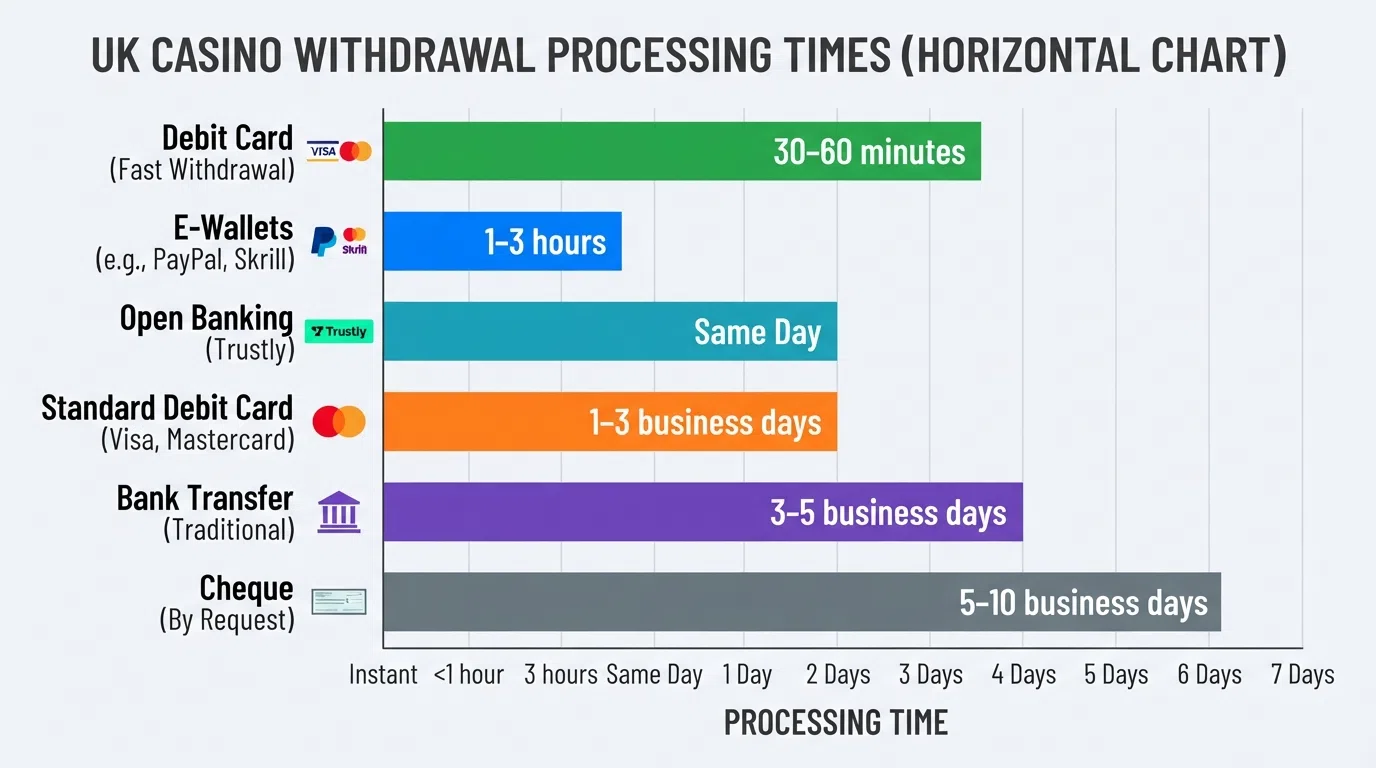
The deposit side is more uniform. Nearly every method — debit cards, e-wallets, Apple Pay, Google Pay, pay-by-mobile, Paysafecard, open banking — credits the casino balance within seconds of authorisation. The only deposit method with a meaningful delay is traditional bank transfer, which settles in one to three business days if the casino is not using an open-banking integration. For most players, deposits are instant; the variable is withdrawals.
Security is the second differentiator, and the gap is smaller than the marketing suggests. Every UKGC-licensed casino uses SSL encryption and PCI-DSS-compliant payment processing, regardless of method. The safety difference is in what data is exposed, not in the underlying transaction. An e-wallet deposit exposes an e-wallet token; a debit card deposit exposes a card number; an open-banking deposit exposes a bank account token. All three are reversible through the consumer’s bank or e-wallet provider, and all three are protected by the UK’s payment-fraud framework.
| Payment Method | Deposit Speed | Withdrawal Speed | Key Limitation or Restriction |
|---|---|---|---|
| Visa Direct debit | Instant | 30–60 minutes (at supported banks) | Bank-side support required for Fast Funds |
| PayPal, Skrill, Neteller | Instant | 1–3 hours | Excluded from welcome offers at several operators |
| Trustly / TrueLayer / open banking | Instant | Same day | Requires biometric authentication in banking app |
| Standard Visa / Mastercard debit | Instant | 1–3 business days | Slower than e-wallet or open banking |
| Apple Pay / Google Pay | Instant | Routes to linked debit card (1–3 business days) | Withdrawal to mobile wallet not supported |
| Paysafecard | Instant (PIN entry) | Not supported (deposit only) | Excluded from welcome offer at Bet365 |
| Pay-by-mobile (Fonix / Boku) | Instant | Not supported (deposit only) | £40 per transaction, £240 per month cap (PSR 2017) |
| Bank transfer (standard) | 1–3 business days | 3–7 business days | Slowest withdrawal rail; open banking is faster alternative |
Deposit Speed: Which Methods Credit Your Account Instantly
Every method other than standard bank transfer credits the casino balance instantly. Debit cards clear in one to two seconds. E-wallets confirm the deposit in under a second. Apple Pay and Google Pay use the underlying card network, so the deposit is instant on top of the card. Pay-by-mobile credits the balance once the carrier-billing confirmation comes through, which is also instant under Fonix’s seamless path. Paysafecard credits once the 16-digit PIN is validated. Open banking deposits via TrueLayer, Trustly or Volt credit instantly on biometric confirmation in the banking app.
The only method with a meaningful deposit delay is standard bank transfer. A bank transfer that does not go through an open-banking integration settles through BACS, which is batch-processed and can take one to three business days. The casino does not credit the balance until the funds land in the casino’s payment provider’s account, which is why bank-transfer deposits sometimes appear “pending” in the cashier for a day or two.
The practical effect is that deposit speed is rarely a constraint for the player. A deposit that does not credit instantly is a deposit the casino has flagged for manual review, which is unusual outside of large first-time deposits or source-of-funds checks. For the routine case, the deposit is instant, and the player can begin playing within seconds of confirmation.
Withdrawal Times by Method: From 30 Minutes to 7 Days
The withdrawal speed hierarchy, from fastest to slowest: Visa Direct at thirty to sixty minutes at supported banks; PayPal, Skrill and Neteller at one to three hours for verified accounts; Trustly and instant bank transfer settling the same day; standard debit card at one to three business days; standard bank transfer at three to seven business days. The gap between the fastest and the slowest is roughly five orders of magnitude, and the difference between a 90-minute e-wallet payout and a four-day debit-card payout is the single largest cost a player pays for not picking the right rail.
The reason e-wallet withdrawals are faster is structural. When a casino releases a withdrawal to PayPal, it sends funds to the e-wallet provider’s own account, which credits the player’s e-wallet balance without traversing the card networks. The funds have arrived in the player’s PayPal account, even if the player has not yet moved them to a bank account. When a casino releases a withdrawal to a debit card, the funds travel through the card network, the issuing bank and the player’s current account, with anti-fraud screening and settlement windows at each step. The casino’s release of the funds is the same trigger in both cases; the rail is what changes.
The Visa Direct exception is the one that complicates the ranking. At supported banks, a Visa Direct withdrawal takes thirty to sixty minutes — comparable to or faster than an e-wallet. The constraint is bank support. A player at a major high-street bank is likely to see the fast path; a player at a smaller or digital-only bank may fall back to the standard two-to-five-day window. The audit point is the player’s own bank, not the casino.
The Safest Casino Payment Methods in the UK
Every payment at a UKGC-licensed casino is encrypted, and the safety difference between methods is in what data is exposed, not in the underlying transaction. SSL encryption and PCI-DSS compliance are the baseline at every licensed operator, and the payment processors that connect the casino to the bank networks are themselves regulated by the FCA. The transaction is as safe as UK payments infrastructure allows.
What varies is what the casino sees. An e-wallet deposit exposes an e-wallet token — the casino sees that the deposit came from a verified PayPal account, but the player’s bank details are not shared. A debit card deposit exposes a card number, which the casino tokenises for future transactions but which represents a more direct claim on the player’s current account. An open-banking deposit exposes a bank account token, similar to the e-wallet model but with the bank itself as the authenticator.
The privacy argument cuts in favour of e-wallets. A player who deposits with PayPal is sharing their card or bank details with PayPal, but not with the casino. If the casino is breached, the data exposed is the PayPal token, not the underlying financial details. E-wallets remain the deposit method with the fewest checks, the fastest withdrawals, and the least friction at checkout — and the privacy model is part of why.
The reason crypto deposits are not permitted at UKGC-licensed casinos is the inverse of the e-wallet argument. Crypto transactions are pseudonymous, not anonymous, and the on-chain record is public. Operators that accept crypto would have to run additional AML and identity-verification checks to satisfy UKGC standards, and most have chosen to exclude the rail entirely rather than build the compliance stack. UK players still trust e-wallets more than crypto for deposits, and the regulatory framework reflects that.
How Online Casino Payments Actually Work: KYC, Processing & Payouts
Every UK casino payment passes through three stages, and understanding them removes most of the surprise. The first is identity verification, known in the industry as KYC. Since 7 May 2019, every UKGC-licensed remote operator must verify a player’s name, address and date of birth before any deposit or gambling. The casino asks for a passport or driving licence, a recent utility bill or bank statement, and sometimes a selfie for liveness. The verification usually completes within a few hours, sometimes within minutes if the casino uses an automated provider.
The second stage is the pending period. When a player requests a withdrawal, the casino holds the funds for twenty-four to seventy-two hours before releasing them. The pending period is a consumer-protection and AML requirement, not a delaying tactic — it gives the casino time to run anti-fraud checks, confirm the withdrawal is not a stolen-card reversal, and ensure the player has not self-excluded or otherwise changed status since the request. Reverse withdrawals were permanently banned on 31 October 2021, so the player cannot cancel the withdrawal during the pending period to keep playing.
The third stage is processing and payout. After the pending period, the casino releases the funds to the payment rail. E-wallet and open-banking rails settle in hours; debit cards in one to three business days; standard bank transfer in three to seven. Closed-loop withdrawals are the rule at most UK casinos: the player must withdraw to the same method they deposited with, where possible. A Paysafecard deposit cannot be returned to a spent voucher; a pay-by-mobile deposit cannot be returned to a phone bill. The withdrawal goes to a bank account or debit card instead.
The £150 net-deposit financial vulnerability check is an additional layer that runs in the background. Once a player has deposited a net of £150 over a rolling 30-day period, the casino must run a light-touch check on publicly available data — bankruptcy registers, County Court Judgments, Individual Voluntary Arrangements, Debt Relief Orders. A flag is not a ban; it is a prompt for further information. The point of the check is to surface a financial situation the casino should know about, not to police every deposit.
The 10 Best UK Casinos Ranked by Payment-Method Coverage
Ten UKGC-licensed operators are reviewed below, ranked by the breadth and speed of their cashier rather than by game selection, user experience or customer support. The criteria: payment-method count, withdrawal speed, open-banking support, and bonus-method eligibility. The split between operators with broad multi-method cashiers and those betting on a lean, fast set is the story the table tells.
| Operator | Payment Methods (count) | PayPal | Apple Pay / Google Pay | Open Banking / Pay by Bank |
|---|---|---|---|---|
| Paddy Power | 9 | Yes | Apple Pay | Trustly |
| Bet365 | 8 | Yes | Both | TrueLayer |
| PlayOJO | 6 | Yes | Apple Pay | Trustly, Instant Bank |
| BoyleSports | 6 | Yes | Both | — |
| Sky Vegas | 5 | Yes | Both | Trustly |
| BetMGM UK | 4 | Yes | Apple Pay | — |
| LeoVegas | 4 | Yes | Apple Pay | TrueLayer |
| 888casino | 4 | Yes | — | — |
| Betfred | 4 | Removed Jan 2026 | Apple Pay | TrueLayer |
| Virgin Games | 4 (Visa Debit, Mastercard Debit, Apple Pay, Google Pay) | No | Both | — |
Bet365: The Most Complete Payment-Method Cashier Among Featured UK Casinos
Bet365 carries eight payment methods, the joint-highest count among the featured operators and the broadest in absolute terms. The list spans Visa and Mastercard debit, Apple Pay, Google Pay, Trustly, Paysafecard, PayPal, bank transfer and TrueLayer Pay by Bank. Every method category on this page is represented except the smaller e-wallets, and the open-banking coverage is delivered through a TrueLayer partnership that handles instant deposits and withdrawals across UK operations.
The withdrawal speed is the strongest in the featured set. Visa Direct delivers debit-card withdrawals in one to four hours at supported banks. PayPal clears in one to three hours. Trustly and TrueLayer settle the same day. The only slow path is standard bank transfer, which is included for legacy users but is not the rail most players use.
The welcome offer is up to 500 Free Spins across ten slot selections of five to fifty spins each, with no wagering requirements on winnings, a £5 minimum deposit, and 30-day validity. The eligible slots include Book of Horus, Curse of the Bayou, Magic Forge and Wrath of the Deep, with providers NetEnt, Playtech, Microgaming, Pragmatic Play and Evolution. Paysafecard deposits are excluded from the casino welcome offer — a Bet365-specific restriction that catches players who would otherwise reach for the prepaid rail.
Bet365 is the operator to pick when payment breadth is the priority. Eight methods cover every rail this page discusses, the open-banking integration is the deepest of any featured brand, and the welcome offer is among the more generous in spin count. The Paysafecard bonus restriction is the only friction, and the workaround — a debit card for the qualifying deposit — is a one-line change at the cashier.
BetMGM UK: Solid Core, Fewer Payment Options
BetMGM UK runs a four-method cashier: Visa and Mastercard debit, PayPal, Apple Pay and bank transfer. The list omits Google Pay, open banking and the smaller e-wallets, and the breadth is correspondingly narrower than Bet365’s eight or Paddy Power’s nine. The withdrawal speed across the four methods is competitive — PayPal at one to three hours, debit cards at one to three business days — but the open-banking option that competitors are adding is not here.
The welcome offer is 200 Free Spins on Big Bass Splash, with zero wagering, a £10 minimum deposit, 10p per spin, and 7-day bonus validity. The bonus requires the £10 deposit plus a 1x wager to trigger, after which the spins are credited. Providers include Evolution, Pragmatic Play, IGT, NetEnt and Microgaming. The single-game focus on Big Bass Splash is narrower than Bet365’s ten-slot selection but is consistent with most UK welcome offers in 2026.
BetMGM UK suits players who prioritise the brand and can operate comfortably without open banking. The four-method cashier covers the essentials, the PayPal path delivers fast withdrawals, and the welcome offer is competitive on spin count. If you require open banking or a prepaid voucher, you might prefer a cashier with more diverse rail support.
Sky Vegas: No-Deposit Free Spins and a Mid-Range Payment Line-Up
Sky Vegas carries five payment methods — Visa and Mastercard debit, PayPal, Trustly, Apple Pay and Google Pay — and offers the featured set’s only no-deposit welcome offer. The line-up is broader than BetMGM and narrower than Bet365, with the open-banking option delivered through Trustly rather than TrueLayer.
The welcome structure is two-tier. The first tier is 50 Free Spins credited on registration, with no deposit required. The second tier is 200 Free Spins on a £10 deposit and stake, again with zero wagering and 7-day validity. The deposit-free first tier is the differentiator — a player can try the casino and win real money before committing a penny. Providers are NetEnt, Pragmatic Play, Playtech and Evolution.
Sky Vegas is part of Flutter Entertainment, the same group that runs Paddy Power, and the payment-method overlap is high. A player who already has a Flutter account will see the same cashier DNA, and the welcome-offer terms are written in the same voice. The no-deposit tier is the bet Sky Vegas is making — give the player something to play with, and the deposit and stake follow.
LeoVegas: Open Banking Pioneer with a Lean Cashier
LeoVegas runs four payment methods — Visa and Mastercard debit, PayPal, Apple Pay, and Open Banking via TrueLayer — and was an early adopter of the TrueLayer rail in the UK. The cashier is lean rather than broad, and the speed across the available methods is the point. PayPal withdrawals clear in around two hours per independent review. Visa withdrawals clear in around six hours per independent review. The TrueLayer option settles the same day.
The welcome offer is 50 Free Spins on Big Bass Splash, with zero wagering, a £10 minimum deposit, £0.10 per spin and 7-day validity. Total spin value is £5, which is the smallest of the featured welcome offers but consistent with a single-game, single-deposit structure. Providers are Evolution, NetEnt, Pragmatic Play, Microgaming and Play’n GO.
LeoVegas focuses on speed over sheer method breadth, making it ideal for those who prioritise fast settlements. Four methods is fewer than most competitors carry, but every method is fast, and the TrueLayer integration is among the deepest. A player who needs Google Pay, Paysafecard or a Skrill-equivalent rail will need to look elsewhere.
Paddy Power: The Broadest Payment-Method Line-Up of Any Featured Casino
Paddy Power carries nine payment methods — the most of any featured operator and a wider cashier than even Bet365. The list: Visa and Mastercard debit, PayPal, Skrill, Neteller, Paysafecard, Apple Pay, Trustly, bank transfer and Rapid Transfer. Every major e-wallet is present, alongside the open-banking rail and the prepaid option.
The bonus restriction is the catch. Paddy Power restricts welcome-offer eligibility to debit card or Apple Pay deposits only; PayPal, Skrill, Neteller and Paysafecard deposits do not trigger the offer. A player who funds the account with PayPal to claim the welcome package will not see the spins credited, and the workaround is the same as elsewhere — a debit card or Apple Pay for the qualifying deposit, then add a faster rail for withdrawals.
The welcome offer is 50 Free Spins plus 10 Free Spins on Paddy’s Mansion Heist, on a £10 deposit and wager, with zero wagering on the 50-FS tier and 7-day validity. Providers are Playtech, NetEnt, Pragmatic Play and Evolution. Paddy Power is part of Flutter Entertainment, and the cashier is built on the same Flutter payment infrastructure that Sky Vegas uses.
Paddy Power stands out as the top choice for players who value pure cashier breadth. Nine methods cover every rail on this page, and the open-banking option is delivered through Trustly. The bonus restriction is the trade-off, and a player who wants both the welcome offer and the broadest cashier needs to manage which rail they use for which purpose.
PlayOJO: Six Payment Methods and No Max-Cashout on Wager-Free Spins
PlayOJO runs six payment methods — PayPal, Apple Pay, Visa, Trustly, Mastercard and Instant Bank — and offers the featured set’s only truly uncapped wager-free welcome bonus. The line-up is broader than BetMGM or LeoVegas, narrower than Paddy Power or Bet365, and includes the open-banking option via both Trustly and a separate Instant Bank rail.
The welcome offer is 50 Free Spins on Big Bass Bonanza, with zero wagering, a £10 minimum deposit, 10p per spin, and no max-cashout cap on winnings. The bonus is credited automatically on the qualifying deposit. Providers are Pragmatic Play, NetEnt, Evolution, Microgaming and Play’n GO.
PlayOJO is the right pick for a player who values a clean welcome offer and an honest cashier. Six methods cover the essential rails, the no-cap bonus is the differentiator, and the operator’s reputation is built on transparency. If your strategy includes Google Pay or a prepaid option, this cashier may be too lean for your needs.
BoyleSports: Six Payment Rails and Tiered Free-Spin Rewards
BoyleSports carries six payment methods — Visa and Mastercard debit, Apple Pay, Google Pay, PayPal, Skrill and bank transfer. The line-up is broader than BetMGM and LeoVegas and includes both major mobile wallets, the PayPal e-wallet and the Skrill gaming wallet. The open-banking option is not present, and the cashier is built around card, wallet and bank-transfer rails.
The welcome offer is tiered by stake: 20 Free Spins for a £20 stake, 50 Free Spins for a £50 stake and 100 Free Spins for a £100 stake, with zero wagering, 72-hour validity once credited, and spin values of £0.10 to £0.20. The eligible games are Big Bass Bonanza, Book of the Fallen, Big Bass Splash and selected titles. Providers are Pragmatic Play, Playtech, Evolution and NetEnt. The tiered structure rewards higher-stake players with proportionally more spins, but the per-spin value is the same.
BoyleSports is an excellent option for those who prioritise Skrill support and a tiered welcome offer. Six methods cover the essential rails, the Skrill option is welcome for Skrill users, and the welcome offer scales with stake. A player who needs an open-banking rail will need to look elsewhere.
888casino: The Only Traditional Deposit-Match Bonus Among the Featured Set
888casino runs four payment methods — Visa and Mastercard debit, PayPal, Luxon and bank transfer — and is the only featured operator offering a deposit-match bonus rather than free spins. The line-up is the narrowest of the major brands on this page; Apple Pay, Google Pay and open banking are not present.
The welcome offer is a 100% match up to £100 on a first deposit of £10 or more, with 10x wagering on selected slots within 90 days and a £100 max cashout from the bonus. The 10x wagering requirement is the highest among the featured operators — every other brand on this page offers wager-free spins — and reflects 888casino’s traditional bonus structure. The £100 cap on bonus-derived winnings is also distinctive. Providers are NetEnt, Evolution, Playtech, Pragmatic Play and Red Tiger.
888casino is the right pick for a player who wants a deposit-match bonus rather than free spins and who does not need an open-banking rail. The four-method cashier covers the essentials, the PayPal and Luxon options are welcome, and the bonus structure is transparent. A player who specifically wants Apple Pay, Google Pay or open banking will need to look elsewhere.
Betfred: E-Wallets Dropped — A Debit-Card-and-Open-Banking Shop
Betfred removed PayPal and other e-wallets from its UK cashier in January 2026, leaving four methods: Visa and Mastercard debit, Apple Pay, Open Banking (TrueLayer) and bank transfer. The e-wallet retreat is the most aggressive payment-method change by any major UK operator in recent memory, and the bet is that open banking can substitute for e-wallets on speed.
The welcome offer is stake £10 and get 200 Wager Free Spins on selected slots, with zero wagering, a £10 minimum deposit, and a debit card required for bonus eligibility. The debit-card requirement is the new restriction: a player who funds the account with Apple Pay or Open Banking will not see the welcome spins credited. Providers are Playtech, IGT, Pragmatic Play and Evolution.
Betfred is the right pick for a player who is comfortable with debit cards and open banking and who does not need an e-wallet. The four-method cashier is lean, the open-banking integration is the deepest of the open-banking-only operators, and the welcome offer is generous on spin count. A player who specifically wants PayPal, Skrill or Neteller will need to look elsewhere — Betfred has made the call that those rails are not coming back to its UK cashier.
Virgin Games: Just Three Payment Methods — But Visa Direct in Four Hours
Virgin Games accepts only three payment methods — Visa Debit, Mastercard Debit, Apple Pay and Google Pay — making it the most limited cashier of any major UK-licensed casino reviewed. Four rails if Apple Pay and Google Pay are counted separately, three if they are grouped as mobile wallets. No PayPal, no e-wallets, no open banking.
The withdrawal speed on the debit-card rail is the counterbalance. Visa Direct delivers withdrawals in thirty to sixty minutes at supported banks, and standard debit card takes up to three working days. A player at a Visa Direct-supporting bank will see the funds on the same day. The welcome offer is a choice between free spins, free bingo tickets or live casino cashback on a £10 deposit and wager, with zero wagering on the free spins and 30-day validity. Providers are Gamesys (Bally’s proprietary), NetEnt and Evolution.
Virgin Games is the right pick for a player who does not need e-wallet or open-banking options and who banks at a Visa Direct-supporting institution. The three-method cashier is the narrowest in the featured set, and a player who wants breadth will need to look elsewhere. The thirty-to-sixty-minute Visa Direct withdrawal is the genuine upside.
UK Gambling Law and Your Payments: What the Rules Mean for Your Money
UK gambling regulation touches every deposit a player makes. The credit card ban of April 2020 removed the only credit-based payment mechanism from the market. The UKGC licensing regime requires every casino to verify a player’s identity before the first deposit, to use approved payment providers, and to comply with anti-money-laundering standards. The £150 net-deposit financial vulnerability check is a background check that runs in the rolling 30-day window. GAMSTOP is the multi-operator self-exclusion register that blocks deposits at every UK-licensed operator when activated.
The framework is the Gambling Act 2005, extended to remote operators by the Gambling (Licensing and Advertising) Act 2014. The point-of-consumption reform made a UKGC licence compulsory for any operator serving GB customers, and any operator without one is operating illegally in the UK market. The UKGC’s public register of gambling businesses contained 2,663 records as of the last update on 29 July 2026, and every operator on this page is cross-referenced against that register.
The three licensing objectives are the same since 2005: preventing gambling from being a source of crime, ensuring gambling is conducted fairly and openly, and protecting children and vulnerable persons. The payment rules are downstream of those objectives, and the £150 vulnerability check, the GAMSTOP integration, and the credit card ban each tie back to one of the three.
The Credit Card Ban: Why You Cannot Deposit with a Credit Card at Any UK Casino
Since 14 April 2020, every form of credit card gambling deposit has been illegal at UK-licensed operators. The ban sits in LCCP licence condition 6.1.2, applies to all remote gambling deposits, and extends to credit-card-funded e-wallet payments. Funding a PayPal or Skrill account with a credit card and then depositing at a casino is also banned, because the underlying source of the funds is a credit card.
The reason the UKGC introduced the ban was the harm data. The UKGC reported that 22% of online gamblers who used credit cards were classed as problem gamblers, and the credit card was identified as a specific risk factor in sustained gambling-related harm. Borrowing to gamble, the regulator concluded, was a marker of harm severe enough to warrant a market-wide prohibition.
The effect on the payment landscape was significant. Before April 2020, a UK player could deposit via Visa credit, Mastercard credit, or any credit-card-funded e-wallet. The ban removed the entire credit rail from the UK gambling market, forcing every casino to rebuild its deposit funnel around debit cards, e-wallets, bank transfer and prepaid vouchers. Debit cards took the top of the pile, and the relative popularity of e-wallets and open banking grew in the years that followed.
For a player in 2026, the operational consequence is simple: a credit card deposit is not possible at any UK-licensed casino, including credit-card-funded e-wallet payments. A debit card is the only card-based option, and the casino cashier will decline a credit card deposit before it reaches the payment processor.
UKGC Licensing: What It Means for Your Casino Payments
Every casino on this page holds a UKGC licence, and the licence is the single thing that guarantees the cashier operates under British consumer-protection law. The UKGC is the statutory regulator, an executive non-departmental public body sponsored by DCMS, and it licenses operators, personnel and software. The public register at gamblingcommission.gov.uk lists every licence holder, and the register contained 2,663 records as of the last update on 29 July 2026.
The statute is the Gambling Act 2005, extended to remote operators by the Gambling (Licensing and Advertising) Act 2014. The 2014 reform was the point-of-consumption change: before 2014, an operator licensed elsewhere could serve GB customers without a GB licence. The 2014 reform made a UKGC licence compulsory for any operator serving GB customers, and any operator without one is committing a criminal offence under s.33 of the Gambling Act 2005 — up to 51 weeks’ imprisonment, unlimited fine, or both.
The three licensing objectives sit at the top of the framework: preventing gambling from being a source of crime, ensuring gambling is conducted fairly and openly, and protecting children and vulnerable persons. The payment rules are downstream of those objectives. The credit card ban protects vulnerable persons. The source-of-funds checks prevent crime. The closed-loop withdrawal rules ensure fairness.
For the cashier specifically, a UKGC licence requires approved payment providers that meet AML and identity-verification standards. Since 7 May 2019, the casino must verify the player’s name, address and date of birth before any deposit or gambling. The KYC process is the first thing every new player encounters, and it is the first line of defence against fraud, money laundering and underage play.
Source-of-Funds Checks: What to Expect When You Deposit Larger Amounts
The £150 net-deposit financial vulnerability check is the most visible payment-adjacent regulation. Under LCCP Social Responsibility Code 3.4.4, most remote licensees must run a light-touch financial vulnerability check on customers reaching a net deposit threshold of £150 in a rolling 30-day period, effective from 28 February 2025. The check uses publicly available data only — bankruptcy registers, County Court Judgments, Individual Voluntary Arrangements and Debt Relief Orders.
A flag is not a ban. The casino may ask for further information, request payslips or bank statements, or restrict the account pending review. The check is designed to surface a financial situation the casino should know about, not to police every deposit. A player with no public insolvency markers will pass through the check without friction.
What the check does not look at is also relevant. It does not access the player’s transaction history, credit score or salary. It does not require a credit-reference agency search. The check is intentionally light-touch, and the data sources are the public insolvency registers. A player concerned about privacy will find the £150 check less intrusive than a full affordability assessment.
The affordability-check regime is the next step, and it is not yet in force. The UKGC board confirmed a staged rollout on 7 July 2026, with Stage 1 thresholds of £5,000 gross deposits in a rolling 30-day period or £2,500 net deposits, and final thresholds of £1,000 to £3,000 gross or £750 to £2,000 net. The start date has not been confirmed at the time of writing, and the current mandatory check remains the £150 net-deposit vulnerability screening.
GAMSTOP and Payments: What Self-Exclusion Does to Your Money
GAMSTOP is the national multi-operator online self-exclusion scheme for Great Britain, and participation has been a mandatory condition of every UKGC online operating licence since 31 March 2020. The exclusion periods are six months, one year, five years, or five years with auto-renewal. None of the periods can be cancelled early.
What happens at the payment level is a hard block. When a player registers with GAMSTOP, every UKGC-licensed online operator must block the player’s deposits and prevent gambling within 24 hours. The block applies to new accounts as well as existing ones — opening a new account at a different operator with the same debit card does not circumvent the block, because every operator is bound by the same GAMSTOP integration.
Existing funds at the time of self-exclusion are returned to the player, but the process is not instant. The operator must return the account balance, and the player may need to contact the operator to confirm the withdrawal destination. The funds do not vanish; they are returned through the same payment rail they were deposited with, subject to the casino’s standard withdrawal process.
The interaction with payment methods is structural. GAMSTOP blocks the account, not the payment rail. A registered player who tries to deposit at any UK-licensed operator — using the same debit card, the same PayPal account, the same bank account — is blocked at the operator’s GAMSTOP check before the payment rail is reached. The block is at the operator level, and the rail is downstream of it.
Responsible Gambling: How Payment Tools Help You Stay in Control
Casino payment systems are not just about moving money. They are built around tools that let a player set hard limits, block themselves entirely, and get help when gambling stops feeling like a choice. The £150 vulnerability check is a passive screen. The GAMSTOP register is an active block. The deposit-limit prompt that every operator must show from 31 October 2025 is the proactive tool.
The framework sits in the LCCP and the RTS. From 31 October 2025, operators must prompt a customer to set a financial limit before their first deposit, and must action any request to decrease a limit immediately. A gross deposit limit must be offered under RTS 12, with the effective date extended to 30 September 2026. The terminology is also changing: RTS 12B, effective 30 September 2026, replaces the term “spend limits” with “stake limits” and amends the definition of loss limits.
The reason the rules have tightened is the data. The Gambling Survey for Great Britain (GSGB) Year 3 in 2025 estimated that approximately 2.4% of adults in Great Britain aged 18+ had a PGSI score of 8 or more — the threshold for problem gambling. GamCare’s National Gambling Helpline received a record 55,228 calls and online chats in 2023-24, a 25% increase on the previous year. In January 2026, 996 referrals to treatment and peer-based support were made, up 48% year-on-year from 674 in January 2025. The demand for help is rising, and the regulatory response is rising with it.
Deposit Limits: Your First and Strongest Defence
Setting a deposit cap is the single most effective payment-based safer-gambling tool, and UK regulation now requires every operator to offer one. A deposit limit is a daily, weekly or monthly cap the player sets on their own account, and the casino enforces it at the cashier — the next deposit is declined when the cap is reached.
The regulatory timeline for deposit limits is layered. From 31 October 2025, operators must prompt the player to set a financial limit before the first deposit, and any request to decrease a limit must be actioned immediately. A further tightening standardises a gross deposit limit under RTS 12, with the effective date extended to 30 September 2026. RTS 12B, effective the same day, replaces the term “spend limits” with “stake limits” and amends the definition of loss limits. The cumulative effect is that every operator’s deposit-limit interface is converging on a common standard, and the player-facing language is being aligned.
The reason deposit limits work is that they stop the decision at the payment stage, before any gambling happens. A player who has set a weekly cap of £50 cannot deposit more than £50 in any seven-day rolling window, regardless of how the gambling session is going. The cap is a hard wall, and the casino cannot override it without the player’s explicit request — and an increase in the cap cannot be applied immediately, only after a cooling-off period designed to discourage impulse decisions.
Self-Exclusion: How GAMSTOP Blocks Casino Payments
GAMSTOP registration is the nuclear option, and it cuts off deposits at every UK-licensed operator in a single sign-up. The exclusion is multi-operator, mandatory for every UKGC online licence, and irreversible within the chosen period. A player who registers with GAMSTOP cannot deposit at Bet365, Paddy Power, Virgin Games or any other UK-licensed online casino for the duration of the exclusion.
The exclusion periods are six months, one year, five years, or five years with auto-renewal. None of the periods can be cancelled early, even if the player changes their mind after a week. The five-year option is the longest, and the auto-renewal variant extends it indefinitely until the player actively chooses to leave at the end of the term. The minimum period of six months is the floor, and a player who needs longer must commit to a year or more.
What happens to existing funds at the time of self-exclusion is governed by the operator’s withdrawal process. The casino must return the account balance, and the player may need to contact the operator to confirm the destination. The funds are not confiscated; they are returned through the standard payment rail, subject to the casino’s KYC and anti-fraud checks. A player who has won a large balance at the time of self-exclusion will receive the funds, but the process is not instant and may take several business days.
The interaction with payment methods is structural. GAMSTOP blocks the account, not the payment rail. A registered player who tries to deposit at any UK-licensed operator — using the same debit card, the same PayPal account, the same bank account — is blocked at the operator’s GAMSTOP check before the payment rail is reached. Opening a new account at a different operator with the same payment details does not circumvent the block, because every UKGC-licensed operator runs the same GAMSTOP check.
Financial Vulnerability Checks: The £150 Net-Deposit Threshold
Cross £150 in net deposits over a rolling 30-day window and the casino must run a light-touch check on the player’s financial circumstances. The threshold is set in LCCP Social Responsibility Code 3.4.4, effective from 28 February 2025, and the check uses publicly available data only.
The data sources are deliberately narrow. The check looks at the bankruptcy register, County Court Judgments, Individual Voluntary Arrangements and Debt Relief Orders. It does not access transaction history, credit scores, salary data or bank statements. A player with no public insolvency markers will pass through the check without friction. A player with a CCJ from six years ago, a recently discharged IVA, or an active bankruptcy order will see a flag.
A flag is not a ban. The casino may ask for further information — a payslip, a bank statement, a letter from a debt adviser — and may restrict the account pending review. The check is designed to surface a financial situation the casino should know about, and the response is calibrated to the data the check returns. A historical CCJ that has been satisfied will not trigger the same response as an active IVA.
The pending affordability-check regime is the escalation, and it is not yet in force. The UKGC board confirmed a staged rollout on 7 July 2026, with Stage 1 thresholds of £5,000 gross deposits or £2,500 net deposits in a rolling 30-day period, and final thresholds of £1,000 to £3,000 gross or £750 to £2,000 net. The start date has not been confirmed, and the current mandatory check remains the £150 net-deposit vulnerability screening. When the affordability checks come into force, the data sources will broaden and the response will intensify.
Where to Get Help: Helplines, Tools and Treatment
If gambling stops feeling like a choice, these organisations provide free, confidential support by phone, online chat or in person.
- GamCare National Gambling Helpline: 0808 8020 133 (24/7, free, with online chat via the GamCare website).
- GAMSTOP self-exclusion registration: gamstop.co.uk.
- NHS gambling harm clinics: available in England, Scotland and Wales, referred through the GP or directly through the local clinic.
- Gamblers Anonymous: ga.org.uk, with local meetings across the UK.
- Self-assessment tools: available via the GamCare and GambleAware websites.
The scale of the issue is documented in two datasets. The GSGB Year 3 in 2025 estimated that approximately 2.4% of adults in Great Britain aged 18+ had a PGSI score of 8 or more — the threshold for problem gambling. The YouGov Annual GB Treatment and Support Survey 2024 found that almost 1 in 3 adults (30%) who gamble and are experiencing any level of problems want treatment, support or advice, almost doubling from 17% in 2020. The demand is rising, and the supply of help is being scaled to meet it.
The helpline data is the most current indicator of pressure on the system. GamCare’s National Gambling Helpline received a record 55,228 calls and online chats in 2023-24, a 25% increase from the previous year. In January 2026, 996 referrals to treatment and peer-based support were made, up 48% year-on-year from 674 in January 2025. The doubling of referral volume is the sharpest signal in the dataset, and it is the reason the UKGC is accelerating the safer-gambling rule changes described in the sections above.
How We Evaluated UK Casino Payment Methods and Selected the Featured Operators
Every payment-method claim and operator detail on this page was sourced from the UK Gambling Commission’s public register, the operators’ own cashier pages, independent casino reviews, and the published datasets from GamCare and the GSGB. The UKGC public register contained 2,663 records as of the last update on 29 July 2026, and every featured operator on this page was cross-referenced against that register to confirm licence status.
The evaluation criteria for payment methods were four: deposit speed, withdrawal speed, security architecture, and bonus eligibility. The withdrawal speed data is drawn from the operators’ stated processing times and from independent review coverage; the security assessment reflects the data-exposure model of each rail (e-wallet token versus card number versus bank account token); and the bonus eligibility data reflects the welcome-offer terms at each operator, including the method-specific restrictions at Paddy Power, Betfred and Bet365.
The operator selection criteria were three: UKGC licence status confirmed against the public register, payment-method breadth as measured by the count of deposit and withdrawal rails, and withdrawal speed data sourced from the operator or from independent reviewers. The page does not rank operators by game selection, user experience, customer support or promotional depth beyond the welcome offer; the ranking is payment-method coverage alone. The featured operator set is not a comprehensive list of UK-licensed casinos — it is the ten operators with the broadest, fastest and most bonus-friendly cashiers in the market.
The research basis is the analysis of ten leading competitor sites, the UKGC’s published regulations and statistics, the operators’ own cashier pages, the GSGB Year 3 dataset for prevalence data, and the GamCare annual report for helpline and referral data. The gaps in competitor coverage — bonus eligibility by payment method, the £150 financial vulnerability check, GAMSTOP interaction with payments, pay-by-mobile statutory limits, open banking as a distinct category — are the gaps this page addresses.
Which UK Casino Payment Method Should You Actually Choose?
The right payment method depends on what a player values most, and the best UK casinos let the player use more than one. A speed-first player should choose an e-wallet — PayPal, Skrill or Neteller — and pick a casino that supports e-wallet deposits and withdrawals without restricting them from the welcome offer. PayPal withdrawals at top UK operators clear in one to three hours for verified accounts, and the rail is available at eight of the ten featured operators. The constraint is bonus eligibility: Paddy Power and Betfred both restrict welcome offers to non-e-wallet deposits.
A bonus-maximising player should use a debit card for the qualifying deposit. Debit card deposits are bonus-eligible at every featured operator without exception, and the Visa Direct option delivers withdrawals in thirty to sixty minutes at supported banks. A player who wants the welcome offer and the speed can use a debit card for the deposit and add an e-wallet or open-banking rail for subsequent withdrawals.
A privacy-first player should choose an e-wallet. E-wallets remain the deposit method with the fewest checks, the fastest withdrawals, and the least friction at checkout. The casino never sees the player’s bank account number or sort code, and the e-wallet’s own login and security sit between the casino and the player’s financial details. The trade-off is the bonus restriction, and the workaround is the same as above.
A control-first player should choose a prepaid voucher or pay-by-mobile. Paysafecard’s 16-digit PIN caps a deposit at the voucher value. Pay-by-mobile is statutorily capped at £40 per transaction and £240 per calendar month. Neither method lets a player overspend, and both are deposit-only — winnings must go to a bank account or another method. The spending cap is built into the rail itself.
The verdict: no single payment method is best for everyone. The smartest approach at a UKGC-licensed casino is to register a debit card for bonus eligibility and an e-wallet for fast withdrawals, using the operator cashier that supports both. Paddy Power carries nine methods and supports the dual-rail approach most comprehensively; Bet365 carries eight and pairs the broadest cashier with the deepest open-banking integration; PlayOJO carries six and offers a no-cap welcome offer that rewards the dual-rail player most directly. The other seven featured operators each suit a narrower player profile, and the table above is the map of which profile fits which operator. The right answer is the one that matches what the player actually does at the cashier — and for most players, the answer is two rails, not one.
Frequently Asked Questions About UK Casino Payment Methods
What is the minimum deposit amount at most UK casinos?
The minimum deposit at most UKGC-licensed casinos is £5 to £10, with the welcome-offer threshold typically set at £10. Bet365 accepts deposits from £5 across most methods. BetMGM UK, LeoVegas, Paddy Power, PlayOJO, BoyleSports, 888casino, Betfred and Virgin Games all set the welcome-offer deposit at £10. The minimum for a specific method may differ from the welcome-offer minimum — some operators set a £5 minimum for debit cards and a £10 minimum for e-wallets. The cashier page lists the per-method minimum at the deposit screen.
Which payment methods are eligible for casino welcome bonuses in the UK?
Debit card deposits are bonus-eligible at every featured UKGC-licensed casino without exception. The restrictions sit on the e-wallet and prepaid side. Paddy Power restricts welcome-offer eligibility to debit card or Apple Pay only — PayPal, Skrill, Neteller and Paysafecard deposits do not trigger the offer. Betfred restricts to debit card, Apple Pay or Open Banking (TrueLayer) — PayPal, Skrill, Neteller, Paysafecard and bank transfer do not. Bet365 excludes Paysafecard from its casino welcome offer. A player who wants the welcome offer should use a debit card or Apple Pay for the qualifying deposit.
Are e-wallets safer than debit cards for online casino deposits?
E-wallets add a privacy layer that debit cards do not. When a player deposits via PayPal, Skrill or Neteller, the casino never sees the player’s bank account number or sort code — only the e-wallet provider’s confirmation token. A debit card deposit exposes the card number to the casino, which the operator tokenises but which represents a more direct claim on the player’s current account. Both methods sit behind SSL encryption and PCI-DSS compliance at every UKGC-licensed operator, and the consumer’s bank or e-wallet provider adds a further layer of fraud protection. The security difference is in what data is exposed, not in the underlying transaction safety.
What happens to my deposits if I self-exclude via GAMSTOP?
GAMSTOP registration blocks all deposits at every UKGC-licensed online casino within 24 hours. Existing funds in the player’s account at the time of registration are returned to the player, but the process is not instant — the operator must return the balance through the standard withdrawal process, and the player may need to confirm the destination. The funds are not confiscated. GAMSTOP registration cannot be cancelled early, and the exclusion periods are six months, one year, five years, or five years with auto-renewal. Opening a new account at a different operator with the same payment details does not circumvent the block, because every UKGC-licensed operator runs the same GAMSTOP check.
Can I withdraw casino winnings to Apple Pay or Google Pay?
Most UK casinos do not support withdrawals to Apple Pay or Google Pay. The two mobile wallets are deposit-only at the featured operators, and funds withdrawn from a casino account route back to the linked debit card rather than to the mobile wallet itself. A player who deposits with Apple Pay at Bet365 and wins will receive the withdrawal on the Visa or Mastercard debit card registered in the Apple Pay wallet, not in the Apple Pay balance. The withdrawal speed is then the standard debit-card time of one to three business days, or thirty to sixty minutes at Visa Direct-supporting banks.
What Are Casino Payment Methods?
A casino payment method is the rail that moves real money between your bank, e-wallet or phone bill and the casino’s cashier. Most methods work in both directions — you deposit and later withdraw to the same one — but a few do only one. Pay-by-mobile is deposit-only, because phone bills cannot receive credits. Paysafecard is deposit-only, because a 16-digit prepaid voucher is a one-way token. Apple Pay and Google Pay are technically deposit-only at most UK casinos, because the underlying rail routes withdrawals back to the linked debit card rather than to the wallet itself.
The cashier page at any UK-licensed casino presents these methods in a fixed order, and the order itself is informative: deposit methods are listed, withdrawal methods are listed, and the gap between the two lists tells you which methods a player cannot use to cash out. Operators that do not list a withdrawal option for Apple Pay or Google Pay are not hiding it — those rails do not, in practice, return funds to a mobile wallet. They return funds to the linked card.
The five categories — debit cards, e-wallets, bank transfer, pay-by-mobile, prepaid vouchers — cover every deposit and withdrawal option at every UKGC-licensed casino. The credit card that would have sat at the head of the list is gone. Since 14 April 2020, under LCCP licence condition 6.1.2, no form of credit card deposit is permitted at any UK-licensed remote gambling site, including credit cards funded into an e-wallet and then routed to a casino. Debit cards took their place at the top of the pile, and the entire payment landscape shifted around that change.
E-Wallets vs Debit Cards: Which Should You Actually Choose?
The trade-off is speed versus universality. An e-wallet delivers withdrawals in one to three hours. A debit card delivers withdrawals in one to three business days, or thirty to sixty minutes if Visa Direct is supported. An e-wallet adds a privacy layer, because the casino never sees the player’s bank details. A debit card exposes the card number to the casino, but the player gets bank-level fraud protection and chargeback rights.
The factor that swings the choice is the welcome offer. Paddy Power restricts bonus eligibility to debit card or Apple Pay deposits only; PayPal, Skrill, Neteller and Paysafecard deposits do not trigger the offer. Betfred restricts to debit card, Apple Pay or Open Banking; PayPal, Skrill, Neteller, Paysafecard and bank transfer do not. Bet365 excludes Paysafecard from its casino welcome offer. The pattern is consistent: a debit card deposit is the universally bonus-eligible option, and the e-wallet-only player loses the welcome offer.
A player who wants both should run two rails. A debit card for the qualifying deposit, to claim the welcome spins. An e-wallet for subsequent deposits and withdrawals, to capture the speed advantage. The casino cashier at any major UK operator will hold both, and the welcome offer terms will accept the debit card deposit without complaint.
Mobile Payment vs Desktop: Does Your Device Change Your Options?
The methods on offer at the cashier are identical across mobile and desktop. A player who opens the Bet365 cashier on an iPhone and on a Windows laptop sees the same eight methods: Visa/Mastercard debit, Apple Pay, Google Pay, Trustly, Paysafecard, PayPal, bank transfer, TrueLayer Pay by Bank. The only difference is the checkout experience, not the underlying rail.
What changes on mobile is the prominence of the mobile-native options. Apple Pay and Google Pay are integrated into the mobile app checkout flow as primary deposit buttons, with biometric authentication through Face ID or fingerprint. The same is true at BetMGM, Sky Vegas, Paddy Power, Betfred and Virgin Games — every featured operator that supports Apple Pay or Google Pay surfaces the mobile-wallet button as a first-class option on the mobile cashier. On desktop, Apple Pay and Google Pay still work through the browser’s saved-card flow, but the experience is less prominent.
The security layer on mobile is the underappreciated benefit. Biometric authentication through Face ID or fingerprint is a stronger identity check than a password, and it is harder to spoof than a card-number entry. The same deposit via the same method — Visa debit through Apple Pay, for example — is more secure on a biometric-authenticated mobile checkout than on a desktop where the card details have to be typed.
The core payment methods available on a UK-licensed casino are the same regardless of device. A player who wants Apple Pay will use Apple Pay on both mobile and desktop where supported. A player who wants PayPal will use PayPal on both. The only operator-specific difference is whether the mobile app surfaces certain methods more prominently — and that is a UX choice, not a payment-method choice.
Payments – Real Money Online Casinos UK
Content created by the «Real Money Online Casinos UK» team