
The Highest-RTP Slots at UK-Licensed Casinos
 Available in GB
Current as of September 8, 2026 · verified against the UK Gambling Commission’s public register of licence holders

The slot with the highest theoretical return available to UK players right now is Ugga Bugga at 99.07%, but the figure every player should care about is not on a review page; it is the percentage displayed in the in-game help screen at the specific casino where the spin takes place. “Best” RTP, in practice, is whatever the operator is actually running on the night, not what the developer’s marketing deck once promised. This page ranks the highest-returning slots deployed in the UK, explains what the percentage means, and shows where the gap between theoretical and deployed is widest. The wager-free welcome offers at several of the casinos below leave the slot maths to work as stated; others attach a wagering requirement that reshapes the real cost of playing. Knowing the difference is the point.
What RTP Actually Means for Your Slot Play
Return to player is a single number that summarises what a slot does with every pound that crosses it over a very long run. It is not a promise, and it is not a forecast. A slot at 96% RTP returns 96 pence of every pound wagered to players in aggregate; the remaining 4 pence is the house edge. Over the thousands of spins that make up a slot’s “long run,” the actual result converges on the theoretical figure. Over the hundreds of spins in a typical session, it can be anything.
What RTP Is and How It Is Calculated
The formula is simple: total amount returned to players, divided by total amount wagered, expressed as a percentage. The maths scales from zero to above 100% (a slot in bonus mode can run positive for the player), and the 100% mark is the break-even line where the house edge disappears. Every percentage point below 100% is house edge; every point above is, briefly, player edge. The “theoretical” qualifier matters because the figure is calculated across millions of simulated game cycles, not measured across a finite sample of real play.
Why a single session drifts from the theoretical figure is the part the maths leaves out. A 96% slot can pay out 200% in a lucky hour and 30% in an unlucky one. The percentage does not describe what will happen on any given spin, or on any given evening; it describes the average outcome of all possible evenings, weighted by probability. A player with a £100 bankroll and a £1 stake is not running a long-run experiment; they are running a 100-spin experiment, and 100 spins is not enough for the law of large numbers to assert itself. The RTP figure becomes a useful guide only across thousands of spins, and the more volatile the slot, the longer the convergence takes.
What Counts as a Good RTP: Benchmarks and Real Ranges
Across the UK-licensed market, RTP figures range from approximately 92% at the lowest tier to 98% on a small number of player-favourable titles, with the typical range sitting between 95% and 96.8%. That seven-percentage-point spread is the practical playing field: a 92% slot loses 8% of every pound to the house, a 98% slot loses 2%. On paper, the difference is six pounds per hundred staked. In a session of 500 spins at the £5 cap, that is £150 of theoretical house edge on the lower-RTP title and £50 on the higher — a £100 swing for nothing more than the choice of game.
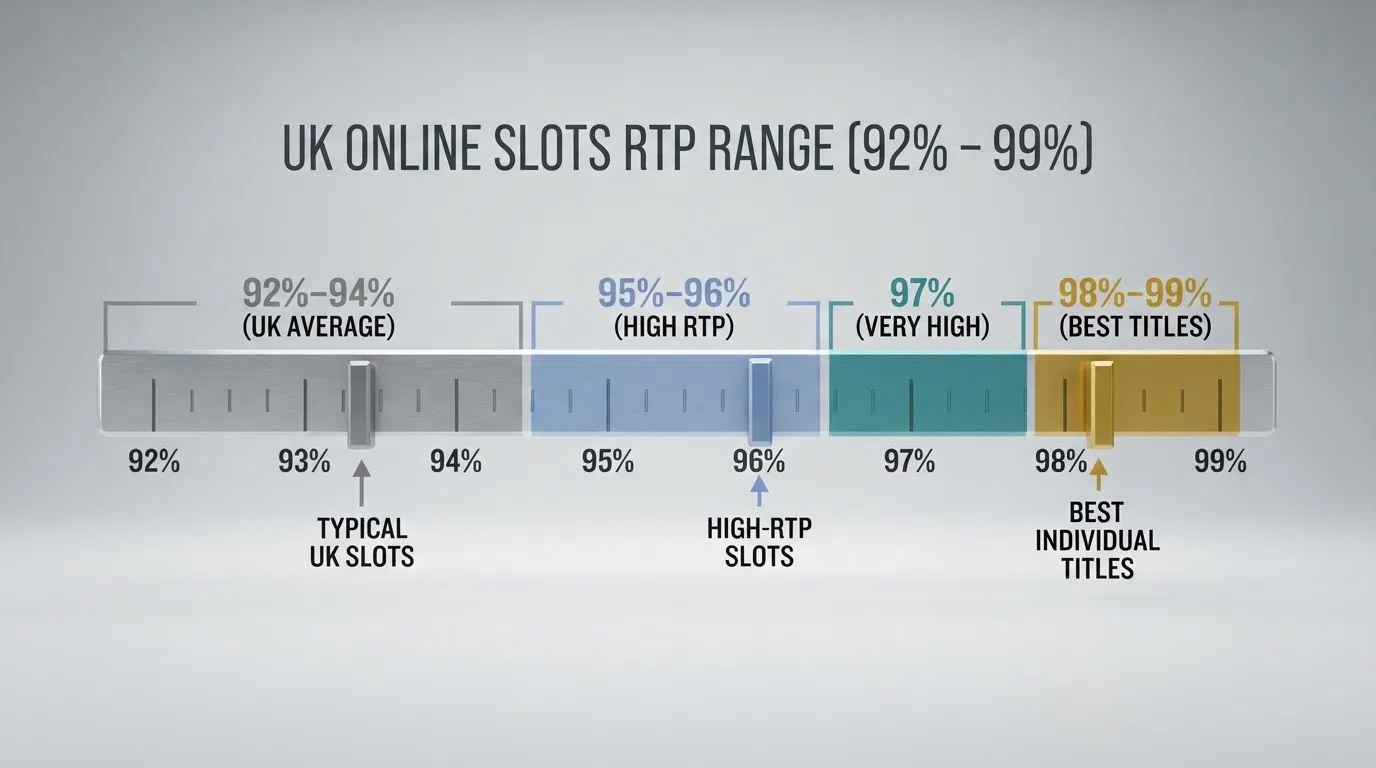
The brackets worth knowing: 95% is the floor of the typical band, 96% is the midpoint most UK slots cluster around, 97% is genuinely high, and 98% or above is exceptional. Anything at or above 99% is a curiosity — two or three titles in the entire UK catalogue, and each one attaches a condition (a specific bet level, a bonus mode, a configuration that may not be the one the casino is running) that prevents the figure from being taken at face value.
The Highest-RTP Slots Available to UK Players in 2026
| Slot | Provider | Theoretical RTP | Volatility | Max Win |
|---|---|---|---|---|
| Ugga Bugga | Playtech | 99.07% | Low | ~1,000× |
| Book of 99 | Relax Gaming | 99.00% | High | 12,075× |
| Mega Joker (Supermeter) | NetEnt | 99.00% | — | — |
| Jackpot 6000 (max-bet mode) | NetEnt | 98.90% | — | — |
| 1429 Uncharted Seas | Thunderkick | 98.50% | Medium | 670× |
| Marching Legions | Relax Gaming | 98.12% | — | 7,458× |
| Money Cart | Relax Gaming | 98.00% | — | 2,000× |
| Blood Suckers | NetEnt | 98.00% | Low | 1,014× |
| Madame Mystique Megaways (enhanced) | Pragmatic Play | 98.03% | — | — |
| Blood Suckers Megaways | Red Tiger | 97.66% | High | 20,521.9× |
| White Rabbit Megaways | BTG | 97.72% | High | 17,420× |
Two qualifications apply to almost every row. First, Mega Joker’s 99% figure applies only in Supermeter mode at maximum coin level; the base game returns 76.9%, and most UK casinos deploy the title at 94.05% rather than the theoretical ceiling. The deployed figure is what matters. Jackpot 6000’s 98.9% similarly requires max-bet mode. Second, several of these titles have multiple certified RTP configurations, and the configuration served by a given operator may sit below the figure on this table. The in-game help screen is the only record that tells the player which one they are actually playing. The fixed-configuration titles — Ugga Bugga, Book of 99, 1429 Uncharted Seas, Blood Suckers — are the most reliable, because their providers do not offer operator-adjustable tiers.
RTP by the Numbers: From 96% to 99%+
A one-percentage-point gap in RTP costs 1% of every pound staked, which sounds small until it is applied to a real session. At the £5 per-spin cap for players aged 25 and over, 500 spins move £2,500 through the reels. A 96% slot keeps £100 of that as house edge; a 99% slot keeps £25. The £75 difference is not a marketing abstraction; it is the price of choosing one title over another at the same stake.
The top of the scale is the hardest to populate. Slots at 98% or above are a small minority of the UK catalogue — roughly a dozen titles in active deployment, drawn from a handful of providers. The 99% club is smaller still: Ugga Bugga, Book of 99, and the conditional modes of Mega Joker and Jackpot 6000. These are the slots that review sites name first and that players remember; the bracket is contested because every additional percentage point of theoretical return costs the operator a real margin, and providers are not motivated to add more entries to it.
The last percentage point, from 98% to 99%, is also the most fiercely conditional. Both 99% titles in active UK play require either a specific bet configuration (Mega Joker’s Supermeter at max coin) or sit on a high-volatility curve (Book of 99) that punishes a small bankroll. The theoretical 99% assumes the long run, and the long run of a high-variance slot is far longer than the long run of a low-variance one.
How to Verify RTP Before You Play — and Why Most Players Skip It
The single highest-leverage action a player can take is opening the in-game help or information screen before the first spin. That screen is the only player-facing legal record of the RTP the operator is actually running. The figure on a developer’s marketing page, a review table, or a casino lobby tile is secondary; the figure inside the game is the one the UK Gambling Commission has required to be certified by an approved testing laboratory and published exactly there.
Where RTP Is Displayed (and Where It Is Not)
Every slot on a UK-licensed site must publish its theoretical RTP in the in-game information pane under the Commission’s Remote Technical Standards (RTS 3), and the figure must have been verified through testing-laboratory certification before the slot can go live. The UKGC does not test games itself; it requires operators to commission an approved test house and submit the game and test report before deployment. The result is a chain: developer supplies the game, test house certifies the RTP, operator deploys, player sees the certified figure on the in-game screen.
No UK regulation requires RTP to appear in the casino lobby, in a search filter, or on a game thumbnail. Lobbies typically display a title, a provider logo and a thumbnail; the RTP lives one click deeper, in the game’s own menu. The reason most players skip the check is that it is a click away from the spin button, and the click costs nothing but the half-second it takes. That half-second is where the deployed-versus-theoretical gap lives.
Why the Same Slot Can Show Different RTP at Different Casinos
The same slot title can be certified and supplied in more than one RTP configuration in the UK, and the percentage on a developer page may differ from the version offered by a specific operator. Providers ship multiple configurations for commercial reasons: operators in higher-tax or higher-cost markets can deploy a lower-RTP version to protect margin while keeping the same game in their catalogue. The percentage on a review table is whichever configuration the reviewer happened to play, and the percentage on a developer page is usually the highest certified configuration. The figure in the in-game help screen at the specific casino is the one that applies to the spins about to take place.
Mega Joker is the worked example. Its theoretical ceiling is 99% in Supermeter mode, and the base game sits at 76.9%, but most UK casinos in 2026 deploy it at 94.05% — a figure the in-game screen will show, if the player opens it. The 99% number on a top-10 list is not a lie, but it is also not the number most players are actually spinning against. The Remote Gaming Duty increase from 21% to 40%, effective 1 April 2026 under section 86 of the Finance Act 2026, has sharpened the pressure on operators to deploy lower-RTP configurations, and reports from the second quarter of 2026 suggest some titles on smaller providers (Peter & Sons among them) have already drifted to 94% against a theoretical 96.1%. Fixed-RTP titles — Blood Suckers, Book of 99, 1429 Uncharted Seas, Ugga Bugga — remain unaffected because their providers do not offer adjustable tiers. For every other title, the verification step is not a nicety; it is the difference between the slot the list promised and the slot on the screen.
RTP vs Volatility: Why Return Is Not the Whole Story
Two numbers govern every slot session: the percentage the slot returns, and the way it returns it. RTP tells the player how much of every pound comes back over the long run. Volatility tells the player how that return is distributed across spins. A slot can return 97% of every pound in a steady drip of small wins or in a single brutal drought followed by a jackpot. The percentage is the same; the experience is not.
The Difference Between RTP and Volatility
Volatility is the frequency and size of payouts, independent of the long-run return. A low-volatility slot pays out often, in small amounts, and the bankroll moves slowly. A high-volatility slot pays out rarely, in large amounts, and the bankroll can halve in twenty spins before a single big hit resets the balance. Two slots at 97% RTP can produce opposite experiences: one drips along at 96%–98% return per hundred spins, the other swings from 40% to 300% across the same window and averages out to the same figure at spin ten thousand.
The two dimensions are orthogonal. A player with a small bankroll cares more about volatility than RTP, because volatility determines whether the bankroll survives long enough for the long run to arrive. A £100 budget on a high-volatility 97% slot can be exhausted in fifty spins without ever seeing a return that matches the theoretical percentage; the same £100 on a low-volatility 96% slot will fund several hundred spins of relatively steady play. The RTP figure is what the slot returns; volatility is what the player experiences on the way to that return.
Best Low-Volatility High-RTP Slots
Two titles combine a top-tier return with a low-volatility profile. Ugga Bugga (99.07%, low) is the standout: its fixed RTP and low variance mean the long run arrives quickly and the bankroll is not exposed to long dry spells. Blood Suckers (98.00%, low) sits a shade below in theoretical return but is the more widely deployed of the two, available at every UKGC-licensed casino carrying the NetEnt catalogue. Both are fixed-RTP titles, which means the 99% and 98% figures are the figures the in-game screen will show at any UK casino, not a best-case configuration that the operator may have dialled down.
Low-volatility slots at 98%+ RTP are rare in the UK market. Most high-RTP titles pair their favourable return with high variance, because variance is the engine that funds the larger return. The pair above works because both are older designs (Ugga Bugga from Playtech, Blood Suckers from NetEnt in 2013) built before the modern high-variance convention became the default. For a player who wants long sessions from a fixed bankroll and the highest available return, this pair is the shortlist.
High-Variance High-RTP Slots Worth the Ride
Book of 99 (99.00%, high) sits at the top of the variance curve: theoretical return at the ceiling, but a path to that return that can run through extended dry spells before a free-spins round produces the bulk of the payout. The 12,075× maximum win is the upside that justifies the ride. Blood Suckers Megaways (97.66%, high) raises the maximum to 20,521.9× and adds the Megaways reel modifier, at the cost of a steeper variance profile than the original Blood Suckers. White Rabbit Megaways (97.72%, high) tops out at 17,420× and is the most volatile of the three, with a free-spins feature that can extend itself by collecting orbs.
The bankroll needed to survive the variance is the practical constraint. A high-volatility 97% slot is not a 97% slot in the first hundred spins; it is a slot that may return 60% of stake in a brutal opening and 140% in a lucky one, with the average of those outcomes sitting at 97% only across thousands of spins. The session-length budget for these titles is roughly five to ten times the bankroll for a low-volatility slot at the same RTP, because the player needs to survive the droughts to reach the bonus rounds where the theoretical return is actually delivered.
RTP Across Slot Types: Megaways, Progressives and More
The slot format shapes the return percentage as much as the title does. Megaways titles cluster in a narrower and generally higher band than standard slots; progressive jackpots sit well below the typical UK average; enhanced-RTP configurations are an emerging third category that rewards the player willing to pay for them up front.
Megaways Slots with the Highest RTP
Three Megaways titles break the 97.5% barrier. Madame Mystique Megaways tops the list at 98.03%, but only through the 100× Bonus Buy that unlocks the enhanced-RTP configuration; the standard play mode runs lower. White Rabbit Megaways (97.72%) and Blood Suckers Megaways (97.66%) sit just below, both high volatility, both with maximum wins in the five-figure multiplier range. The Megaways mechanic — a variable reel size that can produce up to 117,649 ways to win on any given spin — narrows the RTP range compared to standard slots, because the engine’s mathematics are fixed by the mechanic and providers configure the return within a tighter band.
The narrow band is itself useful. A Megaways player cannot drop into a sub-94% configuration by accident, the way they can on a configurable five-reel slot, because the mechanic constrains how low the return can be set. The price is that the variance is high across the category: a Megaways slot at 97.7% RTP is not a steady drip; it is a series of swings that average out over a long session.
Progressive Jackpot RTP: The Trade-Off
A progressive jackpot slot funds its top prize by taking a portion of every stake and routing it into the prize pool. That routing reduces the base-game RTP, because the money feeding the jackpot is no longer available to fund regular payouts. The result is a structural trade-off: the larger the jackpot, the lower the base-game return. A progressive slot at 95% RTP is paying 5% to the house and a further percentage point or two to the jackpot seed; a standard slot at 96% is paying only the house.
The choice the player is actually making is between a standard slot that returns 96% of every pound in regular payouts and a progressive that returns less in regular payouts but offers a non-zero chance at a life-changing top prize. The expected return can be similar across the two formats; the distribution of outcomes is not. A progressive is a lottery ticket with a house edge; a high-RTP standard slot is a slow bleed. Neither is a rational investment. The point of knowing the RTP difference is to know which kind of drain the player is signing up for.
Enhanced RTP Configurations
A small but growing number of slots offer a higher return when the player pays to enter a feature directly. The 100× Bonus Buy on Madame Mystique Megaways, which lifts the RTP to 98.03%, is the clearest example: a player willing to spend 100× their stake to trigger the bonus round gets a mathematically better deal than a player who waits for the feature to trigger organically. The mechanic is provider-designed, not regulator-mandated, and the enhanced figure is not always advertised in the lobby. The in-game paytable is where it lives, and only for titles that carry the option.
Enhanced RTP is distinct from operator-side RTP tiers. The operator chooses which certified configuration to deploy; the provider designs the enhanced configuration and the price at which it can be entered. Both are reasons the figure on a review table may not match the figure in the game, and both are reasons the in-game screen is the only record that matters.
Where to Play High-RTP Slots: UK Casinos Compared
Ten UKGC-licensed casinos carry the high-RTP titles in this guide. All hold a valid GB remote casino licence, verifiable on the Commission’s public register. The split between wager-free offers and the few that still carry wagering is the practical division: a wager-free welcome means the RTP maths works exactly as stated, while a wagering requirement reshapes the cost of playing into something the slot’s return percentage does not describe on its own.

| Operator | UKGC Licence | Welcome Bonus | Wagering | Validity | Cashout Cap |
|---|---|---|---|---|---|
| Bet365 | 39563 | Up to 500 free spins | 0× (wager-free) | 7 days | No cap |
| PlayOJO | 39326 | 50 free spins on Big Bass Bonanza | 0× (wager-free) | — | No cap |
| Sky Vegas | Flutter group | 200 free spins | 0× (wager-free) | 7 days | No cap |
| LeoVegas | 39198 | 50 free spins on Big Bass Splash | 0× on spins | — | No cap |
| Betfred | UKGC licensed | 200 free spins | 0× (wager-free) | 14-day qual / 7-day spin | No cap |
| William Hill | evoke group | 200 free spins on Big Bass Splash | 10× | 72 hours | £30 |
| Casumo | 61549 | 50% up to £100 deposit match | 10× | 7 days | Not specified |
| Videoslots | UKGC licensed | 100% up to £200 + 11 wager-free spins on Starburst | 10× on cash bonus | 30 days | No cap on spins |
| Duelz | UKGC licensed | Not surfaced | — | — | — |
| BetMGM UK | UKGC licensed | Not surfaced | — | — | — |
PlayOJO: Wager-Free on Every Bonus, on Every Slot
PlayOJO’s defining trait is zero wagering — no exceptions, no fine print, no “up to” qualifier. The welcome is 50 free spins on Big Bass Bonanza, triggered by a £10 deposit, with winnings paid in cash at £0.10 per spin. The no-wagering policy extends to every promotion the operator runs, including any on the high-RTP titles in this guide, which means a bonus triggered on Blood Suckers or Ugga Bugga returns what it returns with no further conversion requirement. The platform is SkillOnNet, the catalogue runs to roughly 3,000 slots, and the UKGC licence number is 39326.
For a player who wants the slot’s published RTP to be the number that determines the outcome, PlayOJO is the cleanest offer in the set. The free-spin winnings are cash; there is no bonus balance to clear and no game-weighting to check. What the slot returns is what the player keeps.
Bet365: Up to 500 Free Spins with Wager-Free Winnings
Bet365 offers the highest free-spin volume in the featured set: up to 500 spins, allocated as 5–50 per day for ten days, triggered by a £10 deposit, wager-free, paid as cash at £0.10 per spin on selected titles (Book of Horus, Curse of the Bayou, Magic Forge, Wrath of the Deep). The slot catalogue runs to 4,000+ games, the provider mix includes NetEnt, Playtech, Pragmatic Play, Red Tiger, BTG and Relax Gaming — every studio behind the high-RTP titles in this guide — and the average deployed slot RTP sits at approximately 96.30% per RTPTrack data. The UKGC licence number is 39563, and the 7-day validity from credit gives a reasonable window to use the spins.
A catalogue this broad is itself an advantage for the high-RTP player. The more titles a casino carries, the more likely it is to host the specific high-RTP slot a player wants; a 4,000-title library overlaps with nearly every provider’s full range.
Sky Vegas: 200 Wager-Free Spins Triggered by a £10 Deposit
Sky Vegas, part of the Flutter Entertainment group, runs a straightforward 200 free spins welcome, wager-free, triggered by a £10 deposit and spend, with a 7-day expiry on the spins. The provider mix covers NetEnt, Playtech, Red Tiger and Blueprint. The offer sits in the wager-free majority: what the spins win is cash, with no further playthrough required. The Flutter umbrella behind Sky Vegas means the same operational rigour that runs Paddy Power and Betfair applies to the slot catalogue and the compliance chain.
LeoVegas: 50 Wager-Free Spins and ~96.30% Average Deployed RTP
LeoVegas matches Bet365’s documented average deployed slot RTP at approximately 96.30%, the highest in the featured set. The welcome is 50 wager-free spins on Big Bass Splash, triggered by a £10 deposit, with no wagering on the spin winnings and a 1× playthrough on the deposit itself. The provider mix includes NetEnt, Playtech, Pragmatic Play and Relax Gaming — enough to cover most of the high-RTP titles in this guide. The UKGC licence number is 39198.
For a player who reads the average deployed RTP as a proxy for how friendly a casino is to high-RTP play, LeoVegas and Bet365 sit at the top of the table on that metric. A 96.30% average across a 4,000-title library is meaningfully different from a 95% average across a smaller catalogue.
Betfred: 200 Wager-Free Spins with a Longer Qualification Window
Betfred’s 200 free spins are wager-free, triggered by a £10 deposit and stake, with a 14-day qualification window before the spins credit and a 7-day expiry once they do. The longer qualification window is the most generous in the featured set, useful for a player who does not plan to deposit and stake on the same day. Spin value is £0.10, and the provider mix (Playtech, NetEnt, Red Tiger, Blueprint) covers the main high-RTP studios. No cashout cap is stated on the wager-free winnings.
William Hill: 200 Spins That Carry a 10× Wagering Requirement
William Hill’s offer matches the wager-free brands on the headline count — 200 free spins on Big Bass Splash — but the winnings carry a 10× wagering requirement, a 72-hour credit window, and a £30 cashout cap. The 10× figure is the UK regulatory ceiling, imposed from 19 December 2025 under LCCP Social Responsibility Code 5.1.1, and William Hill is operating at that ceiling rather than below it. The evoke group, William Hill’s parent, has opted to keep wagering rather than migrate to the wager-free model. For a player who values spin count over conversion simplicity, the offer is large; for a player who wants the slot’s RTP to work on its own terms, the £30 cap is the constraint that decides the comparison.
Casumo: A 50% Deposit Match with a 98.37% Site-Wide Payout Rate
Casumo is the only deposit-match welcome in the set: 50% up to £100 on a minimum £20 deposit, with 10× wagering on the bonus and a 7-day validity. The headline metric, though, is the 98.37% site-wide payout rate reported by TalkSport, the highest in the featured set. A casino-level payout figure aggregates every game’s return; an above-98% figure across the full catalogue is a strong signal that the operator is running higher-RTP configurations on the bulk of its games rather than the lower end of the certified range. The UKGC licence number is 61549, the slot catalogue runs to approximately 3,500, and the provider mix covers NetEnt, Playtech, Pragmatic Play, Relax Gaming and BTG.
A 10× wagering requirement on a £100 bonus means £1,000 of qualifying turnover before the bonus converts. The slot RTP applies to that turnover, not to the bonus amount, so the player is running a £1,000 experiment at the slot’s return rate. The expected loss on that turnover at 96% RTP is £40; at 98%, it is £20. The bonus is worth the headline £50 only if the turnover clears before the bankroll does, and the high site-wide payout rate is what makes that plausible.
Videoslots: The UK’s Broadest Slot Library with 9,000+ Titles
Videoslots’ welcome is a 100% deposit match up to £200 plus 11 wager-free spins on Starburst, triggered by a £10 deposit, with 10× wagering on the cash bonus and a 30-day validity. The 11 spins are wager-free; the deposit bonus is not. The 30-day validity is the longest in the featured set. The headline metric, however, is catalogue breadth: 9,000+ games, the largest slot library at any UKGC-licensed operator. A library this size intersects with every high-RTP title in this guide and a long tail of titles that are not in the top ten but sit in the 97%+ range.
For the high-RTP player, the catalogue is the argument. A 9,000-title library means more high-RTP slots to choose from, more Megaways variants, more of the fixed-RTP older titles that hold their theoretical return across every UK deployment.
Duelz: Home to Mega Joker at Up to 99% RTP
Duelz hosts Mega Joker at up to 99% RTP in Supermeter mode, the single highest-theoretical-return slot in the UK catalogue. The welcome offer terms were not fully surfaced in the research behind this page, so the comparison here rests on the high-RTP slot rather than the bonus structure. The cross-reference is to the Mega Joker caveat above: the 99% figure requires Supermeter mode at max coin, and most UK deployments run the title at 94.05% rather than the theoretical ceiling. The in-game info screen at Duelz will confirm which configuration is live.
For a player who specifically wants to play Mega Joker at its highest theoretical return, Duelz is one of the UK casinos that carries it. The rest of the Duelz proposition — welcome terms, catalogue, provider mix — is not characterised in the same detail as the offers above, and a player comparing casinos for a high-RTP session would do well to confirm the current welcome terms directly.
BetMGM UK: Hosting Jackpot 6000 at 98.9% RTP
BetMGM UK hosts Jackpot 6000 at 98.9% RTP in max-bet mode, the second of the two highest-theoretical-return NetEnt classics. The welcome offer terms were not fully surfaced, so the comparison rests on the slot hosting rather than the bonus. Jackpot 6000’s 98.9%, like Mega Joker’s 99%, requires max-bet mode; the base-game return is lower, and the deployed configuration is what the in-game screen will show. The provider mix (NetEnt, BTG, Red Tiger, Playtech) covers the main high-RTP studios, and the BetMGM UK licence is held in the GB register.
The same caveat as Duelz applies: the welcome offer is the part of the comparison this guide cannot characterise, and a player choosing on bonus terms would need to confirm those directly. On slot hosting, both Duelz and BetMGM UK carry a NetEnt classic at its theoretical ceiling — Duelz with Mega Joker, BetMGM UK with Jackpot 6000 — and the in-game screen is the only way to confirm which configuration is actually being served.
UK Gambling Regulation and RTP: What the Rules Actually Guarantee
The UK Gambling Commission is the regulator that makes the in-game RTP figure enforceable. The framework is the Gambling Act 2005, extended to remote operators by the Gambling (Licensing and Advertising) Act 2014, and the Commission’s three licensing objectives — preventing crime, ensuring fairness, and protecting children and vulnerable persons — are the legal foundation for everything from RTP display to stake limits.
UKGC RTP Requirements and Certification
The Commission’s Remote Technical Standards require every licensed slot to publish its theoretical RTP in the in-game information pane, and the figure must be verified through testing-laboratory certification before the slot can be deployed on a UK operator. The Commission does not test games itself; it requires operators to commission an approved test house and submit the game and test report prior to release. The chain is documented, traceable, and enforceable, but it is not a guarantee of a minimum RTP. The Commission does not set a floor; it sets a process. A slot at 92% passes certification as readily as a slot at 98%, provided the published figure matches the tested one.
The public register of licence holders is the verification route for any brand claiming a GB licence. A casino claiming UKGC oversight can be checked on the register in seconds; a casino that cannot be found there is not operating under a GB licence, and the player-protection regime that the licence carries (GAMSTOP, ADR, Commission complaints) does not apply. The credit card ban, in force since 14 April 2020, is the most visible of the player-protection rules and the one most often cited in marketing, but the licensing-objective framework is broader: identity verification before first deposit, mandatory participation in GAMSTOP, affordability checks at the threshold levels the Commission has set.
How the Remote Gaming Duty Rise Is Reshaping Deployed RTP
Remote Gaming Duty for UK online casino operators rose from 21% to 40% effective 1 April 2026, applying to accounting periods beginning on or after that date and enacted in section 86 of the Finance Act 2026. The statutory gambling levy, a separate charge of 1.1% of gross gambling yield for remote casino operators, commenced on 6 April 2025 under the Gambling Levy Regulations 2025. Together, the two charges add roughly 20 percentage points to the operator’s tax burden over a fifteen-month window, and the economic pressure on deployed RTP configurations has followed directly.
Reports from the second quarter of 2026 indicate that some UK operators have begun deploying lower-RTP configurations for certain providers — Peter & Sons titles reportedly at 94% against a theoretical 96.1% — while fixed-RTP titles (Blood Suckers, Book of 99, 1429 Uncharted Seas, Ugga Bugga) remain unaffected because their providers do not offer operator-configurable tiers. The drift is not uniform, and it is not universal; some operators have held their configurations, and the major studios’ flagship titles are unchanged. But the incentive structure is now pointed firmly in one direction, and the “check the in-game info screen” instruction is not a disclaimer. It is the actionable response to a market where the operator’s tax bill is 90% higher than it was eighteen months ago.
Why High-RTP Slots Still Need Responsible Gaming Guardrails
A 98% RTP slot still loses the player 2% of every pound over the long run, and the long run is the only context in which the percentage is meaningful. The 2% compounds across sessions the way it compounds across spins, and a player who treats a high-RTP slot as a low-risk game is misreading the maths. The UK’s player-protection infrastructure exists precisely because the return percentage does not protect anyone from the session-level experience of losing.
RTP and the Illusion of Control
A high-RTP slot produces more small wins and slightly fewer large losses than a low-RTP slot, and the experience of slightly more frequent payouts can feel like a strategy is working. It is not. The 2% house edge on a 98% slot is still a house edge, and a player who plays through £5,000 of turnover at that rate loses £100 on average, regardless of how the wins feel as they arrive. The UKGC’s game-design rules push back on the illusion: auto-play is banned, spin speed is capped at 2.5 seconds per game cycle, features that speed up play are banned, losses disguised as wins are banned, and reverse withdrawals are permanently banned. The rules do not change the RTP; they slow the rate at which turnover accumulates, which is the variable the player can actually influence.
The statutory stake limits — £5 per game cycle for players aged 25 and over, £2 for players aged 18 to 24 — are the most direct brake on the volume of turnover a high-RTP strategy can generate. A player who would once have staked £50 per spin on a high-RTP slot now stakes £5, and the turnover ceiling per session is a fraction of what it was. Financial vulnerability checks, mandatory under LCCP Social Responsibility Code 3.4.4, trigger at £150 net deposits in a rolling 30-day period, using publicly available data on bankruptcy, CCJs, IVAs and DROs to flag customers who may be in financial difficulty. The check is light-touch, not a full affordability assessment, but it is the entry point to a broader conversation the operator is required to have.
Where to Get Help
- National Gambling Helpline (GamCare) — freephone, 24/7, plus live chat
- GAMSTOP — self-exclusion from every GB-licensed online gambling operator, periods of six months, one year, five years, or five years with auto-renewal, cannot be cancelled early
- NHS gambling harm clinics — NHS Northern Gambling Service and NHS National Gambling Clinic (London), plus equivalents in Scotland and Wales
- National Gambling Support Network — 11,960 clients treated in 2024-25, an 11% increase year-on-year, 93% improvement rate among those completing treatment
- Gamblers Anonymous — peer support groups across Great Britain
Every UKGC-licensed operator must participate in GAMSTOP, and the self-exclusion periods apply across every GB-licensed site simultaneously, not just the operator the player registered with. The 13.1% of GB adults who fall into the PGSI 1+ category, and the 0.4% in the PGSI 8+ category, are the population the help infrastructure is sized for. The treatment and prevention funding flows from the statutory levy that operators pay alongside Remote Gaming Duty — a portion of the same tax base that is reshaping deployed RTP. The infrastructure is free, confidential and available regardless of how high the RTP figure on the slot looks.
How We Selected and Ranked These Slots
The slot RTP figures in this guide were sourced from RTPTrack, SlotCatalog, OLBG and the official pages of each provider, cross-referenced where possible to confirm the same title carried the same figure across more than one database. The operator set was verified against the UKGC public register of licence holders, and every brand named in the comparison table above holds a current GB remote casino licence. The ranking criterion is theoretical RTP in descending order, with deployed-RTP caveats applied where research carried them — Mega Joker and Jackpot 6000 carry their headline figures with the conditional-mode and deployed-configuration qualifications spelled out in the ranking section.
The guide’s limits are worth stating. Only GB-licensed operators are considered; offshore brands are out of scope, and the player-protection framework that the GB licence provides does not apply to them. Only slots whose RTP was independently surfaced in research are ranked; the table is not a comprehensive catalogue of every high-RTP title in the UK market, and a slot not listed here is not necessarily a low-RTP slot — it is a slot the research did not surface with a verifiable figure. Operator welcome-offer terms are accurate as of the research date and subject to change; a player should confirm the current terms at the casino before depositing.
What This Means for Your Next Slot Session
The highest theoretical RTP available to UK players sits at 99.07% on Ugga Bugga, but the average UK player spins slots in the 95%–96.8% band, and the 3-percentage-point gap from the bottom of that band to the top is worth roughly £75 per 500 spins at the £5 stake cap. Checking the in-game info screen is the single highest-leverage action a player can take, because the deployed RTP is not always the theoretical RTP, and the April 2026 Remote Gaming Duty increase has made the gap between the two more variable than it was a year ago. A wager-free welcome offer at a UKGC-licensed casino — PlayOJO, Bet365, Sky Vegas, LeoVegas, Betfred — carries zero wagering cost and leaves the slot’s RTP maths to work exactly as the in-game screen states it.
The £5 stake cap and the 2.5-second minimum spin speed together cap how fast money can move through a high-RTP slot, and that cap is the variable a player can actually feel in a session. A 98% slot at 500 spins per hour costs the player £50 per hour in expected house edge; the same slot at 200 spins per hour costs £20. The mathematics of the return does not change; the pace does. For anyone whose play has moved from occasional sessions into a pattern that does not feel occasional, the UK’s help infrastructure is free, confidential and available 24/7 — and the highest RTP in the world does not change the fact that the house edge compounds the same way regardless of the percentage.
Frequently Asked Questions
How many spins does it take for RTP to actually make a difference?
RTP is a long-run average, and the long run is longer than most sessions. A few hundred spins is not enough for the theoretical percentage to assert itself; a slot at 96% can return 200% in a lucky hour and 60% in an unlucky one. The maths converges reliably across tens of thousands of spins, and the more volatile the slot, the more spins that convergence takes. For a low-volatility title like Blood Suckers, a few thousand spins will track the theoretical figure reasonably closely; for a high-volatility title like Book of 99, the convergence is much slower.
Which UK casino offers the highest average RTP across its entire slots library?
Casumo reports a site-wide payout rate of 98.37%, the highest in the featured set; Bet365 and LeoVegas both sit at approximately 96.30% average deployed slot RTP per RTPTrack data. A site-wide payout figure aggregates every game’s return, so an above-98% rate across a full catalogue suggests the operator is running higher-RTP configurations on the bulk of its games. The figure is a useful proxy but not a guarantee on any individual title — the in-game screen is still the record that matters for the specific slot being played.
How have the 2025 online slot stake limits affected high-RTP slot play in the UK?
The £5 per-game-cycle cap for players aged 25 and over (in force from 9 April 2025) and the £2 cap for players aged 18 to 24 (in force from 21 May 2025) are imposed by SI 2025/215. The cap directly limits the turnover ceiling per session, which is the variable that determines how much of a theoretical RTP advantage the player can actually realise. At the £5 cap, a player staking on a 98% slot runs a slower experiment than they would at a higher stake; the percentage does not change, but the pace at which the house edge accrues does. A 2.5-second minimum spin speed, in force since October 2021, reinforces the same ceiling from a different direction.
Why do progressive jackpot slots pay back less than standard slots?
A progressive jackpot is funded by a portion of every stake, which reduces the base-game RTP because that money is routed to the prize pool rather than to regular payouts. A progressive slot at 95% RTP is paying 5% to the house and a further percentage point or two to the jackpot seed; a standard slot at 96% is paying only the house. The expected return can be similar across the two formats; the distribution of outcomes is not. A progressive is structurally a lottery ticket with a house edge, and a high-RTP standard slot is a slow bleed. Neither is a rational investment, and the choice between them is a choice about what kind of drain the player is signing up for.
Does the UKGC test every slot’s RTP before it goes live?
The UKGC does not test games itself. It requires operators to commission an approved testing laboratory, have the game certified, and submit the game and test report to the Commission before deployment. The chain is documented and traceable, and the in-game RTP must match the certified figure. The Commission does not set a minimum RTP; a slot at 92% passes the same process as a slot at 98%, provided the published figure matches what the test house verified.
Is chasing the highest possible RTP worth it for an extra one or two per cent?
A one-percentage-point gap in RTP costs 1% of every pound staked, which at 500 spins of £5 is £25 per session. The gap from 96% to 98% is £50 per session at the same stake. Whether that gap is worth chasing depends on what the player gives up to get it: a higher-volatility title with longer dry spells, a less popular game with a thinner track record, or a casino with a weaker welcome offer. For a player with a large bankroll and a long time horizon, the percentage is worth pursuing. For a player with a small bankroll playing short sessions, the volatility matters more than the RTP, and the difference between a 96% low-volatility slot and a 98% high-volatility one is often the wrong trade.
Limits – realmoney-onlinecasinos-uk
Content created by the «realmoney-onlinecasinos-uk» team