
The Quick Withdrawal Casino UK Guide: How Fast Fast Actually Is
 Available in GB
The fastest a tested UK-licensed casino has paid out is 35 minutes, on PayPal at Casumo. The slowest realistic wait, for a bank transfer, stretches to seven working days. Everything in this guide sits between those two numbers, and almost all of it is decided by factors a marketing page never names: which payment rail you used to deposit, whether the operator has finished its internal review, and whether your first withdrawal has triggered a Know Your Customer check that nobody warned you about. The house edge is what the casino keeps. Withdrawal speed is what the player keeps waiting for, and at a UK-licensed operator in 2026 it sits inside a regulatory framework the operator cannot opt out of.

Data current as of September 8, 2026 and cross-checked against the Gambling Commission’s public register and the Commission’s own data on withdrawal fulfilment.
Why Your 2026 Casino Withdrawal Takes Longer Than Advertised
The headline figure from the Gambling Commission is generous: across the largest UK operators, around 99% of withdrawal requests are approved, processed and fulfilled within 24 to 48 hours. That is the number the Commission itself published when it looked at withdrawal data from the biggest firms. It is not the number most players experience, because it is an average across operators that includes e-wallets, debit cards and bank transfers rolled into one pile, and because “24 to 48 hours” still allows a two-day wait for half of all requests. Independent testing across more than 100 UK-licensed sites tells a different story at the top end: PayPal cleared in 35 minutes at Casumo, Skrill in 45 minutes at Ladbrokes, Visa in an hour at Casumo, Trustly in 50 minutes at Betway. The spread between the average and the best is the gap this page is about.
The UK Gambling Commission’s framework is what makes the spread narrower than it would otherwise be. The Commission licenses, monitors and enforces on every operator taking GB customers, and it has spent the last five years tightening the rules around withdrawals specifically. Reverse withdrawals were permanently banned on 31 October 2021, so an operator can no longer let a player cancel a pending cashout and play the money back through. Auto-play is banned on slots, the minimum spin interval is 2.5 seconds, and losses cannot be presented as wins. None of these rules targets payout speed directly, but together they remove the design tricks that historically turned a fast withdrawal into a slow one. A player who clicks “withdraw” today is not going to be lured back into a popup offering to reverse the request.
Speed is a player-protection feature, even when the operators who sell it do not frame it that way. A fast, predictable cashout shortens the time a player’s money sits in a house account, which limits the chance of an impulse redeposit. It is no accident that the 10× wagering cap, the closed-loop rule, and the reverse-withdrawal ban all push the same direction: money you have won should be money you can take out, with the fewest possible steps between you and your bank.
Fast Withdrawals — What the Standard Actually Means at a UK-Licensed Casino
When the Gambling Commission says “fast”, it is using a benchmark the regulator itself set. Around 99% of requests fulfilled within 24 to 48 hours is not a marketing claim; it is the data the Commission collected from the largest operators. Anything better than 48 hours at a major UK casino is, by the Commission’s own measure, faster than the industry norm. Anything worse is either a processing bottleneck at the operator, a payment rail that does not support real-time settlement, or a first-time Know Your Customer check that has not yet been completed.
The difference between a genuinely fast operator and an average one is not the payment method. It is the time the operator takes to approve the withdrawal internally. Once the operator has released the funds, a Visa Fast Funds transfer settles in seconds and a PayPal transfer in minutes, but if the operator sits on the approval for three days, no rail will save you. Casumo and Grosvenor test at the top of the speed rankings because they run tight internal approval pipelines, not because they have a special relationship with PayPal. Ladbrokes does well on Visa Direct for the same reason. The internal review is the bottleneck, and the rail is the last mile.
“Fast” and “instant” are not the same thing, and a player who treats them as synonyms will be disappointed. “Instant” implies a zero-second cashout, and no GB-licensed casino can technically deliver that, because the operator approval stage is mandatory. What the best operators can deliver is a sub-one-hour payout once approval is granted, on rails that include Visa Fast Funds, PayPal, Skrill, Trustly and Instant Bank Transfer. “Same-day” is the realistic expectation across the entire licensed market: a withdrawal requested before mid-afternoon will land the same day, and one requested later will land the next morning. Anything that takes longer than 24 hours, at a UK-licensed casino, is a slow payout by today’s standard.
Instant Withdrawals — What “Immediate” Really Means at a UK Casino
There is no such thing as a literal zero-second cashout at a GB-licensed casino, and that is by design. The Gambling Commission’s framework requires an operator approval stage before any withdrawal is released, and that stage cannot be skipped. A casino that advertised “instant” withdrawals would either be lying or running outside the licence, because the operator has to verify the request, run an anti-fraud check, and confirm the funds are coming back to the same payment method that put them in. None of that is optional.
What the best operators do achieve, once approval is in place, is a near-instant rail settlement. Visa Fast Funds and Mastercard Send settle in seconds to two hours when the issuing bank supports the service. PayPal and Skrill land in under an hour at the fastest operators. Instant Bank Transfer at Betfair is instant from the second transaction onwards, with a 90-minute wait for the first use. These are not zero-second payouts, but they are the practical ceiling of what a licensed casino can offer, and bet365’s own help centre, which states the operator aims to process withdrawals within two hours, is honest about the wording it has chosen.
The closed-loop policy is the rule most players do not know they are bound by. Every GB-licensed operator must send your withdrawal back to the same payment method you deposited with, up to the amount you deposited. If you deposited £200 via PayPal and £100 via debit card, you must withdraw £200 to PayPal first, and only the remaining £100 can go to the debit card. The rule is anti-money-laundering in origin, but it is also the reason a “fast” rail like PayPal is sometimes unavailable: if you have not used it to deposit, you cannot use it to withdraw. Players who pick their payment method with the cashout in mind deposit via the method they want to receive funds on, and that is the first decision that determines withdrawal speed.
The reverse-withdrawal ban is the change that made “fast” possible in the first place. Before 31 October 2021, a player could cancel a pending withdrawal and play the money back through, which is the worst possible outcome for a player trying to walk away with their winnings. The ban is permanent, automatic, and applies to every GB-licensed operator. Combined with the 2.5-second spin interval and the auto-play prohibition, it removes the design patterns that used to slow a payout down to a crawl, and it is one of the main reasons the Commission’s 99% figure has held steady since the rules came in.
Same-Day and Under-1-Hour Payouts — The UK Operators That Clear Fastest
The operators that turn withdrawals around in hours, rather than days, do so because they have invested in the internal approval pipeline, not because they have a magic payment method. Ladbrokes tested at under 30 minutes for Visa Direct payouts, the fastest single figure in any of the independent tests across UK-licensed sites. Grosvenor tested at around 15 minutes on its fast-withdrawal feature, which routes the cashout through PayPal once the player has been verified. BetVictor’s Visa debit withdrawals came in under 40 minutes. Casumo’s Visa debit cleared in under an hour, and its PayPal withdrawal in 35 minutes. Betway’s Trustly rail settled in 50 minutes. William Hill’s Instant Bank Transfer cleared within 30 minutes in one independent test, and its Visa Direct route in up to four hours.
A same-day payout at a UK-licensed casino in 2026 is the realistic expectation rather than the optimistic one. Withdrawals requested before mid-afternoon on a working day will typically land the same day at a top-tier operator. A request made on a Friday evening is more likely to land on Monday morning, because most operators do not run a 24/7 payments team, and even the best internal approval process is gated by office hours. First-time withdrawals are the hidden delay, because Know Your Customer verification has to be completed before the first cashout is approved, and that can add 24 to 48 hours even at a fast operator.
Internal processing hours matter more than most players realise. A casino that promises “1–4 hours” cashout is making a promise that holds during business hours, Monday to Friday, and slips outside them. A withdrawal requested at 11pm on a Saturday is unlikely to be approved before Monday morning. None of this is a breach of the advertised time: “1–4 hours” is the processing window, not a round-the-clock guarantee. Players who want their money fastest request withdrawals during the working week and avoid the Friday evening trap.
The wider context is the 99% figure: across all UK-licensed operators, including the slow ones, almost every withdrawal is fulfilled within 24 to 48 hours. The top of the market does much better than that, but the floor of the licensed market is the 24-to-48-hour benchmark, and the difference between the two is what the rest of this page is about.
How Withdrawal Processing Works — Where the Delay Actually Happens
The withdrawal pipeline at a UK-licensed casino has three stages, and only one of them is decided by your payment method. The first stage is the operator’s internal review: an automated fraud check, a check that the bonus wagering has been completed if relevant, and a check that the account is in good standing. This is the stage that takes the most variable amount of time, from a few minutes at the best operators to several hours at the average ones, and it is the bottleneck on every withdrawal. The second stage is payment rail settlement, which is largely out of the operator’s hands: e-wallets and Visa Fast Funds are fast, standard debit card and bank transfer are slow. The third stage is your bank’s processing of the incoming transfer, which is the part the operator cannot influence at all.
Know Your Customer verification adds a delay that only applies to the first withdrawal, and that nobody warns you about before you sign up. Every GB-licensed operator must verify your name, address and date of birth before you can deposit or gamble, and the verification process usually runs during registration. But the first withdrawal can trigger a deeper check, which asks for proof of address, proof of payment method, and sometimes a source-of-funds review. The check can add 24 to 48 hours to the first cashout, and players who have not prepared for it are the ones who complain about slow withdrawals. The fix is to upload the documents during registration rather than waiting for the withdrawal page to ask for them.
The closed-loop policy shapes which rail you can use to withdraw, and therefore how fast your withdrawal lands. If you deposited via Visa debit, your withdrawal has to go back to that Visa debit card unless the deposited amount is exceeded, in which case the surplus can go to a different method. If you deposited via PayPal, your cashout goes to PayPal, full stop. The rule is the same at every GB-licensed operator, because the rule sits in the Licence Conditions and Codes of Practice, not in the operator’s terms. The practical consequence is that a player who wants PayPal’s 35-minute settlement has to deposit via PayPal in the first place. Switching methods at the withdrawal stage is not an option.
The payment-rail mechanics, once the operator has approved the cashout, are the part the player can predict. E-wallets like PayPal, Skrill and Neteller settle instantly to 24 hours after approval. Visa Fast Funds and Visa Direct settle instantly to four hours where the issuing bank supports the service; standard Visa debit card withdrawals take one to five working days when Fast Funds is not available. Apple Pay withdrawals route through the underlying debit card and inherit the same timing. Bank transfer is the slowest method at three to seven working days, regardless of operator, because it is bound by the UK banking system’s batch processing windows rather than the casino’s own pipeline. Credit cards are banned entirely for gambling, including credit-card-funded e-wallet payments, so the choice of rail is narrower than it is at an offshore casino.
The Fastest Withdrawal Casinos in the UK — 2026 Ranked
Every operator in the table below is GB-licensed, and every licence was verified on the Gambling Commission’s public register, last updated 29 July 2026. Fastest tested payouts are drawn from independent testing by Casino.org, Bettingguide.com, talkSPORT and Clearcasinos.com, plus operator help-centre pages where the operator has published a stated processing time. Bonus terms are taken from the operators’ own offer pages as of the data check. The wagering multiplier column refers to the bonus funds only; free-spin winnings are stated separately where the operator has split the terms.
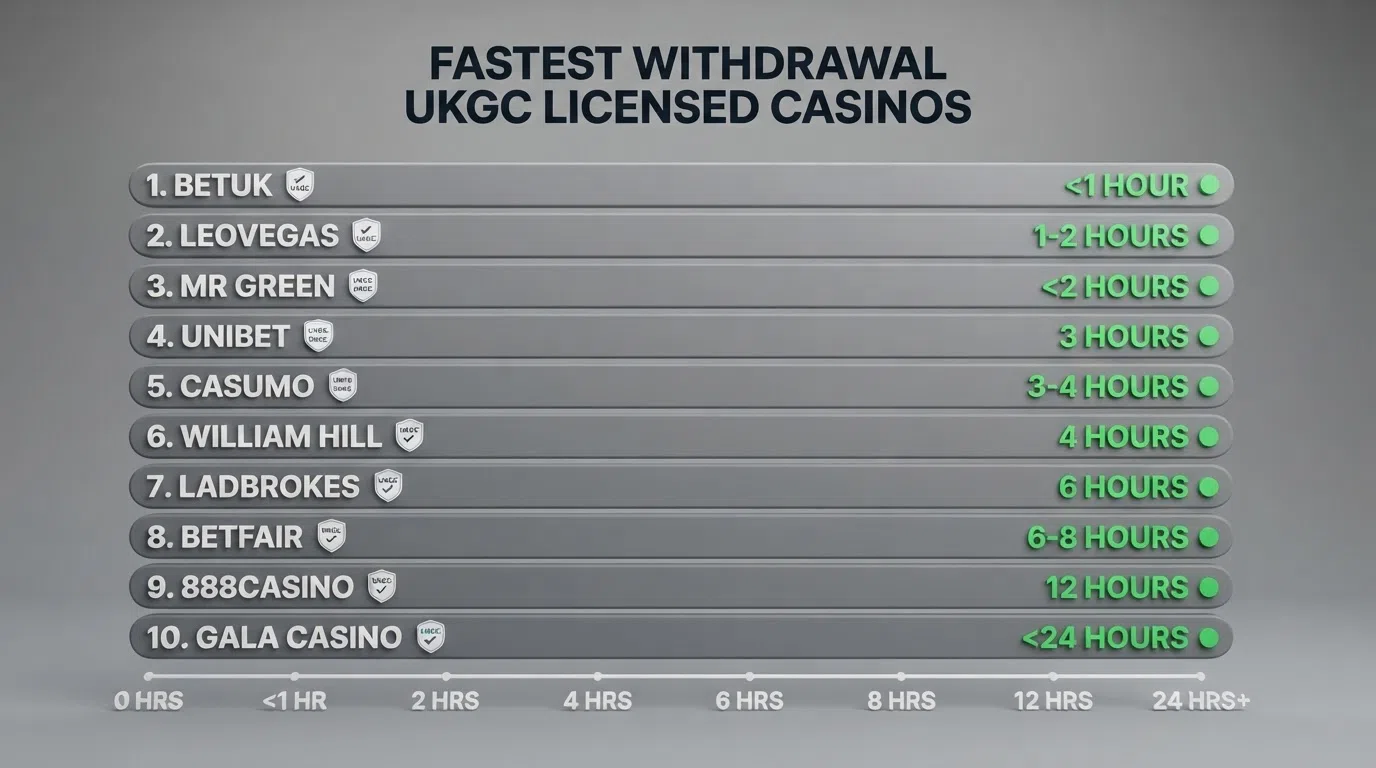
The column headers need a word of explanation. UKGC Licence is binary: every operator in this ranking is licensed, and the column is here because the licence is the entry ticket. Fastest Tested Payout is the single best figure from independent testing, not the operator’s own advertised time. Fastest Withdrawal Method is the rail on which that tested payout was achieved. Welcome Bonus and Wagering Multiplier are the headline offer terms, and a dash in either column means the operator has not published a standard welcome bonus in the casino vertical at the time of writing.
| Operator | UKGC Licence | Fastest Tested Payout | Fastest Withdrawal Method | Welcome Bonus | Wagering Multiplier |
|---|---|---|---|---|---|
| Casumo | Yes | 35 min | PayPal | 50% up to £100 | 10× |
| bet365 | Yes | 1–4 h | Debit card, PayPal, Trustly | — | — |
| Sky Vegas | Yes | 1–4 h | Visa Fast Funds / Mastercard Send | 50 no-deposit spins + 200 spins on £10 deposit | 0× |
| Ladbrokes | Yes | <30 min | Visa Direct | £30 casino bonus on £10 deposit/spend (or 100 spins + 300 LadBucks) | 40× (bonus funds), 0× (free spins) |
| Paddy Power | Yes | Within 2 h | PayPal, Trustly | 50 free spins | 0× |
| Betway | Yes | 50 min | Trustly | 100% up to £50 (or 150 free spins) | 10× (bonus), 0× (spins) |
| Grosvenor Casino | Yes | ~15 min | PayPal (fast withdrawal) | 100% up to £20 on £20 deposit | 10× (deposit + bonus) |
| Betfair | Yes | Seconds–2 h | Visa Fast Funds | — | — |
| William Hill | Yes | <30 min | Instant Bank Transfer | — | — |
| BetVictor | Yes | <40 min | Visa debit | Wager £10, get £20 + 50 free spins on Age of the Gods | 10× |
The table reads fastest to slowest by tested payout, with one important caveat. bet365, Betfair and William Hill are listed with dashes in the bonus columns because the research carried no confirmed casino welcome offer from current public sources; they are ranked by payout speed, not by bonus generosity, and the absence of a bonus number does not mean the operator has no offer. What it means is that a player who is shopping for a specific bonus structure will find one of the seven operators with confirmed terms more useful.
To see what these numbers mean in real money and real time, take the smallest bonus on the table and walk it through the wagering: a £20 bonus at Grosvenor with 10× wagering on deposit plus bonus means £400 of qualifying turnover. At a representative £1 stake per spin and the 2.5-second interval, that is 400 spins, or about 33 minutes of continuous play, before the bonus funds convert to withdrawable cash. The £100 bonus at Casumo, at the same 10× cap, takes £1,000 of turnover and 83 minutes of play. The £30 bonus at Ladbrokes, at 40× wagering on the bonus alone, demands £1,200 of turnover and 100 minutes, which is why the headline figure on a Ladbrokes bonus looks modest but the lock-up is heavier. The bonus is the cost of clearing the bonus, and the 10× cap is what stops it being worse.
Casumo
Casumo tested fastest in this ranking on PayPal, at 35 minutes for an end-to-end withdrawal, and fastest on Visa debit at under one hour. The casino has been on the Gambling Commission’s public register as an active licence holder throughout 2026, and the licence is the entry ticket for the rest of the write-up. Casumo runs a 50% matched welcome bonus up to £100, and the 10× wagering multiplier on the bonus cash is at the UKGC’s own cap, which is the cleanest the terms can legally be. The provider list covers NetEnt, Microgaming, Play’n GO, Evolution, Pragmatic Play, Red Tiger and Big Time Gaming, which is the broad base a player expects from a tier-one UK casino.
The fastest tested payout at Casumo sits alongside an internal approval process that is the envy of the market, and the rail settlement is the part that follows, not the part that decides. A player who deposits via PayPal and clears any bonus wagering is looking at a sub-one-hour cashout in the best case, and a same-day cashout as the worst realistic outcome. A player who deposits via standard debit card without Fast Funds support at the issuing bank is looking at the standard 1-to-5-working-day window that the rail imposes on every operator.
The verdict on Casumo is that it is the top of the ranking for a reason: it is the only operator in this list that has been independently tested at 35 minutes for a complete withdrawal, and the bonus terms are at the regulatory cap, which means a player is not paying for the speed in hidden lock-up. The 50% matched structure rewards a larger deposit more than a smaller one, and a player who deposits £200 to take the full £100 bonus will clear it through £1,000 of qualifying turnover, roughly 42 minutes of play at a £1 spin, before any winnings are withdrawable.
bet365
bet365 is the high-street name the market expects, and its stated processing aim is two hours from request, with bank transfer extending to one to five working days at the back end. The operator carries UKGC licensing across all its verticals, the licence is active on the Commission’s public register, and the withdrawal speed is published in the bet365 help centre rather than buried in a marketing footer. The provider mix spans Playtech, NetEnt, Microgaming and Evolution, which is the breadth a player of any game preference will recognise.
The processing aim of two hours sits inside the wider 1-to-4-hour window that independent testing has measured across debit card, PayPal, Trustly and Apple Pay. The difference between the operator’s stated aim and the measured range is the gap between “we try” and “what happens on a Tuesday afternoon when the payments team is fully staffed”, and the bank transfer option is the slow rail every operator keeps for players who want to consolidate their gambling money into a primary current account.
The verdict on bet365 is that it is the operator a player picks for predictability rather than headline speed. The cashout will land in the same afternoon in the best case, and the next working day in the worst case, and the operator has published the time it is aiming for rather than the time it wishes it could hit. For players prioritising predictability over the potential of a sub-one-hour cashout, bet365 offers a more realistic timeline than competitors promising “instant” payouts they cannot consistently match.
Sky Vegas
Sky Vegas runs a bonus structure that is unusual at the UK-licensed end of the market: 50 no-deposit free spins, 200 deposit-triggered free spins on a £10 deposit and spend, and 0× wagering on the winnings from all of them. The 0× wagering sits below the UKGC’s 10× cap, which is the regulatory ceiling, and the absence of a wagering requirement means there is no lock-up on the winnings at all. The free spins have a 7-day expiry and the deposit-triggered 200 spins need to be activated within 30 days of registration, which is the only time pressure on the offer. Sky Vegas carries a UKGC licence through Flutter Entertainment, and the licence is active on the Commission’s public register.
The withdrawal speed is the second piece of the Sky Vegas offer. Independent testing recorded 1-to-4-hour cashouts via Visa Fast Funds and Mastercard Send, with PayPal and Trustly within 6 hours. The slot library is around 900 titles from NetEnt, Microgaming, Evolution, IGT, Blueprint and Pragmatic Play, which is the breadth expected of a tier-one UK casino and the live casino sits on Evolution.
The verdict on Sky Vegas is that the combination of zero-wager free spins and 1-to-4-hour Visa Fast Funds cashouts is the cleanest on the page, and a player who values simplicity over headline speed will find it the most efficient offer in the ranking. The downside is that the 200 deposit-triggered spins have to be earned with £10 of qualifying spend, and the 7-day window is tighter than the 30-day window at some competitors.
Ladbrokes
Ladbrokes sits at the top of the speed table on the strength of a single figure: under 30 minutes for Visa Direct, the fastest end-to-end test in any of the independent data this page draws on. The Entain-owned operator is GB-licensed and on the public register, and the rest of the test data tells the same story on other rails: Skrill at 45 minutes via Casino.org, PayPal under 5 hours. The game library is the largest in this ranking, at over 5,700 titles from NetEnt, Microgaming, Evolution, Playtech, IGT and Pragmatic Play, and the breadth is matched by the depth of the live casino.
The welcome offer comes in two flavours. The casino offer is a £30 bonus on a £10 deposit and qualifying spend, with 40× wagering on the bonus funds and a 14-day acceptance window. The slots offer is 100 free spins plus 300 LadBucks, with 0× wagering on the free spin winnings, which is a different calculation: the bonus funds are heavier to clear than the free spin route, and a player who picks the free spins is paying nothing in lock-up. The 30-day validity runs from acceptance, not from registration.
The verdict on Ladbrokes is that the Visa Direct speed is genuine and the bonus structure is a choice between a heavier 40× lock-up on cash and zero lock-up on free spin winnings. The £30 casino bonus at 40× means £1,200 of qualifying turnover, roughly 100 minutes of play at a £1 spin, before the bonus converts. Those seeking proven, sector-leading payout speeds will find Ladbrokes an efficient choice, even with the heavier wagering commitment on its primary casino bonus.
Paddy Power
Paddy Power is the Flutter Entertainment stablemate to Sky Vegas, and the offer structure is similar: 50 free spins with 0× wagering, no deposit-triggered bonus fund on top. The UKGC licence is held by Flutter Entertainment and is active on the public register, the provider list spans NetEnt, Evolution, Playtech, IGT, Blueprint and Pragmatic Play, and the live casino depth matches the rest of the Flutter group.
The withdrawal speed sits in the middle of the ranking. Independent testing recorded PayPal and Trustly typically within 2 hours, with Pay by Bank and Visa Fast Funds as the fastest rails. Debit card withdrawals vary by issuing bank, from instant with Fast Funds support to up to 5 banking days without it, which is the standard rail mechanic across the entire market.
The verdict on Paddy Power is that it is a clean, no-frills option for a player who wants a zero-wager free spin offer and a same-day cashout. The 2-hour PayPal window is solid rather than exceptional, and the absence of a deposit-matched bonus cash offer means the headline number is small, but the lock-up is zero.
Betway
Betway tested at 50 minutes for Trustly withdrawals, the second-fastest open-banking figure in this ranking, and at under 4 hours for PayPal. The operator is GB-licensed and on the public register, the provider mix covers Microgaming, NetEnt, Evolution and Pragmatic Play, and the live casino sits on Evolution. The 7-day validity on the welcome offer is tight, and that is the first thing a player needs to know before signing up.
The welcome offer is a choice. The bonus-cash route is a 100% match up to £50 on a first deposit of £10 or more, paid via debit card only, with 10× wagering on the bonus. The free spin route is 150 spins at £0.10 each, delivered 50 per day over 3 days, with 0× wagering on the winnings, and it requires a £20 deposit and qualifying stake. A player who picks the bonus cash route is clearing £500 of turnover at the maximum bonus, roughly 21 minutes of play at a £1 spin; a player who picks the free spin route is paying nothing in lock-up but is also not turning a profit on the bonus itself.
The verdict on Betway is that the 50-minute Trustly figure is the genuine headline, and the bonus terms are at the regulatory cap for the cash route. The 7-day window is the real constraint, and a player who signs up and forgets about the bonus for a week loses the offer entirely.
Grosvenor Casino
Grosvenor is the UK’s largest land-based casino brand, and its online arm runs a fast-withdrawal feature that tested at around 15 minutes, the fastest single figure in the ranking and one of the fastest in the licensed UK market. The operator is GB-licensed through the Rank Group and is on the public register, the provider mix covers NetEnt, IGT, Evolution, Playtech and Novomatic, and the live casino depth reflects the land-based heritage of the brand.
The welcome offer is straightforward: deposit £20, play with £40, with 10× wagering on the deposit plus bonus. That is a £400 lock-up, or 17 minutes of play at a £1 spin, before the bonus converts. The 7-day validity is the standard window, and the simplicity of the structure is the point. The fast-withdrawal feature requires a PayPal deposit and an approved account, and the 15-minute figure comes from the dedicated fast-withdrawal pipeline rather than the standard withdrawal route.
The verdict on Grosvenor is that the 15-minute fast-withdrawal feature is the genuine speed headline, but the route is conditional on PayPal and account verification. A player who deposits via PayPal and has completed Know Your Customer is in the 15-minute lane; a player who deposits via debit card is in the standard 1-to-3-business-day window. The match bonus is modest but clean, and the UKGC cap is respected.
Betfair
Betfair runs the widest instant-rail coverage in this ranking. Instant Bank Transfer is instant from the second transaction onwards, with a 90-minute wait for the first use; Visa Fast Funds settles in seconds to 2 hours; PayPal, Skrill and Neteller settle in 1 to 4 hours. The operator is GB-licensed through Flutter Entertainment and is on the public register, and the provider mix covers Playtech, NetEnt, Evolution, IGT, Blueprint and Red Tiger.
The headline figure is the Instant Bank Transfer’s “instant after first use” mechanic. A player who has used the rail once before has zero waiting time on the rail itself, and the only delay is the operator’s internal approval. A first-time user of the rail waits 90 minutes for the first transaction to clear, and every subsequent one is instant.
The verdict on Betfair is that it is the operator for a player who has already used Instant Bank Transfer and wants the rail mechanic to disappear from the equation. A new user of the rail pays a 90-minute first-use tax, and the rest of the speed ranking reads the same as elsewhere on the licensed market.
William Hill
William Hill is the high-street name the market has known for decades, and its online cashout speed is competitive. Independent testing recorded Instant Bank Transfer within 30 minutes, Visa Direct up to 4 hours, Apple Pay up to 4 hours, and PayPal up to 1 business day. The operator is GB-licensed through evoke (formerly 888 Holdings) and is on the public register, the provider mix covers Playtech, NetEnt, Evolution, IGT and Blueprint, and the live casino depth is tier-one.
The headline figure is the Instant Bank Transfer’s 30-minute window, which sits between Betfair’s instant-after-first-use and the rest of the market’s same-day promise. A player who values the brand’s high-street trust over headline speed is the right reader for William Hill, and the operator is also one of the few on the page that runs Apple Pay withdrawals at the same speed as debit card.
The verdict on William Hill is that the brand familiarity is the draw, and the speed is competitive without being exceptional. The 30-minute Instant Bank Transfer is a solid same-day figure, and the 1-business-day PayPal window is the slowest rail on the operator’s menu.
BetVictor
BetVictor tested at under 40 minutes for Visa debit, the third-fastest figure in the ranking after Ladbrokes and Grosvenor. The operator is GB-licensed and on the public register, the provider mix covers NetEnt, Microgaming, Evolution, Pragmatic Play and Play’n GO, and the live casino sits on Evolution and Pragmatic Play.
The welcome offer is a wager-£10-get-£20 structure, with 50 free spins on Age of the Gods at 10× wagering on the bonus funds. The 7-day registration and wagering window is tight, and the wagering multiplier is at the UKGC cap. The 50 free spins on Age of the Gods are a named-game offer, which is unusual at this end of the market, and the 10× multiplier is the cleanest the bonus can legally be.
The verdict on BetVictor is that the wager-£10-get-£20 structure is the lowest commitment in the ranking, and the under-40-minute Visa debit figure is competitive. A player who wants a small, clean bonus and a fast cashout is in the right place, and the named free spin game is a way to try a Playtech title without a separate commitment.
Which Payment Method Delivers the Fastest Casino Withdrawal?
The ranking below is by rail settlement time after the operator has approved the withdrawal. The operator approval stage is the same across all of these methods, and the figure below is the rail-only contribution. E-wallets lead because they were designed for instant settlement; Visa Fast Funds and Mastercard Send follow because they extend the same speed to the card rails; Trustly and Instant Bank Transfer are the bank-side equivalent; debit card and bank transfer are the slow tail. Availability is the count of the ten featured operators that publish the method in their withdrawal terms.
| Payment Method | Typical Processing Time After Operator Approval | Available at (count of featured operators) | Notes |
|---|---|---|---|
| Visa Fast Funds / Visa Direct | Seconds to 4 hours | 10 | Speed depends on issuing bank support |
| Mastercard Send | Seconds to 4 hours | 2 | Sky Vegas and Betfair; speed depends on bank |
| PayPal | 35 min to 6 hours | 8 | Closed-loop deposit required |
| Skrill | 45 min to 24 hours | 4 | Closed-loop deposit required |
| Neteller | 1–4 hours | 3 | Closed-loop deposit required |
| Trustly | 50 min to 6 hours | 5 | Open-banking rail, no e-wallet needed |
| Instant Bank Transfer | Instant to 90 min | 3 | First transaction slower than subsequent |
| Apple Pay | Up to 4 hours | 5 | Routes through underlying debit card |
| Standard debit card | 1–5 working days | 10 | The rail’s default when Fast Funds unsupported |
| Bank transfer | 3–7 working days | 10 | Slowest method at every operator |
The table is a ranking, not a recommendation. The closed-loop policy means the method a player can use to withdraw is the method they used to deposit, so the choice is made at the deposit stage, not the withdrawal stage. A player who deposits via Visa debit without Fast Funds support at the issuing bank is in the 1-to-5-working-day lane regardless of which operator they have signed up with, and a player who deposits via bank transfer is in the 3-to-7-working-day lane by choice. The fastest cashout is the one that uses a method already on the table, and the table is built at the deposit page.
PayPal — The Most Consistent Fast-Withdrawal Rail at UK Casinos
PayPal is the rail that appears at the most featured operators and the one with the most tested data behind it. Casumo’s 35-minute figure is the headline, but the wider pattern is more useful: Ladbrokes under 5 hours, Betway under 4 hours, Paddy Power within 2 hours, William Hill up to 1 business day, Sky Vegas within 6 hours. The spread is wide because the operator approval stage varies, not because PayPal itself changes speed. The rail is consistent; the operator is the variable.
The closed-loop requirement is the rule that catches out players who do not read the small print. You must deposit via PayPal to withdraw to PayPal, and the deposit must be at least the amount you are withdrawing back. A player who deposits £50 via PayPal and £50 via Visa debit has to withdraw £50 to PayPal first, then can route the next £50 to the debit card. The rule is anti-money-laundering, and the practical consequence is that the deposit method is the withdrawal method, full stop.
PayPal is faster than standard debit card at every operator on this page, and the gap is wide: minutes versus days, in the best case. The gap narrows when the issuing bank supports Visa Fast Funds, because the card rail closes in on PayPal’s speed, but it never closes entirely. A player who wants the most consistent fast cashout deposits via PayPal, and a player who wants the most flexibility deposits via a method that supports Fast Funds. The two are not the same, and the choice is made at sign-up.
E-Wallets Compared — Skrill, Neteller, and MuchBetter Withdrawal Speed
Skrill and Neteller sit alongside PayPal in the e-wallet tier, and the tested data is sparser because fewer operators publish the speed. Ladbrokes tested at 45 minutes for Skrill, which is the single named figure in the independent data, and Neteller sits in the 1-to-4-hour window at the operators that carry it. The closed-loop rule applies to all e-wallets, and the credit-card-funded e-wallet ban means a player who funds Skrill or Neteller with a credit card cannot use that balance to deposit at a UK-licensed casino.
MuchBetter is the mobile-first e-wallet, and the per-operator data is thin in the research. A player who has an existing MuchBetter account and wants to use it at a UK-licensed casino should check the operator’s banking page directly, because the rail is not as universally available as PayPal. The speed is in the e-wallet tier once the operator has approved the withdrawal, but the absence of independent test data means a player is trusting the operator’s stated window rather than a measured figure.
The e-wallet tier is the right place for a player who wants speed and is willing to fund a separate account. PayPal is the most ubiquitous, Skrill is the next most available, Neteller is the third. All three sit in the same operational tier once the operator has approved the withdrawal, and the difference between them is availability, not speed.
Trustly and Instant Bank Transfer — The Bank-Rail Speed Option
Trustly and Instant Bank Transfer bypass the e-wallet middleman and route directly from the casino to the player’s bank. Betway’s 50-minute Trustly figure is the named headline; Sky Vegas’s Trustly sits within 6 hours; bet365’s Trustly is in the 1-to-4-hour window. Instant Bank Transfer at Betfair is instant from the second transaction onwards, with a 90-minute first-use wait; William Hill’s Instant Bank Transfer sits at within 30 minutes in independent testing.
The open-banking rails are newer than the e-wallet rails, and the availability across the featured set is narrower. Trustly appears at five of the ten operators, Instant Bank Transfer at three. The rail itself is fast — the open-banking connection is direct, and the settlement is the bank’s own real-time payment system, not a card network. The constraint is that the casino has to support the rail in the first place, and a player who wants open-banking speed has to pick an operator that carries it.
A player who values the absence of an e-wallet middleman will prefer Trustly and Instant Bank Transfer. A player who values the broadest availability will stay with PayPal. The speeds are similar, the routes are different, and the choice is about the bank account rather than the speed.
Visa Fast Funds and Debit Card Withdrawals — Faster Than You Expect
Visa Fast Funds and Visa Direct turn the humble debit card into a same-day withdrawal rail, and the tested figures support the marketing. Casumo under 1 hour, Ladbrokes under 30 minutes, BetVictor under 40 minutes, Betfair seconds to 2 hours, William Hill up to 4 hours, Sky Vegas 1 to 4 hours. These are not the standard debit card numbers, and a player who assumes the card rail is slow has not checked whether their bank supports Fast Funds.
The support question is the one nobody asks at deposit. Not every issuing bank supports Visa Fast Funds, and the ones that do are the high-street names with the largest current account bases. A player can check by asking the bank directly, or by making a small Fast Funds withdrawal and seeing how long it takes. The rail is the same at every operator; the bank is the variable.
Standard debit card withdrawals, when the issuing bank does not support Fast Funds, take 1 to 5 working days. This is the rail’s default and the number a player should plan for if they have not checked their bank’s support. Apple Pay withdrawals route through the underlying debit card and inherit the same timing, so an Apple Pay withdrawal at a UK-licensed casino is as fast as the card behind it.
Crypto Casino Withdrawals — Faster, but Are They Licensed for the UK?
Crypto withdrawals settle in minutes on-chain by design, and the speed is genuinely faster than anything in the fiat rail. A Bitcoin transaction confirms in around 10 minutes, and other cryptocurrencies are faster still. No GB-licensed casino currently accepts cryptocurrency deposits, and the absence is not an oversight: the UKGC’s regulatory framework is built around fiat payment rails, and the licensing conditions for accepting crypto have not been finalised. Every casino offering fast crypto withdrawals is operating outside the UKGC’s jurisdiction, and a player using one is gambling without the protections the rest of this page is built on.
The protections a player forfeits at an offshore crypto casino are not theoretical. There is no Alternative Dispute Resolution route, because the operator is not signed up to one. There is no GAMSTOP, because GAMSTOP applies to GB-licensed operators only. There is no regulatory complaints route, because the UKGC does not regulate the operator. The “instant withdrawal” promise is enforceable only by the operator’s own good faith, and the player’s only recourse on a disputed payout is the small claims track of the country in which the operator is registered, which is a long way from the player’s bank account.
The UKGC’s enforcement posture towards unlicensed operators is disruption rather than blocking. The Commission issued 208,088 enforcement actions against illegal online gambling between October 2024 and September 2025, including 3,140 disruption notices and 447,778 URLs referred to search engines for delisting between April 2024 and June 2025. The Commission does not currently hold ISP or DNS blocking powers, so an unlicensed casino targeting GB players is not blocked at the network level. It is made harder to find, and harder to pay through, but it is not shut down.
Operating without a GB licence is a criminal offence under section 33 of the Gambling Act 2005: up to 51 weeks’ imprisonment, an unlimited fine, or both. The penalty applies to the operator, not the player. A player gambling on an unlicensed site loses the protection of the UKGC framework, but does not commit an offence by playing. The enforcement risk is the operator’s, and the recourse risk is the player’s.
Bitcoin and Crypto Withdrawal Speed — The Offshore Reality
A Bitcoin withdrawal at an offshore casino confirms on-chain in around 10 minutes, and the operator’s internal processing adds whatever delay it chooses. The speed is real, and it is the reason crypto-only casinos market themselves on it. The absence of a UKGC licence is the cost of that speed, and the cost is paid by the player, not the operator.
The 3,140 disruption notices and 447,778 URL referrals to search engines in the April-to-June 2025 quarter are the scale of the UKGC’s enforcement against unlicensed operators. The numbers are not a theoretical threat: they are the number of URLs the Commission has referred to Google and Bing for delisting, the number of cease-and-desist letters sent, and the number of payment-provider referrals made. The Commission cannot block the sites, but it can make them harder to find, harder to fund, and harder to advertise.
A player at an offshore crypto casino has no recourse on a disputed withdrawal, no GAMSTOP self-exclusion, and no ADR. The operator’s terms are the only contract, and the operator’s good faith is the only enforcement. A player who values the speed of a crypto withdrawal over the protections of a UKGC licence is making a trade the regulator cannot prevent, and the trade is on the player’s side of the table.
Crypto vs Fiat — Speed, Cost, and the GB Licensing Gap
Crypto wins on raw settlement speed. Fiat wins on every other dimension that matters to a UK player: protection, recourse, legal standing. The 10-minute Bitcoin confirmation is faster than the 35-minute PayPal at Casumo, but the PayPal withdrawal is enforceable at the UKGC and the Bitcoin withdrawal is not. The 10× wagering cap, the closed-loop policy, the reverse-withdrawal ban, and the financial vulnerability check threshold apply to GB-licensed operators, and they do not apply to offshore crypto casinos. A player who accepts the trade is choosing speed over everything else, and the choice is the player’s to make.
The Gambling Commission’s enforcement posture is the read-between-the-lines. The Commission does not currently hold ISP or DNS blocking powers, and the legislation to grant those powers has not been enacted. The enforcement is disruption: delistings, cease-and-desist notices, payment-provider referrals. A player at an unlicensed site is not at risk of criminal penalty, but the site itself is at risk of being made harder to reach, and the player’s funds are at risk of being held in an account the player cannot easily access.
A licensed operator, even one with a slower withdrawal than an offshore crypto casino, gives the player something the offshore site cannot: a route to a regulator, a route to an ADR, and a route to GAMSTOP. The cost of those routes is a few hours of withdrawal time, and the value of them is the difference between a payout that lands and a payout that does not.
Do Slots and Live Casino Games Withdraw at the Same Speed?
The game type does not change the withdrawal pipeline at any GB-licensed operator. The payment method, the operator’s internal approval speed, and the player’s Know Your Customer status determine how long a cashout takes, and the slot or live dealer table the player has been playing is irrelevant. The UKGC’s regulatory framework applies uniformly across game types, and the operator’s banking page is the same regardless of which product the player has been using.
Slots players are the largest audience for fast-withdrawal claims, and the reason is session frequency rather than speed difference. A slots player runs hundreds of spins an hour, redeposits more often, and notices a slow withdrawal more sharply than a live casino player who sits at one table for two hours. The withdrawal speed is the same, but the slots player is the one who has the most cashouts to wait for.
The technical standards the UKGC has imposed on slots shape how long a session lasts before a player requests a cashout. Auto-play is banned, the minimum spin interval is 2.5 seconds, and the statutory maximum stake is £5 per game cycle for players aged 25 and over and £2 for players aged 18 to 24. Slower spins mean longer sessions, longer sessions mean more deliberate decisions about when to cash out, and the design of the game no longer pushes a player past the point at which they would have stopped.
Fast Withdrawal Slots — What Changes (and What Doesn’t)
The slots you play have no bearing on how fast your withdrawal lands. The £5 maximum stake for over-25s and £2 for 18-to-24-year-olds caps the size of any single bet, and the 2.5-second minimum spin interval caps the speed at which a player can run through a balance. The combined effect is that a session on a UK-licensed slots site is slower and smaller-staked than at an offshore site, and the player who is planning to cash out is doing so on their own schedule rather than the game’s.
Online slots generated £1.55 billion in Gross Gambling Yield in Q4 of the most recent year, up 7% year-on-year across the online sector and 12% in slots specifically. The growth is happening inside the same regulatory framework that has tightened the stake cap and the spin interval, and the volume of withdrawals from slots play is the largest single category in the market. A player who is one of the millions of slots users in GB is the typical reader of the fast-withdrawal claim, and the speed ranking on this page is built around them.
The 2.5-second spin interval is the rule that shapes the bonus calculation on this page. At a £1 stake per spin and the 2.5-second minimum, a 1,000-spin session is 2,500 seconds, or about 42 minutes of continuous play. The wagering requirement at the 10× cap is the regulatory ceiling, and the time to clear a bonus is the time to play through the wagering at the minimum interval, which is a real number a player can plan around.
Live Casino — Withdrawal Speed for Table Game Players
Live dealer games withdraw at the same speed as slots, and the reason is that the operator, not the game, runs the withdrawal pipeline. Evolution and Playtech are the dominant live providers across the featured set, and every operator on this page carries live casino from one or both. The withdrawal time at the live casino is the withdrawal time at the slots site, because the banking page is the same.
The live casino player is less sensitive to withdrawal speed than the slots player, because a live casino session is typically longer and the redeposit cycle is slower. A player at a roulette table for two hours makes fewer deposits than a slots player running 600 spins in the same period, and the live casino player’s withdrawal frequency is lower. The speed still matters when they do cash out, but it is a less frequent event.
No game-type-specific delay exists in the UKGC framework, and no operator on the licensed market is allowed to introduce one. A live casino player who is also a slots player has the same withdrawal experience at both products, and the comparison a player makes between operators is a comparison of operator-level speed, not game-level speed.
New Fast-Withdrawal Casinos — Can You Trust the Promises?
A new casino marketing fast withdrawals has to be read against a track record that does not yet exist. The independent test data that supports the rankings on this page comes from operators that have been live long enough for Casino.org, Bettingguide.com, talkSPORT and Clearcasinos.com to have tested them. A new entrant has no test data, and the only authoritative source for whether the operator is real is the Gambling Commission’s public register, last updated 29 July 2026.
The register is binary. Either the operator holds an active GB operating licence, or it does not, and the register shows the licence type, status and activity-from date. A player who is considering a new casino checks the register first, before the welcome offer, before the bonus terms, and before the payment methods. A new casino that is not on the register is operating outside UKGC protection, regardless of what its website says.
The 208,088 enforcement actions the Commission took between October 2024 and September 2025 are the scale of the unlicensed market the register protects against. Operating without a GB licence is a criminal offence under section 33 of the Gambling Act 2005, with up to 51 weeks’ imprisonment, an unlimited fine, or both. The penalty is the operator’s, not the player’s, but the player’s recourse on a disputed withdrawal at an unlicensed operator is zero.
A new casino that is on the register is a new entrant to a regulated market, and the welcome offer is the marketing tool it uses to attract players. A player who is comfortable being an early customer reads the terms carefully, deposits small, and tests the withdrawal before committing a larger balance. The first withdrawal is the real test, and the KYC check that runs on the first cashout is the operator’s first impression.
Vetting a New Casino’s Withdrawal Claims — A Practical Checklist
Three checks separate a genuine new entrant from an unlicensed operator. First, the UKGC public register: search for the operator’s trading name, confirm the licence is active, and note the activity-from date. Second, GAMSTOP registration: every GB-licensed operator is on GAMSTOP, and a new casino that is not on the GAMSTOP scheme is not GB-licensed. Third, the payment methods: a new UK-licensed casino will offer debit card, PayPal, Trustly or another regulated rail, and will not offer cryptocurrency as the only banking option. Crypto-only banking is the signature of an offshore operator.
The red flags are easy to read once a player knows what to look for. No UKGC badge in the footer is the first sign. Crypto-only banking is the second. No GAMSTOP registration is the third. A physical address in a tax-haven jurisdiction combined with UK-facing marketing is the fourth. A player who sees any of these is looking at an unlicensed operator, and the fast-withdrawal promise is unenforceable.
The register check is the only one that matters. Every GB-licensed operator is on it, and the register is the only authoritative source. A new casino that is on the register is licensed, regardless of how new it is, and a player who has done the check can deposit with the protections the rest of this page is built on.
What UK Gambling Commission Rules Mean for Your Withdrawal Rights
The UKGC’s licensing framework gives British players withdrawal protections that no offshore licence replicates. The Commission’s three licensing objectives, set out in section 1 of the Gambling Act 2005, are preventing crime, ensuring fair and open gambling, and protecting children and other vulnerable persons. The day-to-day operator obligations sit in the Licence Conditions and Codes of Practice (LCCP) and the Remote Technical Standards (RTS), and every rule that touches withdrawals is in one of those two documents.
The reverse-withdrawal ban is the most direct withdrawal protection. Since 31 October 2021, no GB-licensed operator can offer a player the option to cancel a pending withdrawal, and the rule applies to every product, every payment method, and every player. A player who clicks “withdraw” at a UK-licensed casino cannot be lured into a popup offering to reverse the cashout, and the money sits pending until the operator releases it. The rule is the reason a fast-withdrawal operator can promise what it promises: the design tricks that used to slow payouts down have been removed.
The 10× wagering cap, in force since 19 January 2026, is the bonus-terms ceiling. A player cannot be offered a bonus with a wagering requirement higher than 10× the bonus amount, and mixed-product promotions are banned. The cap is the reason the bonus terms on this page are comparable across operators: every bonus is at the cap or below it, and the only variable is the bonus size.
The point-of-consumption licensing regime, introduced by the Gambling (Licensing and Advertising) Act 2014, is the reason a GB licence is compulsory for any operator taking GB customers, wherever the operator is based. A Curaçao, Maltese or Gibraltar licence is not a substitute. A player on a GB-facing site is on a GB-regulated site, or is on an unlicensed site, and the binary is the entry ticket to the rest of this guide.
How the UKGC Licence Protects Your Money — Concrete Safeguards
The LCCP requires operators to process withdrawals promptly, and the term “promptly” is the Commission’s own. The 99% within 24 to 48 hours figure is what “promptly” looks like in practice at the largest operators, and anything worse is a compliance issue the Commission can pursue. A player who experiences a withdrawal that takes longer than the operator’s stated window has a route to a complaint, and the complaint has a route to an Alternative Dispute Resolution provider if the operator does not resolve it.
The closed-loop policy sits in the LCCP and the RTS, and it is the rule that requires withdrawals back to the same method that funded the deposit. The credit card ban, in force since 14 April 2020, includes credit-card-funded e-wallet payments, which is the reason a player cannot fund Skrill with a credit card and then use the Skrill balance to deposit at a UK casino. The financial vulnerability check at £150 net deposit in a rolling 30-day period, in force since 28 February 2025, is the Commission’s light-touch affordability check, and it uses publicly available data only.
The financial limit prompt is the most recent change. Since 31 October 2025, every GB-licensed operator must prompt a customer to set a financial limit before their first deposit, and a request to decrease a limit must be actioned immediately. A standardised gross deposit limit under RTS 12 has been extended to 30 September 2026, and the rule is the Commission’s bet that a player who sets their own limit will play within it.
Stake Limits, Spin Speed, and the Reverse-Withdrawal Ban — Rules That Shape Your Cashout
The £5 maximum stake per game cycle for players aged 25 and over, in force since 9 April 2025, and £2 for 18-to-24-year-olds, in force since 21 May 2025, are the stake caps that apply to every online slot at a GB-licensed casino. The 2.5-second minimum spin interval, the auto-play ban, and the losses-disguised-as-wins ban are the technical standards the Commission imposed on 31 October 2021, alongside the reverse-withdrawal ban. The four rules together change the shape of a slots session: smaller stakes, slower spins, no auto-play, and no false win celebrations.
The Remote Gaming Duty increase to 40% from 1 April 2026 is the operator-side cost. The duty applies to gross gaming yield, and the rate is up from 21%. The cost is the operator’s, but a player will see it in the bonus generosity over the coming year, because a 40% duty rate leaves less margin for a 100%-matched welcome bonus. The trend is toward smaller bonuses with cleaner terms, and the 10× wagering cap is the regulator’s response to the same pressure.
The reverse-withdrawal ban is the rule that matters most to a player waiting for a payout. A withdrawal that is pending cannot be reversed, and the player who requested it can plan around the timeline. The ban is permanent and applies to every GB-licensed operator, and it is the change that has made the 99% figure a stable benchmark since 2021.
Offshore Casinos — Why a GB Licence Is Non-Negotiable for Your Withdrawal
An offshore casino’s “instant withdrawal” promise is enforceable only by the operator, and the player has no regulatory body to complain to. The UKGC does not regulate the operator, GAMSTOP does not apply, and an Alternative Dispute Resolution route does not exist. The fast-withdrawal claim is a marketing line, and the only recourse on a disputed payout is the small claims track of the jurisdiction in which the operator is registered.
The Commission’s enforcement posture is disruption rather than blocking. The 208,088 enforcement actions between October 2024 and September 2025, including 3,140 disruption notices and 447,778 URL referrals to search engines between April 2024 and June 2025, are the scale of the activity. The Commission does not hold ISP or DNS blocking powers, and the legislation to grant those powers has not been enacted. An unlicensed site is not blocked at the network level; it is made harder to find, harder to fund, and harder to advertise.
A player who chooses an offshore casino is choosing speed over protection, and the choice is the player’s. The register check is the only test that matters: a casino that is not on the UKGC public register is unlicensed, and the fast-withdrawal promise is unenforceable. A casino that is on the register is GB-licensed, and the rest of this guide applies.
Responsible Gambling Tools That Affect Your Withdrawals
Deposit limits, self-exclusion, and financial vulnerability checks are not obstacles to a withdrawal. They are the framework that keeps the withdrawal safe, and the UKGC’s rules are designed to make the tools visible to the player without making them punitive. A player who sets a deposit limit and plays within it is the player the rules are built for, and the withdrawal side of the framework is the part that lets them walk away with their winnings when the session is over.
The prevalence data is the reason the rules exist. Problem gambling prevalence in England is 0.4% of adults at the PGSI 8+ threshold, and 1.6% at the PGSI 3+ moderate-risk threshold, according to the NHS Adult Psychiatric Morbidity Survey 2023–24. The highest prevalence is in the 25-to-34 age group at 3.5%, which is also the largest slots-playing demographic. The numbers are not large in percentage terms, but they are large in absolute terms because the online gambling population is large, and the framework is calibrated to the scale of harm the survey identifies.
The help infrastructure is free, confidential, and available around the clock. GamCare’s National Gambling Helpline on 0808 8020 133 handles over 52,000 calls per year, with treatment waiting times under two weeks. Fifteen NHS specialist gambling harm clinics operate across England, Scotland and Wales, with service use up 130% year-on-year. The statutory levy, in force since 6 April 2025, funds the infrastructure at 1.1% of gross gambling yield, split 50% to treatment, 30% to prevention, and 20% to research.
Deposit Limits and Withdrawal Controls — What the UKGC Requires
Every GB-licensed operator must prompt a player to set a financial limit before the first deposit, and the rule has been in force since 31 October 2025. A request to decrease the limit is actioned immediately; a request to increase it can carry a cooling-off period. The limit is the player’s, and the operator’s job is to enforce it. The limit shapes how often a player redeposits, which shapes how often a player requests a withdrawal, and the deposit-side rule is therefore the upstream control on the withdrawal-side speed.
The financial vulnerability check at £150 net deposit in a rolling 30-day period, in force since 28 February 2025, is the Commission’s light-touch affordability check. The check uses publicly available data only — County Court Judgements, Individual Voluntary Arrangements, bankruptcy orders — and does not require the player to submit payslips or bank statements. A player who triggers the check is asked to confirm they can afford to gamble, and the check is not a stop on play. A player who cannot confirm is referred to support services, and the operator’s compliance with the check is logged.
A standardised gross deposit limit under RTS 12 has been extended to 30 September 2026, and the rule is the Commission’s plan to harmonise deposit limits across operators. The current state of play is that every operator has its own limit-setting flow, and the RTS 12 standard is the Commission’s attempt to make the flows comparable. A player who sets a limit at one operator today will see the same flow at every other operator once the rule is in force.
GAMSTOP and Pending Withdrawals — What Self-Exclusion Means for Your Money
GAMSTOP is the UK’s national self-exclusion scheme, and it has been mandatory for every GB-licensed online operator since 31 March 2020. A player who registers with GAMSTOP is excluded from every GB-licensed gambling site for the chosen period: six months, one year, five years, or five years with auto-renewal. The exclusion cannot be cancelled early, and the registration is irrevocable for the duration.
The effect on a pending withdrawal is that the account is locked once the exclusion is processed, and a withdrawal that is in progress at the moment of exclusion has to be resolved via the operator’s customer support before the lock takes effect. A player who has requested a withdrawal and then registers with GAMSTOP should contact the operator directly to confirm the cashout will be processed; the operator’s obligation is to complete the withdrawal, and the GAMSTOP registration does not override the obligation.
GAMSTOP is a player-protection tool, and the funds in a GAMSTOP-excluded account are the player’s. A player who has self-excluded and left a balance in their account is entitled to a withdrawal, and the operator is required to process it. The lock prevents further play, not further withdrawals of existing funds, and the distinction is the one a player who is mid-exclusion needs to know.
Where to Get Help — Helplines, NHS Clinics, and Support Services
GamCare’s National Gambling Helpline on 0808 8020 133 is free, confidential, and available 24 hours a day, with a live chat option for those who prefer to type. The helpline took over 52,000 calls in the most recent year, with treatment waiting times under two weeks through the National Gambling Support Network. Most callers see improvement after treatment, and the waiting-time figure is the metric the network is measured on.
Fifteen NHS specialist gambling harm clinics operate across England, Scotland and Wales, with service use up 130% over the preceding year. The clinics offer cognitive behavioural therapy and other evidence-based treatments, and the referral route runs through the helpline or through a GP. Gamblers Anonymous runs peer-support meetings across the UK, and GambleAware funds the prevention and research work that the helpline and clinics sit inside.
The statutory levy, in force since 6 April 2025 at 1.1% of gross gambling yield, is the funding mechanism. The split is 50% to treatment, 30% to prevention, and 20% to research, and the levy sits alongside the existing voluntary contributions from operators. A player who needs help is paying for it through the levy, and the help is free at the point of use. The 0808 number is the one to call.
How We Selected and Tested These UK Casinos
Every operator in this ranking is GB-licensed, and the licence was verified on the Gambling Commission’s public register, last updated 29 July 2026. The register is the only authoritative source for confirming a GB operating licence, and the verification was a binary check: is the operator on the register, and is the licence active. The ten operators on this page are on the register, and the absence of an operator is the absence of a verified licence.
The withdrawal-speed data comes from independent testing. Casino.org tested more than 100 UK-licensed sites for payout speed and is the source for the Casumo PayPal figure (35 minutes), the Ladbrokes Skrill figure (45 minutes), the Casumo Visa figure (1 hour), the Betway Trustly figure (50 minutes), and the MyriadPlay Apple Pay figure (6 hours 20 minutes). Bettingguide.com is the source for the Ladbrokes Visa Direct figure (under 30 minutes) and the BetVictor Visa debit figure (under 40 minutes). TalkSPORT is the source for the Grosvenor fast-withdrawal figure (around 15 minutes). Clearcasinos.com and the bet365 Help Centre provided supplementary figures.
The bonus terms were taken from the operators’ own offer pages at the time of the data check, and the wagering multipliers were compared against the UKGC’s 10× cap. A bonus at 10× is at the cap; a bonus at 0× is below the cap; a bonus at 40× is from an offer structured before the cap came into force, and a player who sees one is looking at a legacy offer that the operator has not yet rewritten. The Ladbrokes 40× figure is the only outlier on the page, and the structure is the casino-bonus route rather than the free-spin route, which is at 0×.
This ranking does not measure game library depth, customer support response time, mobile app quality, or live casino depth. Those are separate decisions, and the operators on this page were not ranked on them. A player who has a strong game preference should read the operator write-ups as well as the table, and a player who has a payment method preference should read the payment-method section as well as the operator table. The ranking is by speed and licence, and the rest is in the prose.
What Your Choice of Fast-Withdrawal Casino Depends On
Withdrawal speed is one dimension of a safe gambling experience, and the operator’s licence status, the payment method, and the bonus terms matter just as much. The 99% within 24 to 48 hours figure is the licensed market’s floor; the top of the market is 35 minutes on PayPal at Casumo, and the difference is the operator’s internal approval pipeline. A player who wants the fastest cashout picks an operator with a tested sub-one-hour figure and deposits via the rail that produced the figure.
A GB licence is the non-negotiable starting point regardless of the speed claim. The UKGC public register is the only authoritative source, and the check takes a minute. A casino that is not on the register is unlicensed, and the fast-withdrawal promise is unenforceable. A casino that is on the register is GB-licensed, and the rest of this guide applies.
The bonus wagering requirement is the hidden delay on a first withdrawal. A £50 bonus at the 10× cap means £500 of qualifying turnover, and the turnover has to be completed before any bonus winnings become withdrawable. A player who accepts a bonus is opting in to the lock-up, and the 10× cap is the regulatory ceiling, not a recommendation. A player who does not want the lock-up picks a no-wagering offer, and the operators on this page with 0× on free spin winnings are the cleanest in the ranking.
The trade-off between raw speed and operator features is a player’s choice, not a ranking. Casumo, Ladbrokes and Grosvenor are the speed leaders, and their game libraries and live casinos are tier-one. bet365 and William Hill are the high-street names with slightly slower but more predictable cashouts. Sky Vegas and Paddy Power are the no-wagering options, and the bonus lock-up is zero. The fastest withdrawal is the one from a licensed operator whose terms a player has read, and the terms are on the page at every operator in the table.
The action every player should take before depositing is to check the UKGC public register. The register is the only authoritative source, and the check is the difference between a withdrawal the Commission will back and a withdrawal the player has to chase alone. Once the register check is done, the rest of the choice is preference: speed, bonus, payment method, game library, brand familiarity. The register is the gate, and the ranking is the guide.
Frequently Asked Questions
What is the minimum withdrawal amount at UK fast payout casinos?
The minimum withdrawal amount at a UK-licensed fast-payout casino is set by the operator and is typically £5 to £10 for e-wallets and £10 for debit card withdrawals. Some operators set higher minimums for bank transfer. The minimum is published on each operator’s banking or withdrawal page, and a player should check it before requesting a cashout, because a withdrawal below the minimum is rejected and the balance returns to the playable account.
What is the wagering requirement cap for UK casino bonuses in 2026?
The UKGC’s wagering requirement cap is 10× the bonus amount, in force since 19 January 2026. Every bonus offered at a GB-licensed casino is at the cap or below it, and mixed-product promotions are banned. The cap is set out in LCCP SR Code 5.1.1, and a bonus with a wagering requirement higher than 10× is a breach of the operator’s licence conditions. The 0× free spin offers on this page sit below the cap.
How long do casino withdrawals take with PayPal at UK casinos?
PayPal withdrawals at UK-licensed casinos take 35 minutes to 6 hours after operator approval, with the fastest tested figure of 35 minutes at Casumo. The spread reflects the operator approval stage rather than PayPal’s own speed, which is near-instant once the operator releases the funds. A player who deposits via PayPal and clears any bonus wagering is in the sub-one-hour lane at the fastest operators and the same-day lane at the average ones.
Are instant withdrawal casinos safe and licensed by the UKGC?
Every GB-licensed casino is on the UKGC public register, and the register is the only authoritative source for confirming a licence. An “instant withdrawal” casino that is on the register is licensed and is subject to the LCCP, the RTS, the 10× wagering cap, the closed-loop policy, and the financial vulnerability check threshold. A player should check the register before depositing, and a casino that is not on the register is unlicensed regardless of the marketing claim.
Do all UK casinos offer instant withdrawals or same-day payouts?
No. The Gambling Commission’s data shows around 99% of withdrawals are fulfilled within 24 to 48 hours at the largest operators, and the same-day figure is the realistic expectation rather than the universal one. The fastest operators in this ranking deliver sub-one-hour cashouts on the right rail, and the average operator delivers same-day. Bank transfer is 3 to 7 working days at every operator, and standard debit card without Fast Funds support is 1 to 5 working days.
Why do some UK casino withdrawals take several days?
A UK-licensed casino withdrawal that takes several days is held up at the operator’s internal approval stage, on a slow payment rail, or on a first-time Know Your Customer check. Bank transfer is the slowest rail at 3 to 7 working days regardless of operator. Standard debit card withdrawals take 1 to 5 working days when the issuing bank does not support Visa Fast Funds. First-time withdrawals can take an extra 24 to 48 hours for KYC verification, and a player who uploads the required documents during registration avoids the delay.
Limits – realmoney-onlinecasinos-uk
Content created by the «realmoney-onlinecasinos-uk» team