
Credit Card Casino Sites in the UK: What Actually Stands Between You and a Visa Deposit
 Available in GB
The honest answer at the top: no UK-licensed casino has accepted a credit card since 14 April 2020, when the Gambling Commission’s Licence Condition 6.1.2 came into force. Every site that takes your Visa or Mastercard today operates from outside Great Britain, under a Curaçao licence in most cases, and outside the reach of the UKGC. This page is the honest read of that landscape: which offshore operators accept UK players with credit cards, what their welcome offers actually cost once wagering is priced in, and what you give up by playing at a casino the British regulator cannot reach.
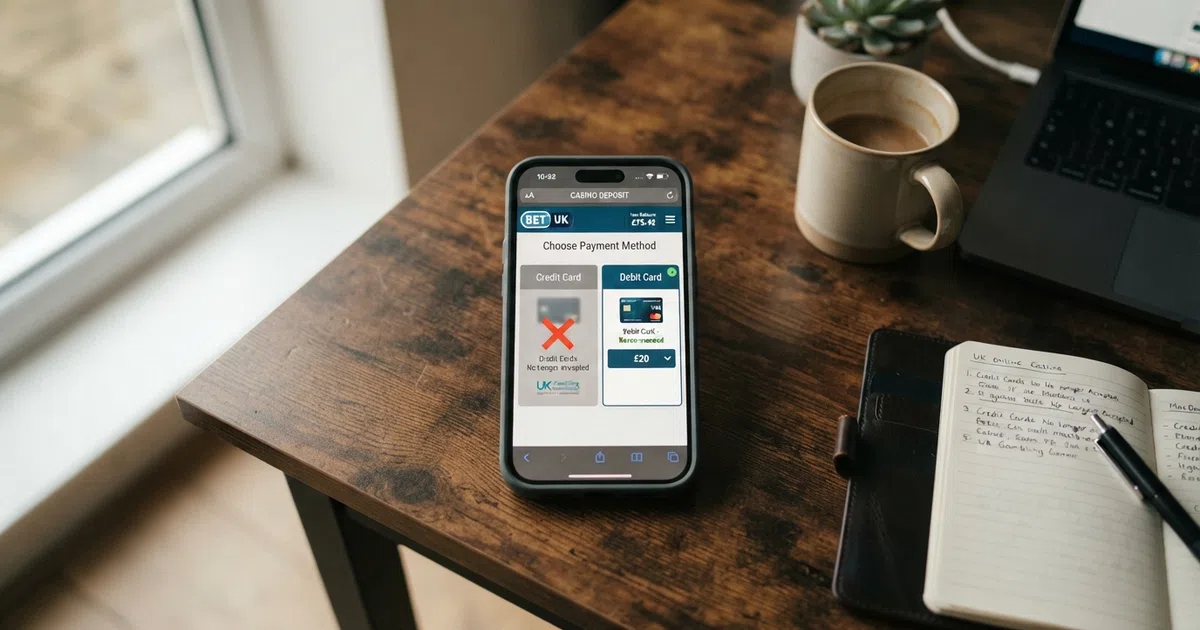
Data current as of September 8, 2026, verified against the Gambling Commission’s public register and LCCP licence conditions.
Why Finding a UK Casino That Accepts Credit Cards Takes You Straight Past the Licensed Market
The search itself contains the answer. A UK player typing “casino sites that accept credit card uk” is looking for something the domestic licensed market has been ordered not to provide. Since April 2020, the term has pointed in one direction: offshore.
What a Credit Card Casino Actually Is — and What It Is Not
In UK search results today, a “credit card casino” means one thing: an online casino that will accept a Visa or Mastercard credit card deposit. The phrase is a payment-method descriptor, not a brand of operator. A GB-licensed casino describing itself as a “credit card casino” would be describing a breach of its licence condition, and the Gambling Commission treats the matter that way.
The distinction from a debit-card casino is the whole point. A debit card spends money the player already has. A credit card spends the card issuer’s money, with interest, fees, and the credit limit’s own ceiling. The UK’s ban turns on that difference: it is a ban on gambling with borrowed money, not on card payments in general. E-wallets were caught in the same net — the Gambling Commission closed the routing loophole explicitly, requiring e-wallet providers to prevent credit-card funding for gambling or stop serving GB customers altogether.
The Pre-Ban World and the Post-Ban Reality — What Changed Overnight
Before 14 April 2020, a UK player with a credit card could open an account at any major UK-licensed operator, deposit instantly, and play. The cashier showed credit alongside debit, PayPal, and bank transfer as standard options. The 2018 UKGC consultation that produced the ban was the first time most players heard there was a question to answer; the answer arrived two years later, in the middle of the first pandemic lockdown, and it was definitive.
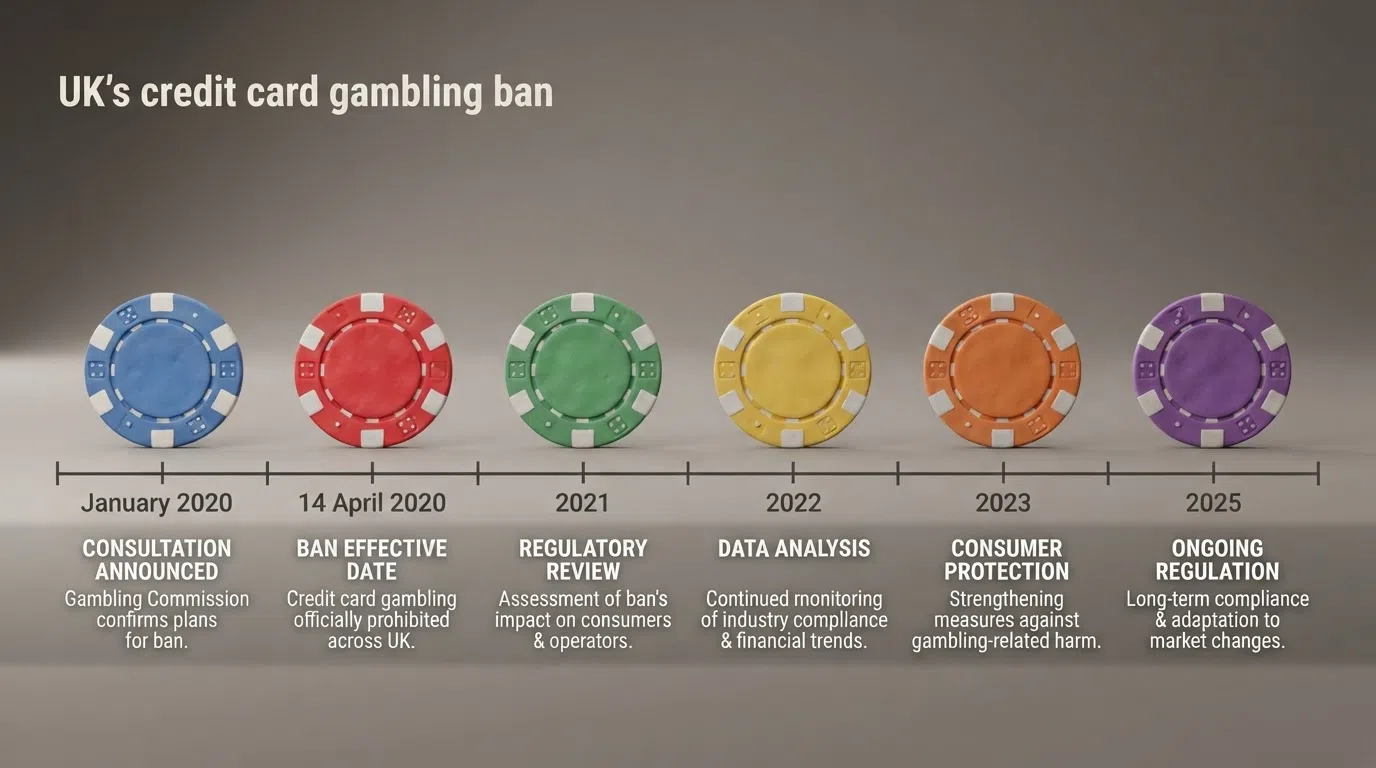
The 22% problem-gambler finding from the consultation sat behind the policy. A player using a credit card to gamble online was found to be a problem gambbler at more than four times the rate of the general online-gambling population. The Commission’s own framing of the ban was unsentimental: “We have banned gambling on credit cards to keep people safe and to avoid spending money that they may not have.” The press release on 14 April 2020 read almost identically: “In January, the Gambling Commission and the Department for Culture, Media and Sport (DCMS) announced the widely-publicised ban — meaning that from today any consumer gambling will not be able to use a credit card as payment.”
That single sentence ended credit card play at every GB-licensed cashier. Offshore operators, which had never been inside the perimeter, simply continued taking the deposits that the licensed market now had to refuse.
Why This Page Exists — What the Reader Is Actually Searching For
The intent behind the search is hybrid. The reader wants to deposit with a credit card and has discovered the GB-licensed market will not let them. They need to know why, in the informational sense, and they need to know which sites still take their card, in the transactional sense. Both needs are real, and serving only one would leave the page half-done. The lead is honest about both: GB-licensed casinos cannot accept credit cards, and the sites that do operate outside the UKGC framework. The rest of the page covers what that second sentence means in practice.
The UK’s Card-Payment Ban — What It Covers, Why It Was Introduced, and Where It Does Not Reach
The ban is the central legal fact for everything on this page. Without it, there is no market for offshore credit card casinos aimed at UK players; with it, the market is what the search returns.
Why the UK Banned Credit Cards for Gambling — the 22% Problem-Gambler Finding
The evidence base was the Commission’s own consultation. Among online gamblers who used credit cards, 22% were classed as problem gamblers — a rate that, in a regulator’s language, demanded action rather than advice. The policy objective was to remove a payment method that lent itself to spending money the player did not have at the moment of wager. The same logic had already been applied to non-remote casinos, bingo halls, adult gaming centres, and family entertainment centres, where credit cards had been barred in stages over the previous decade. The 2020 measure closed the remaining gap: remote gambling, where the bulk of UK play had migrated.
The Department for Culture, Media and Sport and the Gambling Commission announced the measure jointly in January 2020, three months before the effective date. The three-month runway gave operators time to strip credit card options from their cashiers, payment providers time to update merchant category coding, and consumers time to read the coverage. The first day of the ban, 14 April 2020, was a Tuesday.
When the Ban Took Effect and Exactly What It Prohibits
LCCP 6.1.2 has been in force since 14 April 2020. The wording is total: a GB-licensed operator may not accept payment for gambling by credit card, in any product category. The full coverage is:
- All remote gambling — betting, casino, gaming, lotteries
- All non-remote betting
- Any payment routed through a money service business (e-wallet) where the e-wallet was funded by a credit card
- The single remaining exception: non-remote lottery, where credit cards may still be used because lottery terminals share their merchant account with non-gambling products in many retail settings
The e-wallet clause is the one most searchers miss. A player who tried to fund a PayPal or Skrill wallet with a credit card and then use that wallet at a UK casino was using borrowed money to gamble, and the ban was drafted to cover that path explicitly. E-wallet providers serving GB-facing operators must now refuse credit-card funding for gambling, or stop being usable at UK sites at all.
The Gambling Commission’s Enforcement Powers — What They Can and Cannot Do
The UKGC’s enforcement toolkit against unlicensed operators is built around disruption, not blocking. Between April 2024 and June 2025, the Commission issued 3,140 disruption notices and referred 447,778 URLs to search engines, of which 287,961 were ultimately removed. Across 160 disrupted sites, engagement fell by an average of 32%. These are real numbers from a real enforcement budget, paid for since 6 April 2025 by a statutory levy that takes 1.1% of gross gambling yield from remote casino operators.
What the UKGC does not have is statutory power to compel ISPs or DNS providers to block access to unlicensed sites. Legislation has been proposed; it has not been enacted. A Curaçao-licensed casino that takes UK players is, in the formal legal sense, providing gambling facilities without a GB licence, which is a section 33 offence carrying up to 51 weeks’ imprisonment and an unlimited fine — but the sanction is aimed at the operator, not at the player. No player has been prosecuted for gambling on an unlicensed site; the architecture of enforcement assumes the player is the one being protected, not the one being punished.
Non-GamStop and Offshore Casinos That Still Accept Credit Cards — Why They Can
“Non-GamStop” is shorthand for a simpler fact: the casino is not licensed in Great Britain. Without a GB operating licence there is no obligation to participate in GAMSTOP, no obligation to honour LCCP 6.1.2, and no obligation to refuse credit card deposits. Most featured operators are licensed in Curaçao — the GCB regime that took its current shape in 2023 — and operate from there. A Curaçao licence authorises the operator to take payment from wherever its customers are, subject to Curaçao’s own rules, which do not include a UK-style credit card prohibition.
The practical consequence: a player who wants to use a credit card at an online casino in 2026 is funnelled, by the ban’s design, to sites the UKGC cannot reach. GAMSTOP cannot reach them either. The self-exclusion register, mandatory for every GB-licensed online operator since 31 March 2020, does not cover a single Curaçao-licensed brand.
What a Player Gives Up Outside the UKGC-Licensed Market — the Full List
The protections forfeited by playing offshore are not abstract. They are concrete mechanisms, each tied to a specific piece of UK regulation:
- GAMSTOP self-exclusion, the only multi-operator self-exclusion scheme in Great Britain, mandatory for GB-licensed online operators since 31 March 2020, with six-month, one-year, five-year, or five-year-with-auto-renewal periods that cannot be cancelled early
- The UKGC complaints route and an approved Alternative Dispute Resolution provider, which a player can use to escalate a dispute without paying for a lawyer
- Statutory stake caps on online slots — £5 per game cycle for players aged 25 and over, £2 for those aged 18 to 24, in force from April and May 2025 respectively
- Mandatory financial limit prompts before a first deposit, in force from 31 October 2025, with a gross-deposit-limit standard taking effect on 30 September 2026
- Financial vulnerability checks at a £150 net-deposit threshold over a rolling 30 days, using publicly available data on county court judgments, bankruptcies, and individual voluntary arrangements
- British consumer-law redress through the small-claims process if funds are withheld without a contractual basis
- Reality checks, time-out tools, and reverse-withdrawal bans, all GB-mandated and absent offshore
The list reads long because it is long. A player moving from a UK-licensed cashier to a Curaçao-licensed one is not changing a logo; they are leaving a system.
Credit Card Casino Sites Operating Outside the UK Licensing Framework — Ranked and Compared
The ten operators below are the result of a structured research pass. They are the brands that, in the sources reviewed for this page, appeared most often as accepting UK players with credit card deposits, and whose terms could be verified. None holds a GB licence. All operate from outside the UKGC perimeter. The comparison table ranks by research priority; the write-ups that follow are grouped by topic, not by position, so the reader can compare like with like.
| Casino | GB Licence | Offshore Licence | Welcome Bonus | Wagering | Free Spins |
|---|---|---|---|---|---|
| Donbet | None | Curaçao | 150% up to €750 | 30x deposit + bonus | 50 |
| Rolletto | None | Curaçao | 150% up to €500 | 30x bonus | 200 |
| Goldenbet | None | Curaçao GCB | 300% up to £1,500 across 3 deposits | 35x bonus funds | 100 |
| MadCasino | None | Curaçao GCB #161333 | 100% up to £1,500 | 35x | 300 |
| Freshbet | None | Curaçao | 300% up to £3,000 across 3 deposits | 40x | 200 |
| Winstler | None | Curaçao 5536/JAZ (Favorit United N.V.) | 600% up to £9,500 | Not confirmed | — |
| Bilucky | None | Not confirmed | Not confirmed | 40x | — |
| WinBeast | None | Not publicly displayed | Up to £3,000 across 3 deposits | 40x deposit + bonus | 300 |
| CasinOK | None | Curaçao | 300% | €2,000 fixed on FS winnings | 777 |
| Emperia Casino | None | Not confirmed | 450% across 4 deposits up to £3,000 / €3,500 | 35x deposit + bonus / 40x FS | 325 |
How We Evaluate Offshore Credit Card Casinos — the Criteria That Separate the Serviceable from the Risky
The first filter is licence verifiability. A Curaçao GCB licence with a public licence number — MadCasino carries #161333, Winstler operates under master licence 5536/JAZ — is a different signal from a brand that does not display any licence at all. The latter is not automatically illegitimate, but the reader deserves to know the difference.
The second filter is bonus fairness, and here the comparison against a GB-licensed baseline is sharp. From 19 December 2025, wagering requirements on bonuses at GB-licensed operators are capped at 10x the bonus amount, with mixed-product promotions banned outright. The featured offshore set runs from 30x to 40x, with some operators applying the multiplier to deposit plus bonus rather than to the bonus alone. The arithmetic is unforgiving: a 30x multiplier on deposit plus bonus is closer to 60x the bonus amount, three to four times the GB ceiling. The numbers are not comparable and the page will not pretend they are.
The third filter is payment transparency: minimum deposit, maximum per transaction, withdrawal time, and any withdrawal cap. Winstler’s tiered caps of €1,000 per day, €2,500 per week, and €10,000 per month are a different product from MadCasino’s open-ended card withdrawals. A player with a five-figure balance needs to know which one they are dealing with.
Game provider mix and slot count are the final filter, used as a proxy for platform maturity. An 8,000-title library, like the one WinBeast claims, is assembled from dozens of providers and represents a real aggregator agreement; a smaller library is not automatically worse, but the larger one has had more to prove.
What Those Headline Bonus Figures Really Cost — Offshore Wagering Multipliers Against the UK’s 10x Cap
The 10x cap is the benchmark everything offshore has to be measured against, because it is the deal a UK player would receive at a licensed site. A 30x wagering requirement on a Curaçao-licensed bonus multiplies the required turnover three times higher. A 40x requirement — Freshbet’s headline number, shared with Bilucky and WinBeast — multiplies it fourfold. On a deposit-plus-bonus basis, the effective multiplier doubles again.
The Rolletto bonus gives a worked example. A 150% welcome bonus up to €500 at 30x wagering on the bonus amount, with a €5 maximum bet per spin, requires the player to turn over €15,000 in qualifying bets to clear the bonus. At five seconds per spin and €5 per spin, that is 3,000 spins and roughly 250 minutes of play — about four hours and ten minutes of continuous wagering to release a €500 bonus. The UK equivalent at 10x would require €5,000 of turnover and roughly 1.4 hours of play. The 30x offshore multiple is not an aggressive outlier; it is the floor of the featured set.
| Scenario | Bonus | Wagering | Required Turnover | Spins at €5 | Hours to Clear |
|---|---|---|---|---|---|
| UK 10x (counterfactual) | €500 | 10x bonus | €5,000 | 1,000 | ~1.4 hours |
| Rolletto 30x (bonus) | €500 | 30x bonus | €15,000 | 3,000 | ~4.2 hours |
| Donbet 30x (deposit+bonus) | €750 | 30x on €1,250 | €37,500 | 7,500 | ~10.4 hours |
| Freshbet 40x (deposit+bonus, first stage) | £750 | 40x on £1,250 | £50,000 | 10,000 | ~13.9 hours |
Hours-to-clear is a mechanical estimate, not a profit forecast. The arithmetic shows the price of admission; it does not show the cost of playing through.
Donbet — 150% Welcome Bonus with a 30x Wagering Multiplier
Donbet is a mid-range Curaçao-licensed brand with a straightforward bonus. The headline offer is 150% up to €750 plus 50 free spins, with 30x wagering applied to deposit plus bonus at a €20 / €20 minimum. The deposit-plus-bonus structure means the effective multiplier is closer to 60x the bonus amount, not 30x; a player depositing €200 and receiving a €300 bonus has to turn over €15,000 to clear. Visa and Mastercard are accepted for both deposits and withdrawals. There is no GB licence, no GAMSTOP coverage, and no UKGC complaints route — Donbet sits squarely in the offshore bracket. The appeal is the combination of a familiar payment flow with a wagering multiplier at the lower end of the featured set.
Rolletto — 150% Bonus with 200 Free Staggered Spins and a €5 Maximum Bet
Rolletto runs a 150% match up to €500 plus 200 free spins released 50 at once and then 30 per day for five days on Candyland. The 30x wagering applies to the bonus amount — a meaningfully different structure from Donbet’s deposit-plus-bonus. A €5 maximum bet per spin during wagering and a 30-day bonus validity give a defined envelope. The free-spin staging is the unusual element: 50 of 200 land on day one, and the rest drip at 30 per day, so a player who clears the bonus in the first session still has 150 spins to come back for. Curaçao-licensed, no GB licence, no GAMSTOP.
Goldenbet — 300% Across Three Deposits Plus 100 Bonus Spins
Goldenbet stretches the headline higher: 300% up to £1,500 across three deposits plus 100 bonus spins, with 35x wagering on bonus funds. The first deposit carries the largest match; the second and third each add their own slice. Visa and Mastercard credit card deposits are accepted with a £10 minimum and a £2,000 per-transaction maximum — a higher ceiling than most of the featured set, useful for players moving larger balances in a single cashier visit. Licensed in Curaçao under the GCB regime. The three-deposit structure rewards players who plan to stay for the package, and penalises those who treat the first deposit as the only commitment.
MadCasino — 100% Welcome Package with 300 Free Spins and a £10 Minimum Deposit
MadCasino carries the lowest minimum deposit in the featured set at £10 and the highest free-spin count among standard welcome offers at 300. The match is 100% up to £1,500, with 35x wagering applied to the bonus. Card withdrawals take 24 to 72 hours, slower than Freshbet’s one-to-four-hour window but faster than the multi-day timelines some offshore brands still operate. The Curaçao GCB licence number (#161333) is publicly displayed, which is a meaningful signal in a market where some competitors do not show a licence at all. The £10 entry point is the lowest barrier to trying the platform; the wagering multiplier is not the lowest, so the package rewards players who deposit small and test rather than players who plan to clear the bonus in a single session.
Freshbet — 300% Three-Stage Package Up to £3,000 with the Highest Wagering in the Set
Freshbet’s welcome package is the largest headline total in the featured set at 300% up to £3,000 plus 200 free spins, but the 40x wagering is the highest multiplier in the set, and it applies on a per-deposit basis. The first deposit at 150% plus 100 free spins is the largest piece; the second at 100% plus 50; the third at 50% plus 50. A player taking the full package deposits across three sessions and is committed to all three. The £20 minimum per stage and the 1-to-4-hour card withdrawal time are the operational specifics. Curaçao-licensed, no GB licence. The package rewards the player who clears all three stages and is indifferent to the player who only takes one.
Winstler — 600% Welcome Bonus Up to £9,500 with Tiered Withdrawal Limits
Winstler runs the highest headline percentage in the featured set: 600% up to £9,500. The Curaçao master licence (5536/JAZ, operated by Favorit United N.V.) is publicly identified, and the bonus is paired with credit card and crypto deposit options and a £20 minimum. The wagering requirement on the bonus is not confirmed in the research available for this page, and that gap is noted here rather than guessed around. The withdrawal limits are tiered at €1,000 per day, €2,500 per week, and €10,000 per month — a player clearing a five-figure bonus will spend several months withdrawing at the monthly cap. The high percentage is the headline; the cashout pace is the reality.
Bilucky — Instant Card Deposits, 40x Wagering, and a £4,000 Per-Transaction Cap
Bilucky is built around Visa and Mastercard processing, with instant deposits, a £20 minimum, and a £4,000 per-transaction maximum — the highest single-transaction ceiling among the featured set. Card withdrawals are quoted at 1 to 3 business days. Bonus wagering runs at 40x, and free-spin winnings carry the same 40x. The offshore licence is not confirmed in the research for this page, and the reader should know that: a Curaçao, Maltese, or Anjouan registration is not visible in the public-facing material reviewed. The deposit mechanics are the strength; the missing licence record is the weakness.
WinBeast — £3,000 Welcome Package with 300 Free Spins and an 8,000-Game Library
WinBeast’s three-part welcome package reaches up to £3,000 plus 300 free spins, with 100 spins per deposit (taking roughly 8 minutes to play through) and 40x wagering on deposit plus bonus, with a £20 minimum deposit per part. The 8,000-game library is the largest catalogue in the featured set, supplied by aggregator arrangements with multiple providers. Daily withdrawal limits sit at £4,000 and monthly at £30,000, the loosest cashout ceiling among operators with confirmed limits. The licence is not publicly displayed, which is unusual for a brand of this scale and a fact worth weighing against the catalogue and the cashout terms.
CasinOK — 300% Package with 777 Free Spins and a €2,000 Fixed Wagering Hurdle
CasinOK’s welcome package is free-spin heavy: 300% match plus 777 free spins on Book of Witches by Thunderspin. The promotion carries a €100 minimum deposit for the free-spins element and a €2,000 fixed wagering requirement on the free-spin winnings, to be completed within seven days — a tighter window than the 30-day validity common elsewhere. A €5 maximum bet applies during the free-spin wagering. The standard bonus wagering is not stated in the research available for this page, and that gap is noted. Curaçao-licensed; the appeal is the free-spin count and the named provider; the risk is the seven-day clock on the wagering.
Emperia Casino — 450% Across Four Deposits with 325 Free Spins, Launched in 2026
Emperia is the newest brand in the featured set, launched in 2026, with a four-deposit structure that takes the player up to 450% plus 325 free spins across the package, capped at £3,000 or €3,500. Wagering is 35x on deposit plus bonus and 40x on free-spin winnings. The minimum deposit is £17 / €10 — the joint lowest in the set alongside MadCasino — and the maximum bet during wagering is £4. The offshore licence is not confirmed in the research for this page. Credit card acceptance is also not confirmed: the payment methods listed in public-facing snippets are ecoPayz, Neteller, Revolut, Paysafecard, bank transfer, and crypto, without an explicit Visa or Mastercard entry. The package is competitive on paper; the payment-method question is open.
How Credit Card Deposits Work at Non-UK Casinos — and Why They Cost More Than Debit
The mechanics of funding an offshore casino account with a credit card are familiar to anyone who has ever paid for something online, but the cost side is where the difference from a debit card opens up.
How a Credit Card Deposit Reaches an Offshore Casino — Step by Step
A player entering Visa or Mastercard details in the cashier of a Curaçao-licensed brand sends the transaction through the same card networks a GB-licensed operator would use, but to a different merchant. The offshore operator’s payment gateway sits in a jurisdiction where credit card gambling is not prohibited, and the merchant category code is set accordingly. Most featured operators credit the deposit instantly or near-instantly: Bilucky quotes instant deposits at a £20 minimum, MadCasino credits the balance as soon as the authorisation clears, and the larger brands sit in the same range. The funds appear in the player’s account as a balance, and play can begin.
The merchant category code matters more than the player might assume. Some UK card issuers treat gambling MCCs differently, and the difference between a transaction coding as a purchase and coding as a cash advance is the difference between standard purchase interest and cash-advance interest, which is usually higher and starts accruing immediately rather than at the end of the billing cycle.
Cash Advance Fees, Interest, and the Real Cost of Funding Play with Borrowed Money
The research available for this page does not carry a per-issuer breakdown of how UK card issuers treat offshore gambling transactions, so the picture is qualitative rather than numeric. The general UK practice, across major card issuers, is to charge a cash-advance fee — typically a percentage of the transaction with a stated minimum — and to start charging interest on the day the cash advance posts, with no interest-free period. A player who reads their card agreement’s cash-advance clause before depositing will know exactly what they are paying for the privilege; a player who does not, finds out on the next statement.
The contrast with a debit card is the point. A debit card spends the player’s own money; a credit card spends the card issuer’s money. On a debit card, the transaction either goes through or it does not, against the player’s current balance, with no interest. On a credit card, the transaction goes through against a credit limit, with interest, possibly a fee, and the question of whether the issuer classifies the merchant as a cash advance. The decision to use one over the other is a decision about whether the player wants to be paying for the right to play.
Deposit Limits, Minimums, and Maximums at Offshore Credit Card Casinos
The deposit floor across the featured set runs from £10 to £20, with MadCasino and Emperia tied at the lower end and most of the rest clustered at £20. The per-transaction maximum is the more useful number: Goldenbet caps at £2,000, Bilucky at £4,000, and most other featured operators sit in between or do not publish a maximum. None of them offers a UKGC-style mandatory deposit-limit prompt. The “set a financial limit before your first deposit” rule that took effect on 31 October 2025 at GB-licensed operators does not bind a Curaçao licence, and the gross-deposit-limit standard that takes effect on 30 September 2026 will not bind one either. A player who wants a self-imposed ceiling at an offshore site has to set it themselves, and there is no regulatory backstop reminding them to do so.
Alternatives to Credit Cards — What UK Players Use at Licensed and Offshore Casinos
The standard at GB-licensed sites is the debit card, supported by e-wallets, bank transfer, and Open Banking. PayPal, Skrill, and Neteller all remain available at UK-licensed operators, but they cannot be funded by a credit card for gambling — that part of the ban was tightened explicitly. Open Banking and pay-by-bank are the fastest-growing alternative in the UK market: the deposit lands from a bank account in seconds, the verification is built into the flow, and there is no card network involved at all.
At offshore sites, the payment menu widens. Cryptocurrency deposits are routine at most featured operators, and Winstler explicitly markets a credit-cards-and-crypto pairing. The trade-offs are predictable: crypto is faster and more private but lacks the chargeback pathway a Visa or Mastercard transaction offers; e-wallets are quick but add a layer between the bank and the casino; bank transfer is slow but universal; and the credit card itself is the only method that costs the player interest on the deposit. The choice is about which of those trade-offs the player cares about most.
Slot Games You Can Fund with a Credit Card — and the UK Protections You Leave Behind
The slot library at an offshore credit card casino is, in volume terms, larger than what a GB-licensed site can offer. The protective framework that surrounds a slot session at a UK site is, in coverage terms, entirely absent offshore. A player who understands the difference is the one making an informed choice.
Which Slot Providers and Titles Are Available at Offshore Credit Card Casinos
The featured operators are aggregators, sourcing games from dozens of providers under multi-license deals. WinBeast’s 8,000-title claim is the upper end of the range; CasinOK’s Book of Witches by Thunderspin is a single confirmed title in a research set that does not carry per-title RTPs for any slot. The provider mix at the larger brands includes the well-known studios, the smaller ones, and the names that exist almost exclusively on offshore skins. The research for this page does not carry RTP figures for any of these titles; a player who wants to know the return-to-player on a specific game will need to open the game’s information panel at the operator itself.
The qualitative point is that the volume is real but the per-title data is thin, and a reader comparing offshore slot libraries should weight the catalogue size against the absence of an RTP audit from a UK-facing regulator.
RNG Slots vs Live-Dealer Games — How Credit Card Funding Differs
RNG slots are the primary product at every featured operator. Bet ranges run from a few pence to several pounds per spin, and game speed is set by the operator rather than by a regulator’s spin-speed rule. Live-dealer tables — blackjack, roulette, baccarat, game shows — sit at higher minimums, typically £1 to £5 per bet on the standard tables and higher on the VIP variants. A player funding a live-dealer session with a credit card is committing to a higher turnover rate per hour than an RNG player, with the same interest cost on the deposit.
The GB-licensed protective framework does not bind the live-dealer product to the same stake caps as online slots, but the reality-check and time-out mandates still apply, and a session at a GB site stops itself at the operator’s configured interval. Offshore, the player is the only one managing session length.
What the UK’s Slot Stake Caps, Auto-Play Ban, and Spin-Speed Rules Would Have Stopped
The £5 per-spin cap for players aged 25 and over and the £2 per-spin cap for 18-to-24-year-olds, in force from April and May 2025 respectively, are the most visible protections a UK player leaves behind at an offshore site. The age-banded structure was designed to slow the pace of play for the cohort the data showed was most at risk of harm; the offshore market applies neither tier.
The auto-play ban — the function that lets a slot run continuously without player input — is also GB-mandated and absent offshore. The 2.5-second minimum spin speed, the ban on turbo-play, the ban on features that disguise losses as wins (sounds, visuals, near-miss design), and the permanent reverse-withdrawal ban all sit on the GB side of the line. A player used to those constraints may find the offshore product feels faster, louder, and more permissive. That is by design, because the offshore operator has no GB rule to comply with.
Responsible Gambling Without the UK Safety Net — What Offshore Card Play Stands to Lose
The safety net at a GB-licensed site is the cumulative product of a decade of regulatory tightening. At an offshore site, none of it applies. The help that is available to a UK player is still available, regardless of where the player gambles, and that help is the part of the page that matters most.

GAMSTOP, Deposit Limits, and Reality Checks — the UK Tools Offshore Sites Do Not Offer
GAMSTOP is the national self-exclusion register, mandatory for every GB-licensed online operator since 31 March 2020, with exclusion periods of six months, one year, five years, or five years with auto-renewal. A player who registers with GAMSTOP is excluded from every GB-licensed online casino, automatically, for the chosen period, and the period cannot be cut short. The register does not cover a single Curaçao-licensed brand, so the same self-excluded player can sit down at a featured operator and deposit with a credit card without any system-level block.
The financial limit prompt that took effect on 31 October 2025 — every customer must be asked to set a financial limit before a first deposit, and the offer to set it must be visible and unambiguous — is also GB-mandated and absent offshore. The financial vulnerability check at the £150 net-deposit threshold over a rolling 30 days, which uses publicly available data on county court judgments, bankruptcies, and individual voluntary arrangements to flag players who may be in financial distress, is the same: GB only. The reality checks that interrupt a long session, the time-out tools that lock an account for a cooling-off period, the ban on reversing a withdrawal back into a playing balance — all GB, all absent offshore.
The Scale of Gambling Harm in the UK — Why These Protections Were Built
The 22% figure that triggered the credit card ban is the most cited single statistic in the policy debate, but it is not the only one. The National Gambling Helpline, run by GamCare, received 55,228 calls and online chats in 2023-24 — a record year, up 25% on the previous one. NHS gambling referrals in England totalled 4,355 in 2024/25, up 91% on the year before. GamCare made 996 referrals to treatment and peer-based support services in January 2026 alone, up 48% year-on-year. The National Gambling Support Network treated 11,960 clients in 2024/25, an 11% increase.
The prevalence survey that sits behind these treatment numbers is the Gambling Survey for Great Britain. In its 2025 wave, 47% of adults reported gambling in the past four weeks; 38% had gambled online. Around 0.5% of the English adult population experience problem gambling, with a further 3.8% at elevated risk, and an estimated 7% — around 4.3 million adults — are negatively affected by someone else’s gambling. The reason the UK built the protective framework it has, and the reason the credit card ban was the first measure in it, is that the population-level data justifies the cost.
Where to Get Help — Helplines, Tools, and Support Services Any UK Player Can Use
The help infrastructure is available to every UK player regardless of where they play. The National Gambling Helpline, run by GamCare, is free, confidential, and available 24 hours a day on 0808 8020 133. The same number takes online chats. GamCare also runs free counselling sessions, group sessions, and a self-assessment tool for players who want to evaluate their own play before it becomes a problem. The NHS operates gambling harm clinics in England, Scotland, and Wales, and the 4,355 referrals in 2024/25 represent patients the helpline or a GP routed into structured treatment. GambleAware funds the National Gambling Support Network, which treated 11,960 clients in 2024/25 and offers a directory of local services.
GAMSTOP registration is the self-exclusion route for GB-licensed online operators; it does not reach the offshore sites on this page, but it does reach every UK-licensed alternative. A player who registers with GAMSTOP and then moves offshore is not protected by the registration, but is still able to use the helpline, the counselling, the NHS clinics, and the rest of the support infrastructure. The tools and the treatment do not depend on where the gambling happens.
How We Evaluated and Selected the Operators on This Page
The research pass for this page drew on operator websites, affiliate review sites, the Gambling Commission’s public register, and the regulator’s own published guidance. The first filter was licence status: any brand verified as holding a GB operating licence was removed from the featured set, because no GB-licensed casino accepts credit cards. The second filter was credit card acceptance verified at the cashier level or in multiple recent independent reviews. The third filter was bonus terms collected from the operator’s own terms-and-conditions page, with the wagering multiplier, the qualifying deposit, the maximum bet during wagering, and the bonus validity period cross-checked across at least two sources where possible.
The scope limitation is worth stating. The ten operators on this page are the result of the research pass, not the entire offshore market. Brands that accept UK players with credit cards and were not reviewed for this page are not implicitly criticised by their absence; they simply were not in the source material consulted. A player who chooses an operator not on this list should apply the same checks the research applied: licence status, bonus terms, withdrawal time and caps, and the operator’s track record over a meaningful period.
What Every UK Player Should Weigh Before Funding an Offshore Casino with a Credit Card
The honest summary is shorter than the page that precedes it. Credit card casinos exist because they sit outside the UK system, not because the ban has exceptions. There are no exceptions: every site taking a Visa or Mastercard credit card deposit from a UK player today is doing so from a jurisdiction the UKGC cannot directly police, and the player is the one funding that jurisdiction with their deposit.
What the player gains is the payment method they came looking for, plus higher deposit ceilings, looser bonus structures, fewer session-time constraints, and the absence of the GB-mandated stake caps and gameplay restrictions. What the player gives up is GAMSTOP coverage, the UKGC complaints route, an approved ADR provider, British consumer-law redress, the mandatory financial-limit prompt, the financial vulnerability check, reality checks, time-out tools, the auto-play ban, the spin-speed rule, the ban on losses disguised as wins, and the reverse-withdrawal ban. That is not a partial list; it is the full content of the UK player-protection framework that applies to online gambling in 2026.
The research that sits behind the ban found that 22% of credit-card-using online gamblers were problem gamblers. The research that sits behind every other piece of the framework found the same thing, in different measures: the 55,228 helpline contacts, the 4,355 NHS referrals, the 996 GamCare treatment referrals in a single month. The framework exists because the data justified it. A player choosing to step outside the framework is making that choice with the data on the page, and the help infrastructure — the helpline, the counselling, the NHS clinics, the self-assessment tools — is still there regardless of the decision.
The decision belongs to the player. The job of this page is to make sure the player makes it knowing what is behind the cashier, what is not, and what they have agreed to give up to be there.
Frequently Asked Questions
Can you still use a credit card at online casinos in the UK?
No UK-licensed online casino accepts credit cards — that has been the case since 14 April 2020 under LCCP condition 6.1.2. Every site that does accept credit cards today, including all the operators reviewed on this page, operates from outside the UK licensing framework, most commonly under a Curaçao licence.
Why did the UK ban credit cards for gambling?
The Gambling Commission found in its consultation that 22% of online gamblers who used credit cards were classed as problem gamblers, a rate high enough to justify intervention. The ban was framed as a measure to prevent gambling with borrowed money and to stop spending money the player may not have.
When did the credit card gambling ban start in the UK?
The ban took effect on 14 April 2020, following a joint announcement by the Gambling Commission and the Department for Culture, Media and Sport in January 2020. LCCP licence condition 6.1.2 was the legal vehicle, and it has been in force continuously since.
Are there any UK casinos that accept credit cards?
No. The credit card ban covers every product category licensed by the Gambling Commission except non-remote lottery, and it covers every GB-licensed operator without exception. Any site accepting UK players with credit card deposits is operating outside the UKGC perimeter, typically from Curaçao.
What payment methods can I use instead of credit cards at UK casinos?
Debit cards are the standard at GB-licensed sites, supported by e-wallets (PayPal, Skrill, Neteller), bank transfer, and Open Banking pay-by-bank services. None of these alternatives carries the credit-cost of a credit card deposit, and all of them remain available at every UK-licensed operator.
Is it safe to use a credit card at a casino that is not on GAMSTOP?
A non-GAMSTOP casino is, by definition, not licensed in Great Britain. Whether the experience is “safe” depends on the operator’s own conduct and the regulatory regime it answers to, but the UK player-protection framework — GAMSTOP, the UKGC complaints route, an approved ADR, the financial-vulnerability check, the stake caps, the auto-play ban — does not apply. The player is funding play with borrowed money on a platform outside the UK system.
What licence do credit card casinos hold if they are not UKGC-licensed?
Most featured operators are licensed in Curaçao, under either the GCB regime (with a publicly displayed licence number, like MadCasino’s #161333) or under a Curaçao master licence (like Winstler’s 5536/JAZ, operated by Favorit United N.V.). A Curaçao licence is not a substitute for a GB licence under the Gambling Act 2005 and the 2014 point-of-consumption reform.
Do credit card deposits at online casinos count as cash advances?
Whether an offshore gambling transaction codes as a cash advance depends on the card issuer’s treatment of the merchant category. The research for this page does not carry a per-issuer breakdown. The general UK practice, across major card issuers, is to charge a cash-advance fee and to start interest on the day of the transaction with no interest-free period. Players should check their card agreement’s cash-advance clause before depositing.
Can I use a credit card through an e-wallet like PayPal or Skrill at a UK casino?
No. The Gambling Commission closed the e-wallet routing loophole explicitly, requiring e-wallet providers serving GB-facing operators to prevent credit-card funding of gambling or stop serving GB customers altogether. Funding a PayPal or Skrill wallet with a credit card and then using the wallet at a UK casino is not a workaround; it is the case the rule was drafted to cover.
What protections do I lose by playing at a casino that is not on GamStop?
GAMSTOP self-exclusion, the UKGC complaints route, an approved Alternative Dispute Resolution provider, British consumer-law redress, statutory online slots stake caps (£5 for 25+, £2 for 18-24), the mandatory financial-limit prompt, financial vulnerability checks at the £150 threshold, reality checks, time-out tools, the auto-play ban, the spin-speed rule, and the reverse-withdrawal ban. The list is long because the UK framework is detailed, and every item on it applies only to GB-licensed operators.
Payments – realmoney-onlinecasinos-uk
Content created by the «realmoney-onlinecasinos-uk» team