
What a British Player Actually Gets at a VPN-Friendly Casino — and What the Licence Gap Costs
 Available in GB
A VPN-friendly casino is an offshore gambling site whose terms and registration flow are written so that a player routing traffic through a Virtual Private Network can register, deposit, and play without being asked to prove they are physically somewhere the operator is licensed to serve. The UK is the test case. The GB-licensed market is the most heavily regulated consumer gambling market in Europe, and every one of those regulations pushes a determined British player toward a casino the Gambling Commission cannot touch. That is the trade at the heart of this page: bigger bonuses, fewer identity checks, no GAMSTOP — and no UK complaint route when the operator decides to keep your balance.

This article lays out the ten operators that most frequently appear in search results for VPN-friendly casinos in the UK, the legal reality of using a VPN to reach them, the crypto payment systems that make this access possible, and the protection gap that opens the moment a player steps outside the GB-licensed system. Data current as of September 8, 2026, with licence claims checked against operator terms and the UK Gambling Commission’s public register.
Why UK Gamblers Are Routing Around the GB Licence in 2026
The Online Safety Act landed in July 2025, and the way British adults use the internet shifted almost overnight. Ofcom data published afterwards showed VPN use in the UK stabilising at roughly 40% above pre-July levels, and the Gambling Commission revised its illegal-market methodology upward to reflect the change. The Commission had built a 30% VPN adjustment into its disruption estimates; the Ofcom and Similarweb data pushed that figure higher. The surge in VPN adoption did not begin with gambling — but it carried gamblers with it, because the same infrastructure that lets a journalist reach a blocked news site lets a UK player reach an offshore casino.
Three forces are pushing British players toward VPN casinos. The first is GAMSTOP. The national self-exclusion register has been mandatory for every GB-licensed online operator since 31 March 2020, and by mid-2026 the scheme carried 614,738 active exclusions, with 117,756 new registrations during 2025 and under-25s now making up nearly one in three of all exclusions. GAMSTOP only covers GB-licensed operators. An excluded player who wants to keep gambling has to leave the GB system, and a VPN is the simplest way to do that. The second is the credit-card ban. Credit cards have been banned for gambling at GB casinos since 14 April 2020, and every GB operator must verify a customer’s name, address and date of birth before the first deposit. That makes anonymous play structurally impossible at any site holding a GB licence. The third is stake and bonus compression. From 9 April 2025 the GB online slots stake cap fell to £5 per game cycle for adults aged 25 and over, and from 21 May 2025 to £2 for adults aged 18 to 24. From 19 January 2026, GB bonus wagering requirements are capped at 10×. Players who want to spin at higher stakes, chase larger bonuses, or use the credit facility they already have, do not get what they want inside the GB perimeter.
The shape of the UK gambling market in 2026 reflects those pressures. Remote Gaming Duty rose to 40% from 1 April 2026, on top of a statutory levy of 1.1% of gross gambling yield introduced from 6 April 2025. The Commission’s disruption campaign against unlicensed operators — 3,140 disruption notices and 287,961 URLs removed from search engines between April 2024 and June 2025 — runs against an offshore market that keeps growing. The FCA reports that 12% of UK adults now own cryptocurrency, up from 10% in earlier findings. That same crypto-ownership figure is the demand-side signal for the VPN casino proposition: the payment rail and the access tool have moved into the same adult population.
Why UK Players Use a VPN for Online Casino Access
Three motives push a British player toward an offshore VPN casino, and they overlap. GamStop exclusion is the most-cited reason on gambling forums: a player who has registered for self-exclusion and then decides they want to keep gambling has a single, mechanical workaround in a VPN plus an offshore casino. The second is UKGC restriction fatigue. The £5/£2 stake cap, the 10× wagering ceiling, the credit-card ban, the KYC requirement, the reverse-withdrawal ban, the 2.5-second minimum spin speed, the auto-play ban, the losses-disguised-as-wins ban — every one of these rules improves consumer protection, and every one of them removes a feature a determined player used to have. The third is the size of the offers. Offshore welcome packages routinely sit at 200% to 400% with wagering multiples of 40× to 80×, packages that no GB-licensed operator can match under the 2026 bonus rules.
The post-2025 regulatory tightening accelerated all three motives. The Online Safety Act pulled VPN use into the mainstream; the 10× bonus cap removed the GB operator’s ability to compete on headline bonus value; and GAMSTOP exclusion numbers climbed through 2025 into 2026, with under-25s driving the growth. The 26% year-on-year rise in under-25 GAMSTOP registrations is the clearest demand-side signal that something is being routed around.
How a VPN Actually Works with a Casino Platform
A VPN tunnels the player’s internet traffic through a server in a location of their choice. The casino sees the server’s IP, not the player’s. If the server is in Frankfurt, the casino sees a German IP; if in São Paulo, a Brazilian one. That is the entire mechanism. Geo-checks at casino platforms work by comparing the connecting IP against known ranges — country-level IP allocations, datacentre IP blocks, residential IP ranges. Residential IPs, allocated to home broadband customers, are the hardest to spoof convincingly; datacentre IPs, allocated to cloud and VPN providers, are exactly what a casino geo-check is looking for. Datacentre IP ranges are flagged first, residential ranges flagged only after a player has been doing something the operator wants to investigate.
The chain breaks at specific points. A DNS leak reveals the player’s real DNS resolver to the casino’s geo-check. A WebRTC leak exposes the real local IP even when the tunnel is up. A kill-switch that fails to drop the connection when the VPN drops leaves the player briefly exposed on their real IP. Any one of these can produce a KYC freeze at the withdrawal screen. The documented user complaints show the consequences in plain language: a YetiCasino player reports being banned for using a Google Pixel’s built-in VPN without realising it was on; an IceCasino player reports losing their balance because a VPN was active during play; a BC.Game player reports being told they cannot withdraw after VPN detection. The detection does not have to be aggressive to cost a player their money. It just has to be there.
The UK VPN Casino Landscape at a Glance
The VPN casino market serving UK players is structurally offshore. Of the ten operators that appear most often in online searches for these sites, nine hold Curaçao licences (BC.Game under Anjouan sub-licence), one holds a Costa Rica data-processing licence that is not a gambling licence (Cryptorino), and one is variously reported as operating without a gambling licence at all (BetPanda). None of the ten appears on the UK Gambling Commission’s public register. The Curaçao regime is the workhorse: it issues master licences to a small number of holders, who then sub-license to operators; the Anjouan regime is a separate, smaller jurisdiction that several operators have moved to since the Curaçao restructure.
The UK side is being reshaped by the duty change and the levy. The 40% Remote Gaming Duty from 1 April 2026 is an operator-side tax that compresses GB margins and pushes the most aggressive promotional spend offshore. The 1.1% statutory levy on gross gambling yield, split 50% treatment / 30% prevention / 20% research, sits on top of the duty. The Commission’s enforcement budget runs through cease-and-desist notices, search-engine URL referrals, and registrar/host referrals. The Commission does not currently hold statutory ISP or DNS blocking powers — that legislation has been proposed but not enacted — and the disruption campaign’s published figures (3,140 notices, 287,961 URLs removed) are real but partial. The UKGC’s own blog describes the illegal market as evolving: trends include crypto-based payments, AI-generated branding, copied gaming content, and targeted social media promotions.
The demand side is shaped by the FCA’s 12% UK adult crypto-ownership figure and by the Commission tracking crypto payments as an emerging threat. The market is not static: the Commission is exploring a cryptoasset pathway through its Industry Forum, the Commission’s executive director Tim Miller said in February 2026 that this is a “tentative first step” with no timetable, and the chief executive Andrew Rhodes told the IAGR 2025 audience that any decision to license crypto gambling is a “government-level” one, because “once you open that door, you cannot close it.” The pipeline from demand to legal supply has not yet opened.
The VPN-Friendly Casinos UK Players Use — All Offshore, None GB-Licensed
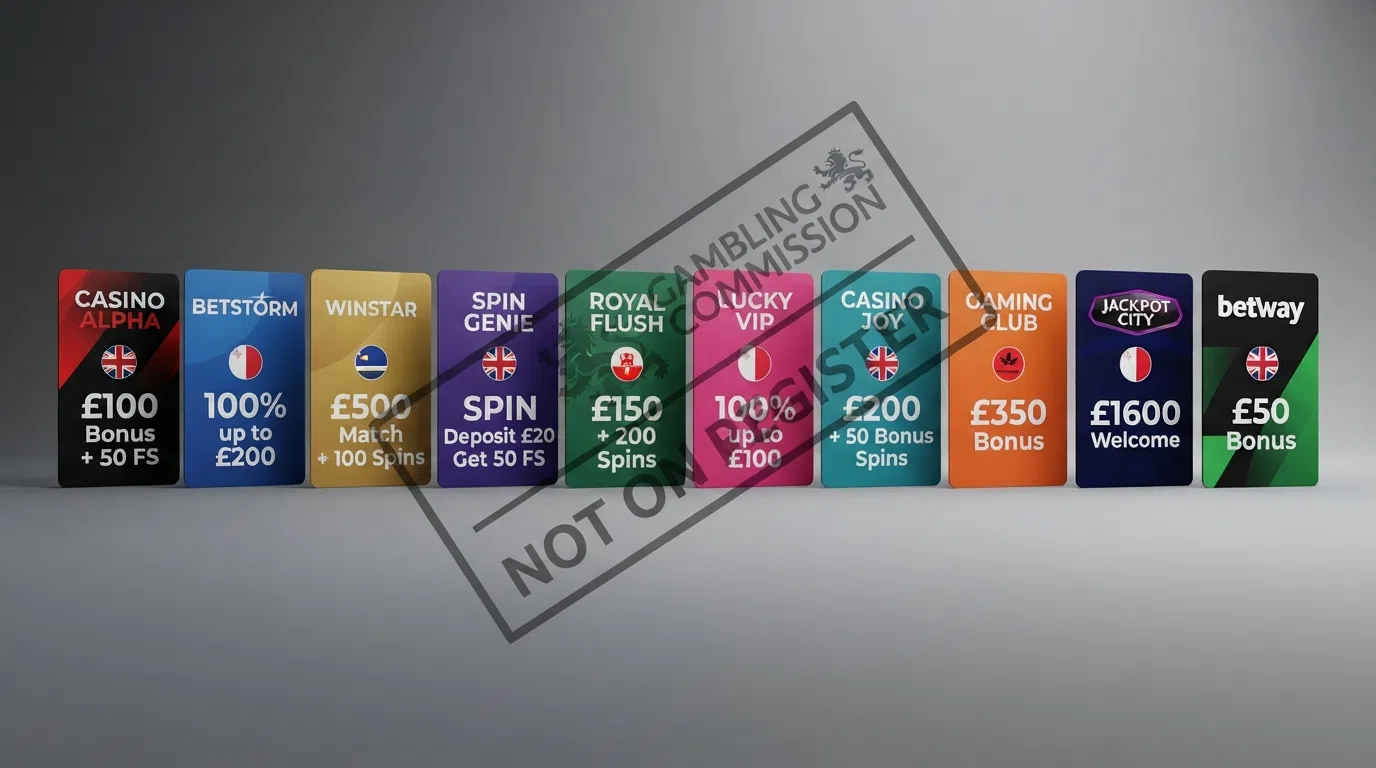
Every operator on this ranking sits outside the UK Gambling Commission’s perimeter. The ranking is built from the ten operators that appear most often in online searches for these sites — the same set that sites such as CasinoBonusWise, SlotsMummy, CasinoDetective and HotChip are featuring in their own top-10 lists. None of them is GB-licensed, and the implications carry through every comparison that follows: no GAMSTOP coverage, no ADR route, no Commission complaints path, no British consumer redress if funds are withheld. The ranking criteria are VPN policy explicitness, bonus fairness measured by wagering multiple, withdrawal-speed evidence, KYC burden, and the documented user complaint history. Game breadth sits in the background because, with one exception, every operator here carries between 3,000 and 7,000 games and the differences at that scale are not decision-relevant.
| Operator | Licence Jurisdiction | Welcome Bonus | Wagering Multiplier | VPN Policy | Withdrawal Speed |
|---|---|---|---|---|---|
| BC.Game | Curaçao (Anjouan) | 380% up to $4,000 across 4 deposits + 400 free spins | 40× | Tolerated | Instant (crypto) |
| Stake | Curaçao | 10% rakeback on losses | — | Tolerated | Instant (crypto) |
| Wild | Curaçao | Up to $1,000 multi-tier + free spins | 40× | Allowed | Under 10 minutes (crypto) |
| BetPanda | — | 100% up to 1 BTC | 80× | Welcomed | Instant (Lightning) |
| Cloudbet | Curaçao | $2,500 zero-wagering package over 30 days | 0× | Tolerated | Instant (crypto) |
| Jackbit | Curaçao (#1049) | 100 wager-free free spins on first deposit | 1× (effectively 0×) | Allowed (intentional policy) | Under 1 hour (crypto) |
| Bitcasino | Curaçao | Up to 10,000 USDT cashback over 7 days | 0× | Tolerated | Instant (crypto) |
| Cryptorino | Costa Rica (data-processing licence) | 100% up to 1 BTC | 66× | Required | ~20 minutes (crypto) |
| Flush | Curaçao | Up to $3,000 + daily free spins | — | Tolerated | Under 1 hour (BTC) |
| Gamdom | Curaçao | — | — | Tolerated | Under 10 minutes (crypto) |
The expected cost of converting BetPanda’s 1 BTC welcome bonus at 80× wagering, played on a slot at the Book of Dead default RTP of 96.21%, is roughly 3.032 BTC as expected loss. In plain terms: the player wagers the bonus 80 times, and the statistical cost of doing so — averaged over many spins under the stated assumptions — is around £0.0379 per £1 wagered. The figure is an estimate across spins, not a guaranteed outcome for any single session.
BC.Game: The 380% Giant with a KYC Trapdoor
BC.Game’s welcome package is the largest in the set: 380% across four deposits up to $4,000, with 400 free spins delivered as 100 spins on each of the first four deposits. The wagering multiple is 40× on bonus funds. The game catalogue runs to 6,000+ titles across Pragmatic Play, Evolution, Hacksaw and Push Gaming, and crypto withdrawals are instant. The VPN policy is the category these casinos most often fall into — “allowed/tolerated” — and the registration flow asks for an email and a password rather than the GB-licence baseline of name, address and date of birth.
The number to read carefully is the 40×. At 40×, a player wagering $1,000 in bonus funds must place $40,000 of bets before the bonus becomes withdrawable. At the default Book of Dead RTP of 96.21%, the expected loss across that turnover sits at roughly £0.0379 per £1 wagered, which works out to around $1,516 in expected loss across the rollover. That is the marketing headline’s arithmetic: 380% sounds like the casino is paying you; 40× says the casino is taking a percentage on every spin until you have done the equivalent of forty full deposits of play. BC.Game is the bonus that pays you the most and costs you the most to clear.
The other number to read is the trapdoor. BC.Game is repeatedly cited in forum complaints — most prominently on GamblersDen — for blocking player accounts at the moment of withdrawal with KYC demanded post-VPN detection. The licence is Curaçao, issued via Anjouan. There is no UK consumer redress if the casino decides to keep the balance. The trade-off is structural: BC.Game pays the biggest bonus and gives the smallest reason to believe it will pay out.
Stake: The Rakeback Model with a UKGC Consumer Notice
Stake.com does not run a welcome bonus in the conventional sense. Its headline offer is 10% rakeback on losses, structured as an ongoing return rather than a one-time deposit match. There is no wagering multiplier because there is no bonus to wager. The game catalogue runs to 3,000+ titles including the Stake Originals in-house range, and crypto withdrawals are instant. The VPN policy is “tolerated.” The licence is Curaçao.
What makes Stake structurally different from the rest of the ranking is the UKGC’s position. The Commission has published a consumer notice regarding Stake leaving the GB market — the closest thing to an explicit official warning that one of these operators carries. The notice does not prevent a UK player from reaching Stake through a VPN, but it is the clearest evidence that the regulator considers Stake a brand UK players should not be transacting with under the GB regime. The “rakeback on losses” model — paying back 10% of what the player has already lost — is a marketing re-frame of the same edge every casino carries. The word “rakeback” makes a refund sound like a reward; the arithmetic is identical to every other operator’s edge minus a smaller slice of it returned to the player.
Wild: The Rapid-Withdrawal Contender with Timed Free Spins
Wild.io runs up to $1,000 in welcome bonus across multiple tiers, with 40× wagering on the bonus amount and a 7-day bonus validity. Free spins are released in five sets — one immediately, then one every 24 hours — which is a structural pressure on the player to log in daily through the bonus week. Crypto withdrawals sit under 10 minutes. The game catalogue runs to 4,000+ titles across Pragmatic Play, Evolution and BGaming. The licence is Curaçao, and KYC is light for standard crypto play.
The number that does the work here is the timed free spins release. Five daily batches means five login events across seven days, which is five chances to forget the time budget and five chances to chase a release that lands in a session you had already closed. The 7-day validity sits on top of that, so missing a day pushes the player toward the bonus expiry. The 40× wagering is in line with BC.Game’s band — meaningful, but not the most aggressive in the set.
BetPanda: The No-KYC, 80× Wagering Heavyweight
BetPanda’s headline figure is 100% up to 1 BTC, paired with 80× wagering inside a 7-day window. The 80× is the highest multiplier in the ranking. The game catalogue runs to 7,000+ titles. KYC is not run at registration, although the operator reserves the right to request verification after large wins. Bitcoin Lightning Network is supported for withdrawals, which is the technical reason crypto cashouts are instant. The licence status is the weakest in the set — variously reported as operating without a gambling licence at all — and VPN use is welcomed.
The 80× number says most of what needs to be said about the bonus. A 1 BTC welcome bonus at 80× requires 80 BTC of wagering before withdrawal. At a slot’s default 96.21% RTP, the expected cost of clearing that turnover is roughly 3.04% of the bonus turnover as expected loss — across spins, not across sessions. The 7-day window sits on top: the player has a week to push through 80 BTC of bets or lose the bonus. That compression is the difference between a bonus you can casually clear and a bonus you have to grind.
Cloudbet: The Zero-Wagering Pioneer
Cloudbet’s $2,500 welcome package is structured differently from the rest of the ranking. The package combines a 10% rakeback element with cash drops over a 30-day window, and the headline wagering requirement is 0× — every reward is real cash, withdrawable from the moment it lands in the account. The game catalogue runs to 3,000+ titles across Microgaming, Evolution and Betsoft. The licence is Curaçao, and KYC is minimal for standard crypto play.
Cloudbet is the structural opposite of BC.Game. BC.Game pays the biggest bonus and charges the most to clear it; Cloudbet pays a smaller headline and charges nothing to keep it. For a player who wants a bonus that does not have to be ground through, Cloudbet is the obvious choice. For a player who wants the largest headline figure and is willing to take the wagering cost, BC.Game still wins on raw offer size. The two operators define the band the rest of the ranking sits inside.
Jackbit: Wager-Free Spins and a Monero Privacy Layer
Jackbit’s headline offer is 100 free spins on Hot Chilli Bells on first deposit, with a 1× wagering requirement on deposit and winnings — effectively wager-free in practice. The minimum deposit to trigger the spins is £50. The game catalogue runs to 6,000+ titles, and Monero (XMR) deposits are supported, which adds a second anonymity layer on top of the VPN itself. The licence is Curaçao, licence number 1049 cited in some reviews. KYC is rarely run; crypto withdrawals sit under one hour.
Jackbit is the only operator in the ranking that explicitly treats VPN use as an intentional policy rather than a tolerated workaround. The Monero support is the technical signal: a privacy-coin deposit is a different shape from a Bitcoin deposit, and Jackbit has chosen to support it. The 1× wagering on the bonus sits at the bottom of the wagering band in the ranking; combined with Monero support and an explicit VPN policy, Jackbit is the operator that has done the most to align its terms with the privacy-first player.
Bitcasino: The Decade-Old Cashback Model
Bitcasino.io has been operating since 2014 as a Yolo Group flagship. The headline offer is up to 10,000 USDT in cashback over the first seven days, with 0× wagering on the cashback — every return is withdrawable cash from day one. The game catalogue runs to 5,000+ titles. The licence is Curaçao, and KYC has been field-tested as inactive on standard transactions: a 0.7 ETH deposit and a 0.08 ETH withdrawal completed without verification in published accounts. Crypto withdrawals are instant.
The decade of operation is the structural signal. Bitcasino has been running under the same brand since 2014, which is a longer continuous track record than any other operator in the ranking. That history does not make it safer — it remains offshore, unlicensed for GB, and outside any UK consumer-protection framework — but it does mean the brand has a longer paper trail than most of the offshore casino market. The cashback model puts it in the same structural band as Cloudbet: zero-wagering returns over a defined window rather than a large headline bonus with a high rollover.
Cryptorino: VPN-Required, 66× Wagering, No RG Tools
Cryptorino’s welcome bonus is 100% up to 1 BTC with 66× wagering. The licence is a Costa Rica data-processing licence, not a gambling licence. The game catalogue runs to 6,000+ titles from 70+ providers, and crypto withdrawals have been tested at around 20 minutes. KYC is not run. VPN use is not just tolerated — it is required to play from many regions.
Two facts make Cryptorino the operator with the sharpest edges. The first is the licensing status: a Costa Rica data-processing licence is not a gambling licence in any meaningful sense, and the operator is one of the few in the ranking that openly runs on the weakest jurisdictional claim. The second is the responsible-gambling position: Cryptorino publishes no responsible-gambling information at all — no deposit limits, no reality checks, no self-exclusion tool, no link to any help service. For a player who wants an offshore casino with no friction, that is the cleanest offer; for a player who wants even a baseline of harm-minimisation tools, it is the operator most explicitly absent. The 66× wagering sits in the middle of the ranking band.
Flush: The $3,000 Daily-Spins Package with Thin Data
Flush runs a welcome package of up to $3,000 plus ongoing daily free spins. The licence is Curaçao. BTC withdrawals sit under one hour in published tests. KYC is minimal. The VPN policy is “tolerated.”
The defining feature of Flush’s write-up is the gap in the data. Game-provider count is not confirmed from primary sources. The wagering multiplier on the welcome bonus is not confirmed. The bonus validity window is not confirmed. Flush earns its place on the ranking because it appears frequently in online searches for VPN-friendly casinos and offers a competitive headline figure, but the comparison carries more em-dashes here than for any other operator.
Gamdom: The Community-Rakeback Model with Gaps
Gamdom runs a 4,000+ game catalogue and is referenced in competitor lists as operating a rakeback model. The licence is Curaçao. Crypto withdrawals are referenced at under 10 minutes. The VPN policy is “tolerated.”
Like Flush, Gamdom’s write-up carries more gaps than the operators with confirmed bonus specifics. The welcome bonus is not confirmed from primary sources. The wagering multiplier is not confirmed. The bonus validity is not confirmed. KYC is not confirmed. Gamdom earns its place on the ranking because it is the kind of brand a UK VPN-casino player actually reaches for — but the comparison is honest about what is and is not documented.
Is It Legal to Use a VPN at an Online Casino from the UK?
The honest answer has three layers, and most search results stop at the first. The first layer is the VPN itself: VPNs are legal in the UK. The government and Ofcom have confirmed this, and no ban is being considered. The second layer is the gambling: online casino is legal in Britain when it is licensed under the Gambling Act 2005, and the UK Gambling Commission is the sole regulator. A GB licence is compulsory at the point of consumption — any operator serving customers in England, Scotland or Wales needs one regardless of where it is based. The third layer is the offence: under section 33 of the Gambling Act 2005, providing gambling without a licence is a criminal offence carrying up to 51 weeks’ imprisonment, an unlimited fine, or both. That offence sits with the operator, not with the player.
There is no confirmed penalty for a UK player who simply gambles on an unlicensed site. The player has not committed a criminal offence by placing a bet at an offshore casino. What the player has done is step outside every protection the UK has built for the licensed market. There is no ADR route, no Commission complaints path, no British consumer redress, no GAMSTOP coverage, and no statutory stake or bonus cap. The legal answer to “is it illegal” is “no, for the player.” The honest answer to “is it safe” is the rest of this article.
The UK Gambling Commission’s Position on VPN Use
The Commission has no specific VPN rule, and its Freedom of Information response confirms no specific recorded information on VPN policy. What the Commission does have is a set of identity and location rules that make VPN use at a GB-licensed casino a near-certain breach of the operator’s terms. LCCP Condition 17.1.1 requires customer identity verification before first deposit — that verification runs against the player’s real name, real address, and real date of birth. The Proceeds of Crime Act 2002 and the Terrorism Act 2000 require the operator to know where its customers are located. A VPN that hides location triggers the operator’s fraud and AML checks. The BritishGambler.co.uk advice is direct: turn your VPN off before gambling at a UK site.
The practical consequence is that VPN use at a GB-licensed casino is a ToS breach, and the operator can respond with account closure, transaction voiding, and fund forfeiture. The Commission does not have to write a VPN rule for the ToS breach to happen — the existing rules produce the breach by default.
What Casino Terms and Conditions Actually Say About VPNs
Every GB-licensed operator’s terms prohibit location-masking. A VPN that changes the apparent country triggers the location-verification rule, the operator’s fraud system flags the account, and the player is asked for verification they cannot provide — because the verification is precisely what the VPN was set up to avoid. The offshore operators that welcome VPNs carry their own version of the same clause, expressed differently. The distinction between a casino “allowing” VPN registration and honouring VPN withdrawals is the entire game. A player can register with a VPN, deposit crypto, and play for weeks without friction; the friction arrives at the withdrawal screen, where the operator’s right to demand KYC is the catch-out clause the marketing copy never mentions.
The documented complaints lay out the pattern. BC.Game has blocked accounts at withdrawal with KYC demanded post-VPN detection. IceCasino closed an account and lost the funds because a VPN was active during play. YetiCasino banned a player and forfeited winnings because the player’s Google Pixel had its built-in VPN switched on without the player realising. CryptoCasino.com closed a UK player’s account after VPN-based registration was detected during withdrawal verification. Every one of these complaints is the same shape: registration succeeded, play succeeded, withdrawal failed.
The Real Risks of VPN Gambling for UK Players — Beyond “Is It Illegal?”
The question most online guides answer is the wrong one. Legality is a red herring when the real risk is losing every pound in the account with no-one to call. The UK player at an offshore VPN casino has no ADR provider to escalate a complaint to, no Commission complaints route, no British consumer redress. The operator holds all the cards — it can close an account at any time and cite a VPN-detection clause, and the player has no forum to challenge the closure in. Funds forfeiture is the documented norm in the complaint record, not a rare edge case.
The GAMSTOP gap sharpens the risk. An excluded player who uses a VPN casino has removed the only safety net they activated. There is no second exclusion register, no UK-based self-exclusion that follows the player offshore, no Commission-mandated deposit limit that travels with them. The 614,738 active GAMSTOP exclusions at mid-2026 represent 614,738 people who chose to step out of gambling; an offshore VPN casino is the door back in for every one of them, with no UK regulator standing on the other side.
Why Crypto Casinos Are the Natural Home of VPN Play
Crypto payments and VPN access are two sides of the same coin. A crypto deposit does not carry a billing address. It does not carry a card number, a sort code, a name. The wallet address is pseudonymous at best and unlinked to a real-world identity by default. That single fact is why crypto casinos can run on light or zero KYC, and why GB-licensed casinos cannot replicate the model. The UK credit-card ban since 14 April 2020 and the KYC-before-first-deposit rule since May 2019 are designed to anchor every UK gambling transaction to a verified identity; crypto at an offshore casino deliberately dissolves that anchor.
The Commission’s own blog describes the illegal market as evolving: trends include crypto-based payments, AI-generated branding, copied gaming content, and targeted social media promotions. The Commission is tracking crypto payments as an emerging threat precisely because the payment rail is the structural enabler of everything else on this page. The Tim Miller Industry Forum statement in February 2026 was a “tentative first step” toward a licensed UK crypto-gambling pathway; the IAGR 2025 Andrew Rhodes remark — “once you open that door, you cannot close it” — frames the regulatory hesitation in a single sentence. The crypto-casino proposition exists because licensed UK supply has not yet been permitted to meet it.
How Crypto Payments Remove the KYC Friction That Blocks VPN Users
The mechanism is mechanical. A bank deposit at a GB-licensed casino routes through a UK-regulated payment processor, which runs fraud and affordability checks, which feed the operator’s KYC pipeline. A crypto deposit routes from a self-custody wallet to the casino’s deposit address, with no intermediary that knows the player’s real name. The casino receives a transaction hash and a wallet address; the casino does not receive a billing address or a verified identity. BetPanda registers the player with no KYC. Cryptorino registers with no KYC. Bitcasino has been field-tested at a 0.7 ETH deposit and a 0.08 ETH withdrawal without verification. The GB-licensed casino’s compliance infrastructure cannot be reproduced in this environment without rewriting the payment rail — and the payment rail is the thing that makes the offshore market work.
The flip side is the same fact from the other direction. No KYC means no consumer-protection infrastructure. The operator cannot be required to file a suspicious-activity report against a wallet it does not know the owner of. The player cannot file a consumer complaint through a Commission that does not know the player exists. The friction the GB system imposes on players is the same friction that protects them; removing the friction removes the protection.
Bitcoin, Monero and Privacy Coins: What Each Means for VPN Casino Players
Not all crypto is equal for privacy. Bitcoin is pseudonymous, not anonymous: the blockchain is public, every transaction is recorded, and chain-analysis firms can trace wallet flows to exchanges and to identities at the exchange boundary. A VPN plus a Bitcoin deposit is a meaningful layer, but the ledger trail is permanent. Monero (XMR) is structurally different. Stealth addresses and ring signatures make Monero transactions untraceable on the blockchain itself, which is why Jackbit’s support for XMR deposits is described in this ranking as adding a second privacy layer on top of the VPN. A VPN-plus-Monero stack is the strongest anonymity combination available at a VPN casino in 2026.
The FCA’s 12% UK adult crypto-ownership figure is the demand-side context. Twelve percent of UK adults hold crypto, and a non-trivial share of them hold privacy coins or know what privacy coins are. The Commission’s illegal-market tracking treats crypto-based payments as an evolving threat, and the structural reason is the payment rail’s resistance to the kind of traceability the UK compliance regime depends on.
The UK Crypto-Regulation Horizon and What It Means for Casino Access
The UK is exploring, not enacting. The Industry Forum request from Tim Miller in February 2026 was a “sensible pathway” exploration with no timetable attached. Andrew Rhodes told IAGR 2025 that any move to license crypto gambling is a government-level decision rather than a Commission-level decision. The Commission’s blog has acknowledged that the illegal market is evolving toward crypto payments and that the regulator is watching the space. None of this is a commitment to license a UK crypto casino in 2026, and the absence of a timetable is the clearest signal on the page.
A licensed UK crypto casino would, in principle, collapse several of the trade-offs on this page. The KYC gap closes because the GB licence brings identity verification back. The protection gap closes because the GB licence brings GAMSTOP, ADR, and Commission complaints back. The bonus and stake compression remains. The crypto payment rail becomes available inside the regulated perimeter rather than only outside it. That is the future state the regulator is approaching slowly; the current state is the offshore casino market as it actually operates.
Which VPN Service Works for Online Casino Play?
Not every VPN survives a casino’s geo-detection. The service the player picks determines whether the casino session plays out or whether the account gets flagged at the withdrawal screen. Live dealer games drop on latency; video slots stutter on bandwidth; the casino’s geo-check runs on the connecting IP. A VPN that fails any one of these tests produces a session that does not work, and a VPN that succeeds at the connection but fails the geo-check produces an account that pays out one day and freezes the next.
Industry consensus names four paid services as the recommended set for casino play: NordVPN, ExpressVPN, Surfshark, ProtonVPN. Every one is a paid product. Free VPNs appear in online reviews rarely and with caveats — bandwidth caps, IP ranges already on casino blocklists, data-logging business models that sell browsing history. The shared recommendation across the top affiliate pages is paid, audited, no-logs, with a kill-switch.
The VPN Features That Casino Players Actually Need
- Audited no-logs policy — a no-logs claim that has been independently verified, not just one the provider prints on a marketing page.
- Kill-switch — drops the connection entirely if the VPN tunnel fails, preventing accidental exposure of the real IP during a drop.
- DNS leak protection — a single DNS leak reveals the player’s real IP to the casino’s geo-check and is enough to trigger a fraud flag.
- Server count and geographic spread — proximity to the casino-hosting jurisdiction reduces latency on live dealer games and provides a fallback if one server range is blocked.
- Dedicated IP availability — a residential IP address that no other player is using, which avoids the shared-IP problem that flags datacentre ranges.
Free VPNs vs Paid VPNs: What the Casino-Play Stakes Change
A free VPN that throttles bandwidth to 2 Mbps cannot sustain a live-dealer session. A free VPN whose business model is selling browsing data cannot be trusted with a player account. A free VPN whose IP ranges are on every casino blocklist produces an account that gets flagged at the first deposit. The consensus among reviewers is paid VPN only, and the reason is operational: a paid service maintains the dedicated infrastructure, the obfuscated servers, and the IP ranges that survive casino geo-detection. The pragmatic test is whether the VPN can hold a 30-minute live blackjack session without dropping. Free services fail that test on bandwidth; paid services occasionally fail it on configuration.
Why a VPN Alone Is Not a Substitute for Casino Due Diligence
A VPN gets the player through the door. It does not protect the money once the player is inside. A casino that welcomes VPN traffic can still withhold funds citing any clause it chooses — and the offshore casino’s terms give the operator broad discretion to do exactly that. The four documented user complaints in this ranking (BC.Game, IceCasino, YetiCasino, CryptoCasino.com) all involved withdrawal problems, not registration problems. The VPN is doing its job in each case; the operator is doing what its terms allow it to do.
The withdrawal-test principle is the only practical safeguard. Deposit small. Withdraw small. Then scale. The principle tests whether the casino actually pays out before the player commits a balance the casino can hold. Forum complaint history for the operator name plus “withdrawal” and “UK” is the second safeguard — the documented complaints above are not edge cases; they are the pattern.
Playing Safely When Your Casino Sits Outside the UK System
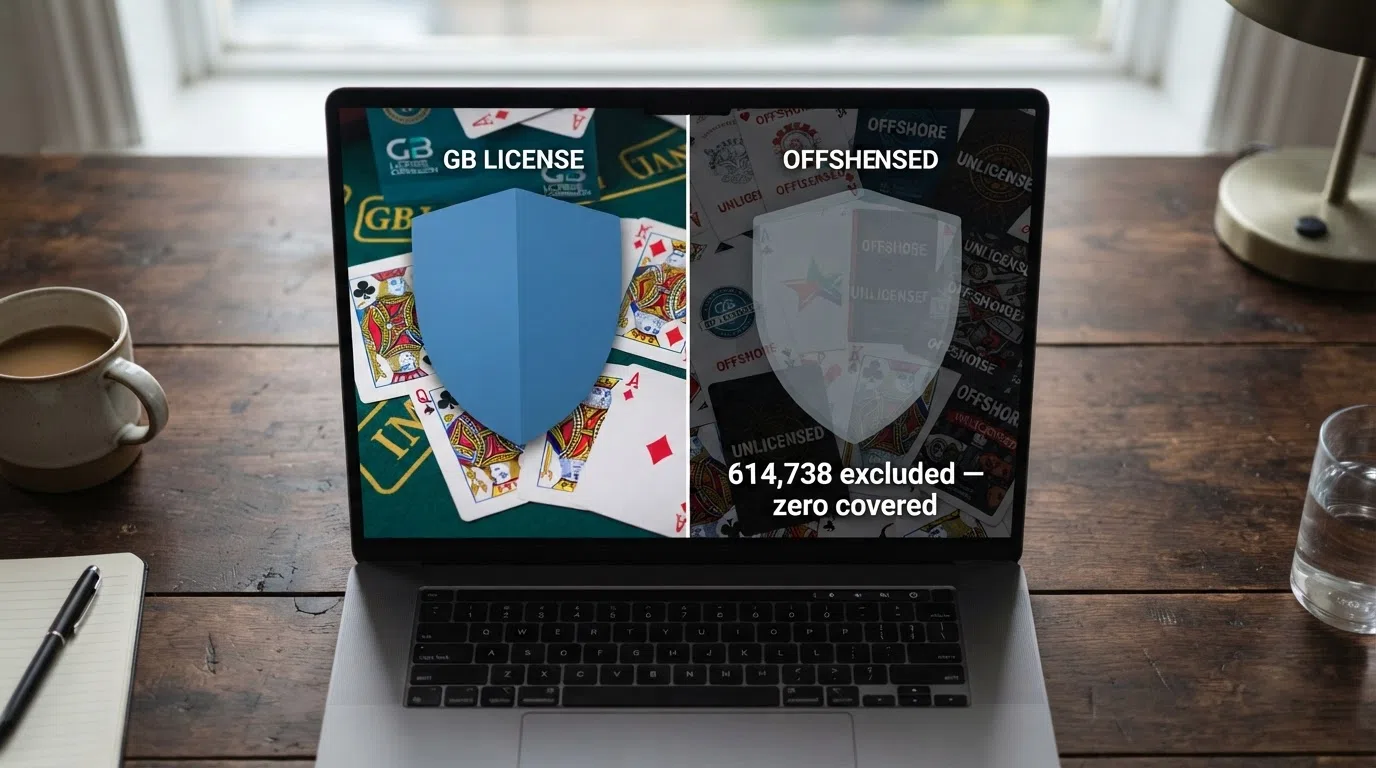
The UK has one of the world’s most structured player-protection frameworks, and every pillar of it disappears the moment a British player logs into an offshore VPN casino. GAMSTOP is the most visible pillar: 614,738 active exclusions at mid-2026, with 117,756 new registrations during 2025 and under-25s making up nearly one in three of all self-exclusions. None of those exclusions travel to an offshore casino. The deposit-limit regime, the reality-check regime, the time-out and self-exclusion tools, the financial vulnerability checks at £150 net deposits — all GB-mandated, all unavailable offshore. The Commission complaints route and the approved ADR provider route — both GB-anchored, both unavailable offshore.
The help infrastructure, by contrast, does travel. GamCare’s National Gambling Helpline operates independently of where the gambling happens. The NGSN treats around 11,960 clients per year, and the helpline receives around 55,000 calls and online chats annually. NHS gambling harm clinics run in England, Scotland and Wales. GambleAware funds treatment. Gamblers Anonymous runs meetings in person and online. None of these services is bound to where the player gambled.
GAMSTOP and VPN Casinos: The Protection Gap in Plain Numbers
GAMSTOP covers only GB-licensed online operators. The exclusion is mandatory for every GB licensee since 31 March 2020. The exclusion periods run to six months, one year, five years, or five years with auto-renewal, and the exclusion cannot be cancelled early. By mid-2026, 614,738 people were actively excluded, with 117,756 new registrations during 2025 alone and under-25s up 26% year-on-year. Nearly one in three of all self-exclusions now comes from the under-25 cohort.
Not one of those 614,738 exclusions follows the player to an offshore VPN casino. An excluded British player who uses a VPN casino has removed the only safety net they activated. The offshore casino has no equivalent of GAMSTOP — Curaçao and Costa Rica do not require multi-operator self-exclusion — and the offshore casino’s own responsible-gambling tools, where they exist, are not bound to a national register. The exclusion is the protection; the protection does not travel.
Responsible-Gambling Tools at Offshore VPN Casinos: What Exists and What Does Not
The GB-mandated toolset is dense by international standards: deposit limits, reality checks, time-outs, session limits, auto-play banned, losses disguised as wins banned, spin speed at a minimum of 2.5 seconds per game cycle, reverse withdrawals permanently banned, deposit-limit prompts at set thresholds. Every one of these is a regulatory requirement at GB-licensed casinos, and every one of them is the kind of friction a player who has moved offshore has chosen to leave behind.
The offshore provision is uneven. Some operators offer deposit limits voluntarily. Most do not. Cryptorino publishes no responsible-gambling information at all — no deposit limits, no reality checks, no self-exclusion tool, no link to GamCare, GambleAware or any other help service. The structural reason is jurisdictional: Curaçao and Costa Rica do not have an equivalent of the LCCP social-responsibility code. The voluntary provision is operator-by-operator, and the absence of a regulatory floor is the sharpest difference between the GB market and the offshore market.
Setting Your Own Limits When the Platform Will Not
When the casino does not enforce a deposit cap, the player has to. The most reliable mechanism is the crypto wallet itself: most wallets allow spending caps, address whitelists, and time-locks that prevent impulsive deposits. The practical step is to set the budget before opening the casino tab, not during the session. A budget set at the start of the day is a budget the player can defend; a budget set mid-session is one that has already been broken.
The UK help infrastructure is available regardless of where the gambling happens. GamCare’s helpline is open across all UK hours. NGSN treatment is available through referral. NHS gambling harm clinics run in England, Scotland and Wales. The 2.4% PGSI 8+ prevalence (GSGB 2025) and the 82% online-gambling disclosure rate on the GamCare helpline are the prevalence context: harm is not rare, and the help services exist because it isn’t.
UKGC vs Offshore: The Protection Gap Every British VPN Player Crosses
| Protection Feature | GB-Licensed Casino | VPN-Friendly Offshore Casino |
|---|---|---|
| GAMSTOP self-exclusion coverage | Yes (mandatory) | No |
| Approved ADR provider | Yes | No |
| Statutory stake caps (£5/£2) | Yes | No |
| Bonus wagering cap (10× from January 2026) | Yes | No |
| Mandatory KYC before first deposit | Yes | No (light or none) |
| Credit-card gambling ban enforced | Yes | No |
| Financial vulnerability checks at £150 | Yes | No |
| Mandatory responsible-gambling toolset | Yes | Varies (often absent) |
| Commission complaints route | Yes | No |
| British consumer redress if funds withheld | Yes | No |
| Reverse-withdrawal ban enforced | Yes | No |
| Spin speed floor (2.5 seconds) | Yes | No |
The right column is not “less protection.” It is structurally different protection: most rows read “no” rather than “weaker,” and a “no” on the ADR row means there is no forum to escalate a complaint to. The right column also reads “varies” on the responsible-gambling tool row, because the offshore provision is operator-by-operator rather than regulator-mandated. The table is the protection gap every operator write-up above has been building toward.
How We Selected and Ranked These VPN-Friendly Casinos
The ranking is built from the ten operators that surface most frequently in online searches for VPN-friendly casinos for UK players — the same set that the leading affiliate pages in this niche are featuring. The sources consulted were operator licensing pages and terms, the UK Gambling Commission’s public register (none of the ten appears on it), competitor analysis from sites including CasinoBonusWise, SlotsMummy, CasinoDetective, HotChip and IMAB, complaint forums at GamblersDen and Casino.guru, and the published data from GAMSTOP, GamCare, GambleAware and the UK Gambling Commission.
The ranking criteria, in order of weight, are VPN policy explicitness (an explicit “allowed” policy scores higher than a “tolerated” stance, which scores higher than “required”), bonus fairness measured by wagering multiple (0× and wager-free structures score highest, 80× scores lowest), withdrawal-speed evidence (instant and under-10-minute structures are weighted equally above 10 minutes), KYC burden (no KYC at registration is the structural fact the ranking is built around), and documented user complaint history (the four documented complaints above are weighted negatively). Game breadth sits in the background because every operator except Flush and Gamdom carries a confirmed 3,000+ to 7,000+ game catalogue.
The qualitative caveat is binding: this ranking compares the ten operators that appear most often in online searches for these sites, and it is not an exhaustive market survey. There are offshore casinos this ranking does not include, and the search results themselves are shaped by affiliate relationships rather than by regulatory standing. The ranking is what online search results look like in 2026, not what the offshore market looks like in total.
What You Should Actually Do About VPN Casinos in 2026 — Our Verdict
Three structural facts hold the page together. Every ranked operator is offshore and unlicensed for GB. The UK protection framework does not travel — no GAMSTOP, no ADR, no Commission complaints route, no British consumer redress — and the protection gap is not a smaller version of the GB regime; it is the absence of the GB regime. The bonuses at offshore casinos are larger than GB bonuses and cost more in expected loss; the zero-wagering offers exist because they are structurally cheaper to run than the 80× offers, and the 80× offers exist because the high rollover extracts enough from the player to fund the headline figure.
A player gains access, higher stakes, larger bonuses, and privacy. A player loses GAMSTOP coverage, ADR access, consumer redress, and the regulatory safety net. The trade is not symmetrical: the GB regime’s friction is the same friction that protects the player, and removing the friction is what removes the protection. The bonus numbers make the trade concrete. A 380% welcome bonus at 40× wagering produces an expected loss of roughly £0.0379 per £1 wagered across spins; an 80× bonus produces roughly £0.0304 per £1. The headline figure and the statistical cost move in opposite directions.
If the choice is to play anyway, the only responsible framing is to treat it as unregulated. Deposit only what the player can afford to lose in full. Test withdrawals with a small amount before scaling up. Treat every bonus as the marketing term it is and read the wagering requirement as the actual price. Know that the UK help infrastructure — GamCare’s helpline, the NGSN, NHS gambling harm clinics — is available regardless of where the gambling happens, and is the right first call if the budget stops holding. This is not a recommendation to play. It is a description of the landscape as it exists in 2026, and the landscape carries risk the UK system was built to remove.
Frequently Asked Questions
Can I get banned from a casino for using a VPN in the UK?
Yes — at a GB-licensed casino, VPN use almost certainly breaches the operator’s terms and can trigger account closure, transaction voiding and fund forfeiture. At an offshore VPN-friendly casino, the registration typically succeeds but the operator reserves the right to demand KYC at withdrawal, and documented complaints show accounts blocked at the cashout screen after VPN detection.
What happens to my money if a VPN casino blocks my UK account?
There is no UK regulatory recourse. The player has no ADR provider to escalate to, no Commission complaints route, no British consumer redress. The four documented user complaints in this ranking (BC.Game, IceCasino, YetiCasino, CryptoCasino.com) all ended with funds lost or forfeited after VPN-related account closures, and that pattern is the realistic expectation rather than an edge case.
Is my personal data safe at a no-KYC VPN casino?
The data a no-KYC casino holds is minimal by design — typically an email address and a wallet ID. The risk is on the wallet side: a no-KYC casino cannot be required to run AML checks against the wallet, and the player has no identity-verified complaint route if funds are withheld. The trade-off is structural: less data collected means less data exposed, but also less protection if something goes wrong.
Can UK authorities detect that I am gambling through a VPN?
The UK Gambling Commission does not currently hold statutory ISP or DNS blocking powers, so detection at the network level is not the mechanism. Detection runs through the operator: payment-provider tracing, KYC triggered at withdrawal, and the operator’s own fraud systems. The Commission’s enforcement model is disruption (cease-and-desist notices, URL referrals) rather than ISP-level blocking, and that model targets operators, not individual players.
What is the difference between a VPN-friendly casino and a non-GamStop casino?
A VPN-friendly casino has written its registration flow to allow VPN use — either explicitly or by tolerance. A non-GamStop casino is any operator not covered by GAMSTOP, which includes every offshore casino and excludes every GB-licensed casino. The two categories overlap: every VPN-friendly casino in this ranking is also a non-GamStop casino, but not every non-GamStop casino welcomes VPN use. GAMSTOP coverage is a function of the operator’s licence; VPN tolerance is a function of the operator’s policy.
What Makes a Casino “VPN-Friendly”?
A casino earns the “VPN-friendly” label through what it does not do. At a GB-licensed site, the operator must verify your name, address and date of birth before your first deposit; at a VPN-friendly casino, sign-up typically asks for an email and a password. At a GB-licensed site, your card transaction routes through a UK-licensed payment processor that runs fraud and affordability checks; at a VPN-friendly casino, the deposit is a crypto transfer from a wallet you already control. At a GB-licensed site, your IP address is geo-checked against the UK licence; at a VPN-friendly casino, the operator has either built its registration flow to ignore IP provenance, or has explicitly written VPN use into its terms.
The labels used in the industry do a lot of work, and they mean different things. “Allowed” means the operator has decided, by policy, that VPN use is fine — Jackbit treats VPN use as an explicit policy rather than a tolerated loophole. “Tolerated” means the operator does not block VPN traffic but reserves the right to demand full KYC at the moment of withdrawal — BC.Game, Wild, Stake and Gamdom sit in this band. “Required” means the operator now requires VPN use to reach the site from many regions — Cryptorino sits here. The distinction matters at the moment of withdrawal, which is the moment the entire operator-player relationship is actually tested.
The baseline a VPN-friendly casino does not enforce is LCCP Condition 17.1.1, the GB-licence rule that requires name, address and date-of-birth verification before first deposit. The offshore operators reviewed here substitute their own light-touch KYC, which generally means none until a withdrawal triggers a manual review. The registration experience is what most British players first notice: it takes a minute, it does not require a utility bill, and it does not run an affordability check against UK bank data.
Casinos – realmoney-onlinecasinos-uk
Content created by the «realmoney-onlinecasinos-uk» team