
Casinos that accept Bitcoin in the UK: what's actually licensed and what isn't
 Available in GB
A UK player typing “casinos that accept Bitcoin UK” into a search bar today is asking a question the licensed market has already answered for them. In 2026, no UK Gambling Commission-licensed casino takes cryptocurrency deposits. Not as an oversight, not because the technology is novel, and not because a competitor is about to add it. Licensed remote casinos cannot clear the Commission’s anti-money-laundering, source-of-funds and licence conditions practice requirements while accepting coins that arrive from an open ledger with no bank in the middle. The licensed product that takes pounds and pays out pounds is real; the licensed product that takes Bitcoin is not.
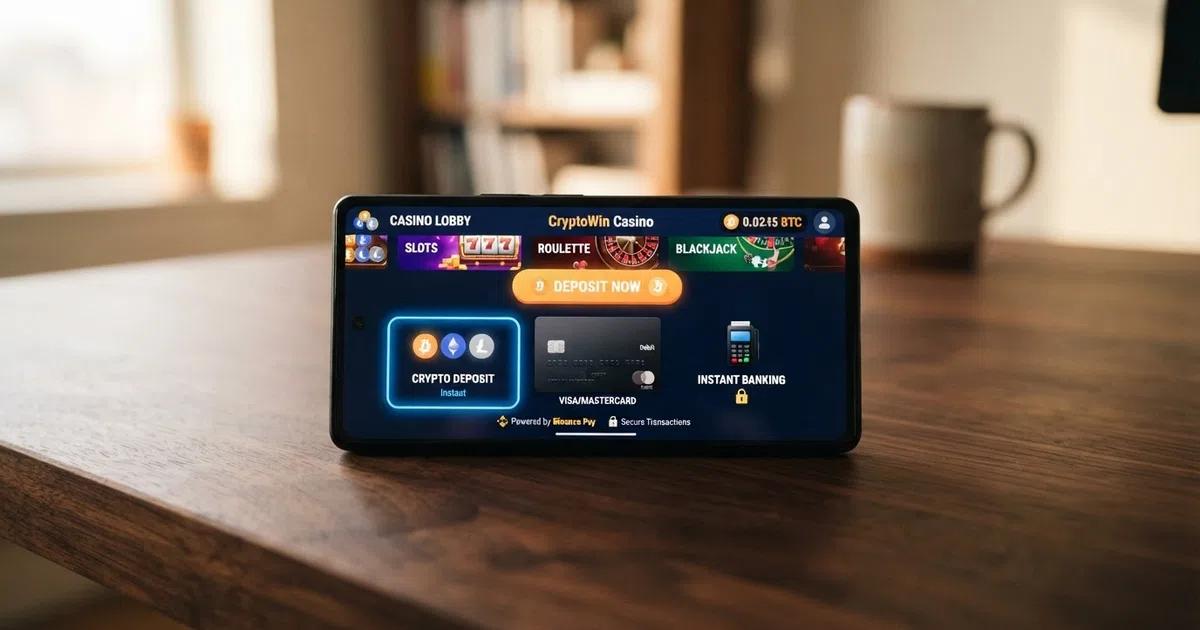
What exists instead is a parallel market. Crypto-casino listicles, affiliate sites and review pages route the same reader to ten offshore operators, most registered in Curaçao, that take BTC, ETH, USDT and a dozen other coins at the cashier. The marketing is well-funded, the bonuses are louder than anything a UK-licensed site can run after the new rules land, and the page you came in on almost certainly ends in a “deposit now” button. None of that changes the licence position. This page is the analysis the marketing strips out: what the offer is worth, what the player trades for it, and the single decision a UK reader with a Bitcoin balance actually has to make.
Data current as of September 8, 2026 and cross-checked against the UK Gambling Commission’s published register and guidance.
Bitcoin casinos explained: the licensed one that doesn’t exist
A Bitcoin casino, defined
A Bitcoin casino is any online casino whose cashier lists Bitcoin — BTC on Lightning, on-chain, or both — among its deposit and withdrawal methods. The term covers two very different products under one name. The first is a licensed online casino that happens to add a crypto rail. The second is a crypto-native operator, almost always registered in Curaçao, Costa Rica or Anjouan, whose cashier is built around coins and whose player account is denominated in crypto. The page you are reading, and the rest of the market it competes with, is almost entirely about the second type, because the first does not exist in the UK.
What “accepts Bitcoin” does and does not mean matters because the marketing rarely distinguishes. It does not mean the games run on a Bitcoin blockchain. The slots, live tables and crash games on these sites are the same RNG-driven or studio-streamed products a licensed casino runs. The coin is just a payment method at the edge: it lands at a wallet address, the casino credits your account in whatever unit the cashier uses (BTC, USDT, USDC or a converted euro balance), and the games pay out into that same internal balance. The blockchain is the deposit rail and the withdrawal rail, not the game itself. The thing the marketing calls “provably fair” is an extra layer of cryptographic verification some operators bolt on top of the RNG, not a different kind of game.
How a Bitcoin deposit reaches a game balance
There are two routes a UK player can take, and only one of them is open from inside the country.
The first is the direct route. The player sends BTC from a self-custody wallet or a custodial wallet to a deposit address the casino provides, the casino credits the equivalent in its account currency after a number of confirmations, and the player wagers. Withdrawals reverse the process. The casino sends BTC to the player’s wallet address; the player receives it. No bank sits between the two. No UK-licensed operator offers this rail in 2026.
The second is the compliant route. The player converts Bitcoin to pounds through an FCA-registered exchange, withdraws the pounds to a UK bank account, and deposits at a UKGC-licensed casino through a rail that takes pounds: debit card, PayPal, Apple Pay, bank transfer and similar. The licensed casino sees a sterling deposit, the player’s bank sees a sterling transaction, and the player plays the same games under UK licence conditions. This is the route that keeps GamStop, deposit limits, the £150 vulnerability check, the 10x wagering cap and every other UK protection in the picture.
Reading a list of Bitcoin casino sites
The lists that rank “best Bitcoin casinos UK 2026” aggregate the same kind of operator. The product is an offshore crypto casino that markets to the UK, accepts UK registrations, and runs in pounds, euros or dollars on the back end even when the deposit is BTC. Every entry in that kind of list is offshore, because the licensed alternative does not exist. The listicle is not a list of one licensed and nine offshore options. It is a list of ten offshore options presented without the licence caveat, and the licence caveat is the first thing the reader needs to know.
A ranking claim in this market is also weaker than it looks. The criteria that lift one operator above another — payout speed, free-spin count, headline percentage — are the criteria the operator markets hardest. Independent verification across all ten for any given week is rare, and the affiliate economics tilt the ranking toward whichever brand is paying the highest commission. Treat the order as one editor’s ordering, not a measure of safety or value.
Which trust signals you can actually verify
Three signals on an offshore crypto casino page are checkable, and three are not. The licence jurisdiction is checkable: the operator names a regulator and a licence number, and that number can be looked up on the regulator’s register. Curaçao GCB publishes its licence list; the Anjouan and Costa Rica frameworks are real but the registers are thinner. Payout speed is partly checkable: payout-time claims are a marketing statistic, not a contract, and the test is what the cashier actually does on a withdrawal — not what the footer says. Provably fair is checkable in a narrow sense: the cryptographic verification proves that the game outcome was generated by the seed the operator publishes, and nothing more. It does not prove the casino paid the win, has the cash to pay the win, or will not reverse the win for a terms-of-service reason.
What cannot be checked from the page alone is solvency, dispute handling and the operator’s history with self-excluded or self-limiting players. The licence register tells you who licensed the operator; it does not tell you how the operator has treated the last hundred withdrawals, and the marketing material is not going to volunteer that. The honest reading is: licence number verified, payout history not verified, solvency not verified, dispute route is whatever the operator’s terms say it is.
Why every Bitcoin casino you can actually use is offshore
What a GB licence permits — and why crypto stays out
A UKGC-licensed remote casino in 2026 is bound by a layer of conditions that Bitcoin, structurally, cannot clear. The table below sets the rules a player takes for granted at a UKGC site against the mechanism a crypto deposit breaks.
| Restriction or limit | What it caps | Value in force |
|---|---|---|
| Online slots stake limit, age 25+ | Max stake per game cycle | £5 |
| Online slots stake limit, age 18–24 | Max stake per game cycle | £2 |
| Credit-card gambling | Any credit-funded payment, including via e-wallet | Banned since 14 April 2020 |
| Bonus wagering cap | Wagering on promotional funds | 10x (from 19 Dec 2025) |
| Mixed-product offers | Staking product X to get product Y | Banned (from 19 Dec 2025) |
| Autoplay | Continuous play without player input | Banned |
| Spin speed | Minimum interval per game cycle | 2.5 seconds |
| Reverse withdrawals | Cancelling a withdrawal to keep playing | Banned |
| Financial vulnerability check | Triggers at net deposits in a rolling 30-day period | £150 |
| Pre-deposit limit prompt | Standardised gross deposit limit by 30 Sept 2026 | From 31 Oct 2025 |
| Credit-card gambling | Credit-funded payments via e-wallet included | Banned since 14 Apr 2020 |
| Remote Gaming Duty | Tax on gross gaming yield | 40% (from 1 Apr 2026) |
Two of those rows explain why crypto stays out. Source-of-funds verification, which kicks in at the £150 net-deposit threshold, asks where the money came from and demands evidence the operator can read: a bank statement, a payslip, a pension letter. A Bitcoin deposit is, by design, the absence of that paper trail. The operator can ask; the ledger cannot answer. The second is AML. The licensed operator’s KYC happens before play, and the same controls extend to the deposit. The Commission has not banned crypto by name. It has built a set of rules that the rail cannot, in practice, satisfy.
Why GamStop cannot reach these sites
GAMSTOP is mandatory for UKGC-licensed remote operators, and the licensed operator is the only place GAMSTOP operates. A player who has self-excluded through GAMSTOP has asked every licensed UK site to refuse their account for a chosen period. The offshore crypto casino is not in that scheme. The marketing pitch is straightforward: keep playing, no UKGC means no GAMSTOP, no friction at the cashier. The practical consequence is what the pitch leaves out. A self-exclusion is a decision the player made about their own gambling. The offshore site is a place to undo that decision by side-stepping it, and the friction the licensed operator is required to apply is the friction the player is looking to avoid. That is not a service; that is a market for a problem.
Anonymous in the ad, verified at the till
The “no KYC” pitch is one of the loudest signals in the offshore crypto-casino ad set. The reality is narrower than the ad. UKGC sites verify name, address and date of birth before the first deposit and before the first wager, by design. Offshore sites accept the registration with an email and a password, and the verification triggers later, at withdrawal or when the cumulative deposit crosses the operator’s own threshold. The trigger point is set by the operator, on the operator’s terms, and the operator reserves the right to ask for documents at that point. A player who has built a balance at a “no KYC” site and then asks to withdraw it in Bitcoin can find themselves uploading a passport before the wallet address is paid. The pitch was the hook. The verification is the gate.
Who gets past the door at an offshore casino
The pitch that pulls a UK player through the door at an offshore casino is geographic eligibility, not licence. “UK players accepted”, “GBP accounts available”, “Bitcoin deposits welcome” — the marketing is built around access. The player gets a registration, a cashier that takes coins, and a catalogue of games. The player does not get ADR via IBAS, does not get a Commission enforcement backstop, does not get the dispute resolution route that a UKGC licence makes available, and does not get the ombudsman-style process that follows a complaint. The terms of service the player accepts at signup name a jurisdiction — usually Curaçao, sometimes the operator’s own incorporation country — and that jurisdiction is where any dispute lands. The site’s marketing is the front of the house. The terms of service are the back.
Provably fair proves the game, not the safety
Provably fair is a real cryptographic mechanism: the operator commits to a server seed, the player supplies a client seed, the outcome is derived from both, and the player can verify after the fact that the seed the operator committed to is the seed that produced the result. That mechanism proves the game was not doctored between the bet and the outcome. It proves nothing about the operator’s solvency, nothing about whether the operator will pay the win, nothing about whether the operator’s stated RTP is the RTP the player is actually playing at, and nothing about whether the operator will let the player withdraw at all. A provably fair game inside a financially dodgy operator is still a financially dodgy operator. Variable RTP slots — a single Pragmatic Play title running at 96.5% on one site and 94% on another — make the “provably fair” label even thinner, because the math the game runs is up to the operator.
What protection you give up offshore
The licensed UK player who switches to an offshore crypto casino gives up, in one signup, every protection the licence was written to provide. Dispute routes run through the operator and the operator’s chosen jurisdiction; UK ADR and the Commission are out of the picture. Terms of service that would be unenforceable under UK consumer law are enforceable under whatever the operator has written. Reverse withdrawals are not banned; payout-speed promises are not policed. The enforcement model against illegal online gambling in the UK runs through disruption, delisting and payment-provider action, not consumer recourse. The provider’s exposure for unlicensed provision runs to 51 weeks’ imprisonment and/or an unlimited fine — a number aimed at the operator, not a remedy the player can call. The reader is not the protected party in that model. The reader is the party the protection is not written for.
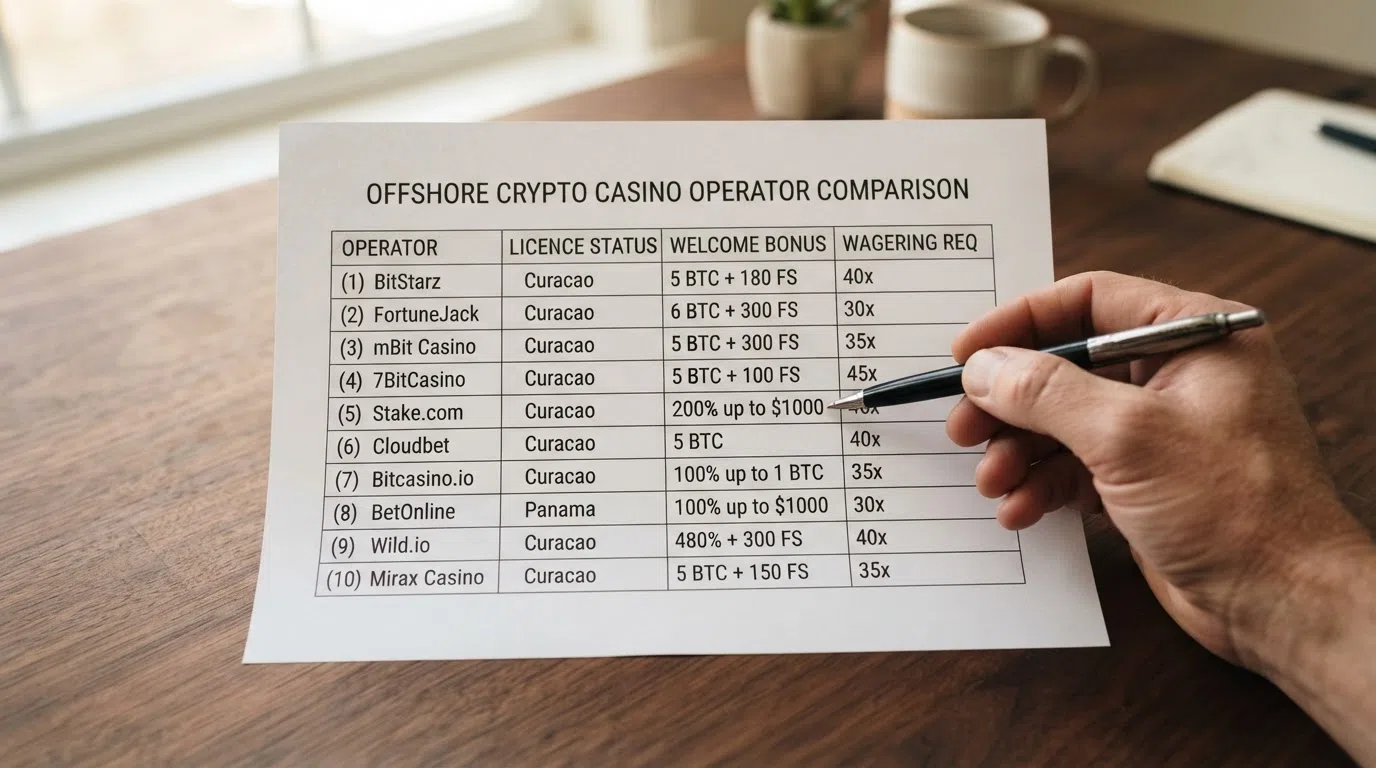
The ten Bitcoin sites marketed to UK players, ranked — none licensed here
The ten operators below are the ones the search results and review pages route UK readers to. All ten are offshore. All ten are not GB-licensed. Where a licence is referenced in the row, the licence is the operator’s offshore licence, and the reference is what the reviewed sources carried; no UKGC licence was confirmed for any of these brands this run. The bonus and wagering columns come from the same reviewed sources, and a “not found” cell means the reviewed material did not state the figure, not that the operator does not run an offer.
| Operator | UK licence status | Welcome bonus | Free spins | Wagering requirement |
|---|---|---|---|---|
| MyStake | Offshore / not GB-licensed (Curacao GCB referenced) | 170% up to £1,500 | 30 | 30x |
| Betplay | Offshore / not GB-licensed (Costa Rica registration) | 100% up to 5,000 USDC | — | 80x |
| 7Bit | Offshore / not GB-licensed (Curaçao GCB OGL/2023/174/0082) | 325% up to 5.25 BTC | 250 | 35x |
| BitStarz | Offshore / not GB-licensed (Curacao referenced) | Up to 5 BTC | 180 | 40x |
| Jackbit | Offshore / not GB-licensed (Curacao CGA (OGL) referenced) | 100 wager-free free spins on Hot Chilli Bells | 100 | Wager-free on spins, 1x on deposit + winnings |
| Bets.io | Offshore / not GB-licensed (Curacao referenced) | 225% up to 1 BTC | 225 | 40x (7-day validity) |
| BetFury | Offshore / not GB-licensed (Curacao GCB OGL/2024/1494/0942) | 590% up to $10,500 | 225 (+ up to 100 no-deposit) | 40x |
| TrustDice | Offshore / not GB-licensed (Curacao 8048/JAZ referenced) | 500% up to 1 BTC / $90,000 across 3 deposits | 100 | 35x–40x (7-day validity) |
| mBit | Offshore / not GB-licensed (Curacao referenced) | Not found this run | Not found this run | Not found this run |
| CoinCasino | Offshore / not GB-licensed (no gambling-specific licence identified) | Not found this run | Not found this run | Not found this run |
Read the bonus number beside the wagering number, not alone. A 325% match at 35x is a different offer from a 590% match at 40x with a 7-day fuse, and the table above shows why: the same row can look generous in one column and punishing in the next. The 10x wagering cap that applies to UK-licensed operators from 19 December 2025 does not apply to any row above, and the offer is calibrated to the regime the operator lives in, not the one the player lives in.
MyStake
MyStake’s 170% up to £1,500 plus 30 free spins sits on a Curacao GCB licence — not a UKGC licence. The 30x wagering is the lowest multiplier in the table, and the percentage of the match is the second-lowest. The combination matters: a smaller match on a smaller multiplier is the closest thing in this set to a bonus a UK player could actually clear, and the size of the offer is what makes it winnable. The offshore licence is the trade. The bonus a UKGC site could now run under the 10x cap is a different shape and a different size.
For a player who has decided to play offshore anyway, the 30x multiplier is the workmanlike number in the field; for a player who has not, the licence is the figure that should land first.
Betplay
Betplay advertises a 100% match up to 5,000 USDC, with 80x wagering and a 30-day window. The percentage is the smallest in the field. The multiplier is the largest. The product is the same: a higher match ceiling paid for by a heavier turnover, against an operator registered in Costa Rica with no gambling-specific licence in the reviewed sources. A player who reads “up to 5,000 USDC” and reads “80x” is reading the same offer; the 80x is the part the marketing puts in the third paragraph.
The verdict is arithmetic, not editorial. 5,000 USDC at 80x is 400,000 USDC of turnover before the bonus converts to a withdrawable balance, against a 30-day fuse. The bonus is large because the cost of clearing it is large, and the player pays the cost.
7Bit
7Bit’s offer is the 325% up to 5.25 BTC plus 250 free spins at 35x wagering, with a €10,000 maximum cashout from the bonus. The Curaçao GCB licence (OGL/2023/174/0082) is on the regulator’s register; the operator has the licence a Curaçao-registered operator has, and no more. The 250 free spins are the biggest spin count in the table. The 35x multiplier is in the middle of the band. The €10,000 cap is the cap the others in the field do not name, and it is the one a player clearing a 5.25 BTC match needs to know about, because above the cap the bonus does not pay out.
The cashout cap is the figure that lands the verdict. A big match with a big spin count is still capped, and the cap is the ceiling on what the player can take out of the offer.
BitStarz
BitStarz runs “up to 5 BTC” plus 180 free spins at 40x, on a Curacao-registered licence. The “up to” carries weight, because the percentage behind the headline is not in the reviewed material; the player reads the ceiling, not the curve. The 180 free spins are the second-largest spin count in the field after 7Bit and BetFury. The 40x multiplier is in line with most of the table.
The verdict is that the offer is in the middle of the field on every dimension the table shows, and a player choosing on those numbers has no reason to pick it over a clearer or more generous one. The brand is the part of the offer the table does not measure.
Jackbit
Jackbit is the wager-free row in the table, and the only one. The 100 free spins on Hot Chilli Bells carry no wagering requirement; the 1x applies to the deposit and the winnings before the withdrawal. The Curacao CGA (OGL) is the licence. The shape of the offer is unusual: smaller than the field on the match, larger than the field on the player-side cost, because the player is converting a deposit plus a win, not a bonus plus a win, and the 1x clears in a single deposit cycle.
For a player who values certainty over headline size, the wager-free framing is the verdict in one line. The offer is the most legible in the table and the one with the fewest moving parts.
Bets.io
Bets.io’s 225% up to 1 BTC plus 225 free spins, at 40x with a 7-day validity, is the shortest fuse in the table. The Curacao licence is referenced in reviews. The 20 USDT first-deposit minimum is the only minimum explicitly stated in the reviewed sources across the ten operators, and the operator that names its minimum is the one whose player knows what size deposit actually qualifies.
The 7-day fuse is the figure that lands the verdict. A 225% match is large, 40x is the standard multiplier, but seven days to clear it is a tight runway against a withdrawal that, on a 1 BTC ceiling, is meaningful size. The bonus is built for players who can move a balance through wagering in a working week, and built against players who cannot.
BetFury
BetFury stacks 590% up to $10,500 plus 225 free spins, with up to 100 no-deposit spins referenced in one reviewed source, at 40x, on Curacao GCB licence OGL/2024/1494/0942. The 590% is the largest headline percentage in the table. The $10,500 ceiling is the largest sterling-equivalent ceiling. The 225 free spins are the joint-largest. The no-deposit element is the only one in the table. The licence is the one with the most recent number, and the one a player can look up on the GCB register.
The verdict is that the package rewards size and the size rewards the player who can move a large balance through 40x in the validity window, which the reviewed sources did not state. The no-deposit spins are a separate element, the kind of offer that pays a small amount in return for the registration, and a player who reads the 590% as a single number is reading the wrong number.
TrustDice
TrustDice runs a 500% match up to 1 BTC or $90,000 across three deposits, plus 100 free spins, at 35x–40x, on a 7-day window, under Curacao licence 8048/JAZ. The three-deposit ladder is the structure, and the structure means the player is making three deposits to reach the headline, not one. The $90,000 ceiling is the largest number in the table. The 7-day fuse is the same as Bets.io. The 35x–40x range is the only band in the field, and the band signals an offer the player should read as 40x for planning purposes.
The verdict is that the offer rewards the player who can fund the ladder and clear the turnover, and the 7-day window is the constraint that decides whether the ladder is worth climbing. A 500% across three deposits at 40x is a large offer, and a 7-day window is a short one, and the player pays the difference.
mBit
mBit is a familiar name in the crypto-casino space, registered under a Curacao licence, and the reviewed material this run did not state its current welcome bonus, free-spin count or wagering multiplier. The brand has history; the run’s evidence on this offer does not. A player looking at mBit on the strength of brand recognition alone is making a decision the reviewed sources do not back up for the current offer.
The honest verdict is that the row reads thin for a reason, and a player who is choosing between the ten should not be choosing on the basis of a brand the data does not currently cover. The licence is the same offshore licence the other rows carry; the offer is the gap.
CoinCasino
CoinCasino markets itself as crypto-first, and the reviewed sources did not identify a gambling-specific licence for the brand. The welcome bonus, free-spin count and wagering multiplier are not in the reviewed material. The brand reads as a crypto-native operation, and the absence of a named licence in the reviewed sources is itself a piece of information a player should weigh.
The verdict is the same shape as the mBit row, with one further gap. A player choosing CoinCasino on the strength of a crypto-first pitch is choosing on the marketing, and the marketing is the only thing the reviewed sources confirm.
Why your Bitcoin welcome bonus is smaller than it looks
A welcome bonus on an offshore crypto casino is a marketing number with a turnover cost, a validity window and a cashout cap attached. The percentage is the part the player remembers; the multiplier is the part the player pays. The package at 7Bit, 325% up to 5.25 BTC plus 250 free spins, is the worked example the next section carries, but the pattern is the same on every row of the table: a big number, a smaller real number, a fuse.
How the bonus actually costs the player
Take 7Bit’s 325% up to 5.25 BTC at 35x wagering as a worked example. Assume the player deposits the maximum 5.25 BTC and clears the bonus, on the best-case slot — Pragmatic Play’s Sweet Bonanza, at a best-case 96.51% RTP, and assume only the bonus amount is wagered. The required turnover is the bonus multiplied by the wagering factor. The expected loss is the turnover multiplied by the house edge. That is the bonus’s real cost, and it is the figure the marketing does not put on the page.
The same arithmetic applies to every other row in the table. A 30x bonus is a third cheaper to clear than an 80x bonus on the same match; a 35x bonus with a 7-day fuse is more expensive to a working player than a 35x bonus with a 30-day fuse. The licence, the multiplier and the window decide what the bonus actually costs, and the percentage on the landing page decides only what the player expected.
No-deposit bonuses and free-chip faucets
The “free” offer is the one that looks the cheapest and is often the most expensive per unit. A no-deposit free spin pays a small amount, sometimes a fraction of a US cent, on a high-volatility slot, against a wagering requirement the player must clear before any win becomes withdrawable. The 100 no-deposit spins BetFury references sit in this category. The offer is real, and the offer pays what it pays. A player chasing no-deposit offers as a side activity is paying the variance a high-volatility slot charges and the time a 40x wagering requirement takes, and the winnings are an odds-on proposition to be small.
Welcome and sign-up offers, unpacked
A welcome package is a matched deposit plus a free-spin bundle plus a wagering requirement plus a validity window. The match percentage is one of four numbers. A 170% match at MyStake is small next to a 590% match at BetFury, and the 30x that comes with MyStake is small next to the 40x that comes with BetFury. The free-spin bundle is the second number. The wagering is the third. The validity is the fourth. The decision a UK player faces is which combination of those four numbers is the closest fit to the deposit they can fund and the time they can spend clearing it.
Deposit matches: the big percentage, the big wagering
The percentage is the player’s reward; the multiplier is the player’s cost. 30x at MyStake and 80x at Betplay are the two ends of the table, and the difference is the difference between a bonus a working player can clear and a bonus a working player can clear only at the cost of the work. 7Bit’s 35x is in the middle; Bets.io’s 40x with a 7-day fuse is the row that requires a player to clear in a working week, not a calendar month. The 20 USDT first-deposit minimum at Bets.io is the only minimum in the table the reviewed sources named, and the minimum is the player’s first decision: how much of the match they can afford to claim.
Free spins: the fine print behind the number
The free-spin count is the figure the marketing puts first, and the figure that pays the player’s least. 30 free spins at MyStake, 250 at 7Bit, 180 at BitStarz, 225 at Bets.io, 225 at BetFury, 100 at TrustDice, 100 at Jackbit. The wager-free Jackbit offer is the only one without a multiplier on the spin win. The others are paid in spins and unwrapped in wagering, and the wagering is where the cost lives. The slot the spins land on is the third number, and the RTP on that slot is the fourth; the same Pragmatic Play title runs at different RTP tiers on different sites, and the player has no way to know which tier the site is running without spinning.
VIP, high-roller and loyalty: what offshore really rewards
The high-roller pitch is the same on every offshore crypto casino: a tiered loyalty scheme, a personal account manager, higher withdrawal limits, faster payouts. The reviewed sources did not carry the tier structure, the qualifying deposit or the loyalty reward for any of the ten operators in this run. The pitch is in the marketing. The terms are not in the row.
A player who joins an offshore site for the VIP program is joining on the marketing, and the marketing is the only thing the data confirms. The licensed UK alternative, for the player whose bankroll fits the high-roller frame, is a UKGC-licensed site with its own VIP structure and an ADR route the offshore site does not offer.
Bonus codes, and what they do and don’t unlock
A bonus code is a token that unlocks a specific offer at the cashier. The token is a distribution mechanism, not the offer itself. A code is what the affiliate site hands the player to track the referral; the offer is the percentage, the cap, the wagering and the fuse the player reads on the affiliate page. The token turns on the offer; the terms decide what the offer is worth. This page describes the mechanism, and the page prints no working code.
Bitcoin payouts are fast — until wagering and verification catch up
The crypto-casino pitch on withdrawals is the most specific claim on the page. “Instant” appears in almost every marketing footer; Lightning Network appears in a smaller subset; “same-day” appears where the operator wants to sound conservative. The claim is real on the rail: a Bitcoin transaction on a working network confirms in minutes, and the cashier at an offshore crypto casino is built to process payouts fast. The claim is not the whole story.
Depositing: the two routes a UK player has
The direct route — BTC from a self-custody wallet to a casino deposit address — is the rail every offshore crypto casino offers. The casino credits the balance in its account currency after a number of confirmations, and the player wagers. The minimum deposit is the operator’s setting; the only minimum the reviewed sources named is Bets.io’s 20 USDT first-deposit floor.
The compliant route is the one that does not need a Bitcoin deposit. The player converts BTC to GBP through an FCA-registered exchange, withdraws the pounds to a UK bank account, and deposits at a UKGC-licensed casino through debit card, PayPal, Apple Pay or bank transfer. The licensed casino sees a sterling deposit. The player’s bank sees a sterling transaction. The deposit is the same deposit, the casino is the licensed casino, and the protection regime is the UK one.
How fast the withdrawal really lands
“Instant” describes the rail, not the gate. A Bitcoin transaction on a working network confirms in minutes, and the cashier at a well-funded offshore casino is built to process payouts on the same timescale. The gate is the wagering requirement, the verification stage, and the operator’s own payout queue. A withdrawal requested while a bonus is still being cleared is held; a withdrawal requested before the operator’s KYC threshold has been met triggers a verification stage that runs on the operator’s clock, not the blockchain’s. The reviewed sources did not state a payout-time figure per operator for this run, and the marketing figure is the one the player sees. The figure the player should plan on is the one the cashier actually takes.
Bitcoin Cash: a separate casino question
Bitcoin Cash is a separate chain with a separate address format and a separate cashier. A Bitcoin casino does not, by default, take BCH; the operator lists it as a separate payment method, and the same marketing pattern applies. The reviewed sources did not carry BCH-specific terms for any of the ten operators, and the offer a BCH player sees is, in practice, a smaller version of the BTC one — same catalogue, same wagering, fewer users on the rail.
Wager-free withdrawals, and what they cost
Wager-free is the cleanest word in the offshore crypto-casino vocabulary, and the cleanest word is the one to read most carefully. A wager-free offer, like Jackbit’s 100 free spins on Hot Chilli Bells, removes the multiplier on the spin win. It does not remove the 1x the operator applies to the deposit plus the winnings, and it does not remove the operator’s right to ask for verification before the withdrawal pays. The “wager-free” label is a smaller version of the “no KYC” label: a real mechanism, a partial mechanism, and the partial mechanism is the player’s job to read.
Beyond Bitcoin: the altcoins these casinos also accept
The cashier at an offshore crypto casino does not stop at BTC. The reviewed ten operators take a mix of coins that includes Ethereum, Litecoin, Tether and USDC, and the welcome offer at Betplay is denominated in USDC, not BTC. The coin is the rail. The bonus, the wagering, the catalogue and the licence are the same. Switching from BTC to USDT does not move the row out of the offshore column, and the row is the row.
Which altcoins join Bitcoin in the cashier
USDC and USDT are stablecoins: coins pegged to the US dollar, used by operators to keep the bonus number stable against crypto price movement. Betplay’s 100% up to 5,000 USDC is the clearest example: a dollar-denominated bonus the player can size against, regardless of where Bitcoin sits on the day. TrustDice’s $90,000 ceiling and Bets.io’s 20 USDT minimum sit in the same logic. The reviewed sources referenced Ethereum and Litecoin support as part of the broader cashier; the per-operator list is on the operator’s deposit page, and the page is the source.
Multi-crypto picks: what extra coins change
More coins in the cashier do not change the licence row. A player depositing in ETH at the same offshore casino a friend deposits in BTC at is making the same choice: offshore licence, no GamStop, no UK ADR, no Commission enforcement backstop. The coin is the deposit method. The site is the site, and the site is the row in the table.
The games you’ll actually find, and the RTP tiers behind them
The catalogue at an offshore crypto casino is the catalogue a UK player would recognise from any online casino: slots, live dealer, table games, plus a crypto-native layer of crash, dice, plinko and keno that the licensed UK market rarely shows. The catalogue is real. The RTP number on any given title is up to the operator, and the operator is the variable.
The slots you’ll meet, and their RTP
Three Pragmatic Play titles carry a researched best-case RTP in the reviewed sources. The table below carries the best-case figure, the provider, the volatility and the maximum win. The “best-case” wording is deliberate: a single Pragmatic Play title can run at 96.5% on one site and 94% on another, and the player cannot see the difference without spinning.
| Slot | Best-case RTP | Provider | Volatility | Max win |
|---|---|---|---|---|
| Gates of Olympus | 96.50% | Pragmatic Play | High | 5,000x stake |
| Sweet Bonanza | 96.51% | Pragmatic Play | High | 21,100x stake |
| The Dog House Megaways | 96.55% | Pragmatic Play | High | 12,305x stake |
The volatility is high across all three, which is the volatility that makes the headline max-win figure possible. A 21,100x max win on Sweet Bonanza is the ceiling on a single spin; the floor on a session is the more common number, and high volatility is the property that puts the floor where the floor is. The reviewed sources did not name a specific operator-RTP for any of the three titles this run, which is the more useful figure for a player choosing between sites; the best-case is the figure the provider publishes, not the figure the operator is running.
Live dealer: real tables, real stakes
The live casino at an offshore crypto casino is the same Evolution- and Pragmatic-Play-streamed product a UK-licensed site runs. Live blackjack, live roulette, live baccarat and the game-show formats stream from the same studios; the table limits and the side-bet structure are the studio’s, not the operator’s. 7Bit’s reviewed provider list includes Evolution among the studios; the rest of the offshore set runs the same catalogue without naming the studios in the reviewed sources. The licence behind the table is the operator’s offshore licence; the table itself is the same.
Blackjack, roulette and the rest at a crypto table
The RNG-driven table games at an offshore crypto casino are the same blackjack, roulette, baccarat, poker and video poker titles a UKGC-licensed site runs. The reviewed sources did not carry a per-title RTP for the table games across the ten operators this run. The table-game RTP is a function of the rules — the number of decks, the dealer’s standing position, the side-bet structure — and the rules are visible on the game page. A player choosing on table games is choosing on rules, and the rules are the figure the player can read.
Crash, dice and plinko: games Bitcoin made its own
The crypto-native layer of the catalogue is the part the licensed UK market rarely shows. Crash, dice, plinko and keno are the games the crypto cashier was built around: low-friction rounds, a clear multiplier, a high-volatility outcome curve. The provably-fair claim is most often applied to this layer, and the application is the same — the cryptographic verification proves the round was generated as advertised, and nothing about the operator’s solvency.
How to play, and what strategy can’t fix
A strategy changes the session; a strategy does not change the house edge. Slot strategies are session-management frameworks: a stop-loss, a win target, a time limit, a bet-size rule. The RTP the slot runs at is the figure the strategy cannot move, and the house edge is the figure the session is paying for. The provably-fair label does not change the math, and the variable RTP the operator chooses does. The honest reading is that a strategy gives the player a structure for the session, and the structure is worth what the math underneath it is worth — which is, on a high-volatility slot at best-case RTP, a little less than the player thought on the way in.
Trying the games for free before you risk a satoshi
The free-play layer at an offshore crypto casino is the layer a UK player should treat as the safest part of the site. The games run the real RNG, the reels spin the same way they spin for real money, and the difference between a demo spin and a real-money spin is what the spin pays, not how the reels behave. What the demo does not show is the cashier, the wagering, the verification stage and the withdrawal queue. A player who learns the game in demo is learning the reels, not the site.
Free Bitcoin slots: no deposit, no payout
A no-deposit free spin is a spin on the house, with a wagering requirement the player must clear before any win becomes withdrawable. The 100 no-deposit spins BetFury references sit in this category. The slot is real, the wagering is real, and the win is an odds-on proposition to be small. A free Bitcoin slot is a way to learn a game without funding a deposit, and it is not a way to play the cashier.
Free casino games: the demo you can trust
A demo game runs the real RNG and the real math, on a balance the casino provides. The reels behave the same way the reels behave for real money, and the bonus rounds trigger on the same logic. The demo does not run the cashier: there is no deposit, no wagering, no verification, no withdrawal. A demo is a way to test the maths without testing the operator.
Demo mode vs real money: what changes
The maths is the same. The stake is not. The withdrawal is not. A demo session is a session the player cannot lose, and a real-money session is a session the player can. A provably-fair label is the same label in both modes. A player who likes the demo is not a player who has tested the operator; the operator is the part the demo skips.
Bitcoin slots on the go: app or browser?
The mobile experience at an offshore crypto casino is, in practice, a browser experience. The reviewed sources did not carry a confirmed iOS or Android app for any of the ten operators in this run. The marketing for the category often implies an app; the reviewed sources did not confirm one.
The app question: what’s actually installable
An app-store listing is the test, and the listing is the part the marketing does not always show. A progressive-web-app saved to the home screen is not the same as an iOS App Store or Google Play listing, and the difference is what the player installs, where it comes from, and what permissions it asks for. The reviewed sources did not carry an app-store availability claim for any of the ten operators this run.
Browser play: what works without an app
The browser is the default, and the default is usually enough. The same catalogue, the same cashier, the same login — the player gets on a phone what the player gets on a desktop, with the difference that the cashier sits one tap closer. The reviewed sources did not carry a mobile benchmark this run, and the player who can read a slot on a phone is the player who does not need the benchmark.
Safer gambling when the site sits outside UK rules
The safer-gambling infrastructure in the UK is licensed-site infrastructure. The deposit limit, the reality check, the time-out, the £150 vulnerability check, the GAMSTOP self-exclusion — every one of these is a condition of the UKGC licence, and every one of these stops at the offshore door. The offshore crypto casino runs the marketing layer of safer gambling (a deposit limit field on the registration form, a “take a break” link in the footer) without the UK regulatory layer behind it. The player who needs the UK layer needs the UK site.
The tools a licensed casino must offer
A UKGC-licensed casino in 2026 is required to offer a deposit limit, prompt the player to set one before the first deposit from 31 October 2025, run reality checks during play, offer a time-out, and apply a financial vulnerability check from a £150 net deposit in a rolling 30-day period. Autoplay is banned. Spin speed is capped at 2.5 seconds. Reverse withdrawals are banned. The bonus wagering is capped at 10x from 19 December 2025. The deposit limit is the player’s first decision; the vulnerability check is the operator’s; the autoplay ban is the rule that means the player has to keep pressing the button.
Self-exclusion, and how to actually use it
GAMSTOP self-exclusion is mandatory for UKGC-licensed remote operators. A player who has self-excluded through GAMSTOP has asked every licensed UK site to refuse their account for a chosen period, and the licensed sites comply. The offshore crypto casino is not in the scheme, and the marketing for the offshore site is built around the gap. A player who has self-excluded and is looking for a way around the exclusion is looking for the gap on purpose, and the gap is the wrong product. The licensed route — and the route that respects the self-exclusion decision — is the UK one.
Help that’s free, 24/7, whatever site you use
The help that reaches a UK player is not a help that depends on the licence the player is sitting behind. The GamCare National Gambling Helpline — 0808 8020 133, free, 24/7 — is the number a UK player can call at any hour from any phone. The GambleAware support finder routes the player to the right service for the situation. NHS gambling-harm treatment services are commissioned by NHS England from 1 April 2026, funded by the statutory levy on gambling operators. GAMSTOP is the self-exclusion register for the licensed UK market. None of these depend on the site the player used, and the player who needs the help needs the help, not the licence.
How this page picked and checked the casinos
The ten operators on this page are the operators the reviewed sources route UK readers to: search-result and review-page material in the crypto-casino editorial space, plus regulatory and legal sources for the UK position. The synthesis drew on GamblingPedia’s UKGC reporting, Costigan King’s legal commentary, ProvenlyFair’s coverage of crypto-casino trust signals, SlotArk’s slot-RTP data, the ICLG and Chambers regulatory summaries, GOV.UK’s published duty and levy materials, and NHS England’s announcement of gambling-harm commissioning from 1 April 2026.
The whitelist check against the UK Gambling Commission’s public register did not surface a UKGC licence for any of the ten operators this run; the licence references in the table are the offshore licences the reviewed sources name, and the references were not independently re-verified against the offshore regulator’s register for every row. The ordering is editorial, on the basis of the reviewed material, and the order is not a safety ranking. The figures a player reads on the operator’s own page may have moved by the time the player reads them, and a player who is about to deposit is reading a fresh page.
What this page did not confirm this run: per-operator payout times, per-operator VIP terms, per-operator app-store availability, the current bonus terms for mBit and CoinCasino, and the operator-level RTP for any specific slot. Where the data is thin, the page says so; where the data is not carried, the page covers the point qualitatively.
The decision a UK Bitcoin gambler actually faces
A UK player with a Bitcoin balance and the intent to gamble has two routes and one decision. The first route is the compliant one: convert Bitcoin to pounds through an FCA-registered exchange, withdraw to a UK bank account, deposit at a UKGC-licensed casino through a rail that takes pounds. The licensed casino in 2026 takes the £5 stake cap or the £2 stake cap depending on age, runs a 10x wagering cap on bonuses from 19 December 2025, applies the £150 vulnerability check, prompts for a deposit limit, connects to GAMSTOP, runs under LCCP compliance and pays Remote Gaming Duty at 40%. The player gives up the crypto rail and the offshore bonus size. The player keeps the protection, the dispute route, the self-exclusion that works, the stake limit and the bonus cap that the offshore site does not run.
The second route is the offshore one: deposit Bitcoin at a Curaçao-registered crypto casino, take a 325% or 590% match against a 35x or 40x multiplier, play a variable-RTP slot at the operator’s chosen tier, withdraw on a rail the operator runs on the operator’s clock, with no GamStop cover, no UK ADR, no Commission enforcement backstop, and terms the player agreed to at signup. The player gets the crypto rail, the bigger bonus, the wagering regime the licensed market no longer allows, and the catalogue. The player gives up the protection.
The decision is the one the page has been circling since the opening line. The compliant route keeps the UK licence’s safety net. The offshore route keeps the rail. The route a UK player should pick is the one whose costs the player has actually read, and the costs are the figures this page has carried on every row.
Frequently asked questions
Are Bitcoin casinos legal in the UK?
There is no statute that bans the use of cryptocurrency in UK-licensed gambling, but no UKGC-licensed casino accepts Bitcoin in 2026. The compliant route is to convert Bitcoin to pounds via an FCA-registered exchange and play at a licensed casino. The offshore route is the route the marketing pushes, and the offshore route is not a UK-licensed one.
Do any UKGC-licensed casinos accept Bitcoin deposits in 2026?
No. Current UKGC expectations around anti-money-laundering, source-of-funds verification and licence conditions practice mean licensed operators cannot clear the requirements while accepting direct crypto deposits. The reviewed sources did not surface a UKGC-licensed operator with a Bitcoin cashier, and the page’s position is that the licensed product does not exist in the market.
Can UK players use GamStop and still gamble at crypto casinos?
GAMSTOP is mandatory for UKGC-licensed remote operators. Offshore crypto casinos are not in the scheme. A self-excluded UK player can register and gamble at an offshore crypto casino, and the marketing for the offshore site is built around that fact. The player who has self-excluded and is looking for a way to keep gambling is the player the offshore route is designed to catch.
Is KYC required at Bitcoin casinos that accept UK players?
UKGC sites verify name, address and date of birth before the first deposit and the first wager. Offshore crypto casinos accept a registration on an email and a password, and trigger verification at the operator’s own threshold — usually at withdrawal or after a cumulative deposit. The “no KYC” marketing is the pitch; the threshold-triggered verification is the gate.
What is the fastest way to deposit and withdraw at a Bitcoin casino from the UK?
On the rail, Bitcoin transactions confirm in minutes, and the cashier at a well-funded offshore casino is built to process payouts on that timescale. On the gate, the wagering requirement, the operator’s verification stage and the payout queue decide the real time. The marketing figure is the rail figure, and the rail is not the whole story.
Which slots are commonly offered at Bitcoin casinos accepting UK players, and how do RTP tiers work?
The catalogue at an offshore crypto casino is the same slot, live and table catalogue a UK-licensed site runs: Pragmatic Play, Evolution, NetEnt and the other major studios. A single Pragmatic Play title like Sweet Bonanza, Gates of Olympus or The Dog House Megaways can be set to a higher or lower RTP tier by the operator, and the player cannot see the difference without spinning. Best-case figures for the three titles are 96.51%, 96.50% and 96.55%; the operator-level figure is the one the player is actually playing against.
Payments – realmoney-onlinecasinos-uk
Content created by the «realmoney-onlinecasinos-uk» team