
British Casinos Not on GamStop: The Protection Gap Behind the Label
 Available in GB
Current as of 17 August 2026 and verified against the Gambling Commission public register.

A British casino that is “not on GamStop” is a British-facing casino that runs on a licence outside Great Britain. The label is a player-facing shortcut for offshore, not a regulatory category, and not a verdict on safety or quality. It tells you one thing: the operator is not bound by the UK Gambling Commission’s rulebook, and the self-exclusion scheme that runs inside that rulebook does not reach the site.
That is the whole label, and the rest of this page is what that one fact does to the British player’s experience.
What the British and non-GamStop labels actually mean
Online-only: why this page does not cover high-street bookmakers
The cluster behind this keyword is entirely online-intent. Land-based British casinos are a separate subject with a different consumer-protection regime, and the non-GamStop label is an online-only concern. The Gambling Commission’s GAMSTOP requirement is itself remote-only. The pages that score for this keyword are reviewing online casinos, and so does this one.
What “not on GamStop” signals to a British player
Not on GamStop means the operator does not integrate with the UK self-exclusion scheme. GAMSTOP has been mandatory for GB remote licensees since 31 March 2020, and the Commission enforces participation as a condition of licence. The scheme does not reach unlicensed sites. A Curaçao-licensed operator carrying a British-facing lobby has no GAMSTOP integration and no contractual obligation to add one. The label is a marketing shorthand for that gap, and it is worth treating as one — neither better nor worse than a UKGC-licensed site by definition, simply different in what the operator is required to do.
Where to start: the three questions every British player should ask
Three questions structure the rest of this page. Is the operator licensed, and by whom — a question the Gambling Commission register answers for GB sites and a foreign regulator answers otherwise. What protections apply to a deposit — ADR access, deposit-limit prompts, a credit-card ban, dispute resolution. What the bonus terms are actually worth — a wagering multiple is the headline number, and the figure beside it decides whether the headline is a real offer or a turnover trap. Each question has a UKGC answer and an offshore answer, and the two answers do not always agree.
The GamStop gap — why playing offshore is legal but leaves you unprotected
Playing offshore is legal in the UK in the sense the law cares about. No UK player has been prosecuted for using an offshore casino. Public commentary is consistent on this point: UK law does not prohibit individuals from gambling on overseas-licensed platforms. The Gambling Act 2005 regulates operators, not players. Section 33 of the Act creates a criminal offence for providing facilities for gambling without the required licence — that target is the operator, not the punter.
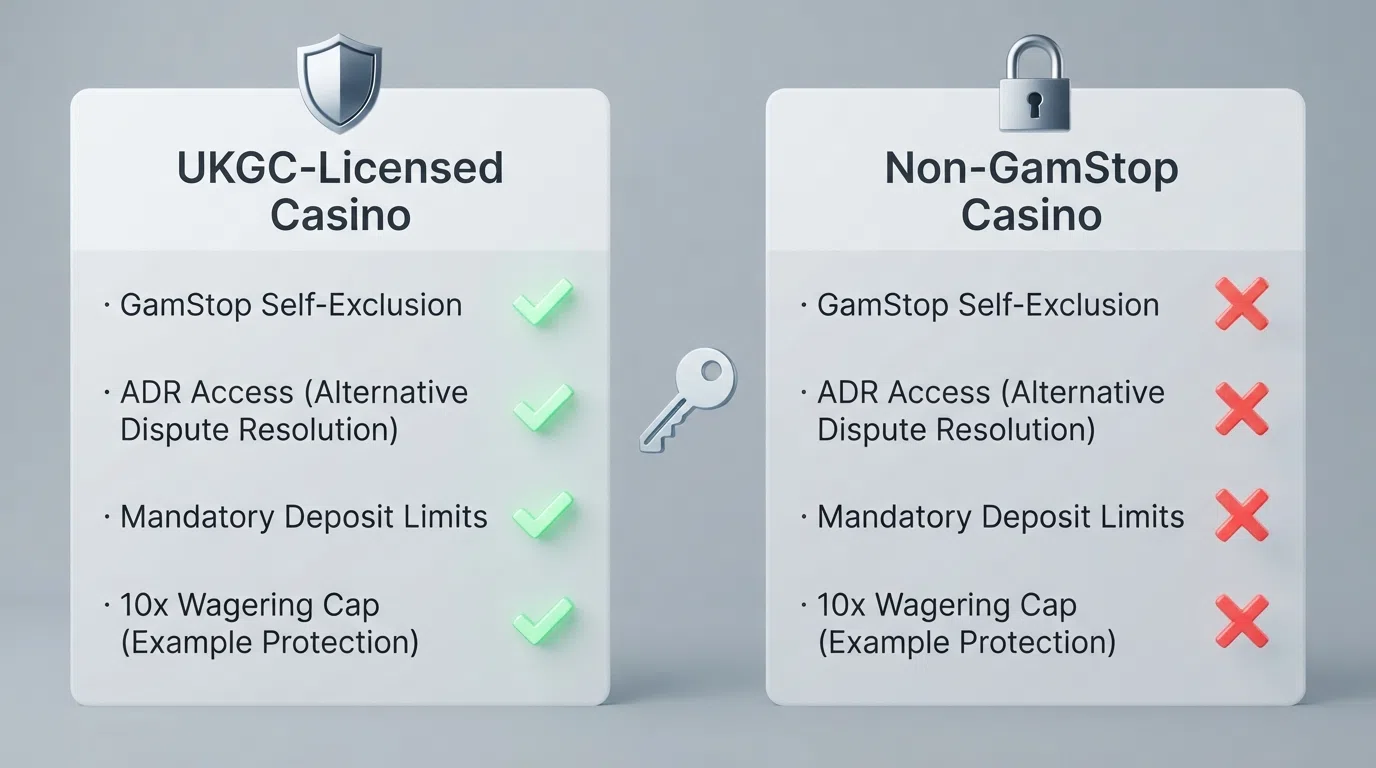
That is not the same as saying the two routes are equivalent. A GB licence is compulsory at the point of consumption: since the Gambling (Licensing and Advertising) Act 2014, any operator providing facilities to GB customers needs a Gambling Commission licence, regardless of where it is incorporated. A Curaçao, Maltese or Gibraltar licence is not a substitute for GB consumer-facing regulation. What an offshore licence does not bring is the bundle of enforceable rights that come with the GB licence — the ADR access, the deposit-limit framework, the bonus ceiling, the credit-card ban, the GAMSTOP register.
What “not on GamStop” means for a British player
GAMSTOP is a UKGC tool. Step outside the licence and it vanishes. GAMSTOP has been mandatory for GB remote licensees since 31 March 2020, and the exclusion runs for six months, one year, or five years — the five-year period can be set to auto-renew. The exclusion cannot be cancelled early. The scheme is online-only and licence-bound, which is the structural reason it cannot reach an unlicensed site. A British player who has self-excluded through GAMSTOP will find the wall intact at every UKGC-licensed casino and absent at every offshore one. The self-exclusion gap is the most immediate consumer risk in the non-GamStop market, because it is the one tool designed precisely for the moment a player wants to stop.
The UKGC-licensed route: what it actually protects
A UKGC licence is a bundle of enforceable rights, not a logo. Compulsory ADR access is one — operators must belong to a UKGC-approved alternative dispute resolution scheme, which gives a player a route beyond the operator’s own support when a complaint stalls. The deposit-limit framework is another: the operator must prompt the customer to set a financial limit before first deposit, and any decrease to that limit is actioned immediately. The credit-card ban has been in force since 14 April 2020 and extends to credit-card-funded e-wallet routes. Bonus rules came into force on 19 December 2025: wagering is capped at 10x, mixed-product promotional offers are banned, and these apply across all promotional offers. Each of these is an obligation a UKGC licence enforces; an offshore licence enforces none of them.
What you leave behind: dispute resolution, deposit limits, self-exclusion
The losses offshore are item-by-item, and each one has a real consequence. No UKGC complaints route — a player cannot escalate a dispute to the Commission. No approved ADR scheme — the alternative dispute resolution process the Commission signs off on does not exist outside its jurisdiction. No statutory deposit-limit framework — the obligation to prompt and to action decreases is Commission-mandated and runs with the licence. No GAMSTOP coverage — the self-exclusion register does not extend. No British consumer redress if funds are withheld — there is no statutory right of recourse against an offshore operator that declines a withdrawal.
The shape of the gap is not abstract. A player who has used a Curaçao-licensed casino for two years and runs into a withheld-withdrawal complaint has, in practice, the operator’s customer support as the only route. That is a real difference, and the comparison table below puts it next to what a UKGC-licensed operator is required to provide.
Enforcement in Britain: how the Commission actually acts
The UKGC disrupts supply, it does not block websites. The Commission’s enforcement toolkit is built around cease-and-desist notices, search-engine delisting referrals, domain-registrar and hosting pressure, affiliate and advertiser action, and payment-provider referrals. The Commission does not currently hold statutory ISP or DNS blocking powers — legislation has been proposed but not enacted. The practical consequence for a player is that a non-GamStop casino can sit on a British-facing domain for years and the Commission’s response is disruption at the edges, not removal from the network.
UKGC-licensed vs offshore: the side-by-side picture
| Protection | UKGC-Licensed Casino | Non-GamStop Casino |
|---|---|---|
| Operating licence jurisdiction | Gambling Commission (GB) | Offshore (commonly Curaçao GCB) |
| GAMSTOP self-exclusion | Mandatory since 31 March 2020 | None |
| ADR route via UKGC-approved scheme | Required | None |
| Deposit-limit prompt before first deposit | Required, decreases immediate | Operator-dependent, not required |
| Credit-card gambling | Banned since 14 April 2020 | Operator-dependent |
| Bonus wagering ceiling | 10x since 19 December 2025 | Operator-set, no GB cap |
| Mixed-product promotional offers | Banned since 19 December 2025 | Allowed |
| Online slots stake cap (25+) | £5 per game cycle | No GB cap |
| Online slots stake cap (18–24) | £2 per game cycle | No GB cap |
| UKGC complaints route | Yes | None |
| British consumer redress on fund disputes | Available | None |
The right column is not a list of missing features by accident. Each row is a protection the Commission has decided British players need and has enforced through the licence. None of them travel with the player when the operator sits offshore.
10 British-facing casinos compared — licensed security vs offshore freedom
Five UKGC-licensed operators and five non-GamStop offshore casinos appear below, ranked by research availability rather than editorial preference. The featured set reflects what British-facing comparison queries return in practice, and the gaps in the table are gaps in the public data, not hidden flaws. Where a column shows n/a, the research did not return a value for that operator in this run.
| Operator | Licence & GamStop Status | Welcome Bonus | Free Spins | Wagering Multiplier | Min Deposit |
|---|---|---|---|---|---|
| bet365 | UKGC-licensed (GB) | n/a | n/a | n/a | n/a |
| Sky Vegas | UKGC-licensed (GB) | No-deposit spins listed | Yes (no-deposit) | n/a | n/a |
| Paddy Power | UKGC-licensed (GB) | No-deposit spins listed | Yes (no-deposit) | n/a | n/a |
| Betfair | UKGC-licensed (GB) | No-deposit spins listed | Yes (no-deposit) | n/a | n/a |
| Ladbrokes | UKGC-licensed (GB) | n/a | n/a | n/a | n/a |
| Donbet | Curaçao GCB, outside GamStop | 150% up to €/$750 | 50 | 30x | €/$20 |
| Rolletto | Curaçao GCB, outside GamStop | 150% up to £500 | 200 | 30x | £20 |
| MadCasino | Curaçao GCB (no. 161333), outside GamStop | 100% up to £1,500 | 300 | 35x | £10 |
| Emperia | Curaçao (Fortuna Games N.V.), outside GamStop | Up to £3,000 across 4 deposits | 325 | 35x deposit+bonus; 40x FS winnings | £17 |
| Bilucky | Offshore (authority not captured), outside GamStop | 100% up to £250 | 200 (on Beware the Deep Megaways) | 40x | £20 |
The comparison table: what to read and what the gaps mean
Three columns carry full coverage: licence status, free-spin count, and minimum deposit where research returned one. The wagering column is fully populated for the offshore set — every Curaçao-licensed operator in the featured set has a captured multiple — and sparse on the UKGC side because the bonus details were not returned for those brands in this research run. The licence status row is the highest-information row in the table. Every UKGC-licensed brand in the featured set is verified against the Gambling Commission’s public register of gambling businesses, last updated 29 July 2026. Every non-UKGC brand is labelled as offshore in GB. The cells marked n/a are not editorial judgements. They are what research did not return, and the audit would rather have a gap than a guess.
Donbet: 150% welcome match with a Curaçao licence and a 30-day clock
Donbet opens with a 150% match up to €/$750 plus 50 free spins on the first deposit. The wagering requirement is 30x, applied to the deposit bonus and the free-spin winnings combined — a single turnover target rather than two separate ones. The bonus validity is 30 days, which is shorter than the longer windows some offshore competitors run. The maximum cashout is capped at 5x the bonus amount, which puts a ceiling at €/$3,750 on the headline figure. The minimum deposit is €/$20. The licence is Curaçao GCB, and the operator sits outside GamStop. The verdict for a player who has self-excluded through GAMSTOP and is looking for a short-window turnover challenge with a defined cashout ceiling: the offer is on the page in plain numbers, and the cashout cap is the figure to read first because it sets the practical value of the package.
Rolletto: £500 match and 200 free spins delivered over five days
Rolletto’s welcome offer is a 150% match up to £500 plus 200 free spins, split into 50 spins issued instantly and 30 per day across five daily logins. The wagering requirement is 30x on bonus funds. The minimum deposit is £20. The licence is Curaçao GCB, and the operator runs outside GamStop. The GBP denomination is the practical difference from a euro-denominated rival — a British player funding the account in pounds avoids the currency-conversion cost that an offshore euro-licensed operator would carry on deposit and on withdrawal. The free-spin structure rewards daily logins, which is a design choice as much as a bonus mechanic. For a player who likes a recurring login ritual, that is a feature. For a player who wants the full spin allocation up front, it is a slower path to the same end.
MadCasino: a £1,500 ceiling and 300 free spins at 35x wagering
MadCasino carries a 100% match up to £1,500 plus 300 free spins. The wagering requirement is 35x. The minimum deposit is £10, the lowest entry point among the offshore operators reviewed. The licence is Curaçao GCB under licence number 161333, and the operator sits outside GamStop. The headline figure is the second-largest in the offshore set reviewed, behind Emperia’s four-deposit package. The wagering multiple is mid-range — higher than Donbet and Rolletto at 30x, lower than Emperia’s 40x on free-spin winnings. A player weighing entry cost against spin count and wagering load: the £10 entry point makes this the cheapest door in, and the 35x multiplier sits in the middle of the offshore band. That is what the headline buys.
Emperia: four deposits, £3,000 in match bonuses and 325 free spins
Emperia offers up to £3,000 in match bonuses plus 325 free spins, split across four deposits rather than a single first-deposit trigger. The wagering requirement is 35x on deposit plus bonus and 40x on free-spin winnings. The maximum bet during wagering is £4. The game library is over 12,000 titles, the largest in the featured set. The licence is Curaçao via Fortuna Games N.V., and the operator is outside GamStop. The minimum deposit is £17. The headline is the largest in the set reviewed — that fact alone is the reason the operator is on a “what does the offer cost” list. The wagering load is the highest in the offshore band: the 40x on free-spin winnings in particular is a multiplier that turns a spin win into a small turnover target by itself. The £4 bet cap during wagering is a constraint the player will feel, because every other offshore operator in the featured set either does not publish a bet cap or publishes a higher one. A player who has the bankroll to sustain a four-deposit commitment and can live with the wagering load gets the largest headline figure in the featured set; Emperia’s wagering requirements effectively lock funds for anyone unable to meet the 40x turnover. The headline bonus size is a marketing event; the turnover terms are the actual cost.
Bilucky: 200 free spins on Beware the Deep Megaways with 80-plus providers
Bilucky offers a 100% match up to £250 plus 200 free spins on Beware the Deep Megaways on the first deposit. The wagering requirement is 40x on the welcome package and 40x on free-spin winnings. The library carries 80-plus providers across 2,000-plus games. The licence is offshore — the authority was not captured in this research run — and the operator sits outside GamStop. The minimum deposit is £20. Bilucky is the only operator in the featured set with a named bonus-slot title, which makes the welcome offer a slot-specific commitment rather than a generic “free spins on selected games” line. A player who wants to test a specific title before committing is the ideal audience for this package; The 40x wagering load is the inevitable cost of such specific slot-title access, meaning the offer is tailored strictly for slot specialists.
bet365: UKGC-licensed giant with bonus terms to verify
bet365 is UKGC-licensed in Great Britain and is verified against the Gambling Commission public register. The welcome bonus and free-spin terms were not returned by the research in this run, and the operator’s current offer should be verified on the bet365 site directly. The UKGC licence is the relevant fact: ADR access, deposit-limit prompts, the credit-card ban, the 10x bonus-wagering cap, and the £5/£2 slot stake limits all apply to the bet365 casino product. A player who picks bet365 is buying the licence, not the headline figure — because the headline figure is unverified here and the licence is not. The verdict is procedural: verify the current offer before signing up, and rely on the licence protections as the reason to consider the brand at all.
Sky Vegas: no-deposit spins from a household-name UKGC operator
Sky Vegas is UKGC-licensed in Great Britain, verified as noted in the bet365 entry. The research captured no-deposit spins among UK offers; exact terms and caps were not fully returned. The UKGC licence framework applies, including the 10x bonus-wagering ceiling in force since 19 December 2025 and the ban on mixed-product promotional offers. A no-deposit spin is the cheapest way to test a casino — the player risks no bankroll — and the UKGC framework limits how far a no-deposit spin can be turned into a turnover trap. The current terms should be checked on the Sky Vegas site before relying on the package. The verdict for a player who wants to try a UKGC-licensed casino without an upfront deposit: this is the offer type to look for, and the licence is the part that keeps it short.
Paddy Power: no-deposit spins under a UKGC licence
Paddy Power is UKGC-licensed in Great Britain and is verified against the Gambling Commission register. The research captured no-deposit spins among UK offers; exact terms and caps were not fully returned. The UKGC consumer protections apply. A no-deposit spin package at a UKGC-licensed operator sits inside the same framework that governs Sky Vegas — the 10x bonus-wagering cap and the ADR route are both available if the no-deposit terms turn out to require turnover. A player looking for a familiar high-street brand name with a no-deposit-style entry point gets the brand recognition at the cost of not having the full terms verified here.
Betfair: no-deposit spins and the exchange brand’s casino side
Betfair is UKGC-licensed in Great Britain, verified as noted in the bet365 entry. The research captured no-deposit spins among UK offers; exact terms and caps were not fully returned. The exchange brand is better known for sports betting than for casino, but the casino product runs on the same UKGC licence. The ADR route and the deposit-limit framework apply. A player who knows Betfair from the exchange side and wants to test the casino product gets the brand familiarity and the licence framework together. The verdict is the same shape as Sky Vegas and Paddy Power: the no-deposit structure is the offer type; the licence is the ceiling on what the terms can ask for.
Ladbrokes: UKGC-licensed heritage brand — bonus terms not captured
Ladbrokes is UKGC-licensed in Great Britain and is verified against the Gambling Commission register. The welcome bonus and free-spin terms were not returned by research in this run; the current offer should be verified on the operator site. The UKGC protections apply regardless of the headline offer — ADR access, deposit-limit prompts, the credit-card ban, the 10x bonus-wagering cap. A player picking Ladbrokes is doing the same calculation as with bet365: the licence is the verifiable fact, the headline is not. The heritage brand name is the additional signal — it does not change the licence, but it changes how long the operator has been in the British market and how much track record exists behind the brand.
Why your welcome bonus costs more than it pays — wagering explained
A welcome bonus is a loan of marketing budget with a turnover key, and the key’s teeth are the wagering requirement. A 10x UKGC cap on a £100 bonus means £1,000 in turnover before the bonus is withdrawable. A 35x offshore multiple on the same bonus means £3,500. The 10x ceiling is in force for every UKGC-licensed operator since 19 December 2025; the offshore multiple is set by the operator and is not bounded by the Commission. Donbet and Rolletto run 30x. MadCasino runs 35x. Emperia runs 35x on deposit plus bonus and 40x on free-spin winnings. Bilucky runs 40x. The multiplier is the difference between a bonus that clears within a session of moderate play and a bonus that demands a multi-day commitment.
Free-spin winnings carry their own separate wagering terms at most offshore operators — 40x at Emperia and Bilucky, 30x at Donbet. A spin win is a small sum, and the multiplier decides whether the small sum clears within reach or whether it gets eaten by the playthrough.
The max-cashout cap is the other figure that turns a big headline smaller. Donbet caps withdrawals from bonus play at 5x the bonus amount — on a €/$750 maximum bonus, that is a €/$3,750 ceiling, which is generous relative to headline figures many competitors run. Other operators in the featured set did not publish their cashout cap in the research captured here; a player should look for that figure before sizing a deposit to a bonus.
No-deposit vs deposit-match: two welcome offers, two risk profiles
A no-deposit spin costs nothing to claim and costs nothing to test. A deposit-match bonus multiplies the first deposit and ties the player’s own funds to the wagering requirement. The two offer types serve two kinds of player: no-deposit for the player who wants to test a casino without committing bankroll; deposit-match for the player who has decided to play and wants more spins or a higher ceiling for the same deposit. The UKGC-licensed operators in the featured set — Sky Vegas, Paddy Power, Betfair — list no-deposit spins among UK offers. The offshore operators in the featured set — Donbet, Rolletto, MadCasino, Emperia, Bilucky — are all deposit-triggered. A player who has decided to fund an account anyway gets the headline figure; Those not yet ready to commit capital gain access to the no-deposit route and the safety of the UKGC framework. The primary distinction is whether one prioritizes headline size or consumer protection.
Free spins: what 50 or 200 or 325 spins are actually worth
Spin count is vanity; spin value and wagering terms are the real number. The featured set carries free-spin counts from 50 at Donbet to 325 at Emperia. The value of one spin was not captured in this research run for individual offers. The wagering requirement on free-spin winnings is what determines the practical value of a spin bundle — 40x at Emperia and Bilucky, 30x at Donbet — and the stake cap during free-spin wagering, where captured, is the other constraint. A 325-spin bundle at 40x is a larger turnover target than a 50-spin bundle at 30x, and the headline counts do not surface that. A player comparing spin offers should read the wagering multiple on the spin winnings first, and the spin count second.
Bonus codes: what they are and why this page does not print them
A bonus code is a claim key, not a value. The offer terms — the multiplier, the validity window, the cashout cap — are the figure that decides whether a bonus is worth claiming. Codes change, expire and rotate. The current code for any specific offer should be picked up on the operator site at the moment of deposit, where it sits in plain view. This page describes what each offer is worth and how to qualify for it, and leaves the code itself as an operational detail rather than printing it as if it were a fact about the offer.
Loyalty rewards and ongoing promotions beyond the welcome offer
The welcome bonus is a one-time event, and what happens after is what determines the long-term cost of a casino. Loyalty programmes and reload offers exist at both UKGC-licensed and offshore operators, but individual terms were not captured in this research run. UKGC-licensed operators run under the 10x wagering cap for all promotional offers — the ceiling is not a welcome-bonus-only rule. Offshore operators face no such cap, and the wagering load on a reload bonus at a Curaçao-licensed operator can match or exceed the welcome package. A player who intends to stay at a casino for months should evaluate the ongoing-promotion terms with the same care as the welcome offer, because the welcome is a marketing event and the reload terms are the actual cost of staying.
Slots, live dealers and game libraries — what British players really get
Online slots are the bulk of what British-facing casinos offer, and the regulation around them is one of the clearest tests of the licence route. UKGC-licensed operators are bound by age-banded stake limits: £5 per game cycle for players aged 25 and over, £2 per game cycle for players aged 18 to 24, in force via SI 2025/215. Offshore casinos are not bound by those caps. The difference is a stake ceiling at every spin on a UKGC site and no statutory ceiling offshore — the operator’s own terms apply.
Online slots Gross Gambling Yield was up 12% year-on-year in Q1 2026. Total online GGY in the same quarter was £1.55 billion, up 7% year-on-year. The numbers are market-scale data; they describe how much British players are playing, not how much they are winning. They are the background against which the stake caps and the wagering ceilings apply.
Slot variety: classic, video, progressive and British-themed reels
The slot category splits into classic three-reel games, video slots with bonus rounds, and progressive jackpots with pooled prizes. British-themed slots are a niche within the non-GamStop search results, and the headline graphics in that cluster tend to lean on familiar cultural cues. The featured operators carry libraries spanning 2,000-plus games at Bilucky to over 12,000 at Emperia, and the gap between those two figures is the size of a small operator’s entire catalogue. Library size is a quality signal but not a guarantee — a 12,000-game lobby that splits evenly across 80 providers is a different product from a 12,000-game lobby built on a few high-volume studios.
Slot RTP and volatility: the numbers behind the reels
| Slot Title | RTP | Provider | Volatility |
|---|---|---|---|
| Book of Dead | 96.21% | Play’n GO | n/a |
| Big Bass Bonanza | 96.71% | Pragmatic Play | n/a |
| Gates of Olympus | 96.50% | Pragmatic Play | n/a |
| Starburst | 96.09% | NetEnt | n/a |
RTP is a long-run theoretical return — a percentage of wagered money returned to players across many spins, not a per-session figure. Volatility is the other half of the slot cost story, and it is rarely published per title — which is why the volatility column carries n/a across the board. A high-RTP, low-volatility slot returns small sums often. A high-RTP, high-volatility slot returns large sums rarely. The two figures together describe what a session feels like, and a player who knows one without the other is reading half the picture.
Table games and live-dealer studios: the non-slot casino floor
Live-dealer blackjack, roulette and baccarat studios stream to British players from a handful of providers, and the live-casino experience is a different product from a random-number-generator table game. Table-game RTPs are generally higher than slot RTPs — blackjack played with basic strategy sits in the high-99s, roulette in the mid-90s — and the live-dealer format adds a social layer that the RNG version does not. Provider names were not captured per operator in this research run, and the live-casino product at most of the featured operators is the same handful of studios on different integration platforms.
Free-play vs real-money slots: demo mode and why it matters
Demo mode lets a player test a slot’s mechanics before committing a pound. UKGC-licensed operators must offer demo play. Offshore casinos may or may not provide a fun-mode option, and the availability was not captured per operator in this research run. The point of demo play is mechanical: a player who has not seen a Megaways reel in action will not learn what the format does by reading about it. A casino that does not offer demo mode asks a player to deposit to find out what the slot does, and that is a real cost on a title the player has never played.
Game providers: who powers British-facing casino lobbies
Play’n GO, Pragmatic Play and NetEnt supply the four slot titles with captured RTPs in the research. Bilucky carries 80-plus providers across 2,000-plus games; Emperia carries over 12,000 games across an unlisted provider set. Provider lists per operator were not captured in full in this research run. The provider mix is a quality signal because the studios set the math model for each slot — a Pragmatic Play title is a different product from a NetEnt title even when both are 96%-range RTP. A player who has a preferred provider is reading the per-operator lobby for that name; a player who does not is reading the count and the headline library size.
GBP payments and the withdrawal wait — how fast British casinos actually pay
GBP support is widespread among British-facing casinos — it is not a licence proxy. A Curaçao-licensed casino can offer GBP just as easily as a UKGC-licensed one. What GBP support signals is a payment rail — debit cards and e-wallets denominated in pounds — not a regulatory endorsement. The distinction matters because the search results frequently blurs the two: a casino that accepts pounds is not, by that fact alone, UKGC-regulated.
Depositing in pounds sterling: what GBP support actually means
A casino that accepts GBP is using pounds as a settlement currency. It is not licensed by the Gambling Commission. The distinction is structural, not operational: the deposit rail works the same way in both cases. Debit cards and e-wallets are the main GBP deposit methods. Minimum deposits across the featured set range from £10 at MadCasino to £20 at Rolletto and Bilucky, with Emperia at £17 and Donbet at €/$20. A player with a small bankroll has a £10 entry point offshore; a player looking for the largest libraries sits at the higher end.
How fast are withdrawals? Benchmarks, bottlenecks and verification
KYC verification is the biggest bottleneck, and the bottleneck sits at the deposit stage rather than the withdrawal stage. UKGC-licensed operators must complete KYC before first deposit; offshore operators may delay verification until withdrawal, which moves the friction to the moment the player wants their money out. E-wallet withdrawals are typically faster than bank transfers. Per-operator withdrawal-speed figures were not captured in this research run, which is the practical reason a player who values fast payouts should look at review aggregators and at the operator’s stated times on the cashier page.
Payment methods British players can use: debit cards, e-wallets and what is blocked
Debit cards are the default. E-wallets including PayPal, Skrill and Neteller are widely supported. Credit cards have been banned for gambling since 14 April 2020, and the ban extends to credit-card-funded e-wallet routes — funding a Skrill account with a credit card and then using Skrill at a casino is the route the ban was designed to close. Prepaid cards and bank transfers remain available. No per-operator payment-method list was captured in this research run.
Real-money vs free-play: when to deposit and when to demo
Free-play demo mode lets a player test a casino before depositing. Real-money play triggers KYC and ties the funds to the operator’s withdrawal process. UKGC-licensed operators carry deposit-limit prompts and ADR; offshore casinos may not, and the difference is most visible at the deposit decision. A player who has decided to commit real money should pick the route that gives them the most recourse if the withdrawal stalls — Opting for the UKGC-licensed path ensures the availability of a deposit-limit prompt before commitment, providing a clearer boundary on the gambling spend.
Payout-speed signals in reviews: what British players report
Review aggregators are the data source where operator-published withdrawal times are missing. The gap between operator-claimed processing times and player-reported experience is the section where aggregators earn their keep. Per-operator withdrawal data was not captured in this research run, which is the practical reason a player who values fast payouts should read recent player reviews on independent aggregators and weight patterns over single incidents.
Mobile casino access — apps, browsers and what non-GamStop sites offer
UKGC-licensed operators typically offer native iOS and Android apps, available through the UK Apple App Store and Google Play. Non-GamStop offshore casinos favour mobile-browser play and rarely appear in UK app stores. App availability was not captured per operator in this research run. Mobile-specific bonuses exist in the market but were not individually captured.
Native apps vs mobile-web: what each delivers
Native apps offer push notifications and biometric login, both of which assume a relationship with the device that mobile-web does not. Mobile-web requires no download and updates silently — the casino changes its lobby overnight, and the player sees the change the next time they open the browser. Non-GamStop casinos rarely appear in UK app stores because the app stores apply their own compliance review, and an offshore operator without GB licensing does not always meet that review. A player who wants an app is more often pointed at a UKGC-licensed operator; Both mobile approaches offer a functional experience. For those who prioritize platform stability and native-like performance, the UKGC-licensed app environment remains the benchmark.
Non-GamStop casinos on mobile: what to expect
Most non-GamStop casinos are mobile-web-first, and the experience is HTML5 lobby, browser-rendered live-dealer tables, and an in-browser cashier. Direct APK downloads from the operator site carry security risks that British players should weigh — sideloaded apps bypass the app-store review and can request permissions a browser-based session would not. The mobile-web experience at the featured offshore operators is the standard industry experience: lobby, search, deposit, play. It is not less functional than a native app for most session types.
New British-facing casinos — why fresh is not always better
New casinos bring new offers and new risks, and the evaluation framework does not change because the launch date is recent. The same licence-verification step, the same bonus-term check, the same payment-method review apply. What “new” adds is a variable the player cannot yet evaluate: the operator’s track record.
The new-operator advantage: modern sites and aggressive welcome offers
Newer platforms tend to have faster mobile-web interfaces and design choices that reflect the past two years of UX work, rather than the past ten. Welcome offers from new entrants are often larger than the established-brand offers, because the operator is competing for a player base that the established brands already have. The same wagering and cashout-cap scrutiny applies to a new entrant’s welcome package as to any other operator’s: the headline is not the value, the multiplier and the cap are. The featured set includes operators at various stages of market presence, and the table comparison above is the place where the bonus size sits next to the multiplier.
The new-operator risk: no payout track record and untested support
A casino with no history has no withdrawal-speed reputation. Player-review history takes time to accumulate — six months of withdrawals is the minimum useful sample, and a brand launched last week has none. Dispute-resolution patterns are invisible for new operators until players run into disputes, which means the player who runs into the first one is also the test case. The absence of a track record is itself a risk factor, and a player choosing a new operator is choosing to be an early signal rather than reading one.
How to evaluate a casino you have never heard of
A checklist for the unfamiliar operator: verify the licence jurisdiction and look up the operator on the relevant register — the Gambling Commission’s public register of gambling businesses was last updated 29 July 2026 and is the source for GB operating-licence verification. Check the bonus terms for wagering multiples and max-cashout caps. Search player forums for withdrawal complaints, looking for patterns rather than single incidents. Confirm GBP support and the available payment methods, and check whether credit-card funding is blocked at the cashier. Each step is procedural and does not require trusting the operator’s own marketing.
Staying in control — responsible gambling tools and where British players get help
Player-protection tools exist on both sides of the GamStop line, but the safety net is not the same. UKGC-licensed casinos run a deposit-limit framework, GAMSTOP coverage, ADR access and the credit-card ban. Offshore casinos may offer some tools voluntarily, but there is no external regulator enforcing them, and the absence of a statutory framework means tools can be removed or ignored.
The scale of gambling harm in Britain is real. GamCare reported 996 referrals to treatment and peer-based support services in January 2026, up 48% year-on-year from January 2025. The figure is a measure of demand, not of supply — it is how many people sought help, not how many needed it. Around 0.5% of the adult English population experience problem gambling; around 3.8% are at elevated risk; an estimated 7% of the British population are negatively affected by someone else’s gambling. These are not abstractions. They are the figures behind the help lines, the clinics and the support network.
Deposit limits and session timers: what UKGC rules require
UKGC-licensed casinos must prompt the customer to set a financial limit before first deposit. Any decrease to that limit is actioned immediately. RTS 12 second-phase requirements were moved from 30 June 2026 to 30 September 2026. A financial vulnerability check triggers when net deposits exceed £150 in a rolling 30-day period, in force since 28 February 2025; the check uses public-record indicators and is not a credit check. Offshore casinos face none of these obligations, and a player who has decided to set a deposit limit at a non-GamStop casino is asking the operator to honour a request that the regulator does not require the operator to honour.
Self-exclusion: GamStop and what happens outside it
GAMSTOP is the UK gold standard. Exclusion runs for six months, one year, or five years — the five-year period can be set to auto-renew — and the exclusion cannot be cancelled early. GAMSTOP has been mandatory for GB remote licensees since 31 March 2020, and the scheme does not reach unlicensed sites. A player who has self-excluded through GAMSTOP is blocked at every UKGC-licensed casino and unblocked at every offshore one. The non-GamStop player who wants to self-exclude must do it casino by casino, at each operator individually, and the operator is not obliged to honour the request once made.
Reality checks and cool-off periods: how they work
Reality checks are pop-up reminders of time spent and money wagered, fired at set intervals. Cool-off periods lock the account for 24 hours to several weeks. Both tools are standard at UKGC-licensed casinos. Offshore availability varies and was not captured per operator in this research run. A player who has decided to use a reality check is making a session-level decision; a player who has decided to use a cool-off is making a multi-day decision. The tools sit below GAMSTOP on the intervention ladder and above nothing on the same ladder, which is why they are standard at the licensed end and absent-by-default at the offshore end.
Where non-GamStop casinos stand on player protection
Some Curaçao-licensed casinos provide deposit-limit and self-exclusion options voluntarily. There is no external regulator enforcing them. The absence of a statutory framework means tools can be removed, weakened or quietly not honoured when a player asks. A non-GamStop casino that offers a deposit-limit feature is offering it on its own terms, and the player has no Commission route if the feature stops working. The honest framing is that offshore casinos may offer some protection, and the reader should not assume equivalence with the UKGC framework.
Where to get help: British gambling support services
The National Gambling Helpline is 0808 8020 133, free, 24/7, run by GamCare. NHS gambling treatment clinics operate in England, Scotland and Wales. The National Gambling Support Network treated 11,960 clients between April 2024 and March 2025. The number is a year’s worth of treatment, and it is the size of the demand that the licensed industry’s protection framework was built to serve. A player who needs help can call the helpline today; the call is free and the conversation is confidential.
How we evaluate and rank British casino sites
Operators were checked against the Gambling Commission public register of gambling businesses, last updated 29 July 2026, to verify GB operating-licence status. Research draws on the Gambling Commission, GamCare, Publicasity and operator-site data captured in 2026. Ranking criteria are licence status, bonus terms, wagering transparency, and GBP support. No invented weightings sit behind the order. The featured set balances UKGC-licensed household names with non-GamStop offshore operators the keyword demands, and the balance is editorial: a list of ten UKGC brands would not answer the page’s question, and a list of ten offshore brands would understate what the licensed market offers.
What British players should actually do about non-GamStop casinos
UKGC-licensed casinos give British players deposit-limit prompts, ADR access and a 10x bonus-wagering cap. Non-GamStop casinos trade those protections for bigger headline bonuses and no per-spin stake cap. The right choice depends on what the player values more: stronger safeguards or higher headline offers. Neither side is the universal answer, and the decision is the player’s, not the page’s.
A player who has self-excluded through GAMSTOP and is looking at non-GamStop casinos should understand that the self-exclusion is the gap the non-GamStop market is built around. The protection the player asked for is the protection the offshore site does not have to honour. A player who has not self-excluded and is comparing the two routes for value is making a different calculation: the UKGC side offers lower wagering and ADR; the offshore side offers higher headline figures and a faster sign-up. The arithmetic is in the multiplier and the cashout cap, not in the welcome-banner figure. A player who has decided that consumer protection matters more than headline size has already chosen the UKGC side, and the rest of the comparison is detail. A player who has decided that headline size matters more than consumer protection has already chosen the offshore side, and the rest of the comparison is the wagering load.
This page describes what each side offers. The decision is the player’s.
Frequently asked questions
Is it legal for UK players to use casinos not on GamStop?
Yes. UK law does not prohibit individuals from gambling on overseas-licensed platforms. The Gambling Act 2005 regulates operators, not players, and no UK player has been prosecuted for using an offshore casino. What changes offshore is consumer protection, not legal status.
What protections do I lose if I play at a non-GamStop casino?
You lose GAMSTOP coverage, the UKGC complaints route, the ADR access the Commission approves, the statutory deposit-limit framework and British consumer redress if funds are withheld. Each of these is an obligation a UKGC licence enforces; an offshore licence enforces none of them.
How long do non-GamStop casino payouts take?
Withdrawal speed depends on KYC verification more than on the operator’s processing time. E-wallet withdrawals are typically faster than bank transfers. Per-operator payout times were not captured in this research run, and recent player reviews on independent aggregators are the practical source.
Are welcome bonuses at non-GamStop casinos fair in 2026?
Offshore bonuses run at 30x to 40x wagering and carry their own cashout caps in some cases. The UKGC cap is 10x in force since 19 December 2025. The headline figure is not the value; the multiplier and the cashout cap are, and reading both is the difference between a bonus and a turnover trap.
Can I set deposit limits or self-exclude at non-GamStop casinos?
Some offshore casinos offer deposit-limit and self-exclusion tools voluntarily, but there is no external regulator enforcing them. A player who needs self-exclusion must do it casino by casino, and the operator is not obliged to honour the request once made. The statutory alternative, GAMSTOP, is the licensed market’s answer.
“British casino” vs “UK casino” — does the difference matter?
Search engines treat “British casino” and “UK casino” as interchangeable, and the search results returns the same operators under both phrases. In practice, “British casino” tends to dominate the non-GamStop cluster because British players are the audience the offshore operators are courting. The terminology question is partly about access — a UK player searching in British-English phrasing is more often looking for offshore options than for a UKGC-licensed site. The reader’s real question is not etymology. It is whether a UKGC licence applies, what changes when one does not, and what the bonus terms look like on either side.
Wager-free bonuses and the UKGC rulebook: does the cap change the game?
A 10x wagering cap on a £100 bonus means £1,000 in turnover. The same bonus at 35x offshore means £3,500. The UKGC cap, in force since 19 December 2025, has reshaped the value calculus for British players who use UKGC-licensed operators: every promotional offer at a UKGC site now sits near the wager-free end of the spectrum by historical standards. Offshore bonuses carry higher multipliers — 30x at Donbet and Rolletto, 35x at MadCasino and Emperia, 40x at Bilucky — but also higher headline figures. The comparison is not one-sided. A player who values a low-wagering environment picks the UKGC side and accepts a smaller headline. A player who values headline size accepts the higher multiplier and the absence of UKGC protections.
Mobile bonuses and game selection: does the phone get less?
Mobile-specific bonuses are occasionally offered, but none were captured per operator in this research run. Game libraries on mobile-web are typically the full HTML5 catalogue, which on most operators is the complete library minus a handful of legacy Flash titles. Live-dealer tables stream to mobile browsers without a separate app, and the live-casino experience on a modern phone is comparable to the desktop product. A player who plays primarily on a phone is not getting a smaller game library than a desktop player at the same operator.
What defines a “new” British-facing casino?
New can mean launched this month or new to the British search results. Some operators are genuinely new incorporations — a Curaçao-licensed company registered in the past year. Others are established offshore brands newly targeting British players through British-facing domains and GBP payment rails. The launch date is less important than the licence jurisdiction and the operator’s track record, which is why a “new” brand with an established parent company reads differently from a “new” brand with no corporate history behind it.
Account – Real Money Online Casinos UK
Content created by the «Real Money Online Casinos UK» team