
No ID Verification Withdrawal Casinos for UK Players: What the Term Really Means in 2026
 Available in GB
A UK player who searches for a “no ID verification withdrawal casino” is not asking a theoretical question. They have opened a sign-up form, been asked for a passport and a utility bill, and closed the tab. The page they land on next is what this guide is written to be honest about, because the search term is a marketing phrase that conceals a sharp trade-off, and the trade-off is the only thing on it that matters.

Current as of September 8, 2026. Licence status verified against the UK Gambling Commission’s public register.
What a “No-ID-Verification Casino” Actually Means — and Why They Exist
“No ID verification,” “no KYC,” and “no verification” are three search phrases used by the same people looking for the same product: a casino that lets them deposit, play and withdraw without first uploading a photo of a passport. The phrases look different on a search bar and resolve to identical offers. “No ID verification” is the most common UK search, “no KYC” is the crypto-native term that leaked out of the Bitcoin forums, and “no verification” is the broadest variant used by players who have not yet learned the industry’s vocabulary. They name the same thing.
The product itself is narrower than the marketing suggests. No operator licensed in a major jurisdiction, on or off the British coast, runs zero KYC at every threshold. Anti-money-laundering law is not optional anywhere, and the difference between a “no-KYC casino” and a UKGC casino is a threshold rather than a category. “No-KYC” means no verification up to a higher cumulative threshold — typically a few thousand pounds in combined deposits and withdrawals, occasionally a single withdrawal over £1,000. Past that line, the same document request that greets every UKGC player on day one lands at the offshore casino on day ninety, and it lands at withdrawal rather than at sign-up. The promise is real but the scope is smaller than the landing page admits.
UK players are not breaking the law by using offshore sites. The Gambling Act 2005 targets operators, not customers. What those players permanently give up is everything the UKGC framework was built to guarantee: dispute resolution, fund segregation, GAMSTOP self-exclusion, Alternative Dispute Resolution access, and British consumer redress if funds are withheld. The search volume behind this term is not a misunderstanding of the law. It is a demand for frictionless access, and the offshore market exists because the regulated one, by design, cannot offer it.
The Terminology Tangle: No ID, No KYC, and No Verification All Mean the Same Thing
“No ID verification” is the phrase a player who has never worked in compliance will type. It refers to the document upload itself — the passport scan, the selfie, the utility bill. “No KYC” is the same idea named by the abbreviation compliance teams use: Know Your Customer. It is the term a Bitcoin-poker regular reaches for. “No verification” is the broadest term and the one Google’s autocomplete finishes most aggressively. It covers the same product from a higher altitude and is the term most likely to surface a Curaçao or Anjouan-licensed brand in the results.
The licence jurisdictions behind these sites are Curaçao, Costa Rica, and Anjouan. All three run lighter regulatory frameworks than the UKGC: fund segregation exists as a licence condition but is inconsistently audited, self-exclusion is operator-managed rather than centrally enforced, and ADR access is whatever the operator chooses to publish. The thresholds at which these casinos request documents sit in a band — cumulative deposits and withdrawals of £2,000 to £3,000 is the most common trigger, a single withdrawal over £1,000 is another, and at the more conservative end of the offshore market, the first withdrawal regardless of size. The specific number varies by operator, but the shape of the curve is consistent: no checks at sign-up, no checks at deposit, and a soft gate at withdrawal that some players never trip and others do.
The UK Market for No-ID Play: What a British Player Is Actually Looking At
The UK Gambling Commission’s stance is the single hard fact the rest of this page negotiates around. Under LCCP Condition 17.1.1, every GB-licensed remote operator must obtain and verify a customer’s name, address and date of birth before that customer is permitted to gamble. The grace period that briefly allowed post-deposit verification closed on 7 May 2019. LCCP Social Responsibility Code 3.2.11 layers an additional obligation: age must be verified before a customer can deposit funds, access free-to-play games, or claim a free bet or bonus. There is no UKGC pathway to skip either check. Any operator offering that experience is, by definition, not UKGC-licensed.
The offshore market fills the gap because the gap exists by design. The 2014 Gambling (Licensing and Advertising) Act made a GB licence compulsory at the point of consumption, but the requirement applies to operators, not to customers. A British player can register with a Curaçao-licensed brand, deposit in Bitcoin, play a slot, and withdraw to a wallet the UKGC has no jurisdiction over — and the law does not step in. What the law cannot give that player is recourse if the operator withholds funds. The Commission’s enforcement toolkit runs against the operator (cease-and-desist notices, search-engine delisting, registrar disruption), not against the customer’s bank statement.
The single source of truth for whether an operator holds a GB licence is the UKGC’s public register, last updated 29 July 2026. A brand is either on it or it is not. For every casino reviewed on this page, that is the line that separates the two halves of the ranking.
Why Every UKGC Casino Must Verify Your Identity — and What That Really Costs You
The legal machinery that makes ID checks mandatory at every UKGC casino is short on rhetoric and long on obligation. LCCP Condition 17.1.1 lists the three data points: name, address, date of birth. The operator must verify all three before a single spin, before the first deposit, before the welcome bonus is credited. The 7 May 2019 deadline closed a loophole that briefly let operators verify customers after their first deposit — the period that produced most of the compliance failures the Commission has prosecuted since. LCCP Social Responsibility Code 3.2.11 layers an additional age check that must complete before a customer can access free-to-play games, deposit, or claim a bonus. For most UK customers, the entire process takes under sixty seconds and involves no document upload. The Commission designed the rules this way deliberately: electronic verification against credit-bureau and electoral-roll data resolves the vast majority of UK-resident customers without any paperwork, and the friction that gives the search-term its emotional charge exists mostly in the imagination of a player who has never tried.
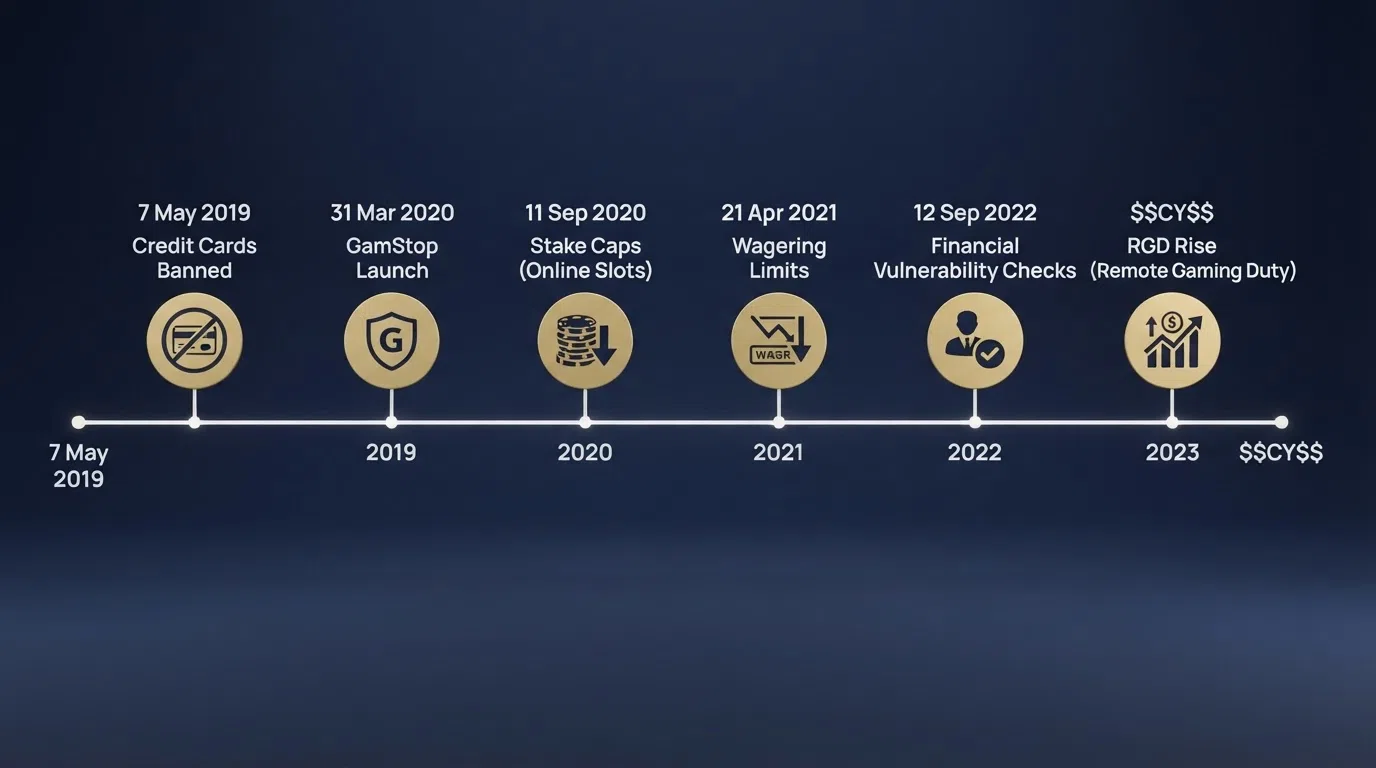
The cost of stepping outside that framework is not the sixty seconds of electronic checks. It is the loss of every institution that sits behind them. A UKGC player who is denied a withdrawal can complain to the operator, escalate to an Alternative Dispute Resolution provider, or refer the matter to the Commission itself. A non-UKGC player who is denied a withdrawal has, in most cases, no equivalent route — the licence jurisdiction’s regulator may or may not respond, and the operator’s own terms govern what happens next. The credit-card ban, in force since 14 April 2020 under LCCP licence condition 6.1.2, does not exist offshore because credit cards are a UKGC product feature rather than a universal one. GAMSTOP, the national multi-operator self-exclusion scheme, covers GB-licensed sites only and reaches nothing beyond the border.
The arithmetic is uncomfortable for the marketing copy. Electronic verification at a UKGC casino adds less than a minute to registration. The same minute, removed, costs the player years of dispute resolution, fund protection, and self-exclusion coverage if anything goes wrong. That is the deal the page is about.
The UKGC Licensing Requirements, Explained in Plain English
LCCP Condition 17.1.1 asks for three things: a name, an address, a date of birth. The operator must verify each one against a reliable source before the customer is permitted to gamble. The three checks are the minimum, not the maximum — most UKGC operators ask for additional information (email, phone, sometimes occupation) but the regulatory floor is the three. The May 2019 deadline made this gate operate before the first deposit rather than after it, and the change shifted the entire industry from post-deposit to pre-deposit verification as the norm.
The Commission’s own register, last updated 29 July 2026, is the single place a UK player can confirm a brand is licensed. Every name on the UKGC half of the ranking below sits on it. The register is searchable by operator name and returns account numbers, licence types, and active dates — the kind of detail that lets a reader check a brand’s licence history without trusting a footer link.
What a Player Gives Up Outside the UKGC Framework: The Protections Offshore Sites Cannot Offer
The list is not abstract. Each item is a named institution, a specific right, or a regulatory guarantee that vanishes at the border:
- GAMSTOP self-exclusion coverage. The national multi-operator scheme is mandatory for every GB-licensed online operating licence since 31 March 2020. An offshore casino has no obligation to participate, and the overwhelming majority do not.
- Alternative Dispute Resolution (ADR) access. UKGC licensees must offer access to an ADR provider for unresolved disputes. Offshore brands may publish their own complaints procedure; few route to an independent body.
- UKGC complaints route. The Commission will investigate complaints against GB licensees and can order restitution, licence suspension, or revocation. It has no jurisdiction over an operator licensed in Curaçao or Anjouan.
- Fund segregation guarantees. UKGC rules require customer funds to be held in segregated accounts. Curaçao, Costa Rica, and Anjouan licence conditions include segregation language, but the audit cycle is inconsistent and the practical protection is operator-dependent.
- British consumer redress. Section 75 of the Consumer Credit Act and ordinary chargeback rights apply to UK-regulated payment flows. Crypto deposits made to an offshore operator fall outside both.
The self-exclusion gap is the one that matters most for the player who already has a gambling problem and is searching this term to get back to a site they previously excluded themselves from. GAMSTOP’s exclusion periods run for six months, one year, five years, or five years with auto-renewal, and the exclusion cannot be cancelled early. If the person does not contact GAMSTOP after the period expires, the exclusion continues for up to seven further years. None of this applies at an offshore brand, which will not check.
GamStop, Self-Exclusion, and the Offshore Blind Spot
GamStop is the centrepiece of the UKGC’s safer-gambling architecture. Mandatory since 31 March 2020, the scheme forces every GB-licensed online operator to check a customer’s email and other identifying details against the GAMSTOP database before granting access. A self-excluded player cannot register, cannot deposit, cannot log in at any UKGC-licensed site during the exclusion period. The system is the only one of its kind in any major gambling jurisdiction, and it works.
It works only inside the UKGC perimeter. A player who has self-excluded through GamStop can register at a Curaçao-licensed casino in under a minute, deposit in Bitcoin, and play without any check. The offshore brand’s own self-exclusion tools, where they exist, are operator-managed — the player sets a limit or a block, the operator enforces it for as long as it chooses to, and there is no central record. The asymmetry is not subtle. A player who has recognised a problem and taken the most consequential step available to them in the regulated market can route around that step in ten minutes in the unregulated one.
Safe, Trusted, Legit: The Signals That Separate a Real Option from a Risk
Every casino on the non-UKGC half of the ranking is licensed in a lighter regulatory framework. The differences between those frameworks matter at the margin but not at the category level. Curaçao is the oldest of the three jurisdictions and the most commonly cited. Costa Rica operates without a dedicated gambling commission and licences through general business registries. Anjouan — the Comoros island licence — is the newest and the lightest, with the shortest application-to-issuance cycle and the fewest ongoing obligations. Across all three, fund segregation exists in the licence conditions and is inconsistently audited. None of them offer UKGC-equivalent ADR access, and none of them enforce GamStop-style central self-exclusion.
The first filter is the licence itself. Beyond that, the practical signals a player can check are: operator track record and community reputation (how long has the brand been live, what do player forums say), withdrawal-complaint patterns (has the operator withheld funds from winners, and if so, how recently), and game-provider mix (do the studios listed have public commercial relationships with the brand). None of these are guarantees. They are the same signals a player uses to evaluate a UKGC operator whose licence they have not personally verified. The difference is that at a UKGC operator, a complaint that goes nowhere is a regulator failure. At an offshore one, it is the regulatory structure working as designed.
10 Casinos Ranked by How Little ID They Ask For — UK-Licensed and Offshore Side by Side
The ranking below is ordered by verification friction — least first, most last — with licence status stated plainly on every row. The UKGC-licensed half of the table uses electronic checks that clear in under sixty seconds for most UK customers; the offshore half skips ID at sign-up and reserves it for withdrawal thresholds. The columns reflect what a UK player needs to compare across the two routes, which is not the same thing a slots fan or a poker player would want.
| Casino | Licence / Jurisdiction | GAMSTOP Connected | Verification Required Before Play | Can Verification Be Deferred? | Verification Speed | Payout Speed |
|---|---|---|---|---|---|---|
| Jackbit | Curaçao (since 2022) | No | No | Yes — at registration and deposit; reserved for AML / fraud flags | N/A for standard play | Instant to a few minutes (crypto) |
| BC.Game | Curaçao | No | No | Yes — wallet-connection only at signup; withdrawal-gated thresholds apply | N/A for standard play | 5–120 minutes (crypto) |
| CoinCasino | Anjouan (Deep Sea Tech Ventures, Costa Rica) | No | No | Yes — email and password only at signup; verification at withdrawal thresholds | N/A for standard play | 5–25 minutes (crypto) |
| PlayOJO | UKGC (SkillOnNet) | Yes | Yes — electronic checks at registration | Partially — document upload deferred to first withdrawal if needed | Electronic checks instant for most customers | — |
| Sky Vegas | UKGC (Flutter) | Yes | Yes — electronic checks before first deposit | No | Under 60 seconds for most customers | <6 hours (PayPal / Trustly) |
| MrQ | UKGC (Lindar Media) | Yes | Yes — electronic checks before first deposit | No | Electronic checks; document upload if needed | — |
| Bet365 | UKGC (Hillside UK Gaming ENC, account 38721) | Yes | Yes — electronic checks at registration | No | Electronic checks; document upload if electronic verification fails | E-wallets within hours; debit card 1–3 working days |
| Betfair | UKGC (Flutter) | Yes | Yes — electronic checks before first deposit | No | Electronic checks; documents if needed | — |
| 888 Casino | UKGC (evoke plc) | Yes | Yes — electronic checks before first deposit | No | Electronic checks for most customers | — |
| William Hill | UKGC (evoke / 888) | Yes | Yes — electronic checks before first deposit | No | Electronic checks for most customers | — |
A dash in the payout column is the honest answer: research did not surface a confirmed payout speed for that operator in this run, and a guess would make the table worse. The UKGC-licensed operators whose payout windows are confirmed are the ones a reader most often hears about in passing — Bet365’s e-wallet-to-debit-card spread is the industry’s reference point, and Sky Vegas’s sub-six-hour PayPal and Trustly release is the fastest electronic-verification payout among the listed brands. The offshore trio (Jackbit, BC.Game, CoinCasino) operates on crypto-native rails and quotes its own speeds in minutes, not hours.
The ranking’s logic is the search term’s logic, in reverse. The player at the top of the table asked for “no ID verification” and got it, along with everything that no ID verification costs them. The player at the bottom asked the same question and accepted electronic verification in exchange for everything the offshore route cannot offer. The reader’s job is to decide which trade-off they are willing to make.
Bet365 — UKGC-Licensed, Electronic Verification, the Industry Benchmark
Bet365 holds two active UKGC licences for its GB-facing operations: Hillside (UK Gaming) ENC, account 38721, and Hillside (UK Sports) ENC, account 55149. Both are confirmed active on the Commission’s public register. Verification runs as electronic checks at registration against credit-bureau and electoral-roll data; for most UK customers the system resolves the match without a document upload. Where electronic verification cannot reach a confident match — recent address change, thin credit file, name on the electoral roll missing — the operator requests a passport and a proof of address before the first deposit. Payouts follow the same split: e-wallets clear within hours, debit-card withdrawals take one to three working days.
The benchmark is not the speed. It is the combination: GAMSTOP coverage, ADR access, UKGC complaints route, and fund segregation, alongside a payout experience that, for a player using PayPal or Trustly, is as fast as anything in the offshore market. The right reader for Bet365 is a UK player who wants every protection the regulated market offers and is willing to spend the sixty seconds that costs them.
Sky Vegas — 200 Free Spins, No Wagering, Verification in Under 60 Seconds
Sky Vegas runs under a UKGC licence held by Flutter Entertainment, confirmed on the public register. Electronic verification against credit-bureau and electoral-roll data completes in under sixty seconds for most UK customers, and most pass through without ever seeing a document-upload screen. The welcome offer is 200 free spins with no wagering requirement, made standard across the UKGC market by the 10× statutory cap on bonus wagering that took effect on 19 December 2025. PayPal and Trustly are the fastest payout routes; e-wallets clear within six hours and there is no fee.
The right reader for Sky Vegas is a UK player who values both speed and the absence of bonus fine print. The no-wagering structure means a free-spin win is paid in cash, not in bonus funds, and the verification window is short enough that a player who closes the page after registration and comes back to deposit later will not have lost their place. Worth choosing over a higher-friction UKGC alternative if PayPal or Trustly is the player’s wallet of choice.
MrQ — 10 No-Deposit Free Spins, No Wagering, Electronic Checks
MrQ is Lindar Media’s UKGC-licensed casino brand, confirmed on the public register. The welcome offer splits into two parts: 10 free spins on Big Bass Splash at 10p per spin, no deposit and no wagering, followed by 50 further spins after a minimum deposit and spend of £10. Electronic verification must complete before the first deposit, and the no-deposit spins still pass through an electronic age check under LCCP SR Code 3.2.11, which obliges operators to verify age before a customer can access free-to-play games or any free bet or bonus. The process is invisible to most UK customers.
The right reader for MrQ is a UK player who wants to test a casino without committing a deposit first. The no-deposit free spins are a real offer, not a marketing hook, and the no-wagering structure means any winnings are withdrawable from the first spin. A caveat the page carries: the offer structure rewards a player who reads the bonus terms, and a player who treats the 10 no-deposit spins as a free trial and walks away after thirty minutes gets exactly what was advertised.
PlayOJO — Electronic Checks at Registration, ID Only If Something Fails
PlayOJO is SkillOnNet’s UKGC-licensed brand, confirmed on the public register. The welcome offer is 50 free spins on Big Bass Bonanza at 10p per spin, with a £10 minimum deposit and a total bonus value of £5 — a deliberately small number that reflects the no-wagering philosophy. Electronic checks run at registration and clear most customers instantly. Where they cannot resolve a match, document upload is deferred to the first withdrawal rather than the first deposit, which is a practical concession to the friction the search term names.
The right reader for PlayOJO is a UK player who wants the no-wagering structure and a casino that does not bury its terms. The brand’s marketing has long leaned on transparency, and the £5 headline figure is a faithful summary of what the spins are worth — neither inflated nor hidden. Where it falls short of a higher-friction UKGC alternative is in the bonus size: a player looking for a larger matched deposit will find more elsewhere.
William Hill — A Multi-Channel Giant with Standard UKGC Electronic Checks
William Hill Organization Limited holds multiple active GB operating licences under evoke / 888, including General Betting Standard (Non-Remote and Remote), Remote Casino, and Gambling Software, with the earliest active dates running from 1 January 2009. The licence history is the deepest of any brand on the page. Electronic verification runs as standard UKGC checks and must complete before the first deposit or any gambling. The product range is the widest of any brand in the ranking: slots, live casino, table games, sportsbook, and poker under one roof.
The right reader for William Hill is a UK player who wants a single account that spans verticals and a licence history measured in decades rather than years. The verification experience is the same gate every UKGC operator runs, and the breadth of product is the brand’s main differentiator.
Betfair — Flutter’s Exchange and Casino Hybrid, Same Electronic Gate
Betfair holds a UKGC licence under Flutter Entertainment, confirmed on the public register. The brand runs the same electronic-verification gate every UKGC operator runs, and the same pre-gambling rule under LCCP Condition 17.1.1 applies. The product mix is the distinctive part: exchange betting sits alongside slots, live casino, and table games, and a player who wants one account for sports and casino will not find a closer fit anywhere on the list. Payout experience follows the same UKGC pattern as every other Flutter brand.
The right reader for Betfair is a UK player who uses the exchange and wants the casino vertical bundled in. For a player who only wants casino, Sky Vegas is the cleaner Flutter option; for a player who values the exchange, Betfair is the only entry in the ranking that offers it.
888 Casino — The evoke Flagship, Electronic Verification for Most Customers
888 Casino holds a UKGC licence under evoke plc, confirmed on the public register. Standard UKGC electronic checks run before the first deposit or any gambling, and most UK customers pass through without a document upload. The product mix is the conventional casino vertical — slots, live casino, table games — without the sportsbook or exchange that some Flutter and William Hill customers value.
The right reader for 888 Casino is a UK player who wants a long-established casino brand and a conventional product mix. The verification experience is identical to every other UKGC entry, and the brand’s longevity is the main reason to choose it over a more recent UKGC alternative.
Jackbit — Curaçao-Licensed, No Verification at Registration, Crypto-Native
Jackbit operates under a Curaçao licence issued in 2022, is not UKGC-licensed, and is not connected to GAMSTOP. Registration and deposit require no documents; verification is reserved for genuine fraud and AML flags. The game library runs to more than 5,000 slots and games, and the operator supports a built-in Monero wallet for on-chain privacy — the only one of the three offshore brands on this page to integrate a privacy coin at the wallet level. Crypto payouts are quoted as instant to a few minutes.
The right reader for Jackbit is a UK player who has decided the trade-off is worth it and values the privacy of a Monero-friendly stack. The trade-off itself is the same one the rest of the offshore brands offer: no GAMSTOP coverage, no ADR, no British consumer redress, and the structural risk that a withdrawal past the threshold triggers a document request at the worst possible moment.
BC.Game — Curaçao-Licensed, Wallet Connection at Signup, Withdrawal-Gated KYC
BC.Game operates under a Curaçao licence, is not UKGC-licensed, and is not connected to GAMSTOP. Sign-up is a wallet connection — no email required, no KYC at registration or deposit. The game library runs to more than 10,000 titles, the cryptocurrency roster covers more than 150 coins, and payouts land in 5 to 120 minutes depending on the network. The catch sits in the verification policy: BC.Game describes itself as withdrawal-gated rather than stays-no-KYC, with soft thresholds and a specific big-winner clause that triggers document requests. Past the trigger line, the same document upload that a UKGC player meets on day one lands at BC.Game on the day of the win.
The right reader for BC.Game is a UK player who wants the largest game library on the page and a wallet-only sign-up. The honest frame is that the “no-KYC” branding covers the deposit and play phase and stops at the withdrawal that matters.
CoinCasino — Anjouan-Registered, Telegram-Native, No KYC at Signup
CoinCasino is registered in Anjouan (under Deep Sea Tech Ventures, Costa Rica), is not UKGC-licensed, and is not connected to GAMSTOP. Sign-up requires only an email and a password, and the operator runs a Telegram-native interface that is unusual for the segment. The welcome offer is a 200% match up to $30,000 plus 50 free spins, with 60× wagering that releases in instalments — the highest wagering multiple of any featured brand. The game library runs to 4,000+ titles from approximately 60 studios, the crypto roster covers 22 coins including BTC, ETH, LTC, USDT, and XRP, and a Bitcoin test withdrawal has been recorded at 25 minutes, with a quoted range of 5 to 25 minutes.
The right reader for CoinCasino is a UK player who wants the Telegram-native interface and a high-match welcome offer, and who reads the 60× wagering as a real cost rather than a footnote. The “200% up to $30,000” headline is a marketing figure, and the 60× multiplier is the arithmetic that turns it into a number worth calculating. For a player depositing the full $30,000, the required turnover is $1,800,000 before the bonus releases, and at 60× the cost of clearing is not a number a reader should treat as rounding.
Withdrawals Without ID: How Fast Can You Really Get Paid?
The withdrawal experience is the part of the no-ID promise that the marketing copy treats most loosely, and the part that matters most. The distinction is not between “verification at sign-up” and “no verification ever.” It is between “verification at sign-up” and “verification at withdrawal,” and the second of those two can land on the largest withdrawal a player ever makes.

UKGC casinos require full identity verification before any funds are released. Offshore platforms let players cash out within standard operator thresholds, and the thresholds vary by brand and by deposit pattern. At the conservative end of the offshore market, the first withdrawal triggers a check regardless of size. At the more permissive end, cumulative deposits and withdrawals between £4,000 and £8,000 sit at the upper bound of the no-questions zone, with a single withdrawal over £1,000 as a separate trigger. Past those lines, the same passport scan that greets every UKGC player on day one lands at the offshore casino on the day the player needs their money most.
The speed tiers a UK player actually experiences are three: crypto payouts in minutes, e-wallet releases within hours, and debit-card transfers taking one to three working days. The fastest crypto payouts in the ranking are Jackbit’s, quoted as instant to a few minutes; BC.Game quotes 5 to 120 minutes; CoinCasino quotes 5 to 25 minutes. The fastest UKGC e-wallet payout in the ranking is Sky Vegas’s sub-six-hour PayPal and Trustly release; Bet365’s e-wallet payouts clear within hours and its debit-card payouts take one to three working days. The gap between the two halves of the ranking is not as wide as the marketing suggests. The structural gap — what happens when an offshore casino decides it needs documents — is wider than any speed figure can capture.
Withdrawal Speed Tiers: Instant Crypto vs. Same-Day E-Wallet vs. Multi-Day Debit Card
Crypto payouts are the headline: Jackbit instant to minutes, BC.Game 5 to 120 minutes, CoinCasino 5 to 25 minutes from a confirmed 25-minute Bitcoin test. The figures are real, the operators are live, and the technology is the same blockchain that powers every other crypto transaction. The catch is that the speed is conditional on the operator not asking for documents, and that condition is the one that disappears at the threshold.
E-wallet payouts at UKGC casinos sit in the hours band. Sky Vegas’s PayPal and Trustly release completes in under six hours, and the operator charges no fee. Bet365’s e-wallet payouts clear within hours as well, though the exact figure varies by wallet. MrQ, PlayOJO, William Hill, Betfair, and 888 Casino did not surface a confirmed payout window in research, and the table marks the gap honestly. The structural feature of UKGC e-wallet payouts is that they sit behind verified identity — by the time the player is requesting a withdrawal, the verification gate has already passed.
Debit-card payouts are the slowest tier and the most reliable in the UKGC system. Bet365’s one-to-three-working-day window is the industry’s reference point, and the speed is the same for every other UKGC operator because it is set by the card network and the issuing bank rather than by the casino. Crypto payouts are faster, e-wallets are in the middle, and debit cards are the slowest band. The point the page makes is not about which band is fastest in the abstract; it is about which band is fastest when the casino decides it needs a passport scan.
Deposit Methods That Let You Skip ID Checks — and the Ones That Do Not
Cryptocurrency is the only deposit method that genuinely reduces the ID friction at the operators that offer it, and the absence of crypto support is the single biggest reason a “no-verification” casino cannot actually skip verification. The technology matters here: a Bitcoin deposit does not carry the cardholder name, billing address, and CVV that a card payment carries, and the operator has no payment-rail data to match against a credit-bureau file. The verification work that a UKGC casino does in the background at registration, an offshore casino skips because the deposit itself carries no name to verify.
Debit cards and bank transfers are the verification-heavy routes. At a UKGC casino, a debit-card deposit is matched against the cardholder’s name and address through the card network, and a bank transfer carries the account-holder identity that the originating bank has already verified. Both routes feed the electronic-verification system and clear most UK customers without a document upload, but the friction they remove is not the verification itself — it is the player’s need to upload a document.
The credit-card ban, in force since 14 April 2020 under LCCP licence condition 6.1.2, applies to all remote gambling at GB-licensed operators and extends to credit-card-funded e-wallet payments. The motivation, recorded in the Commission’s published reasoning, was a finding that 22% of online gamblers who used credit cards were classed as problem gamblers. At an offshore brand, the ban does not apply and credit cards may be accepted; at a UKGC brand, the deposit will be declined at the card-network level. A UK player who wants the protections of the regulated market and uses a credit card cannot have both, and the page states that trade-off plainly.
Real-Money Play and Cashing Out: What Happens When You Actually Win
The end-to-end journey at an offshore casino runs: wallet connection or email signup, crypto deposit, play, withdrawal request. The verification gate sits at the end, not the beginning, and the shape of the gate is the entire product. Past the trigger threshold — cumulative deposits and withdrawals of £2,000 to £3,000, a single withdrawal over £1,000, or the first withdrawal at the more conservative end of the market — the operator requests a passport and a proof of address. The player who has them provides them and waits. The player who does not — because the whole point of the sign-up was anonymity — has a more complicated problem.
UKGC casinos require full identity verification before any funds are released, which means the document request arrives on day one and the player who passes it is done with verification for the life of the account. The offshore model reverses the order: no checks at sign-up, no checks at deposit, a gate at withdrawal. The gate is real, and the player who trips it is the player who has accumulated enough activity to matter. That structural feature is the difference the page is about.
Bonuses That Skip the Paperwork: What No-Verification Offers Actually Deliver
The bonus landscape splits along the licence line. Inside the UKGC market, the dominant offer type is a no-wagering free-spin package — Sky Vegas’s 200 free spins, MrQ’s 10 no-deposit spins, PlayOJO’s 50 free spins at 10p each. The wagering cap that took effect on 19 December 2025 under LCCP Social Responsibility Code 5.1.1 closed the door on any bonus with a wagering requirement above 10×, and the no-wagering structure is now the norm rather than the exception. Outside the UKGC market, the dominant offer type is a high-match welcome package with a high wagering multiple — CoinCasino’s 200% up to $30,000 at 60× is the most prominent example in the ranking. The two structures are not the same product in different costumes; they are different products with different price tags.
The “200% up to $30,000” headline is a marketing figure, and the 60× multiplier is the arithmetic that turns it into a cost. For a player who deposits the maximum and claims the full bonus, the required turnover is $1,800,000 — a sum that converts the welcome offer from a freebie into a multi-day commitment measured in millions of dollars in wagered volume. The marketing copies a figure, and the wagering requirement is the figure’s actual cost. The same point applies, in a different direction, to UKGC no-wagering free spins: the headline number of spins overstates what the offer is worth in pounds, but the cost of clearing is zero, which is the more important number.
Wagering Requirements and Bonus Terms: Why 60× Is a Different Universe from 10×
The 10× statutory ceiling on UKGC bonus wagering is a hard line. No GB-licensed operator can offer a bonus with a wagering requirement above 10×, and the change that took effect on 19 December 2025 made the cap a licence condition rather than a guidance document. Offshore, no such cap exists. Curaçao, Costa Rica, and Anjouan impose no statutory wagering ceiling, and the wagering multiples at the featured offshore brands run from 0× (no-wagering offers, where they exist) to 60× (CoinCasino) and beyond.
The turnover calculation is the only honest comparison. A bonus of B with a wagering multiplier of W requires a turnover of B × W before the bonus releases. At the 10× cap, a £100 bonus needs £1,000 in wagered volume; at 60×, a $100 bonus needs $6,000. The 10× ceiling is not a marketing promise; it is the maximum an operator is allowed to charge. The 60× multiple is what a Curaçao-licensed brand considers a competitive welcome offer. The gap between the two is the gap between a regulated market and an unregulated one, and the no-wagering structure at Sky Vegas and MrQ — where the bonus is paid in cash rather than in bonus funds — is the form UKGC bonuses have evolved to take.
Eligibility Restrictions and Geo-Limits on No-ID Bonuses
UKGC bonus eligibility is restricted to GB residents verified electronically. The verification gate is the eligibility gate: a player who has cleared electronic checks is eligible; a player who has not is not. Offshore, the geography is more complicated. Some offshore brands exclude UK players explicitly in their terms; others accept UK players but apply bonus terms that vary by jurisdiction. Research did not surface a per-operator geo-list for the featured offshore brands, and the page states that as a qualitative point: a UK player should check the operator’s own country-restriction list before claiming a bonus, because the welcome offer that appeared in a comparison table may not be the one available to a British card.
The no-deposit versus deposit-gated distinction is the more useful one for a player choosing where to test a casino. MrQ’s 10 no-deposit spins on Big Bass Splash are a true no-deposit offer — the player can claim them, play them, and withdraw any winnings without ever funding the account. CoinCasino’s 200% match requires a deposit to trigger, and the bonus value is meaningless without one. The cost of a no-deposit offer to the player is the time it takes to claim and play, and the cost of a deposit-gated offer is the deposit itself plus the wagering required to release any winnings.
Crypto Casinos: The Real Engine Behind No-KYC Play
Cryptocurrency is not an optional extra at no-verification casinos. It is the payment rail that makes the entire product commercially viable, and a no-ID casino without crypto support barely exists. The reason is structural. A UKGC casino verifies identity at sign-up because the card payment carries the cardholder’s name and the bank transfer carries the account-holder’s identity, and the operator has a regulatory obligation to confirm both. A crypto deposit carries neither: the wallet address is a string of characters, the blockchain is public, and the link between a wallet and a person is exactly what crypto is designed to break. The offshore operator that defers verification to the withdrawal stage is not making a marketing decision; it is reflecting the limits of what its payment rail tells it.
Bitcoin is the gateway cryptocurrency and the one every featured offshore brand accepts. Ethereum, Litecoin, USDT, and XRP are the next tier. BC.Game’s 150+ coin roster is the largest in the ranking. Jackbit’s Monero support is the distinctive feature for players who value on-chain privacy — Monero’s transaction graph is opaque by design, and a player who deposits and withdraws in XMR leaves a thinner trail than one who uses a transparent ledger. CoinCasino accepts 22 coins including BTC, ETH, LTC, USDT, and XRP. The wallet setup a UK player needs is straightforward: a self-custody wallet (a hardware wallet, a mobile wallet, or a desktop client) and enough crypto to cover the deposit and the network fee. The infrastructure is the same as for any other crypto transaction, and the learning curve is one afternoon rather than one week.
Bitcoin, Altcoins, and the Wallets That Make Anonymous Play Possible
The wallet question is practical before it is philosophical. A UK player who wants to play at a no-KYC casino needs a self-custody wallet they control, not an exchange-hosted balance, because the exchange knows who they are and the casino does not. The wallet setup takes an afternoon; the security practice is the same as for any other crypto holding. The cost of a mistake — sending funds to the wrong address, losing the seed phrase, leaving funds on an exchange that gets hacked — is the same cost it is anywhere else, and the page does not pretend it is smaller at a gambling site.
The privacy calculus is where the coins differ. Bitcoin and Ethereum are pseudonymous: the address is public, the transaction graph is traceable, and a sophisticated counterparty can link an address to a person with enough data. Monero is private by design: the transaction graph is obscured, the amounts are hidden, and the link between sender and receiver is not publicly computable. For a player whose primary motivation is the privacy the search term names, Monero is the technically correct answer. For a player whose primary motivation is the convenience of a familiar coin, Bitcoin is the practically correct one. The trade-off between the two is a trade-off the page flags but does not adjudicate.
No-Signup Crypto Casinos and the Privacy Frontier
The “no-signup” model — a casino where a wallet address is the only identifier — is the extreme end of the no-KYC market and the part most prone to the gap between marketing and reality. BC.Game’s wallet-connection-only sign-up is the partial example in the ranking: the player connects a wallet, deposits, plays, and the casino knows the wallet address and nothing else until the verification threshold trips. CoinCasino’s Telegram-native interface is a different shape — email and password, no KYC at signup, and the operator’s compliance posture sits behind the same withdrawal threshold as the rest of the offshore segment.
What a player trades away when they trade an email address for a wallet address is everything that an account provides. Bonus tracking requires an account. Loyalty rewards require an account. Transaction history requires an account. Responsible-gambling tools — deposit limits, reality checks, self-exclusion — require an account, and at an operator that does not hold verified identity data, even the tools that exist cannot be enforced. The privacy frontier is real, and the cost of standing on it is the cost of standing outside the systems that the regulated market built to protect the player who needs protection. The page carries that trade-off without softening it.
Mobile and Pay-by-Phone: A Low-Friction Deposit Route Inside the UKGC Market
Mobile billing and pay-by-phone deposits offer a verification-light experience within the UKGC system, and the friction reduction is structural rather than regulatory. The phone network’s own KYC — the identity check the mobile operator runs when a customer takes out a contract — does the heavy lifting that the casino would otherwise do. A player who pays by phone bill is, by definition, the named account holder on a contract that the mobile operator has already verified, and the casino’s residual verification obligation is light.
The distinction is between phone verification (the casino asking for a phone number) and ID verification (the casino asking for a passport). The legal obligation under LCCP Condition 17.1.1 is identity verification, not phone verification, and a casino that skips the phone step has not skipped the ID step. The pay-by-phone route reduces friction — the player does not need to upload a document — but it does not remove the UKGC obligation. The verification is happening somewhere, and the phone network is doing it.
Phone Verification vs. ID Verification: What the Distinction Actually Means
“Phone verification” in casino marketing language means the operator has sent a one-time code to a phone number to confirm the customer controls the line. It is a marketing-consent and account-security measure, not a regulatory check. “ID verification” means the operator has confirmed the customer’s name, address, and date of birth against a reliable source, as LCCP Condition 17.1.1 requires. A casino that skips the phone step is a different product from a casino that skips the ID step, and the search-volume cluster behind “no phone verification casino” is smaller and structurally different from the one behind “no ID verification casino.”
A UK player who wants pay-by-phone deposits at a UKGC casino will still go through electronic identity verification. The phone number is a separate input that the operator uses to send bonus offers and security alerts. The two checks live in different parts of the registration flow, and conflating them is the most common way a player misunderstands the search results.
Slots and Live Dealer Games You Can Play Without Submitting Documents
The game library at an offshore casino is, on the whole, larger than at a UKGC one. Jackbit runs to 5,000+ titles. BC.Game runs to 10,000+. CoinCasino runs to 4,000+ from approximately 60 studios. The UKGC-licensed half of the ranking offers the conventional product mix — slots, live casino, table games, and (for the multi-vertical brands) sportsbook and poker — without competing on raw catalogue size. The reason is regulatory. The UKGC’s Remote Technical Standards govern the technical integrity of games offered to GB customers, and the compliance overhead of certifying 10,000 titles from 150 studios limits the libraries that GB-licensed operators can offer. Offshore operators are not bound by the same standards and the ceiling is the studio’s willingness to integrate.
The shape of the market is captured in the Commission’s own figures. Online slots drove a 12% year-on-year GGY increase in Q1 2026, with 26.8 billion total bets and spins across the quarter. For the financial year April 2024 to March 2025, online casino games generated £5.0 billion in GGY, with £4.2 billion from slots alone. The UK player who searches for a no-ID casino is, in market terms, a slot player — the product that drives the segment’s growth and the product that the 10× wagering cap and the age-banded stake limits (£5 for 25+, £2 for 18–24) are designed to constrain.
New No-Verification Casinos in 2026: What Is Actually New
The no-verification market in 2026 sits at the intersection of two regulatory shifts: a tightening UKGC market that has closed several loopholes, and a stable offshore market that has absorbed the resulting demand. The Remote Gaming Duty rise from 21% to 40%, effective 1 April 2026, is the largest of the UKGC-side changes. It applies to all online casino operators with a GB presence and is a significant cost increase, but the Commission’s own data shows the market has not contracted: total online GGY for January to March 2026 was £1.55 billion, a 7% year-on-year increase, with slots up 12%.
The player-side changes that took effect during 2025 are the ones that reshaped the competitive landscape. The age-banded slot stake caps — £5 for 25+ from 9 April 2025, £2 for 18–24 from 21 May 2025 — capped the largest single bet a UKGC player can place on a slot and pushed the most aggressive high-stakes play offshore. The 10× wagering cap on bonuses from 19 December 2025 eliminated the high-wagering welcome offers that had been a UKGC staple. The financial vulnerability check at £150 net deposit in a rolling 30-day period, in force from 28 February 2025 under LCCP SR Code 3.4.4, added a light-touch affordability check that runs in the background for most UK customers and prompts a deeper review for a small minority. The cumulative effect is a UKGC market that is cheaper for the player to operate in (lower wagering, no high-stakes slots) and more expensive for the operator to run (higher RGD, levy, compliance overhead). The offshore market absorbed the players for whom the UKGC changes were a step too far.
Responsible Gambling When Nobody Knows Who You Are
The central tension of the no-ID proposition is the one the marketing copy never names. The very feature that attracts players — anonymity — is the feature that disconnects them from every UK responsible-gambling safeguard, and the offshore tools that exist are voluntary where the UKGC tools are mandatory. The Commission’s safer-gambling infrastructure is built on the assumption that the operator knows who the customer is. GAMSTOP works because the operator checks the customer’s email and identifying details against the national database before granting access. Financial vulnerability checks work because the operator has verified identity data to run the check against. Deposit limits work because the operator can enforce them. None of these mechanisms function at a casino that does not hold verified identity data, and the offshore operators that do not hold it cannot enforce what they do not have.
The UKGC’s mandatory tools sit inside the regulated market. GAMSTOP self-exclusion is mandatory for every GB-licensed online operating licence since 31 March 2020. Deposit limits are customer-set but the offer is mandatory: from 31 October 2025 operators must prompt customers to set a financial limit before their first deposit and action any decrease immediately. Financial vulnerability checks at the £150 net deposit threshold, in force from 28 February 2025, are a soft backstop for customers whose circumstances the operator can see changing. Reality checks and time-outs are built into the platform. The system is not perfect — the Commission publishes the data and the data shows a market under stress — but it is the only system of its kind in any major jurisdiction.
The Tools a UK Player Can Use No Matter Where They Gamble
The help resources that work across the board — UKGC-licensed, offshore, crypto, fiat — are the ones that do not need the casino’s co-operation to function. The National Gambling Helpline, run by GamCare, is free, confidential, and available 24/7 on 0808 8020 133, plus live chat and WhatsApp. The helpline received 996 referrals to treatment and peer-based support in January 2026, up 48% from 674 in January 2025, and 81.5% of 2026 helpline contacts cited online forms of gambling — a five-year high. NHS gambling treatment clinics operate in England, Scotland, and Wales. Gamban blocks gambling websites and apps at the device level. GamCare and Gamblers Anonymous run peer-support networks. None of these tools need the casino to know the player is using them, and that is the feature that makes them work.
The prevalence data frames the size of the population the tools serve. The Gambling Survey for Great Britain (GSGB Year 3, 2025) estimates approximately 2.4% of adults in GB aged 18+ had a PGSI score of 8+, equivalent to approximately 1.3 million adults. The NHS Adult Psychiatric Morbidity Survey (APMS 2023/24) found 0.4% of adults with PGSI 8+. The two surveys use different methodologies and arrive at different headline numbers; the gap between them is the measurement uncertainty, not a contradiction. The treatment data tells the same story from a different angle: 11,960 clients were treated by the National Gambling Support Network in 2024/25, an 11% increase year-on-year.
The Trade-Off Between Anonymity and Player Protection — Stated Plainly
If the casino does not know who the player is, it cannot stop them when they need stopping. That is the trade-off, stated without softening. The UKGC’s financial vulnerability check at £150 net deposit in a rolling 30-day period uses publicly available data — bankruptcy, county court judgments, IVAs, DROs — and the check only works because the operator has verified identity data to match it against. The check is a backstop, not a solution, but it is a backstop that exists inside the UKGC system and does not exist outside it.
The offshore self-exclusion is operator-managed, not centrally enforced, and the operator’s incentive to enforce it once the player has asked to be excluded is the operator’s own commercial judgement. GAMSTOP cannot reach an operator outside the GB licensing system. The National Gambling Helpline can, and it does, and the record referral numbers in 2026 suggest the help is being sought. The page closes this section by saying: the player who needs the protections the UKGC market was built to provide should be inside the UKGC market, and the player who has already decided to step outside it should know the safety net they have given up and use the one that still works.
How We Selected and Ranked the Casinos on This Page
The selection was built around one principle: the page ranks every casino in the featured set by verification friction, with licence status stated plainly on every row. The UKGC-licensed half was confirmed against the Commission’s public register, last updated 29 July 2026, and the operators are the ones a UK player would recognise as the major UKGC brands — Bet365, Sky Vegas, MrQ, PlayOJO, William Hill, Betfair, 888 Casino. The offshore half was sourced from the no-KYC segment’s published operator list — Jackbit, BC.Game, CoinCasino — and the verification policies were taken from each operator’s published terms and the reviewer testing that has been done by the no-KYC affiliate sites. William Hill’s licence history, with active GB licences from 1 January 2009, is the register-depth example: a player can confirm the brand has been continuously licensed for seventeen years through the same register that confirms every other UKGC entry.
The ranking’s primary axis is verification friction. Secondary axes — payout speed, bonus fairness, game breadth — were assessed qualitatively and are reflected in the table and the operator write-ups, but they do not break ties. Where research did not surface a confirmed figure, the table marks the gap honestly rather than guessing. The limitation the page states plainly: every offshore operator’s claims about verification policy are based on published terms and reviewer testing, not on this page’s own deposits. A player who wants certainty should test the withdrawal process themselves at a small scale before committing meaningful funds, and the page says so.
What You Should Actually Do: Friction vs. Protection in One Honest Sum
The arithmetic of the page is short. Electronic verification at a UKGC casino adds under sixty seconds to registration. The same minute, removed, costs the player the GAMSTOP coverage that every UKGC operator must provide, the ADR access that every UKGC operator must offer, the UKGC complaints route, the fund-segregation guarantee, the British consumer redress, and the credit-card ban that protects the player from a specific and well-documented harm. The 10× wagering cap that took effect on 19 December 2025 made UKGC bonuses structurally cheaper to clear than any offshore equivalent, and the 60× multiplier on CoinCasino’s welcome offer is the figure the offshore segment is competing against. The 200% up to $30,000 headline is the marketing; the 60× wagering is the cost.
A UK player who values both speed and safety has one rational answer, and the page states it: the UKGC market. The electronic checks clear in under sixty seconds for most customers, the no-wagering free-spin offers at Sky Vegas, MrQ, and PlayOJO are the most generous bonus structures in the segment, and the protections that sit behind them are the ones the page has been describing. A player who values only speed, and who has decided the trade-off is worth it, has the offshore half of the ranking. Jackbit is the most private, BC.Game has the largest game library, and CoinCasino is the one to choose if the Telegram interface fits. The minimum steps a player who takes the offshore route should take: start with a withdrawal at a small scale to confirm the operator’s verification policy in practice, never bet more than the player can afford to lose at a venue where the only recourse if funds are withheld is the operator’s own terms, and use the National Gambling Helpline on 0808 8020 133 if the play stops being a choice.
The search term that brought the reader to this page is a real product, sold by real operators, to real customers. The trade-off it conceals is the only thing on the page that matters, and the trade-off is the one the reader has to make.
Comparison of Key Responsible Gambling Protections
The regulatory gap between the two halves of the market is most visible in the responsible gambling protections available to the player.
| Protection | UKGC-Licensed | Offshore (Curaçao/Anjouan) |
|---|---|---|
| Mandatory GAMSTOP Access | Yes | No |
| Independent ADR Access | Yes | No |
| Financial Vulnerability Checks | Yes | No |
| UKGC Complaints Route | Yes | No |
Frequently Asked Questions
Is it actually possible to gamble online without ever sending a photo of my passport?
Yes — at Curaçao, Costa Rica, or Anjouan-licensed offshore casinos, no documents are requested at sign-up or deposit, and a player can register, deposit in crypto, play, and withdraw within the operator’s stated thresholds without ever uploading a passport. No UKGC-licensed casino offers this experience, because LCCP Condition 17.1.1 requires name, address, and date of birth verification before the first deposit or any gambling, and the rule has been in force since 7 May 2019.
What happens to my winnings if an offshore site suddenly demands documents?
The offshore operator’s verification policy typically triggers at cumulative deposits and withdrawals of £2,000 to £3,000, at a single withdrawal over £1,000, or at the first withdrawal at the more conservative end of the market. When a trigger fires, the operator requests a passport and a proof of address and holds the withdrawal until the documents arrive. The player who can provide them waits a few days; the player who cannot, because the whole point of the sign-up was anonymity, has limited recourse beyond the operator’s own complaints process.
Do any of the casinos on this page connect to the GamStop network?
Seven of the ten do — Bet365, Sky Vegas, MrQ, PlayOJO, William Hill, Betfair, and 888 Casino are all UKGC-licensed and therefore GAMSTOP-connected, because GAMSTOP participation is mandatory for every GB-licensed online operating licence since 31 March 2020. The three offshore brands (Jackbit, BC.Game, CoinCasino) are not GAMSTOP-connected and do not participate in the scheme.
Can I use a debit card instead of crypto at a no-verification casino?
In practice, no. The offshore casinos in this ranking are crypto-native: their deposit and withdrawal rails assume a self-custody wallet, and the verification deferral works because crypto deposits do not carry the cardholder name and billing address that a debit-card payment carries. Some offshore brands accept debit cards, but the card payment’s identity data tends to push the operator into its verification flow at the deposit stage rather than the withdrawal stage.
What recourse do I have if a casino outside the UKGC system refuses to pay me?
The recourse depends on the operator’s licence jurisdiction and the operator’s own published complaints process. The UKGC has no jurisdiction over Curaçao, Costa Rica, or Anjouan licensees, and the Commission’s complaints process is not available. ADR access is whatever the offshore operator chooses to publish, and British consumer-redress rights (Section 75, chargeback) do not reach crypto deposits to an offshore wallet. The honest answer is that the recourse is limited and the player should treat the risk as part of the trade-off.
How many extra minutes does verification actually add at a UK-regulated site?
For most UK customers, under sixty seconds. The electronic-verification system matches the customer’s name, address, and date of birth against credit-bureau and electoral-roll data, and the match resolves for the vast majority without a document upload. The minute is a one-off at registration and the player never sees it again. The same minute, removed, costs the protections described in the body of this page — protections that cannot be bought back after they are needed.
RNG vs. Live Play: Does Verification Status Change the Game?
The game itself does not change between a UKGC casino and an offshore one. The slots at Jackbit, BC.Game, and CoinCasino are the same products from the same studios — Pragmatic Play, Hacksaw Gaming, Nolimit City, Evolution — that supply the UKGC-licensed brands. The live-dealer tables are Evolution and Pragmatic Play Live, regardless of the casino’s licence jurisdiction. The game does not know what licence the operator holds, and the RNG that powers it does not either.
What changes is the audit layer above the game. UKGC-licensed operators are bound by the Commission’s Remote Technical Standards, which require games to be tested by an accredited testing house and the RNG to be certified against a published standard. Offshore operators are not bound by the same standards, and RNG auditing at offshore brands is provider-level rather than operator-level: the studio certifies the game once, and the operator integrates it without an independent check on the integration. The distinction matters at the margin, not at the headline, and a player who values the integrity of the RNG should know which layer of audit applies to the game they are playing.
Fresh Brands vs. Established Operators: Does Age Predict Reliability?
The trust equation for a new offshore casino is different from the trust equation for an established UKGC operator. William Hill’s licence history, with active GB licences dating from 1 January 2009, is the longevity benchmark. Jackbit’s 2022 Curaçao launch is a mid-age offshore reference point. The newest offshore operators in the segment have not been live long enough to have a track record, and the absence of a confirmed launch date is itself information — the player who deposits at a brand that has been live for six weeks is taking a different kind of risk than one established for six years.
Operator age matters more offshore than at a UKGC brand. The UKGC’s regulatory architecture means that a six-month-old UKGC casino is held to the same standard as a seventeen-year-old one; the licence, the ADR route, the Commission complaints process, and the segregated accounts all apply equally. At an offshore casino, the same architecture does not exist, and the operator’s own track record is the only track record available. A player who values the protection of a long-established UKGC brand should weight age as a tie-breaker. A player who has decided the offshore trade-off is worth taking should weight it more heavily.
Account – realmoney-onlinecasinos-uk
Content created by the «realmoney-onlinecasinos-uk» team