
Non UKGC Licensed Casinos: The Offshore Sites Reaching UK Players
 Available in GB
Data current as of September 8, 2026 and cross-checked against the Gambling Commission’s public licence register.

A non-UKGC casino is an online gambling operator that accepts UK customers without holding a licence from the Gambling Commission. It will usually display a Curaçao, Anjouan, Malta or Costa Rica licence badge in its footer instead, and the marketing around it leans on that badge as if it were equivalent. It is not. A Curaçao or Maltese licence has no legal standing in the British market, and the operator is running without the authorisation that the Gambling (Licensing and Advertising) Act 2014 made compulsory for any business serving GB customers. That is the central fact about this corner of the market, and it is the one the welcome-bonus headlines are designed to push out of view.
This page reviews the offshore sites UK players actually encounter in 2026, names the licence each one holds, and lays out what a UKGC licence delivers that those licences do not. The subject does not lend itself to a balanced write-up of “two valid options.” One of these routes is the legal, regulated British market. The other is the unregulated one. The question the page answers is what the second one costs the person using it, and which readers, if any, the numbers suggest it is built for.
What a Casino Outside the UK Gambling Commission Is
A non-UKGC casino is a gambling operator that has chosen, for commercial reasons, not to apply for a Gambling Commission licence, or has held one and surrendered it. The single most important fact about such an operator is that it is offering a regulated product to a regulated audience without the licence the regulator requires. The Gambling (Licensing and Advertising) Act 2014 made point-of-consumption licensing compulsory: any operator, regardless of where it is incorporated, needs a UKGC licence to provide remote gambling facilities to customers in Great Britain. A Curaçao, Maltese or Gibraltar licence is not a substitute, and the Commission has confirmed publicly that a Curaçao-licensed operator is “not permitted to offer gambling services within the UK without a licence from us.”
The second fact is the one that determines what a UK player actually risks. The criminal offence created by section 33 of the Gambling Act 2005 falls on the operator, not on the customer. The maximum penalty for the operator is up to 51 weeks’ imprisonment, an unlimited fine, or both. No UK player has been prosecuted for gambling on an unlicensed site. So the legal risk of using a non-UKGC casino is, in practice, near-zero for the player. That is not the same as the risk of using one. The risk that does land is the loss of every statutory protection the UKGC licence is built to guarantee: identity verification before play, stake caps, GamStop coverage, fund segregation, a regulator with the power to suspend the licence, and a binding dispute-resolution route. The player who steps outside the perimeter is not prosecuted, but they step outside the protections. The rest of this page is about what that means in pounds, in lost recourse, and in the actual cost of the bonuses the offshore sites are built around.
How a Casino Operates Without a UKGC Licence
The offshore-licensing model is the structure non-UKGC casinos use to reach UK players while answering to a different regulator. Most hold a licence from Curaçao, the Malta Gaming Authority, Anjouan, Costa Rica, or Gibraltar, and the licence the operator chooses is the licence the player gets protection from. None of these is interchangeable with a UKGC licence in British law, and the differences between them are large.
The Malta Gaming Authority sits at the top of the offshore tier. It runs a Player Support Unit, requires operators to segregate customer funds from operating funds, and publishes reasoned decisions on disputes that can be tested in public. A complaint from a UK player about an MGA-licensed operator is, in practice, the closest thing the offshore sector offers to what IBAS delivers for the British market. Curaçao and Anjouan sit below it: their licensing frameworks are lighter, their player-dispute mechanisms thinner, and the published-decision record much smaller. Costa Rica operates a different model again: it does not issue gambling-specific licences in the same way, and the regulatory infrastructure is correspondingly limited. Gibraltar’s regime is well-regarded but is closer in function to a European-licensed market than to the lighter-touch Curaçao framework, and it is rarely the licence of choice for operators marketing heavily to the UK from outside the regulatory perimeter.
The commercial reality is that these operators accept UK players knowing that doing so is not authorised under British law. The geographic targeting is not hidden: English-language websites, GBP account balances, payment methods that work in the UK, customer support that takes UK time zones. The business model relies on the gap between the operator’s legal exposure and the player’s, and on bonuses heavy enough to compensate the player for what the licence does not deliver. The question is whether it does.
The Non-UKGC Operator Landscape in 2026
The non-UKGC landscape that reaches UK players in 2026 is a market of established brands and constant new entrants, and the typical profile is consistent enough to draw a portrait. The headline offers are aggressive: 150%, 300%, 600% matched deposits, with hundreds of free spins attached, and a no-deposit sweetener on registration in many cases. The payment mix leans crypto. The responsible-gambling infrastructure is thinner than the UK equivalent, and the marketing speaks in words the British market has been told not to use. The Gambling Commission’s own observation, drawn from its four-part series on illegal online gambling, is that “consumer motivations to use illegal sites are varied — there is no single driver of engagement. Some consumers are unaware that they are gambling illegally, highlighting the need for greater awareness.” That is a candid framing: a meaningful share of the traffic does not arrive knowing what it is arriving at.
This page profiles ten operators in full further down — nine that serve UK customers without a UKGC licence, and one UKGC-licensed operator included as the benchmark against which the rest are measured. The split is intentional. The single most useful piece of context for a reader considering a non-UKGC site is the alternative they are choosing against, and the alternative is a UKGC-licensed site with a defined set of mandatory protections attached.
Are Non-UKGC Casinos Legal? The 2026 Regulatory Reality
The legal framework that defines this market is short, specific, and older than most readers assume. Section 33 of the Gambling Act 2005 makes providing gambling facilities without the required licence a criminal offence. The 2014 Act extended that requirement to every remote operator serving GB customers, anywhere in the world. Together, those two pieces of legislation are why a Curaçao-licensed operator is operating illegally in the UK even when the operator itself is registered in Willemstad and runs its servers somewhere else entirely.

The expected-loss calculation that follows quantifies the cost of one of the offers these operators use to attract UK players. The work uses a representative non-UKGC welcome bonus of £300 (a £100 deposit with a 300% match at Goldenbet), a wagering requirement of 35× producing a required turnover of £10,500, and Book of Dead as the slot title with an RTP of 96.21%. The expected loss is the turnover multiplied by one minus the RTP: £10,500 multiplied by 0.0379, which gives £397.95. That is the statistical cost of clearing the bonus over the volume of play the wagering requirement demands. For a UKGC operator on the same £300 bonus, the wagering cap of 10× produces a required turnover of £3,000. The expected loss on the same slot is £3,000 multiplied by 0.0379, which gives £113.70. The arithmetic does not lie: a 35× non-UKGC bonus is, on a like-for-like basis, expected to cost a player roughly £284 more than a 10× UKGC one, before any consideration of which operator is offering it. The expected loss is a statistical average over many spins at the stated RTP, not a guaranteed outcome for any individual player.
The penalty the section 33 offence carries is the operator’s, not the player’s. The maximum is 51 weeks’ imprisonment, an unlimited fine, or both. The Commission does not have the resources, the legal basis, or the stated intent to pursue individual customers, and no UK player has been prosecuted for using an offshore casino. The enforcement model is built around disruption, not prosecution, and the numbers from the last reporting year are large: 3,140 disruption notices issued between April 2024 and June 2025, 447,778 URLs referred to search engines, 287,961 of those URLs removed, and an average 32% fall in engagement across 160 disrupted sites. For the 12 months to September 2025, the headline figure is 208,088 enforcement actions. The annual report for 2024-25 records 516 cease-and-desist requests to illegal operators, up from 384 the year before.
The Commission’s tools are real, but they are also bounded. The UKGC does not currently hold statutory ISP or DNS blocking powers — legislation to grant them has been proposed but not enacted. The disruption model depends on voluntary cooperation from search engines, domain registrars, hosting providers, and payment processors. A site that moves fast, rotates its domains, and finds a payment route that holds can stay reachable. That is part of why the market continues to exist at the scale it does, and it is also why the disruption numbers, however large, are a number of actions rather than a number of sites removed permanently.
What UKGC Licensing Requires (and Why Its Absence Matters)
A UKGC licence is not a single rule. It is a stack of obligations, and each one exists because the regulator identified a harm it wanted to address. The stack has grown heavier in the last five years, and a meaningful part of it has been added since 2024. A non-UKGC operator is not bound by any of it.
Pre-verification of name, address and date of birth has been mandatory for every remote licensee since 7 May 2019: a customer cannot deposit or gamble until the operator has confirmed who they are. The online slots stake cap came into force in April and May 2025: £5 per game cycle for players aged 25 and over, £2 per game cycle for players aged 18 to 24, imposed by the Gambling Act 2005 (Operating Licence Conditions) (Amendment) Regulations 2025. A non-UKGC site is not subject to either tier, and a player who has self-restricted by setting a £2 stake limit on a UKGC site can place a £500 spin on an offshore one without the platform objecting.
GamStop has been a mandatory condition of every UKGC online operating licence since 31 March 2020. The Commission has suspended licences over failure to participate. A player on GamStop is blocked from every UKGC-licensed site; a non-UKGC site is not on the scheme and is not part of that block. The credit card ban has applied to all remote gambling payments since 14 April 2020, including credit-card-funded payments through e-wallets. A non-UKGC site is under no such restriction and frequently accepts credit card deposits that a UKGC operator would decline.
The deposit-limit prompt took effect on 31 October 2025: every customer must be prompted to set a financial limit before their first deposit, and any decrease request must be actioned immediately. A light-touch financial vulnerability check has been triggered at a net deposit threshold of £150 over a rolling 30-day period since 28 February 2025. Approved ADR is required: IBAS handles around 90% of UK gambling disputes, with binding decisions on operators for disputes up to £10,000 and an average resolution time of 54 days. The bonus wagering cap of 10× the bonus amount took effect on 19 December 2025, and mixed-product promotions are banned. The statutory levy at 1.1% of gross gambling yield for remote casino licences took effect on 6 April 2025, with proceeds split 50% to treatment, 30% to prevention and 20% to research.
Read the list as a single object and the picture is clearer than any one item in it. A UKGC licence is a continuously-maintained, regulatorily-enforced commitment to a set of player protections. A non-UKGC licence is none of those things, and the protections are not a default the offshore operator has chosen to skip; they are requirements the offshore operator is not subject to.
The Offshore Licence Patchwork: MGA, Curaçao, Anjouan and Beyond
Not all alternative licences are equal, and the differences between them are not cosmetic. The Malta Gaming Authority is the highest-tier alternative to a UKGC licence available to a UK-facing operator. It runs a Player Support Unit that can be approached by a customer with a complaint, it requires operators to segregate customer funds from operating funds, and it publishes reasoned decisions on disputes that establish a record. For a UK player with a complaint, the MGA route is the closest functional substitute for IBAS — slower, less automatic, and without the same statutory teeth, but a real route.
Curaçao and Anjouan are different. Neither regulator runs a player-dispute mechanism of the MGA or IBAS kind. A complaint from a customer is, in practice, a complaint to the operator, with whatever leverage the operator chooses to give it. The Commission has confirmed, in correspondence reported in the trade press, that a Curaçao licence “is not permitted to offer gambling services within the UK without a licence from us” and that claims of Curaçao licensing have no legal standing in the British market. The two regulators are not equivalent in coverage or recourse, and treating them as if they were is the mistake the marketing invites.
Costa Rica operates a different licensing framework again. The country does not issue gambling-specific licences in the way Malta, Curaçao or the UK do, and the regulatory infrastructure is correspondingly limited. A Costa Rica-licensed operator is, in effect, an operator with a corporate registration and a minimal additional layer of oversight. Gibraltar’s regime is closer in function to a European-licensed market, but it is rarely the licence of choice for operators marketing heavily to the UK from outside the regulatory perimeter, and it does not substitute for a UKGC licence in British law.
For a UK player weighing a complaint, the practical hierarchy is straightforward. MGA offers a route. Curaçao, Anjouan, and Costa Rica offer what the operator chooses to offer. None of them offers the binding ADR with a £10,000 cap and a 54-day average resolution that IBAS does, and none of them offers a regulator with the power to suspend the licence on a player-protection finding.
Is It Legal? What the Law Actually Says for UK Players
The clearest way to state the legal position is the way the Commission states it. The operator is the one committing the offence; the player is not. The risk to the player is not prosecution. The risk to the player is the loss of the protections the licence exists to provide. The Commission’s own framing, drawn from its blog on confronting the threat of illegal gambling, is that “unlicensed sites often lack age verification, responsible gambling tools, secure payment systems and an appropriate dispute resolution scheme.” That is a list of the things a UKGC licence guarantees, and the list is what a player steps outside when they step outside the perimeter.
What disappears in concrete terms is: GamStop coverage, so a self-excluded player is no longer self-excluded; the Commission’s complaints route, so a regulator that can compel an operator is no longer involved; approved ADR, so a binding dispute decision is no longer available; British consumer redress, so the avenues a UK consumer would normally use are not available; guaranteed fund segregation, so an insolvency of the operator can leave the player unsecured; mandatory responsible-gambling tools, so deposit limits, reality checks and time-outs are present only when the operator chooses to offer them; stake caps, so the £5 and £2 per-game-cycle limits do not apply; financial vulnerability checks, so the £150 net-deposit trigger does not exist. The list is the cost of the route, and it is paid entirely by the person who takes it.
UKGC vs Non-UKGC: The Protection Gap at a Glance
The table below sets the two regimes side by side on the protections a UK player most often asks about, with the no-data marker where the protection is not regulatorily required of a non-UKGC operator. The columns are not symmetric by design: the UKGC column carries the statutory requirement, the non-UKGC column carries the position the offshore operator finds itself in. The gap between them is the page’s subject.
| Protection | UKGC-Licensed Casino | Non-UKGC Casino |
|---|---|---|
| Identity verification before play | Required since 7 May 2019 | Not required |
| Online slots stake cap (25+) | £5 per game cycle (SI 2025/215, Apr 2025) | No regulatory ceiling |
| Online slots stake cap (18–24) | £2 per game cycle (SI 2025/215, May 2025) | No regulatory ceiling |
| GamStop participation | Mandatory since 31 March 2020 | Not on the scheme |
| Credit card deposits | Banned since 14 April 2020 | Not prohibited |
| Pre-first-deposit financial limit prompt | Required from 31 October 2025 | Not required |
| Financial vulnerability check | £150 net deposits / 30 days (from 28 Feb 2025) | Not required |
| Financial risk assessment | Stage 1 at £5,000/£2,500 (announced 7 Jul 2026) | Not required |
| Approved ADR (IBAS) | Binding on operator up to £10,000, 54-day average | Operator-dependent; not statutory |
| Bonus wagering cap | 10× the bonus amount (from 19 Dec 2025) | No regulatory cap; 30×–40× typical |
| Fund segregation disclosure | Required from 31 October 2025 | Not required |
| Statutory levy funding | 1.1% of GGY (remote casino, from 6 Apr 2025) | Not applicable |
The asymmetry is the point. The non-UKGC column is shorter on specifics not because the protections are equal, but because the requirements do not exist. A player reading the table is not weighing two competing claims; they are weighing a defined set of obligations against a category of operators that is not subject to any of them.
Checking the Register: The UKGC Public Licence Database
The single most useful step a UK player can take before depositing at any online casino takes under a minute. The Commission’s public register lists over 2,661 licensed gambling businesses and is searchable by business name, trading name, domain name or account number. A valid entry shows the licence status, the licence type, the account number, the trading names covered and the dates the licence was issued and is valid through. The absence of an entry for a casino that is actively marketing to UK players is the answer to the question a player is asking.
The check is non-negotiable, and it is not the same as reading the licence badge in the site’s footer. A footer badge is a marketing claim. A register entry is the regulator’s own record. A Curaçao or Anjouan badge does not, and cannot, produce a UKGC register entry — the operator has not applied for a UKGC licence, or has had one suspended or surrendered. The first version of the question to ask is not “is this site licensed” but “is this site licensed by the regulator of the market it is serving me from.”
The Offshore Casinos Reaching UK Players in 2026, Ranked Side by Side
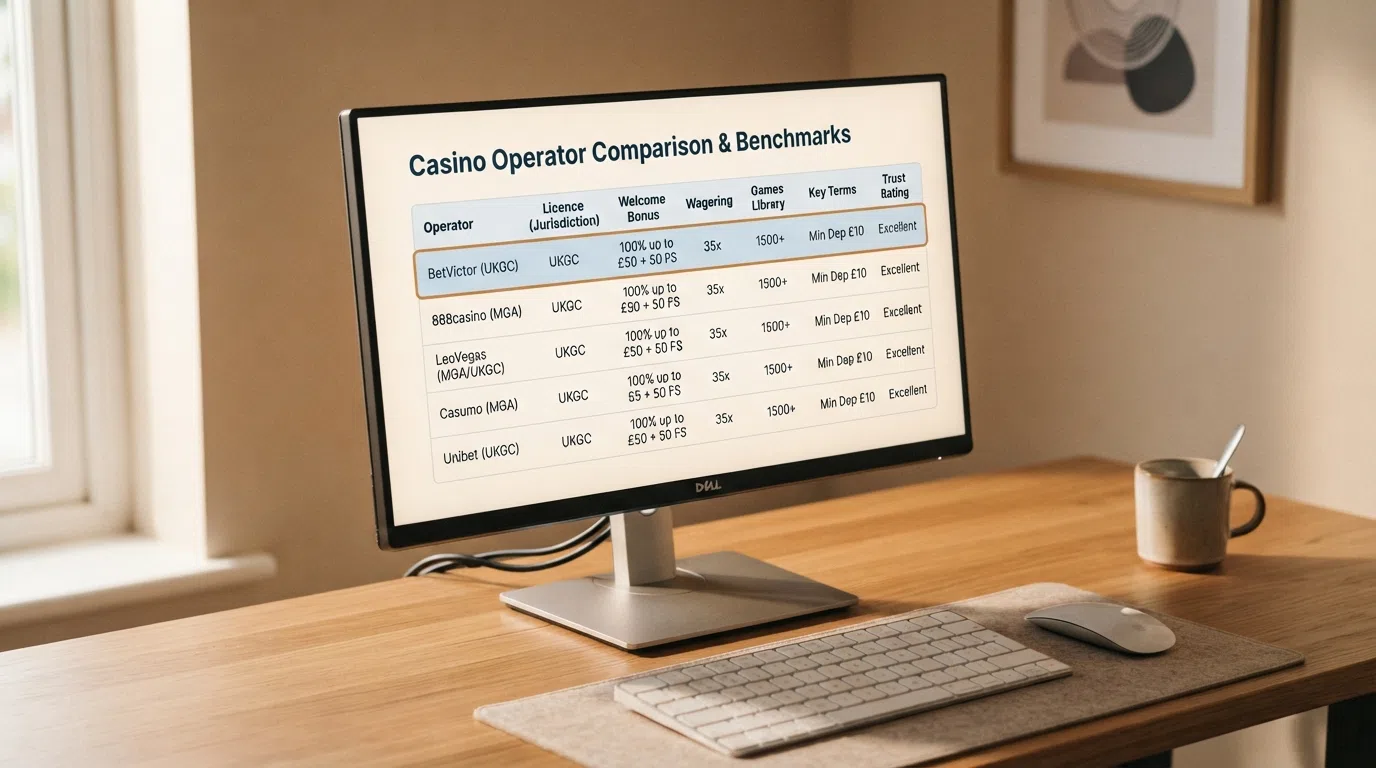
The table below ranks the ten operators reviewed on this page by licence quality, bonus value and terms transparency. Nine are non-UKGC operators actively serving UK customers; the tenth is a UKGC-licensed operator included as the benchmark the rest are measured against. The columns are the ones a player most often asks about, and the cells that research did not back carry the no-data marker so the gap is visible rather than disguised.
| Casino | Licence (jurisdiction + GB-legal status) | Welcome Bonus | Wagering Requirement | Free Spins | Bonus Validity |
|---|---|---|---|---|---|
| Goldenbet | Curaçao GCB · Not GB-legal | 300% up to £1,500 across 3 deposits | 35× on bonus funds | 100 FS with bonus code; 33 no-deposit FS on Book of Dead | — |
| MyStake | Curaçao GCB · Not GB-legal | 150% up to £750 first deposit (300% to £1,500 across 3 deposits) | 30× on bonus funds | 30 no-deposit FS on registration | 30 days |
| Rolletto | Curaçao · Not GB-legal | Up to £5,500 + 200 FS across 3 deposits (casino route 100% up to £1,000 + 200 FS) | 30× on bonus amount; 30× on FS winnings | 200 FS on welcome; 30 no-deposit FS on registration | 30 days |
| Donbet | Anjouan Gaming Board (also Curaçao CGA) · Not GB-legal | 150% up to £750 + 50 FS standard; 170% up to £1,000 + 100 FS crypto | 30× on combined deposit + bonus + FS winnings | 50 FS standard; 100 FS crypto; 15 no-deposit FS on sign-up | 30 days |
| Wildzy | Anjouan · Not GB-legal | 600% matched across 4 deposits up to £10,000 | 10× on first deposit; 30× on no-deposit bonus | — | — |
| Stake | Curaçao CGA · Not GB-legal (surrendered UKGC Mar 2025) | 200% deposit match up to $1,000 (region-dependent) | 40× on welcome bonus | No standard FS — VIP/race-based rewards | 30 days |
| CasinOK | Curaçao CGA (OGL/2024/1800/1049) · Not GB-legal | — | — | — | — |
| Winorio | Costa Rica · Not GB-legal | Welcome package across 3 deposits (amount not confirmed) | 40× on bonus | Included (details not confirmed) | 5 days |
| Wild.io | Anjouan (prev. Curaçao 8048/JAZ) · Not GB-legal | Crypto welcome bonus (specifics not confirmed) | — | — | — |
| Betway | UKGC · GB-legal | Stake £20 & Get 150 FS; 100% match up to £50 on first £10+ deposit | 0× on FS winnings; 10× on match bonus | 150 FS (50/day for 3 days, £0.10/spin) | 7 days from registration |
Reading the table from the wagering column alone tells a reader most of what they need. The UKGC cap is 10× the bonus amount, and that cap is the legal ceiling every UKGC operator must observe. Five of the nine non-UKGC operators in the table sit at 30× or 40×; Rolletto’s 30× applies to both the bonus amount and the free-spin winnings; Donbet’s 30× applies to the combined deposit, bonus and free-spin winnings, with a 5× bonus-amount maximum cashout and a £100 maximum withdrawal from no-deposit free-spin winnings on top. Wildzy is the only non-UKGC operator whose headline first-deposit wagering matches the UKGC ceiling, and even Wildzy’s no-deposit bonus carries 30× wagering on its £5–£15 face value. The bonus-validity column tells the rest of the story. The UKGC benchmark is 7 days from registration. Eight of the nine non-UKGC operators allow 30 days. Winorio allows 5 days, which is the tightest timer in the set and effectively turns the welcome offer into a same-week-or-lose-it proposition.
Goldenbet
Goldenbet is a Curaçao GCB-licensed casino that is not authorised to offer gambling services to UK customers and does not hold a UKGC licence. The headline offer is a 300% matched welcome up to £1,500 spread across three deposits, plus 100 free spins delivered with a bonus code. The wagering requirement on bonus funds is 35×, well above the 10× cap that applies to UKGC operators. The no-deposit offer is the more unusual feature: 33 free spins on Book of Dead credited on registration, with zero wagering on those specific spin winnings. Book of Dead carries a published RTP of 96.21%, which is the figure used in the expected-loss calculation earlier in this article. The game library is reported at 5,000+ titles from multiple studios.
For a UK player, the trade-off is unusually clearly drawn. The 33 no-deposit free spins on a high-RTP title with zero wagering is a real offer in the sense that the winnings are withdrawable without further play. The matched-deposit portion is a 35× bonus — at the upper end of the offshore set, and meaningfully above the UKGC cap. The licence does not provide GamStop coverage, IBAS access, fund segregation disclosure or stake-cap protection. A player choosing Goldenbet is choosing a high-RTP no-deposit sweetener attached to a high-wagering matched-deposit bonus, on a platform that offers none of the UKGC protections.
MyStake
MyStake holds a Curaçao GCB licence and is not GB-legal. The welcome package is 150% up to £750 on the first deposit, scaling to 300% up to £1,500 across three deposits, with 30 no-deposit free spins credited on registration. The wagering requirement is 30× on bonus funds, with a 30× multiplier on the no-deposit free-spin winnings as well. The bonus validity is 30 days. The no-deposit free spins are credited without a deposit, which is a genuine deposit-free entry point, but the 30× wagering on the resulting winnings brings the offer closer to the offshore norm.
The position the offer occupies in the table is mid-range. The 30× wagering is below Goldenbet’s 35× and below Stake’s 40×, but still three times the UKGC cap. The 30-day validity is the standard offshore window and gives a player more time than Betway’s 7-day clock. The licence terms mirror those of other Curaçao operators: no UKGC authorisation, no GamStop coverage, no statutory ADR, and no mandated fund-segregation guarantee. Ultimately, MyStake presents a relatively standard package for the offshore market. The wagering and bonus validity fall within typical ranges, offering a predictable — if unregulated — alternative to domestic sites, provided the player understands the complete lack of statutory recourse.
Rolletto
Rolletto is a Curaçao-licensed operator serving UK customers without UKGC authorisation. The headline welcome is the largest in the featured set: up to £5,500 plus 200 free spins spread across three deposits, with a casino-route option of 100% up to £1,000 plus 200 free spins. The wagering requirement is 30× on the bonus amount and 30× on free-spin winnings, with a 30-day validity. The no-deposit offering is 30 free spins on registration; a separate 100 free spins on Book of Dead is available via a promo code route, with 1× wagering reported on that code-specific offer. The game library is reported at over 5,000 titles.
The bonus-amount headline is the largest in the set, and the wagering is in the offshore mid-range rather than the upper range. The two things to weigh against the headline are the 30× multiplier on free-spin winnings, which applies to the 200 free spins as well as the deposit bonus, and the absence of any UKGC-level protection on the funds. A player clearing the full £5,500 welcome would need to wager the bonus amount 30 times, a turnover figure that dwarfs anything a UKGC operator is permitted to ask. The offer is, in that sense, a scaled-up version of the same trade-off the rest of the offshore set presents: a larger number in exchange for the same gap in protection.
Donbet
Donbet holds an Anjouan Gaming Board licence (and is also reported under Curaçao CGA) and is not GB-legal. The welcome package splits into two routes: a 150% standard match up to £750 plus 50 free spins, and a 170% crypto-deposit match up to £1,000 plus 100 free spins. The wagering requirement is 30× applied to the combined deposit, bonus and free-spin winnings, with a 30-day validity. The no-deposit route is 15 free spins on sign-up, with 30 no-deposit free spins also referenced; the no-deposit free spins are reported at 10p per spin, with 30× wagering on resulting winnings. The two caps on top of the wagering are the more important numbers: a maximum cashout of 5× the bonus amount, and a maximum withdrawal of £100 from no-deposit free-spin winnings.
The combined-base wagering — applied to the deposit as well as the bonus and the free-spin winnings — is the strictest structure in the set. Most operators apply the multiplier to the bonus amount only; applying it to the deposit as well raises the effective turnover requirement. The two cashout caps put a ceiling on what a player can ultimately withdraw from the offer regardless of how the wagering is cleared, which means a player can run the wagering to completion and still be unable to withdraw the full winnings. Donbet’s bonus structure is designed to prioritise the house edge through cumulative wagering requirements and cashout limits. It represents a strict interpretation of the offshore model, leaving little room for a player to extract significant value once the various caps are applied.
Wildzy
Wildzy is a 2026 entrant on an Anjouan licence, not GB-legal. The welcome package is the most aggressive in the featured set: a 600% matched bonus spread across four deposits, up to a total of £10,000. The wagering requirement on the first deposit is 10× — equal to the UKGC cap and the lowest in the offshore set. The no-deposit offer is a £5–£15 bonus credited on sign-up, with 30× wagering on the no-deposit value. The headline numbers and the terms sit on opposite sides of the ledger. The 600% match and the £10,000 ceiling are the marketing offer. The 10× first-deposit wagering is the only headline figure in the entire offshore set that does not exceed the UKGC cap, and even that 10× applies to the first deposit only.
The 30× on the no-deposit bonus is a different number on a different offer, and the gap between 10× and 30× within a single operator’s bonus structure is the kind of detail a player reading the headline alone would miss. The licence position is the same as the rest of the offshore set: no UKGC authorisation, no GamStop, no statutory ADR route. Wildzy is the operator in this ranking where the wagering math looks most reasonable, and that is also the operator whose licence was issued most recently. Track record at this age is essentially zero, and a 2026 launch with a 600% welcome is exactly the profile the section on new entrants describes further down the page.
Stake
Stake’s trajectory through the British market is the most unusual in the set. The operator surrendered its UKGC licence in March 2025 and now serves UK customers exclusively through its Curaçao Gaming Authority licence under the new CGA framework. The brand is a major global operator, with five active gambling licences worldwide and an in-house-built sportsbook, but it is not GB-legal in 2026. The welcome offer is a 200% deposit match up to $1,000 (region-dependent), with 40× wagering on the welcome bonus and a 30-day validity. There is no standard free-spins offering; rewards run through a VIP and race-based system instead.
The 40× wagering is the highest in the featured set. The surrender of the UKGC licence in March 2025 is the more significant fact for a UK player, because it is the choice to leave the regulated British market rather than to operate within it. The Commission has confirmed that a Curaçao licence is not a substitute for a UKGC licence. For a UK player, the trade-off is the inverse of the rest of the set: a brand name with global recognition and a long operational history, but operating in the UK without the regulatory protections the rest of the British market is built around. The track record the brand carries does not transfer to its UK-facing position, because the UK-facing position is a different operator with a different licence.
CasinOK
CasinOK is the operator in this ranking with the most uncertain profile. It holds a Curaçao CGA licence (OGL/2024/1800/1049) under Ryker B.V., a company founded in 2025, and it is not GB-legal. What is known is the third-party safety signals: a Casino Guru Safety Index of 8.1 out of 10 and an AskGamblers Player Rating of 9.3 out of 10. Both are published methodologies with their own criteria, and both put CasinOK in the upper tier of the offshore set by the standards those services apply. What is not known is the bonus structure. Research did not confirm a welcome bonus, free-spin offering, wagering requirement, game providers or payment-method specifics.
For a UK player, the position is unusual. The safety ratings are the strongest in the featured set, and they come from independent third parties with a published record. The missing bonus data is the absence that matters most for a player weighing the offer. A safety rating tells a player what other players have experienced; a missing bonus structure tells a player they cannot fully price the offer before signing up. The honest summary is that CasinOK is the operator in this ranking where the qualitative signals are strongest and the quantitative offer is least documented, and the gap between those two is information a player should weigh before depositing.
Winorio
Winorio holds a Costa Rica licence under AXENTRA LTD, which launched in March 2025, and is not GB-legal. The headline is the game library: more than 10,000 titles, the largest in the featured set. The welcome package spans three deposits (the specific amount is not confirmed from research) and carries a 40× wagering requirement on the bonus. The bonus validity is 5 days from credit — the shortest timer in the set and roughly one-sixth of the standard offshore 30-day window.
The 10,000+ title library is genuinely large, and it is the part of the offer a player can verify. The 5-day validity is the part that determines whether the bonus is claimable in practice, and it is the most punishing timer in the set. A 40× wagering requirement that a player has 5 days to clear, with the player able to play during whatever hours they are awake and online, is a timer that effectively forces high-stake play to complete. The 40× is the joint-highest in the set, the 5 days is the lowest validity, and the combination is the most restrictive bonus structure in the featured set. As with the other operators in this set, it holds no UKGC authorisation, participates in no national self-exclusion schemes, and offers no binding statutory dispute resolution. The library is the draw, and the timer is the cost.
Wild.io
Wild.io is an Anjouan-licensed operator (previously Curaçao 8048/JAZ) under Nonce Gaming B.V., operating since 2022, and is not GB-legal. The position in the market is crypto-first. The game library is 7,000+ titles from 60+ studios, with an integrated sportsbook. The welcome offer is described as the biggest crypto welcome bonus in the featured set, with the specifics not confirmed from research. The published performance data is on the withdrawal side: Bitcoin withdrawals confirmed at under one hour from testing.
The combination is distinctive. The library is large without being the largest, the operator has four years of operating history (the longest in the Anjouan cohort of the set), and the payout speed is the fastest confirmed figure in the ranking. The crypto positioning means the deposit and withdrawal routes are different from the rest of the set, and the absence of a confirmed bonus structure means the cost of the offer cannot be priced from the public data alone. Wild.io differentiates itself through its crypto-first speed and established operational history, making it a distinct choice for players comfortable with a digital-currency environment. While the bonus specifics remain opaque, its relative longevity in the Anjouan cohort adds a layer of operational predictability that newer entrants cannot yet claim.
Betway: The UKGC-Licensed Benchmark
Betway is the UKGC-licensed operator in this ranking, included as the benchmark the other nine are measured against. The licence is confirmed via the public register (account number visible on the site) and the operator is GB-legal. The welcome offer is a £20 stake generating 150 free spins, delivered as 50 spins per day over three days at £0.10 per spin, plus a 100% match bonus up to £50 on a first deposit of £10 or more. The free-spin winnings carry zero wagering; the match bonus carries 10× wagering; the validity is 7 days from registration; there is no cap on free-spin winnings.
The offer is structurally different from the rest of the table. The 0× wagering on the free-spin winnings is the single most player-favourable number in the ranking. The 10× wagering on the match bonus is the UKGC statutory cap. The 7-day validity is tighter than the 30-day offshore standard but workable at the bonus sizes involved. The absence of a cap on free-spin winnings is itself a feature: it is the structural opposite of the 5× bonus-amount cap that applies at Donbet or the £100 no-deposit cap at Rolletto. A UK player choosing Betway is choosing the 10× wagering ceiling, the zero-wager free-spin structure, the IBAS route on disputes, the GamStop coverage, the fund-segregation disclosure, and the regulator with the power to suspend the licence. The bonus headline is smaller than the offshore set, and that is exactly the trade-off the regulatory perimeter is built to deliver.
How to Spot a Safe Non-UKGC Casino Before You Deposit
A non-UKGC casino is, by definition, not a UKGC-licensed casino, and the question of “safety” has to be framed around that fact. The framework below is what a player can actually verify, in what order, and which red flags mean walking away regardless of how good the welcome offer looks.
The first step is the licence check, and the UKGC public register is the only check that answers the central question. The second step is reading the offshore-licence claim against the offshore regulator’s own record. A Curaçao CGA number is verifiable on the Curaçao Gaming Authority’s register. An MGA number is verifiable on the Malta Gaming Authority’s register. An Anjouan number is verifiable on the Anjouan Gaming Board’s register. A licence number the operator publishes that does not resolve on the regulator’s own database is a more serious red flag than the absence of a badge. The third step is reading the bonus terms line by line before depositing, because the headline number is rarely the number that determines what the offer actually costs.
Licence Verification: The First and Non-Negotiable Step
The order of the check matters. The UKGC public register is the first stop, because it answers the question that matters most for a UK player: is this operator authorised to provide gambling services to GB customers. The register lists over 2,661 licensed businesses and is searchable by business name, trading name, domain name or account number. The presence of a valid entry is a green light; the absence of an entry for a casino that is actively marketing to UK players is a clear answer in the other direction.
The offshore regulator’s own database is the second stop. The Commission has confirmed that a Curaçao licence is not a substitute for a UKGC licence, and a Curaçao or Anjouan badge does not, and cannot, produce a UKGC register entry. The offshore-licence claim is a separate question with its own verification route, and the operator’s failure to resolve on its own regulator’s database is the most reliable early signal that the licence claim is not what it appears to be. The MGA route is the strongest offshore verification available: the Player Support Unit is reachable, the segregated fund requirement is enforceable, and the published decisions establish a record a player can read.
Reputation Signals: Player Feedback, Blacklists and Industry Ratings
Once the licence check is done, the third-party reputation signals add information the licence record does not carry. Casino Guru’s Safety Index is a structured score with a published methodology, weighting licence quality, complaint history, withdrawal performance and terms fairness. AskGamblers’ Player Rating is a community-sourced score with a separate methodology. Neither is a regulator, and neither is a substitute for a UKGC licence. Both are signals that tell a player what other players have experienced at the operator, and the combination of a strong Safety Index and a strong Player Rating is the closest the offshore set comes to a public quality signal.
Player forums and review sites carry information the structured ratings miss: patterns of withdrawal complaints, customer support responsiveness, term changes after sign-up, payment-route restrictions that surface only when a player tries to cash out. A pattern of unresolved withdrawal complaints at an operator is a more reliable signal than a positive welcome bonus, and an operator that changes its terms after a player has deposited is one a player should not be at. Blacklist and warning-list databases maintained by industry watchdogs are a final check; a current entry on a recognised blacklist is a hard stop regardless of the other signals.
Bonus-Term Red Flags That Predict a Bad Experience
A welcome bonus is a contract, and the terms are where the contract lives. The four red flags below are the ones the bonus terms of the featured set illustrate in practice.
Wagering multipliers above 35× are the first red flag. A 40× multiplier applied to a £1,000 bonus is a £40,000 turnover requirement, and the bonus is functionally a high-volume play commitment. Rolletto, Stake and Winorio all sit at 30×–40× on the headline welcome, and the difference between those numbers and the UKGC 10× cap is the subject of the expected-loss calculation earlier in this page.
Validity windows shorter than 14 days are the second red flag. Winorio’s 5-day validity is the worst in the featured set, and the practical effect of a 5-day timer on a 40× bonus is to force high-stakes play that the bonus cannot sustain at standard stakes. A 30-day window is the offshore norm and gives a player a workable clearing window; anything shorter compresses that window beyond what most players can use.
Game-weighting exclusions are the third red flag. A bonus that applies 100% to slots but excludes or down-weights table games steers play toward the higher-house-edge products. A 10% weighting on roulette is, in effect, a 10× effective multiplier on the wagering requirement at that game. Operators vary significantly in how transparently they publish their weighting tables, and the operator that hides its weighting is the operator a player should not be at.
Cashout caps are the fourth red flag, and they are the most directly costly. Donbet’s 5× bonus-amount maximum cashout and £100 maximum withdrawal from no-deposit free-spin winnings are explicit ceilings on what a player can withdraw regardless of how the wagering is cleared. A bonus that has been fully wagered, with winnings above the cap, returns the excess to the house. The cap is a number to look for before depositing, and a player who cannot find it on the bonus terms page should assume the worst.
Why a Curated List Helps — and What It Cannot Replace
A comparison page like this one can verify the licence status, the regulator, the bonus structure and the published terms of an operator at the time of research. It can cross-reference the welcome offer against the offshore regulator’s database, the bonus terms against the wagering norms, and the cashout structure against the cap rules. It cannot verify a real-time licence status, because a licence can be surrendered, suspended or revoked between the time the page is published and the time a player reads it. It cannot test payout reliability, because payout reliability is a function of thousands of individual transactions over time, and no static page can replicate that data. It cannot verify operator solvency, because solvency is a financial statement rather than a bonus term. And it cannot track terms that change after publication, because operators do amend their bonus structures, and a page snapshot is not a live feed.
The page is a starting point, not a final word. The combination of a verified licence check against the UKGC register, a read of the bonus terms line by line, a check of the operator’s standing on at least one third-party rating service, and a search of the recent player-forum record is what a real decision looks like. The curated list helps a player know which questions to ask, and the answer to each of those questions is a step the player takes themselves.
New Non-UKGC Casinos in 2026: Fresh Brands, Familiar Risks
Three of the ten operators profiled on this page are 2025 or 2026 launches: Wildzy (2026), CasinOK under Ryker B.V. (2025) and Winorio under AXENTRA LTD (March 2025). A fourth, Stake, is an established global brand that surrendered its UKGC licence in March 2025 and is a “new” UK-facing operator in the sense that its current UK position began that month. The pattern across the new entrants is consistent enough to draw a profile.
The welcome offer is the loudest part of the profile. Wildzy’s 600% matched welcome across four deposits, up to £10,000, is the most aggressive in the featured set. Winorio’s 10,000+ title library is the largest. CasinOK’s third-party safety ratings are the strongest, on ratings that did not exist for a 2025-founded operator this time last year. The pattern is that a new entrant arrives with the largest number in one column, and that number is the marketing entry point. The pattern is also that a new entrant arrives with no track record, because the operator has not been operating long enough to have one.
What to Expect From a Brand-New Non-UKGC Casino
The launch playbook is consistent. The headline offer is large. The first-deposit wagering may look low (Wildzy’s 10× on the first deposit is the only figure in the offshore set that does not exceed the UKGC cap), and the overall structure of the welcome package carries a higher combined multiplier when subsequent deposits are included. The crypto positioning is a near-universal feature, because crypto is the payment route that survives payment-provider disruption most consistently. The responsible-gaming infrastructure is thin, and the launch does not typically include a GamStop alternative, a deposit-limit tool, or a financial-vulnerability check. The RG tools that exist on a UKGC-licensed site from day one are absent on a new offshore launch by default.
What that means in practice is that the new-entrant offer is the most visible part of the picture, and the absence of the rest of the picture is the part the marketing does not address. A player choosing a 2026 offshore launch is choosing the largest welcome bonus in the set on a platform with the shortest operating history, the thinnest RG infrastructure, and the most limited player-feedback record. The trade-off is the marketing, and the cost is the absence of everything the UKGC licence would have added.
Gambling Without GamStop: Self-Exclusion and Player Safety Outside the UKGC
GamStop is the UK national multi-operator self-exclusion scheme. It had 561,983 active exclusions at the end of 2025, with 117,756 new registrations during the year — a 19% year-on-year increase and the scheme’s highest annual total. By mid-2026, more than 614,738 consumers were on GamStop, with a 16% year-on-year increase in registrations in the first half of the year, and May 2026 set a new monthly record of 12,236 sign-ups. The scale of the scheme is one piece of evidence that the self-exclusion tool is widely used, and the year-on-year growth is evidence that more UK players are using it, not fewer.
The reason GamStop is in this article is that the scheme’s coverage stops at the UKGC perimeter. Since 31 March 2020, participation in GamStop has been a mandatory condition of every UKGC online operating licence, and the Commission has suspended licences over failure to participate. A player on GamStop is blocked from every UKGC-licensed online gambling site. A non-UKGC casino is not on the scheme and is not part of the block. The self-exclusion tool that a UK player has set up to protect themselves does not extend to the offshore sector, and a player on GamStop who chooses a non-UKGC site is choosing to step outside the exclusion they have set for themselves.
GamStop Explained: What It Is and Who It Covers
GamStop is a single multi-operator scheme that covers all UKGC-licensed online gambling sites. A registered player is blocked from opening new accounts, depositing, or gambling at every participating operator for the duration of the exclusion. The exclusion periods are 6 months, 1 year, 5 years, or 5 years with auto-renewal, and the exclusion cannot be cancelled early. A player who registers for a 5-year exclusion is excluded for 5 years, regardless of whether the registration was made in a moment of distress or after a deliberate decision.
The scale is the part of the story that puts the rest of it in context. Over 600,000 active exclusions is a population larger than the population of many UK cities. The year-on-year registration increase — 19% in 2025, 16% in the first half of 2026 — is the trend line that tells a UK player the scheme is being used at increasing volume. A tool this widely used, with this many registrations, is a tool that has demonstrably changed behaviour for a large number of people. The reason that matters for a non-UKGC page is that the tool stops at the regulatory perimeter, and a player on GamStop who steps outside the perimeter steps outside the protection the tool offers.
UKGC Casinos and GamStop: The Mandatory Connection
GamStop participation has been a mandatory condition of every UKGC online operating licence since 31 March 2020. The Commission has used the licence-suspension power over failure to participate, and the consequence for a UKGC operator of non-participation is the loss of the licence. The mandatory link means a UK player on GamStop cannot open an account at a UKGC-licensed casino, and the block applies at the operator level rather than at the player-action level. A player does not have to remember which operators to avoid; the operators do not have an account to open.
The mandatory link is also why a UK player on GamStop is in a specific position when considering a non-UKGC site. The UKGC-licensed sector is closed. The non-UKGC sector is not. A self-exclusion that was meant to apply to all UK-facing online gambling does not, in fact, apply to all UK-facing online gambling, and the gap between the two is exactly the gap the self-excluded player is most at risk of falling into.
Self-Exclusion at Non-UKGC Casinos: What (If Anything) Replaces GamStop
The honest answer is that the non-UKGC sector does not have a GamStop equivalent. The featured operators in this ranking do not participate in the scheme, and the wider offshore sector does not run a multi-operator exclusion mechanism of comparable scale. A non-UKGC casino that offers any self-exclusion tool typically offers per-account closure — a player can ask the operator to close their account, and the operator may or may not action the request promptly. A per-account closure is not a multi-operator exclusion. A player who closes an account at one non-UKGC casino can open an account at the next, and the new account is a fresh start with no exclusion record.
The Commission’s framing, drawn from its own communications, is that “unlicensed sites often lack age verification, responsible gambling tools, secure payment systems and an appropriate dispute resolution scheme.” The lack of multi-operator self-exclusion is part of the lack of responsible-gambling tools. For a UK player who has set up a GamStop exclusion, the practical effect of moving to a non-UKGC casino is that the exclusion they have set up does not follow them. The protection is at the perimeter, and they have walked out of it.
Beyond GamStop: Deposit Limits, Reality Checks and Where to Get Help
The UKGC-mandated responsible-gambling toolkit, and the help services available to every UK player regardless of where they gamble, are the two pieces of infrastructure that exist outside the licence.
On the operator side, the UKGC requires a deposit-limit prompt before first deposit (from 31 October 2025), with only gross deposit limits permitted to be called “deposit limits” from 30 September 2026. Reality checks at intervals during play are required, as are time-out options and the financial vulnerability check at £150 net deposits in 30 days. The non-UKGC operators in the featured set offer what their own terms describe, and the description is typically thinner than the UKGC equivalent. A player choosing a non-UKGC operator is choosing to set their own limits without the operator’s mandatory prompt structure, and the discipline that requires is itself a cost of the route.
On the help side, the UK infrastructure is robust and is available to every UK player regardless of where they gamble. The National Gambling Helpline, run by GamCare, handled over 130,000 calls and online messages in the most recent reporting period, with 996 referrals to treatment in January 2026 — a 48% year-on-year increase. 81.5% of 2026 helpline contacts cited online gambling, the highest rate in five years. The NHS operates 15 specialist gambling treatment clinics in England, Scotland and Wales, with service use up 130% year-on-year and 4,355 referrals in 2024/25, up from 2,284 the year before. The National Gambling Support Network, administered by GambleAware, treated 11,960 clients in 2024/25 — an 11% increase — and the rate of problem gambling among those clients fell from 87% at initial assessment to 27% at final assessment. The overall adult problem gambling prevalence in England is 0.4% on the PGSI 8+ measure and 1.6% on the PGSI 3+ at-least-moderate-risk measure, drawn from the Adult Psychiatric Morbidity Survey 2023-24.
The help services do not depend on where a player gambles. GamCare, the NHS clinics, the National Gambling Support Network, Gamblers Anonymous, and the National Gambling Helpline are all available to a UK player who is using a non-UKGC site, and the data on their use is part of the context for what the offshore route can cost. The risk context is real: 0.4% of adults is a small percentage of a large population, and the year-on-year increases in help-service use are a signal that the demand for help is growing.
How We Selected and Ranked These Non-UKGC Casinos
The operators in this ranking were drawn from those actively serving UK customers without a UKGC licence and visible in the search results at the time of research. Each operator’s licence status was checked against the UKGC public register, and the claimed offshore licence was cross-referenced against the offshore regulator’s own database where the database was accessible. The UKGC check is the more important of the two, because a UK-facing operator without a UKGC register entry is by definition outside the regulatory perimeter. The offshore-licence check is the second layer, and an offshore licence that does not resolve on the regulator’s own record is a finding in itself.
The ranking order weights three criteria. Licence jurisdiction quality is the first, because the licence is the regulator a player can complain to and the only enforcement route that exists. An MGA-licensed operator ranks above a Curaçao-licensed operator on this dimension, and a Curaçao-licensed operator ranks above an Anjouan-licensed one. The second criterion is bonus value and wagering burden, because the wagering multiplier is the single largest determinant of what a bonus actually costs to clear, and the calculation earlier in this article quantifies the difference. The third criterion is data transparency, because an operator with confirmed, verifiable terms ranks above one whose terms are not confirmed, regardless of how attractive the headline number is. CasinOK is the clearest example: third-party safety ratings are the strongest in the set, but the missing bonus data is the absence that ranks the operator lower in the table.
The limits of the page are worth stating explicitly. This ranking does not test payout reliability in a controlled way. It does not verify real-time solvency. It does not capture terms that change after publication. It does not include every non-UKGC operator serving UK customers, because the market is larger than any single page can profile. What the page does is provide a snapshot at a point in time, with the verification routes a player can repeat themselves, and the framework a player can apply to operators not covered here.
What UK Players Should Actually Decide About Non-UKGC Casinos
The central trade-off on this page is the one the table and the calculation both make concrete. A non-UKGC casino offers a higher headline bonus and no GamStop coverage. A UKGC-licensed casino offers a smaller headline bonus and every statutory protection the regulator mandates. The wagering math makes the bonus comparison one-sided: a 35× non-UKGC bonus costs roughly £284 more in expected loss than a 10× UKGC bonus on the same £300 face value at the same slot RTP, and the gap widens at 40×. The expected loss is a statistical average over many spins, not a guaranteed outcome for any individual player, and a player who clears a 35× bonus with a single big win is not the player the calculation describes. The calculation describes the average, and the average is the price a player is paying for the bonus they have taken.
The protections a non-UKGC casino does not provide cannot be replicated by due diligence. No amount of reading terms, checking ratings, or asking customer support substitutes for statutory fund segregation, an approved ADR with binding decisions up to £10,000, and a regulator with the power to suspend the operator’s licence. A player can do everything right and still find that the operator has withheld funds, because the recourse a UKGC player has is a recourse a non-UKGC player does not. The protections are not a checklist of items to verify; they are the regulatory framework the licence represents, and they exist only when the licence exists.
Some UK players will use non-UKGC casinos regardless of what any page says, and the practical minimum for that player is straightforward. Verify the operator against the UKGC public register first, and accept the answer. Read the bonus terms line by line before depositing, including the wagering multiplier, the validity window, the game weighting, and the cashout cap. Treat the welcome offer as a marketing offer, not as a guaranteed value, and assume the average expected loss is the price being paid. Isolate the bankroll from the rest of the finances, and set personal deposit and time limits that the operator’s tools do not enforce. Use GamCare, the NHS clinics, the National Gambling Support Network, or the National Gambling Helpline if the gambling stops feeling controlled, because the help services are available to every UK player regardless of where they gamble.
The data on this page supports a clear direction. The UKGC-licensed sector exists to deliver a defined set of protections, and the non-UKGC sector is built around a marketing offer that the protections do not cover. The decision belongs to the reader, and the reader now has the numbers to make it with.
Frequently Asked Questions
What player protections do I lose by playing at a non UKGC casino?
A non-UKGC casino is not subject to the UKGC’s pre-verification of identity before play, the £5/£2 online slots stake cap, the mandatory GamStop integration, the credit card ban, the deposit-limit prompt before first deposit, the £150 financial vulnerability check, the 10× bonus wagering cap, or the IBAS dispute-resolution route with binding decisions up to £10,000. None of these can be replicated by due diligence, because they are statutory requirements of a UKGC licence rather than features an operator chooses to offer.
How can I verify whether an online casino holds a UKGC licence?
The Gambling Commission’s public register lists over 2,661 licensed gambling businesses and is searchable by business name, trading name, domain name, or account number. A valid entry shows the licence status, the licence type, the account number and the trading names covered. The absence of an entry for a casino actively marketing to UK players is the answer the register gives, and the check takes under a minute.
Are my deposits safe at a non UKGC casino — what happens if the operator goes insolvent?
A UKGC-licensed casino must disclose its fund-segregation status and is subject to insolvency-protection rules. A non-UKGC casino is not subject to either requirement, and the protection a player has is the protection the offshore operator chooses to provide. An MGA-licensed operator carries a stronger position because the MGA requires customer fund segregation; a Curaçao- or Anjouan-licensed operator carries a weaker one because those regulators do not require equivalent segregation.
Can non UKGC casinos accept credit card deposits from UK players?
UKGC-licensed casinos have been banned from accepting credit card payments for all remote gambling since 14 April 2020, including credit-card-funded e-wallet payments. Non-UKGC casinos are not subject to this ban, and a meaningful share of them accept credit card deposits. A UK player using a credit card at a non-UKGC site is using a payment method the UK regulator has ruled inappropriate for gambling.
Why do some UK players choose non UKGC casinos over UKGC-licensed ones?
The reasons research identifies vary. Some players are drawn by larger welcome bonuses, higher wagering multipliers in the marketing rather than the terms, and no GamStop coverage. Some are unaware that the site is operating outside the UK regulatory perimeter, which is the awareness gap the Commission has explicitly highlighted. Others are seeking payment methods, game providers, or product features the UKGC-licensed market does not currently offer. None of the reasons change the underlying regulatory position.
Does the Gambling Commission take action against non UKGC casinos serving UK players?
Yes. Between April 2024 and June 2025 the Commission issued 3,140 disruption notices, referred 447,778 URLs to search engines, achieved 287,961 URL removals, and recorded a 32% average fall in engagement across 160 disrupted sites. For the 12 months to September 2025, the headline figure is 208,088 enforcement actions. The 2024-25 annual report records 516 cease-and-desist requests to illegal operators, up from 384 the year before. The Commission does not currently hold statutory ISP or DNS blocking powers.
New vs Established: Does Track Record Matter When Neither Is UKGC-Licensed?
Track record matters, but it does not substitute for a licence. Wild.io has been operating under Nonce Gaming B.V. since 2022, which is the longest operational history in the Anjouan cohort of the set, and the published Bitcoin withdrawal speed of under one hour is the kind of operational data that only an operator with years of transactions can produce. Stake is a globally established brand with five active gambling licences, and the brand recognition carries weight in a market where most operators are unknown. An operator with five years of payout history and a verifiable licence record is a different proposition from a six-month-old brand with no transaction history and a licence issued in the same calendar quarter.
The limits of track record are real and worth stating. An established non-UKGC casino can still fold without recourse, because there is no UKGC insolvency-protection framework that applies to an operator outside the regulatory perimeter. An established non-UKGC casino can still change its terms, still delay withdrawals, still close accounts, and still respond to player complaints with whatever the operator chooses to do. Track record reduces the probability of a bad outcome, and the absence of UKGC recourse determines the consequences when one occurs. The two are not the same thing, and neither replaces the other.
Licence – realmoney-onlinecasinos-uk
Content created by the «realmoney-onlinecasinos-uk» team