
Real Cash Online Casino Games in the UK: Sites, Slots and the Wagering Line That Splits Them
 Available in GB
A real cash game is the one where the pounds in your account are your own, the stake is the figure the spin costs you, and anything you win can be withdrawn back to a bank or a wallet under your own name. The lobby, the soundtrack and the bonus rounds look identical to a social casino running on coins; the difference is whether a win can leave your account or merely sit as a number on a screen. In the British market, that line is policed: real cash play happens only at sites licensed by the UK Gambling Commission, and the rules around it are unusually specific.

Data current as of September 8, 2026 and verified against the UK Gambling Commission’s public register.
What “real cash” means when the lobby is free to load
Real cash means the stake is your money, the win is your money, and the cashout screen asks for a withdrawal method you control. Coins, credits and the “Twists” of social casinos are not money at all — they are loyalty points that exist to keep you playing inside the same app. A social casino cannot pay you out, by design, because the currency was never a stake in the first place; a “win” of 10,000 coins buys more play and nothing more. UK-licensed real cash play is a different product, sitting under the Gambling Act 2005, with a Commission licence number in the footer and a real-money cashier behind the lobby.
The same stake number is in play whether a spin is in demo mode or paid mode; the difference is what the win becomes. A win in demo is more credits. A win in real cash is pounds, subject to the wagering, validity and cap rules the operator’s welcome page spells out.
Deposit, play, withdraw: the loop behind every cash game
Every real cash game runs through one loop. You deposit through a method the operator accepts, the funds land as a balance, you place a stake from that balance, the game settles, and a winning balance can be withdrawn back through the cashier — generally to the same source that funded it. Identity verification sits before any of that, and at every UK-licensed site it sits before the first deposit or any gambling at all. A site that lets you play first and verify later is not licensed.
The methods a UK player actually uses are the ones the Commission permits: debit cards, PayPal, Apple Pay, Trustly, Pay by Bank, Skrill, Neteller, bank transfer, Google Pay, and Paysafecard on the deposit side only. Credit cards have been banned for all remote gambling since 14 April 2020, and the ban extends to credit-card-funded e-wallets — putting a deposit on a credit card and pulling it out as a PayPal balance will not pass compliance.
Social casinos and the coins you can never cash out
Social casinos run on coins with no cash redemption, and the model is the model. Sweepstakes-style mechanics — where a “Sweeps Coin” supposedly converts to a prize on a side route — are not the UK model and are not how any of the licensed operators in this ranking work. UK-licensed real cash play is a single product with pounds in and pounds out; “free to play” in the marketing sense is not the same as “pays real cash” in the cashier sense, and the difference is the entire decision a UK player is making.
The practical tell is the cashier. If a site has no withdrawal button, or the withdrawal button routes you to a partner app you have never heard of, you are not playing for cash.
The British market by the numbers in 2026
The licensed British market is large and getting larger. Online slots produced £773 million in gross gambling yield between January and March 2026, the first full quarter under the new stake limits, up 12% on the same quarter a year earlier. Players in Great Britain ran 25.1 billion spins in those three months, with 4.8 million average monthly active accounts — 6% more than the year before, on a smaller stake per spin. The latest Gambling Survey for Great Britain puts past-four-week participation at 47% of adults, with 38% gambling online.
The Commission itself holds a public register of 2,663 licensed gambling businesses, last refreshed on 29 July 2026. The register is the single piece of evidence a player can check before depositing, and the rest of this page assumes you have checked it for any operator you end up playing with.
The games that pay real cash — ranked by the number that matters
Three game families pay real cash at a UK-licensed casino. Online slots run a fixed stake per spin, with a per-spin ceiling set by law. Table games — roulette, blackjack, baccarat and their variants — sit on the casino floor without a statutory stake cap. Live dealer games stream a real dealer onto your screen and follow the table rules of the underlying game. Within those three families, what separates a good real cash game from a poor one is the return to player (RTP) and the volatility, read as a pair rather than a single number.
To put a cost on a session, take the stake and the spin count, then apply the game’s house edge. For 100 spins of Gates of Olympus at the £5 maximum stake and 96.50% RTP, the expected loss runs at £5 × 100 × (1 − 0.9650) = £17.50. That is the average cost of the session, not a guaranteed loss and not a guarantee of anything else — a single player will be nowhere near that figure, but over many sessions the average is what the maths says.
Slots, tables and live dealers: what actually pays cash
Slots are by volume the dominant real cash product. Every spin is a single stake capped at £5 for players aged 25 and over, and at £2 for players aged 18 to 24. The cap sits on the game cycle itself, not on a daily spend. There is no equivalent statutory cap on roulette, blackjack or live casino — those games run on table limits set by the operator, which can run from pennies to thousands per hand.
The families do not pay the same way. Slots return a fixed RTP, set in software, applied to a long run of spins. Table games are closer to their theoretical edge by design — blackjack at full rules can return over 99%, roulette sits lower, and live dealer variants sit closer to the underlying game. Which family suits a bankroll depends on how you want to lose it: in many small decisions, or in fewer larger ones.
How a spin becomes a win: RNG, paylines and house edge
A real cash slot is governed by a random number generator, certified by an independent test house before the game goes live and re-tested on a schedule. The RNG picks the outcome of the next spin the moment you press the button; the reels are a presentation layer. Paylines are the line patterns the slot pays on — the more lines in play, the more stake per spin, and the more chances the spin has to pay something. The house edge is the inverse of the RTP: a slot at 96.50% RTP keeps 3.50% of all the money that runs through it, on average, forever.
A slot cannot be “due”. The RNG has no memory of what the last spin did, and no concept of running hot or cold. The numbers a player reads as patterns are noise.
The slots with researched numbers, and who makes them
| Slot title | RTP | Provider | Volatility |
|---|---|---|---|
| Blood Suckers | 98.00% | NetEnt | — |
| Big Bass Splash | 96.71% | Pragmatic Play | High |
| Gates of Olympus | 96.50% | Pragmatic Play | High |
| Sweet Bonanza | 96.48% | Pragmatic Play | High |
| Book of Dead | 96.21% | Play’n GO | High |
| Starburst | 96.09% | NetEnt | Low |
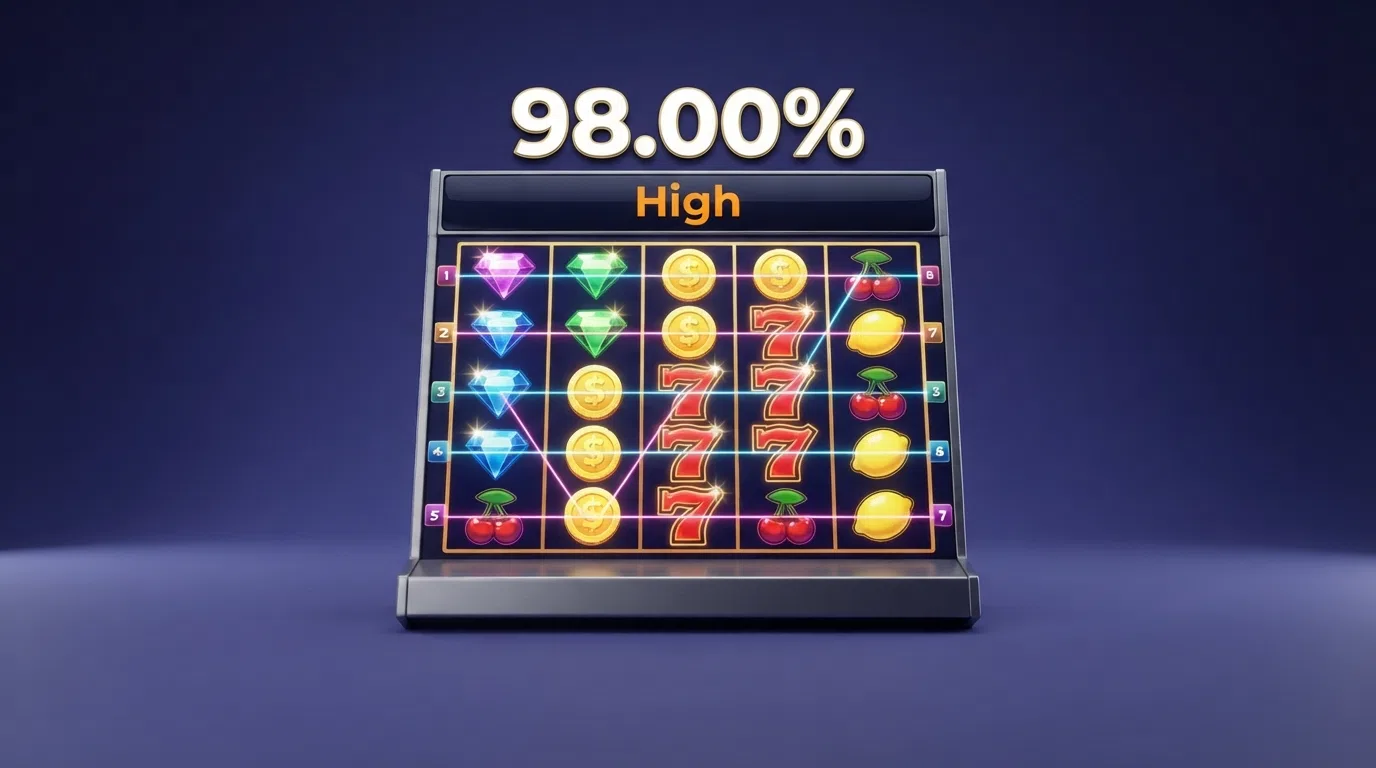
Blood Suckers is the outlier. Its 98.00% is a fixed single-tier configuration, which means a UK casino cannot quietly dial it down the way many providers allow — it is the same at every site that carries it. The rest of the table clusters tighter, between 96.09% and 96.71%, and the differences compound: a session at 98.00% keeps half what a 96.00% slot keeps, over enough spins. Mega Moolah is the well-known progressive jackpot slot from Games Global, classed as Medium volatility; its headline RTP is not carried here, because the figure that matters on a progressive is the jackpot contribution, not the base game’s return.
Return to player and volatility: why two 96% slots differ
Two slots can sit a tenth of a point apart on RTP and feel like different games. The reason is volatility. A low-volatility slot pays small wins often — the bankroll wobbles gently, sessions stretch. A high-volatility slot pays rarely, then heavily — the bankroll can drop for an hour and then spike on a single feature. Sweet Bonanza at 96.48% High and Starburst at 96.09% Low return similar amounts on average; the shape of the session is nothing like.
The number to read first is the volatility, not the RTP, if you have a session you cannot afford to lose. The second number is the RTP, because a 2% gap is a 2% gap on every pound you put through the slot, forever.
Winning at slots is selection, not strategy
No system changes a slot’s RNG. A player who picks a 98% title over a 96% title keeps a meaningful share of their money; a player who picks a 96% title with a feature they enjoy and a stake they can afford keeps less and has a better time. Selection is the strategy. The £5 ceiling on a single spin bounds what one decision can cost; it does not bound the session, and it does not bound the month.
Set a session loss you can accept before you open the lobby. Stop when you hit it. The slot is not in a mood.
Demo mode: learn the game before you spend
Demo mode runs the same RNG with play credits, which means a session in demo is a statistically honest rehearsal of the real thing. The wins do not pay; the volatility feels the same; the features trigger the same way. A few operators in this ranking — Casumo among them, where the demo is confirmed — make the demo readily available across the lobby, which is the right place to learn a new title before putting money on it.
What demo does not do is prepare you for the cashier. The real test of a casino is the deposit, the verification, and the withdrawal — and none of those run in demo.
The ten UK casinos we ranked — and the wagering line that splits them
| Operator | Licence status | Welcome offer | Wagering | Slot count |
|---|---|---|---|---|
| Bet365 | UKGC-licensed (Active) | Up to 500 wager-free spins | 0× | 500+ |
| William Hill | UKGC-licensed (Active) | 200 spins on Big Bass Splash | 10× | 500+ |
| Sky Vegas | UKGC-licensed (Active) | 50 no-deposit + 200 spins | 0× | 400+ |
| Ladbrokes | UKGC-licensed (Active) | Deposit £10, get £30 bonus | 10× | 1,000+ |
| Paddy Power | UKGC-licensed (Active) | 60 no-deposit + 200 spins | 0× | 500+ |
| Betfred | UKGC-licensed (Active) | Stake £10, get 200 spins | 0× | 500+ |
| Betfair | UKGC-licensed (Active) | Free spins or bonus (varies) | 10× | 500+ |
| Betway | UKGC-licensed (Active) | 100% match up to £50 | 10× | 500+ |
| Casumo | UKGC-licensed (Active) | 50% match up to £100 | 10× | 3,500+ |
| PlayOJO | UKGC-licensed (Active) | 50–80 spins on Big Bass Bonanza | 0× | 3,000+ |
Every operator in this table holds an active UKGC licence, verified against the Commission’s public register at the 29 July 2026 snapshot. The wagering column is the one that splits them: half the set is at 0× (wager-free on the welcome offer) and half is at 10×, the legal ceiling that came in on 19 December 2025.
What makes a casino worth ranking at all
The floor is the licence. Above the floor, the ranking looks at what the welcome offer actually costs after wagering, how large the game library is, whether demo mode is available without a deposit, and how the operator treats the cashier. Wagering is the single biggest discount on a “big” welcome bonus: a £30 bonus at 10× means £300 of required turnover before the bonus is yours, and a £30 bonus at 0× means it is yours the moment the wager settles. The headline number is the smaller of the two facts.
Bet365 — 500 wager-free spins
Bet365’s welcome is the wager-free benchmark of the set: up to 500 free spins with no wagering on the winnings. Five hundred-plus slots sit behind the lobby, drawn from NetEnt, Playtech, Pragmatic Play, Microgaming and Blueprint. For a player who cares more about the absence of a multiplier than the size of the headline, this is the cleanest offer on the page.
William Hill — 200 spins with a £30 cap
Two hundred spins on Big Bass Splash at £0.10 per spin come with a £10 deposit, and the 10× wagering on winnings runs alongside a 17-minute window. The bigger cut sits at the top: a £30 cap on what the offer can pay out, regardless of what the spins actually land. Big Bass Splash is a 96.71% High-volatility title, which makes the cap the practical limit on a feature that would otherwise look generous.
Sky Vegas — 50 spins with no deposit needed, plus 200 more
Sky Vegas splits the welcome into two halves. The first 50 spins land without a deposit, and the next 200 arrive after a £10 deposit and stake. Everything is wager-free, with a 7-day validity on the spins and a 30-day window on the qualifying deposit. The 400+ slots are a notch below the set, and the structure rewards a player who can move on the offer before it expires.
Ladbrokes — a £30 bonus at 10× wagering
Ladbrokes’ welcome is the more conventional shape: a £10 deposit produces a £30 bonus, the bonus runs at 10× wagering, and 1,000+ slots sit behind the lobby. The 10× is the cap the Commission wrote in, not a Ladbrokes concession, and 7 days is the typical validity on a bonus this size. For a player who wants a cash bonus rather than spins, this is the cleanest version of that product on the set.
Paddy Power — 60 no-deposit spins, then 200 more after £10
Paddy Power runs the largest no-deposit spin count in the ranking, at 60, and adds 200 more after a £10 deposit. The full welcome is wager-free. The no-deposit spins expire faster than the deposit spins — a few days against 30 — and the asymmetry is the shape of the offer: the front half is a taste, the back half is the deal. Five hundred-plus slots carry the Playtech, NetEnt, Pragmatic Play, Red Tiger and Blueprint libraries.
Betfred — 200 spins with no wagering
Betfred’s welcome is a flat 200 wager-free spins at £0.10 each, in return for a £10 qualifying stake. The spins live 7 days and the qualifying stake lives 14. Five hundred-plus slots is the standard library for the set. For a player who does not want to think about which half of a split welcome they are on, this is the simpler shape.
Betfair — an offer that varies, at 10× wagering
Betfair’s current welcome varies by promotion and is not pinned to a single number; the structural line is the 10× wagering cap, which is the ceiling the Commission sets rather than a Betfair choice. Seven days is the typical validity, and 500+ slots is the standard library. Worth checking the current promotion page before you deposit, because the form of the offer has changed more than once.
Betway — a 100% match up to £50
Betway runs the most familiar welcome shape of the set: a 100% match on the first deposit, up to £50, with 10× wagering on the bonus amount and 7 days of validity. Five hundred-plus slots, drawn from Microgaming, NetEnt, Pragmatic Play, Evolution and IGT. A straight cash bonus with the cap applied cleanly.
Casumo — 3,500+ slots and a working demo mode
Casumo is the largest library in the ranking, at 3,500+ slots, drawn from NetEnt, Play’n GO, Pragmatic Play, Microgaming, Evolution, Big Time Gaming and Push Gaming. The welcome is a 50% match up to £100, with a £20 minimum deposit, 10× wagering and 7 days of validity. Demo mode is confirmed across the lobby, which is the edge for a player who wants to learn a new title before staking on it.
PlayOJO — no wagering, ever
PlayOJO’s position is the cleanest wagering stance in the British market: 50 to 80 wager-free spins on Big Bass Bonanza at £0.10 per spin, no wagering on anything the casino pays, and no max cashout cap on what the welcome produces. Three thousand-plus slots sit behind the offer, drawn from NetEnt, Pragmatic Play, Play’n GO, Microgaming, Evolution and Blueprint. “No wagering requirements on any winnings, full stop” is the line the brand uses, and it is the line the cashier honours.
Reading between the lines of “best” claims
“Best” in this ranking is scoped to the ten operators reviewed here, against the criteria the previous subsection sets out. Offer size matters only as a function of wagering and validity. Slot count matters only as a function of the games you actually want. Licence status is the floor that everything else sits above. A 0× offer at 50 spins beats a 10× offer at 500 spins for a player who values simplicity, and the reverse is true for a player who values spin count — neither is “best” in the abstract.
The 10× cap, in force since 19 December 2025, redefined what a “big” bonus means at a UK site. Anything above 10× is illegal; anything below 10× is the operator choosing to be more generous than the law requires. The 0× operators are not just sitting below the cap — they are sitting at zero, which is a different kind of offer entirely.
Why your 2026 bonus is smaller than it looks
Every welcome offer in this ranking is shrunken by the same two forces: the wagering multiplier on the bonus amount, and the validity window during which the wagering has to be done. The Commission’s December 2025 cap pulled the multiplier down to a legal maximum of 10×, which is a structural reduction of what “big bonus” used to mean. A bonus at 10× is still a bonus that has to be turned over ten times before it is yours; a bonus at 0× is yours the moment the wager settles, with no turnover to clear.
How a no-deposit offer actually works
A no-deposit offer credits the spins or the cash without a deposit, on the operator’s bet that you will stay to play. The wagering, where it exists, applies to the winnings rather than to a deposit. A validity window runs before the bonus expires — 7 days at Sky Vegas, 72 hours at William Hill, 30 days on the deposit half of Paddy Power. Max cashout caps sit on top of all of that: William Hill’s £30 cap is the most visible in this set, and others carry their own.
The point of a no-deposit offer is to test the cashier with the operator’s money rather than yours. The cost of the test is the cap and the window.
No-deposit spins: what you can actually keep
The headline count is the smaller of the facts. Sky Vegas’s 50 no-deposit spins and Paddy Power’s 60 no-deposit spins are wager-free, which is the form a UK player actually wants. William Hill’s 200 spins are larger in count, run at 10× on the winnings, and cap what the offer can pay at £30. The same headline “200 spins” therefore keeps different amounts depending on which operator sits behind it: 200 wager-free spins at £0.10 is a different offer from 200 spins at £0.10 with a £30 cap and 17 minutes to clear 10× on what you win.
The 0× offers are the offers whose headline is also the offer.
Wagering and the 10× cap that reshaped every bonus
Wagering is the multiple of the bonus amount that has to be turned over before the bonus converts to withdrawable cash. A £30 bonus at 10× wagering means £300 of stakes must run through qualifying games before the £30 is yours; a £30 bonus at 0× means the £30 is yours the moment the wager settles. The Commission has capped the multiplier at 10× since 19 December 2025, under LCCP Social Responsibility Code 5.1.1 — every welcome offer in this ranking sits at 10× or below, and the operators at 0× are sitting at zero, which is the floor rather than the cap.
PlayOJO’s “no wagering requirements on any winnings, full stop” is the brand articulation of the floor. It is not a slogan; it is the cashier’s behaviour.
Which casinos put the best no-deposit deal on the table
Sky Vegas and Paddy Power lead on no-deposit spin count among the featured set, with 50 and 60 respectively, both wager-free, both paired with a deposit-gated second batch. PlayOJO sits apart because its no-wagering position applies to anything the casino pays, not just the welcome — there is no cap on what a spin can convert to. Validity windows differ across the three: the longer the window, the more time to use the spins on a title the player actually wants.
A “best” no-deposit deal on this page is wager-free, with a cap that does not strangle the offer, and a window that gives the spins a real chance to be used.
Winning real cash without spending to play
Free-to-win real cash play is a real category at UK-licensed sites, but it is narrower than the marketing makes it sound. The legitimate routes are freeroll tournaments with cash prizes and promotional prize draws run by licensed operators. Demo mode is a third “free” route, but it does not pay real cash at all — it pays credits, with no withdrawal. Outside the licensed market, “free cash” offers carry no UKGC protection, no GAMSTOP coverage, and no complaints route.
Freerolls and prize draws: the legit routes to free wins
A freeroll is a tournament with a real cash prize pool that does not require an entry fee. A prize draw is a promotion run by a licensed operator, where a free entry can win a real cash or real-value prize. Both sit inside the licensed product and run on the operator’s terms. Neither is a substitute for a paying game; both are legitimate ways to put a cash win on a session that cost nothing to enter.
Verify the operator’s terms before you enter either, and treat the schedule the way you treat any bonus: a window applies, and the prize is paid under the rules the operator has published.
Free slots that pay cash versus the demo that never does
Free spins that pay real cash come from bonus offers, the kind the previous section works through. Demo mode is a different product: same RNG, play credits, no withdrawal. The “free” prefix does the same amount of work in both cases, but only the bonus offer routes a win to a real cashier.
The £5 and £2 per-spin caps apply to real cash slots, including the free spins from a welcome offer, because the cap sits on the game cycle rather than on the funding source. A free spin is still a stake; the cap does not know it was free.
Free prizes versus funded play: what “free” buys
A free game caps what you can win. A funded play removes the cap and risks your money. The underlying game has the same RTP either way, because the RNG does not know who paid for the spin. The trade is between the size of the ceiling and the size of the stake.
Players protecting a small bankroll are well served by the free route, because the worst case is the entry fee, which is zero. Players with a bankroll they can afford to lose, and who want the full RTP curve to express itself, are better served by funded play, because the ceiling is the slot’s max win rather than the operator’s cap.
Where UK players find legitimate free-to-win games
Only GB-licensed operators run legitimate prize promotions at the level a UK player can trust with their details. The Commission’s public register, holding 2,663 records at its 29 July 2026 update, is the place to confirm an operator holds a real licence before entering any promotion. The offshore route — Curaçao, Malta, Gibraltar as a substitute for a GB licence — is not a substitute, and the protection gap is the cost.
No legitimate free-to-win route skips age and identity verification. If a site offers real cash prizes without asking for either, the protection it cannot offer is the protection the player most needs.
Fast money is a promise, not a setting
Payout speed is one of the most over-marketed numbers in real cash play, and one of the most misunderstood. A casino that advertises “instant withdrawal” is describing the fastest path through its own queue, not a universal setting that applies to every player. The actual time a payout takes is set by the verification work the operator has to do, the funding method the player chose, and the operator’s own processing window — and those three things sit ahead of any marketing claim.
The ways money leaves a casino: cards, wallets and banks
UK-licensed casinos settle withdrawals through a defined set of methods, and the set is the same across the Commission-licensed set:
- Debit cards (the baseline)
- E-wallets: PayPal, Skrill, Neteller
- Pay by Bank, Apple Pay, Google Pay
- Bank transfer
- Paysafecard (deposit only, never a withdrawal)
Credit cards and credit-card-funded e-wallets have been off the list since 14 April 2020, so a “fast” withdrawal paid back to a credit card is not a withdrawal the operator can run.
Instant withdrawal claims versus the real payout queue
“Instant cash out” is a claim about the operator’s own queue, not a guarantee of the time the funds will reach the player. The verification gate runs first: identity is confirmed before the first deposit or any gambling at all, and the source-of-funds check runs at the £150 net deposit threshold in a rolling 30-day period. Once those have cleared, the operator’s processing window opens; once that closes, the method’s own clearing time applies. The whole chain has to close before the money is in the player’s account.
No per-operator payout duration is carried on this page, because no specific figure was verified across the featured set. The shape of the queue is what is reliable, not a single hour count.
What actually slows a payout: checks, weekends and method
Three things slow a real cash payout. The first is the verification and source-of-funds work the operator has to do, and the work scales with the size of the balance and the operator’s own risk model. The second is weekend and bank-holiday processing, which adds 24 to 72 hours to most queues. The third is the method’s own clearing time, with bank transfer the slowest of the standard set and e-wallets the quickest. The reverse-withdrawal ban, in force since the 2021 game-design reforms, means the operator cannot push a player to cancel a withdrawal to keep the funds in play — once the player has asked, the queue runs.
How to verify a payout record before you join
Check the operator’s UKGC licence on the Commission’s public register, which the next section covers. Read the operator’s payout terms for the method list and the language the operator uses about processing windows — “up to” hours are a different promise from “within” hours. Treat any guaranteed hour figure as marketing, including the operator’s own. Prefer operators whose welcome offer is wager-free, because a wager-free offer means the winnings can be withdrawn at the operator’s standard pace rather than at the end of a wagering queue.
Real cash in your pocket: the apps that actually deliver
The mobile question in real cash play is not whether an app exists — every featured operator in this ranking runs mobile play, either through a native app or a browser. The question is what the app actually carries, and whether the cashier inside it is the same cashier the desktop version runs. The featured set all check the second box, and most check the first.
The apps worth installing in the UK
The featured set is the apps worth installing. Library size is the proxy: Casumo at 3,500+ slots, PlayOJO at 3,000+, Ladbrokes at 1,000+, and the rest of the set at 400+ to 500+. The cashier — deposit, withdrawal, verification — sits inside the app, and the games run from the same providers as the desktop site. Where research carried no per-operator app rating, the comparison sits on library and cashier rather than an invented app score.
Android versus iPhone: what actually differs
The two platforms run the same games via browser, and the native apps sit in the Play Store and the App Store respectively. The casino, not the phone, decides the library; the experience is near-identical in practice, with the platform differences limited to biometric login and the specific way each store handles app updates. A player who already has an account on desktop can move to mobile without re-verifying, and the reverse is also true.
App versus browser: where the slots run better
Browser play needs no download and runs on any device with a modern browser. Native apps add push notifications, biometric login, and a slightly faster load on repeat visits. The slots themselves are the same titles on both routes — the RNG is identical, the RTP is identical, the difference is the wrapper. The choice is convenience, and the payout is the same either way.
What to check in an app: library, cashier and stability
A three-point checklist covers the app question. First, the slot library in the app matches the desktop count the operator publishes — a half-empty mobile lobby is a bad sign. Second, the cashier offers deposit and withdrawal inside the app, not just deposit. Third, the app is stable on the device the player will use, which is a check that has to be done with the device in the player’s hand. Licence status sits above all three, and the next section is the lookup.
Offshore or protected: the UK rules that decide your safety
A UKGC licence is the floor of everything this page has discussed, and the floor carries the rules. The Commission runs on three licensing objectives set in section 1 of the Gambling Act 2005: preventing crime, ensuring fairness, and protecting children and vulnerable people. The point-of-consumption rule, brought in by the 2014 Act, means a GB licence is compulsory for any operator serving GB players, wherever the operator is based. Northern Ireland sits outside the UKGC model and runs under separate, older law.
The UKGC licence and what it actually covers
A GB licence is a single document covering a single set of rules. The licence binds the operator to the three licensing objectives, to the LCCP, to the Remote Technical Standards, and to the financial and safer-gambling rules that sit on top. Players on a licensed site are protected by GAMSTOP coverage, by an Alternative Dispute Resolution route, by a Commission complaints route, by segregated customer funds rules, and by the social responsibility code.
The tax side is the operator’s, not the player’s. Players pay no tax on gambling winnings in the UK — the player-side betting duty was abolished in 2001. Operators pay Remote Gaming Duty, which rose from 21% to 40% from 1 April 2026 at the Autumn Budget 2025, and the statutory levy of 1.1% of GGY, in force from 6 April 2025, split across treatment, prevention and research. The rises sit on the operator; the player does not see them at the cashier.
The statutory caps and bans in force
| Rule | What it caps or bans | In force since |
|---|---|---|
| Online slots stake cap | £5 per spin for 25+, £2 for 18–24 | 9 April 2025 (£5 tier); 21 May 2025 (£2 tier) |
| Bonus wagering cap | Maximum 10× the bonus amount | 19 December 2025 |
| Credit cards for remote gambling | Banned, including credit-card-funded e-wallets | 14 April 2020 |
| Financial vulnerability check | Triggered at £150 net deposits in a rolling 30-day window | 28 February 2025 |
| Gross deposit limit | Customer-set, mandatory; only that form may be called a “deposit limit” | 30 June 2026 (extended to 30 September 2026) |
The table is the shape of the protected product. Every figure on it is a cap or a ban written into the LCCP; every date is the date that rule came into force.
Verifying a licence on the public register
The Commission’s public register is the place a player goes before depositing. It carried 2,663 records of licensed gambling businesses at its 29 July 2026 update, and the search takes the operator’s name or the operating entity’s name — Hillside, WHG, Bonne Terre, LC International, PPB Counterparty, PPB Entertainment, Petfre, Betway Limited, Casumo Services, SkillOnNet among the entities in this ranking. The match sits in the operator’s own footer, and a Curaçao, Maltese or Gibraltar licence in the footer is not a substitute for a GB licence. The register is the verification; the footer is the cross-check.

Offshore casinos and the protections you lose
An unlicensed site costs the player a defined list of protections. There is no GAMSTOP coverage, so a self-exclusion does not reach the site. There is no ADR, so a dispute has no independent route. There is no Commission complaints route, because the Commission has no jurisdiction. There is no fund-segregation guarantee, because the rule that imposes segregation is the LCCP. Enforcement in the UK is disruption rather than ISP blocking — 3,140 disruption notices, 447,778 URLs referred to search engines, 287,961 of them removed, in the period from April 2024 to June 2025 — and the section 33 offence is the operator’s, not the player’s. The risk an unlicensed site poses to a UK player is the loss of protection, not the loss of liberty.
The tools, the signs and where to get help
The licensed product carries its own safer-gambling layer, separate from the offer and the cashier. The tools are mandatory; the help routes are public; the signs are worth knowing before anyone in a household needs them.
The limits and tools every licensed casino must offer
A licensed operator must offer customer-set deposit limits, with a gross deposit limit rule in force from 30 June 2026 (extended to 30 September 2026) that defines what can be called a deposit limit. Reality checks and time-outs are mandatory. The £150 financial vulnerability check threshold triggers source-of-funds work in the background. Session loss, session win and time-played displays have to be visible during play, and the spin speed on slots has a 2.5-second minimum. None of these tools is optional at a licensed site.
Where to get help in the UK, right now
- National Gambling Helpline (GamCare) — 0808 8020 133, free, 24/7, call or live chat. In January 2026 the helpline made 996 referrals to treatment and peer-based support, up 48% on the year before.
- GambleAware and the National Gambling Support Network — free confidential early intervention and treatment across Great Britain. 11,960 clients were treated in the year to March 2025.
- NHS gambling harm clinics in England, Scotland and Wales.
- Gamblers Anonymous UK — peer support meetings nationwide.
Self-exclusion through GAMSTOP: how it works
GAMSTOP has been a mandatory condition of every GB online operating licence since 31 March 2020. The exclusion periods on offer are six months, one year, five years, or five years with auto-renewal. The exclusion cannot be cancelled early, and the mechanism does not reach unlicensed sites — a self-exclusion is only as strong as the licensed product it is registered against. The route is online, the registration is at gamstop.co.uk, and the effect is a block on new accounts at every GB-licensed online operator for the period selected.
The signs that play is becoming a problem
The prevalence numbers are large enough to be worth knowing. The latest PGSI 1+ figure is 13.1% of adults who gamble, equivalent to roughly 6.8 million GB adults, with some level of gambling problem. 82.6% of National Gambling Helpline contacts in 2026 disclosed online gambling, the highest proportion in five years. The signs to watch are increasing stake size, increasing session length, chasing losses, hiding play from family or friends, and gambling to fix a financial problem rather than to enjoy a session. The next step to take, at any of those signs, is the National Gambling Helpline on 0808 8020 133.
How we chose, checked and ranked these casinos
The selection began with our review of the most popular ranking pages online, which provided our starting list for comparison. Every operator in this ranking was checked against the UKGC public register, with the licence status, the operating entity, and the snapshot date (29 July 2026) carried as the verification record. The criteria that ordered the ranking are licence status (the floor), the offer’s true cost after wagering, the size of the game library, demo availability, and the cashier. The ranking is qualitative rather than a scored model: no operator is given a number, because no weighting has been invented for the reader.
Deposit with your eyes open: what the numbers said
The stake cap and the RTP together make a session’s cost predictable in a way it has not been in the past. A 100-spin session at the £5 maximum and a 96.50% RTP runs an expected loss of £17.50, and the player can decide in advance whether that is a session worth having. Wagering decides whether a bonus is worth clearing at all, because a 10× bonus is a £300 commitment for a £30 payout and a 0× bonus is none. Licence status decides whether any of the rest of the page applies, because the protections, the stake cap, the wagering cap and the safer-gambling tools all sit on a UKGC licence and not on the welcome banner.
The numbers on this page are the numbers a UK player can use. The banner is decoration.
Frequently Asked Questions
Can I win real money from no-deposit free spins at UK casinos?
Yes, at licensed UK sites, where no-deposit free spins are paid as withdrawable cash once the wagering (where any applies) and the validity window have run. Wager-free offers convert the winnings to cash immediately; offers with 10× wagering on winnings require that turnover to be cleared first. Max cashout caps may apply, and the winnings sit on top of the operator’s standard verification and withdrawal queue.
What is the maximum I can stake on online slots in the UK?
The statutory maximum is £5 per game cycle for players aged 25 and over, and £2 per game cycle for players aged 18 to 24, in force since 9 April 2025 and 21 May 2025 respectively. The cap sits on the slot itself and applies to every real cash spin, including free spins from a welcome offer. There is no equivalent statutory cap on roulette, blackjack or live casino, where limits are set by the operator.
Do I pay tax on real cash casino winnings in the UK?
No. UK players pay no tax on gambling winnings of any kind; the player-side betting duty was abolished in 2001 and has not been reinstated. The operator pays Remote Gaming Duty (40% from 1 April 2026) and the 1.1% statutory levy, neither of which is deducted from a player’s payout at the cashier.
Can I play real cash casino games on my mobile phone?
Yes, at every operator in this ranking. The featured set all offer mobile play through a native app or through the device’s browser, with the same game library, the same cashier, and the same UKGC licence as the desktop site. Verification done on one device carries across to the others, and the £5 and £2 slot stake caps apply on mobile exactly as on desktop.
How fast do UK online casinos pay out real cash winnings?
The time depends on the verification work, the funding method, and the operator’s own processing window. E-wallets are the quickest of the standard set; bank transfer is the slowest. Weekend and bank-holiday processing adds to the queue. No guaranteed hour figure is reliable across the featured set, because the queue is set per withdrawal, and a single hour count from a marketing page is not a representative answer.
What are the best real cash slot games to play in the UK?
The short answer, on the figures research carries, is the titles in the table earlier in this page: Blood Suckers at 98.00% for the player who wants the highest long-run return, Big Bass Splash, Gates of Olympus, Sweet Bonanza and Book of Dead for the player who wants a high-volatility session, and Starburst for the player who wants a low-volatility session that does not run out of small wins. The “best” slot is the one whose volatility matches the session the player can afford and whose RTP is among the higher figures on the page.
Casinos – realmoney-onlinecasinos-uk
Content created by the «realmoney-onlinecasinos-uk» team