
Slot Tournaments at UK Online Casinos: How They Work, What They Pay and Where to Play
 Available in GB
A slot tournament looks simple from the outside: a countdown clock, a leaderboard, and a shot at a prize pool that can run into six or seven figures. The mechanic underneath is anything but simple. The UK Gambling Commission regulates every step: how fast a spin can run, what you can stake per game cycle, how many times a bonus from a tournament win must be wagered before it withdraws, and which operators are even allowed to take your money. Two adults at the same casino can face different maximum stakes on the same tournament, simply because one is over 25 and the other is not. That single fact reshapes how the entire format works in Britain compared with almost any other regulated market.

This page works through what a UK slot tournament actually is, how the format plays out spin by spin, what you can win from free-entry events, where the ten UK-facing operators with the strongest tournament offerings differ, and what the regulatory framework does — and does not — protect you from.
Current as of September 8, 2026 against the UK Gambling Commission public register and operator terms.
What UK Slot Tournaments Actually Are — and What They’re Not
A slot tournament is a timed competition. Players pay an entry fee (or enter free), then have a fixed window — anything from a single minute to several hours — to rack up points on a designated slot or set of slots. When the clock stops, the leaderboard finalises, prizes distribute, and balances settle. The game is the same slot every competitor is playing; the difference is how many spins you fit in and what each spin returns relative to the field.
Three things separate a tournament from ordinary slot play. First, time is the binding constraint: you have a fixed budget of seconds, not a fixed budget of pounds. Second, scoring is comparative: a single spin that pays 50× your stake is impressive in isolation, but in a tournament the same result reads against every other player’s 50× spins in real time. Third, prizes concentrate at the top of the leaderboard. The winner takes a disproportionate share; the rest compete for a diminishing curve.
47% of adults in Great Britain had gambled in the past four weeks, and 38% had gambled online. That is the market these tournaments operate inside. It is heavily regulated, broadly active, and structurally different from offshore or US-style tournament play. The £5 per-spin maximum for players aged 25 and over, and the £2 cap for players aged 18 to 24, apply to tournament spins exactly as they apply to ordinary slot spins. A player on the £2 cap has a structural ceiling the £5 player does not, and that asymmetry plays out on every leaderboard in the country.
The Tournament Format: Timers, Leaderboards and Spins
Every tournament is built from the same three elements. A timer sets the boundary: one minute, five minutes, twenty minutes, or a full day in the case of provider-network daily events. A leaderboard ranks every participant on a shared scoring basis — total points, total wins, biggest single win multiplier, or total amount wagered. And a scoring engine does the math in real time, posting your position alongside everyone else’s.
| Scoring System | Mechanism | Rewards |
|---|---|---|
| Points-Based | Points per pound won | Consistency |
| Win-Multiplier | Single biggest win relative to stake | Variance |
| Wager-Race | Total turnover | Patience & bankroll depth |
Beneath the leaderboard sits a constraint that British players do not always feel but always play under. Auto-play is banned, and spin speed may not be faster than 2.5 seconds per game cycle. That floor dictates the maximum number of spins a round can contain: roughly twenty-four per minute, no more. Turbo modes and slam-stop features — once common in tournament play — are prohibited. Every spin is manual, and pace is player-limited rather than software-limited.
The round resolves at the countdown’s end. Your balance at that moment determines your prize tier under whatever scoring system the operator is using. Prizes credit within a window — sometimes immediately, sometimes within 72 hours — and the round closes. Some events run on a continuous cycle: Pragmatic Play’s Drops & Wins structure runs daily tournaments with up to £20,000 paid out to the top 500 players, plus weekly wheel drops, on a minimum qualifying stake of £0.15 per spin.
Scheduled, Sit-and-Go and Drops & Wins: the Tournament Types That Matter
UK players encounter three formats repeatedly, and each changes the experience in ways the headline prize figure does not capture.
Scheduled tournaments run at a fixed start time. The lobby opens ahead of the round; you register, wait, and the tournament kicks off when the clock hits zero. PokerStars Casino runs its own scheduled slot tournaments in this mode, separate from any provider network.
Sit-and-go tournaments start the moment the field fills. Duelz Casino operates head-to-head slot battles that fire every fifteen minutes — a near-continuous sit-and-go cadence where two players enter and one walks off with the prize. £10,000 per week in cash prizes flows through that loop. The format rewards staying close to the lobby: the next round is never far away.
Provider-network tournaments are run by game studios rather than operators. Pragmatic Play’s Drops & Wins 2026–2027 campaign runs from 4 March 2026 to 3 March 2027 with a £25,000,000 prize pool across daily tournaments and weekly wheel drops, distributed through every participating UKGC-licensed casino. You do not enter a single lobby; you opt in at any participating operator and play eligible Pragmatic Play slots at the minimum qualifying stake.
The buy-in versus free-entry distinction cuts across all three formats. Buy-in tournaments require a stake to enter; free-entry tournaments do not. Free-entry still has its own gradations: a Duelz Cash Tournament requires no deposit at all, while Virgin Games’ Slot Masters requires a £10 lifetime deposit on the account before free entry unlocks. The difference is real money at stake, and it shows up in the prize terms downstream.
Leaderboards, Prize Pools and What You’re Actually Playing For
Prize pools in UK slot tournaments range from a few hundred pounds at a small operator freeroll to £25,000,000 across a twelve-month provider network. The headline figure tells you the maximum; the payout tier tells you what one place actually pays. Drops & Wins distributes £20,000 a day across the top 500 players, meaning even a finish in the top tier pays a small but real amount rather than a jackpot-style lump.
The harder question is what currency the prize is paid in. Cash prizes — what Duelz pays out weekly — are withdrawable immediately, with no wagering attached. Bonus-fund prizes are different. Under the UKGC’s December 2025 bonus rules, wagering on any bonus is capped at 10× the bonus amount, and a £10 bonus-fund prize therefore requires £100 in qualifying turnover before it can be withdrawn. That cap limits the real value of bonus-fund tournament prizes in a way the headline figure does not telegraph. Free-spin prizes sit somewhere between the two, depending on whether the operator caps winnings or attaches wagering.
A cash prize and a bonus-fund prize of the same nominal value are not the same prize. One withdraws; the other requires play before it does.
The UK Tournament Landscape: What’s Different Here
Britain regulates slot play at the spin level, not the session level. The £5 maximum stake for players aged 25 and over, and the £2 maximum for players aged 18 to 24, apply to every spin — including every spin inside a tournament round. A player on the £2 cap cannot chase a leaderboard position by doubling their stake; the ceiling is the ceiling regardless of the field.
The auto-play ban and the 2.5-second spin-speed floor cap how fast any competitor can play. Turbo and slam-stop features are banned. Losses disguised as wins — slot designs that celebrate a return smaller than the stake with the same fanfare as a real win — are banned. Every one of these rules tightens the space tournament software can occupy in Britain, and every one shapes the experience a UK player has compared with an offshore site running on its own house rules.
The bonus wagering cap, effective from 19 December 2025, applies directly to tournament prizes paid in bonus funds. A 10× cap on wagering is far lower than the 30×, 40× or 50× figures common in offshore markets, and it means a UK player clearing a tournament bonus pays a fraction of the turnover they would elsewhere. That is a genuine upside of the regulated market, even if the stake cap looks like a constraint.
How UK Casino Tournaments Work, Spin by Spin
The mechanics are uniform across operators: enter, play under a timer, watch the leaderboard, collect a prize if your position qualifies. What changes is the scoring system, the time window, and the qualifying games. The walkthrough below follows a round from entry to resolution.
Speed is the dominant variable. Quote-2 puts it plainly: “Speed is crucial — one of the most important things in a slot tournament is playing as fast as possible. The more spins you can squeeze in during the time limit, the better your chances of hitting winning combinations or triggering bonus features.” Under the 2.5-second floor and the auto-play ban, that speed ceiling is fixed by regulation, not by player preference. The fastest any competitor can play is roughly twenty-four spins per minute, and only by hitting the spin button immediately after each result lands.
The Mechanics: Entry, Timed Rounds and the Leaderboard Engine
Entry methods vary. Some tournaments require an opt-in from a promotions page; others auto-qualify any player who spins a designated game during a qualifying window; still others issue tickets as loyalty rewards or part of a welcome package. Drops & Wins at BetMGM UK auto-qualifies any player who spins eligible Pragmatic Play titles at the minimum stake of £0.15 — no separate entry step beyond meeting the stake threshold. Duelz’s head-to-head battles require a click on the tournament tile. The difference is whether you remember to enter, or whether the operator enters you automatically.
Once inside, the round counts down. The leaderboard updates in real time, with position flashes triggered by scoring events. Scoring systems differ: points-based systems award a fixed number of points per pound won; win-multiplier systems rank you by your single biggest win relative to stake; wager-race systems count total turnover regardless of result. Each rewards a different play style. A points-based system rewards consistency. A win-multiplier system rewards variance. A wager-race system rewards patience and bankroll depth.
At round end, positions finalise. Prizes credit within a window — immediately on some networks, within 72 hours at Virgin Games’ Slot Masters, for instance. The cycle then resets, either to the next round of the same format or to a scheduled gap.
Finding and Entering Tournaments: Where UK Players Look
Two discovery paths matter. The first is the operator’s tournament lobby: a dedicated page listing live and upcoming events with entry buttons and qualifying terms. Duelz, Coral and PartyCasino all run proprietary lobbies of this kind. The second is the provider network path: Pragmatic Play’s Drops & Wins events surface inside participating operators’ game lobbies, with the same prize pool appearing across BetMGM UK, MrQ, LeoVegas and others simultaneously.
Eligibility checks are mostly invisible. Most UKGC-licensed operators require verified age and identity before a first deposit, and that verification carries through to tournament entry. Some events require a minimum stake per spin (Drops & Wins sets £0.15), a minimum deposit history (Virgin Games’ £10 lifetime threshold for Slot Masters), or an opt-in.
Free-to-enter versus deposit-gated is the practical distinction. Free-to-enter requires nothing beyond an account; deposit-gated requires a qualifying deposit before entry unlocks. The £10 lifetime deposit rule at Virgin Games is the cleanest example: a player who has deposited £10 in total across the life of their account can enter Slot Masters free; a player who has never deposited cannot.
Winning Strategy: What Moves the Needle
Three variables move a leaderboard position: spin speed, stake size, and scoring-system alignment. Spin speed is regulated: the 2.5-second floor is a hard ceiling, and no one in the tournament can exceed twenty-four spins per minute. Stake size is also regulated: £5 for over-25s, £2 for under-25s. A player on the £2 cap cannot run a max-bet strategy at all; they play at their structural ceiling on every spin.
That leaves scoring-system alignment as the variable the player controls. On a points-based leaderboard, consistent small wins accumulate; chasing a single monster payout wastes spins. On a win-multiplier leaderboard, the opposite holds: one big spin moves you further than twenty steady ones. On a wager-race, total turnover is what counts — bankroll depth and round length matter more than volatility.
Rebuy and re-entry economics complicate the picture. Some events allow re-entries within the round, charging a fee each time; others lock entry after the first spin. A re-entry is a fresh chance at the leaderboard at the cost of additional stake, and the math on whether it pays depends on the prize tier and your current position. A player outside the top 100 with five minutes remaining and a re-entry available is buying a long shot, not a sure thing.
UK-specific constraints cut both ways. The stake cap is a structural ceiling on per-spin exposure — a safety net for the bankroll, a ceiling on upside. The speed floor is the same: it prevents turbo-mode losses from accelerating beyond a player’s control, but it also caps the number of chances a player can take in a fixed-time round. The auto-play ban removes the option of stepping away from the screen, which some players prefer and others resent.
Rules, Fairness and the Question Every Player Asks
Slot tournaments at UKGC-licensed casinos cannot be rigged. The structural safeguards are not a marketing promise; they are written into the Remote Technical Standards and audited by independent test houses before any game goes live. RNG certification is mandatory. Game outcomes are random, and the operator has no ability to alter them mid-round.
PrimeSlots.co.uk states the position plainly: “There’s no way in which the outcome of real money slots spins can be rigged or manipulated — they are wholly random and unique.” That is not a slogan; it is the regulatory position under which every UK-licensed game operates. Auto-play is banned, the 2.5-second spin-speed floor is enforced, losses-disguised-as-wins features are banned, and reverse withdrawals have been permanently prohibited since 31 October 2021. Each of these rules shapes how a tournament round plays; collectively, they rule out the design patterns that elsewhere blur the line between random outcome and operator-controlled outcome.
If a dispute arises, the path runs through the operator’s complaints procedure, then to an alternative dispute resolution (ADR) provider, and finally to the Gambling Commission. Every UKGC-licensed operator must belong to an approved ADR scheme. That is the chain a player walks if a tournament prize is not credited or a leaderboard is miscalculated.
Free Slot Tournaments That Pay Real Cash: the UK Reality Check
Free-entry tournaments at UK casinos pay out in three currencies: cash, bonus funds, and free spins. Cash withdraws immediately. Bonus funds require play — capped at 10× wagering under current UK rules. Free spins sit between the two, depending on the operator’s terms.
Genuinely deposit-free tournaments are rare among UKGC-licensed operators. The combination of mandatory identity verification before first deposit and the practical reality that operators prefer to convert free-entry players into depositing players means that the “no deposit, free tournament, real cash prize” combination narrows quickly. Duelz’s Cash Tournaments come closest: free entry, real cash prizes, no deposit required for tournament entry itself, though the welcome offer still carries a £25 minimum deposit. Genting’s land-based daily qualifying tournaments offer a similar model: free entry, real cash prizes — first £1,500, second £500, third £250, plus monthly finals — running 4pm–7pm from 2 May to 31 July 2026.
Free-Entry vs. Freeroll: What Each Actually Means
The two terms are used interchangeably in marketing, but they are not identical. Free entry means no buy-in fee at the point of tournament entry. It does not necessarily mean no deposit requirement at any point in the account’s history. Duelz’s Cash Tournaments are free-entry with no deposit condition on the tournament itself. Virgin Games’ Slot Masters is free-entry conditional on a £10 lifetime deposit — free for the round, gated by account history.
Freeroll is the stricter term. A freeroll charges no buy-in and requires no deposit condition at all — the player walks in from a freshly registered, unverified-funds account and plays for the prize pool. UK freerolls at licensed operators tend to be smaller-scale and less heavily marketed than the headline free-entry events, because the conversion economics of a genuinely deposit-free tournament are weaker for the operator.
The marketing language usually elides this distinction. A “free slot tournament” in a promotional email is more often a free-entry tournament with a deposit history condition than a pure freeroll. The terms page tells you which.
No-Deposit Tournaments: the UK Picture
The UKGC framework requires identity verification before first deposit. A genuinely no-deposit tournament is therefore accessible to a player who has registered and verified but never deposited. Among the featured operators, that combination is narrow. Virgin Games is the cleanest example of the deposit-history model: the £10 lifetime deposit threshold is not a per-tournament deposit but a one-time account-level gate, and it means a player who has deposited elsewhere but never at Virgin Games cannot enter Slot Masters until they cross it.
Duelz sits at the other end: Cash Tournaments are free to enter with no deposit history requirement on the tournament itself, though the welcome bonus is gated. The £10 minimum deposit for Duelz’s welcome spins is a separate condition from the tournament entry, and a player who wants to play tournaments without depositing can do so.
Among UKGC-licensed operators overall, the genuinely deposit-free tournament is a thin slice. Most free-entry events sit behind a deposit-history threshold of some kind, and the marketing tends to bury the distinction.
What You Can Actually Win From Free Tournaments
Cash is the cleanest prize. Duelz’s £10,000 weekly Cash Tournament payout is withdrawable as soon as it lands. MrQ’s free-spin winnings are credited to the real-money balance with no wagering attached and no cap — a £10 spin win is a £10 cash credit. LeoVegas’s free-spin winnings carry no wagering, though a 1× deposit wagering requirement unlocks the spins themselves.
Bonus funds require play. The 10× wagering cap, effective from 19 December 2025, applies: a £10 bonus-fund prize requires £100 in qualifying turnover before withdrawal. That ceiling is far lower than the 30×–50× figures that dominated UK bonuses before the cap, and it sharpens the value of a bonus-fund prize materially.
Free-spin prizes vary by operator. MrQ: 0× wagering, winnings uncapped. LeoVegas: 0× on free-spin winnings. Pub Casino: cash spins, 0× wagering, no maximum cashout. Virgin Games: free spins with the 10× cap. Coral: free spins as tournament prizes, also subject to the 10× cap.
UK gambling winnings are tax-free for the player. The operator pays Remote Gaming Duty at 40% from 1 April 2026; the player pays nothing on what they win.
Daily Free Tournaments and Free-Spins Events
Daily tournaments are the steady rhythm of the UK tournament calendar. Coral runs daily slots tournaments with sessions between 14:00 and 23:00 UK time, prizes ranging from £1–£50 cash or up to 100 free spins per tournament. Duelz’s head-to-head battles fire every fifteen minutes around the clock. Drops & Wins runs a £20,000 daily pool across the network.
Free-spins tournaments use free spins as play currency rather than as prize. A player receives a fixed allocation of free spins at a fixed stake and uses them inside a timed round. The wagering status of the resulting winnings depends on the operator: at MrQ and Pub Casino the winnings are cash, at most other featured operators they are bonus funds subject to the 10× cap.
Building a routine is straightforward: pick one or two operators with daily tournament schedules, learn the qualifying windows, and play within the time budgets the UKGC’s deposit-limit framework already imposes. Daily free tournaments are not a career; they are a recurring low-cost entry into the leaderboard economy.
10 UK Casinos With Slot Tournaments Compared
| Operator | UKGC Licence | Welcome Bonus | Wagering | Tournament Type | Prize Pool (Indicative) |
|---|---|---|---|---|---|
| Duelz Casino | Yes — 048695-R-327029-011 (SuprPlay Limited) | 140 free spins (£25 min deposit, 20/day for 7 days) | 10× bonus; FS winnings capped £100/day | Proprietary head-to-head Cash Tournaments | £10,000/week in cash |
| BetMGM UK | Yes | 200 free spins (£10 min deposit) | 35× spin winnings | Pragmatic Play Drops & Wins | £20,000/day; £2 million monthly |
| MrQ | Yes | 100 free spins on Big Bass Splash (£10 min deposit) | 0× (wager-free, uncapped winnings) | Pragmatic Play Drops & Wins | £25 million campaign pool (Mar 2026–Mar 2027) |
| PartyCasino | Yes (Entain group) | Free spins and tournament-based promos | 10× | Proprietary slots tournaments on Playtech titles | £100,000/week (historic); prizes up to £20,000 |
| 888 Casino | Yes (evoke / 888 Holdings) | 100% match up to £100 (£10 min deposit) | 10× bonus | Drops & Wins and branded tournaments | £10,000+ per event |
| LeoVegas | Yes | 50 free spins on Big Bass Splash (£10 min deposit, 1× deposit wagering to trigger) | 0× on spin winnings | Daily Drops & Wins + regular promos | £20,000/day network pool |
| PokerStars Casino | Yes (Flutter Entertainment) | Casino Instant Bonus (£20–£49.99 deposit → £20 bonus; £50+ → £50 bonus; opt-in) | 20× winnings cap on bonus | Own-brand scheduled slot tournaments | — |
| Coral | Yes (Entain group) | Free spins and Coral Coins via slot tournaments | 10× | Coral Slots Tournaments (daily, 14:00–23:00 UK) | £1–£50 cash or up to 100 FS per tournament |
| Virgin Games | Yes | Free spins on selected games | 10× | Slot Masters (free entry with £10 lifetime deposit) | — |
| Pub Casino | Yes | 50 cash spins on Octobeer Fortune (£10 deposit and wager) | 0× on spin winnings, no max cashout | Freeroll and scheduled tournaments | £500+ per event |
The table is a snapshot, not a verdict. Every operator holds a UKGC licence; that is the floor, not the ceiling. What separates them is the tournament format they run, how generous the prize pool is, and how clean the welcome-offer wagering is on top.
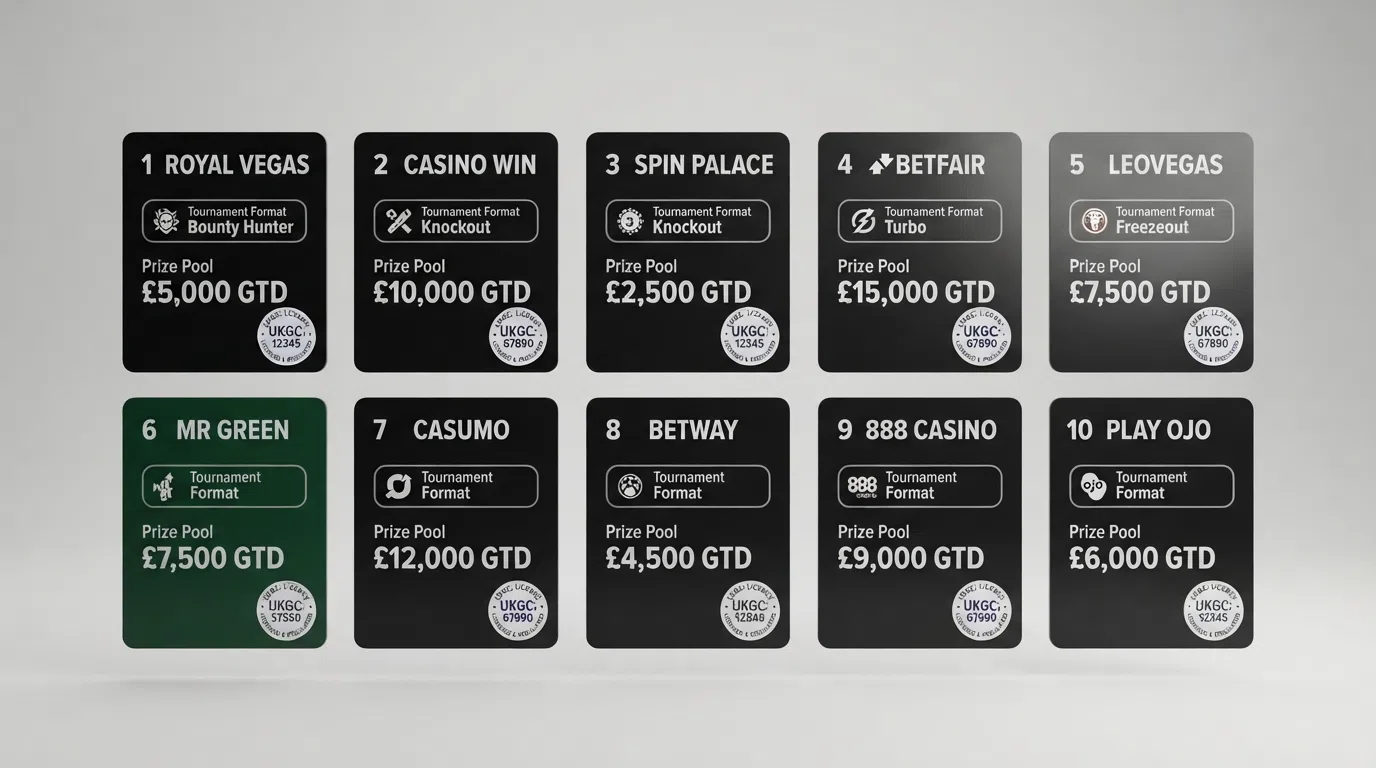
Duelz is the only featured operator with a dedicated head-to-head cash tournament running every fifteen minutes; everyone else overlays a network or proprietary format on a more conventional slot catalogue. MrQ and Pub Casino carry the cleanest welcome terms (wager-free on free-spin winnings, no caps), while BetMGM’s 35× wagering and Duelz’s £100/day free-spin cap sit at the more demanding end. The stake cap, the auto-play ban and the speed floor apply to all ten operators identically — they cannot be outcompeted on regulation.
BetMGM UK — Drops & Wins at Scale
BetMGM UK’s tournament draw is the Pragmatic Play Drops & Wins campaign: £20,000 paid out daily to the top 500 players across the network, with a monthly pool of up to £2 million. The qualifying bar is a £0.15 minimum stake on eligible Pragmatic Play slots, well below the £5 regulatory maximum, which means even a low-stakes player can enter the leaderboard. The welcome offer is 200 free spins on a featured Pragmatic Play title at £0.10 per spin, with 35× wagering on spin winnings and a 7-day validity window. The 35× figure is higher than the rest of the featured set, and the welcome bonus is more of a tournament-entry vehicle than a standalone value proposition.
For a player whose primary interest is the Drops & Wins pool rather than welcome spins, BetMGM is one of the most direct routes in. For a player chasing low wagering, the welcome offer sits on the wrong side of the spread.
MrQ — Wager-Free Spins With Drops & Wins
MrQ pairs Drops & Wins participation with the cleanest welcome offer in the featured set: 100 free spins on Big Bass Splash at £0.10 per spin, 0× wagering, winnings uncapped and credited as real money, 48-hour validity, £10 minimum deposit. A winning spin at MrQ is a winning spin — it lands in the cash balance and withdraws like any other deposit.
The tournament side runs through the same Pragmatic Play Drops & Wins pool as BetMGM and LeoVegas. MrQ’s edge is the welcome offer: a player who values clean terms above all else has fewer better options. The 48-hour validity is tight, and the £0.10 spin value is standard rather than generous, but the wagering figure is what separates MrQ from most of the field.
LeoVegas — Wager-Free Spins and Daily Drops & Wins
LeoVegas offers 50 free spins on Big Bass Splash at £0.10 per spin with a £10 minimum deposit and 1× deposit wagering to trigger the spins. The spin winnings themselves carry 0× wagering — they credit as cash. Drops & Wins daily tournaments overlay the same £20,000-per-day network pool.
The 1× deposit wagering to trigger is the qualifier. The spins themselves are wager-free; the deposit is not. The 3-day validity is the shortest in the featured set, which compresses the play window and rewards a player who acts quickly.
For a player who wants wager-free spin winnings and a short, decisive welcome cycle, LeoVegas sits close to MrQ. The smaller spin allocation (50 versus 100) is the trade-off.
Duelz Casino — Head-to-Head Tournament Specialist
Duelz is the only featured operator whose defining tournament format is its own. Cash Tournaments run continuously, with head-to-head slot battles every fifteen minutes and £10,000 in cash prizes paid out weekly. A player who wants a tournament experience that does not require waiting for a scheduled round or sharing a leaderboard with thousands of others has a narrow shortlist, and Duelz sits at the top of it.
The welcome offer is more demanding: 140 free spins on selected games, £25 minimum deposit, 20 spins per day over seven days, 10× wagering, free-spin winnings capped at £100 per day. The daily drip and the cap together make the welcome a slower burn than MrQ’s or LeoVegas’s. The tournament proposition is the draw; the welcome spins are a separate value calculation.
The UKGC licence number 048695-R-327029-011 is registered to SuprPlay Limited, Malta-based. The licence is current and verifiable on the Commission register.
PartyCasino — Proprietary Tournaments at Scale
PartyCasino runs its own large-scale slots tournaments on exclusive and Playtech titles, separate from the Drops & Wins network. The headline figure is a historic £100,000 weekly cashpool with individual prizes up to £20,000 — meaningful numbers that put PartyCasino among the larger tournament prize pools in the UK market.
The welcome-offer specifics were not fully verified from public sources this round. The 10× wagering figure sits at the post-cap regulatory floor. The Entain group licence (the same group that holds Coral and Gala) covers the operation.
For a player who wants a tournament ecosystem outside the Pragmatic Play network and is comfortable with Entain’s broader slots catalogue, PartyCasino is the most directly comparable alternative.
PokerStars Casino — Own-Brand Scheduled Tournaments
PokerStars runs scheduled slot tournaments on its own platform, not just the Drops & Wins overlay. The format is closer to the PokerStars poker tournament cadence: scheduled start times, structured fields, and a competitive frame.
The welcome offer is the Casino Instant Bonus: deposit £20–£49.99 to receive a £20 bonus, or £50 or more to receive a £50 bonus. Opt-in is required. A three-day slot wagering challenge applies, and winnings from the bonus are capped at 20× the bonus amount. That 20× cap on winnings is a structural ceiling on what a player can extract from the bonus, distinct from the wagering multiplier.
The Flutter Entertainment UKGC licence covers the operation. For a player who values a familiar brand and a scheduled, structured tournament format, PokerStars carries an offer the rest of the featured set does not match.
888 Casino — Match Bonus and Branded Tournaments
888 Casino is one of the few featured operators whose welcome offer is a percentage match rather than a free-spin bundle: 100% up to £100, £10 minimum deposit, 10× wagering, 90-day validity. The 90-day validity is the longest in the featured set, which gives a slower-paced player more time to clear the bonus.
Tournament offerings overlay Drops & Wins and 888-branded events with prize pools of £10,000 or more. The evoke / 888 Holdings UKGC licence is current. For a player who prefers a match bonus structure over free spins, 888 is the cleanest example in the featured set.
Coral — Daily Own-Brand Tournaments With Coral Coins
Coral runs daily slots tournaments with cash bonuses, free spins and Coral Coins — a loyalty-integrated tournament model unique among featured operators. Sessions run from 14:00 to 23:00 UK time, with prizes ranging from £1–£50 in cash or up to 100 free spins per tournament.
The Entain group licence applies. The 10× wagering cap sits at the post-regulatory-change floor. The Coral Coins integration adds a loyalty dimension most tournaments do not have: tournament play earns loyalty currency, which is then redeemable for further tournament entries or bonuses.
For a player who wants daily tournament rhythm and a loyalty layer underneath, Coral is the most distinctive offer. The smaller per-tournament prize sizes are the trade-off against the larger weekly pools at PartyCasino and Duelz.
Virgin Games — Slot Masters: Free Entry With a Threshold
Virgin Games’ Slot Masters tournaments are free to enter but require a £10 lifetime deposit on the account. The threshold is not a per-tournament deposit; it is a one-time gate that opens once and stays open. A player who has deposited £10 in total across the life of their Virgin Games account can enter Slot Masters free for as long as the tournaments run.
Prizes include free spins and cash, credited within 72 hours. The 10× wagering cap applies. The threshold model straddles free-entry and deposit-gated, and it is the cleanest example in the featured set of the deposit-history qualifier that catches players out.
For a player who has crossed the £10 threshold already, Slot Masters is a genuinely free-entry tournament with real prizes. For a player who has not, the entry is gated.
Pub Casino — Cash Spins and Freeroll Tournaments
Pub Casino pairs cash-value free spins with no further wagering alongside freeroll and scheduled tournaments with £500-plus prize pools. The welcome offer is 50 cash spins on Octobeer Fortune at £0.20 per spin, with a £10 deposit and wager to trigger. Spin winnings are cash — no further wagering, no maximum cashout, 48-hour validity.
The £0.20 per-spin value is twice the standard £0.10 figure across the featured set, and the no-max-cashout clause is the most generous treatment of free-spin winnings available. The smaller prize pools at the freeroll and scheduled tournaments are the trade-off.
For a player who values cash-equivalent welcome terms and clean withdrawal conditions on small tournament prize pools, Pub Casino is a strong fit. For a player chasing six-figure weekly pools, the prize scale sits well below PartyCasino’s historic offering.
Playing Tournaments on Your Phone: What Changes
Mobile tournament play in the UK is functionally identical to desktop play. The same games, the same qualifying stakes, the same prize pools, the same UKGC rules apply across both delivery methods. What changes is the experience around the game: notifications, screen real estate, and touch-input speed.
Most UKGC-licensed operators do not run mobile-exclusive tournament catalogues. The mobile and desktop lobbies carry the same tournaments, with the same opt-in flows and the same prize terms. Any mobile-specific promotions are flagged inside the operator app or mobile site rather than separated into a parallel tournament calendar.
Mobile-Specific Free Tournaments and Freerolls
UKGC-licensed operators do not, in general, run mobile-exclusive tournament promotions. The tournament calendar is the same on phone and desktop. Mobile-only prize boosts, where they exist, are flagged inside the operator’s app rather than advertised as a separate mobile tournament stream.
A player who wants to play tournaments on a phone gets the same catalogue as a desktop player, with the same terms. The differentiation between operators is in the catalogue itself, not in the device used to access it.
Crypto Casino Tournaments: a Separate Track for UK Players
Cryptocurrency casinos run their own tournament formats, with BTC and ETH prize pools and crypto-native scoring systems. The format is recognisable: timed rounds, leaderboards, crypto-denominated prizes. The mechanics are familiar to anyone who has played a slot tournament in a fiat currency.
The structural difference is regulatory. Cryptocurrency casinos serving UK players do not hold a UK Gambling Commission licence. They operate offshore, under licences issued in Curaçao, Anjouan, or other non-GB jurisdictions. A UK player can reach them; the Gambling Commission cannot regulate them; and the protections the UK system provides do not extend to anyone who plays on them.
What Crypto Tournaments Look Like — and the Risk You Take
A crypto tournament looks like a fiat tournament with a different prize currency. The slot spins, the leaderboard updates, the countdown clock runs, and the prize pool is denominated in BTC or ETH rather than GBP. The experience is similar enough that a player moving from a UKGC-licensed casino to a crypto casino will not feel lost.
What the player leaves behind is the UK safety net. No GAMSTOP coverage means a self-excluded player can still reach the site. No ADR means disputes have no UK-accredited resolution path. No Commission complaints route means there is no regulator to escalate to. No British consumer redress means funds withheld by an offshore operator stay withheld. The operator faces criminal liability under section 33 of the Gambling Act 2005 — up to 51 weeks’ imprisonment, an unlimited fine, or both — but that penalty falls on the operator, not the player, and does not recover funds already lost.
The Commission’s enforcement against unlicensed operators is disruption-based, not blocking-based. From April 2024 to June 2025, the Commission issued 3,140 disruption notices, referred 447,778 URLs to search engines, and saw 287,961 URLs removed. ISP blocking is not currently a statutory power, though legislation has been proposed. A crypto casino that is the subject of a disruption campaign can reappear under a new domain, and the cycle repeats.
For a UK player, the choice is between a regulated tournament ecosystem with a £5 stake cap and a 10× wagering ceiling, and an unregulated one with no stake cap, no wagering ceiling, and no recourse if something goes wrong. The trade-off is real, and it is not symmetric: the upside of the offshore site is mostly flexibility, while the downside is the loss of every protection the UK system offers.
Are Slot Tournaments Legal in the UK? Yes — With Strings Attached
Slot tournaments are legal in Great Britain at any operator holding a UK Gambling Commission remote operating licence. The activity falls under the remote casino licence category, and the rules that apply to ordinary online slot play apply identically to tournament play. The Gambling Act 2005, extended to remote operators by the Gambling (Licensing and Advertising) Act 2014, is the statutory base; the LCCP and RTS instruments are the working rules.
The UKGC is a single statutory regulator, an executive non-departmental public body sponsored by the Department for Culture, Media and Sport. It licenses operators, personnel and software, and publishes a public register of licence holders at gamblingcommission.gov.uk. The register is the definitive check any player can run themselves.
Three licensing objectives sit at the top of the framework, set out in section 1 of the Gambling Act 2005: preventing gambling from being a source of crime or disorder; ensuring gambling is conducted in a fair and open way; and protecting children and other vulnerable persons from being harmed or exploited. Every licence condition and code of practice traces back to one of these three.
The framework covers Great Britain — England, Scotland and Wales. Northern Ireland runs on separate, older legislation and is outside the Commission’s remit. A UKGC licence is GB-only in scope.
UKGC Licensing: What the Gambling Commission Requires
A remote casino operating licence is required for any operator taking GB players, wherever the operator is based. The point-of-consumption reform introduced by the 2014 Act closed the previous arrangement under which an operator licensed in another jurisdiction could lawfully take GB customers. Today, no operator takes GB players without a UKGC licence, regardless of where the operator’s servers sit.
The licence conditions and codes of practice (LCCP) set the operational rules: social responsibility codes cover player protection, marketing, and affordability; ordinary codes cover financial reporting and operational integrity. The Remote Technical Standards (RTS) set the technical rules: RNG certification, game-design restrictions, session display requirements.
The Commission publishes a public register at gamblingcommission.gov.uk. Every UKGC-licensed operator appears on it, with licence number, licence type, and current status. A player can verify any operator’s licence status themselves by searching the register. Independent reviews frequently cross-reference the register as a verification step.
Offshore Tournaments: What a UK Player Risks
Playing at a non-UKGC casino is not a criminal offence for the player. No penalty is established for the act of gambling on an unlicensed site. The player does, however, lose every protection the UK system provides. There is no GAMSTOP coverage — a self-excluded player can still reach the site. There is no ADR — disputes have no UK-accredited resolution path. There is no Commission complaints route — no regulator to escalate to. There is no British consumer redress — funds withheld by an offshore operator stay withheld.
The Commission enforces against unlicensed operators through disruption rather than blocking. The April 2024–June 2025 figures: 3,140 disruption notices, 447,778 URLs referred to search engines, 287,961 URLs removed. The Commission does not currently hold statutory ISP blocking powers, though legislation has been proposed.
The operator, not the player, faces the criminal penalty under section 33 of the Gambling Act 2005: up to 51 weeks’ imprisonment, an unlimited fine, or both. That penalty falls on the operator and does not recover funds a player has already deposited or lost.
Built-In Fairness: RNG Certification, Audits and Player Protection
Slot tournament outcomes at UKGC-licensed casinos are random, certified, and audited. Independent test houses certify the RNG before any game goes live. Game outcomes cannot be altered by the operator mid-round. The structural guarantees are written into the RTS and enforced by the Commission: auto-play banned, spin speed at or above 2.5 seconds, features that speed up play banned, losses disguised as wins banned, reverse withdrawals permanently banned since 31 October 2021. Each of these rules shapes how a tournament round plays; collectively, they rule out the design patterns elsewhere used to blur the line between random outcome and operator-controlled outcome.
If a dispute arises, the path runs through the operator’s complaints procedure, then to an alternative dispute resolution (ADR) provider approved by the Commission, and finally to the Commission itself. Every UKGC-licensed operator must belong to an approved ADR scheme, and the Commission can take enforcement action against operators that fail to resolve disputes fairly. Session loss and win display, along with session time, have been mandatory since 31 October 2021 — a player can always see what a session has cost them.
When the Leaderboard Becomes a Problem
Tournament play creates specific risks that ordinary slot play does not. Time pressure from a countdown clock encourages faster, less considered play. Rebuy mechanics turn sunk-cost thinking into a recurring decision. Leaderboard chasing creates competitive pressure to keep playing beyond a planned budget. Each of these mechanisms can accelerate harmful play in ways that a slow, solitary slot session does not.
The UK problem gambling rate, measured by PGSI 8+ on the Problem Gambling Severity Index, was 2.4% in the Gambling Survey for Great Britain 2025 annual report — stable at around 2.5% across three survey years. A further 3.5% scored in the moderate-risk band (PGSI 3–7), and 7.8% scored in the low-risk band (PGSI 1–2). These figures are population-level, not tournament-specific, but they set the scale of the population the responsible-gambling infrastructure serves.
Time Pressure, Rebuys and Leaderboard Chasing: Why Tournaments Hit Differently
Three tournament mechanics can accelerate harmful play, and each has a UKGC constraint that limits how far it can run.
Time pressure is the first. A timed round encourages faster play than an ordinary session, and faster play under the 2.5-second floor still runs at roughly twenty-four spins per minute — a pace at which losses accumulate faster than a player might notice. The speed floor is a regulator-set upper bound that prevents turbo modes from accelerating the pace further; it is not a cap on total losses.
Rebuy and re-entry economics are the second. A re-entry fee purchases another shot at the leaderboard, and the decision to buy one is a fresh gambling decision made under time pressure, often with money already lost in mind. The stake cap — £5 for over-25s, £2 for under-25s — applies to every spin including the first spin of a re-entry, which bounds the per-spin exposure but does not bound the cumulative spend across re-entries.
Leaderboard chasing is the third. A player who is just outside a paid position with minutes remaining faces a clear competitive incentive to keep playing: one more big spin could move them up. The incentive is real, and the sunk-cost psychology is well understood. The UKGC’s mandatory deposit-limit prompt, in force from 31 October 2025, requires operators to surface the deposit-limit setting before the first deposit of a session — a check that runs once per session rather than once per tournament round.
UK Tools: Deposit Limits, Time-Outs, Self-Exclusion and GamStop
The UK responsible-gambling toolkit is layered. Customer-set deposit limits are the first line: a player can set a daily, weekly or monthly deposit ceiling, and operators must action decreases immediately while increases may carry a delay. From 30 September 2026, only a gross deposit limit based solely on money paid in may be called a “deposit limit” (RTS 12) — a labelling change that tightens the meaning of the term.
Time-outs and reality checks sit one layer up. A reality check is an on-screen prompt at a player-set interval showing session time and net position; a time-out is a player-set exclusion from play lasting 24 hours to several weeks. Both are available at every UKGC-licensed operator.
Self-exclusion through GAMSTOP is the structural option. GAMSTOP offers exclusion periods of six months, one year, five years, or five years with auto-renewal. Participation has been mandatory for every GB-licensed online gambling operator since 31 March 2020. The exclusion cannot be cancelled early. Once a player registers with GAMSTOP, every UKGC-licensed operator must refuse to take their business for the duration of the exclusion.
Financial vulnerability checks, in force from 28 February 2025, run on publicly available data at a £150 net deposit threshold over a rolling 30-day period. The check looks for County Court Judgments, bankruptcy orders, Individual Voluntary Arrangements, and Debt Relief Orders. Operators who find a match must run a financial risk assessment before accepting further deposits.
Where to Get Help: the UK Treatment Infrastructure
The National Gambling Helpline, run by GamCare, takes over 52,000 calls a year. The waiting time from referral to treatment through the National Gambling Support Network is less than two weeks. Nine in ten people who complete treatment report improvement in their condition.
The NGSN is funded by the statutory levy, in force from 6 April 2025. Remote casino operators contribute 1.1% of gross gambling yield to the levy, with proceeds split 50% to treatment, 30% to prevention, and 20% to research. The levy is separate from Remote Gaming Duty, which rose to 40% from 1 April 2026.
NHS gambling harm clinics operate in England, Scotland and Wales. Gamblers Anonymous runs peer-support meetings. The full infrastructure is publicly funded in part and charity-delivered in part, and any UK player can reach it without going through the operator they play with.
The PGSI 8+ rate at 2.4% means roughly one in forty adults in Great Britain meets the threshold for problem gambling. The infrastructure exists for that population — the question for a reader weighing tournament play is whether the tools are active in their own account before the leaderboard becomes the problem.
How We Evaluate UK Casino Tournaments
This ranking draws on three sources: the UK Gambling Commission public register, operator websites and published terms, and independent review sites that cross-reference the register. Every featured operator was checked against the public register for current licence status. Tournament offerings were verified from operator promotions pages and from independent reviews that have documented the formats, prize pools and qualifying terms.
Five criteria shape the ranking. Tournament format and variety: does the operator run a proprietary format, a provider-network overlay, or both, and how broad is the schedule? Indicative prize scale: how large is the headline pool, and how is it distributed across the leaderboard? Entry terms and accessibility: is the tournament free to enter, and what deposit history or other conditions apply? Wagering fairness on welcome and prize terms: how clean is the bonus, and how does it interact with the 10× cap? UKGC licence standing: is the licence current, and is the operator in good standing with the Commission?
The evaluation is qualitative. No weightings have been applied, and no scoring rubric has been published. The UKGC public register at gamblingcommission.gov.uk is the verification source any player can run themselves, and the Commission’s register is the definitive licence check.
Your First Tournament: What Actually Matters
Three filters decide whether a UK tournament is worth entering, and they apply in order. First, licence status. The operator must hold a current UKGC remote casino operating licence. This is non-negotiable: every other consideration is moot without it. The Commission’s public register at gamblingcommission.gov.uk is the verification step, and it takes a minute.
Second, tournament format. The format determines how the round plays and what kind of player it suits. Drops & Wins network play suits players who like the largest pools and are happy playing alongside thousands of others on the same Pragmatic Play titles. Duelz’s head-to-head suits players who want a near-continuous short-form format with cash prizes and no waiting. Proprietary scheduled tournaments at PartyCasino or PokerStars suit players who prefer a structured cadence with a defined field.
Third, prize terms. Cash prizes withdraw immediately. Bonus-fund prizes require play, capped at 10×. Free-spin prizes vary by operator, with MrQ, LeoVegas and Pub Casino offering wager-free treatment of spin winnings, and the rest subject to the 10× cap and varying cashout ceilings.
Free-entry is the right place to start. A first tournament should not require a deposit to enter, should pay in cash rather than bonus funds where possible, and should run on a format that gives the player a reasonable shot at the prize tiers without requiring hundreds of spins to compete. Duelz’s head-to-head format fits that brief closely: free entry, cash prizes, fifteen-minute cadence, two-player field.
The best tournament casino for a given UK player depends on which format they value and whether they prioritise wager-free prizes or larger prize pools. A player who wants the largest weekly pool and is comfortable with the Drops & Wins network has a different answer from a player who wants head-to-head cash tournaments every fifteen minutes. The ranking in the table above orders by tournament relevance and offer attractiveness; the right pick depends on the player, not the order.
The UKGC safety net is the deciding factor that none of the format questions change. Stake caps, spin-speed floors, bonus wagering ceilings, deposit-limit prompts, GAMSTOP coverage, ADR and the Commission’s complaints route all apply identically across every UKGC-licensed operator. They cannot be outcompeted. The leaderboard is entertainment, not a target. Pick a licensed operator, start with a free-entry tournament, and treat the countdown clock as a feature of the format rather than a goal to optimise against.
Frequently Asked Questions
Can you win real money from a free slot tournament without depositing anything?
Yes — at operators like Duelz, where Cash Tournaments are free to enter with no deposit condition on the tournament itself and pay out in cash with no wagering attached. Genuinely deposit-free tournaments are rare among UKGC-licensed operators because most free-entry events sit behind a deposit-history threshold. Virgin Games’ Slot Masters, for example, requires a £10 lifetime deposit on the account before free entry unlocks. Where the entry is genuinely free and the prize is cash, the win withdraws immediately with no wagering.
How do Pragmatic Play Drops & Wins tournaments work and which UK casinos host them?
Drops & Wins runs from 4 March 2026 to 3 March 2027 with a £25,000,000 prize pool across daily tournaments and weekly wheel drops. The daily tournaments pay up to £20,000 to the top 500 players. Any player who spins eligible Pragmatic Play slots at the minimum qualifying stake of £0.15 per spin is automatically entered. Participating UKGC-licensed operators include BetMGM UK, MrQ and LeoVegas, with the same prize pool and the same format running across all of them.
Do the UK online slots stake limits of £5 and £2 change how slot tournaments play out?
Yes — the caps apply to tournament spins exactly as they apply to ordinary slot spins. A player aged 25 or over is limited to £5 per game cycle; a player aged 18 to 24 is limited to £2. Two adults at the same casino can face different maximum stakes on the same tournament, which means max-bet strategy is bounded differently for the younger cohort. The age band, set under SI 2025/215, has been in force since 9 April 2025 (25+) and 21 May 2025 (18–24).
How does GamStop self-exclusion affect your access to slot tournaments at UK casinos?
A player registered with GAMSTOP is blocked from every UKGC-licensed online gambling operator for the duration of their exclusion. Periods are six months, one year, five years, or five years with auto-renewal; exclusion cannot be cancelled early. GAMSTOP participation has been mandatory for every GB-licensed online operator since 31 March 2020. A self-excluded player cannot enter tournaments at any UKGC-licensed casino, though they can still reach offshore sites that do not hold a GB licence.
Are online slot tournaments genuinely fair, or can the operator rig the outcome?
UKGC-licensed slot tournaments cannot be rigged. RNG certification is mandatory under the Remote Technical Standards, independent test houses audit every game before release, and outcomes are wholly random. The structural safeguards — auto-play banned, 2.5-second spin-speed floor, losses-disguised-as-wins banned, reverse withdrawals banned — limit operator control over the round. If a dispute arises, the path runs through the operator’s complaints procedure, then to an approved ADR provider, and finally to the Gambling Commission.
App vs. Browser: Does It Affect Your Tournament?
Two practical differences matter. First, native apps can send push notifications — a tournament starting in five minutes, a leaderboard position change, a prize credit. Browser play relies on the page being open and the player’s attention being on it. Second, app stability on tournament-heavy sessions tends to be more consistent than mobile-browser play, where connectivity drops can interrupt a timed round.
Spin speed and tournament performance do not differ materially between app and browser. The 2.5-second floor is enforced by the game server, not by the device; the touch-input speed at which a player can hit the spin button is not meaningfully different from a mouse click. Where one delivery method is faster than the other, the gap is small enough not to show up on a leaderboard.
App downloads and account linking are the practical cost of the native route. Browser play requires no installation and no separate login; app play trades that convenience for the notification and stability layer.
Promotions – realmoney-onlinecasinos-uk
Content created by the «realmoney-onlinecasinos-uk» team