
500% Casino Bonuses in the UK: The Numbers Behind the Headline
 Available in GB
A 500% bonus sounds like a five-for-one. The maths that the marketing copy flatters, and the maths that the wagering requirement actually demands, are not the same equation. A UK player typing “online casino with 500% bonus” into a search bar lands on a peculiar mismatch in 2026: the search is for a thing, and the licensed UK market has, for the most part, stopped selling that thing. The reasons are regulatory, and the reasons are arithmetic, and the page that follows is the working through of both.

Current as of September 8, 2026 and checked against the Gambling Commission’s public register of licence holders.
What a 500% Casino Bonus Actually Means for UK Players
A 500% deposit match is a multiplier: a player deposits £20 and the operator credits £100 in bonus funds, so the account shows £120 to play with. The percentage is the easy half of the story. The harder half is what happens to that £100 before any of it can be withdrawn. A bonus is not a gift; it is a deferred withdrawal, and the wagering requirement is the price the player pays to convert bonus funds into cash they can take out.
For a UK-licensed casino, the maximum wagering requirement on a bonus is ten times the bonus amount, capped under LCCP Social Responsibility Code 5.1.1 since 19 December 2025. The cap applies to the bonus amount only — not to the bonus plus the deposit combined, as one widely-repeated explainer makes explicit. That distinction is the difference between a £1,000 turnover requirement and a £3,000 one on the same £20 deposit, and it is the reason a 500% match is rare rather than routine on a UKGC-licensed site.
The headline percentage alone tells a player almost nothing. A 100% match at 10x wagering can cost the player less in expected loss than a 500% match at a higher multiple offshore, because wagering multiplies play, and play multiplies the house edge. The marketing number is a multiplier on the deposit. The wagering number is a multiplier on the bonus. The latter is the one that determines what the offer actually costs.
UK-licensed casinos have, in 2026, shifted their welcome pages away from the high-percentage deposit match. Two rule changes pushed them. First, the 10x wagering cap removed the operator’s margin buffer that made huge percentages viable offshore — a 500% match with a 30x or 40x wagering multiple can be priced in, because the operator is collecting a long tail of house edge over a long play-through. At 10x, that buffer is gone. Second, the mixed-product ban under the same code prevents operators from spreading bonus liability across verticals; a casino-only bonus has to earn its keep on casino play alone.
The result is a market where a 500%-bonus search returns mostly offshore marketing, where the wagering terms are heavier than anything a UK-licensed operator can now lawfully impose, and where the player’s recourse if the bonus is refused is essentially none. The remainder of this page is the licensed version of that offer: what the same player can claim today, what it costs, and what a UKGC licence is actually buying them.
How a 500% Deposit Match Works — The Numbers Behind the Headline
A 500% match converts a deposit into bonus funds at a five-to-one ratio. A £10 deposit returns £50 in bonus funds; a £20 deposit returns £100; a £50 deposit returns £250. The total bankroll to play with is the deposit plus the bonus, but only the deposit is the player’s own money from the moment it lands. The bonus sits in a separate balance and carries its own conditions.
Two mechanics govern what happens next. The first is game weighting. Most UK bonuses count slot play at 100% toward wagering, table games at 10% or 20%, and live casino often at zero. A player who runs a £100 bonus through blackjack thinking they are clearing the requirement at 10x may be clearing it at zero. The second is the conversion step itself: when wagering is complete, the bonus funds convert to withdrawable cash, but a maximum cashout cap may limit how much of that converted balance actually leaves the account.
The 10x cap on a £100 bonus means £1,000 in slot turnover before withdrawal. At a typical slot RTP of 96.21% (Book of Dead is the reference figure carried through the rest of this page), the expected loss across that £1,000 turnover is roughly £37.90. The £100 bonus returns, in expectation, about £62.10 of that to the player. The wagering figure has done its arithmetic; the headline percentage is irrelevant to the result.
Why Genuine 500% Match Bonuses Are Rare in the UK Licensed Market
A 500% match bonus has not been banned in the UK. It has been made uneconomic. A UKGC-licensed operator can still credit bonus funds at any percentage, but the 10x wagering ceiling on the bonus amount means a 500% match is being cleared on a small turnover relative to the bonus size — five times the deposit, ten times the bonus, and that is the play-through the operator has to absorb the house edge on. At a slot house edge of roughly 3.79% (the inverse of the 96.21% RTP), £1,000 in turnover yields the operator about £37.90 in gross margin, before the bonus is even paid out. A 500% match at £20 deposit hands the operator a player who is, on average, an immediate loss.
New casinos sometimes use a large percentage as a marketing signal — a 200% or 300% match to stand out in a crowded welcome-page market — but they face the same LCCP caps as established brands. The difference is the depth of the offer: a 200% match at 10x wagering on a £20 deposit clears on £400 turnover, and the operator’s expected margin is closer to the bonus cost. The larger the percentage, the more the operator is paying for the same acquisition. Few will go to 500% on those terms.
Free-spins-led welcome packages have become the dominant UK acquisition tool for the same reason: the cost is bounded per spin, the spin value is small, and the no-wagering format now common in the UK means the operator knows the maximum exposure on the offer before the player claims it. A 500-spin package at £0.10 per spin is a £50 maximum liability to the operator, and the player gets a known quantity in return. That is a cleaner economic transaction than a 500% match on a £20 deposit.
The Bonus Types That Carry a Big-Percentage Promise
A 500% bonus is a marketing construct, not a category. Behind it sits a small family of offer shapes, each with its own cost structure and its own UK-specific terms.
The most common is a deposit match bonus, where the operator multiplies the deposit by a stated percentage and credits the result as bonus funds. Free spins packages rival a match bonus in effective value when the spin count is high and the per-spin value is meaningful, and the no-wagering format now dominant in the UK means winnings convert to cash the moment they land. No-deposit offers exist, but in the UK they are almost always partial: a small no-deposit portion credited on sign-up, with the bulk of the welcome package gated behind a qualifying £10 deposit. Wagering requirements are the multiplier that defines what any of these offers actually costs, and the T&Cs layer — expiry windows, maximum cashout caps, game weighting, max-bet rules — is what determines what the player keeps.
The honest comparison between a 500% match and a 100% match is not the percentage. It is the total turnover the player must run through slots to clear the bonus, and the expected loss on that turnover at the eligible game’s RTP. That comparison is the spine of the rest of this section.
Deposit Match Bonuses — What the Percentage Really Multiplies
A deposit match bonus is the cleanest format for understanding what a “500% bonus” actually means. The operator takes the deposit, multiplies it by a percentage, and credits the result as bonus funds. The deposit is the player’s; the bonus is the operator’s, until wagering is complete.
The 100% match is the UK benchmark. 888casino’s 100% up to £100 at 10x wagering is the worked example carried through this page, and it is the offer the 500% match has to be measured against. A £100 deposit returns £100 in bonus funds; clearing requires £1,000 in slot turnover; expected loss at a 96.21% RTP is roughly £37.90; the player keeps, in expectation, the £100 deposit plus a £62.10 net from the bonus. The net cost of the offer to the player is about £37.90.
Now the same arithmetic at 500%. A £20 deposit returns £100 in bonus funds; clearing still requires £1,000 in slot turnover at the 10x cap, because the cap is on the bonus amount, not the deposit. The expected loss is the same £37.90. The bonus is the same £100. The arithmetic is identical. The only thing the higher percentage has done is lower the deposit the player has to make to receive the bonus — and, in doing so, lowered the player’s own bankroll backing the play-through. The 500% match is not a better offer than the 100% match at the same wagering cap. It is the same offer, sold to a player depositing a fifth of the money.
Offshore, where wagering multiples can run to 30x, 40x or 50x, the 500% percentage carries weight because the wagering is large enough to make the bonus feel substantial. In the UK, the 10x cap flattens that advantage. A 500% match at 10x is a smaller, less interesting offer than a 100% match at 10x, because the player has less of their own money in the pot to absorb variance.
Free Spins Packages — When Spins Beat a Percentage Match
Free spins are the welcome offer the UK market has converged on, and the reason is the no-wagering format. When free-spin winnings are credited as cash with no further play-through required, the player knows the maximum cost of the offer to themselves: it is the spin count times the per-spin value times the house edge on the eligible game. The marketing number — “500 free spins” — is the multiplier. The wagering number is zero. The cost is bounded and visible.
The structure matters. A 500-free-spin package at £0.10 per spin on a slot with a 96.21% RTP is a £50 total stake. The expected loss across those spins is roughly £1.90. The player keeps, in expectation, the winnings from £50 in slot play with no further play-through. Compare that to the £100 match bonus above, which carries an expected loss of £37.90 to release £100 in bonus funds. The free-spins package is, in cost-to-player terms, the better deal by a factor of twenty.
The eligible game is where the package can disappoint. A 500-spin offer on a slot with a 94% RTP carries a higher expected loss than the same offer on a 96.71% slot like Big Bass Bonanza, and a high-volatility slot like Book of Dead (RTP 96.21%, max win 5,000x) returns most of its payout in rare large wins rather than steady smaller ones. The player pays the same per spin either way; the variance is what changes.
The 500-free-spin package at bet365, with no wagering on winnings, is the reference offer for this section because it makes the cost structure legible. There is no conversion step, no cashout cap to remember, no game weighting table to misread. The player plays the spins, the winnings are theirs.
No-Deposit Bonuses and Why Most UK Offers Still Need a Deposit
A no-deposit bonus is bonus funds or free spins credited at registration, with no payment required. In the UK licensed market, the offer is rarely pure. Identity must be verified before any deposit or any gambling at a UKGC-licensed site — that has been the rule since 7 May 2019, and it cuts against the anonymous-claim mechanics that pure no-deposit offers rely on. A 500-spin offer in the UK regulated market is universally deposit-triggered rather than pure no-deposit, which is the structural reason a “500 free spins, no deposit” headline in search listings almost always resolves to a deposit-gated package on the operator’s own page.
The honest reading of a UK no-deposit offer is “a small portion of the welcome package is credited on sign-up, with the rest gated behind a £10 deposit and a qualifying stake.” Sky Vegas’s 70 no-deposit spins plus 200 more after £10 of play is the clearest version of that split, and Paddy Power’s 60 no-deposit spins on sign-up (out of a 260-spin total) follows the same pattern. The deposit-triggered portion is not a hidden cost; it is the bulk of the value, and a player who claims the no-deposit portion without funding the qualifying deposit is leaving most of the welcome package on the table.
Maximum cashout caps on no-deposit winnings are common. They are the operator’s acknowledgement that the bonus is risk-free for the player and the cap is the operator’s protection. A no-deposit offer that paid out unlimited winnings would, by definition, be uninsurable against the one player who converted a £0.10 spin into a five-figure payout.
Wagering Requirements — The Multiplier That Redefines Every Bonus
The wagering requirement is the multiplier on the bonus amount that determines the total slot turnover required before bonus funds convert to withdrawable cash. The formula is exact: turnover equals the bonus amount multiplied by the wagering figure. A £100 bonus at 10x wagering is £1,000 in slot turnover; a £50 bonus at 10x is £500.
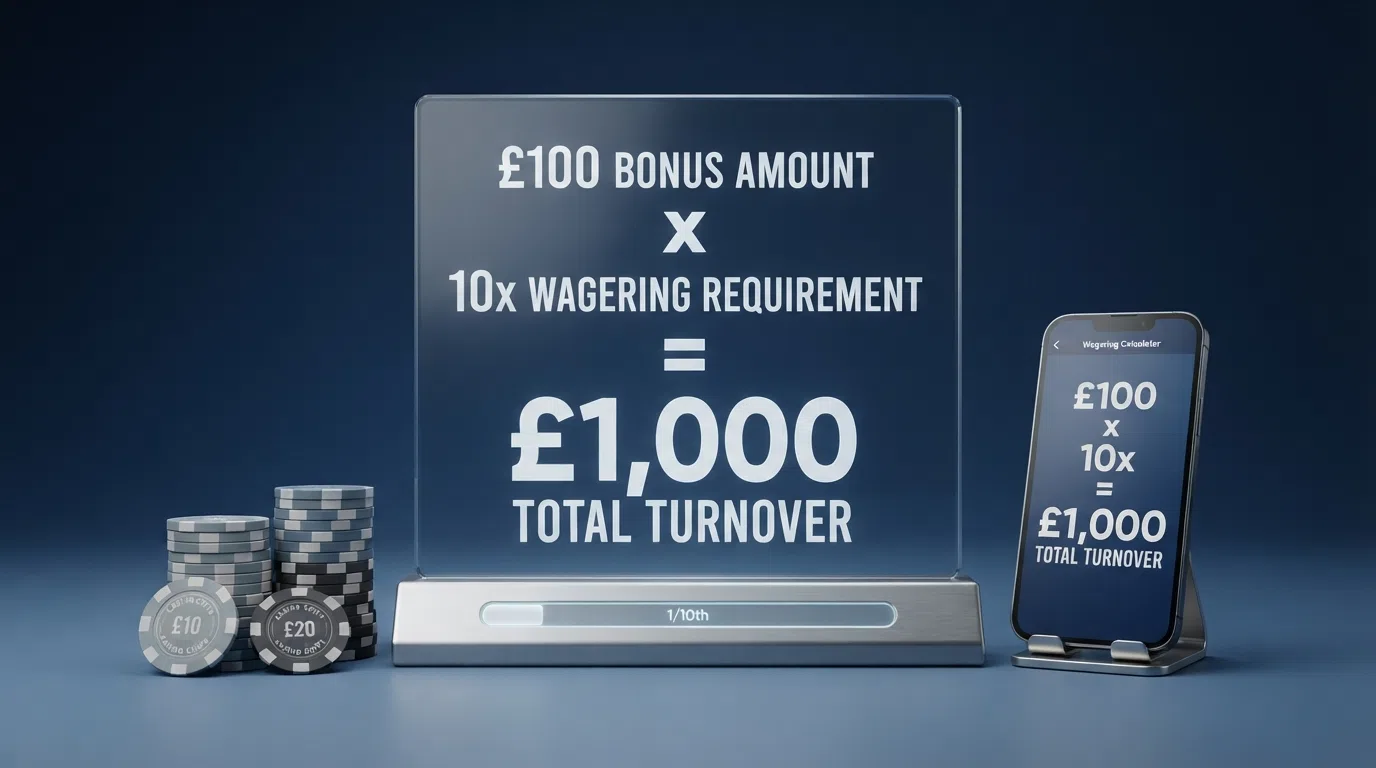
The UK’s 10x cap, in force since 19 December 2025 under LCCP Social Responsibility Code 5.1.1, is a hard ceiling and applies to the bonus amount only. A £100 bonus means £1,000 in turnover, regardless of whether the player deposited £20, £100 or £500 to claim it. The cap exists because the previous market — where wagering could run to 50x or 65x — was identified by the Commission as producing the heaviest bonus-chasing behaviour among the players it most wanted to protect.
Game weighting is the second-order multiplier the wagering figure hides. Slots typically contribute 100% of each £1 staked toward the wagering requirement; table games may contribute 10% or 20%; live casino often contributes zero. A player who runs a £100 bonus through a live roulette table at the full stake is, in many cases, not clearing the wagering at all. The headline 10x becomes an effective 100x or infinity, depending on the game.
The wagering figure is the one number a player should look at before the bonus amount. A lower-percentage offer with a lower wagering multiple can be cheaper to clear than a higher-percentage offer with a heavier one, and in the UK, where the wagering multiple is now capped at 10x, the wagering figure is broadly consistent across licensed offers. The remaining variance is in the bonus amount, the eligible games and the validity window.
Bonus Codes, Expiry Windows and Maximum Cashout Caps
Three pieces of fine print decide whether a bonus is claimable, how long it stays in the account, and what the player can take out.
Bonus codes, where required, are entered at registration or at the deposit step. Most UK-licensed welcome offers in 2026 are opt-in rather than code-gated: the player toggles a checkbox during sign-up or deposit, and the bonus is credited automatically. Code-gated offers still exist, particularly around seasonal promotions, but the standard welcome flow is opt-in.
Expiry windows vary widely. BetVictor carries a 7-day qualification window from registration and a 30-day expiry on bonus funds and free spins. Betway’s 7-day validity from registration is the shortest in the featured set. 888casino’s 90-day validity from credit is the longest. The longer the window, the more time a player has to clear the wagering at a comfortable pace; the shorter the window, the more concentrated the play has to be, and the closer the offer edges toward a deposit-bonus-chasing structure.
Maximum cashout caps are the line between what the bonus balance shows and what the player can actually withdraw. BetVictor’s £300 maximum withdrawal on the £30 casino bonus funds is the cleanest example: the bonus is small, the cap is generous relative to the bonus, and the player keeps the balance up to that ceiling. 888casino’s £100 winnings cap on the 100% up to £100 offer is a one-to-one cap, where every pound of winnings above £100 is forfeit. Max-bet-while-wagering restrictions (typically £5 per spin or hand at UK-licensed sites) and payment-method exclusions (e-wallets sometimes, prepaid cards sometimes) round out the T&Cs layer; a breach voids the bonus, and the player is back to their deposit balance.
Reload Bonuses, Cashback and Ongoing Offers After the Welcome
The welcome offer is the loudest number on the page. The reload bonus, the cashback offer and the seasonal promotion are the quieter ones that recur.
Reload bonuses are lower-percentage matches on subsequent deposits — typically 25% to 50%, against the 100% to 500% of the welcome offer. The same 10x wagering cap and the same mixed-product ban apply. A 50% reload at 10x is a tenth of the welcome offer’s bonus at the same wagering cost; the value is the operator’s retention spend, not a generosity shift.
Cashback is a percentage of net losses over a period (a day, a week, a month) returned as bonus funds or, less commonly, as cash. The UK market is split: some operators credit cashback as withdrawable cash, others as bonus funds with their own wagering. The 10x cap applies to bonus-funds cashback; cash cashback carries no wagering by definition.
Monthly and seasonal promotions exist, but they rarely match the welcome offer’s headline value. The welcome offer is the acquisition cost; the reload is the retention cost. The player’s expected loss on a reload at 10x is the same shape as the welcome offer, scaled down.
Slots-Specific Bonuses — Free Spins and Match Offers Tied to One Game
A bonus restricted to a single slot title is the UK market’s most common welcome offer shape, and the eligible game’s RTP and volatility determine the bonus’s expected return.
The two slots carried through this page as references are Book of Dead (Play’n GO, RTP 96.21%, max win 5,000x, high volatility) and Big Bass Bonanza (Pragmatic Play, RTP 96.71%, max win 2,100x, high volatility). A bonus locked to a 96.71% slot costs the player less per spin than the same bonus on a 94% slot; the difference across 500 spins at £0.10 is the difference between roughly £1.65 and £3.00 in expected loss. The volatility changes the shape of the outcome, not its average.
The player should check the eligible game’s RTP before committing a deposit. Most UK-licensed operators publish the RTP of the bonus slot in the offer terms; if the figure is not stated, the slot’s provider page or a comparison table is the verification route. A bonus locked to a 92% slot is, in expectation, twice as expensive to clear as the same bonus on a 96% slot, and the wagering requirement does not care which game it is run through — it counts turnover, not RTP.
How Your Payment Method Affects Bonus Eligibility
Payment method is the gate most players don’t read until the bonus fails to credit.
Credit cards have been banned for gambling in the UK since 14 April 2020 under LCCP 6.1.2, and the ban extends to credit-card-funded e-wallet payments. No UK bonus can be claimed with a credit card, and a player who funds an e-wallet with a credit card and then deposits from the e-wallet has breached the bonus terms even if the card was not used at the casino. The bonus is void; the deposit remains; the player has funded a casino from a credit card and may have to withdraw the deposit to a different payment method to clear the position.
E-wallets (Neteller, Skrill) and prepaid cards (Paysafecard) are sometimes excluded from welcome-offer qualification at specific operators. The exclusion is in the T&Cs, and a player who deposits via an excluded method before checking the list has chosen the bonus off rather than the operator.
Cryptocurrency is a different question. Most UK-licensed casinos do not accept crypto deposits at all, because accepting crypto and verifying the source of funds under LCCP 3.4.4 are difficult to reconcile. Where a UK-licensed operator does accept crypto, the bonus eligibility is the same as for any other deposit method — but the operator population that accepts both crypto and a UKGC licence is small, and a player who finds one should verify the licence on the Commission’s public register before depositing.
Claiming a Large Welcome Bonus on Mobile — What Stays the Same
The welcome offer on a UK-licensed casino is the same offer whether the player claims it on desktop, on a mobile browser or in a dedicated app. The terms — the bonus amount, the wagering multiple, the eligible games, the expiry window — travel with the account, not the device.
What changes between desktop and mobile is the opt-in step. A desktop registration form typically has a checkbox or a bonus-code field at the deposit step; a mobile form has the same field, often at the bottom of a longer scroll. The opt-in has to happen before the first deposit, not after, and a player who deposits first and then looks for the bonus has missed the toggle.
The 30-day claim window on the bet365 free-spins offer applies regardless of device, as does the 7-day qualification window at BetVictor and the 90-day validity at 888casino. The clock starts at registration, not at the first deposit, and it runs on the same calendar whether the player is on Wi-Fi at home or on a 4G connection in a queue.
Payment Restrictions and Opt-In Steps on Mobile
Mobile payment methods are the same payment methods the operator accepts on desktop, with two practical differences. The first is app-store billing: deposits made through Apple Pay or Google Pay at an app that supports in-app billing may route through the app store, and app-store-billed deposits are sometimes excluded from bonus qualification because the app store takes a fee the operator does not want to gross up. The second is e-wallet exclusion: an e-wallet that is excluded from welcome-offer qualification on the desktop site is excluded on mobile too, because the exclusion is in the offer terms, not the platform.
The opt-in toggle is the last step before the first deposit, and it is the step most often missed on mobile because the form is long. A player who has scrolled through identity verification, address confirmation and marketing preferences by the time they reach the opt-in has more cognitive distance from the offer than a desktop player who reached the same field on a shorter form. The offer is the same; the attention to it is what changes.
The Best UK Casino Welcome Offers Available in 2026
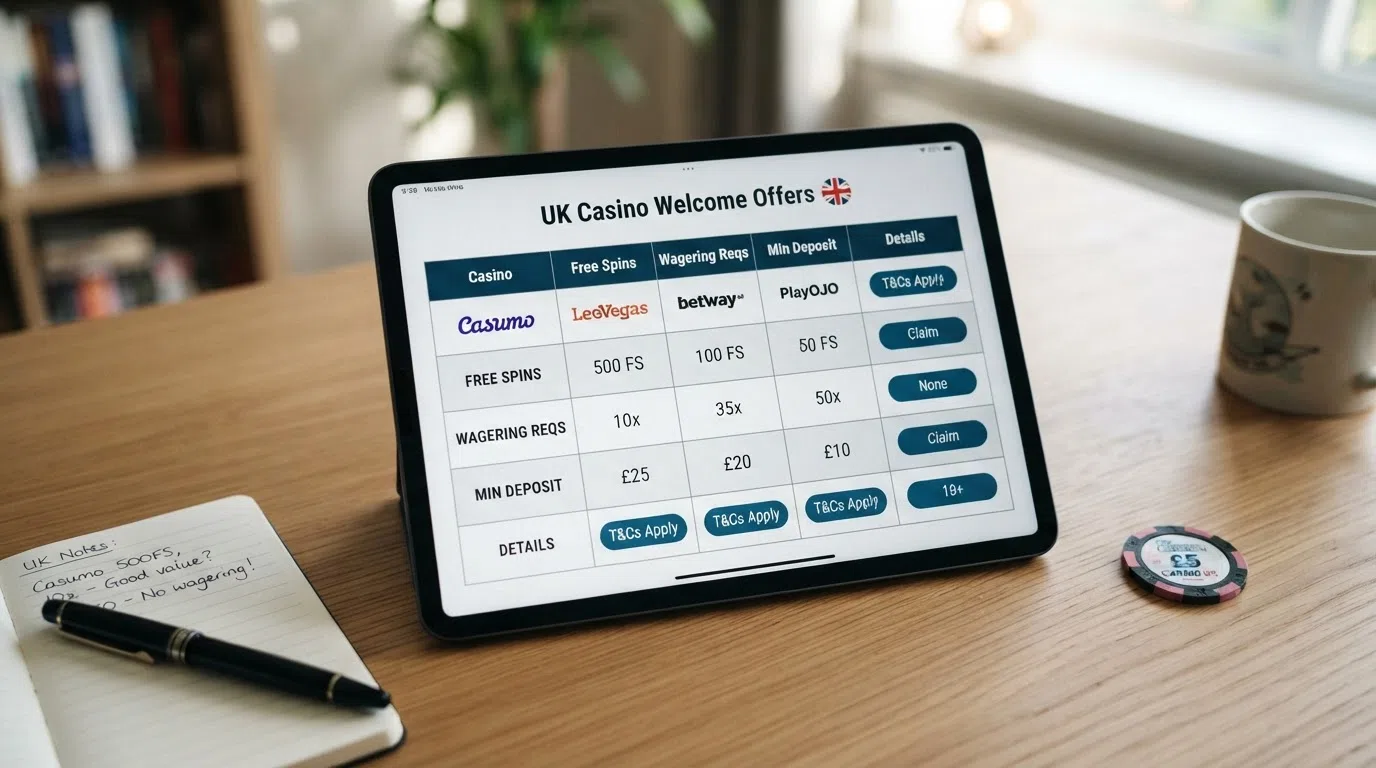
The table below ranks the ten UK-licensed casino welcome offers this page reviews, by bonus value and wagering burden. The columns carry the three numbers that decide what an offer is worth: the welcome-offer shape, the free-spins count, and the wagering requirement on the bonus.
| Casino | Welcome offer | Free spins | Wagering requirement | Minimum deposit |
|---|---|---|---|---|
| bet365 | Free-spins package | Up to 500 | No wagering on free-spin winnings | £10 lifetime deposits |
| BetVictor | £30 in Casino Bonus Funds | 50 on Fishin’ Frenzy | 10x on bonus funds | £10 deposit + £10 wager |
| 888casino | 100% match up to £100 | — | 10x on selected slots | £10+ |
| Betway | 100% match up to £50 | — | 10x | £10+ |
| Paddy Power | Free-spins package | 260 (60 no-deposit) | No wagering on free spins | Mixed (deposit-free + deposit-triggered) |
| Betfair | Free-spins package | 150 (50 no-deposit) | No wagering on free spins | Mixed (deposit-free + deposit-triggered) |
| Sky Vegas | Free-spins package | 70 no-deposit + 200 after £10 spend | No wagering on free spins | £10 spend for full package |
| LeoVegas | Free-spins on Big Bass Splash | 50 | — | £10 |
| Coral | Free-spins package | 100 | No wagering | £10 |
| Ladbrokes | 100 free spins + 300 Ladbucks | 100 | — | £10 |
No UK-licensed operator in this set offers a genuine 500% deposit match in 2026. The largest welcome bonus by headline value is the 500-free-spin package at bet365, and the largest by bonus cost is the £100 match at 888casino. The cheapest offers to clear are the no-wagering free-spins packages, because the cost is bounded by the spin count and the per-spin value, and the wagering requirement is zero.
A player who arrived at this page searching for a 500% match is, in the UK licensed market, looking for a thing the market has stopped selling. The 500-free-spin offer is the closest available equivalent at the same headline number, and it is a better offer than any 500% match at 10x wagering would be, because the player keeps every penny of winnings without a conversion step.
bet365 — Up to 500 Free Spins With Zero Wagering on Winnings
bet365’s UK welcome offer is the largest free-spins package in the featured set and the one most directly equivalent to a “500%” headline. New players receive up to 500 free spins, with no wagering requirement on free-spin winnings — winnings are credited as cash and can be withdrawn immediately.
The offer is triggered by £10 of lifetime deposits rather than a single deposit at a specific value, and the spins must be claimed within 30 days of registration. The 30-day claim window is the one operational constraint; a player who registers and does not return within a month leaves the spins unclaimed. Eligible titles include Book of Horus and other selected slots, and the per-spin value carries through the package.
For a player comparing this offer against a 500% match at 10x wagering, the comparison is favourable. The 500-free-spin package has a bounded maximum cost to the operator and a bounded expected loss to the player, and the no-wagering format means the conversion step is absent. A player who would otherwise deposit £20 to claim a 500% match can deposit the same £20 here and play 500 spins with their winnings paid in cash.
The verdict: this is the offer for a player who searched for “500% bonus” and arrived, in the UK, at the closest equivalent the licensed market sells. The wagering number is zero. The cost is visible. The 30-day claim window is the only operational constraint.
BetVictor — £30 in Bonus Funds Plus 50 Free Spins
BetVictor’s UK welcome offer is a small cash-bonus package with a clear withdrawal cap and 50 free spins on Fishin’ Frenzy. The headline figure depends on which version of the offer the player is reading: the operator’s own site lists £30 in Casino Bonus Funds with 10x wagering and a £300 maximum withdrawal, while some secondary listings show £20. The higher figure carries a £10 deposit and a £10 wager on selected games as the qualifier.
The 10x wagering requirement on the £30 bonus is £300 in slot turnover, and the £300 maximum withdrawal cap is generous relative to the bonus. The player who clears the wagering keeps the bonus balance up to £300; anything above is forfeit. The 7-day qualification window from registration is the shortest in the featured set, and the 30-day expiry on bonus funds and spins is the second-shortest.
BV Gaming Limited is the licence holder, with the Casino Remote licence active from 1 November 2014 on the Gambling Commission’s public register. The licence has been in force continuously for over a decade, which is the kind of operational history a player can check before depositing.
The verdict: this is the offer for a player who wants a small cash bonus with a clear cost ceiling. The £30 bonus at 10x wagering costs, in expectation, around £11.40 in slot loss at 96.21% RTP, and the £300 cap means the upside is bounded. The free spins on Fishin’ Frenzy are the secondary value, and the 7-day qualification window is the operational constraint.
888casino — 100% Match Up to £100 With 90 Days to Clear
888casino’s UK welcome bonus is the longest-validity match offer in the featured set. New players receive a 100% match up to £100 on first deposit, wagered 10x on selected slots within 90 days of credit. The 90-day window is roughly twelve times Betway’s 7-day validity and is the most generous clearing period any UK-licensed casino in this set offers.
The winnings from the bonus are capped at £100, which is a one-to-one cap on the maximum bonus. A player who deposits £100, claims the £100 bonus, runs it through slots and ends the wagering period with a bonus-derived balance above £100 keeps £100 and forfeits the rest. The cap is the operator’s protection on a 10x-cleared match; without it, a single high-variance spin on a £100 bonus could pay out a four-figure sum.
888 UK Limited is the licence holder, with Casino Remote active from 1 November 2014. The 90-day validity is the structural advantage of this offer over shorter-window matches; a player who wants to clear the wagering at a measured pace rather than in a 7-day sprint has the time to do it.
The verdict: this is the offer for a player who values time over headline size. The £100 match at 10x wagering is the standard UK match; the 90-day window and the £10 minimum deposit are the differentiators. The £100 winnings cap is the constraint to plan around.
Betway — 100% Match Up to £50, Cleared at 10x Wagering
Betway’s UK welcome bonus is the tightest match offer in the featured set: 100% up to £50 on first deposit, 10x wagering, 7-day validity from registration. The £50 cap is half 888casino’s, and the 7-day window is the shortest in the set.
The arithmetic is simple. A £50 bonus at 10x wagering is £500 in slot turnover, with an expected loss at 96.21% RTP of roughly £18.95. The player who clears the wagering keeps the bonus balance (no separate cashout cap is published in the primary listing). The 7-day validity concentrates the play, and a player who registers on a Monday and returns the following Wednesday has missed the window.
Betway Limited is the licence holder, with Casino Remote active from 1 November 2014. The licence verification is the same UKGC public register route used for every other operator in this set.
Betway’s offer is tailored for a player who wants a small, fast-to-clear match and is comfortable concentrating the play into a week. The 7-day window is the constraint; the £50 cap is the size. A player who would otherwise deposit £100 and claim a larger match is leaving 888casino’s £100 on the table by choosing Betway; Betway’s strict timeline is an intentional feature for players who prefer a fast-paced clearing window.
Paddy Power — 260 Free Spins Including 60 No-Deposit Spins
Paddy Power’s UK welcome package is a free-spins-led offer with a genuine no-deposit portion. New players receive 60 free spins on sign-up with no deposit required, and a further 200 spins are triggered by a qualifying deposit and play. The full 260 spins carry no wagering on winnings.
The no-deposit portion is the structural differentiator. A player who registers and verifies their identity receives 60 spins without funding the account, and the winnings from those spins are credited as cash. The deposit-triggered portion requires a qualifying stake before the additional 200 spins are credited.
The licence sits with the relevant Paddy Power / Flutter group entity on the Gambling Commission’s public register, and the verification route is the same businesses search used for every other operator in this set. Paddy Power and Betfair are both Flutter brands, and the no-deposit-spin mechanic is consistent across the two.
Paddy Power provides a welcome package focused on the free-spins enthusiast. The 60 no-deposit spins are a free-trial mechanic; the 200 additional spins are the bulk of the value, and they require a deposit. The initial spins let you test the game before committing capital; the full package is unlocked once the deposit condition is met.
Betfair — 150 Free Spins Including 50 No-Deposit Spins
Betfair’s UK welcome offer is structurally similar to Paddy Power’s, scaled down. New players receive 50 free spins on sign-up with no deposit required, and a further 100 spins are triggered by a qualifying deposit and play. The full 150 spins carry no wagering on winnings.
Betfair Casino Limited is the licence holder, with UK Gambling Commission licence 000-039435-R-319329-004. The licence number is the most directly verifiable identifier in the set; it is the same number that appears on the Commission’s public register entry for the operator.
The verdict: this is the smaller version of the Paddy Power structure — same mechanic, lower total spin count, same no-wagering format. A player choosing between the two Flutter offers is choosing between 260 spins at Paddy Power (60 no-deposit) and 150 spins at Betfair (50 no-deposit). The Paddy Power offer is the larger package; the Betfair offer is the smaller. Both carry the same no-wagering format and the same licence-verification route.
Sky Vegas — 70 No-Deposit Spins Plus 200 More After a £10 Spend
Sky Vegas’s UK welcome offer is the largest no-deposit free-spins portion in the featured set. New players receive 70 free spins with no deposit required on sign-up, and a further 200 free spins are unlocked after spending £10 on the site. The full package carries no wagering on free-spin winnings.
The 70-spin no-deposit portion is larger than Paddy Power’s 60 or Betfair’s 50, and the £10 spend trigger for the additional 200 spins is the lowest qualifying threshold in the set. A player who deposits the £10 and wagers it on any qualifying game unlocks the 200 additional spins.
The licence sits with the relevant Flutter/Sky entity on the Commission’s public register. Sky Vegas is a Flutter brand; the verification route is the same businesses search used elsewhere in this set.
Sky Vegas gives players a direct path to a high-volume free-spins start. The 70 no-deposit spins are a free trial; the 200-spin deposit-triggered portion is the bulk of the value, and the £10 spend trigger is the lowest qualifying threshold. This structure prioritises immediate accessibility over complex deposit tiers, making it a straightforward choice for value-seekers.
LeoVegas — 50 Free Spins on Big Bass Splash
LeoVegas’s UK welcome offer is a compact free-spins package tied to a single slot. New players receive 50 free spins on Big Bass Splash, triggered by a £10 qualifying deposit. The wagering requirement on the free-spin winnings is not captured in the primary source for this offer, and a player claiming it should verify the wagering term at the operator’s own page before depositing.
Big Bass Splash is a Pragmatic Play title in the Big Bass series; the RTP of the specific Splash variant is not captured from the gathered source, though the broader Big Bass Bonanza carries a 96.71% RTP at high volatility. A player valuing the offer should check the Splash variant’s RTP on the provider’s page or in the game’s information panel before claiming.
The licence sits with the relevant LeoVegas operating entity on the Commission’s public register. LeoVegas is a Malta-headquartered operator with a UKGC-licensed UK entity, and the verification route is the same register search used elsewhere in this set.
LeoVegas focuses on a compact, single-title welcome experience. The £10 deposit trigger is standard; the wagering term is the verification the player has to do before claiming. By anchoring the offer to Big Bass Splash, LeoVegas appeals to players familiar with that specific slot’s high-volatility math.
Coral — 100 Free Spins With No Wagering
Coral’s UK welcome offer is a clean, no-wagering free-spins package. New players receive 100 free spins on a £10 qualifying deposit, with no wagering requirement on free-spin winnings. The structure is the simplest in the featured set: a deposit, a spin count, a per-spin value, and a zero-wagering payout.
The licence sits with the relevant Entain/Coral entity on the Commission’s public register. Coral is one of two Entain brands in the set (Ladbrokes is the other), and the verification route is the same register search used elsewhere.
Coral maintains a streamlined welcome structure for users who dislike conversion steps. A £10 deposit, 100 spins, no wagering, no conversion step, no cashout cap. It represents a “what you see is what you get” format that avoids the complexities of bonus funds entirely, making it highly suitable for players who prioritise transparency over massive headline figures.
Ladbrokes — 100 Free Spins Plus 300 Ladbucks
Ladbrokes’s UK welcome offer is a hybrid free-spins-and-loyalty-currency package. New players depositing £10 receive 100 free spins plus 300 Ladbucks — the Ladbrokes loyalty-currency token, redeemable in the site’s loyalty programme. The wagering requirement on the free-spin winnings is not captured in the primary source, and a player claiming it should verify the wagering term at the operator’s page.
The 300 Ladbucks are a secondary value: they are not cash, not bonus funds, but a loyalty token with its own conversion rate in the Ladbrokes loyalty programme. A player valuing the offer has to decide what 300 Ladbucks are worth, which depends on the loyalty programme’s redemption terms and is not captured in the primary source.
The licence sits with the relevant Entain/Ladbrokes entity on the Commission’s public register. Ladbrokes is the second Entain brand in the set (Coral is the other), and the verification route is the same register search.
Ladbrokes includes a loyalty-token element alongside its standard spins. The 100 free spins are the primary value, and the wagering term is the verification the player has to do; the 300 Ladbucks are a token whose value depends on the loyalty programme’s redemption rate. This offer effectively rewards ongoing play rather than just the initial registration.
UK Gambling Regulation — The Rules That Shape Every Bonus You See
The UK bonus market is shaped by a single regulator and a single rule change. The Gambling Commission is the licensing authority for Great Britain, and the 19 December 2025 amendments to LCCP Social Responsibility Code 5.1.1 are the most direct constraint on the size and structure of every welcome offer a UK player can claim.
The statutory backbone is the Gambling Act 2005, extended to remote operators by the Gambling (Licensing and Advertising) Act 2014. The licensing objectives in section 1 of the 2005 Act — preventing crime and disorder, ensuring fair and open gambling, and protecting children and other vulnerable persons — are the principles the Commission applies when issuing, reviewing or revoking licences. The operating instruments are the Licence Conditions and Codes of Practice (LCCP) and the Remote Technical Standards (RTS), which together set the rules every licensed operator must follow.
The 10x wagering cap and the mixed-product ban are the two LCCP provisions that most directly affect a welcome offer. The cap is the arithmetic ceiling on every bonus; the ban is the structural ceiling on what can be bundled into one incentive. Both apply to all incentives, not only welcome offers, and both have been in force since 19 December 2025.
The UKGC Licence and the 10x Wagering Cap
The table below sets out the rules that cap and shape every UK-licensed casino offer in 2026.
| Rule | What it means for your bonus | In force since |
|---|---|---|
| 10x wagering cap on bonus amount (LCCP SR Code 5.1.1) | No UK-licensed casino can require more than £10 of slot turnover for every £1 of bonus funds credited | 19 December 2025 |
| Mixed-product ban (LCCP 5.1.1) | A bonus cannot bundle casino with betting, bingo or lottery; one offer, one product | 19 December 2025 |
| Direct marketing opt-in | Marketing for a bonus must be opted into per product and per channel | 1 May 2025 |
| CAP Code and BCAP Code advertising rules | Bonus ads must not have strong appeal to under-18s; no one under 25 may appear in a gambling ad | 1 October 2022 (strong-appeal test) |
| Slot stake cap (age 25+) | Maximum £5 per spin on online slots | 9 April 2025 |
| Slot stake cap (age 18–24) | Maximum £2 per spin on online slots | 21 May 2025 |
| Spin-speed limit | No spin faster than 2.5 seconds per game cycle | 31 October 2021 |
| Auto-play ban | No automatic play on online slots | 31 October 2021 |
| Deposit-limit prompt | Operators must prompt the player to set a financial limit before first deposit | 31 October 2025 |
| Credit-card gambling ban | No gambling with a credit card or credit-card-funded e-wallet | 14 April 2020 |
The 10x cap and the mixed-product ban are the two rules a player will encounter first, because they are the ones that determine the offer’s headline number. The advertising rules are the ones a player will encounter second, because they determine whether the offer can be marketed to them in the first place. The slot stake caps are the ones that determine the speed of play, and the deposit-limit prompt is the one that determines whether a player can deposit at all without first setting a financial ceiling.
GAMSTOP, Self-Exclusion and the Player-Protection Safety Net
GAMSTOP is the national multi-operator self-exclusion scheme for online gambling in Great Britain, and it has been mandatory for all online licensees since 31 March 2020. A player who registers with GAMSTOP is excluded from every UKGC-licensed online operator for the period they select — six months, one year, five years, or five years with auto-renewal. The exclusion cannot be cancelled early, and the operator population covered is every UK-licensed online casino, not a subset.
The identity-verification requirement, in force since 7 May 2019, sits ahead of any deposit or any gambling at a UKGC-licensed site. A player cannot deposit anonymously, and a player who has self-excluded through GAMSTOP cannot deposit at all — the operator’s identity check picks up the GAMSTOP registration before the deposit is accepted.
Financial vulnerability checks are mandatory under LCCP 3.4.4 at net deposit thresholds: £500 from 30 August 2024 and £150 from 28 February 2025. A player depositing more than £500 in a rolling period is checked for indicators of financial harm; the £150 threshold extends the check to a much larger share of the depositing population. The checks are not the same as full affordability assessments, which have been announced and piloted but are not in force as a general mandatory regime in 2026.
The Gambling Commission’s public register of licence holders is the verification route for any operator’s licence status. A player who wants to confirm a casino is UKGC-licensed searches the register by business name; the result shows the licence type, the licence number, the status (active, suspended, revoked) and the trading names covered.
What Happens When a Casino Bonus Sits Outside the UKGC System
Unlicensed provision of online gambling to customers in Great Britain is a criminal offence under section 33 of the Gambling Act 2005, carrying up to 51 weeks’ imprisonment (six months in Scotland), an unlimited level-5 fine, or both. The offence sits with the operator, not the player; the player who gambles on an unlicensed site commits no offence under the Act, but loses the protections a UKGC licence confers.
The protections are what a UKGC licence is actually buying. No Alternative Dispute Resolution (ADR) scheme is obligated to handle a complaint against an unlicensed operator. No GAMSTOP coverage means a self-excluded player can still deposit at the unlicensed site. No deposit protection, no segregation of player funds from operator funds, no fairness guarantee on the games, no Commission enforcement if the operator refuses to pay a winning. The player is in the position of any unsecured creditor of an offshore company.
UK enforcement is disruption-based. The Commission issues cease-and-desist notices, conducts test purchases, refers domains to search engines for delisting, and works with payment providers and hosting companies to disrupt the operator’s access to UK customers. The Commission does not currently hold statutory ISP or DNS blocking powers, and blocking legislation has been proposed but not enacted.
The primary risk to a player who gambles on an unlicensed site is the loss of protections, not a personal penalty. The page does not moralise about the choice; it states the trade-off, and the trade-off is that the headline bonus percentage on an unlicensed site is paying for protections the player will not have if the operator decides not to pay out.
ADR, Dispute Resolution and What to Do When a Bonus Is Withheld
Every UKGC-licensed operator is required to participate in an approved Alternative Dispute Resolution (ADR) scheme. The complaints escalation is operator internal process first, ADR second, Gambling Commission third if the ADR outcome is unsatisfactory. The ADR is the mechanism that resolves disputes over bonus terms, game outcomes, account restrictions and self-exclusion failures.
The ADR can rule on bonus-term disputes where the operator’s interpretation of its own T&Cs is contested, and on payouts that the operator has refused. The ADR cannot rule on operator solvency — if the operator has gone out of business, the ADR is not the route; the player’s recourse is through the operator’s insolvency process. The ADR also has an eight-week rule: the operator must have issued a final response to the complaint before the ADR will accept the case. A player who has not yet received that final response is back at the operator’s internal process, not at the ADR.
The Commission does not handle individual complaints directly. Its role is to license the ADR, audit the operator’s participation in the ADR, and take regulatory action where the operator’s conduct breaches the licence conditions. A player who has exhausted the ADR route and remains dissatisfied can refer the matter to the Commission, which will consider whether the operator’s conduct warrants regulatory action.
When a 500% Bonus Tests Your Limits — Staying in Control
A 500%-headline bonus is, by design, an offer structured to incentivise heavy play. The percentage is the bait; the wagering requirement is the hook; the play-through is the line the player has been sold. The UK’s safer-gambling infrastructure exists to limit how far that line can run.
The link between large headline percentages and bonus-chasing behaviour is well-documented in the consultation documents the Commission published ahead of the 2025 rule changes. The 10x cap and the £2/£5 slot stake caps are direct responses to that pattern. The deposit-limit prompt is a third: from 31 October 2025, the player is asked to set a financial limit before the first deposit, and the bonus is claimed against that limit rather than the player choosing the deposit and the bonus choosing the limit.
The help infrastructure a UK player can access is immediate. The National Gambling Helpline (0808 8020 133, free, 24/7, run by GamCare) is the first call. NHS gambling treatment clinics in England, Scotland and Wales provide face-to-face support. GambleAware and the National Gambling Support Network offer digital self-assessment tools, and Gamblers Anonymous runs peer-support meetings. The prevalence data the NHS publishes — 0.4% of adults at PGSI 8+ (likely experiencing gambling-related harms) and 1.6% at PGSI 3+ (at least moderate risk) — is the population-level figure behind these services. The 0.4% is the population the rules are designed to protect; the 1.6% is the population the rules are designed to prevent from joining the 0.4%.
Bonus-Chasing — Why a Bigger Headline Number Isn’t a Better Deal
The psychology of a 500% headline is that it triggers a larger first deposit than the player would otherwise make. A player who would deposit £20 to play slots sees a 500% offer and deposits £100, because the bonus number is now £500 and the offer feels like a windfall. The arithmetic is that the player has staked £100 of their own money to claim a £500 bonus at 10x wagering — £5,000 in slot turnover, expected loss around £189.50 at 96.21% RTP. The £500 bonus returns, in expectation, £310.50 of that to the player. The net position is a £100 deposit and a £189.50 expected loss, with a £310.50 expected return from the bonus. The player is, in expectation, £121 worse off than they would have been depositing the £20 they originally intended.
A 100% match at 10x wagering, by contrast, is the same offer with a smaller percentage. The player who would deposit £100 anyway claims a £100 bonus, clears £1,000 in turnover, expected loss £37.90, expected return from bonus £62.10. The player is in a better net position by chasing the smaller percentage, because the smaller percentage is matched to the deposit the player would have made anyway.
The UK’s deposit-limit prompt — mandatory before first deposit from 31 October 2025 — is the circuit-breaker. The player has to set a financial limit before the deposit, and the bonus is then claimed against that limit. A player who sets a £100 limit cannot deposit £200 to chase a higher tier. A player who sets a £20 limit has constrained the offer to the £20 deposit they would otherwise have made. The prompt is the operator’s structural intervention in the bonus-chasing pattern.
The slot stake caps — £5 for players 25+ from 9 April 2025 and £2 for players 18–24 from 21 May 2025 — are the speed limit. A player who wants to chase a bonus by running high-volume slot play is capped at £5 per spin, and the 2.5-second minimum spin interval (in force since 31 October 2021) caps the rate of play. The combination means a £1,000 turnover requirement at £5 per spin takes at least 200 spins, and at 2.5 seconds per spin that is 500 seconds — just over eight minutes of play for the minimum turnover, before considering variance.
Deposit Limits, Reality Checks and Where to Get Help in the UK
Deposit limits are the player-set financial ceiling that the operator must prompt the player to set before the first deposit from 31 October 2025. A decrease in a deposit limit takes effect immediately; an increase has a 24-hour cooling-off period before it takes effect. The limit is the player’s, and the player can set it as low as zero.
Reality checks are mandatory operator-side prompts that interrupt play at intervals (typically every 30 or 60 minutes) and display the session’s win or loss and the time played. The player can dismiss the check and continue; the operator cannot suppress the check.
Time-outs are player-set breaks of 24 hours, 7 days, or any period up to 6 weeks. A player who takes a time-out cannot deposit, cannot gamble, and cannot reverse the time-out during the period. Self-exclusion through GAMSTOP is the longer version of the same break, with a minimum period of six months and no early cancellation.
The National Gambling Helpline is 0808 8020 133, free, 24/7, run by GamCare. The helpline is the first call for any UK player who is concerned about their own gambling or someone else’s. NHS gambling treatment clinics in England, Scotland and Wales provide face-to-face support; the NHS PGSI-style self-check (a score of 8 or higher is the threshold the NHS uses for likely gambling-related harms) is the self-assessment route. GambleAware and the National Gambling Support Network offer digital self-assessment tools; the GambleAware self-assessment quiz has been completed over 160,000 times according to the charity’s published statistics. Gamblers Anonymous runs peer-support meetings across the UK for players who want a group setting.
How the UK’s Financial Vulnerability Checks Interact With Bonus Offers
Financial vulnerability checks are mandatory under LCCP 3.4.4 from two net deposit thresholds: £500 from 30 August 2024 and £150 from 28 February 2025. A player who crosses either threshold in a rolling period is checked for indicators of financial harm — income source, outstanding debt, recent life events — and the operator may pause the account pending further information.
For a player depositing to claim a bonus, the check is a behind-the-scenes pause rather than a refusal. The deposit has been accepted, the bonus has been credited, and the wagering requirement is running. The check may ask the player to provide additional information, and the operator may restrict further deposits until the information is provided. The check does not void the bonus or confiscate the balance; it constrains what comes next.
Full financial risk assessments — affordability checks that go beyond the vulnerability screen — are not in force as a general mandatory regime in 2026. The Commission has consulted on a more detailed affordability framework, and operators have been piloting internal affordability processes, but a nationwide mandatory affordability assessment regime is not yet in operation. The vulnerability check at £150 and £500 is the current state of the regime.
The statutory levy funds the treatment, prevention and research infrastructure the player is referred to if a vulnerability check identifies harm. From 6 April 2025, the levy is 1.1% of gross gambling yield for remote casino and bingo (the top rate), with the proceeds split 50% to treatment, 30% to prevention and 20% to research. The levy is the funding mechanism behind the NHS gambling treatment clinics, the GambleAware digital tools, and the Commission’s research programme.
How We Selected and Ranked These Casino Welcome Offers
The ten operators in the ranking were selected from UK-licensed brands that publish a current welcome offer, with verification of each licence status against the Gambling Commission’s public register of licence holders. The verification was done by business-name search; the result for each operator shows the licence type, the licence number, the licence status (active in every case in this set) and the trading names covered.
The bonus-term data was gathered from the operators’ own sites and from independent UK iGaming publishers — oddschecker, the Independent, the Racing Post, Livescore, BritishGambler and Bojoko are the most consistent sources in the editorial set. The publishers are useful for cross-referencing the headline offer (free-spins count, percentage match, bonus amount) against the operator’s own page; the publisher’s listing is rarely more current than the operator’s, and the operator’s page is the binding version.
The ranking criteria applied are wagering burden, free-spins value, no-wagering status, validity window and the total turnover cost of clearing each offer. No invented weightings or scores have been used: the criteria are listed in priority order, and the table is sorted by them. The no-wagering free-spins packages are ranked above the wagering-gated matches because the cost is lower and the offer is more transparent. The match bonuses are ranked by bonus size and validity window, with 888casino’s 90-day validity above Betway’s 7-day.
Offshore and unlicensed operators have been excluded regardless of the headline bonus percentage. A 500% match at 40x wagering on an unlicensed site is not in this ranking, because the cost is not bounded by UK rules and the protections are absent. The ranking is the UK-licensed version of the welcome-offer market; the offshore version is a different market, and the comparison is not useful.
What a UK Player Should Actually Do About Big-Percentage Bonus Offers
The decision framework below is the one the page’s own figures support, in the order the figures make the case.
Check the wagering multiplier and the total turnover cost before looking at the headline percentage. A 100% match at 10x wagering is, in expectation, cheaper than a 500% match at 40x wagering offshore, and a 100% match at 10x is the same offer as a 500% match at 10x in the UK, because the cap is on the bonus amount. The percentage is the marketing number. The wagering figure is the cost. The cost is the one to look at.
Prefer a no-wagering free-spins package over a high-percentage match with heavy terms. The bet365 500-free-spin offer with zero wagering on winnings is, on the page’s own numbers, the most cost-effective welcome in the UK licensed market in 2026. The Coral 100-free-spin offer is the cleanest structure. The Paddy Power and Betfair no-deposit portions are the best free-trial mechanics. A player who has the choice between a £100 match at 10x wagering and a 100-free-spin no-wagering package is, in expectation, better off taking the spins.
Verify every operator’s UKGC licence on the public register before depositing. The register is at the Gambling Commission’s website; the search is by business name. The result confirms the licence is active, shows the licence number and lists the trading names covered. A player who cannot find the operator on the register is looking at an unlicensed site, and the protections a UKGC licence confers are not in place.
Treat the expected-loss figure — not the bonus amount — as the real cost of claiming any welcome offer. The expected loss is the turnover multiplied by the house edge. A £100 bonus at 10x wagering is £1,000 in turnover; at 96.21% RTP, the expected loss is £37.90; the player keeps £62.10 in expectation. The bonus is the headline; the loss is the cost. The cost is the number the player needs.
Set a deposit limit before claiming a bonus so the offer does not determine the deposit size. The deposit-limit prompt is mandatory at every UK-licensed casino from 31 October 2025. A player who sets the limit at the level they would have deposited anyway, and then claims the bonus against that limit, has structurally separated the deposit decision from the bonus decision. The player who lets the bonus set the deposit has let the offer choose the financial exposure, and that is the pattern the prompt is designed to interrupt.
Frequently Asked Questions
What wagering requirements apply to UK casino bonuses after the 2026 rule changes?
UK-licensed casinos are capped at 10x the bonus amount on wagering requirements under LCCP Social Responsibility Code 5.1.1, in force since 19 December 2025. The cap applies to the bonus amount only, not to the bonus plus the initial deposit combined. A £100 bonus at 10x wagering requires £1,000 in slot turnover before withdrawal, and the same cap applies to all incentives at a UKGC-licensed operator.
Are huge percentage bonuses riskier than smaller, lower-wagering welcome offers?
In expectation, yes. A 100% match at 10x wagering on a £100 deposit carries an expected loss of roughly £37.90 at a 96.21% slot RTP, and the player keeps the deposit plus an expected £62.10 from the bonus. A 500% match at 40x wagering offshore carries an expected loss several times higher, and the absence of UKGC protections means the player has no ADR route if the operator refuses to pay. The percentage is the marketing number; the wagering figure is the cost; the cost is the one to look at.
Where can UK players check whether a casino bonus comes from a UKGC-licensed operator?
The Gambling Commission publishes a public register of licence holders at its website. The search is by business name and returns the licence type, licence number, status and trading names covered. A player who cannot find the operator on the register is looking at an unlicensed site, and the protections a UKGC licence confers — ADR, GAMSTOP coverage, deposit protection, fairness guarantee — are not in place.
Can I claim a casino welcome bonus with a credit card in the UK?
No. Credit cards have been banned for gambling in the UK since 14 April 2020 under LCCP 6.1.2, and the ban extends to credit-card-funded e-wallet payments. A player who funds an e-wallet with a credit card and then deposits from the e-wallet has breached the bonus terms; the bonus is void and the deposit remains. The only routes to a UK-licensed welcome bonus are debit cards, bank transfers and eligible e-wallets.
Do casino bonus winnings count as taxable income for UK players?
No. Player gambling winnings are not taxed in the UK, whether the winnings come from a deposit, a bonus or a free spin. The tax is levied on the operator, not the player: Remote Gaming Duty is 21% in 2026 and rises to 40% from 1 April 2026. The player keeps the full amount of any winnings, and the operator pays the duty on its gross gaming yield.
What happens to a bonus if I self-exclude through GAMSTOP before meeting the wagering?
GAMSTOP self-exclusion prevents any further deposit or play at a UKGC-licensed operator for the period selected (six months, one year, five years, or five years with auto-renewal). Any active bonus balance at the point of self-exclusion is treated under the operator’s GAMSTOP policy: most operators forfeit the bonus balance and any associated winnings, because the bonus was contingent on continued play. The exclusion cannot be cancelled early, and the bonus cannot be revived. A player considering self-exclusion should treat any in-play bonus as a sunk cost.
Casino Apps vs Mobile Browser — Does Bonus Eligibility Change?
UK-licensed casino apps carry the same welcome offer as the desktop site. The bonus is tied to the player account, and the app is a client for the same account. There is no app-exclusive welcome offer in the featured set, and there is no mobile-browser-only welcome offer either.
The opt-in flow is where the UX diverges. A mobile browser registration form is a long scroll with the bonus opt-in near the bottom; a dedicated app moves the opt-in into the deposit step or, in some operators, into a separate “Offers” tab. The player who wants to claim the welcome offer has to opt in before depositing in either case, and missing the toggle on mobile is no different from missing it on desktop.
App-specific promotions exist at some operators, but they sit alongside the standard welcome offer rather than replacing it. A player who downloads the app to claim an app-only promotion is still entitled to the standard welcome offer on first deposit, provided the standard offer has been opted into before the deposit.
Promotions – realmoney-onlinecasinos-uk
Content created by the «realmoney-onlinecasinos-uk» team