
Pay by Phone Casinos UK: Where the £40 Cap Actually Lands
 Available in GB
A “pay by phone casino” is not a class of casino. It is a casino, holding a UK Gambling Commission licence, that accepts one specific deposit route: a charge pushed to your mobile phone bill or phone credit. That distinction is the page’s first and most useful one, because the marketing language of the sector buries it. A site that takes phone-billed deposits is the same kind of site, governed by the same licence and the same safer-gambling rules, as any other UKGC-licensed casino. The phone method is the way money goes in, never the way it comes out, and that single fact decides almost everything the rest of this page argues.
Every figure below was checked against the UK Gambling Commission’s public register and the published regulation current as of September 8, 2026.
What a pay by phone casino is — a billing method, not a casino type
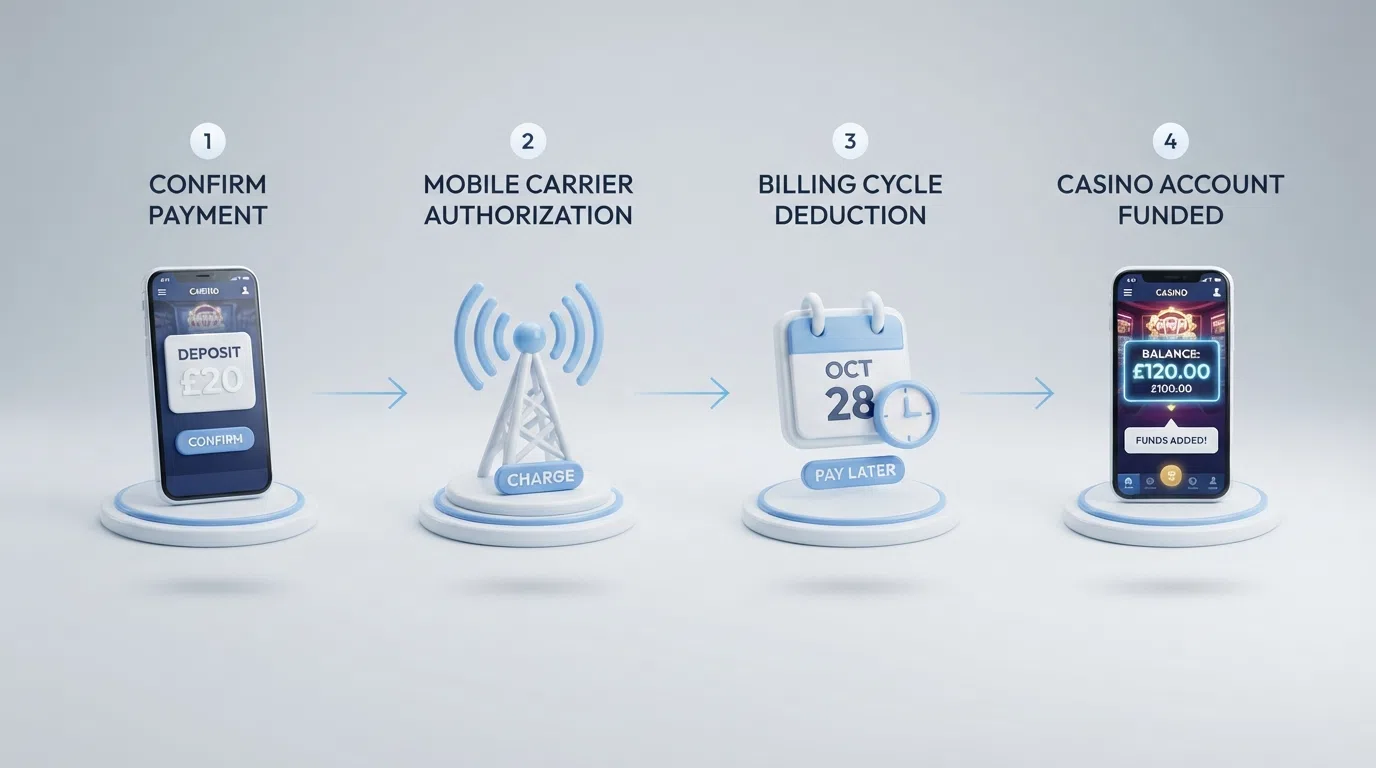
The phone method is one entry on a deposit-page menu that otherwise looks like any other: debit card, bank transfer, e-wallet, prepaid voucher. Selecting it sends a single-use confirmation prompt to your phone; the amount is added to your next monthly bill or deducted from your prepaid credit; the casino account is credited the same minute. No bank or card details are shared with the operator, which is the privacy angle the marketing tends to lead with. That privacy covers deposits only. Withdrawals always go back through a separate, pre-registered method — debit card, bank transfer or e-wallet — and that limitation is non-negotiable across every brand on this page.
Pay by phone, pay by mobile, carrier billing: one method, three names
“Pay by phone,” “pay by mobile” and “carrier billing” describe the same transaction. Boku, the brand most players recognise, is the largest single provider and operates in over 90 countries with more than 28 million active users; in the UK it is free to use on EE, Vodafone, O2 and Three. Fonix, Siru Mobile and PayViaPhone sit in the same lane under different names; what they share is a single-use SMS confirmation, a charge applied to your phone account, and the same statutory caps regardless of which one your casino uses.
Online only: why phone billing never reaches a land-based casino
The terminal at a land-based casino takes chips, cash and cards. It does not take a phone-bill instruction. Every deposit method on this page is remote, licensed under the Gambling Act 2005 as extended to online operators by the Gambling (Licensing and Advertising) Act 2014, and bound to the same point-of-consumption rules as any other online casino. The phone method did not, and could not, change the licence.
Which UK casino sites take phone-bill deposits for real-money play
A minority of GB-licensed casinos carry it. Peachy Games, for instance, sits among a very small set of UKGC-licensed brands in 2026 that take phone-bill deposits. The ten operators ranked below are, by design, drawn from that minority, and every one of them funds real-money play from the same phone-billed deposits that fund everything else on the site — the method gates no specific game or stake tier beyond the caps that follow.
How phone-bill deposits work — and why they stop at £240 a month
The mechanics of a phone-bill deposit are simple. What complicates them is the cap, and the cap is not a casino’s idea. Under the Payment Services Regulations 2017 — the same regime that brought in strong customer authentication for card payments — electronic communications services are excluded from full Payment Services Regulation up to a defined ceiling. That ceiling is the £40 per single transaction and £240 per calendar month limit every UK phone-bill deposit respects. Day-to-day regulation of the underlying carrier-billing services moved from the Phone-paid Services Authority to Ofcom on 1 February 2025, so the regulator you complain to if a charge is wrong is now Ofcom, not the PSA. The limits themselves did not change at the handover.
The deposit flow: from tap to funded account in one phone bill
You enter an amount (up to £40), confirm your phone number, and receive a single-use SMS prompt. Tapping confirm pushes the charge to your mobile account; the casino credits your balance the same minute. No bank details, no card details, no app download. The only friction the method adds is the SMS itself, which is precisely why the regulator chose to cap it.
Pay by phone bill vs pay by phone credit: two different pots of money
“Pay by phone bill” means the charge lands on your monthly mobile account and is collected by your network the usual way. “Pay by phone credit” means the charge is deducted from prepaid credit you have already topped up — pay-as-you-go balance, in industry terms. Both routes hit the same £40/£240 caps, and both are governed by the same Payment Services Regulations. The distinction matters when the reader is on PAYG: a £40 deposit consumes £40 of top-up credit immediately, not at the end of the month.
Withdrawals: the phone takes money in, never out
A pay by phone casino cannot pay winnings back to your phone bill. The reason is structural: the carrier-billing channel is one-way, designed for small digital purchases, not for receiving funds. Every operator on this page requires a secondary withdrawal route — a debit card, a bank transfer or an e-wallet — to be set up before the first cashout. Anyone who deposits only by phone and wins will need to register a card or account before the money can leave.
Minimum deposits: the £5 and £10 entry points
The lowest entry on this page is Mr Vegas at £5.12, set by Siru Mobile’s own minimum. The standard floor across most of the ranking is £10. The higher-floor brands — Rose Casino, Ivy Casino — start at £20. The statutory cap is the only number that truly cannot be negotiated; the minimum is a commercial choice, and it tends to track the size of the welcome offer behind it.
The networks that carry pay by phone: EE, Vodafone, O2 and the rest
EE, Vodafone, O2 and Three are the four networks that carry Boku and most other carrier-billing services in the UK. Sky Mobile, BT Mobile and Virgin Mobile run as MVNOs on those networks, so support typically follows the underlying host. Carrier-billed deposits are a network-level capability, not a casino-level integration; a casino cannot enable them for one customer and disable them for another.
Beyond Boku: Fonix, Siru Mobile and PayViaPhone
Boku is the brand name players meet first, but it is not the only pipeline. Fonix, listed on London’s AIM and self-described as the largest SMS and carrier-billing aggregator in the UK, routes a large share of the casino market. Siru Mobile caters to lower minimums and the PAYG segment. PayViaPhone is a third route, used by brands on certain platform aggregators. Fees vary: some operators absorb the cost of the carrier-billing transaction, while others charge up to 15% of the deposit — a fee that comes straight off the playable balance before the first spin.
The £40 and £240 caps — and why no casino can lift them
The £40-per-transaction and £240-per-calendar-month caps are set in primary legislation. They are not casino policy, not network policy, and not a customer-service ticket that can be raised. To deposit more, the player must use a different method — debit card, bank transfer or e-wallet — and that method carries its own rules. Ofcom’s takeover of carrier-billing regulation in February 2025 did not change these numbers; it changed who enforces the rules around them.
Our ten best pay by phone casinos: every one UKGC-licensed and GamStop-linked
| Casino | UKGC licence | Phone method | Welcome offer | Game providers |
|---|---|---|---|---|
| Duelz | 48695 (SuprPlay Ltd) | Fonix | Wager £25, up to 140 free spins over 7 days | NetEnt, Play’n GO, Pragmatic Play |
| MrQ | Confirmed (Lindar Media Ltd) | Fonix | 100 free spins on Big Bass Splash | NetEnt, Play’n GO, Pragmatic Play |
| Peachy Games | Confirmed | Boku-style | 100 free spins on Big Bass Splash (min £10 deposit + £10 stake on slots) | Pragmatic Play, Play’n GO, NetEnt (~700 slots) |
| Casushi | 100050 (Solaya Group Ltd) | Pay by Phone | 100 bonus spins on Big Bass Splash | Pragmatic Play, Play’n GO, NetEnt |
| Spinzwin | Confirmed (Progress Play) | PayViaPhone | Up to £1,000 + 100 free spins | NetEnt, Microgaming |
| Justin Casino | Confirmed (Jumpman Gaming) | Pay by Mobile | Win up to 500 bonus spins | NetEnt, Pragmatic Play (~1,100 games) |
| Casino Kings | Confirmed | Pay by Mobile | Deposit and play £20, 100 free spins on Big Bass Splash | Pragmatic Play |
| Rose Casino | Confirmed | Pay by Mobile | £50 deposit match paid as cash (min £20) | — |
| Ivy Casino | Confirmed | Pay by Mobile | 20 free spins on Big Bass Splash (min £20) | NetEnt, Play’n GO, Pragmatic Play |
| Mr Vegas | Confirmed | Siru Mobile | Per terms | — |
Every operator above holds a UKGC licence, every one of them is mandatorily connected to GAMSTOP since 31 March 2020, and the £40/£240 statutory cap applies to each. The table’s job is to make the licence and the method comparable at a glance; the verdict on which brand suits which reader is the operator block that follows.
Duelz
Duelz runs under UKGC licence 48695, held by SuprPlay Limited, which is verifiable on the Commission’s public register. Launched in 2018, the brand built its reputation on a fantasy-themed gamification layer that sits on top of a familiar NetEnt, Play’n GO and Pragmatic Play library. The phone route runs through Fonix. The welcome offer is a wager-gated drip: deposit and wager £25, then collect up to 140 free spins at 20 per day across seven days, with a 10× wagering requirement on whatever the spins return. The minimum deposit is £10. The £40/£240 statutory cap is in force.
Duelz suits a player who likes the gamified framing and is comfortable with a 10× playthrough on spin winnings. The seven-day drip means the value stretches rather than lands in one go, and that is the part the headline number hides.
MrQ
MrQ, operated by Lindar Media, runs on Fonix for phone-billed deposits. The welcome offer is 100 free spins on Big Bass Splash, triggered by a £10+ deposit, with each spin set at 10p and 0× wagering on whatever they return. The 48-hour validity is short, but the absence of wagering is the rare thing: any winnings land as withdrawable cash. The statutory £40/£240 cap is in force.
MrQ is the cleanest no-wagering offer on the page. A player who values certainty over volume picks it; a player who wants a larger headline number of spins and is willing to play them through picks something with a multiplier.
Peachy Games
Peachy Games is one of the very few UKGC-licensed casinos in 2026 supporting pay by phone billing via a Boku-style charge direct to the mobile network bill. The welcome is 100 free spins on Big Bass Splash for a £10 deposit plus a £10 stake on slots, with 0× wagering and a 48-hour window. The library is curated to around 700 slots.
The headline point about Peachy is not the offer — MrQ and Casushi match it on spins and on the 0× wagering. It is the rarity: phone-bill deposits are the exception among UKGC-licensed brands, and Peachy sits firmly in that exception.
Casushi
Casushi holds UKGC licence 100050, held by Solaya Group Ltd, which launched the brand in January 2020. The phone method is listed simply as “Pay by Phone.” The welcome is 100 bonus spins on Big Bass Splash, £10 minimum, 0× wagering, 48-hour validity. The Pragmatic Play, Play’n GO and NetEnt line-up is the same trio most of the page shares.
Casushi is the third leg of the 0× wagering cluster. Its distinguishing detail is brand personality — a sushi-casual theme that the marketing leans on — and licence transparency: 100050 is a number a reader can check.
Spinzwin
Spinzwin runs on the Progress Play platform and takes phone-billed deposits through PayViaPhone. The headline offer is up to £1,000 plus 100 free spins, but the operator is also the only one in the ranking that charges a 15% fee on phone deposits — a fee taken off the top of the balance before the first spin. The platform enforces a £30 daily cap on top of the statutory £40/£240 limits.
Spinzwin is the operator a reader should approach last. The headline offer is the largest, and the fee structure is the worst on the page. A £20 phone deposit becomes £17 of playable balance before a stake is set. The trade-off is real: more bonus money, less of it usable.
Justin Casino
Justin Casino launched in October 2025 on the Jumpman Gaming platform, which carries around 1,100 games across NetEnt, Pragmatic Play and the rest of Jumpman’s aggregator. The phone method is Pay by Mobile, the minimum is £10, and the welcome offer is a wheel-style “win up to 500 bonus spins” format — common across Jumpman brands, where the headline number is the ceiling, not the floor.
Justin is the newest name on the list, and the largest spin ceiling. A reader who values the newest licence and the largest possible spin count picks Justin; a reader who values knowing exactly what they will receive picks a flat 100.
Casino Kings
Casino Kings takes Pay by Mobile deposits. The welcome is deposit and play £20, then 100 free spins on Big Bass Splash. The minimum deposit is £10. The “play £20” gating means the spins unlock after real-money play, not at the deposit moment — a different structure from MrQ and Peachy, which credit spins at deposit.
Casino Kings suits a player who likes the play-then-collect structure and is happy with Big Bass as the named title. The £20 playthrough is the cost of admission, and the 100 spins are the refund.
Rose Casino
Rose Casino launched in March 2025. The phone method is Pay by Mobile, the minimum is £20, and the welcome is a £50 deposit match paid as cash — not as bonus credit, not as spins, but as withdrawable money. The 0× wagering is built into the structure rather than a special feature.
Rose is the cash-match outlier on a page otherwise dominated by free spins. A reader who values a cash welcome over a spins welcome — and is comfortable with the £20 floor — picks Rose. The 0× wagering is the second-best line on the page after the same line on the spins-only brands.
Ivy Casino
Ivy Casino launched in 2024, which makes it the second-newest name on the page after Justin. The phone method is Pay by Mobile, the minimum is £20, and the welcome is 20 free spins on Big Bass Splash — the smallest spin count in the ranking. The library features Big Bass and Eye of Horus, both Pragmatic Play titles with significant UK followings.
Ivy suits a player who values a smaller, slower welcome and is happy to deposit £20 for 20 spins. The wagering is per standard terms; the library mix — NetEnt, Play’n GO, Pragmatic Play — is the same trio the rest of the top half shares.
Mr Vegas
Mr Vegas accepts phone-billed deposits through Siru Mobile, and that one detail — the £5.12 minimum — is the entry point’s whole story. Siru’s lower floor is a function of its own pricing, not a casino-set policy. The welcome is per terms, which is the page’s most opaque line and the one a reader should check directly before depositing.
Mr Vegas is the lowest-deposit brand on the page. A reader whose priority is testing phone-bill deposits for the smallest possible stake picks Mr Vegas; a reader whose priority is a known welcome offer picks a brand with a published 100 or 140 spin headline.
Bonuses you can actually clear: the 10× cap changes everything
A welcome bonus is only worth what its wagering leaves behind, and on 19 December 2025 the UKGC changed the arithmetic. The new rules cap wagering requirements at 10× and ban mixed-product promotional offers — the cross-sell format where a sportsbook would hand out casino free spins, or vice versa. Every offer on this page sits underneath that 10× ceiling now. Some sit well underneath; some sit on the ceiling; a few sit at zero, and that last group is the one a reader should pay closest attention to.
No-deposit bonuses: why none of the checked operators offer one
A no-deposit bonus is free credit, free spins, or a free bet handed to a new account before any deposit lands. None of the ten operators on this page offers one. Every welcome offer in the ranking is deposit-gated — the spins or the cash match unlock only after a real-money deposit, usually £10 or £20. The keyword for the page asks about a no-deposit bonus; the honest answer is that, among UKGC-licensed brands taking phone-bill deposits, this is the offer shape the market currently uses, and a reader who wants a no-deposit offer will need to look beyond the phone-bill set or wait for one to appear.
Free spins on a phone-bill deposit: the 100-spin offers
Free spins are the dominant welcome currency on this page. MrQ, Peachy Games and Casushi each offer 100 free spins on Big Bass Splash for a £10 minimum deposit. Duelz offers up to 140 spins, dripped at 20 per day over seven days, for a £25 wager trigger. Justin Casino goes up to 500 spins via a wheel, with the actual number drawn at random. Spinzwin pairs 100 spins with a cash match, and Casino Kings releases 100 spins after a £20 playthrough. Rose Casino and Ivy Casino are the non-spin welcome brands — Rose pays cash, Ivy offers 20 spins for £20.
The 100-spin offer is the cluster’s centre of gravity. Big Bass Splash is the named title in six of the ten cases, which is itself a fact about the market: Pragmatic Play’s fishing series is the default wagering vehicle for UKGC-licensed welcome offers right now.
Welcome bonuses and the wagering attached to them
A welcome bonus carries its real value in the wagering multiplier and the expiry window. MrQ, Peachy and Casushi carry 0× — whatever the spins return is already cash, and the 48-hour validity is the only time pressure. Duelz carries 10×, the new regulatory ceiling, on a seven-day drip. Spinzwin’s terms follow the standard Progress Play format. Rose’s £50 match is paid as cash, so the 0× is built into the structure. Justin, Casino Kings and Ivy carry their own per-terms wagering that the small-print policy will state more precisely than a ranking can.
A reader who wants a known wagering number and known expiry should pick from the 0× cluster. A reader who is comfortable with a 10× ceiling and a longer drip should consider Duelz. Anything above 10× is not legal in Britain, so the offer does not exist on a UKGC-licensed site.
No-wagering offers: where winnings land as cash
Three of the ten operators — MrQ, Peachy and Casushi — pay free-spin winnings as real cash with no playthrough. That is the clearest offer on the page. Duelz’s 10× is the new regulatory maximum, not a generous number. Spinzwin, Justin, Casino Kings, Rose and Ivy all run their own terms, and the 0× exception is the one a reader should treat as the benchmark.
The 0× cluster is small but it is structurally important. A 100-spin welcome at 0× is worth more than a 200-spin welcome at 10× to a player who actually intends to cash out, because the multiplier swallows a meaningful share of medium-volatility returns. The arithmetic in the slots section below shows this in numbers, not in marketing language.
The slots worth playing by phone bill — and what the £5 cap changes
Phone-billed deposits fund the same slots as any other deposit. The method gates no specific title, and the only slot-specific rule that touches a phone-bill session is the age-banded maximum stake. Under SI 2025/215, the per-game-cycle maximum stake is £5 for players aged 25 and over (in force from 9 April 2025) and £2 for players aged 18 to 24 (in force from 21 May 2025). Two adults at the same casino, on the same slot, can face different maximum bets — a fact the welcome-offer language never mentions and the per-spin arithmetic makes vivid.
Which slots take phone-bill deposits
Every slot at a phone-bill casino is reachable by phone-billed funds. The named favourites across the ranking are Pragmatic Play’s Big Bass series — Splash, Bonanza, and the rest of the fishing format — and NetEnt’s Starburst. Big Bass Splash is the free-spin vehicle for MrQ, Peachy, Casushi, Casino Kings and Ivy, which makes it the most-deposited-toward title on the page by volume.
Three slots with researched RTPs: Big Bass, Starburst, Book of Dead
| Slot | RTP | Provider | Volatility | Max win |
|---|---|---|---|---|
| Big Bass Bonanza | 96.71% | Pragmatic Play | Medium-to-high | 2,100× stake |
| Starburst | 96.09% | NetEnt | Low | ~500× stake |
| Book of Dead | 96.21% | Play’n GO | High | ~5,000× stake |
The RTP numbers here are long-term averages. Starburst’s low volatility and ~500× ceiling make it the slot for longer, lower-variance sessions. Book of Dead’s high volatility and ~5,000× ceiling make it the slot for shorter, higher-variance sessions where a long quiet stretch is the price of a chance at a larger return. Big Bass Bonanza sits between the two — the median shape for the UK slot market.
A 100-spin session at the £5 stake cap, on Big Bass Bonanza, costs an expected £500 × (1 − 0.9671) = £16.45 in expected loss. At the £2 cap that same session costs an expected £200 × (1 − 0.9671) = £6.58. The 60% reduction in stake produces a 60% reduction in expected loss, which is the mechanical effect of the age band. The RTP is the same; the spend is not.
The £5 and £2 stake caps: what they mean per spin
A player aged 25 or over presses spin with up to £5 riding on the result. A player aged 18 to 24 presses the same spin button with up to £2 riding on the result. Both players see the same slot, the same RTP, the same volatility profile; the only difference is how much of their bankroll each press represents. The £5 and £2 numbers are set in primary legislation and apply to every UKGC-licensed casino — there is no opt-in for a higher ceiling, no loyalty-tier exception, no opt-out clause.
Mobile slots and free-play: trying before you deposit
Most UKGC-licensed casinos run a free-play demo mode for slots, and the demo is the natural first move for a player who has not yet committed a phone-bill deposit. The demo uses the same RNG and the same RTP as the real-money game; the only thing it omits is the financial consequence. A reader who is uncertain about a slot’s volatility or about how a welcome offer plays out can run dozens of demo sessions before the first phone-bill charge lands on the next bill.
Apps vs browser: pay by phone works without the download
The phone is already the payment device, which is why the browser is the natural home for a phone-bill casino. Most of the operators on this page run an instant-play mobile site, and the deposit flow is the same in the browser as in any dedicated app. Downloading an app is optional. Phone-billed deposits work identically in both.
Dedicated casino apps with pay by phone
A subset of the operators ship dedicated iOS and Android apps. The phone-bill deposit flow is the same in-app as in the browser: the SMS confirmation arrives, the charge hits the next bill, the casino balance credits within seconds. The only additional rule is the app-store age-gate, which sits on top of the UKGC’s own age-verification requirement. A player aged 18 to 24 will pass the app-store check, complete the UKGC verification on first deposit, and then face the £2 stake cap inside the app — the same cap that applies in the browser.
Mobile-browser play: no download, same deposits
The mobile browser does everything the app does, and it does it without the download. The £40 per-transaction and £240 per-calendar-month caps apply identically. Boku, Fonix, Siru Mobile and PayViaPhone all work in-browser with no separate account setup. For most players on this page, the browser is the right answer.
New pay by phone casinos: what 2026 has actually added
Newness matters in a regulated market, because each new UKGC-licensed casino is, by definition, a brand that has cleared the Commission’s licence process. The three newest names on the ranking — Justin Casino, Rose Casino, Ivy Casino — illustrate the different shapes newness can take. Justin is a new brand on an established platform (Jumpman Gaming). Rose is a new brand with a cash-match welcome. Ivy is the second-newest name, dating to 2024, with a smaller-spin welcome and the same Big Bass title the rest of the market uses.
Newly launched pay by phone casinos
Justin Casino launched in October 2025. Rose Casino launched in March 2025. Ivy Casino launched in 2024. All three take phone-billed deposits through Pay by Mobile. The three are the newness the 2026 market has actually added; older brands like Duelz (2018) and Casushi (January 2020) are not new in the same sense, though they remain current in the market.
New sites: what’s genuinely new vs repackaged
A new brand on an old platform is not, in the licence sense, a new casino. Spinzwin sits on the Progress Play platform; Justin sits on the Jumpman Gaming platform. The platform carries the licence infrastructure, the payments, the games and the safer-gambling tooling; the brand is a skin over the top. A reader who wants a genuinely new casino experience should look for a new licence holder, not just a new name.
How to choose a pay by phone casino without getting burned
The licence check is the whole game. Every other test is secondary. A UKGC-licensed casino is bound by the safer-gambling rules, the marketing rules, the bonus rules and the complaints route. An unlicensed casino is bound by none of them, and the marketing language used to find one is identical to the marketing language used to find the other.
Licence first: the UKGC check that catches rogue sites
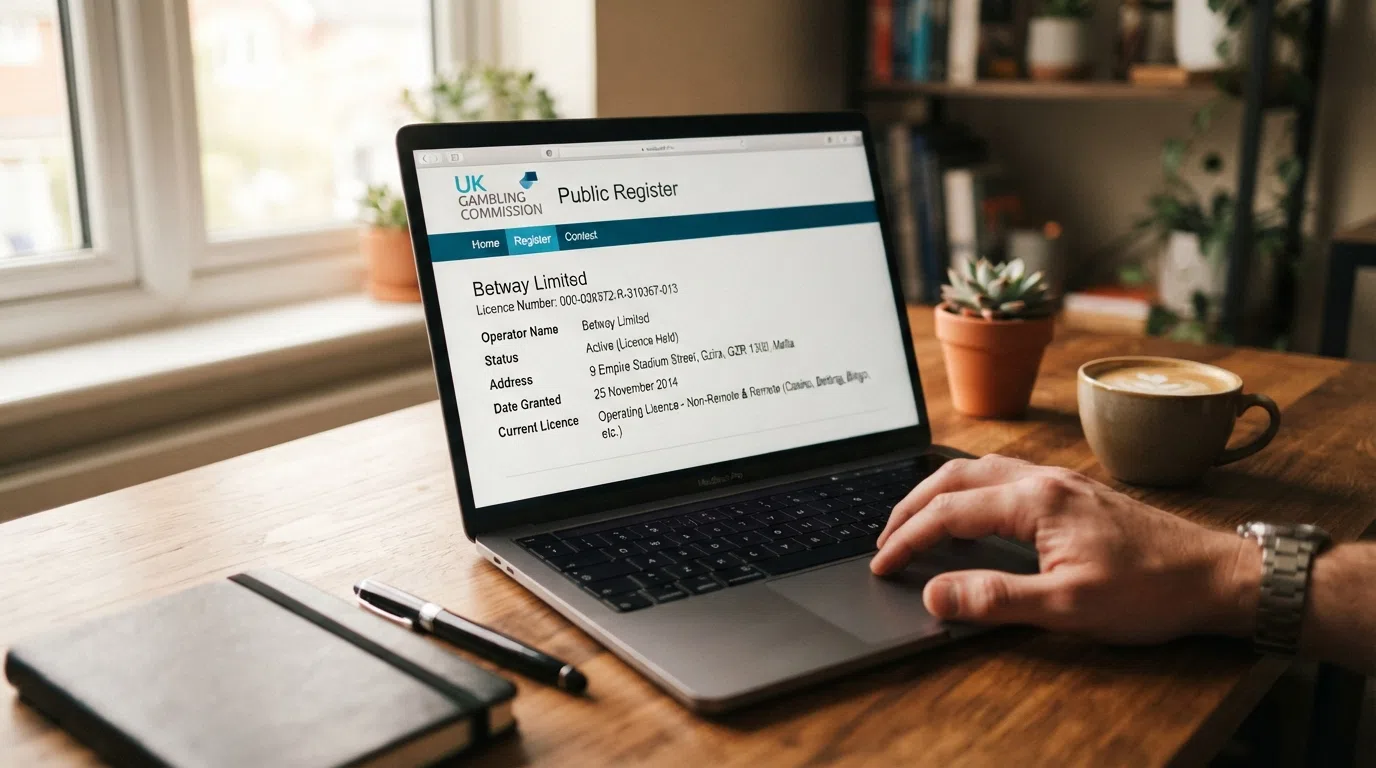
The Commission’s public register — the same register that holds 2,663 active records as of August 2026 — is the source of truth. A reader types the operator’s name, confirms a current licence, and notes the licence number. Duelz’s 48695 is verifiable on the register; Casushi’s 100050 is verifiable on the register. An absent licence is a stop sign. A reader who cannot find a brand on the register should not deposit, regardless of how persuasive the welcome offer looks.
Legit vs rogue: the warning signs
The structural signs of an unlicensed site are consistent. No UKGC licence number on the homepage. No GAMSTOP link. No alternative dispute resolution (ADR) route. No Commission complaints pathway. A reader who sees any of these absent should treat the site as offshore, regardless of what the welcome page claims. Offshore sites have no British consumer redress if funds are withheld; the £500 that “wins” today can sit in a frozen account next month with no regulator to call.
Reviews, ratings and master lists: reading them without the hype
Seven of the ten top Google UK results for this keyword are affiliate reviews or publisher-affiliate hybrids. The reviews are useful for the data they carry — bonus terms, withdrawal times, phone-deposit methods — but the verdicts they reach are paid for. A reader who treats affiliate rankings as a starting point for a UKGC register check, rather than a destination, gets the data without the marketing layer.
UK regulation: the licence, the limits and the offshore gap
Pay by phone is legal in Britain. The phone method is a deposit route within a fully licensed product, governed by the Gambling Act 2005 as extended to remote operators by the Gambling (Licensing and Advertising) Act 2014. The Gambling Commission is the regulator; GAMSTOP is mandatory for every licensed online operator; providing gambling without a GB licence is a criminal offence under section 33 of the 2005 Act.
The UK Gambling Commission licence: what it actually guarantees
A UKGC licence guarantees a regulator, not a win. The Commission’s three licensing objectives, set out in section 1 of the Gambling Act 2005, are preventing crime and disorder, ensuring fairness and openness, and protecting children and vulnerable persons. The licence does not change the house edge; it does not guarantee a payout. It does mean the operator is subject to LCCP codes, the social responsibility code, the bonus rules, the financial vulnerability checks and the complaints route, and it means the player pays no tax on winnings. From 1 April 2026, the operator pays Remote Gaming Duty at 40%, up from 21%; from 6 April 2025, a statutory levy at 1.1% of GGY funds treatment, prevention and research.
GamStop: mandatory for every licensed casino, and what sits outside it
GAMSTOP is not a courtesy. Since 31 March 2020, GAMSTOP participation has been a mandatory condition of every UKGC online operating licence, and the Commission has suspended licences over non-participation. A casino that claims to be UKGC-licensed and not on GAMSTOP is, by definition, lying about one or the other. Self-exclusion periods are six months, one year, five years, or five years with auto-renewal; exclusion cannot be cancelled early, and a non-renewed exclusion continues for up to seven years after its formal expiry. A player who has registered with GAMSTOP cannot deposit at any of the ten operators on this page.
Non-GamStop and no-verification sites: what you lose playing there
The loss is not money — it is protection. A non-GamStop, no-verification site has no ADR route, no Commission complaints path, no KYC safety net, and no British consumer redress if funds are withheld. The Commission’s enforcement against offshore sites runs through disruption notices, search-engine delisting referrals and payment-provider pressure; it does not run through ISP blocking, because the Commission has no statutory ISP-blocking power. Between April 2024 and June 2025, the Commission issued 3,140 disruption notices, referred 447,778 URLs to search engines, and saw 287,961 URLs removed. No criminal penalty has been traced for a player who merely gambles on an unlicensed site; the consequence is loss of regulatory protection, not legal liability.
The statutory caps: a one-glance table of UK limits
| Limit or rule | What it caps or requires | Who it applies to | In force since |
|---|---|---|---|
| Phone-bill deposit | £40 per transaction, £240 per calendar month | All UK phone-bill deposits | Payment Services Regulations 2017 |
| Slot stake (25+) | £5 maximum per game cycle | All UKGC online slots | 9 April 2025 (SI 2025/215) |
| Slot stake (18-24) | £2 maximum per game cycle | UKGC online slots players aged 18-24 | 21 May 2025 (SI 2025/215) |
| Wagering requirements | 10× maximum | All UKGC-licensed welcome offers | 19 December 2025 (LCCP SR 5.1.1) |
| Credit cards | Banned for all remote gambling | All UKGC-licensed operators | 14 April 2020 (LCCP 6.1.2) |
| Financial vulnerability check | Triggered at £150 net deposits in 30 days | All UKGC-licensed operators | 28 February 2025 (LCCP 3.4.4) |
| Deposit-limit prompt | Required before first deposit | All UKGC-licensed operators | 31 October 2025 |
The table is a fact sheet, not a verdict. The detail on the slot stake cap lives in the slots section above; the detail on the vulnerability check lives in the safer-gambling section below.
Staying in control: the tools and help behind phone-bill play
A frictionless deposit method raises the importance of the safer-gambling tools, and Britain mandates them. From 31 October 2025, every UKGC-licensed operator must prompt a customer to set a financial limit before the first deposit, and any request to decrease a limit must be actioned immediately. From 30 June 2026 — extended to 30 September 2026 — only gross deposit limits may be called “deposit limits.” The phone-bill method does not exempt a casino from any of this.
The limits every UK casino must offer: deposit caps, reality checks, time-outs
Deposit limits are mandatory. Reality checks are mandatory. Time-outs are mandatory. A player can set a daily, weekly or monthly cap, request a 24-hour cooling-off period, or trigger a longer self-exclusion. The game-design rules in force since 31 October 2021 also require the operator to display session losses, session wins and time played, which means a player who has been at the slots for two hours can see the time and the result without having to look for it. Auto-play is banned, spin speed is capped at 2.5 seconds, and reverse withdrawals were permanently banned at the same time.
Self-exclusion: how to register and the periods you can choose
GAMSTOP registration takes minutes and blocks every GB-licensed online operator at once. A player can register for six months, one year, five years, or five years with auto-renewal. The exclusion cannot be cancelled early, and a non-renewed exclusion continues to block new account creation for up to seven years after its formal expiry. There is no cooling-off window, no “I changed my mind” path; the design is deliberately hard to undo.
GamCare, the helpline and NHS clinics: where to turn when it’s too much
The National Gambling Helpline (0808 8020 133) is free and open 24 hours a day, every day of the year; GamCare also runs a live chat on its website. The National Gambling Support Network treated 11,960 clients in Great Britain in 2024/25 — an 11% increase on the previous year, with 93% of treatment completers showing improvement. NHS England recorded 4,355 gambling-harm referrals in 2024/25, up from 2,284 the year before. Fifteen specialist NHS gambling-harm clinics operate in England, Scotland and Wales, and from 1 April 2026 NHS England commissions gambling-harms treatment funded by the statutory levy. The prevalence numbers justify the infrastructure: 0.4% of adults are problem gamblers (PGSI 8+), 1.6% are at moderate risk or above (PGSI 3+), and the highest rate — 3.5% — is in the 25 to 34 age band.
How we ranked these pay by phone casinos
The ranking above was built from a cross-section of popular UK casino review and publisher sites: Casino.org, OLBG, Racing Post, the Independent, Casinos.com, talkSPORT, the Evening Standard, Bookies.com, casinowithdrawal.co.uk and AskGamblers. Each operator was checked against the UKGC public register, with licence numbers noted where the register confirmed them (Duelz 48695, Casushi 100050) and licence confirmation noted where the search snippet confirmed the licence without surfacing the number. The ordering criteria were qualitative: licence status, phone-bill method, welcome offer shape, wagering requirement, and minimum deposit. No weighting was invented; the ranking follows the cluster’s own centre of gravity, with the 0× wagering offers at the top, the larger spin ceilings in the middle, and the cash-match and lowest-minimum brands at the edges.
Your pay by phone shortlist: what to do before you tap deposit
The phone method is a deposit route, not a casino type. It is legal in Britain, capped at £40 per transaction and £240 per calendar month, and accepted by a minority of UKGC-licensed brands. The ten operators ranked above are all UKGC-licensed, all mandatorily connected to GAMSTOP, and all bound by the same £40/£240 cap that no casino can raise. Three of them — MrQ, Peachy and Casushi — pay free-spin winnings as cash with 0× wagering, which is the exception worth anchoring a shortlist around. Duelz offers the largest single-brand spin drip at 10×. Rose pays a £50 cash match. Mr Vegas accepts the lowest minimum deposit, at £5.12 via Siru Mobile. Spinzwin is the only brand in the set that charges a 15% fee on phone deposits, which directly reduces the playable balance and is the trade-off a reader should weigh against the larger headline offer.
The single next action is the licence check. Type the operator into the UKGC public register, confirm the licence number, and only then tap deposit. The marketing language of the sector buries the distinction; the register does not.
Frequently asked questions
Do pay by phone deposits qualify for welcome bonuses?
Yes, in the same way any other deposit method does. Every welcome offer on this page is deposit-gated, and phone-billed deposits count toward the qualifying deposit. No operator in the ranking excludes phone-billed deposits from the welcome. Wagering terms and the offer shape — spins, cash match, or play-then-collect — apply the same way regardless of the deposit route.
Are pay by phone casinos safe, and how do I check the licence?
Yes, if they are UKGC-licensed. The Commission’s public register is the source of truth: type the operator’s name, confirm a current licence, and note the number. Duelz’s 48695 and Casushi’s 100050 are both verifiable on the register. A reader who cannot find a brand on the register should not deposit. The licence is what binds the casino to the safer-gambling rules, the bonus rules and the complaints route; an unlicensed site has none of these.
Can I use pay by phone if I am on GamStop self-exclusion?
No. GAMSTOP is mandatory for every UKGC online operator, and a player registered with GAMSTOP is blocked at the account creation stage at every brand on this page. The exclusion runs for six months, one year, five years, or five years with auto-renewal, and it cannot be cancelled early. A non-GamStop site accepting phone-billed deposits is, by definition, an unlicensed site, and the protections discussed in the regulation section do not apply there.
What fees do pay by phone deposits charge?
It depends on the operator. Most UKGC-licensed brands on this page absorb the carrier-billing fee and pass the full deposit to the playable balance. Spinzwin is the exception: it charges 15% on phone deposits, which is taken off the top of the balance before the first spin. The £40/£240 statutory cap is independent of the fee — the cap is the maximum the carrier will let the casino charge, not the maximum the casino credits.
Is Boku the only way to pay by phone at UK casinos?
No. Boku is the brand most players recognise, but Fonix, Siru Mobile and PayViaPhone route phone-billed deposits across the same UK networks. Fonix is the largest SMS and carrier-billing aggregator in the UK and powers a large share of the casino market. Siru Mobile caters to lower minimums and the pay-as-you-go segment. PayViaPhone is a third route, used by brands on certain platform aggregators. The £40/£240 statutory cap applies regardless of which one the casino uses.
Which UK mobile networks support casino pay by phone deposits?
EE, Vodafone, O2 and Three carry the major phone-billing services in the UK, and Boku is free to use on all four. Sky Mobile, BT Mobile and Virgin Mobile operate as MVNOs on those networks, so support typically follows the underlying host. A reader whose network is not on the list should confirm with their operator directly, because carrier-billing is a network-level capability and not every UK network has integrated with every provider.
Payments – realmoney-onlinecasinos-uk
Content created by the «realmoney-onlinecasinos-uk» team