
What a UK "penny slot" really costs — and where to find one worth playing
 Available in GB
The label says penny. The bill does not. A “penny slot” in the UK online market is not a machine where one spin sets you back a single penny; it is a slot where each payline can be played for as little as £0.01. The paylines multiply, and so does the cost. A 20-payline penny slot at £0.01 per line costs £0.20 per spin when every line is active. A 50-payline game at the same per-line price costs £0.50. The marketing word survives because it describes a starting price, not the price of a finished spin.

That gap matters because the British online slots market generates substantial interest and participation. Online slots generated £773 million in gross gambling yield in the January to March 2026 reporting period, up 12% on the year before, and 25.1 billion spins were logged across the quarter. Forty-seven per cent of British adults reported gambling in the past four weeks. Penny slots sit inside that volume. They are the entry-level product most often handed to a new or casual player, and they are the game where the difference between the advertised stake and the stake you actually place is widest.
Three things frame every spin at a UK-licensed casino. First, the law. Every online slot is capped at £5 per game cycle for players aged 25 and over, and £2 for players aged 18 to 24, under SI 2025/215. Second, the maths. Return-to-player percentages vary by roughly nine points across popular titles — from 88.12% at one end of the scale to 96.82% at the other — and that spread is what the house edge is made of. Third, the marketing. Welcome offers at UK-licensed casinos can hand a new player several hundred free spins before a penny leaves their account, but the terms behind those spins vary more than the headlines suggest.
This page works through each of those layers. It explains what a penny slot is and what a spin actually costs, lists the titles with published RTP figures that justify the time spent on them, walks through the welcome offers at ten UK-licensed operators, and sets out the legal and responsible-gambling framework that every GB-licensed penny-slot session runs inside.
*Data current as of September 8, 2026. Licence claims verified against the Gambling Commission’s public register.*
What a penny slot actually is — and what it is not
The term comes from land-based casinos, where penny machines sat at the front of the floor as the cheapest way in. They were mechanical, single-payline, and a coin really did buy a single spin. The name carried over to the online market, where it describes something different.
Online, a penny slot is any slot game that accepts £0.01 as its minimum stake per payline. The payline is the line across the reels on which a winning combination pays out. Modern video slots run several at once — typically 10, 20, 25 or 50 — and the player activates a chosen number, with the cost per spin equal to the number of active paylines multiplied by the stake per line. One industry source puts it plainly: a penny slot rarely means a full spin costs one cent. It means each individual payline costs 1p, and most modern penny slots online run 10, 20, or even 50 paylines simultaneously.
The 1p-per-line label survives in UK marketing because it is technically true and commercially useful. A player who reads the word “penny” and assumes the spin will cost them a penny is misreading the structure. A player who reads it as the minimum price for the cheapest configurable unit on the game has read it correctly. The difference is twentyfold at a 20-payline game, and fiftyfold at a 50-payline one.
How penny slots work: paylines, cost per spin and the stake-cap ceiling
The payline multiplication is the mechanic that makes a penny slot cost what it costs. Three worked examples at £0.01 per line:
- 10-payline slot, all lines active: £0.10 per spin.
- 20-payline slot, all lines active: £0.20 per spin.
- 50-payline slot, all lines active: £0.50 per spin.
Most modern penny slots default to all paylines active, so the per-spin cost is the per-line price times the line count. Some players reduce the line count to lower the stake, but doing so also disqualifies them from line-based features — free-spin retriggers, scatter bonuses that depend on line coverage, progressive jackpot qualification — and from any payline that produces a winning combination on that spin.
Above all of this sits the statutory stake cap. Every online slot at a GB-licensed casino is capped at £5 per game cycle for players aged 25 and over, and £2 for players aged 18 to 24. A game cycle is the period from initiation to when all staked money is lost or all winnings delivered. The cap is a hard ceiling on the total stake within that cycle, regardless of payline count. Two adults sitting at the same slot at the same casino can face different maximum bets because of their age band. Max-betting all lines at a penny each is the cheap way to approach the cap — a 50-payline game at £0.10 per line costs £5 per spin, which is the maximum for anyone 25 or older and well above the £2 ceiling for younger players.
The cap does not apply to offshore sites. A player who spins at a casino without a UKGC licence has no statutory ceiling on their stake. That sounds like freedom and works like a loss: the protections that come with the cap — auto-play ban, 2.5-second spin floor, losses-disguised-as-wins ban — go with it.
Penny slots vs pound slots: what changes when the stakes rise
The arithmetic looks different at each end of the scale. A 20-payline penny slot at £0.20 a spin gives a £20 deposit 100 spins, and at 96.21% RTP the expected loss over those spins is about 76p. A 20-line slot set to £1 per line costs £20 a spin, which means a £20 deposit buys exactly one spin. The same percentage return applies, but the exposure per decision is a hundred times larger.
Two things change as the stake rises. The first is volatility exposure for a given bankroll. A player on a £20 bankroll at 20p a spin can absorb a long losing run without exhausting their funds; a player on the same bankroll at £20 a spin is one decision away from zero. The second is the duration of the session. Penny slots last longer on the same deposit, and that longevity is the point of the format — the entertainment-per-pound is higher, even though the expected loss per pound is unchanged.
The trade-off is between entertainment duration and win ceiling. A penny slot session stretches a deposit into a longer experience with smaller wins. A pound slot session delivers fewer, larger outcomes. Neither changes the long-run return; both give the house the same edge in the long run. The difference is the shape of the ride on the way there.
How to play penny slots online: rules, tips and the UK interface
The UK-licensed slot interface is more constrained than the offshore version, and the constraints are there for a reason. Since 31 October 2021, GB-licensed slots have been built to a fixed set of rules: auto-play is banned, the minimum spin interval is 2.5 seconds, features designed to speed up play are banned, losses disguised as wins (a spin that returns less than the stake but is presented with celebratory graphics and sound) are banned, and reverse withdrawals are permanently banned. The session display must show total losses, total wins and total time played.
What that means in practice: you set your paylines and your stake per line, press spin once, and wait at least 2.5 seconds for the result. There is no turbo button, no auto-play loop, and no animation that cheers a spin that paid back less than it cost. A round takes long enough to feel like a decision rather than a reflex, and the maths of the session is visible while it runs.
The paytable — the on-game reference that lists every symbol, every winning combination and the value of each — is the most important screen to read before playing. It tells you the RTP for the game at your stake, the value of each symbol, how the bonus features trigger, and whether the progressive jackpot requires a minimum bet. One industry observer puts the progressive question bluntly: if the jackpot needs a £0.25 minimum bet to trigger, your 1p spin is just a donation to the pot.
Real-money penny slots: playing for cash at UK-licensed sites
Three things change when demo credits become cash. The first is identity. Since 7 May 2019, every GB-licensed casino must verify a customer’s name, address and date of birth before they can deposit or gamble. There is no anonymous real-money play at a British-licensed site. The second is payment method. Since 14 April 2020, credit cards have been banned for all remote gambling in Britain, including e-wallet payments funded by credit card. The third is the loss-aversion the player carries into the session — and the loss-aversion the session is designed, within the law, to dampen.
A real-money penny slot session at £0.20 a spin on a £20 deposit buys 100 spins. At a 96% RTP, the expected loss over those 100 spins is roughly 80p. That is the cost of the entertainment the session delivers — the same calculation, the same percentage, the same house edge as any other stake size. The slot does not know or care whether the stake is real money or a demo credit; the maths is identical. What changes is the player’s relationship to the number on the balance display.
Penny slot RTP, payouts and the progressive jackpot question
Return-to-player is the long-run percentage of stake that a slot returns to players across millions of spins. A 96% RTP slot returns, on average, £96 for every £100 staked across its full population of plays. Over a session of 100 spins, that average looks like noise. Over millions of spins, it looks like a number.
The RTP spread across popular penny slots is wide. Book of Dead sits at 96.21%. Starburst at 96.09%. Big Bass Bonanza at 96.71%. Fluffy Favourites at 95.39%. Rainbow Riches at 95%. Dead or Alive at 96.82%. Mega Moolah at 88.12% on the base game, with a further 5.30% of every stake going to the progressive jackpot contribution. The gap between the top and the bottom of that range — roughly nine percentage points — is what a bankroll feels over time. A 96% slot keeps more of your stake than an 88% slot. Over an evening of play, that difference is real money.
Progressive jackpots are a different conversation. The odds of hitting a progressive jackpot on any given spin are estimated at roughly one in ten million. A 1p spin that does not carry the minimum qualifying bet does not even enter the draw. The jackpot is a long-shot feature layered on top of a base game whose RTP already accounts for the contribution — the 88.12% base RTP on Mega Moolah, for example, reflects the fact that 5.30% of every stake is being siphoned into the progressive pool.
Max-win multipliers tell the same story on a smaller scale. Sweet Bonanza offers a maximum win of 21,175x stake; Book of Dead 5,000x; Big Bass Bonanza 2,100x; Starburst 500x. These are ceilings, not expectations. A single spin can hit any of them or none of them. The RTP is the average; the max-win figure is the outlier.
The penny slots worth your time — and the ones that are not
Three criteria separate a worthwhile penny slot from a bankroll drain. The first is RTP — the higher, the better, because the gap between 96% and 88% compounds over a session. The second is volatility — high volatility swings harder between winning and losing sessions, low volatility pays smaller amounts more often, and the choice between them is a choice about what kind of ride you want. The third is the bonus feature — whether the free spins, the respins, the collect mechanics add genuine value to the base game, or just animation.
RTP is the single most important number on the paytable. It is the only figure that describes the long-run cost of playing the game, and it is published for every title a reputable provider releases. A player who picks a 96% slot over a 92% slot has made the most consequential decision available before pressing spin.
Volatility shapes the play experience at low stakes in ways the RTP number does not capture. A high-volatility slot at 1p a line feels like a series of quiet sessions punctuated by occasional big outcomes. A low-volatility slot feels like a steady drip of small returns. Bankroll-wise, the difference is how long the deposit lasts when the game goes cold.
Bonus features are worth checking before loading. Book of Dead’s free spins with expanding symbols, Big Bass Bonanza’s collect mechanic during free spins, Divine Fortune’s Falling Wilds Respins — these add structure to the base game and the free-spin round. Features that are purely cosmetic add nothing.
Top-rated penny slots for UK players: the RTP-backed shortlist
The table below covers the titles with published, verifiable RTP figures in the research. Where a figure is not given in the source, the cell carries an em dash rather than a guess. The volatility column follows the same rule.
| Slot Title | Provider | RTP | Volatility | Min Bet | Max Win |
|---|---|---|---|---|---|
| Book of Dead | Play’n GO | 96.21% | High | £0.10 (10 lines × £0.01) | 5,000x |
| Starburst | NetEnt | 96.09% | Low | £0.10 | 500x |
| Dead or Alive | NetEnt | 96.82% | High | — | — |
| Big Bass Bonanza | Pragmatic Play | 96.71% | Medium-high | £0.10 | 2,100x |
| Mega Moolah | Games Global | 88.12% (base) + 5.30% jackpot | Medium | £0.10 | Progressive |
| Fluffy Favourites | Eyecon | 95.39% | Medium | — | — |
| Rainbow Riches | Light & Wonder | 95% | Medium | £0.20 | 500x |
| Divine Fortune | NetEnt | 96.59% | Medium | £0.20 | Progressive |
| Sweet Bonanza | Pragmatic Play | 96.49% | Medium-high | £0.20 | 21,175x |
| Fizzy Pennyslot | Hacksaw Gaming | 96.44% (94.41% lower band) | High | £0.01 | 10,170x |
The spread is the point of the table. Dead or Alive at 96.82% sits at one end of the range; Mega Moolah at 88.12% on the base game at the other. The gap is eight and a half percentage points, and on a long session that gap is what a bankroll feels. Sweet Bonanza offers the highest max-win multiplier in the shortlist at 21,175x; Starburst the lowest at 500x. A player who wants long sessions on a small deposit is best served by the high-RTP, low-to-medium volatility end of the list. A player chasing the biggest single-spin outcome is looking at the progressive jackpots — and accepting the lower base RTP that funds them.
Are penny slots worth playing? The arithmetic of low-stakes sessions
Penny slots are cheap per spin but not costless. A 20-payline penny slot at £0.01 per line costs £0.20 per spin. At a 96% RTP, the expected loss per spin is 0.8p — the 4% house edge applied to the stake. Over 100 spins, the expected loss is about 80p; over 500 spins, about £4. At the statutory 2.5-second minimum spin interval, 500 spins is about 8 minutes of play.
A £20 deposit at £0.20 a spin buys 100 spins. That is roughly eight minutes of play under the spin-speed floor, at an expected loss of about 80p. The session is entertainment-priced rather than investment-priced: the question is whether four minutes of slot play is worth 80p to the player, not whether the slot will pay out.
The arithmetic makes penny slots a purchase rather than a strategy. The house always has an edge, and that edge does not shrink because the stake is small. What the small stake buys is longevity on the same deposit and a lower cost per mistake — neither of which is a path to profit, but both of which are real differences from the higher-stakes alternative.
Playing penny slots for free: what demo mode actually delivers
Demo mode at a UK-licensed casino lets you load any slot in the lobby with a notional balance and play it exactly as the real-money version plays. The maths is identical — same RNG outcomes, same RTP, same feature triggers — because the game runs the same software with the same parameters. The only thing missing is the cash.
Three things demo mode is good for. The first is learning a game’s interface: how the paylines are set, where the bet controls sit, how the bonus round triggers. The second is testing volatility — a hundred demo spins will tell you whether a game is the quiet, drip-feed kind or the cold-and-then-loud kind. The third is comparing titles side by side without committing a deposit.
Two things demo mode cannot do. It cannot simulate the loss-aversion a real balance creates, because the balance is fictional. And it cannot reproduce the experience of a session that has run longer than intended — because there is no deposit at risk, there is no stop point enforced by the maths.
Free penny slots no download: instant browser play at UK casinos
Every UK-licensed slot runs in a browser tab. There is no client to download, no software to install, no app required for desktop play. The games are HTML5 — the web standard for interactive media — and they load in seconds on any modern browser. That is as true for demo mode as it is for real-money play.
One operator in the featured set, Virgin Games, explicitly confirms demo play across more than 900 titles. Most UK-licensed operators offer the same, gated by the same age-verification step that real-money play requires. The gate is the point: anonymous demo play at a GB-licensed site has not been legal since 7 May 2019, when the identity-verification requirement came into force.
Free penny slots no registration: the anonymous-play question
Anonymous play is not possible at any GB-licensed casino. The identity-verification requirement that took effect on 7 May 2019 means a customer must have their name, address and date of birth confirmed before they can deposit or gamble. The same gate applies to demo mode, because the regulator treats any gameplay — including free play — as gambling activity that the licensing framework covers.
A site that lets you spin without ID is not a GB-licensed site. It may hold an MGA, Curaçao or Gibraltar licence, none of which is a substitute for the British framework. The protections that go with the GB licence — GAMSTOP, ADR, Commission complaints, the stake cap, the spin-speed rules, the 10× wagering cap — do not apply at unlicensed sites. What you give up by skipping registration is the entire British consumer-protection regime.
Section 33 of the Gambling Act 2005 makes the provision of gambling facilities without a UKGC licence a criminal offence, carrying up to 51 weeks’ imprisonment, an unlimited fine, or both. The penalty is aimed at the operator, not the player. The player’s loss is the absence of any British redress if funds are withheld, if a bonus term is disputed, or if a self-exclusion decision is ignored.
Free penny slots with bonus rounds: practising the features risk-free
The bonus round is where most slots deliver their headline features, and it is where demo practice pays off most directly. Book of Dead’s free spins with expanding symbols, Big Bass Bonanza’s collect mechanic during the free-spin round, Divine Fortune’s Falling Wilds Respins — each is a feature that the paytable describes in words but a demo session demonstrates in outcomes.
Demo play reproduces the bonus round exactly as the real-money version plays it, because the feature is part of the game’s software rather than a marketing layer on top of it. A player who has watched a bonus round trigger twenty times in demo mode knows roughly how often it pays and what shape the payout takes. That knowledge does not change the RTP, but it changes the player’s understanding of what the RTP looks like in practice.
The titles whose bonus features are worth rehearsing are the ones whose features carry meaningful variance. Book of Dead’s free-spin round can retrigger and stack expanding symbols; Big Bass Bonanza’s collect mechanic turns a free-spin round into a multiplier ladder; Divine Fortune’s Falling Wilds Respins feed directly into the progressive jackpot path. A few sessions in demo mode turn the paytable description of these features into something the player can recognise when it happens.
Free-play vs real-money penny slots: the psychological gap
The RTP is the same in demo and real-money mode. The felt experience is not. The reason is loss-aversion — the asymmetry in how a player responds to a loss of a given size against a win of the same size. In demo mode, the loss is a notional number; in real-money mode, it is money the player deposited and could have spent elsewhere.
Stake-size decisions change when the balance is real. A player who would happily press spin at £0.20 a spin in demo mode may hesitate at the same stake with cash, or alternatively may press spin more aggressively because the losses are starting to feel recoverable. Neither reaction is wrong, but both are absent in demo mode and present in real-money play. Demo mode is a game-selection tool. It tells you how a slot plays. It does not tell you how you will play it.
New penny slots landing at UK casinos in 2026
The first months of 2026 brought four penny-slot releases with published RTP figures from established providers:
- ValhalLuck — Play’n GO, 96.25% RTP, April 2026.
- 5 Hot Diamond Desire — Indigo Magic, 96.64% RTP, March 2026.
- Volcano Power Hold & Hit — Spinomenal, 96.28% RTP, February 2026.
- Joker’s Luck Gems — Skywind Group, 96.50% RTP, January 2026.
All four sit above 96% RTP, which puts them at the favourable end of the shortlist and slightly above the Book of Dead / Starburst benchmark. The earlier precedent is Fizzy Pennyslot from Hacksaw Gaming, released June 2024 at 96.44% RTP with a 94.41% lower configuration band and a 10,170x max win — a title that showed a specialist provider could break into the penny-slot category without conceding RTP.
The release cadence is what keeps the category fresh. Major providers drop new titles monthly, and the penny-slot end of the market is where the volume sits — a 1p minimum bet is a built-in audience. A player who wants the latest games is looking at the same shortlist of providers (Play’n GO, Pragmatic Play, NetEnt, Hacksaw, Skywind, Spinomenal, Indigo Magic) but a different month.
Newly released penny slot titles worth trying
The four 2026 launches — ValhalLuck, 5 Hot Diamond Desire, Volcano Power Hold & Hit, Joker’s Luck Gems — all clear the 96% RTP bar, all run at penny-slot minimum stakes, and all come from providers already established in the UK market. They are worth trying for the same reason the established shortlist is worth playing: the maths is published, the volatility is what the provider says it is, and the bonus features are documented on the paytable.
A new title’s RTP is not a guarantee — some providers ship multiple RTP configurations and the operator chooses which to host. The lower-band RTP on Fizzy Pennyslot (94.41%) is the example: the game can be hosted at either configuration, and the player sees only the one their casino has loaded. Checking the paytable before playing is the only way to confirm which RTP is in play.
New online casinos offering penny slots: what to check before you join
Three things to check on any new UK-licensed casino before depositing. The first is the UKGC licence — every operator must appear on the Gambling Commission’s public register, and the entry should match the trading name, the company name and the licence status. The second is the game-provider list — penny slots come from a known set of studios (Play’n GO, NetEnt, Pragmatic Play, Eyecon, Hacksaw, Games Global) and a casino without those studios does not have the category. The third is the welcome-offer terms — under the 10× wagering cap that came into force on 19 December 2025, no bonus term can require more than ten times the bonus amount in wagering, and mixed-product promotional offers are banned.
A new site with the same games as an established one needs a sharper offer to draw players. That usually means a bigger spin count, a no-deposit entry, or both. The headline number is the easy thing to compare; the wagering requirement, the spin value, the expiry window and the maximum cashout are what determine what the offer is actually worth.
UK casino welcome offers for penny slots: who requires a deposit and who does not
Two of the ten featured operators — Sky Vegas and Paddy Power Games — offer spins without requiring a deposit. The other eight require at least a small deposit and, in most cases, a minimum stake before the spins release. The table below sets out every welcome offer in the set, the wagering terms that govern them, and whether a deposit is required. Where a cell is not covered by the research, it carries an em dash.
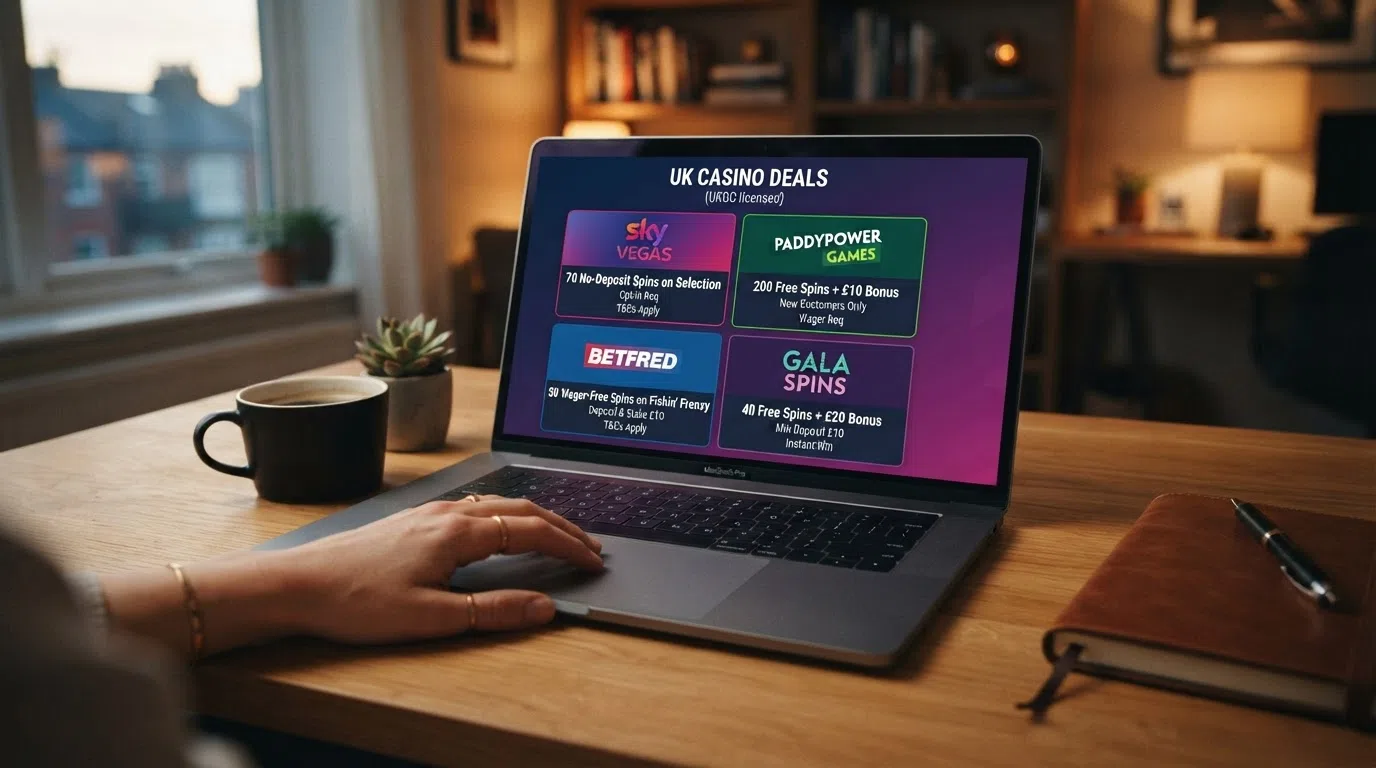
| Operator | UKGC Licence | Welcome Offer | Wagering | Deposit-free? | Spin Value | Game Providers |
|---|---|---|---|---|---|---|
| Sky Vegas | Active (public register, 29 Jul 2026) | 70 no-deposit spins + 200 spins on £10 stake | No wagering | Yes | £0.10 | NetEnt, Playtech, IGT, Blueprint, Pragmatic Play |
| bet365 Games | Account 55148, active | Up to 500 spins over 10 days | No wagering | No (lifetime deposit) | £0.10 (£50 max total) | NetEnt, Playtech, Games Global, Pragmatic Play |
| Betfred Casino | Active | Stake £10, get 200 spins | No wagering | No | £0.10 | Playtech, NetEnt, IGT, Blueprint, Pragmatic Play |
| Ladbrokes Casino | Active | Deposit + spend £10, get 100 spins | 10× on bonus funds | No | £0.10 | Playtech, NetEnt, IGT, Blueprint, Pragmatic Play |
| Paddy Power Games | Active | 60 no-deposit spins + 200 spins on £10 wager | No wagering | Yes | £0.10 | Playtech, NetEnt, Pragmatic Play |
| Coral Casino | Active | Deposit + wager £5, get £10 bonus + 100 spins | 10× on bonus | No | £0.10 | Playtech, NetEnt, IGT, Blueprint, Pragmatic Play |
| William Hill Vegas | Account 2752, active | 200 spins on Big Bass Splash | 10× on winnings, £30 max cashout | No | £0.10 | Playtech, NetEnt, Pragmatic Play, Evolution |
| 888casino | Active | 100% deposit match up to £100 | 10× within 90 days | No (£10 min deposit) | N/A (cash bonus) | NetEnt, Playtech, Pragmatic Play, Evolution |
| Gala Spins | Active | Deposit + spend £10, get 100 spins + £10 bingo | No wagering on spins, 2× on bingo | No | £0.10 | NetEnt, Playtech, IGT, Blueprint, Pragmatic Play |
| Virgin Games | Active | Welcome offer not confirmed this run | — | — | — | NetEnt, IGT, Eyecon, Blueprint, Pragmatic Play |
The shape of the table is the message. Eight of ten offers carry no wagering requirement on the free-spin winnings, which means whatever the spins pay is withdrawable as cash. Two (Ladbrokes and Coral) carry 10× wagering on bonus funds under the new LCCP cap. William Hill carries a £30 max cashout on free-spin winnings — the one visible ceiling in the set. 888casino is the outlier: a deposit-match bonus rather than a free-spin offer, and the only one a penny-slot player would evaluate on bonus-fund turnover rather than spin value.
Sky Vegas: 70 no-deposit spins with zero wagering
Sky Vegas opens the door without asking for a deposit. The welcome package is 70 free spins on registration, followed by 200 more once you deposit and stake £10. Wagering on the winnings is zero — whatever the spins pay, you keep.
The spin value is £0.10, which puts each of the 70 no-deposit spins at £7 of slot value, and the full 270-spin package at £27. The no-deposit spins expire after 7 days; the deposit-triggered spins need the £10 stake to be made within 30 days. The game-provider roster is broad — NetEnt, Playtech, IGT, Blueprint, Pragmatic Play and others — so the bonus can be used on most of the penny-slot shortlist.
For a penny-slot player, the relevant comparison is between 70 free spins at £0.10 and the cost of buying those spins yourself at £0.20 each. Seventy free spins at the operator’s stake size is £7 of play; the same seventy spins at a 20-payline configuration would be £14. The marketing word “free” lands harder here than at most competitors, because the wagering-free structure means the winnings are real cash from the first spin.
Paddy Power Games: 60 no-deposit spins plus 200 more after deposit
Paddy Power’s package splits into two batches. The first 60 spins require no deposit — 50 on selected slots, 10 on Paddy’s Mansion Heist. The second batch of 200 spins unlocks once you deposit and wager £10. Wagering on the winnings is zero across both batches.
The spin value is £0.10, and the claim window is 7 days from when the spins are credited. The provider range — Playtech, NetEnt, Pragmatic Play and others — covers most of the penny-slot shortlist, though the specific games for the no-deposit spins are narrower than the post-deposit batch.
The structure is similar to Sky Vegas: no-deposit spins first, then a deposit-gated top-up, with zero wagering on winnings. The headline number (60 versus 70) is slightly smaller; the value per spin is identical; the post-deposit batch is the same 200. For a player who only wants the no-deposit entry, Paddy Power is the same shape of offer as Sky Vegas with a smaller first batch.
bet365 Games: up to 500 free spins across 10 days with no wagering
bet365’s welcome structure is the highest-volume free-spin offer in the set: up to 500 spins distributed as 5 to 50 random spins per day over 10 days, with no wagering on winnings. The catch is in the distribution — you do not know on any given day how many spins you will receive, and the total has a maximum value of £50 (500 × £0.10).
To qualify, you must have made lifetime deposits of at least £10. The spins must be used within 7 days of being issued, and the full offer expires 30 days after registration. The bonus slot list includes Book of Horus, Curse of the Bayou, Magic Forge and Wrath of the Deep — titles that are not always on the penny-slot shortlist but are eligible here.
The £50 ceiling on total spin value is the trade-off. A player who lands the maximum 500 spins gets £50 of slot play with zero wagering; a player who lands the minimum 50 spins gets £5. The expected value depends on the random distribution, which the operator sets. The headline figure is the ceiling, not the guarantee.
Betfred Casino: 200 free spins for a £10 stake with no wagering
Betfred’s offer is the cleanest deposit-gated structure in the set: stake £10 on slots, receive 200 free spins with zero wagering on the winnings. The spin value is £0.10, the £10 stake must be completed within 14 days of registration, and a debit card deposit is required to qualify.
The provider range — Playtech, NetEnt, IGT, Blueprint, Pragmatic Play and others — covers most of the penny-slot shortlist. The terms are short: one stake, one batch of spins, no wagering, 14-day window. There is no max-cashout cap stated, no second deposit requirement, and no game restriction beyond the provider’s standard selection.
For a penny-slot player willing to stake £10, Betfred is the most straightforward exchange in the table: £10 in, 200 spins at £0.10 each (£20 of slot value) with whatever the spins pay withdrawable as cash.
Gala Spins: 100 free spins plus a £10 bingo bonus for a £10 deposit
Gala Spins runs a hybrid offer: deposit £10 and spend £10 on slots, and you receive 100 free spins plus a £10 bingo bonus. The free spins carry no wagering; the bingo bonus carries 2× wagering. The spin value is £0.10, and both elements expire after 7 days.
The structure works for a slots-and-bingo player who would use the bingo bonus anyway. The £10 bingo bonus at 2× wagering is a light condition — £20 of bingo stake to clear it — and the 100 free spins are the same shape as the other no-wagering entries in the table.
For a player who only wants slots, the bingo half of the offer is irrelevant. The relevant comparison is the 100 spins at £0.10 with no wagering (£10 of slot value) against the other £10-deposit entries in the table. Betfred and Ladbrokes both give 100 or more spins for the same deposit; Gala Spins adds a bingo leg that a slots-only player can leave on the table.
Ladbrokes Casino: 100 free spins with the new 10× wagering floor
Ladbrokes’ offer sits at the statutory wagering ceiling. Deposit and spend £10 on slots and you receive 100 free spins at £0.10 each — but the bonus funds carry a 10× wagering requirement, the maximum allowed under the LCCP social responsibility code that took effect on 19 December 2025.
The wagering applies to bonus funds rather than to free-spin winnings directly. The acceptance window is 48 hours; the spins are valid for 7 days once accepted. The provider range is the standard Entain portfolio — Playtech, NetEnt, IGT, Blueprint, Pragmatic Play.
The 10× wagering requirement is the new industry ceiling. Under the old terms it would not have been notable; under the new cap it is the most a UK-licensed casino can ask. A player evaluating Ladbrokes alongside Betfred is comparing 100 spins with 10× wagering on the bonus against 200 spins with zero wagering. The headline spin count favours Ladbrokes; the terms favour Betfred.
Coral Casino: £10 bonus plus 100 free spins for a £5 stake
Coral carries the lowest deposit barrier in the set: deposit £5 and wager £5 on slots, and you receive a £10 bonus plus 100 free spins. The bonus carries 10× wagering; the free-spin winnings are withdrawable immediately without wagering. The spin value is £0.10.
The structure is a hybrid: cash bonus + free spins, with the spins treated more favourably than the bonus funds. A player who treats the £10 bonus as the main feature needs to wager it through 10× (£100 of qualifying stakes) before withdrawing; a player who treats the 100 spins as the main feature gets £10 of slot value with no wagering on the winnings.
For a player with a small starting bankroll, the £5 entry point is the relevant comparison against the £10 entries elsewhere in the table. Coral is the cheapest door in.
William Hill Vegas: 200 free spins on Big Bass Splash with a £30 cashout cap
William Hill’s offer has the most visible ceiling in the set. Deposit and stake £10, receive 200 free spins on Big Bass Splash at £0.10 each. The free-spin winnings carry 10× wagering, and the maximum cashout from those winnings is capped at £30.
The ceiling matters because it limits the upside of a winning spin run. A player who hits a strong sequence on Big Bass Splash during the free-spin round could see their winnings reduced to the £30 cap before withdrawal. The 10× wagering requirement is the LCCP ceiling; the £30 cap is specific to this offer. The spins are credited within 72 hours of the qualifying stake and must be triggered within 7 days of deposit.
The trade-off is volume versus ceiling. William Hill offers 200 spins — twice as many as Coral’s 100 — but with both a wagering requirement and a cashout cap. A player who expects a small return from the spins is unaffected; a player who hits a large return loses everything above £30.
888casino: a 100% deposit match up to £100 — the cash-bonus outlier
888casino is the only deposit-match offer in a field of free-spin packages. First deposit matched 100% up to £100, with 10× wagering on the bonus within 90 days and a £100 maximum cashout. Minimum deposit £10.
For a penny-slot player, the relevant question is what a £100 bonus at 10× wagering means at 20p a spin. The wagering requirement is £1,000 of qualifying slot stake — 5,000 spins at £0.20 each, or about three and a half hours of play under the 2.5-second spin floor. The expected loss across those 5,000 spins at 96% RTP is about £40; the bonus pays £100 minus that £40 of expected loss, leaving a net expected value around £60 if the player can complete the wagering without exhausting their bankroll.
The £100 max cashout caps the upside at the same figure as the bonus ceiling. The 90-day window is the longest in the set. The cash-bonus structure suits a player with a larger bankroll who would rather run 5,000 spins than chase free-spin offers.
Virgin Games: the demo-first operator with a welcome offer to verify
Virgin Games’ strength is not its welcome offer — which the research run did not confirm — but its demo library. More than 900 slots are available in demo and real-money mode, across a provider range that includes NetEnt, IGT, Eyecon, Blueprint and Pragmatic Play.
For a penny-slot player, the relevant comparison is the breadth of the demo catalogue rather than the bonus headline. A site that lets you load 900 titles in demo mode is a site where you can compare volatility profiles, test bonus features, and find the games whose math you like before committing a deposit. That is the operator’s distinctive offer to a penny-slot audience, and it sits alongside whatever welcome package the site is running this month.
Players should check the operator’s own promotions page for the current welcome offer, as the specific terms were not confirmed in the research underlying this review.
The legal framework that protects UK penny slots players
Five rules shape every penny-slot session at a GB-licensed casino, and they are all statutory rather than voluntary.
The stake cap. SI 2025/215 imposed an age-banded maximum stake per game cycle: £5 for players aged 25 and over (in force 9 April 2025) and £2 for players aged 18 to 24 (in force 21 May 2025). The cap applies to total stake within a cycle, regardless of payline count. Two adults at the same casino face different maximum bets on the same slot.
The game-design rules. Since 31 October 2021, auto-play is banned, spin speed must be at least 2.5 seconds per cycle, features designed to speed up play are banned, losses disguised as wins are banned, and reverse withdrawals are permanently banned. Operators must display total losses, total wins and total time played during a slots session.
The credit-card ban. Since 14 April 2020, credit card payments have been prohibited for all remote gambling in Britain, including e-wallet payments funded by credit cards.
The wagering cap. From 19 December 2025, wagering requirements on bonuses are capped at 10×, and mixed-product promotional offers are banned. No UK-licensed casino can require more than ten times the bonus amount in qualifying stakes.
The identity-verification requirement. Since 7 May 2019, a GB remote licensee must verify a customer’s name, address and date of birth before they can deposit or gamble. Anonymous play at a British-licensed site has not been possible for seven years.
Together these rules define the British penny-slot environment. They are not present at unlicensed sites, and their absence is the most concrete difference between a GB-licensed casino and an offshore one.
UK Gambling Commission licensing: what it means for your penny-slot session
The UKGC is the regulator. It licenses operators, personnel and software under the Gambling Act 2005, and it publishes a public register of licence holders that any player can search. The three licensing objectives — preventing crime, ensuring fair and open gambling, and protecting children and vulnerable persons — are the test against which every operator’s systems are measured.
The point-of-consumption rule, introduced by the Gambling (Licensing and Advertising) Act 2014, means that any operator serving GB customers must hold a UKGC licence regardless of where the operator is based. A Gibraltar-registered company running a casino for British players needs a GB licence to do it legally. The licence comes with the LCCP and the RTS — the Licence Conditions and Codes of Practice and the Remote Technical Standards — which set out the game-design rules, the bonus rules, the advertising rules and the responsible-gambling infrastructure.
A Gibraltar, Malta or Curaçao licence is not a substitute. Those regimes have their own standards, but they do not include GAMSTOP, the British complaints route, ADR access, the stake cap, the spin-speed floor, the 10× wagering cap, or the identity-verification gate that British-licensed operators apply. A player at an offshore site has none of these protections. Section 33 of the Gambling Act 2005 makes the provision of unlicensed gambling facilities a criminal offence; the penalty falls on the operator, but the player loses the British safety net.
GAMSTOP, deposit limits and the tools that come with a UK licence
The responsible-gambling infrastructure at a GB-licensed casino is mandatory, not optional.
GAMSTOP is the national multi-operator online self-exclusion scheme. Participation has been mandatory for all GB-licensed online operators since 31 March 2020. A player can self-exclude for six months, one year, five years, or five years with auto-renewal. The exclusion cannot be cancelled early. It covers every GB-licensed online site — not the unlicensed ones.
Deposit limits are customer-set, but the offer is mandatory. From 31 October 2025, operators must prompt every new customer to set a financial limit before their first deposit. A decrease in the limit must be actioned immediately. A standardised gross deposit limit, based solely on money paid in, must be offered with at least equal prominence.
Financial vulnerability checks are mandatory at a £500 net deposit in a rolling 30-day period from 30 August 2024, dropping to £150 from 28 February 2025. The check uses publicly available data (county court judgments, bankruptcy orders, individual voluntary arrangements, debt relief orders) and is not a credit check. It triggers a player interaction when the threshold is crossed.
Reality checks and time-outs are standard tools. A reality check is a pop-up reminder of time and money spent during a session; a time-out is a short cooling-off period that blocks play for a defined window. Both are built into the licensed slot interface.
Playing penny slots at offshore sites: the risks a UK licence removes
An offshore site — one without a UKGC licence — can offer a higher stake, faster spins, credit-card deposits, anonymous play, and a bonus with a 50× wagering requirement. It can also offer none of the British protections: no GAMSTOP coverage, no ADR, no Commission complaints route, no British redress if funds are withheld.
The UKGC’s enforcement against unlicensed sites is disruption-based rather than ISP-blocking. Between April 2024 and June 2025 the Commission issued 3,140 disruption notices, referred 447,778 URLs to search engines for delisting, and achieved the removal of 287,961 URLs, with an average 32% fall in engagement across 160 disrupted sites. Legislation for court-ordered blocking has been proposed but not enacted.
Section 33 of the Gambling Act 2005 carries up to 51 weeks’ imprisonment, an unlimited fine, or both for the operator. The player does not face a penalty for gambling at an unlicensed site. The cost is the loss of the protections a British licence provides — and that loss is the difference between a complaint route that goes to the Commission and a complaint route that goes nowhere.
Staying in control: responsible gambling on low-stakes slots
Low stakes do not mean low risk. The NHS Adult Psychiatric Morbidity Survey 2023–24 found 0.4% of adults experienced problem gambling (PGSI 8+), 1.6% experienced at least moderate risk (PGSI 3+), and prevalence was highest among 25–34 year olds at 3.5%. The Gambling Survey for Great Britain found 47% of adults had gambled in the past four weeks. The penny-slot player is inside those numbers, and the protections that apply to higher-stakes play apply to them too.
The National Gambling Helpline (run by GamCare on 0808 80 20 133, 24/7) made 996 referrals to treatment in January 2026, up 48% on January 2025. Between April 2024 and March 2025, the National Gambling Support Network treated 11,960 clients across Great Britain, an 11% increase on the year before. The statutory levy that funds the treatment system — 1.1% of gross gambling yield on remote casino, remote bingo and remote software licences — has been in force since 6 April 2025, with proceeds split 50% to treatment (NHS), 30% to prevention (OHID) and 20% to research (UKRI).
The operator-side tools — GAMSTOP, deposit limits, reality checks, time-outs, financial vulnerability checks — are mandatory at every GB-licensed casino. The statutory levy funds the treatment side. The gap between the two is the help available to a player who decides the tools are not enough.
Setting deposit and loss limits: the mandatory tool every UK player has
The deposit-limit prompt, mandatory since 31 October 2025, is the most concrete player-protection tool at a GB-licensed casino. Every new customer must be prompted to set a financial limit before making their first deposit. A decrease in the limit takes effect immediately; an increase has a cooling-off period.
A limit set before the first spin is a different decision from one set after a losing session. The first is made from a clear head, in a quiet moment, with no stake at risk. The second is made in the middle of play, with the day’s losses on the balance display and the adrenaline of a close session in the background. The mandatory prompt exists because the first decision is reliably better than the second.
The standardised gross deposit limit, based solely on money paid in rather than net deposits, must be offered with at least equal prominence. The original implementation date of 30 June 2026 has been extended to 30 September 2026.
Reality checks, time-outs and session tracking: the tools built into the interface
Every GB-licensed slot must display total losses, total wins and total time played during a session. The display is not a marketing overlay — it is a regulatory requirement. A player who loads a slot at a British casino sees their session maths on the screen while they play.
Reality checks are pop-up reminders that interrupt play at defined intervals to show time elapsed and money spent. Time-outs are short cooling-off periods that block play for a defined window — 24 hours, a week, a month. Both are built into the licensed interface.
The 2.5-second spin floor is itself a harm-reduction measure. A spin every two and a half seconds is a slower pace than a spin every second. Over a session of 500 spins, the difference is roughly ten minutes — ten minutes during which the player has time to register each outcome, time to check their balance, time to decide whether the next spin is the one they want to make.
Self-exclusion and support: GAMSTOP, GamCare and the NHS
The escalation path runs from a customer-set deposit limit, through a session-level reality check, through a time-out, to GAMSTOP self-exclusion and formal treatment.
GAMSTOP exclusion periods are six months, one year, five years, or five years with auto-renewal. The exclusion cannot be cancelled early. It covers every GB-licensed online site. It does not cover unlicensed sites, which is why the offshore section above matters: a player who self-excludes at a GB-licensed casino can still reach an offshore site that does not participate in the scheme.
The National Gambling Helpline (0808 80 20 133, 24/7) handles more than 52,000 calls per year. The National Gambling Support Network treated 11,960 clients in 2024–25. NHS gambling harm clinics operate in England, Scotland and Wales. Gamblers Anonymous runs peer-support groups. GambleAware funds the prevention and treatment infrastructure. The statutory levy underwrites the whole system.
For a player who has decided the tools are not enough, the helpline is the first call. For a player who is not sure, the reality check is the first prompt. The two sit at different points on the same path.
How we selected and ranked the UK’s best penny slots casinos
The ten operators in the table above were selected on five criteria, in this order of priority.
UKGC licence status. Every operator must appear on the Gambling Commission’s public register with an active licence. The register was last updated on 29 July 2026; the entries above were verified against that update. This is the threshold condition: an unlicensed operator is not eligible regardless of any other factor.
Welcome-offer terms. The 10× wagering cap that came into force on 19 December 2025 means every offer in the set operates at or below the statutory ceiling. No-wagering free-spin offers are ranked above wagering-bearing offers at the same spin volume. Deposit-free entry points are ranked above deposit-gated ones.
Game-provider breadth. Penny slots come from a known set of studios. Operators that carry Play’n GO, NetEnt, Pragmatic Play, Eyecon and at least one progressive-jackpot provider score above operators that do not.
Spin value and volume. The £0.10 spin value is standard across the set. The headline spin count is the next comparison; the effective value (spin count × spin value) is what the offer is actually worth.
Demo availability. Virgin Games’ 900+ demo library is a distinguishing feature for a player testing titles before committing. Other operators in the set offer demo mode but do not publicise the catalogue size.
The slot-title shortlist is narrower. Only titles with published, verifiable RTP figures appear in the RTP-backed shortlist. Titles whose RTP is not in the research are not included. The selection is not an exhaustive market survey — it covers the titles the research confirmed, from the providers with the strongest UK presence.
The bottom line on UK penny slots: what to actually do
The arithmetic is plain. A £20 deposit at a 20-payline penny slot (£0.20 per spin) buys 100 spins. At 96% RTP, the expected loss across those 100 spins is about 80p. At the 2.5-second spin floor, 100 spins is roughly four minutes of play. The session costs less than a coffee and lasts about as long.
Three things follow from the numbers. First, penny slots are an entertainment purchase, not an income strategy. The house always has an edge, and the edge does not shrink because the stake is small. Second, the welcome offer that suits a penny-slot player best is the no-deposit spins with no wagering — Sky Vegas and Paddy Power Games both offer this structure, and both let a player run real-money spins without risking their own deposit. Third, the single highest-value action any UK player can take before loading a penny slot is to verify the operator’s UKGC licence on the public register, set a deposit limit before the first spin, and check the game’s RTP on the paytable.
The British penny-slot market is well-regulated, well-documented, and well-supplied with free-play entry points. A player who treats it as entertainment, picks the highest-RTP titles they can find, sets a limit before they start, and stays within it gets what the format offers. A player who treats it as anything else gets what the house edge delivers.
Frequently asked questions about penny slots in the UK
Can you really play slots for 1p per spin in the UK?
Not exactly. A penny slot lets you set the stake per payline at £0.01, but most games run 10 to 50 paylines, so a full spin costs between £0.10 and £0.50 when every line is active. The 1p figure is the per-line minimum, not the cost of a complete spin.
Are online penny slots genuinely fair and what payout percentage should I expect?
At a UK-licensed casino, every slot runs on a certified random number generator and publishes its return-to-player percentage. Popular penny slots range from about 88% RTP (Mega Moolah’s base game) to about 97% (Dead or Alive at 96.82%), with most established titles sitting in the 95% to 96.5% band. The RTP is a long-run average, not a session guarantee.
What is the maximum you can win on a penny slot machine?
The published max-win multipliers range from 500x stake on Starburst to 21,175x on Sweet Bonanza, with progressive jackpots on Mega Moolah and Divine Fortune offering life-changing sums. The hit rate on any of these is low; the max-win figure is the ceiling, not the expectation. A 1p spin that does not meet the progressive jackpot’s minimum qualifying bet does not enter the jackpot draw at all.
Can I play penny slots on my mobile phone in the UK?
Yes. Every slot at a UK-licensed casino runs in a mobile browser without an app or download, and most operators also offer native iOS and Android apps. The same stake caps, the same 2.5-second spin floor, and the same identity-verification requirement apply on mobile as on desktop.
What is the maximum stake per spin on UK online slots in 2026?
£5 per game cycle for players aged 25 and over, and £2 per game cycle for players aged 18 to 24, under SI 2025/215. The cap applies to the total stake within a single cycle, not per payline. The age band means two adults at the same casino can face different maximum bets on the same slot.
Can a 1p spin trigger a million-pound payout?
Only if the spin carries the progressive jackpot’s minimum qualifying stake. A 1p-per-line spin on a 50-payline game costs £0.50, which is below the minimum bet most progressive jackpots require to enter the draw. The odds of hitting the jackpot once you are in the draw are roughly one in ten million. The “1p spin wins a million” headline describes a scenario that requires both the qualifying stake and the long-shot outcome.
Slots – realmoney-onlinecasinos-uk
Content created by the «realmoney-onlinecasinos-uk» team