
The Safest UK Online Casinos — A Licence-First Ranking
 Available in GB
Data current as of September 8, 2026 · Licence claims verified against the UK Gambling Commission public register

The safest online casino in the UK is whichever one holds an active UKGC licence and lives up to the conditions that licence carries. That is the whole thesis of this page, and the rest of it is unpacking what those conditions actually mean in pounds, in seconds, in time-out windows and in the documents a casino asks for before it pays you out. Every operator below is licensed by the UK Gambling Commission. The ranking that follows is built on the licence first, the bonus terms second, and the technical safeguards third. A flashy welcome offer from an unlicensed site is not a deal. It is a way to lose your deposit and your consumer protections in one transaction.
The UK online casino market is not small. Total online gross gambling yield in Q1 2026 came in at £1.55 billion, with slots GGY up 12% year-on-year. That is a meaningful chunk of the British economy moving through a tightly regulated channel, and the regulatory layer is what separates it from the offshore alternative. A UKGC-licensed casino is not safer by marketing. It is safer by statute, by audit, by enforcement record, and by the set of tools it is required to hand you before you spend a pound.
The UKGC Licence: Why It Is the Only Safety Guarantee That Counts
The UK Gambling Commission is the single statutory regulator for commercial gambling in Great Britain. A UKGC licence guarantees strict player protection, covering everything from fair gaming and secure payments to identity checks, data security, and responsible gambling tools. That sentence is the backbone of every safety claim that follows on this page, and it is worth understanding where it comes from before the rest of the rankings make sense.
The Commission operates under three licensing objectives written into the Gambling Act 2005: preventing gambling from being a source of crime, ensuring gambling is conducted fairly and openly, and protecting children and other vulnerable persons. Every condition on every UKGC licence traces back to one of those three lines. The stake cap on slots protects the vulnerable. The RNG certification requirement ensures fairness. The identity verification rule keeps crime out. The Commission does not have to invent new rules for new products; it applies the same three objectives and watches how the market bends around them.
The 2014 point-of-consumption reform closed the offshore loophole. Before 2014, an operator could sit in another jurisdiction and serve British customers without a GB licence. After 2014, no operator may offer remote gambling to GB customers without holding a UKGC operating licence. An MGA licence or a Curaçao licence is not a substitute. If a casino is serving British customers from a server in Malta, it still needs the UKGC licence to do so. The Commission enforces this through disruption: between April 2024 and June 2025 it issued 3,140 disruption notices and referred 447,778 URLs to search engines for delisting. It does not have statutory ISP blocking power, so the leverage comes from making unlicensed sites hard to find.
A licence in Great Britain is not a UK-wide credential. The UKGC covers England, Scotland and Wales. Northern Ireland operates under separate, older legislation. For a player in Belfast, the regulatory map is different. Everything on this page applies to a player in London, Manchester, Edinburgh or Cardiff.
What a UKGC Licence Actually Guarantees — and What It Does Not
A licence is not a promise that you will win, and it is not a guarantee that the site will never have a technical fault. What it guarantees is a baseline of enforceable rules that an offshore site is under no obligation to follow.
The first safety gate is identity verification. Since 7 May 2019, every UKGC-licensed operator must verify your name, address and date of birth before you make a deposit or place a bet. A site that lets you play for money without checking who you are is unlicensed. The verification has to happen before any deposit, including one funded by a bonus or free bet. The rule is not a polite request; it is a licence condition.
Player funds sit in segregated accounts. The Commission requires licensees to hold customer money separately from operating capital, and the level of protection — basic, medium, or high — depends on how the operator segregates and which arrangements sit behind that segregation. Medium protection is the standard the Commission has been pushing operators toward: customer funds held in a separate UK bank account, with the operator’s own funds visibly distinct.
The game-design rules reshape what a slot actually looks and feels like. Since 31 October 2021, auto-play is banned, spin speed may not exceed 2.5 seconds per game cycle, losses disguised as wins are banned, and reverse withdrawals are permanently banned. The last one matters more than it sounds. A reverse withdrawal is the option to cancel a cashout and put the money back into play. Banning it removes the moment where a player about to walk away is offered one more spin on the house’s money. That single ban has probably saved British slots players more than any stake cap.
The online slots stake cap sits at £5 per game cycle for players aged 25 and over, and £2 for players aged 18 to 24. The age banding is deliberate, and it is the sharpest UK-specific safety measure. A 24-year-old on the same slot at the same casino, on the same evening, can stake a maximum of £2 while a 25-year-old can stake £5. The regulator decided the under-25 cohort carries more risk and priced the difference into the stake. Most competitor pages miss this entirely.
What a licence does not cover: it does not certify the operator as profitable, it does not insure your deposits, and it does not adjudicate marketing disputes. If a bonus term feels unfair, the route is the operator’s complaints process, then an approved alternative dispute resolution provider — not the Commission itself.
Encryption, Data Protection and the Technical Side of Casino Security
A padlock in the address bar means the connection between your browser and the casino’s server is encrypted. The technical standard is TLS 1.2 or higher, with TLS 1.3 increasingly common. The padlock is a starting line, not a finish line. Without TLS, anything you send — login credentials, card details, documents for KYC — would travel in plaintext. The encryption is what stops the café Wi-Fi attacker from reading your session.
Payment data carries its own standard. PCI-DSS is the Payment Card Industry Data Security Standard, and any operator that processes debit card payments has to meet it. PCI-DSS covers how card data is stored, transmitted, and accessed. The standard is not a UKGC invention, but the UKGC requires compliance as a condition of operating, and the bank’s own fraud-detection systems add a second layer on top.
Two-factor authentication is increasingly standard. A password alone is one factor; a code sent to your phone or generated by an authenticator app is the second. PSD2 Strong Customer Authentication requires two-factor confirmation on every deposit at a UK-regulated gambling site, which is why every deposit now pops up a bank-side confirmation prompt. SCA is not a casino feature; it is a regulatory requirement built into the payment flow.
The UKGC’s Remote Technical Standards are the rulebook every game on a UK-licensed site has to follow. RNG certification, game logic, server security, and live-dealer studio standards all sit inside RTS. Approved test houses — eCOGRA, iTech Labs and G.L.I. — are the laboratories that audit each game and submit a test report before it is released. A seal from one of those three on a casino’s footer means a real report exists, and the report can be verified on the test house’s own website.
Real-Money Play: Why UK-Regulated Casinos Are Safer Than They Look
The fear that brings most readers to a page like this is concrete. Rigged games. Stolen deposits. Operators that vanish. Each of those fears has a specific answer inside the UKGC framework, and the answer is enforceable rather than aspirational.
Rigged games are blocked at the testing layer. An operator cannot release a slot or a table game until an approved test house has certified the RNG and the game logic against the Remote Technical Standards. The certification is not a one-time stamp. Game providers have to maintain it across updates, and the operator carries the obligation to keep the certificates current. A rigged game cannot legally reach a UKGC-licensed site because the gate it would have to pass is staffed.
Stolen deposits are blocked at the segregation and verification layers. Customer funds sit in a separate account, identity is verified before the deposit goes through, and the payment processor runs its own fraud checks. The combined effect is that a stolen card or a compromised password does not automatically empty an account. The verification step is also the recovery step: a verified identity is the basis on which a disputed deposit is reversed.
An operator that vanishes is the simplest case. The Commission maintains a public register. A licence is either active, suspended or surrendered. A casino that surrenders its licence is required to honour outstanding customer balances, and the Commission will supervise the wind-down. The public register is what tells you whether the operator you are about to deposit with still has the legal standing to take your money.
UK Gambling Laws: What the 2005 Act and Its Reforms Mean for Your Play
The Gambling Act 2005 is the foundation, but it is not the finished building. The Act set the three licensing objectives, established the Commission, and gave it the power to attach conditions to licences. Every reform since has been a tightening of that framework, and the post-2020 cascade has been particularly aggressive.
The 2014 point-of-consumption reform is the hinge. Before 2014, a UK-facing operator needed a licence in its home jurisdiction. After 2014, it needed a UKGC licence to serve British customers. The change is what made the UK market the most tightly regulated remote gambling market in the UK. A site that serves British customers without a UKGC licence is committing a criminal offence under section 33 of the Gambling Act 2005 — up to 51 weeks’ imprisonment, an unlimited fine, or both. The penalty is on the operator, not the player.
The post-2020 reforms stack up quickly. Credit card gambling was banned from 14 April 2020. The 10× wagering cap on bonuses came in on 19 December 2025, alongside the ban on mixed-product promotions. The online slots stake cap landed in two stages in 2025: £5 for 25+ from 9 April 2025, and £2 for 18–24 from 21 May 2025. The statutory levy on remote operators started on 6 April 2025 at 1.1% of gross gambling yield, funding treatment, prevention and research. Each reform tightened one specific hole.
The Commission has no statutory power to block ISPs from hosting unlicensed sites. Enforcement is disruption-based: cease-and-desist notices, search-engine delisting, payment-provider pressure, and domain suspension. The 447,778 URLs referred to search engines between April 2024 and June 2025 is what that looks like at scale. It is not the same as making unlicensed sites unreachable. It is making them harder to find and harder to pay through.
The UKGC Register: How to Verify Any Casino Licence in Under a Minute
The single most empowering safety tool a UK player has is free and takes under a minute. It is the public register at gamblingcommission.gov.uk/public-register. Every operator on this page was checked against it before it was listed.
Open the register, search the operator name or account number, and read the result. The entry shows the licence type, the activities it covers, and the status. “Active” means the licence is in force. “Suspended” means the Commission has paused it — usually during an investigation. “Surrendered” means the operator gave it back. A site that quotes a UKGC account number that does not appear on the register is either unlicensed or quoting someone else’s number. Both are red flags.
The five operators whose UKGC account numbers were confirmed this run are worth knowing as worked examples. bet365 sits at Account 55149 under Hillside (UK Gaming) ENC, with remote casino active from 17 October 2019. Sky Vegas is Account 065519 under Bonne Terre Gaming Limited, part of Flutter Entertainment, active since 2014. William Hill is Account 39225 under WHG (International) Limited, with Casino Remote active from 1 November 2014 — over a decade of continuous oversight. Ladbrokes is Account 54743 under LC International Limited, part of Entain. Betfair is Account 39435 under Flutter Entertainment. For the other five — Paddy Power, Coral, Betfred, Gala Bingo and 32Red — the UKGC licence is verified, although the specific account number was not isolated this run. They remain UKGC-licensed; the page did not surface the six-digit number. Each can be verified on the public register by name.
What Happens When You Play at an Unlicensed Site
The protections do not gradually thin at an unlicensed site. They vanish in one step. The moment a player deposits at a site without a UKGC licence, every safeguard described on this page is gone.
GAMSTOP does not cover the site. A player who has self-excluded through GAMSTOP and then deposits at an unlicensed site has no protection from the exclusion, because the unlicensed site is not a member. The exclusion blocks GB-licensed operators. It does not reach offshore brands. The UKGC complaints route disappears. If the operator withholds a withdrawal, the player has no British regulator to complain to. The approved alternative dispute resolution providers are UK-specific, and unlicensed sites do not sign up to them. The statutory stake caps vanish. There is no £5 or £2 limit at an offshore site because no statute applies. The 10× wagering cap vanishes. The auto-play ban, the spin-speed limit, the losses-disguised-as-wins ban, the reverse-withdrawal ban — every one of them is a UKGC condition, and not one of them binds an unlicensed operator. The credit card ban is the only protection that survives, and it survives only because the player’s own bank may decline the transaction, not because the casino is constrained.
The player is not committing a criminal offence. Section 33 of the Gambling Act 2005 targets the operator, not the customer. The penalty for the player is the loss of every consumer protection the British framework provides. The penalty is exactly the absence the rest of this page describes. The £1.55 billion online GGY figure for Q1 2026 measures the licensed market. Everything outside it is unregulated by design.
Choosing a Safe UK Casino: The Five Checks That Catch What a Logo Cannot
A UKGC badge in the footer is necessary. It is not sufficient. A footer logo is a piece of HTML that any website can paste in. The five checks below turn the logo from a claim into a verified fact, and each one takes less than five minutes.
The hierarchy is licence, then encryption, then independent testing, then payment methods, then reputation. The first check catches the dangerous sites — the unlicensed ones. The next three catch the licensed-but-careless ones. The fifth catches the licensed-and-bad ones, the operators whose own customers are warning other customers off.
The Five-Point Safety Check Every Player Should Run
- Check one — verify the UKGC licence on the public register. Do not trust a footer logo. Open gamblingcommission.gov.uk/public-register, search the operator name or account number, and confirm the licence is active and covers remote casino operations. Under a minute, and it catches the outright scams.
- Check two — confirm the padlock and the TLS certificate. Click the padlock in the address bar and read the certificate issuer. A valid certificate issued to the casino’s actual domain is the baseline. A certificate issued to a different domain, or no certificate at all, is a stop sign. A site accepting deposits without HTTPS is not a UKGC-licensed site.
- Check three — look for an eCOGRA, iTech Labs or G.L.I. seal and verify it. Those three are the UKGC-approved test houses most commonly displayed. The seal should link to a current certificate on the test house’s own website. A seal that does not link, or links to an expired certificate, is decorative.
- Check four — read the payment methods page before you deposit. Debit card and PayPal support is the expected baseline for a UK-licensed operator. Credit cards are banned — a site that lists them as a deposit method is unlicensed. e-wallets and bank transfer are common additions. The payment methods page is also where exclusions surface: bet365 excludes PaysafeCard from its welcome offer, Betfred excludes e-wallets. A site that lists only cryptocurrency is operating outside the GB-licensed framework.
- Check five — search independent user reviews, but read for the right complaint. Withdrawal complaints are the meaningful ones. A bonus complaint (“I didn’t get my free spins”) is operator error; a withdrawal complaint (“my withdrawal has been pending for three weeks”) is a structural problem. Forums, Trustpilot, and the operator’s own complaints history on the UKGC public register are all worth a few minutes. A pattern of withdrawal complaints is the warning sign no seal can hide.
Red Flags: What an Unsafe Casino Looks Like Before You Deposit
A red flag is information the operator is giving you by what it does not have. The absence of a UKGC licence number in the footer is the most obvious one. The next is a UKGC number that does not appear on the public register. Both are signs the operator is either unlicensed or borrowing a number from somewhere else, and both are stop signs.
No HTTPS padlock, or a TLS certificate issued to a different domain, is the second flag. The third is pressure to deposit before identity verification. A UKGC site must verify identity before any deposit, including bonus-funded deposits. A site that lets you deposit, play, and only asks for documents at withdrawal is failing the licence condition. A site that never asks is not licensed.
The fourth red flag is bonus terms that quote wagering above 10×. The 10× cap has been in force since 19 December 2025, and any bonus term quoting 20×, 30×, 40× or 60× is either from a non-GB site or from a pre-cap cached page. Bonus terms that omit wagering entirely are equally suspect. The statutory cap is a clear ceiling, and a licensed site is supposed to honour it.
The fifth is credit cards listed as a deposit method. The credit card ban has been in force since 14 April 2020, including credit-card-funded e-wallet payments. A site accepting credit cards is unlicensed, and unlicensed sites are a different category of risk from licensed ones. The five red flags above are all signs that the operator is either not licensed or not meeting the conditions of its licence. Either one is a reason to walk away.
The 10 Safest UK Online Casinos, Compared
Every operator below holds an active UKGC remote casino operating licence, verified on the public register at the time of research. The ranking puts licence first, bonus fairness second, and the safety features the operator layers on top third. The table is the comparison; the operator write-ups underneath it are what those rows mean in practice.
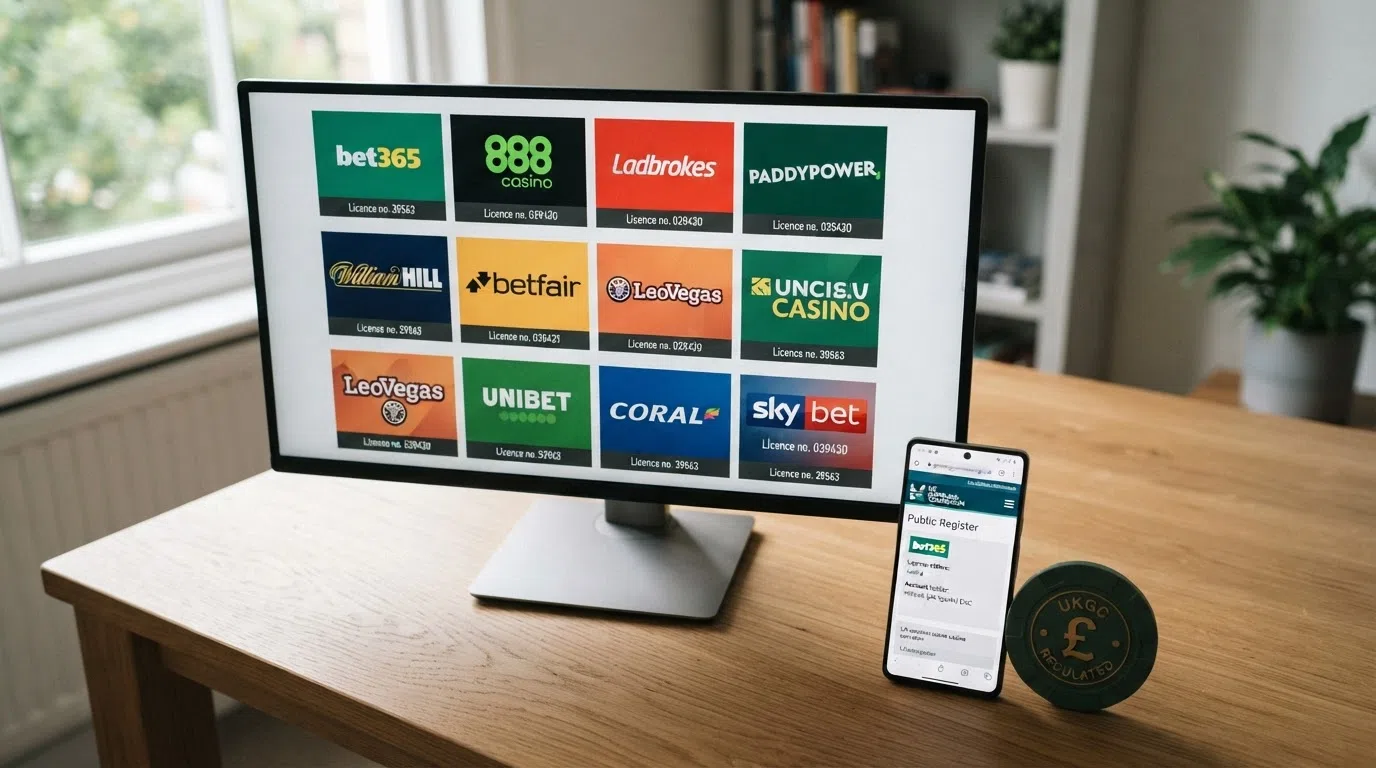
| Operator | UKGC Licence | Welcome Offer | Wagering on Free Spins |
|---|---|---|---|
| bet365 Games | Account 55149 — confirmed | Up to 500 free spins | 0× |
| Sky Vegas | Account 065519 — confirmed | 70 deposit-free + 200 on £10 deposit (270 total) | 0× |
| William Hill | Account 39225 — confirmed | Not confirmed this run | Subject to 10× cap |
| Ladbrokes | Account 54743 — confirmed | 100 free spins on £10 deposit and spend | Subject to 10× cap |
| Paddy Power | UKGC-licensed (Entain / Flutter) | 60 deposit-free + 100 on £10 deposit (160 total) | 0× |
| Coral | UKGC-licensed (Entain group) | 100 free spins on £10 deposit and bet | Subject to 10× cap |
| Betfred | UKGC-licensed | 200 free spins on £10 debit card deposit and stake | 0× |
| Gala Bingo | UKGC-licensed (Entain group) | 100 free spins on £10 deposit and spend | 0× |
| Betfair | Account 39435 — confirmed | 50 deposit-free + 100 on £10 deposit (150 total) | 0× |
| 32Red | UKGC-licensed (Kindred) | 320 free spins on £30 deposit and stake | 10× |
The wagering column is where the post-December 2025 landscape becomes visible.
Payment Methods and Safety Profile
| Payment Method | Primary Safety Feature | Best For | |
|---|---|---|---|
| Debit Card | Bank-grade fraud detection | General use | |
| PayPal | Account separation | Speed and privacy | |
| Bank Transfer | Direct transaction | High-stakes play | |
| Paysafecard | No bank linkage | Cash control | |
| Paysafecard | No bank linkage | Cash control | Six of the ten operators sit at 0× — every pound won on a free spin is a pound withdrawable, with no turnover requirement attached. Three sit at the statutory cap or below, with the specific figure not surfaced this run, which means they are bound by the 10× ceiling but did not quote a lower number. One operator — 32Red — sits exactly at 10×, which is at the cap rather than below it. The licence column is the entry criterion: every operator is in, and the specific account number is named where research confirmed it. |
What the table does not show is the spread in the deposit-free tier. Sky Vegas, Paddy Power and Betfair all offer deposit-free spins — the player registers and receives free spins with no payment required, no token deposit, no £5 that cannot be withdrawn. The remaining seven require a qualifying deposit or stake before the spins land. The deposit-free tier is a small marketing edge in headline terms, and a meaningful signal in safety terms, because the operator is absorbing the cost of the offer before the player has risked anything.
How We Evaluated Safety: The Criteria Behind the Ranking
The entry criterion is a UKGC remote casino licence, active at the time of research. No unlicensed operator appears on this page. The first filter is binary, and it catches the operators the rest of the criteria cannot help with.
The second criterion is bonus fairness measured against the 10× wagering cap. Zero-wagering offers score higher because they carry no hidden cost. The £1,000 in turnover a £100 bonus requires at 10× is a meaningful constraint; the £4,000 the same bonus would have required at 40× in the pre-cap era was, for a recreational player, effectively un-clearable. The cap is what turned UK casino bonuses from marketing obstacles into something closer to genuine value.
The third criterion is whether the operator offers a genuinely deposit-free tier. A no-deposit offer is an operator’s bet on its own product: it is willing to let a new player try the games without a deposit. An offer that calls itself “no deposit” but requires a £5 token payment that cannot be withdrawn is not the same. The genuinely deposit-free offers are the strongest signal of operator confidence in the product.
The data sources are the UKGC public register, the operators’ own terms and conditions, and the websites of the independent test houses — eCOGRA, iTech Labs and G.L.I. — to verify that any displayed seal corresponds to a current certificate. The page does not test deposits or withdrawals first-hand. It does not assign numerical scores. It does not rank operators outside the GB-licensed market. The comparison is qualitative and grounded in the public record.
bet365 Games — 500 Spins with No Playthrough Requirement and a Long UKGC History
bet365 Games sits at UKGC Account 55149 under Hillside (UK Gaming) ENC, with the remote casino licence active since 17 October 2019. The welcome offer is up to 500 free spins across multiple selections, with prizes of 5, 10, 20 or 50 spins per selection over 10 selections within 20 days, 24 hours between each. Wagering is 0× — every pound won on a free spin is a pound withdrawable. The 30-day validity is the window.
Two conditions narrow the offer. A deposit is required, and PaysafeCard deposits are excluded. The PaysafeCard exclusion is one of the few in the featured set: a player funding the account with a PaysafeCard voucher will not trigger the welcome offer. The eligible slots are Book of Horus, Curse of the Bayou, Magic Forge and Wrath of the Deep, and the free-spin value is not stated in the operator’s snippets — the page therefore does not state a per-spin figure for bet365.
The 500-spin headline is the largest in the featured set, and the 0× wagering makes it the largest cleanly. The trade is the deposit requirement. A player who wants a deposit-free entry point should look at Sky Vegas, Paddy Power or Betfair. A player who is going to deposit anyway gets the deepest spin bundle of the ten.
Sky Vegas — 70 Rounds Before Any Deposit, No Stake Required, Winnings Unlocked
Sky Vegas operates under UKGC Account 065519, held by Bonne Terre Gaming Limited as part of Flutter Entertainment, and has been active on the public register since 2014. The welcome offer splits into two tiers. The first 70 free spins land on registration, with no deposit, no stake and no payment method required. A further 200 free spins land after a £10 deposit and stake — 270 in total, all at 0× wagering and £0.10 per spin.
The 7-day free spin expiry applies to both tiers. The deposit-and-stake requirement for the second tier has 30 days to be met. The 12 eligible slots include Deal or No Deal Megaways, and the rest of the eligible list is on the operator’s site.
The deposit-free 70 is the most generous registration tier among the three operators that offer one (Sky Vegas 70, Paddy Power 60, Betfair 50), and it carries the same 0× wagering as the deposit-gated top-up. The combination — a real no-deposit entry, a sizeable deposit-gated extension, and zero playthrough on both — is what makes Sky Vegas the strongest deposit-free offer on this page.
William Hill — A UKGC Veteran Where the Licence History Speaks Loudest
William Hill sits at UKGC Account 39225 under WHG (International) Limited, with the Casino Remote licence active since 1 November 2014. Over a decade of continuous UKGC oversight is the licence history, and it is the safety story: an operator that has held an active remote casino licence through multiple enforcement cycles, multiple rule changes and a doubling of the slots stake cap is an operator that knows how to be licensed.
The welcome offer was not confirmed this run. The page states the gap rather than filling it. Current terms are on the William Hill promotions page, and the operator’s own T&Cs are the authoritative source. The absence of a confirmed offer is not a safety problem — William Hill’s licence is in good standing on the public register — but it does mean this write-up cannot tell the reader what they will receive for signing up. A player who values the licence history above the headline offer will find it here. A player who is choosing on the bonus terms alone will need to check the operator’s site directly.
Ladbrokes — 100 Free Spins Backed by Entain’s Compliance Machinery
Ladbrokes operates under UKGC Account 54743, held by LC International Limited as part of the Entain group. The welcome offer is straightforward: deposit and spend £10 on slots, and 100 free spins at £0.10 each land in the account. 48 hours to accept the offer once it is triggered, and 7 days to use the spins.
The relevant eligible games are not mentioned in our current data, and the wagering multiplier is not quoted — meaning it sits at or below the 10× statutory cap. The book on the offer is the Entain compliance infrastructure. Entain operates multiple UKGC licences and runs dedicated compliance teams across its brands. The same machinery that supports Ladbrokes supports Coral and Gala Bingo, which is why those three sit together in the Entain group.
A player who wants a clean, deposit-gated free-spin offer from a long-established high-street brand finds it here. A player who wants 0× wagering should look at the operators in the table that name it explicitly.
Paddy Power — 60 No-Deposit Spins: the Most Generous Deposit-Free Tier
Paddy Power is UKGC-licensed under the Entain / Flutter group; while the exact account number wasn’t retrieved this time, the licence status is confirmed. The welcome offer splits into two tiers: 60 genuinely deposit-free free spins on registration, and a further 100 free spins after a £10 deposit — 160 in total, all at 0× wagering and £0.10 per spin, with a 7-day validity on both.
The eligible slots are named: Fishin’ Frenzy, Eye of Horus, King Kong Cashpots, Deal or No Deal Megaways, and Paddy’s Mansion Heist. The deposit-free 60 is the broadest genuinely deposit-free tier among the featured operators on a per-spin-count basis, and it sits alongside Sky Vegas and Betfair in the no-deposit-first set. The 7-day validity is tight, and the eligible list is specific, which is why the terms page is worth reading before claiming.
A player who wants the largest deposit-free spin count and a named slot list finds it here. A player who values a confirmed account number on the public register will find it at Sky Vegas or Betfair.
Coral — a Hundred Spins on Deposit, an Entain Licence Behind Them
Coral is UKGC-licensed under the Entain group; while the precise account number was not captured in this audit, the licence status is confirmed. The welcome offer is deposit and bet £10 or more on slots, and 100 free spins at £0.10 each land in the account. 48 hours to accept the offer once it is triggered, and 7 days to use the spins.
We did not receive the specific eligible game list for this promotion, and the wagering multiplier is not quoted, which means it sits at or below the 10× statutory cap. The Coral offer is structurally similar to the Ladbrokes offer — same group, same £10 trigger, same 100 spins at £0.10, same time window. The book is the same: Entain’s group-level compliance machinery.
A player comparing Coral with Ladbrokes is comparing two offers from the same group, with the difference in eligible slots and the brand-specific promotions that sit on top. A player choosing between the two on welcome terms alone will find little to separate them.
Betfred — 200 Spins with No Turnover Obligation, Debit Card Only
Betfred is UKGC-licensed; while the exact account number for this operator wasn’t retrieved this time, the licence status is confirmed. The welcome offer is deposit using a debit card, stake £10 or more on slots, and 200 free spins land on selected titles at 0× wagering. The 7-day validity runs from the moment the spins are credited.
The payment-method restriction is the specific feature. e-wallets are excluded from this offer. A player funding the account with Skrill, Neteller or PayPal will not trigger the 200 spins. The debit-card-only restriction is also a safety signal in its own right, because the bank’s own fraud-detection and chargeback rights apply only to card-funded deposits, and the operator is asking the player to use the method that carries the most consumer protection.
Data regarding eligible games is missing from our current data source. The free-spin value is not stated. The 0× wagering is the headline, and the debit-card restriction is the part of the headline that does the work.
Gala Bingo — Wager-Free Spins from a Household-Name Operator
Gala Bingo is UKGC-licensed under the Entain group; while the specific account number wasn’t immediately surfaced in our recent scan, the licence status is confirmed. The welcome offer is deposit and spend £10 on slots, and 100 free spins at £0.10 each land in the account at 0× wagering. The 7-day validity runs from registration.
The eligible featured slots are not specified in the snippets. The 0× wagering is confirmed. The brand is one of the more familiar British names in the Entain portfolio, and the licence is the same group licence that supports Ladbrokes and Coral. A player choosing between the three is choosing on eligible slots and brand preference, not on safety — the licence infrastructure is shared.
Betfair — Two Tiers of Free Spins, Zero Wagering on Both
Betfair operates under UKGC Account 39435 as part of Flutter Entertainment, active on the public register. The welcome offer splits into two tiers: 50 genuinely deposit-free free spins on registration, and a further 100 free spins after depositing and playing £10 — 150 in total, all at 0× wagering and £0.10 per spin.
Information on the eligible games is not available in our current data. The bonus validity was not confirmed this run. The deposit-free 50 is the smallest of the three no-deposit-first offers (Sky Vegas 70, Paddy Power 60, Betfair 50), but the 0× wagering on both tiers and the confirmed UKGC account number make the offer structurally clean. A player who values the confirmed account number above the deposit-free spin count finds the cleanest account record here.
32Red — 320 Spins with the 10× Cap Applied: the Only Featured Operator That Wagers
32Red is UKGC-licensed under Kindred Group, operating as 32Red Limited; licence status is verified. The welcome offer is deposit and stake £30 on slots, and 320 free spins at £0.10 each land on Big Bass Splash. Wagering on free-spin winnings is 10× — the statutory maximum. Claim within 48 hours of qualifying, and the spins expire 30 days after claiming. Debit card or instant bank transfer is the only qualifying deposit method.
32Red is the only operator in the featured set whose bonus terms sit at the 10× cap rather than below it. The cap is the legal ceiling, and 32Red is using all of it. A £32 win (320 × £0.10) carries a £320 turnover obligation before withdrawal. The trade is the spin count: 320 is the largest in the featured set, and the wagering is at the legal limit rather than above it.
The 10× figure is itself a safety signal. Before 19 December 2025, the same offer would have carried 30×, 40× or 60× wagering at many operators. 32Red’s 10× is the post-cap normal, and the difference between the pre-cap norm and the post-cap ceiling is what the wagering reform was designed to close. A player who values spin count over zero-wagering cleanliness will find the largest bundle here. A player who refuses to wager at all will find 0× elsewhere.
Why Your Casino Bonus Is Smaller Than It Looks — and Safer for It
The 10× wagering cap that came into force on 19 December 2025 changed the shape of a UK casino bonus. A £100 bonus at 10× wagering costs £1,000 in turnover to clear, against £4,000 at the 40× that was the pre-cap norm for similar offers. The cap did not make bonuses bigger. It made them clearable, which is a different kind of improvement.
The pre-cap era of 30×, 40× and 60× wagering was the era of the bonus as a marketing obstacle. A casual player who claimed a £100 bonus at 40× would need to stake £4,000 before withdrawing any winnings derived from it. The probability of clearing that turnover on a typical slot RTP is low enough that the bonus effectively converted into a long, lossy play session. The 10× cap changed the math. £1,000 in turnover at a 96% RTP carries an expected loss of £40, against £160 at 40×. The bonus is now something a recreational player can actually clear, and the operator can no longer use the wagering figure as the hidden charge.
A worked example: a £50 bonus at 10× wagering means £500 in total stakes before the bonus winnings are withdrawable. At a 96% slot RTP, that £500 in turnover carries an expected loss of £20. The £50 bonus, less the £20 expected loss, leaves the player roughly £30 ahead on average — which is what a bonus is supposed to look like. At the pre-cap 40×, the same calculation: £2,000 in turnover, £80 expected loss, and the player is now £30 behind on a £50 bonus. The cap turned bonuses from negative-expectancy marketing into something closer to a fair trade.
The cap also banned mixed-product promotions. A casino bonus can no longer tie a player into a sportsbook. The bonus is on the casino product, and the wagering is on the casino product. A player who only wanted the slots offer is no longer required to bet on football to clear it.
The 10× Wagering Cap: Why Your Bonus Is Worth What It Says on the Tin
Wagering is the multiplier the operator applies to the bonus amount to calculate the total stakes required before withdrawal. A £50 bonus at 10× wagering means £500 in total stakes. A £50 bonus at 40× means £2,000. The cap is a single number — 10 — and it applies to every casino bonus a UK-licensed operator offers.
What counts towards wagering depends on the game. Slots typically contribute 100% — every pound staked counts as a pound towards the requirement. Table games often contribute less, sometimes nothing, because their RTP is higher and the operator’s exposure is correspondingly lower. A player who plans to clear a bonus on roulette rather than slots will find the wagering accumulates more slowly than the terms suggest.
The pre-cap comparison makes the reform visible. The same £50 bonus at 40× would have required £2,000 in stakes to clear. For a recreational player betting £0.10 a spin, that is 20,000 spins, or 27.7 hours of continuous play at the new 2.5-second minimum spin interval. The 10× cap reduced that to 5,000 spins and 6.9 hours. The bonus is now a session a player can reasonably complete, and the operator’s exposure is bounded enough that the offer can be generous.
Among the featured operators, six of ten offer 0× wagering on free-spin winnings — bet365, Sky Vegas, Paddy Power, Betfred, Gala Bingo and Betfair. Three sit at the 10× cap or below without a specific figure quoted — Ladbrokes, Coral, William Hill. One sits at exactly 10× — 32Red. The 0× offers are the gold standard; the 10× offers are at the legal limit. Anything above 10× in current UK terms is either offshore or from a cached pre-cap page.
No-Deposit Bonuses and Free Spins: What the Terms Reveal About Safety
A no-deposit offer is the cleanest test of an operator’s confidence. The operator is paying for the privilege of letting a new player try the games. A token-deposit offer — one that calls itself “no deposit” but requires a £5 payment that cannot be withdrawn — is a different thing, and the difference shows up in the T&Cs.
Genuinely deposit-free offers on this page are the 70 spins from Sky Vegas, the 60 from Paddy Power, and the 50 from Betfair. In all three, the spins land on registration, no money changes hands, and the winnings are withdrawable subject to the operator’s standard KYC. The terms are in the operator’s T&Cs; the page does not paraphrase them.
Win caps on no-deposit spins are common across the industry and are stated in the T&Cs. A typical cap sits between £25 and £100 on the winnings from deposit-free spins. The cap is not a safety issue — it is a cost-control measure on the operator’s side, and it is part of the offer’s terms. A player who claims a deposit-free offer without reading the win cap is the player most likely to be surprised at withdrawal.
Game eligibility is the other T&C that catches players out. Free spins are nearly always restricted to specific titles, and playing the wrong game voids the bonus. Sky Vegas names 12 eligible slots, Paddy Power names five, and the rest do not name specific titles in the snippets. The terms page is the source of truth.
The wagering figure on any spins that are not explicitly “wager-free” cannot exceed 10× under the UKGC cap. The five operators in the featured set that sit at 0× have made a clean offer; the four that sit at or below the 10× cap are within the rules. A wagering figure of 20×, 30× or 40× in a current UK bonus is a sign the offer is either not from a UKGC-licensed site or is from a pre-cap page.
Safe Payments at UK Casinos: Which Methods Protect Your Money Best
The credit card ban is the foundation. No credit card gambling has been possible at any UKGC-licensed site since 14 April 2020, and the ban extends to credit-card-funded payments routed through e-wallets. The rule is binary: a site that takes a credit card is not licensed. A player who reaches for a credit card at an online casino and finds the transaction declined has just been protected by their own bank, and the protection is statutory.
Debit cards are the baseline. Every UKGC-licensed casino takes Visa Debit and Mastercard Debit, and the protection profile is the bank’s own: real-time fraud detection, chargeback rights, and the FCA’s regulatory perimeter sitting behind the issuing bank. The trade is that the card details sit on the casino’s payment processor, which is why the PCI-DSS standard is non-negotiable for any operator processing debit card payments.
E-wallets sit between the player and the casino. PayPal, Skrill and Neteller take the player’s funds, hold them in the e-wallet account, and pass them to the casino without the casino ever seeing the player’s bank details. The separation is the security feature. PayPal requires UKGC licensing of any gambling merchant it serves in Britain. Skrill and Neteller offer similar separation.
Bank transfer is the slowest method and the most direct. It is the only method some high-stakes players use, because no intermediary sits between the player and the casino. The security profile is the bank’s own, and the speed is whatever Faster Payments delivers — typically same day, occasionally next working day.
Paysafecard is the prepaid voucher option. It is funded by cash at a retail outlet and carries no link to a bank account. The trade is that withdrawals are not possible back to a voucher, and the welcome offer terms at some operators (bet365) exclude PaysafeCard deposits. The exclusion is one to watch in the T&Cs.
Deposit Methods Ranked by Safety: Debit Cards, E-Wallets and the Credit Card Ban
Debit cards sit at the top of the consumer-protection ranking. The bank’s fraud-detection systems run in real time, and the chargeback rights are backed by the FCA’s regulatory perimeter. A disputed transaction has a clear escalation path: the casino, the card issuer, the chargeback scheme. The card details sit on the casino’s payment processor, which is why the PCI-DSS standard and the TLS encryption layer matter — without them, the stored card data is a liability. The 2.5-second minimum spin interval and the mandatory session timeouts reduce the exposure window, but the card details themselves are the asset that needs the strongest protection.
PayPal is the second method on the safety ranking, and the first on the separation ranking. The casino never sees the player’s bank details, and PayPal’s own buyer protection adds a second dispute layer. PayPal is also the only major e-wallet that requires UKGC licensing of any gambling merchant it serves in Britain, which means a PayPal deposit at an unlicensed site is itself a signal — it should not be possible. Skrill and Neteller offer similar separation but with thinner consumer-side dispute mechanisms. The e-wallet layer also makes withdrawals faster: once KYC has cleared, e-wallet withdrawals typically process within 24 hours, against 2–5 working days for debit cards and bank transfers.
Bank transfer is the slowest and the most direct. No intermediary holds the funds, and the security profile is the bank’s own. The speed is the trade. A bank transfer deposit can take a working day to clear, and a bank transfer withdrawal can take 2–5 working days after KYC has been approved.
Paysafecard is the prepaid voucher. The fund is purchased at a retail outlet, the voucher code is entered at the casino, and the deposit is credited without linking to a bank account. The trade is that withdrawals cannot be returned to a voucher — the operator pays out to a bank account or an e-wallet — and the welcome offer at some operators excludes PaysafeCard deposits. The exclusion is not universal, and the operator’s T&Cs are the source of truth.
PSD2 Strong Customer Authentication is the layer that sits on top of every deposit method. Every deposit triggers a bank-side confirmation prompt requiring two factors — something the player knows (a PIN or password) and something the player has (a device biometric or a one-time code). The prompt is not optional. The UKGC’s licence conditions and PSD2 together mean that every regulated deposit is a two-factor transaction.
Withdrawal Speed and KYC: Why the Wait Is a Safety Feature, Not a Delay
The first withdrawal is the slow one. The casino already holds verified identity from the pre-deposit check, but the first cashout triggers the source-of-funds and address verification that the deposit-level KYC does not require. The documents are typically a photo ID, a proof of address dated within the last three months (a utility bill or a bank statement), and sometimes a proof of payment method (a screenshot of the card or e-wallet account).
A casino that pays out in five minutes with no ID check is a red flag, not a feature. The same checks that slow the first withdrawal are the checks that keep the operator inside the licence conditions. The UKGC’s identity verification rule from 7 May 2019 catches the easy cases at the deposit stage, and the withdrawal KYC catches the harder cases — source of funds, source of wealth, beneficial ownership — that the deposit stage does not cover.
Withdrawal times by method, once KYC has cleared, are predictable. PayPal and the e-wallets typically process within 24 hours, with the funds landing in the e-wallet account the same day in many cases. Debit cards and bank transfers take 2–5 working days, and Faster Payments has narrowed the bank-transfer window at the upper end of that range. A delay after KYC has been approved is a legitimate reason to contact support; a delay before KYC is requested is not.
The financial vulnerability check at £150 net deposit in a rolling 30-day period is a separate layer. From 28 February 2025, operators must run a public-data check at that threshold — county court judgments, individual voluntary arrangements, bankruptcy orders. The check uses public data only, and the £150 figure is the trigger. A player who has hit the £150 threshold will see a soft check rather than a hard decline, and the check is the safety net the player will probably never trigger but that exists for the player who needs it.
Safe Slots and Live Games: The Rules That Keep Every Spin Fair
The Remote Technical Standards are the rulebook every UKGC-licensed game has to follow. They cover the random number generator, the game logic, the server architecture, and the live-dealer studio standards. Approved test houses — eCOGRA, iTech Labs and G.L.I. — audit each game against the RTS, and the test report has to be submitted before the game is released. A game without a current test report cannot legally be offered to a UKGC-licensed player.
The game-design rules reshape what a slot actually does. Auto-play is banned — a player cannot set a slot to spin on their behalf for a defined number of cycles. The minimum spin interval is 2.5 seconds, which sets a hard ceiling on how fast a player can churn through spins. Losses disguised as wins are banned: a slot cannot present a spin outcome that is technically a loss but is celebrated with lights, sounds and a “win” message. Reverse withdrawals are banned: once a player has asked to cash out, the cashout cannot be cancelled. The auto-play ban and the spin-speed limit together cap the maximum number of spins in an hour at around 1,440 — the time it would take to lose control is the time it would have taken anyway.
The age-banded stake cap is the sharpest measure in the framework. A 24-year-old on the same slot at the same casino on the same evening is legally limited to £2 per spin, while a 25-year-old is limited to £5. The age banding was a deliberate regulator decision based on the risk profile of the under-25 cohort. The cap is enforced at the operator level — the casino’s own systems are required to track the player’s age and apply the right ceiling — and the operator’s failure to enforce it is a licence-condition breach.
Slot Safety: RNG Certification, RTP Auditing and the £5 Stake Cap
The random number generator is the heart of every slot. It produces the sequence of symbols on every spin, and the certification process verifies that the sequence is statistically independent and uniformly distributed — that each spin is genuinely unaffected by the spin before it, and that the distribution of outcomes matches the game’s design. The certification is performed by an approved test house, and the test report is submitted to the UKGC before the game is released.
RTP is the return-to-player percentage, calculated over millions of simulated spins. A 96% RTP means the slot returns £96 of every £100 staked across a very large number of spins — a long-run average that no individual session will hit. The RTP figure is verified during the certification process, and the verification is what stops an operator from claiming a 96% RTP on a slot that actually pays out 92%. UK slots typically cluster around 96%, with some higher and some lower. The figure is in the game’s help file on every regulated site.
The age-banded stake cap is enforced by the operator. A 24-year-old who has verified their date of birth at registration cannot stake £5 a spin on a UKGC-licensed slot; the operator’s system caps them at £2. A 25-year-old whose date of birth has been verified can stake up to £5. The cap is not on the game; the game does not know the player’s age. The cap is on the operator’s platform, and the operator’s failure to enforce it is a breach of the licence condition that the UKGC can and does pursue.
Demo mode is a useful diagnostic. A UKGC-licensed site is required to verify identity before any deposit or gambling — and a demo session counts as gambling for the purposes of the rule. A demo mode that launches without a login is a sign the site is either not licensed or is treating the demo as outside the licence conditions. The exception is a demo mode that requires registration first, and that is the configuration at every UKGC-licensed operator.
Live Casino and Game Providers: Why the Studio’s Licence Matters as Much as the Casino’s
Live casino works through a physical studio with real dealers, real cards and real roulette wheels. The dealer is filmed, the stream is sent to the player’s device, and the player bets on the outcome of the real game rather than a simulation. The studio is a separate licensed entity from the casino operator, and the studio’s UKGC licence covers the studio’s compliance with the Remote Technical Standards.
The major live studios — Evolution, Playtech and Pragmatic Play Live — all hold their own UKGC licences for the studio operations. The casino operator and the studio operator are separately regulated, and the studio’s compliance is as relevant to the player’s safety as the casino’s. A live-dealer game from an unlicensed studio cannot legally be offered to a UKGC-licensed player.
Slot and table game providers — NetEnt, Play’n GO, IGT, and the rest — build their games to the UKGC’s Remote Technical Standards. The same test houses that certify the casino also certify the provider’s RNG and RTP. A game that carries an eCOGRA seal on the casino’s site carries the same eCOGRA certification on the provider’s site, and the certificate is verifiable on the test house’s own website. The supply chain is regulated end to end.
Mobile Casino Safety: Why Apps and Browsers Are Equally Secure
The UKGC makes no distinction between a native casino app and a mobile browser session. The same Remote Technical Standards, the same KYC rules, the same payment protections and the same responsible-gambling tools apply to both. The regulatory layer is identical, and the choice between app and browser is a choice about delivery method, not safety.
Mobile devices bring additional security layers that a desktop does not. Biometric login — fingerprint or face ID — adds a second factor that a desktop typically cannot match. App-store vetting adds a gate before the app reaches the device: Apple App Store and Google Play both require UKGC licensing for gambling apps in the GB storefront, and an unlicensed gambling app is removed from the storefront. The app also sandboxes casino data away from other apps on the device, which limits the blast radius of any compromise on the device.
The TLS baseline is 1.2 or higher, with TLS 1.3 increasingly standard on both apps and mobile sites. The encryption is end-to-end, which means a session on café Wi-Fi is still encrypted — the attacker sees ciphertext, not the player’s login or card details. A VPN adds a second layer if the player regularly plays on public networks, but the TLS is the primary protection.
Apps vs Mobile Browser: Both Are Secure, but They Protect You Differently
A native app advantages stack up around identity and gating. Biometric login (fingerprint or Face ID) is a second factor that the player carries on their body, and the app uses it to unlock the session. App-store vetting means the app passed a review before it was downloadable, and Apple and Google remove unlicensed gambling apps from the GB storefronts. The app also sandboxes casino data away from other apps on the device, which means a compromise in another app does not reach the casino’s stored session.
A mobile browser advantages stack up around footprint and session control. No app to download means no permissions to grant, and no storage footprint on the device. Clearing the browser cache removes all session tokens, which is useful on a shared device or a device the player does not fully control. The browser does not have access to the biometric hardware in the same way the native app does, which means the second factor has to come from a different path — typically SMS or an authenticator app.
The common ground is the protection that does not depend on the delivery method. TLS 1.2 or higher encrypts the session on both. PSD2 Strong Customer Authentication is required on every deposit on both. The server infrastructure is the same UKGC-licensed backend, and the KYC rules apply identically. The security is in the licence, and the licence covers both.
Mobile Payments, SCA and Session Security on the Go
PSD2 Strong Customer Authentication is the layer that sits on top of every mobile deposit. The deposit triggers a bank-side confirmation prompt requiring two factors: something the player knows (a PIN or password) and something the player has (a device biometric or a one-time SMS code). The prompt is part of the payment flow, not an optional step, and the operator cannot bypass it.
Session timeouts are mandatory. UKGC-licensed apps and mobile sites log the player out after a defined period of inactivity, and the timeout is typically shorter on mobile than desktop because the device is more likely to be lost, left unattended, or used by someone other than the registered player. A timeout of 5 to 15 minutes is typical; the operator’s T&Cs state the exact figure.
Public Wi-Fi is the case where the TLS layer does the work. A casino session on café Wi-Fi or hotel Wi-Fi is encrypted end-to-end, which means the data is unreadable to anyone monitoring the network. The TLS is the primary protection. A VPN adds a second layer by routing the connection through a private tunnel, which is useful for a player who regularly plays on public networks and wants the extra step. The combination of TLS and a VPN is the most defensive configuration, and the TLS alone is the regulatory baseline.
Crypto Casinos and the UK: Why Almost No Licensed Operator Accepts Bitcoin
The UKGC does not prohibit crypto deposits. The Commission’s position is that cryptocurrency is a payment method, and the operator accepting it must meet the same anti-money-laundering conditions as any other payment method. The catch is the cost of compliance, and the cost is high enough that almost no UKGC-licensed casino accepts cryptocurrency in practice. The UK Gambling Commission technically permits crypto deposits at licensed operators, but only under strict conditions; the compliance cost of meeting these requirements is high enough that almost no UKGC-licensed casinos currently accept cryptocurrency in practice.
The AML conditions are the friction. Crypto transactions are pseudonymous, and the operator has to verify the source of funds on every deposit, trace the on-chain history, and demonstrate the funds are not linked to criminal activity. The verification overhead is heavier than for a debit card, and the operator has to staff the compliance function to deliver it. The result is that the operators that have the scale to absorb the cost — the largest UKGC-licensed groups — have decided the customer demand does not justify the compliance spend.
Anonymous play is impossible at any GB-licensed site, regardless of payment method. The pre-deposit identity verification rule from 7 May 2019 means the casino knows who the player is before any deposit or bet. A player who wants to gamble with cryptocurrency and without identity verification has to leave the GB-licensed market.
The offshore crypto-only casino is the alternative, and it is the unprotected alternative. A Curaçao-licensed crypto casino offers no UKGC protections: no GAMSTOP, no stake caps, no wagering cap, no ADR, no British consumer redress. The player who deposits at one has stepped outside every safeguard on this page in a single transaction.
Why Bitcoin and Offshore Crypto Casinos Are a Safety Dead-End for UK Players
The “provably fair” system is the headline feature of crypto casinos. Blockchain-based verification lets the player check that a game outcome was not manipulated after the fact: the operator publishes a hash before the bet and reveals the seed after, and the player can verify the two match. The mechanism is real, and it does what it says. It does not do what the marketing suggests.
Provably fair verifies the outcome. It does not verify segregated funds. It does not verify that the operator will pay out a large win. It does not verify that the operator will still be operating next week. A site that goes offline with player balances in its hot wallet has provably-fair games that nobody can play. The verification is at the game level, not the operator level.
The Curaçao licence is the most common credential among offshore crypto casinos. It is not recognised in Great Britain. It does not provide a UKGC-equivalent complaints route, and the alternative dispute resolution options it offers are limited. The licence is a fee paid to a regulator with a different rule book.
What the player loses at an offshore crypto casino is the full set of UK protections. GAMSTOP does not cover the site. The £5/£2 stake cap does not apply. The 10× wagering cap does not apply. The auto-play ban, the spin-speed limit, the losses-disguised-as-wins ban, the reverse-withdrawal ban — none of them apply. The credit card ban may still apply at the bank level, but the casino is not constrained by it. The financial vulnerability check does not run. The responsible-gambling tools are whatever the operator chose to implement, and the operator is not bound by the UKGC’s mandatory set.
The result is a casino where the house edge is the only structural protection the player has, and the operator’s solvency is a private matter. The “provably fair” badge is a game-level feature on top of an operator-level risk that no badge covers.
Responsible Gambling: The UK Safeguards That Work Even When You Stop Watching
The responsible-gambling infrastructure is the part of the UK framework that works even when the player is not paying attention. GAMSTOP, deposit limits, reality checks and time-outs are mandatory, and they are the part of the licence that operates on the player’s behalf. The reason the infrastructure exists is that the risk is real. Around 0.5% of the adult UK population experience problem gambling, with 3.8% at elevated risk and an estimated 7% negatively affected by someone else’s gambling. Those numbers are not abstractions. They are roughly one player in every two hundred, and the tools on this page are the regulators’ response.

GAMSTOP is the cornerstone. It has been a mandatory condition of every UKGC online operating licence since 31 March 2020, and every licensed site is a member. The exclusion periods are six months, one year, five years, or five years with auto-renewal. The exclusion cannot be cancelled early — the player who chooses five years is locked out for five years. The exclusion covers every UKGC-licensed site simultaneously, and an excluded player who tries to register at a new site is blocked at the registration step.
The deposit-limit rule has been tightened in two stages. From 31 October 2025, every operator must prompt the player to set a financial limit before the first deposit. Decreases in the limit must be actioned immediately — a player who lowers their weekly cap to £20 sees the new cap take effect straight away. Increases carry a 24-hour cooling-off period. From 30 September 2026, only a gross deposit limit may be called a “deposit limit” — the term is reserved for a limit measured before any withdrawal deductions, and any other limit has to be called something else. The rule is a clarity measure, and it is the regulator’s response to operators using net-deposit or net-spend figures in marketing as if they were deposit limits.
Reality checks and time-outs are the in-session tools. A reality check is a mandatory on-screen popup at a defined interval — typically 60 minutes — showing the session duration, the amount staked and the net win or loss. The popup is not optional, and the player has to acknowledge it before continuing. A time-out is a short-term self-exclusion the player can take on themselves: 24 hours, 48 hours, one week, or up to six weeks, locking the player out of a single operator without the permanence of GAMSTOP.
GAMSTOP, Deposit Limits and Reality Checks: The Tools You Control
- GAMSTOP registration. The process takes minutes at gamstop.co.uk. The player supplies name, date of birth, email and postal address, and the exclusion takes effect across every UKGC-licensed site at once. The exclusion cannot be reversed early, and the player who has registered cannot deregister until the period has expired.
- Deposit limits. The player sets a daily, weekly or monthly cap on deposits, and the operator enforces it in real time. A decrease in the limit takes effect immediately. An increase carries a 24-hour cooling-off period. From 30 September 2026, only a gross deposit limit — measured before any withdrawal deduction — may be called a “deposit limit”. The label is reserved for the gross figure.
- Reality checks. A mandatory on-screen popup at a defined interval showing session duration, total staked and net win or loss. The player has to acknowledge the popup before continuing. The interval is set by the operator within the licence conditions, and 60 minutes is typical.
- Time-outs. A short-term self-exclusion at a single operator, lasting 24 hours to six weeks. The lockout applies to the operator where it was set, and the player can take a time-out at any other operator separately. GAMSTOP is the multi-operator alternative; a time-out is the single-operator one.
Where to Get Help: GamCare, the NHS and a Problem Gambling Rate of 0.5%
The help infrastructure is the part of the framework the player reaches when the in-casino tools are not enough. GamCare runs the National Gambling Helpline and is the most common route into treatment, handling 50% of NGSN referrals. In January 2026 alone, GamCare made 996 referrals to treatment and peer-based support, up 48% from the 674 referrals made in January 2026-1. The increase is real, and the helpline is the first call.
NHS gambling harm clinics are the next step. NHS England, Scotland and Wales run the clinics, and the referral numbers tell the demand story: 4,355 referrals in 2024/25, up from 2,284 the year before. The Q4 2024/25 figure alone was 1,361 referrals, and the trend through 2025/26 is still climbing. The clinics offer cognitive behavioural therapy and other evidence-based interventions, and the referral is free at the point of use.
GambleAware publishes the annual treatment statistics from the National Gambling Support Network, and it funds the prevention programmes that sit alongside the treatment offer. The National Gambling Support Network is the framework that connects GamCare, the NHS clinics and the wider provider base. The statutory levy that funds it is set at 1.1% of remote casino gross gambling yield, split 50% to treatment, 30% to prevention and 20% to research, in force since 6 April 2025.
The financial vulnerability check at £150 net deposit in a rolling 30-day period is the safety net most players will never trigger. From 28 February 2025, operators have been required to run a public-data check at that threshold — county court judgments, individual voluntary arrangements, bankruptcy orders. The check is a soft intervention, not a hard decline, and the operator is supposed to use the result to start a conversation with the player about their play. Most players never hit the threshold. The players who do are the ones the safety net was built for.
How We Selected and Ranked the Safest UK Online Casinos
The entry criterion is binary and non-negotiable. Every operator on this page holds an active UKGC remote casino operating licence, verified against the public register at gamblingcommission.gov.uk/public-register at the time of research. No unlicensed operator appears on the page, and the licence check is the first filter. An operator that fails it does not get ranked.
The data sources are public. The UKGC public register supplies the licence status and the account numbers where research confirmed them. The operators’ own terms and conditions supply the bonus terms, the wagering figures, the validity windows and the eligible slot lists. The independent test-house websites — eCOGRA, iTech Labs and Global Lab International — supply the certification verification for any seal displayed on the operator’s site. The prevalence and treatment data — 0.5% problem gambling, 4,355 NHS referrals, 996 GamCare referrals in January 2026 — come from the GOV.UK treatment assessment, NHS England Digital, and GamCare respectively. Every figure on this page is traceable to one of those sources.
The evaluation criteria are qualitative. UKGC licence status and history are the first. The fairness of bonus terms, measured against the 10× wagering cap, is the second. The availability of genuinely deposit-free offers is the third — the operator’s willingness to let a new player try the games without a deposit is the strongest signal of operator confidence in the product. The transparency of terms — clear wagering figures, named eligible slots, explicit win caps where they apply — is the fourth.
What this page does not do: it does not test deposits or withdrawals first-hand. It does not assign numerical scores or weightings. It does not rank operators outside the GB-licensed market, because the safety profile of an offshore site is not comparable to the safety profile of a UKGC-licensed one. The comparison is qualitative, the criteria are stated, and the data sources are public.
Staying Safe: What UK Players Should Actually Do Next
One — open the UKGC public register and verify the casino’s licence before creating an account. A footer logo is a piece of HTML. The public register is the verification.
Two — set the deposit limit on day one, before the first deposit, at a figure that is affordable to lose in a month rather than a week. The prompt is mandatory from 31 October 2025. Decreases take effect immediately. The cap is in the player’s hands from the first session.
Three — read the bonus terms for the wagering figure, the win cap and the game eligibility before opting in. A bonus the player cannot clear is worse than no bonus. The 10× cap is the legal ceiling; 0× is the gold standard, and six of the ten featured operators offer it.
Four — register with GAMSTOP if gambling has ever felt not fully within the player’s control. The exclusion covers every UKGC-licensed site at once and cannot be cancelled early. The decision is reversible only by the calendar.
Five — keep the National Gambling Helpline number in the phone: 0808 8020 133. The 0.5% problem-gambling rate means roughly one player in every two hundred will need it. There is no shame in being the one who called.
Frequently Asked Questions
What is the maximum I can stake on an online slot in the UK?
The statutory maximum is £5 per game cycle for players aged 25 and over, and £2 for players aged 18 to 24. The age banding is enforced by the operator’s platform, not by the game, and the rule has been in force since 9 April 2025 for the £5 cap and 21 May 2025 for the £2 cap. The cap applies to online slots only. Other online products — roulette, blackjack, live casino, bingo, sports betting — do not carry a statutory stake cap.
Are crypto casinos legal and safe for UK players?
Crypto casinos are legal in the UK only if they hold a UKGC operating licence. In practice, almost no UKGC-licensed casino currently accepts cryptocurrency, because the anti-money-laundering compliance cost is too high. The offshore crypto-only casinos that serve British customers are unlicensed in Great Britain, and an unlicensed site means no GAMSTOP, no stake caps, no wagering cap, no ADR, and no British consumer redress. The “provably fair” mechanism verifies game outcomes but not operator solvency.
Can I use a credit card to deposit at a UK online casino?
No. Credit cards have been banned for all remote gambling in Great Britain since 14 April 2020 under LCCP licence condition 6.1.2, and the ban extends to credit-card-funded payments routed through e-wallets. A site that accepts credit cards is not UKGC-licensed. The protection is statutory, and the player’s own bank may also decline the transaction as a backstop.
What responsible gambling tools must a UK-licensed casino provide?
Every UKGC-licensed operator must be a member of GAMSTOP, offer deposit limits, run reality checks at defined intervals, provide time-outs of 24 hours to six weeks, and prompt the player to set a financial limit before the first deposit. From 28 February 2025, operators must run a financial vulnerability check at £150 net deposit in a rolling 30-day period using public data. The toolset is mandatory and applies to every licensed site.
What is GAMSTOP and how do I register for self-exclusion?
GAMSTOP is the multi-operator self-exclusion scheme that has been mandatory for every UKGC-licensed online operator since 31 March 2020. Registration takes minutes at gamstop.co.uk and requires name, date of birth, email and postal address. Exclusion periods are six months, one year, five years, or five years with auto-renewal, and the exclusion cannot be cancelled early. Once active, the exclusion covers every UKGC-licensed site at once. Unlicensed sites are not members.
How long does it take to withdraw winnings from a UK online casino?
The first withdrawal is the slow one. The casino verifies identity at deposit (since 7 May 2019) but runs additional source-of-funds and address checks at first withdrawal, which typically take 24–72 hours to clear. Once KYC has cleared, e-wallet withdrawals (PayPal, Skrill, Neteller) typically process within 24 hours, while debit card and bank transfer withdrawals take 2–5 working days. A casino that pays out in five minutes with no ID check is a red flag, not a feature.
Casinos – realmoney-onlinecasinos-uk
Content created by the «realmoney-onlinecasinos-uk» team