
Ten UK Casinos That Take Direct Banking, Ranked by How Fast You Get Paid
 Available in GB
The phrase “direct banking” gets used loosely in casino marketing, sometimes to mean Open Banking, sometimes to mean a plain old bank transfer, and sometimes to mean whatever the cashier is doing that week. What a player at a UK-licensed casino actually chooses between is narrower: regulated Open Banking via Trustly or TrueLayer on one side, and a manual bank transfer on the other. Both move money between your bank and the casino without a card. They differ sharply on speed, on what they cost the operator, and on what the casino can do with your money once you have asked for it back. The credit card ban that took effect in April 2020 pushed both rails forward; the Open Banking rails in particular now do what cards do, only faster and without the chargeback route a player might otherwise have. Eight in ten iGaming customers told YouGov they would switch to an operator offering instant payouts — which is the figure casinos keep in mind when they decide which of these rails to surface at the top of the cashier.
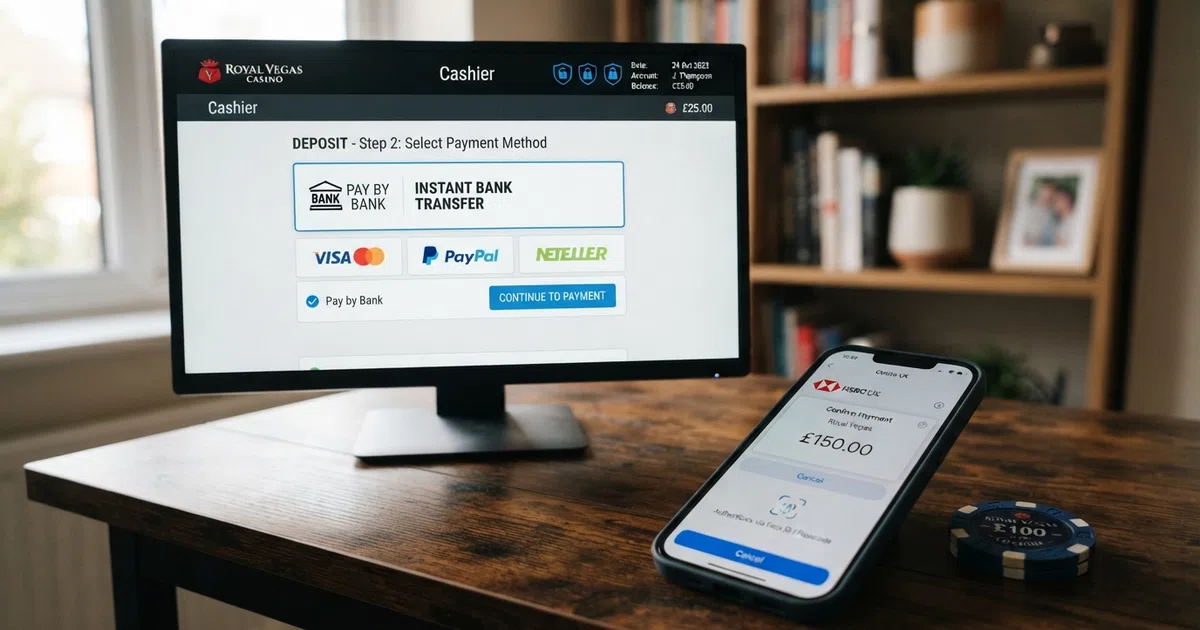
Data current as of September 8, 2026, verified against the UK Gambling Commission public register and each operator’s own support pages.
Why Your Banking Method Shapes Your Whole Casino Experience
Direct banking, in plain language, is any account-to-account payment you initiate from the casino cashier. Open Banking is the FCA-regulated subset of that activity, where a licensed Payment Initiation Service Provider (PISP) such as Trustly or TrueLayer calls your bank’s API on your behalf. Most UK players never see the distinction at the cashier because both are presented as Pay by Bank. The distinction matters because Open Banking deposits are irrevocable: the casino cannot reverse them and neither can you. That is a useful guarantee for the operator and a reason to choose carefully between operators, since you cannot undo the deposit if something goes wrong on the casino’s side.
Pay by Bank is now supported by Barclays, HSBC, Lloyds, NatWest and Santander — the major high-street names a UK player is most likely to bank with. Open Banking deposits settle instantly for both player and operator, against cards where the operator can wait days for funds even though the player can spend them straight away. The two practical consequences are speed and irreversibility. Both are sharper than the marketing copy suggests.
What Direct Banking and Open Banking Mean for UK Casino Players
Direct banking is the umbrella term covering any payment that goes straight from your bank account to the casino’s, with no card network in the middle. Open Banking is the regulated version of that — the FCA-supervised framework that lets a licensed PISP like Trustly or TrueLayer authenticate you through your banking app and push the payment through the bank’s own API. Trustly connects directly to a player’s bank account; deposits clear in seconds and withdrawals are usually paid back within the same day via Faster Payments. TrueLayer’s Pay by Bank is now live across bet365’s UK and German operations, with further expansion planned through 2026 — the clearest sign yet that Open Banking is becoming a default rail rather than a specialist option.
Casinos use the two terms interchangeably at the cashier, which is why this page treats them as one rail in practice. The technical distinction is that Open Banking is a regulatory regime; direct banking is a description of how the money moves. If your bank is in the Open Banking directory and the casino’s PISP is FCA-authorised, the deposit is Open Banking. If the casino gives you a sort code and account number to send to from your own banking app, that is direct banking of the older, manual sort.
How Open Banking Casino Payments Actually Work
The flow is the same whoever you bank with. At the cashier you select Pay by Bank, or the Trustly or TrueLayer option, and choose your bank from a list. You are passed to your own banking app or online banking, authenticate in the way you normally would (face, fingerprint, passcode), and approve a single payment. The money reaches the casino through Faster Payments — the UK instant-payment rail — typically inside six seconds, with Trustly reporting a 98.8% conversion rate at that speed. No card details are typed, no separate account is registered, and the casino never sees your bank login.
The withdrawal reverses the flow. The casino pushes the money back through the same PISP, which routes it over Faster Payments to the account you deposited from. Faster Payments runs 24/7 and settles in seconds at the rail level, but the end-to-end time depends on how long the casino takes to release the funds — which is the operator variable the comparison table later in this page lays out.
Bank-Linked Casino Payments Compared: What Each Method Delivers
Open Banking, in this comparison, is the API-driven, FCA-supervised rail, with instant deposit credit and same-day withdrawal once the casino releases the funds. Direct banking is the wider term for account-to-account payments initiated at the cashier — Open Banking is one route, manual bank transfer is another. Instant banking is the marketing phrase casinos apply to real-time bank payments, usually Open Banking under the hood. Traditional bank transfer is the older rail where the player pushes funds from their banking app to a sort code and account number, settling in hours to a day rather than seconds — a process that has carried “multi-day settlement times associated with older banking rails” “Deposits tend to clear in seconds. Withdrawals are usually paid back to the same verified account within the day, using the UK’s Faster Payments system rather than the multi-day settlement times associated with older banking rails.” — IBTimes UK, 2025. for as long as online gambling has existed.
The two rails a player will see most often at a UK casino are Open Banking and the manual transfer. Cards still dominate by volume, but the trend since the 2020 credit card ban is clearly toward bank-linked payments. The four-year question for any UK player is not whether the casino takes a bank payment — almost all of them do — but whether the operator processes the withdrawal quickly when the time comes.
How to Pick a Casino That Won’t Keep You Waiting for Your Money
The first signal of a strong banking-method casino is deposit speed. If the cashier says instant and the funds appear in seconds, the rail is set up correctly. The second signal is withdrawal speed, and here the difference between operators is widest: Sky Casino and Paddy Power commit to roughly 90 minutes for a first-time withdrawal, with subsequent withdrawals instant. LeoVegas, by contrast, takes two to five days on the same Open Banking rail. Both are UKGC-licensed, both use Open Banking — the only thing that changed is the operator’s processing commitment.
The third signal is fee transparency. Across the ten casinos reviewed here, none charges the player a fee for Open Banking deposits or withdrawals. Fees do exist in the system, but they sit on the operator side: Open Banking costs operators around 4.5% per transaction versus 3–7% for cards, and unlike cards it carries zero chargeback risk against a 2–4% chargeback ratio. That asymmetry is the reason operators are moving toward Open Banking — and the reason a player should not have to pay for the privilege of using it.
Which UK Casinos Genuinely Accept Open Banking and Pay by Bank
The cleanest test is the cashier page, not the homepage. A casino can list “Pay by Bank” in its marketing copy and route deposits through a PISP while quietly using a slower rail for withdrawals. Sky Vegas, Paddy Power, PlayOJO, MrQ, bet365, LeoVegas, William Hill, Ladbrokes, Videoslots and Betfair all accept Open Banking in some form for deposits — and all but one of them apply the same rail to withdrawals, with LeoVegas being the slowest at two to five days. MrQ extends Open Banking into KYC as well, through ClearStake’s “ID by Bank” service that verifies name, address and date of birth directly from a player’s banking app — removing the need to upload a passport or driving licence.
Ladbrokes is the one operator in the set where Open Banking is available for general deposits and withdrawals but explicitly excluded from the welcome-bonus qualifying deposit, which must be made by card or mobile wallet. The bonus is a separate issue from the banking method, but the practical effect is the same: a player who deposits via Open Banking at Ladbrokes will not trigger the welcome offer.
How to Read Casino Banking Reviews Without Getting Misled
Reviews of UK casino banking methods typically report deposit speed and method availability, and stop there. The deeper picture — the operator’s pending period, its withdrawal reversal policy, its first-time vs repeat withdrawal behaviour — is where the real differences sit. The UKGC banned reverse withdrawals permanently in October 2021, so once a player requests a withdrawal, it cannot be cancelled by a support agent on a sales call. That is a useful baseline. What is not standardised is the pending period before a withdrawal even enters processing.
Sky Casino’s support page states the first withdrawal takes at least 90 minutes, after which subsequent withdrawals should be instant. Paddy Power’s help centre uses the same language. Both are under the Flutter group umbrella and the 90-minute figure appears to be a group-level policy for first-time payouts through Instant Bank Transfer. LeoVegas, by contrast, takes two to five days for an Open Banking withdrawal according to the GambleGuru review — a different commitment from the same rail. A “review” that summarises both as “fast withdrawals” has smoothed over a difference of hours versus days.
The Banking Checklist: Speed, Limits, Fees and Reliability
- Deposit speed. Open Banking credits within six seconds at a 98.8% conversion rate. Cards, e-wallets and Apple Pay also clear instantly at the cashier; manual bank transfers take longer.
- Withdrawal speed. This is where the operators differ. Open Banking withdrawals can clear same-day via Faster Payments when the operator processes quickly; debit card withdrawals take one to five business days; manual bank transfer withdrawals take three to five days.
- Fees. None of the ten featured operators charges the player a fee for Open Banking deposits or withdrawals. The fee sits on the operator side, and the operator absorbs it.
- Reliability. Open Banking’s deposit success rate is 98.8% inside six seconds. Cards fail more often at the deposit stage because of 3-D Secure challenges, address mismatches and insufficient-funds declines — none of which Open Banking inherits.
How Fast Your Money Actually Moves: Deposit and Withdrawal Times Compared
“Instant” at the cashier is one of two things: the moment the casino’s account is credited (the player-side reality) or the moment the operator’s settlement is final (the operator-side reality). For cards, those two moments can be days apart. For Open Banking, they coincide. The rail settles instantly for both sides, which is why the same phrase at the cashier means different things depending on the method.
The three-stage withdrawal lifecycle — pending period, processing, settlement — applies to every method. Open Banking collapses the last stage into seconds once processing starts. Debit cards leave the last stage at one to five business days. Manual bank transfers leave it at three to five days. The pending period sits with the operator, not the rail, and is the variable the comparison table later in this page turns on.
| Method | Deposit Speed | Withdrawal Speed After Processing | Player Fees | Key Limitation |
|---|---|---|---|---|
| Open Banking / Pay by Bank (Trustly, TrueLayer) | Instant (under 6 seconds) | Same-day via Faster Payments | None across featured operators | First-time withdrawal often 90 min minimum; operator-controlled |
| Debit card (Visa, Mastercard) | Instant at cashier; operator settlement may take days | 1–5 business days | None across featured operators | Slowest operator-settled rail; 3-D Secure can fail |
| Traditional bank transfer | Hours to 1 business day | 3–5 business days | None across featured operators | Slow on both directions; manual input |
How Open Banking Deposits Work at UK Casinos
The deposit starts when a player picks Pay by Bank at the cashier and chooses their bank. The PISP — Trustly or TrueLayer — redirects the player to their own banking app, where authentication happens. The player approves a single payment, the PISP routes it over Faster Payments, and the casino credits the balance within seconds. No card details are typed. No separate e-wallet account is registered. The casino never touches the player’s bank login.
Across the ten featured operators, deposits are instant and free. Trustly’s own figure of 98.8% of deposits completing inside six seconds is the benchmark — anything noticeably slower suggests the operator is holding the deposit in a pending state rather than letting the rail settle.
Direct Banking Deposits: What Happens Behind the Scenes
The operator sees a different picture. An Open Banking deposit arrives through Faster Payments and is irrevocable — there is no chargeback right and no possibility of a card-network reversal. A card deposit carries chargeback risk at 2–4% per transaction, and the operator pays interchange and scheme fees on top. The arithmetic makes Open Banking cheaper for the operator on net, even at the 4.5% per-transaction cost of the rail — and that is the explanation for why so many UK casinos have moved Open Banking to the top of the cashier in 2025 and 2026.
What a player sees as a faster deposit is a side-effect of an operator preference. The fee saving, the chargeback elimination and the instant settlement make Open Banking the rail a UK casino wants to push.
Traditional Bank Transfer Deposits: When They Make Sense
A manual bank transfer is the older rail, where the player pushes funds from their banking app to a sort code and account number provided by the casino. Settlement is hours to a business day rather than seconds, and there is no card network or PISP in the middle. The clear case for a bank transfer is a large deposit that exceeds the Open Banking cap — most featured operators cap Open Banking deposits at £10,000 per transaction or per day, though the caps vary: Sky Vegas at £10,000 daily, Paddy Power at £25,000 daily, Videoslots at £10,000 daily, LeoVegas at £10,000 per transaction.
Outside that case, the only argument for a manual transfer is familiarity. The rail is slower, the friction is higher, and there is no advantage to it that a UK player would choose.
Withdrawal Speed and Processing Times by Method
The end-to-end withdrawal time is the sum of three stages: the operator’s pending period, the operator’s processing, and the rail’s settlement. Open Banking and Faster Payments handle the last stage in seconds. The first two are operator-controlled, and that is where the difference between a 90-minute Sky Casino or Paddy Power withdrawal and a five-day LeoVegas withdrawal comes from. Debit card withdrawals take 1–5 business days after processing because the card networks do not run an instant settlement rail for outbound payments. Manual bank transfer withdrawals take 3–5 business days for the same reason.
A casino that publishes its withdrawal times per method is a casino you can plan around. A casino that publishes a single “instant” or “same-day” figure without saying per method is one where the actual time depends on which method you used.
Instant Banking at Casinos: Real-Time Settlement vs Marketing Language
“Instant banking” is a marketing phrase applied to real-time account-to-account payments, almost always Open Banking. The instant in the phrase refers to the rail — the moment the casino credits your withdrawal to your bank — not to the entire withdrawal process. A casino can take 24 hours to start processing your withdrawal and still call the rail “instant”, because the rail itself is. The honest version of the same claim is “instant once we release it”.
The operators in this comparison that actually deliver end-to-end fast settlement are Sky Casino, Paddy Power, PlayOJO, MrQ, Videoslots and bet365 — all of which sit at the same-day end of the Open Banking scale. LeoVegas sits at the 2–5 day end. The marketing copy is identical in both cases.
Fast-Withdrawal Casinos: Which Banking Methods Deliver Your Money Fastest
If the goal is the fastest possible end-to-end withdrawal, Open Banking or Pay by Bank is the rail. It is the only method that can clear on the same day, and it does so via Faster Payments at the rail level. Debit cards come second, at one to three business days typically. Manual bank transfers come last, at three to five business days. Within the Open Banking tier, the operator variable is decisive: Sky Vegas (withdrawal within 6 hours, 90 min first time), Paddy Power (within 2 hours, 90 min first time), Videoslots (within 6 hours), PlayOJO and MrQ (same-day), LeoVegas (2–5 days), all running the same rail.
The honest summary: the rail is fast, the operator decides how much of that speed reaches the player.
Payment Limits and Minimum Deposits for Banking-Method Casinos
Most UK Open Banking casinos set a £10 minimum deposit. The maximums vary more widely. Sky Vegas caps at £10,000 per day. Paddy Power is the highest in the featured set at £25,000 per day. Videoslots caps at £10,000 per day. LeoVegas caps at £10,000 per transaction. bet365 ranges from £5 to £20,000 depending on the method. MrQ, PlayOJO, William Hill, Ladbrokes and Betfair list £10 as the minimum without publishing a hard daily maximum in their public support pages.
There is no statutory GB deposit ceiling — only the operator’s own limits and the player-set limit the operator must prompt for before the first deposit. From 30 September 2026, a gross deposit limit based solely on money paid in must also be offered, and only such a limit may be called a “deposit limit”. For Open Banking specifically, the £10 minimum is now the de facto floor across the major UK-licensed casinos.
10 UK Casinos That Accept Direct Banking, Ranked by Payment Speed and Value
The ten operators below are all UKGC-licensed and all support Open Banking or Pay by Bank in some form. The table ranks them by a combination of withdrawal speed, bonus fairness (the lower the wagering, the fairer) and banking transparency. The split the table reveals is consistent: most operators deliver instant deposits, and the difference between them lives almost entirely in the withdrawal window and the bonus terms.
| Operator | UKGC Licence | Open Banking Method | Deposit Speed | Withdrawal Speed | Welcome Bonus | Free Spins | Wagering |
|---|---|---|---|---|---|---|---|
| Paddy Power Games | Active (Flutter) | Trustly Instant Bank Transfer | Instant | Within 2 hours (90 min first) | — | 50 no-wagering + 100 on deposit | 0× |
| Sky Vegas | Active (Flutter) | Trustly Pay by Bank | Instant | Within 6 hours (90 min first) | — | 50 no-deposit + 200 on deposit | 0× |
| MrQ | Active (Lindar Media) | Open Banking instant bank transfer | Instant | Same-day | — | 100 on Big Bass Splash | 0× |
| PlayOJO | Active (SkillOnNet) | Trustly Open Banking | Instant | Same-day | — | 50 on Big Bass Bonanza | 0× |
| bet365 Casino | Active (Hillside UK Gaming ENC) | TrueLayer Pay by Bank | Instant | Instant | — | Up to 500 (reveal mechanic) | 0× |
| Videoslots | Active (Videoslots Ltd) | Trustly | Instant | Within 6 hours | 100% up to £200 | 11 on Starburst | 35× (bonus funds) |
| Betfair Casino | Active (Flutter) | Pay by Bank (Flutter group) | Instant | Same-day | Varies by product | 50 typical | 0× (free spins typical) |
| LeoVegas | Active (39198, LeoVegas Gaming PLC) | TrueLayer Open Banking | Instant | 2–5 days | — | 50 on Big Bass Splash | 0× on spins |
| William Hill Vegas | Active (evoke plc) | Trustly instant bank transfer | Instant | Same-day | — | 200 on Big Bass Splash | 10× (winnings), £30 cap |
| Ladbrokes Casino | Active (Entain) | Open Banking (general; not bonus-qualifying) | Instant | Same-day | — | 100 + 300 Ladbucks | 0× |
Eight of the ten sit at 0× wagering on their welcome free spins. William Hill Vegas is the only operator in the set carrying both a wagering requirement and a cashout cap. Videoslots is the only operator carrying a traditional deposit match with 35× wagering. The two outliers matter because they are the ones a player who reads the table carefully will cross off first.
Sky Vegas
Sky Vegas runs on Flutter Entertainment’s UKGC licence and supports Trustly Pay by Bank for both deposits and withdrawals. The welcome is built around 250 free spins — 50 no-deposit and 200 triggered by a £10 deposit and spend — at 10p per spin, with zero wagering requirements and no cashout cap. Game providers include NetEnt, Play’n GO, Pragmatic Play and Evolution, which is the standard Flutter Casino stack rather than a stretch. Deposits are instant; withdrawals arrive within 6 hours after a 90-minute first-time window. The minimum deposit is £10 and the daily ceiling is £10,000, with no player fees.
For a player who values no-wagering free spins and a fast Flutter-group payout, Sky Vegas is the strongest fit. The 50 no-deposit spins mean a player can sample the casino before committing a pound, which is rare in the featured set.
Paddy Power Games
Paddy Power Games, also under Flutter, is the standout for withdrawal speed: Trustly Instant Bank Transfer deposits clear instantly and withdrawals arrive within 2 hours after the 90-minute first-time window. The welcome combines 50 no-wagering free spins with 100 additional spins on a £10 deposit and stake, again at 10p each with no cashout cap. The £25,000 daily withdrawal limit is the highest in the featured set, which matters for high-stakes players and large slot wins.
For a player prioritising end-to-end payout speed and a high withdrawal ceiling, Paddy Power Games is the strongest match. The Flutter group infrastructure is the same as Sky Vegas, and the withdrawal time is faster.
PlayOJO
PlayOJO is the no-wagering casino in the strictest sense: its house policy is zero wagering on every promotion, every spin, every bet. The welcome is 50 free spins on Big Bass Bonanza — RTP 96.71% with medium-to-high volatility — at 10p per spin, with winnings paid as cash and no cap. Trustly Open Banking deposits are instant and withdrawals are typically same-day (§6 PlayOJO). The licence is held by SkillOnNet Ltd, confirmed on the UKGC public register. The OJOplus cashback on every bet, regardless of outcome, is a differentiator none of the other nine match.
For a player who wants no-wagering as a permanent feature rather than a one-off welcome, PlayOJO is the cleanest fit. The RTP and volatility of Big Bass Bonanza are not the friendliest in the set, but the cashback policy compensates over time.
MrQ
MrQ’s welcome is 100 free spins on Big Bass Splash (RTP 96.76% ) with zero wagering and no cashout cap, credited on a £10 minimum deposit with a 48-hour window to use them. Open Banking instant bank transfers cover deposits and withdrawals, and ClearStake’s “ID by Bank” service handles KYC directly through the player’s banking app — verifying name, address and date of birth without the usual document upload. The licence is held by Lindar Media Ltd, active on the UKGC public register.
For a player who wants a fast KYC alternative to passport scans and a no-wagering welcome on a high-RTP slot, MrQ is the standout. The ClearStake integration is the genuine innovation — it removes the slowest part of the signup flow.
bet365 Casino
bet365’s headline welcome is up to 500 free spins, revealed 5 to 50 per day across 10 of the next 20 days, on a £10 deposit and stake, with zero wagering and no cashout cap (§6 bet365). TrueLayer Pay by Bank went live in 2026 for instant deposits across bet365’s UK and German operations, with further market expansion planned through 2026. The licence is held by Hillside (UK Gaming) ENC. Game providers include Playtech, which the other nine operators in the featured set do not all carry, making bet365 the largest game-roster operator of the ten.
For a player who wants a major-operator banking integration and the widest game library, bet365 is the natural pick. The reveal mechanic on the free spins is a slower drip than a one-shot credit, which is the trade-off for the headline 500 figure.
LeoVegas
LeoVegas offers 50 free spins on Big Bass Splash (RTP 96.76% ) with zero wagering on the spins, after a 1× deposit wagering trigger. TrueLayer Open Banking deposits are instant, from £10 to £10,000 per transaction. Withdrawals, however, take 2–5 days — the slowest in the featured set on the same rail. The UKGC licence (account 39198) has been active since 1 November 2014, and PayPal deposits are excluded from the welcome bonus.
For a player who values a long-established UKGC licence and a high-RTP bonus slot, LeoVegas fits. The 2–5 day withdrawal is the cost, and it is a real cost when Sky Casino and Paddy Power are doing the same rail in 90 minutes.
William Hill Vegas
William Hill Vegas carries the only welcome offer in the set with both a wagering requirement and a cashout cap: 200 free spins on Big Bass Splash on a £10 deposit and stake, with 10× wagering on spin winnings within 72 hours and a £30 maximum cashout (§6 William Hill Vegas). Trustly instant bank transfer is available for both deposits and withdrawals. The licence is held by evoke plc, active on the UKGC public register.
The honest read: the 200-spin headline is a poor deal in 2026. A £30 cap on free-spin winnings at 10p per spin means a player is betting on landing a small win from a small number of paid spins. The evoke licence and the bank-transfer availability are real, but the bonus terms are the most restrictive in the featured set.
Ladbrokes Casino
Ladbrokes’ welcome combines 100 free spins with 300 Ladbucks (the operator’s in-house currency) on a £10 deposit and stake, with zero wagering on the spins (§6 Ladbrokes). Open Banking is available for general deposits and withdrawals, but the welcome-bonus qualifying deposit must be made by Visa/Mastercard debit, Apple Pay or Google Pay. That is the one operator in the featured set that excludes Open Banking from bonus qualification. The licence is held by Entain plc, active on the UKGC public register.
For a player who banks by debit card or wallet, Ladbrokes is a clean fit. For a player who prefers Open Banking for everything, the welcome offer is unavailable — which is the kind of detail the cashier’s bonus-eligible methods list will surface, and the deposit-page small print rarely does.
Videoslots
Videoslots runs the only traditional deposit-match welcome in the featured set: 100% up to £200 plus 11 wager-free spins on Starburst (RTP 96.09% ) on a £10 minimum deposit. The bonus funds carry 35× wagering with a 30-day validity, against the new UKGC 10× cap — Videoslots is one of the few operators whose bonus terms currently exceed the regulatory 10× cap; a player should verify the current status before depositing. Trustly deposits are instant and withdrawals arrive within 6 hours (§6 Videoslots). The game library is the largest in the featured set at over 7,000 titles from NetEnt, Play’n GO, Pragmatic Play, Evolution, Microgaming and a dozen more providers.
For a player who wants the largest game library and a real deposit match, Videoslots is the strongest match. The 35× wagering is the cost of the higher headline, and the offer’s status relative to the 10× cap is worth a check before committing.
Betfair Casino
Betfair runs the same Flutter-group Trustly infrastructure as Sky Vegas and Paddy Power, with Pay by Bank available for instant deposits. The welcome offer varies by product vertical — typically 50 free spins or a deposit-match, with 0× wagering on free spins under the Flutter group standard. The UKGC licence is active under Flutter Entertainment, and the cross-product banking coverage is the widest of any featured operator: a single account spans sports, casino, poker and exchange, with Pay by Bank working across them.
For a player who plays across multiple Flutter products and wants one banking method that works everywhere, Betfair is the cleanest fit. The welcome offer variability is the trade-off — the headline is not as predictable as Sky Vegas’s 250 fixed spins.
Why Your 2026 Casino Bonus Is Smaller Than It Looks
The headline number on a casino welcome is the number the marketing team wants you to see. The number a player should look at is the wagering requirement, the cashout cap, the spin value and the spin validity window. Read together, those four numbers turn “500 free spins” into a precise number of pounds of bonus value — and that number is almost always smaller than the headline.
The UKGC’s 10× wagering cap, in force from 19 December 2025, set a hard ceiling on how much the bonus can demand back from the player before withdrawal. A £200 deposit match with 10× wagering requires £2,000 in turnover to clear — a real but manageable figure against the 35× standard that prevailed before the cap, where the same bonus would have required £7,000. Eight of the ten featured operators in this comparison carry 0× wagering on their free spins, which means the 10× cap is academic for them: there is no wagering to apply it to. The two exceptions, William Hill at 10× and Videoslots at 35× on bonus funds, are the operators where the cap is doing real work.
Welcome Bonuses and Deposit-Match Offers at Banking-Method Casinos
Deposit-match offers — the casino matches your deposit with bonus money, usually up to a cap — are now rare at UKGC-licensed casinos. Videoslots is the only operator in the featured set offering one (100% up to £200 at 35×). Every other featured casino has moved to free-spins-only welcomes, on the simple logic that free spins with no wagering are a cleaner marketing proposition than a deposit match with any wagering at all. The 10× cap accelerated the shift: a 10×-capped deposit match is less attractive than an uncapped no-wagering free-spin bundle, so operators cut out the middleman and ran with the spins.
The practical consequence for a player is that bonus value at a UK casino in 2026 is most often the cash value of the free spins — 50 spins at 10p is £5 of stake, 500 spins at 10p is £50. Anything the player wins on those spins is theirs, with no wagering and (at most featured operators) no cashout cap.
Free Spins for Open Banking and Direct Banking Depositors
Nine of the ten featured operators accept Open Banking deposits for bonus qualification without comment. Ladbrokes is the single exception: the welcome offer is available only to deposits made by Visa/Mastercard debit, Apple Pay or Google Pay, and Open Banking deposits — though accepted for general play — will not trigger the welcome. A player who prefers Open Banking for everything will find Ladbrokes’ cashier splits that preference from the bonus, which is a real and somewhat unusual limitation.
The wider picture: Open Banking is the most common rail for bonus-qualifying deposits at UKGC-licensed casinos, but the cashier page is the only place this is stated clearly. A player who deposits before reading the bonus-eligible methods list may find the welcome offer not credited, with support pointing to the small print as the reason.
Wagering Requirements, Game Contributions and the 10× Cap
The 10× cap on wagering requirements came into force on 19 December 2025 under LCCP Social Responsibility Code 5.1.1, alongside a ban on mixed-product promotional offers. A £100 bonus at 10× requires £1,000 in qualifying turnover before withdrawal — a third of what the same bonus would have demanded under the old 35× standard. Game-weighting matters: slots contribute 100% to wagering, but table games and live casino typically contribute 10–20% or nothing at all. The 10× cap, like the old 35× standard, applies to bonus funds only; free spins with no wagering are not affected.
Eight of the ten featured operators now offer 0× wagering on free spins. The two outliers are William Hill Vegas at 10× (with a £30 cashout cap) and Videoslots at 35× on bonus funds. The 0×-wagering cluster is the dominant model, and a player who chooses anything else in 2026 is choosing the higher-friction option deliberately.
New Casinos With Direct Banking: What Is Worth Your Attention in 2026
The pace of new UKGC casino licences in 2026 is steady, and most new entrants now launch with Open Banking as a default payment method rather than adding it later. The clearest sign is TrueLayer’s 2026 expansion into bet365’s UK and German operations — a major established operator adding Pay by Bank to a platform that already had every other rail. New entrants launching with Open Banking integrated at the point of release is now the norm rather than the exception.
A new casino’s track record is the part a player cannot see. The welcome offer may be larger, the game library may be smaller, and the withdrawal history is necessarily thin. The verification checklist on the next page is built to surface what a player cannot check from the homepage.
Newest Open Banking Casino Sites in the UK
The UKGC public register is the most reliable way to find newly licensed operators. The register is searchable by licence type (Casino Remote, Bingo Remote, General Betting Standard), status (Active, Surrendered, Lapsed) and trading name. Filtering to Active Casino Remote licences and sorting by licence-issue date surfaces the recent entrants.
The trade-off is consistent across the new-entrant cohort. A new casino often offers a more generous welcome than the established operators, on the logic that it needs to acquire players who already have accounts elsewhere. The bonus generosity is real, but it sits alongside a thinner game library, fewer payment methods and a shorter history of payouts. The rule of thumb: a new casino is a reasonable place to try a small deposit and a welcome offer, and an unreasonable place to test a large withdrawal before the operator has proven it can handle one.
What to Verify Before Depositing at a Newly Launched Banking-Method Casino
- UKGC licence number. Search the public register and confirm the licence is Active, that the trading name matches the casino’s footer, and that the licence type is Casino Remote.
- Withdrawal policy per method. Open the casino’s help or banking page and look for a per-method timeline. A casino that lists only “1–3 business days” without a per-method breakdown is one where the actual time depends on which method you used.
- GAMSTOP support. GAMSTOP is mandatory for every UKGC online licence since 31 March 2020. A casino that does not participate is not UKGC-licensed.
- ADR provider. The UKGC requires every licensed operator to name an Alternative Dispute Resolution provider. The ADR name should appear in the terms and conditions and on the complaints page.
- Player complaints about withdrawal delays. Independent complaint forums and review sites will surface a pattern of slow payouts faster than the operator’s own support pages will.
- Bonus small print. Minimum play requirements, maximum cashout caps, eligible deposit methods and game weighting all sit in the bonus terms. The cashier’s bonus-eligible methods list is the single most useful page to check before depositing.
What a GB Gambling Licence Actually Means for Your Bank-Linked Payments
A UK Gambling Commission licence is the single most important fact about any online casino serving GB customers. The Gambling Act 2005 set the three licensing objectives — preventing crime, ensuring fairness, protecting the vulnerable — and the Gambling (Licensing and Advertising) Act 2014 extended them to every operator serving GB customers from anywhere in the world. A Malta, Curaçao or Gibraltar licence does not substitute. The point-of-consumption reform made a GB licence compulsory, and a casino without one is committing a criminal offence under section 33 of the Gambling Act 2005 — up to 51 weeks’ imprisonment, unlimited fine, or both.
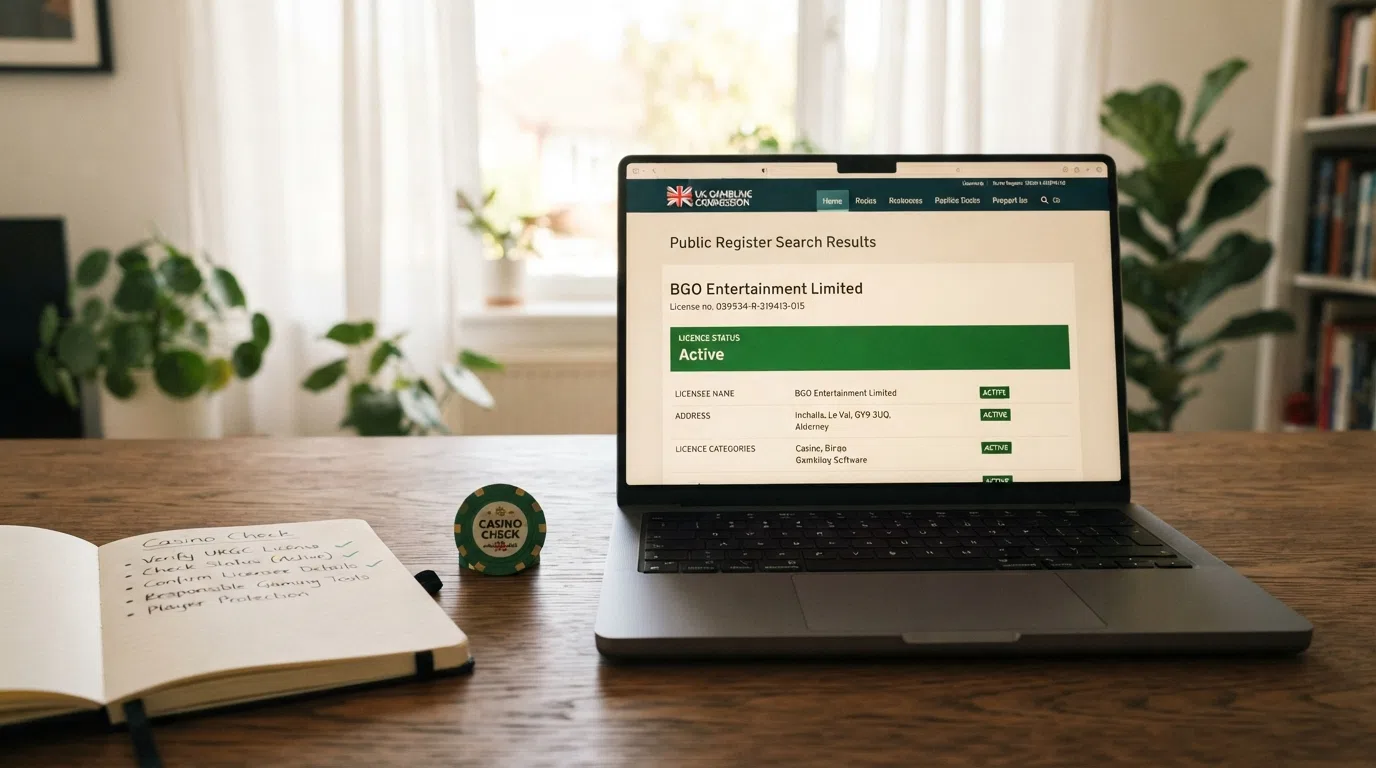
The Commission’s enforcement approach is disruption rather than ISP blocking. The published figures for April 2024 to June 2025 are 3,140 disruption notices served, 447,778 URLs referred to search engines, and 287,961 URLs removed. A player who chooses an unlicensed site is not breaking the law, but is gambling without any of the protections the GB regime provides.
UKGC Licensing Requirements for Casino Banking and Payments
The credit card ban took effect on 14 April 2020 under LCCP licence condition 6.1.2, and extends to credit-card-funded e-wallet payments. Since 7 May 2019, every remote licensee must verify name, address and date of birth before any deposit or any gambling — the 72-hour grace period that existed before that date no longer applies. Player funds must be held in segregated accounts, separate from the operator’s working capital. Reverse withdrawals have been permanently banned since 31 October 2021, so once a player requests a withdrawal, no support agent can cancel it on a follow-up call.
These conditions are the floor, not the ceiling. The 10× wagering cap and the gross deposit limit from 30 September 2026 are recent additions to that floor. The overall picture is a regulatory regime that is tightening year on year, in a direction that is broadly favourable to a player who reads the small print.
GAMSTOP Self-Exclusion: What It Covers and How It Works
GAMSTOP is the national multi-operator online self-exclusion scheme, mandatory for every UKGC online operating licence since 31 March 2020. One registration blocks all GB-licensed online gambling for the chosen exclusion period — six months, one year, five years, or five years with auto-renewal. None of these can be cancelled early. The block applies to deposits and to new account creation, and is enforced at the operator level regardless of the payment method — an Open Banking deposit from an excluded player is rejected by the casino’s own systems.
What GAMSTOP does not cover is unlicensed sites, which the scheme does not reach, and land-based venues, which are covered by separate self-exclusion arrangements. For a player who has registered with GAMSTOP, an Open Banking deposit at a UKGC casino is impossible by design.
Casinos Outside GamStop: The Risks No Bonus Is Worth
A non-GAMSTOP casino is, in the GB context, an unlicensed casino. It may hold a Malta, Curaçao or Gibraltar licence — and any of those licences may be legitimate in their own jurisdiction — but none of them substitute for a UKGC licence at point of consumption. The protections a player forfeits are the full set: no GAMSTOP coverage, no UKGC complaints route, no ADR provider, no British consumer redress, no statutory slot stake caps, no 10× wagering cap, no gross deposit limit, no financial vulnerability check.
The Commission’s response is disruption rather than blocking. The published figures for April 2024 to June 2025 — 3,140 notices served, 447,778 URLs referred, 287,961 URLs removed — are the largest enforcement numbers in the regulator’s recent history. A player who chooses an unlicensed site is choosing to play outside the GB system. The bonus is not worth it.
No-Verification Casinos and the UK’s KYC Rules
The “no ID verification” casino is a red flag. Since 7 May 2019, a UKGC remote licensee must verify name, address and date of birth before any deposit or gambling. The 72-hour grace period that allowed players to register and play first, upload documents later, no longer exists. A casino that offers “no verification” deposits is either unlicensed or breaking the licence conditions it claims to hold.
Open Banking is becoming part of the KYC solution rather than the problem. MrQ’s integration of ClearStake’s “ID by Bank” service verifies a player’s identity directly from their banking app, without passport scans or driving licence uploads. The player authenticates through the bank, the bank confirms the name, address and date of birth, and the casino accepts the result. The same rail that deposits funds can also verify identity, and that convergence is the most interesting Open Banking development in 2026.
Player Protections When Using Open Banking and Direct Banking
Open Banking payments are irrevocable, and that has consequences for both sides. A player cannot chargeback an Open Banking deposit, which means the choice of operator matters more than the choice of method. A casino cannot reverse a deposit either, which is the operator-side benefit that drives adoption.
Beyond the rail itself, the GB regime layers a set of financial safeguards on top. From 28 February 2025, a financial vulnerability check is triggered at £150 net deposit in a rolling 30-day period, using publicly available data only — bankruptcy orders, CCJs, IVAs, DROs. The check is a light public-record scan, not an affordability assessment. Affordability, in the form of financial risk assessments, is staged: Stage 1 thresholds of £5,000 net deposits in 24 hours (25+) and £2,500 (under 25), with final thresholds of £1,000 / £3,000 (25+) and £750 / £2,000 (under 25). The start date is not yet confirmed, and the announcement is that gamblers spending more than £1,000 online in a 24-hour window will undergo a financial risk assessment “Gamblers who spend more than £1,000 online in a 24-hour window will have to undergo a financial risk assessment.” — BBC News, 2026..
Two further protections sit on top. From 31 October 2025, operators must prompt for a financial limit before the first deposit and must action any decrease immediately. From 30 September 2026, a gross deposit limit based solely on money paid in must be offered, and only such a limit may be called a “deposit limit”. The British model is not to cap a player’s spending at the state level — there is no nationwide deposit or loss ceiling — but to require the offer of one and to compel a check at defined thresholds.
Where to Set Limits and Get Help: Responsible Gambling Tools That Work
The UKGC’s safer-gambling regime is mandatory and broad. Every UKGC-licensed casino must offer deposit limits, session reminders, reality checks, time-outs and self-exclusion. The deposit-limit prompt before first deposit is in force; the gross deposit limit is on the way. Reality checks displaying total losses, total wins and time played during a slots session have been mandatory since October 2021. The statutory levy at 1.1% of GGY, in force since 6 April 2025, funds the treatment, prevention and research infrastructure that the rest of this section describes.
The headline number on the harm side is the 2.4% Problem Gambling Severity Index rate in the Gambling Survey for Great Britain, stable at 2.5% in 2023, 2.7% in 2024 and 2.4% in 2026. The figure is stable rather than falling, and it is worth holding alongside the 47% adult past-four-week gambling rate and the 37% online participation rate (15% excluding the national lottery) to get a sense of the population at risk.
Deposit Limits, Session Reminders and Reality Checks
The deposit-limit prompt is the front line. Since 31 October 2025, every UKGC-licensed operator must ask a player to set a financial limit before the first deposit, and any request to decrease an existing limit must take effect immediately. A request to increase a limit, by contrast, comes with a 24-hour cooling-off period under the same rules. The increase-delay is the part of the policy that does the work, because the easy path is to raise a limit mid-session and the deliberate path is to wait a day.
Session reminders pop up at intervals the player sets, and reality checks display elapsed time, total wins and total losses during a slots session — mandatory since October 2021. The gross deposit limit arriving 30 September 2026 is the next step, and only such a limit may be called a “deposit limit” in the marketing.
Self-Exclusion Through GAMSTOP and Direct Operator Tools
GAMSTOP is the multi-operator answer. One registration blocks every UKGC-licensed online casino for the chosen period — six months, one year, five years, or five years with auto-renewal — and the block cannot be cancelled early. A player who has registered cannot deposit via Open Banking or any other method at any UKGC casino, because the operator’s own systems check the GAMSTOP database on signup and on each deposit attempt.
Operator-level self-exclusion is the short-term complement. Most UKGC casinos offer time-outs from 24 hours to six weeks, applied to the single operator. A player who wants a short cooling-off period without the long-term commitment of GAMSTOP can use operator-level time-outs. A player who wants the nuclear option uses GAMSTOP.
Where to Get Help: GamCare, BeGambleAware and NHS Services
GamCare runs the National Gambling Helpline on 0808 8020 133, free and confidential, 24 hours a day. The most recent published referral figures are 996 referrals in January 2026, up 48% year-on-year from 674 in January 2025. Online gambling is the most-cited form, with 81.5% of helpline contacts naming online forms and 36.1% in-person forms — online at a five-year high.
The treatment pathway runs from the helpline through to specialist care. GambleAware funds the National Gambling Support Network (NGSN), where 72% of clients gambled online and the problem gambling rate fell from 87% to 27% between initial and final assessment. NHS gambling harm clinics operate in England, Scotland and Wales. Gamblers Anonymous runs peer-support meetings. The whole infrastructure is funded by the statutory levy at 1.1% of GGY, split 50% to treatment, 30% to prevention and 20% to research.
The number to call is 0808 8020 133. It is free, it is 24/7, and the January 2026 referral numbers suggest the service is now seeing more callers than at any point in its history.
How We Checked, Scored and Ordered This Casino Shortlist
The operators featured here were selected based on their UKGC licence status and the transparency of their banking processes, as verified against official support pages. Each operator was checked for its Open Banking method (Trustly or TrueLayer), deposit and withdrawal speeds, limits, and player fees. Bonus terms were confirmed against each operator’s current promotions page and the conditions for bonus-eligible deposit methods.
The ranking criteria were withdrawal speed (weighted by method), bonus fairness (0× wagering ranks above any positive wagering), and banking transparency (whether the operator publishes per-method timelines). External sources consulted include the TrueLayer blog, the iGaming Future piece on ClearStake ID by Bank, and the YouGov 2020 instant-payouts survey referenced by TrueLayer. The page does not cover live-casino game selection, sports-betting banking, or loyalty-programme terms — those are separate decisions and not the subject of this comparison.
What You Should Actually Do About Your Casino Banking Choice Today
The data points in one direction. Open Banking casinos get your money to you faster than the same casinos on a card rail, and the difference between a 90-minute Sky Casino or Paddy Power withdrawal and a five-day LeoVegas withdrawal is not marginal — it is the difference between a casino that has decided to prioritise payout speed and one that has not. Wagering is the second filter, and the picture is overwhelmingly toward 0×: eight of the ten featured operators carry 0× on free spins in 2026, so paying wagering is a choice rather than a default. The 10× cap is the regulatory floor, and any operator above it on a current welcome offer is worth a closer look at the bonus terms.
The three-step decision framework the data supports: pick your banking method first (Open Banking if speed matters), filter by withdrawal speed (anything at 90 minutes or less is genuinely fast), then check the bonus wagering (0× is the standard, anything else is the exception). The actionable next step before depositing a pound is the UKGC public register — a thirty-second check that confirms the licence is Active and matches the trading name. A casino that is not on the register is not a casino you should be depositing with, whatever its welcome offer.
Frequently Asked Questions
Can I claim a welcome bonus when I deposit via Open Banking or Trustly?
At nine of the ten featured operators, yes — Open Banking deposits qualify for the welcome offer, including Sky Vegas, Paddy Power, PlayOJO, MrQ, bet365, LeoVegas, William Hill, Videoslots and Betfair. The single exception is Ladbrokes Casino, where the welcome-bonus qualifying deposit must be made by Visa/Mastercard debit, Apple Pay or Google Pay, and Open Banking deposits — though accepted for general play — will not trigger the welcome offer.
Are Pay by Bank casino payments protected under UK regulation?
Yes, at a UKGC-licensed casino. The Gambling Commission’s licence conditions, the credit card ban since 14 April 2020 and the mandatory GAMSTOP registration since 31 March 2020 all apply to any operator that takes Open Banking deposits. The Open Banking payment itself is irrevocable, so there is no chargeback right once a deposit is made — which is why the choice of a UKGC-licensed operator matters, not just the choice of method.
Do all UK banks support Pay by Bank for casino deposits?
Most major UK banks support it. Barclays, HSBC, Lloyds, NatWest and Santander all support Pay by Bank / Open Banking, which covers the bulk of UK current account holders. Smaller building societies and some specialist banks may not appear in the Open Banking directory, in which case the casino’s cashier will show them as unavailable and the player will need to use a different method.
Are there any fees for depositing or withdrawing with Open Banking at UK casinos?
None of the ten featured operators charges the player a fee for Open Banking deposits or withdrawals. The fee sits on the operator side — around 4.5% per transaction against 3–7% for cards — and the operator absorbs it as the cost of a rail that also eliminates chargeback risk.
Can I use Open Banking if I am on GAMSTOP self-exclusion?
No. GAMSTOP blocks every UKGC-licensed online casino for the chosen exclusion period, and the block is enforced at the operator’s own systems regardless of payment method. An Open Banking deposit attempt from a registered player is rejected at the cashier. The block cannot be cancelled early, and the exclusion period must run its course.
Payments – realmoney-onlinecasinos-uk
Content created by the «realmoney-onlinecasinos-uk» team