
Trusted casinos not on GamStop: what UK players actually face in 2026
 Available in GB
Last checked against the Curaçao Gaming Authority register and updated as of September 8, 2026.

“Trusted” is a word that does a lot of work on the pages of non-GamStop casinos. It appears in every affiliate headline, every welcome banner and every comparison table, and almost never with anything behind it. The ten operators below are not trusted because someone called them trusted in a listicle. They are trusted in the sense that a player who insists on gambling outside the UK licensing system can verify a licence number against an offshore register, find a payout record that does not contradict the marketing, and put real money on the line without expecting a quiet disappearance.
None of the ten is licensed by the UK Gambling Commission. That is the whole point of the page — the British self-exclusion scheme called GamStop cannot reach any of them, the consumer protections attached to a GB licence do not apply, and the rules the British regulator has spent the last five years tightening are not in force here. The 10× wagering cap, the £5 slot stake ceiling, the credit-card ban, the auto-play block, the 2.5-second spin floor: every one of those stops the moment a player crosses into the offshore market. What follows is what that costs, what the ten look like when checked against the only register that applies, and how to keep yourself whole if you go ahead.
What “trusted” can and cannot mean off GamStop
“Trusted” is the first word that needs a working definition, because outside the GB licence it has nowhere to land.
What “trusted” has to mean off GamStop
A UKGC licence is a public statement that an operator has cleared the Commission’s licence objective tests, holds segregated player funds, accepts a Commission complaints route, and submits to a continuing audit. When that licence is missing, “trusted” has to be built from evidence a player can check themselves. The building blocks are a verifiable licence number on the actual regulator’s register, a transparent bonus structure with a stake-per-spin floor and a cap on the no-deposit freebies, a working payment rail with a known withdrawal ceiling, and an owner that has not disappeared between two brand launches in the last twelve months.
By that test, the Curaçao-licensed brands dominate the page. Seven of the ten operators below are run by Santeda International B.V., a Curaçao-registered company holding Curaçao Gaming Authority licence OGL/2024/1798/1048. That single licence covers MyStake, Goldenbet, Freshbet, Donbet, Rolletto, Cosmobet and Velobet — which means a player inspecting any one of those brands can verify the same licence number and the same parent. It also means a payout dispute with one of them is, in practice, a dispute with the same office. The remaining three sit on Curaçao or Curaçao-Anjouan dual licences of their own.
The word is doing real work here. It is not a marketing label, and it is not the same as the trust a UKGC licence buys. It is the smaller, more brittle kind of trust that comes from a register entry you have read with your own eyes.
Safety and security benchmarks
A footer badge proves nothing. Every Curaçao-licensed casino in the top ten carries a “Licensed by Curaçao Gaming Authority” badge in the footer, and the same badge appears on sites that the operator will not register, on landing pages that the regulator has never audited, and on mirror sites that have been removed from the index three times. The check is the register, not the footer. The CGA register at Cga.cw lists the holder of every active OGL/ licence by number; the number on the casino’s footer either appears there with a matching brand name, or it does not, and the page that does not appear is not one to play on.
Fund segregation is the harder test. The UKGC obliges licensees to hold customer money in segregated accounts that cannot be raided in an insolvency. MGA-licensed casinos operate under a similar regime. Curaçao does not enforce the same standard with comparable rigour — the LOK reform that came into force in December 2024 introduced a new compliance regime, but the level of audit on player-fund protection is still the older, lighter touch. A player who reads the licence number against the register and finds a match has cleared the first gate, not the last.
Encryption is the floor. TLS on the cashier and a clear privacy notice on the data the operator keeps are the only mechanical requirements the page will assume; the GB obligations of a financial vulnerability check at the £150 net deposit threshold, a credit-vulnerability prompt, and a mandatory deposit limit before first deposit apply only inside the GB licence.
Real-money play expectations
A player depositing at any of the ten is, from the first transaction, in an environment without a £5 stake cap on online slots. Players aged 25 and over in Great Britain are limited to £5 per game cycle at GB-licensed casinos; the 18–24 age band is limited to £2. None of those caps apply off the GB licence, and the offshore casino is free to run a £50 spin, a £200 spin, and everything in between. The same is true of the 2.5-second spin floor, the ban on auto-play, and the ban on losses disguised as wins. The trade for those freedoms is that the operator is also free to refuse a withdrawal under its own terms, with no Commission complaints route to escalate through and no approved alternative dispute resolution provider to take the complaint to. Real-money play off GamStop is a different contract from real-money play inside it, and the contract is read by the operator’s own terms of service rather than by the Gambling Act 2005 and its codes of practice.
Reviews and player feedback as trust signals
Every top result for this keyword is a curated affiliate listicle — that is the entire shape of the page-one competition. The reviews on those pages are written by the affiliate’s editorial team, often against a paid placement, and the same ten brands recur across most of them. Player feedback on independent forums tells a different story in places, but forums are not regulated either, and the same single account can post ten different reviews under ten different names. The honest reading is that the listicle is a starting point, not a verdict; the registry check is the verdict.
Software fairness and independent testing
The games at the ten are not bespoke builds the operator made in a back room. Pragmatic Play, NetEnt, Evolution, Microgaming and Play’n GO supply the same titles that ship to every other licensed market, and the random number generators in those games are certified by independent test houses. The level of audit those certifications provide is comparable to what a UK player would see at a GB-licensed site; the games themselves do not suddenly become rigged because the host licence moved offshore. What changes is the regulator that watches the operator, not the laboratory that watches the math.
Legal for you, but not licensed for Britain
The player commits no criminal offence. The operator commits one every time it accepts a GB customer without a GB licence.
What GamStop is — and what “not on GamStop” means
GamStop is the national multi-operator self-exclusion scheme. It is mandatory under every Gambling Commission online operating licence, has been since 31 March 2020, and a GB licensee that fails to participate has its licence suspended. Registration blocks the person from every GB-licensed online gambling site for the period they choose, with four options on the table: six months, one year, five years, or five years with auto-renewal. The choice is not reversible, and if the person does not actively lift the exclusion at the end of the period, it continues for up to seven further years before it lapses. GamStop is online-only and it is licence-bound; it has no way to reach an operator that does not hold a GB licence. The brands below are precisely that — operators that have not taken a GB licence and that the GB self-exclusion system therefore cannot touch.
UKGC licensing vs non-UK regulation
The Gambling (Licensing and Advertising) Act 2014 closed the point-of-consumption loophole by requiring any operator serving GB customers to hold a GB licence, regardless of where the operator is based. That is the legal frame that makes every one of the ten an unlicensed operator from a GB perspective. Know-your-customer rules inside the GB licence were tightened in May 2019, with a hard requirement that the operator verify name, address and date of birth before the player can deposit or gamble; the pre-2019 grace period in which a player could fund an account and play for up to 72 hours before sending documents is gone. None of that has any force outside the GB licence. An offshore operator is bound only by its own KYC policy, which is usually lighter and almost always slower.
Offshore and international casinos accepting UK players
The UKGC’s enforcement model is disruption, not blocking. The Commission does not currently hold statutory ISP/DNS blocking powers — proposed legislation would let it apply to a court for a blocking order, but that is proposed, not enacted. What it does hold is the lever of cease-and-desist notices, test purchases, URL referrals to search engines, payment-provider referrals, and work with domain registrars and hosts. Between April 2024 and June 2025 the Commission issued 3,140 disruption notices, referred 447,778 URLs to search engines, achieved 287,961 removals, and recorded an average 32% fall in engagement across 160 disrupted sites. For the twelve months ending September 2025 the broader figure was 208,088 enforcement actions, with search-engine referrals the largest single category.
That is the shape of the wall. It is real, it slows the supply side, and it has not stopped any of the ten from being reachable from a British IP today.
Non-UK licences: MGA, Curaçao and beyond
Three licence tiers sit behind the offshore market. The MGA (Malta Gaming Authority) is the strongest non-UKGC option, with EU regulation, segregated player funds, certified RNG obligations, a working MGA Player Support Unit for dispute resolution, and audit procedures that the UKGC accepts as broadly equivalent. Curaçao sits below MGA: the new National Ordinance on Games of Chance came into force on 24 December 2024 and replaced the old master-sublicence structure with a direct B2C and B2B licensing regime through the Curaçao Gaming Authority, but the level of fund-segregation enforcement is lighter than the MGA’s. Anjouan sits below Curaçao as the lowest tier in the offshore market, and is most often seen as a second licence on a Curaçao-licensed operator, which is exactly how Cloudbet carries it.
What UK players give up outside GamStop protections
| Protection | GB-licensed casino | Non-GamStop casino |
|---|---|---|
| Online slot stake cap (25+) | £5 per game cycle | No statutory cap |
| Online slot stake cap (18–24) | £2 per game cycle | No statutory cap |
| Wagering requirement ceiling | 10× since 19 December 2025 | 20×–60× typical, 35× most common |
| Credit card deposits | Banned since 14 April 2020 | Accepted at most operators |
| Auto-play on slots | Banned | Available |
| Minimum spin interval | 2.5 seconds | No minimum |
| Losses disguised as wins | Banned | Allowed |
| Reverse withdrawals | Permanently banned | Available at most |
| Cross-operator self-exclusion | GamStop | None |
| Commission complaints route | Yes | No |
| Approved ADR provider | Yes | None on Curaçao and Anjouan sites |
| Mandatory deposit limit before first deposit | From 31 October 2025 | Operator-set or absent |
The empty cells on the right are not a rounding error. They are the GB consumer-protection model, removed. The 10× wagering cap is the column the player will feel fastest, and the absence of an ADR provider is the column that hurts longest.
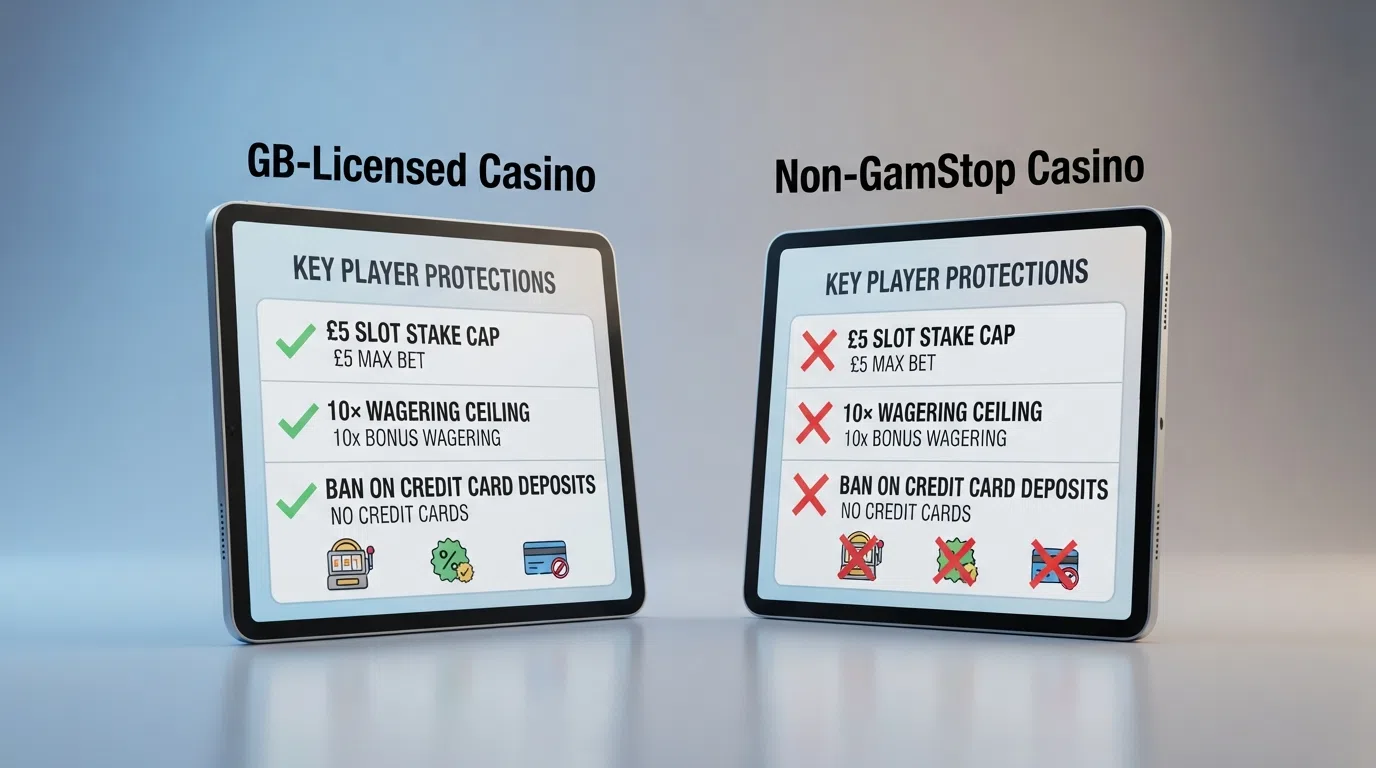
How non-GamStop casinos stay trusted without UKGC oversight
The economics are what push operators offshore in the first place. Remote Gaming Duty rises from 21% to 40% on 1 April 2026 for GB-licensed operators, and a statutory levy of 1.1% of gross gambling yield sits on top of that from 6 April 2025. The total cost of carrying a GB licence against the GB player base is now meaningfully heavier than it was three years ago, and an operator without a GB licence keeps the whole difference. A 40-percentage-point gap in tax on the same revenue line is enough to fund marketing budgets, larger welcome packages, and higher withdrawal ceilings than a GB-licensed competitor can offer — and it is also why the offshore market keeps producing brands. What it cannot fund, at least not on the same scale, is the regulator that watches what the operator does with the money once it has it.
The ten offshore casinos that earned our trust in 2026
The ten are ranked by the trio the keyword actually asks for: licence tier, transparency on the bonus terms, and payment reliability. None of them is GB-licensed, every one is offshore, and the table lays out what each carries before the prose goes into the differences.
| Operator | UK licence status | Licence jurisdiction | Welcome offer | Wagering requirement | No-deposit offer |
|---|---|---|---|---|---|
| MyStake | Not GB-licensed | Curaçao (OGL/2024/1798/1048) | 300% up to £1,500 (150/100/50) | 30× | 30 spins |
| Goldenbet | Not GB-licensed | Curaçao (OGL/2024/1587/0365) | 300% up to £1,500 + 100 FS | 35× | — |
| Freshbet | Not GB-licensed | Curaçao | 100% up to £500 (250% £1,500 total) | 30× | 25 spins |
| Donbet | Not GB-licensed | Curaçao | 150% up to £750 + 50 FS | 30× | 15 spins at 10p |
| Rolletto | Not GB-licensed | Curaçao | Up to £5,500 + 200 FS | 30× | 100 FS on Book of Dead |
| Cosmobet | Not GB-licensed | Curaçao | 100% up to £500 + up to 250 FS | 30× / 7 days | — |
| BC.Game | Not GB-licensed | Curaçao (GCB) | Four-tier up to 360% (180% first) | — | — |
| Stake | Not GB-licensed | Curaçao | No welcome offer | n/a | — |
| WinSpirit | Not GB-licensed | Curaçao (OGL/2024/923/0383) | 100% + 100 FS | — | 20 spins |
| Cloudbet | Not GB-licensed | Curaçao + Anjouan | 100% up to 5 BTC | — | — |
A dash in the wagering or no-deposit column is not a low value; it is the absence of a verified figure in the research. Where research confirmed the term, it sits in the table. Where it did not, the cell is empty and the prose below handles the operator on its own merits.
MyStake Casino
MyStake is the most transparent brand in the group. The Santeda licence number (OGL/2024/1798/1048) is the single piece of evidence a player can check once and use for the other six Santeda brands, and the welcome offer is laid out across three deposits at 150%, 100% and 50% to a total of £1,500. The wagering is 30× on deposit and bonus combined with a 30-day validity, which is on the long end of the offshore market. The 30 no-deposit spins on registration are the easiest free trial in the ten, and the £7,500 weekly withdrawal ceiling is a high-limit option among the Curaçao-licensed brands. That ceiling is reduced when a player’s balance exceeds 10× their total deposits, which is a term worth reading before a big win — the cap that looks generous on day one tightens once the maths of cumulative play is taken into account. This operator offers the most legible contract of the entire offshore shortlist.
Goldenbet Casino
Goldenbet is the same group’s deposit-gated twin. The 300% match across three deposits plus 100 free spins is in the same envelope as MyStake’s offer, and the wagering is heavier at 35× bonus funds. Goldenbet has no no-deposit offer; the welcome requires a deposit, and the 100 free spins are bundled with the matched deposit rather than front-loaded. The Curaçao register confirms a different licence number (OGL/2024/1587/0365), which is useful for the player who wants to verify the brand specifically rather than the parent group. Verdict: a marginally tougher wagering multiple than MyStake with the same Santeda backing, picked by a player who wants a separate register entry for the brand they play on.
Freshbet Casino
Freshbet runs a more modest first-deposit headline at 100% to £500, with the wider 250% to £1,500 total available across three deposits. The 25 no-deposit spins on registration are a real deposit-free entry point, and the 30× wagering is in line with the rest of the Curaçao set. The licence is Curaçao but the specific number was not confirmed in this run’s research; the CGA register should be checked for the current OGL/ number before a deposit. Verdict: a smaller first-deposit match with a confirmed no-deposit add-on, the right pick for a player who wants to test the cashier before committing more than the £20 minimum.
Donbet Casino
Donbet splits its welcome across a 150% casino offer up to £750 plus 50 free spins, with a separate 170% crypto bonus up to £1,000 plus 100 free spins for crypto depositors. The 15 no-deposit spins arrive on a code-triggered basis and are fixed at 10p per spin, which makes the implied cap on the no-deposit value legible before the player claims it. The 15% Mafia Room VIP cashback is a recurring-value offer in the Curaçao set that holds its weight across more than a month, and the GTW B.V. licence-entity transition flagged in research is worth checking against the CGA register for the current entity name. Verdict: the cashback pick, a brand in the ten with a recurring return that does not depend on a fresh deposit each week.
Rolletto Casino
Rolletto carries the largest headline bonus in the ten at up to £5,500 plus 200 free spins across the first three deposits. The 100 no-deposit spins on Book of Dead are the only no-deposit offer in the page that names its slot and that slot’s RTP (96.21% on Play’n GO’s Book of Dead), which makes the implied value of the free trial easier to read than a generic spin bundle. The 30× wagering is on deposit and bonus combined. Verdict: the bonus-hunter’s pick, the right brand for a player whose read of the page is that they are here for the matched-deposit ceiling and the named no-deposit slot.
Cosmobet Casino
Cosmobet is the library pick. The 100% to £500 plus up to 250 free spins is a competitive match, but the differentiator is the provider depth: 100+ studios behind 6,000+ games, which is the widest single-operator library in the page. The 30× wagering is tight at seven days, which is shorter than the 30-day window most of the set carries and which means a player who does not clear the bonus in the first week loses the bonus funds and the winnings attached to them. Verdict: a brand for a player who plays the catalogue rather than the welcome offer, and who is willing to keep the play tight enough to clear a seven-day window.
BC.Game
BC.Game is the crypto-first house at the top of the page. The four-tier welcome package reaches 360% in total, with 180% on the first deposit alone, and the platform is built around the coin rather than the card. Payouts are instant on the crypto rail. The wagering multiple is not confirmed in this run’s research, and the small base of conventional payment methods means a fiat-only player will not get the same offer as a crypto-funded one. Verdict: the brand for a player who already holds BTC, ETH or USDT and wants the matched deposit paid out the same hour, accepting the narrower payment shelf as the price of the speed.
Stake Casino
Stake is the page’s only no-welcome-offer operator, and the absence is on purpose. The brand is built around daily races, reload promotions and its proprietary Stake originals rather than a one-off matched deposit. The crypto rail is the only one that matters; fiat funding is supported but not the focus. Payouts are instant on crypto. Verdict: the brand for a player who has decided that welcome offers are not the value they once were and who would rather have a daily race leaderboard than a 300% match with a 35× clause behind it.
WinSpirit Casino
WinSpirit runs a 100% match plus 100 free spins, with 20 no-deposit spins on top. The Curaçao licence (OGL/2024/923/0383) is independently registered, not a Santeda number. The payout story is split: crypto and e-wallets clear in 0–24 hours, cards and bank wire take 3–7 days, which is the widest spread on the page. Eleven cryptocurrencies are listed. This is a solid choice for a player seeking a non-Santeda registry entry, provided they can accept the slower card payout timelines.
Cloudbet
Cloudbet is the dual-licensed BTC house. The 100% match reaches 5 BTC, the minimum deposit is 0.001 BTC, and the Curaçao plus Anjouan dual licence is the only one in the page that carries two regulators’ names on it. The platform is crypto-first in the same way as BC.Game and Stake, with the same instant-crypto payout profile. Verdict: the brand for a high-stakes BTC player who wants the ceiling and the dual-licence backstop, accepting that fiat options are limited and the welcome is denominated in Bitcoin rather than pounds.
How to vet a non-GamStop casino yourself
The GB regulator will not do the check. The reader has to do it.
Step-by-step evaluation framework
The order matters. The first move is the register, the second is the bonus terms, the third is the cashier.
- Find the licence number in the casino’s footer or its terms of service, then type it into the Curaçao Gaming Authority register at Cga.cw. The brand name in the register must match the brand name in the URL, or the licence is being held by a different entity than the one the player is signing up to.
- Read the bonus terms before depositing. The wagering multiple, the expiry window, the cap on no-deposit winnings, and the list of excluded games are all in the small print. A 30× wagering on a 30-day window is a different contract from a 30× wagering on a 7-day window, and the second costs more in lost bonuses than the first.
- Make the smallest real withdrawal the operator allows, as soon as the account is funded. The test is not whether the deposit arrived; it is whether the operator will return a small amount of the player’s own money without inventing a verification hurdle. If the test withdrawal stalls or arrives with a deduction not in the terms, the next deposit is the last.
Red flags vs green flags
A visible licence number that resolves on the CGA register is the floor, not the ceiling. A bonus terms page that names a cashout cap below £200 on a no-deposit freebie is the industry norm, not a red flag on its own. The red flags that should end a sign-up are a missing licence number, a licence number that does not appear on the register, a terms page that ties the welcome offer to deposits that exceed what the player can afford, a registered-address owner that runs more than ten brands at once without a corporate-group disclosure page, and a customer-support channel that does not respond within 24 hours to a pre-deposit query. The green flags are a register match, a bonus terms page that names the wagering and the expiry in the same sentence, a withdrawal that clears inside the advertised window, and a corporate page that lists the parent and the licence for each brand it operates.
Finding the most trusted option for your needs
The right brand depends on what the player actually wants. A crypto-funded player who wants the welcome paid out the same hour lands on BC.Game, Stake or Cloudbet. A fiat-funded player who wants the largest matched deposit and the most legible terms lands on MyStake. A bonus hunter who reads the no-deposit value of free spins lands on Rolletto, where the 100 no-deposit spins on Book of Dead name the slot and its 96.21% RTP. A player who wants a recurring return rather than a one-off welcome lands on Donbet’s 15% Mafia Room cashback. A player who wants the widest library lands on Cosmobet’s 100+ providers. A player who wants a register entry that is not the Santeda group lands on WinSpirit. The player who wants none of a welcome and is happy to chase daily races lands on Stake.
Why your non-GamStop bonus is smaller than it looks
The wagering multiple and the RTP quietly shrink every headline figure. The bonus word is “free”. The bonus maths says otherwise.
Welcome offers and sign-up bonuses
A 300% match across three deposits is three separate wagers, not one. MyStake’s 150% on the first deposit, 100% on the second, 50% on the third, is a single player going through the same wagering requirement three times. The 30× combined on deposit plus bonus at MyStake is on a 30-day window; Goldenbet’s 35× is on a tighter window, and Cosmobet’s 30× is on a 7-day window that leaves no room for a week of reading the terms. A player who sees “300%” in the headline and treats it as a single bonus has misunderstood the contract.
No-deposit bonuses
Five of the ten offer something on registration without a deposit. MyStake’s 30 spins, Freshbet’s 25, Donbet’s 15 at a fixed 10p per spin, Rolletto’s 100 on Book of Dead, and WinSpirit’s 20. The cost of those free trials is in the wagering on the winnings — 20× to 60× is the offshore market’s range, with 35× the most common single figure — and in the cashout caps, which sit between £50 and £200 across the offshore market. The 15 no-deposit spins at Donbet are fixed at 10p, so the maximum value of the no-deposit offer is £1.50 in spins before wagering; the implied value of the 100 no-deposit spins at Rolletto depends on the spin value, which the operator sets. Either way, the no-deposit offer is a free trial, not a free lunch.
Free-spins offers
Spins are bonuses in another wrapper. A 100 free-spin offer from Goldenbet or the 250-spin ceiling at Cosmobet looks like volume, but the winnings from those spins inherit the same 30× to 35× wagering multiple as the matched-deposit bonus. The named slot matters because it sets the RTP. Rolletto’s 100 no-deposit spins on Book of Dead are the page’s only named no-deposit slot, and Book of Dead carries a 96.21% RTP from Play’n GO. The other free-spin bundles do not name a slot in research, which means the player cannot check the implied return before claiming.
Low-wagering and fair-terms bonuses
The GB cap is 10×, set in LCCP Social Responsibility Code 5.1.1 on 19 December 2025. Any page quoting 40× or 60× is describing a pre-2025 market. The offshore set is sitting at 20× to 60×, with 35× the most common figure, and not one of the ten is at 10×. There is no low-wagering outlier in the page. The fair-terms brand is the one that is closest to 30×, that names a 30-day window, and that does not require three deposits before the welcome clears. MyStake is the closest fit, and it is still 30× rather than 10×.
Cashback and loyalty rewards
Cashback is the steadier return. The 15% Mafia Room VIP cashback at Donbet is the recurring-value offer in the ten that holds its weight across more than a month — it pays on net losses in the room rather than on a one-off matched deposit, and it does not have a wagering multiple attached to the cashback itself. Stake’s daily races and reload promotions are the second recurring-value offer, paid as cash rather than bonus funds and so not subject to a clearing requirement. A player who reads the page as a comparison of headline bonuses has missed the two offers on it that pay out as cash.
Getting paid: where non-GamStop withdrawals stall
The rails are different; the promises are similar; the delivery is uneven.
E-wallet casinos
Skrill, Neteller, MiFinity, MuchBetter, AstroPay, Jeton and ecoPayz are the e-wallets that appear across the ten. They move money faster than cards, with the same-day-to-24-hour profile that the offshore market has settled on. The crypto-first operators (BC.Game, Stake, Cloudbet) limit the e-wallet shelf in favour of the coin; the Curaçao brands carry a wider shelf. A player with an e-wallet funded in pounds will reach a payout faster than a card-funded player at almost every brand in the page.
Paysafecard and prepaid options
Paysafecard is a deposit-only voucher. It funds a casino account at MyStake, Goldenbet and Cosmobet among the ten, and it cannot receive a withdrawal. A player who funds the account with a Paysafecard voucher has to register a separate withdrawal method before the first cashout, and that registration is the point at which a KYC check typically begins. The voucher is the easy way in; the bank account or e-wallet behind the withdrawal is the part that has to verify.
Deposit and withdrawal speed
The speed gap is the clearest spread in the page. WinSpirit pays crypto and e-wallets in 0–24 hours and cards and bank wire in 3–7 days. BC.Game, Stake and Cloudbet pay crypto instantly and offer the same 3–7-day profile on the limited fiat options they carry. A player choosing between the rails is choosing between an instant crypto payout and a four-day card payout on the same brand, and the choice is made at the deposit, not at the withdrawal.
Payout reliability and limits
Reliability is the question that sits behind the speed. MyStake’s £7,500 weekly withdrawal ceiling is the largest single-brand cap on the Curaçao side, with a reduction rule that kicks in when a player’s balance exceeds 10× their cumulative deposits. The rule is the operator’s protection against a player withdrawing a balance that does not match their deposit history, and it is also the reason a big win does not always leave in one weekly slice. The other Curaçao brands carry their own caps, generally lower; the crypto-first brands do not publish a pounds cap because their currency is the coin. The hardest reliability question is the one the GB market has an answer for and the offshore market does not: what does the player do when the operator refuses the payout? The GB answer is the Commission complaints route and the approved ADR provider. The offshore answer is the operator’s own terms of service, the licence regulator’s complaint process, and a much longer wait for any resolution.
Crypto deposits: faster money, fewer protections
The same coins that speed payouts also remove the paper trail a dispute relies on.
Bitcoin casinos
Bitcoin is the default coin across the ten, from the 5 BTC match ceiling at Cloudbet down to the $10-equivalent minimum at BC.Game and Stake. The welcome offers sit on top of the coin rather than on top of the pound, and a player reading the bonus in pounds is reading a converted number rather than a contract. The 5 BTC ceiling at Cloudbet is the headline; the £1,500 ceiling at MyStake is the pounds-denominated equivalent of a much lower BTC figure at today’s rate, and the comparison is not always in the player’s favour.
Ethereum and Dogecoin options
BTC, ETH, LTC, USDT, DOGE, TRX, BCH, XRP, DASH and USDC are the coins that appear across the ten. WinSpirit lists eleven cryptocurrencies. The alt-coins ride alongside Bitcoin on the same rails, with the same instant payout profile and the same irreversible-transaction caveat. A player funded in USDT is funding a stablecoin rather than a volatile coin, which is the right choice for the player who wants the speed of crypto without the price-movement risk between deposit and withdrawal.
No-KYC and anonymous play
Crypto reduces the identity trail. The GB licence requires KYC before deposit since 7 May 2019, and an offshore site has no such rule. The cost of that reduction is the loss of the KYC record that a dispute relies on. A player who funded a GB-licensed account with a verified bank statement and a verified address has a paper trail that an alternative dispute resolution provider can read. A player who funded an offshore account with a Bitcoin wallet has a paper trail that ends at the wallet, and the operator’s refusal to pay becomes very hard to escalate from there.
Crypto vs fiat: trust considerations
The same operator behaves differently by payment rail. Crypto is instant and irreversible; cards carry the chargeback right of a credit-card network but a 3-to-7-day payout. The trade is speed against recourse. A player who picks the crypto rail is picking the rail that pays out in minutes, with no chargeback lever if it does not. A player who picks the card rail is picking the rail that pays out in days, with a chargeback lever that the card network will look at if the operator refuses the payout. Neither rail is the safer one in all situations; the safer one is the rail that matches the size of the bet the player can afford to lose.
The most trusted crypto casinos
BC.Game, Stake and Cloudbet are the crypto-first houses. The other seven accept crypto but are built around the fiat shelf. The crypto-first houses are the right brand for the player who already holds the coin and wants the welcome paid out in the same hour; the fiat-shelf brands are the right brand for the player who wants a wider cashier and is willing to wait 0–24 hours on the e-wallet rail or 3–7 days on the card.
Playing non-GamStop casinos from your phone
The casino fits a pocket even where the app store will not list it.
Native apps vs mobile browser
Native apps are rare off GamStop. The Apple App Store and Google Play both enforce rules that keep unlicensed gambling apps out of the UK storefronts, and a “download” link in an offshore casino’s footer is most often an Android APK to sideload. The default play is the mobile browser, which is what the page assumes unless a brand has specifically shipped a listed UK app. None of the ten on this page ships a listed UK app.
iOS and Android compatibility
Both platforms reach the same browser lobby. iOS in Safari and Android in Chrome both load the same HTML5 game client, and the games do not change between the two. The sideloading risk is on Android, where installing an APK from a casino’s footer carries the standard install-from-unknown-sources caveat; on iOS the equivalent is a Web Clip to the home screen, which is a bookmark rather than an install and which does not ask the device for new permissions.
Mobile-specific features and limitations
The full game library is reachable on mobile. The 70+ to 100+ provider libraries across the ten are HTML5 builds, and the same Pragmatic Play, NetEnt, Evolution and Play’n GO titles run on a phone screen. The live-dealer tables are also HTML5, with the smaller screen changing the ergonomics of multi-table play but not the underlying game. Nothing is lost on mobile; nothing is gained.
Trust signals on mobile
The licence check is harder, not easier, on a phone. A footer badge is small, and a fake one is easy to render at any size. The CGA register has a mobile version, and the verification is the same number-into-the-search-box check on a phone as on a desktop. The session-security check is the TLS lock in the address bar and the privacy notice on data retention; neither is weaker on mobile than on desktop, but neither is stronger either.
Real games, real providers — oversight is the missing piece
The slots are licensed IP. The operator is not.
Online slots: trusted titles and sites
Pragmatic Play and NetEnt supply the bulk of the slot library across the ten. The only slot with a named RTP in this run’s research is Book of Dead (Play’n GO) at 96.21%, which is the slot behind Rolletto’s 100 no-deposit spins. The £5 and £2 GB stake caps do not apply off the GB licence, and a £50 spin is a legal move on every Curaçao-licensed brand on the page.
Live casino: roulette, blackjack, baccarat
Live dealer runs on Evolution and Pragmatic across the ten. The tables are real, the dealers are real, the games are the same roulette, blackjack and baccarat titles that ship to every other regulated market. The missing piece is the UK live-dealer protection regime that does not apply here: no GB game-speed rules, no GB stake limits, no GB live-dealer advertising restrictions.
Provider trust: NetEnt, Microgaming, Playtech, RTG
NetEnt, Microgaming, Play’n GO and Pragmatic appear across the ten as the studio names that signal a real library. RTG (Real Time Gaming) is a legacy niche that appears in some offshore casinos but is not in the page’s ten. The provider’s presence is a positive signal for the game library; it is not a licence, and it does not tell the player anything about the host’s regulator.
Bingo and specialist games
Bingo and specialist titles exist at several of the ten, alongside the slot and live-dealer libraries. They inherit the same Curaçao licence, the same payment rails, and the same absence of a GB consumer-protection backstop. For a user playing here, these games are governed by exactly the same terms and operational risks as the casino’s core slot selection.
High-roller play
The biggest welcome packages target the high roller. Rolletto’s up to £5,500 plus 200 free spins is the largest matched-deposit envelope on the page, and the £7,500 weekly withdrawal cap at MyStake is the largest single-brand ceiling. The two meet the same player’s need at different points: a big match on the way in, a big cap on the way out. Neither changes the underlying 30× to 35× wagering, which is the same multiple that applies to a £20 deposit.
Sweepstakes-style options
Sweepstakes-style play is a softer legal frame that appears in some US-facing markets. It is not a GB-licensed route, and the ten on the page do not run on a sweepstakes model. A player who is offered a sweepstakes-style route by an offshore casino is being offered a different contract from a real-money welcome, and the contract’s value depends on the rules the sweepstakes operator publishes rather than the regulator that watches it.
New non-GamStop casinos in 2026: newest is not most trusted
Freshness is a marketing claim, not a trust signal.
The newest trusted non-GamStop entries
The newest names in the offshore market typically reuse an existing operator’s licence. The seven Santeda brands are the obvious example: a new Santeda launch inherits the OGL/2024/1798/1048 register entry, the same payment rails, the same bonus structure, and the same payout history (or the lack of one) as the brand it was spun out of. A new name is not a new company; it is a new front on the same operation.
What makes a new casino trustworthy
The same registry check applies harder to a fresh brand. A new name is a new risk surface, and the licence number is the first thing to verify because the licence belongs to the operator, not the brand. A fresh licence number is a better sign than a reissued footer; a parent group’s track record is the second thing to verify, and a group with several brands under a single Curaçao licence is a different bet from a group with several licences.
New-casino bonuses vs established reliability
The newest offer rarely beats the oldest payout record. A new casino front-loads the welcome package to compensate for a missing reputation; an established operator holds a payout history that the player can read on independent forums. The trade is bonus size against proof, and the proof is the more useful of the two for a player who has decided to play off GamStop at all.
Safer gambling tools when GamStop can’t reach you
The help exists off GamStop too. The player has to bring it.
Self-exclusion tools outside GamStop
Site-level exclusion binds only the casino at which the player asks for it. There is no cross-operator self-exclusion network off GamStop; the offshore set is not a single database, and a player who excludes from one Curaçao-licensed casino can register at another the same evening. Gamban is the device-level tool that blocks gambling sites across an individual phone or laptop and that reaches brands GamStop cannot. The National Gambling Support Network and the National Gambling Helpline at 0808 8020 133 are the UK-side help lines that operate independently of the casino the player is using.
Deposit limits and reality checks
The GB market mandates a deposit limit before first deposit from 31 October 2025 and a standardised “deposit limit” definition by 30 September 2026. None of the ten on the page is bound by either rule. A player who wants a deposit limit on an offshore casino has to set it inside the account settings, and not every brand on the page makes the limit easy to find. The right move is the same one the GB market is moving toward: set the limit before the first deposit, and at a number the player can afford to lose.
Recognising problem-gambling signs
The prevalence numbers are the reason this section exists. In England, around 0.5% of adults experience problem gambling and 3.8% are at elevated risk, with almost 1.6 million adults who gamble potentially benefiting from some type of treatment or support. The 15.6% PGSI 1+ figure for 2024 is up from 13.1% in 2023. The 11,960 clients treated in 2024/25 are up 11% on the prior year, and 93% of clients completing treatment saw improvement. GamCare’s 996 referrals in January 2026 are up 48% year-on-year. The treatment works; the route into it starts with the National Gambling Helpline at 0808 8020 133 or the GamCare website. A player who reads this page and decides the off-GamStop route is the right one for them is also the player who should know where the help is, in case the route is the wrong one for them six months later.
How we checked and ranked these casinos
The evaluation basis is the only one the page can stand behind. The ten were verified against the Curaçao Gaming Authority register at Cga.cw, with the OGL/ number from each brand’s footer or terms page checked against the active register. Where a register entry did not appear, the operator was either moved to a dash in the table or excluded from the page; the Santeda group licence (OGL/2024/1798/1048) is the single piece of evidence that covers MyStake, Goldenbet, Donbet, Freshbet, Rolletto, Cosmobet and Velobet. The bonus terms in the table are the terms published in the brands’ own bonus pages, taken at the time of research. The wagering multiples and the no-deposit counts are the values the research could confirm, with no invented weighting or percentages added to fill the gaps. The payout speeds in the prose are the speeds the brands publish, not speeds the page has measured. The ranking order is by licence tier, transparency on the bonus, and payment reliability — three criteria, applied in that order, with no proprietary scoring system behind them.

What to actually do before you play off GamStop
The decision this page has been building toward comes down to three moves.
Verify the licence. Type the OGL/ number from the casino’s footer into the Curaçao Gaming Authority register and confirm that the brand name in the register matches the brand name in the URL. A mismatch is a hard stop.
Cap the deposit. Set the limit inside the account before the first deposit, and at a number the player can afford to lose. The GB market is moving toward a mandatory pre-deposit limit; the offshore market has no such rule, which means the rule has to be self-imposed.
Treat the bonus as a cost, not a gift. The headline “300%” is the cost the player will pay in wagering across three deposits. A 30× multiple on a £1,500 bonus is £45,000 of wagering before the bonus funds become withdrawable cash, and the expected loss on that wagering at the 96.21% Book of Dead RTP is £1,762.95 — which is more than the bonus itself. The bonus is a contract that the house expects to come out ahead on, and the player who treats it as a discount on the first deposit has misunderstood the deal. A player who treats it as a marketing line that has to be earned before it can be spent is reading the contract correctly.
The page does not pick a brand. The page is the shortlist and the evaluation, not a recommendation. The decision is the player’s, with a verified licence, a deposit ceiling they set themselves, and a clear-eyed read of what a 30× to 35× multiple actually costs in expected loss. The rest is the player’s call.
Frequently asked questions
Is it legal for a British player to gamble at a casino outside GamStop?
Gambling at an offshore casino is not a criminal offence for the player. The criminal offence sits with the operator under section 33 of the Gambling Act 2005, which targets the unlicensed provision of gambling to GB customers. The player forfeits the consumer protections that come with a GB licence, including the Commission complaints route, the approved ADR provider, and the stake and wagering caps, but the act of placing a bet on an unlicensed site is not itself prosecuted. The relevant sections of the Act apply to the operator, the advertiser and any GB-based intermediary.
What happens if an offshore casino withholds my winnings?
The first step is the operator’s own complaints process, in writing, against the terms of service. The second step is the licence regulator — the Curaçao Gaming Authority for the Curaçao-licensed operators, the MGA Player Support Unit for any Malta-licensed brand, the Anjouan regulator for the dual-licensed Cloudbet. There is no GB Commission complaints route, no approved UK ADR provider, and no Financial Ombudsman Service involvement. The escalation is slower and the outcome is less certain than it would be at a GB-licensed casino, and a player who is not comfortable with that should not deposit at the offshore brand in the first place.
What happens to my money if a non-GamStop casino goes bankrupt?
The answer depends on the licence and the operator’s terms. MGA-licensed casinos operate under a segregated-player-funds regime that protects the balance in an insolvency. Curaçao-licensed casinos do not enforce the same standard with comparable rigour, and the LOK reform that came into force in December 2024 did not change that. A player whose balance sits with a Curaçao-licensed operator that goes into administration is an unsecured creditor, and the recovery process is the same as for any other unsecured creditor — slow, partial, and uncertain.
Can I deposit with Bitcoin or another cryptocurrency at these casinos?
All ten of the operators on the page accept Bitcoin. Ethereum, Litecoin, USDT, Dogecoin, TRX, Bitcoin Cash, XRP, DASH and USDC are also accepted at most of them, and WinSpirit lists eleven cryptocurrencies in total. BC.Game, Stake and Cloudbet are crypto-first brands with the instant-payout profile; the Curaçao-shelf brands accept crypto alongside cards and e-wallets, with a 0–24-hour payout on the e-wallet rail. The GB market does not allow crypto deposits at UKGC-licensed operators, which is one of the practical reasons crypto players end up on the offshore set.
Why do some UK players choose non-GamStop casinos over licensed British sites?
The reasons the page can stand behind are the absence of the GB stake caps on slots, the absence of the 10× wagering ceiling on bonuses, the option to deposit with crypto, and the option to register with an e-wallet or voucher without a full pre-deposit KYC check. The reason the page will not stand behind is the use of non-GamStop casinos to bypass a self-exclusion taken out under the GB scheme. The two are not the same, and a player who took a self-exclusion with GamStop and is reading this page to find a route around it is making a decision that the help lines at GamCare and the National Gambling Helpline are set up to talk through.
Is there any responsible-gambling support available to players off GamStop?
Yes. The National Gambling Helpline at 0808 8020 133 runs 24/7; GamCare, the National Gambling Support Network, the NHS gambling harm clinics in England, Scotland and Wales, and Gamblers Anonymous UK are all reachable from a UK phone. Gamban is the device-level tool that blocks gambling sites across a player’s phone or laptop and that reaches brands GamStop cannot. The treatment works: 93% of clients completing treatment through the National Gambling Treatment Service in 2024/25 saw improvement. The route into the help is the same whether the player is using a GB-licensed casino or an offshore one, and the help is the same too.
Can online casino software be trusted?
The games do not become rigged because the host licence moved offshore. Pragmatic Play, NetEnt, Evolution, Microgaming and Play’n GO ship the same titles to every market they serve, and the random number generators in those games are certified by independent test houses. The MGA requires certified RNG and published RTP; Curaçao requires neither with the same rigour, which means the games arrive at the offshore casino with the lab certificate already in place, and the casino’s job is to host them rather than audit them. The trust question is about the operator, not the studio.
Account – realmoney-onlinecasinos-uk
Content created by the «realmoney-onlinecasinos-uk» team