
Casino VIP Programmes in the UK — What High Rollers Actually Get, and What the New Rules Took Away
 Available in GB
The UK still runs VIP programmes, and they still pay out real value, but the gap between a VIP player and everyone else has narrowed. A dedicated host and faster withdrawals are not marketing copy — they are the perks that survive every rule the Gambling Commission has added since 2025. A 10× wagering cap, a £5 ceiling on every slot spin, and a deposit-limit prompt that fires before a first deposit have all redrawn what “high roller” means inside a UK-licensed casino. This page is the side-by-side of what ten major UK operators disclose, what the rules let them offer, and what chasing a tier actually costs.

Data current as of September 8, 2026, verified against the UK Gambling Commission’s public register and the LCCP social responsibility codes.
What a UK Casino VIP Programme Actually Delivers
A casino VIP programme is a tiered system that rewards high-spending customers with individualised benefits — a dedicated account manager, faster withdrawals, higher transaction ceilings, bespoke bonuses, and hospitality — beyond the standard points-for-play ladder that any signed-up player can join. The distinction matters because UK regulators have treated the two as different products since at least 2022, and the BGC code of conduct on High Value Customer VIP Reward Programmes treats VIP treatment as a category that warrants its own oversight.
The UK landscape in 2026 is shaped by a tight rule set: wagering requirements cannot exceed 10× the incentive amount (since 19 January 2026), mixed-product offers are banned, and direct marketing must be opt-in per product per channel. The slot stake cap of £5 per spin for over-25s and £2 for 18-to-24s, in force from April and May 2025 respectively, has shrunk the unit of play that high-roller sessions are built from. None of this has killed the VIP product. It has changed what one is worth.
The audience for a UK VIP programme is narrower than the marketing suggests. A player chasing tier status by depositing to maintain host contact is the profile the BGC code of conduct is written about. A player who already plays heavily, prefers table games, and wants faster withdrawals and a single point of contact is the profile the programme is built for. The first pays a hidden cost. The second collects what is on offer.
Inside a UK Casino VIP Programme — Status, Tiers and Access
UK programmes split into two structures. An invitation-only model keeps qualification criteria unpublished and uses operator-side signals — deposit frequency, game preference, net loss — to issue a private invite. An opt-in model lets a player enrol in a loyalty ladder and climb through public point thresholds. Virgin Games runs the first through its V Points loyalty scheme on the open side and an invitation-only Virgin Games Plus tier on the private side. Most major UK operators run the second on the surface and reserve a higher tier behind closed terms.
The tier structure is conventional: bronze, silver, gold, platinum and diamond, with a few operators using bespoke names. Each gate typically unlocks a faster withdrawal window, a higher per-transaction ceiling, a points multiplier, and a named contact. The perks that sit above tier mechanics — hospitality, event access, individualised bonuses, gifts — are reserved for the top of the ladder and almost never published. The BGC code of conduct describes them collectively as “individualised bonuses, benefits, gifts, hospitality” and a “dedicated account manager”, which is the closest the UK self-regulatory code comes to defining what a VIP programme is.
The distinction from a standard loyalty scheme is operational, not cosmetic. A loyalty scheme is points-based, transparent, and self-serve. A VIP programme is host-mediated, opaque on criteria, and individualised on reward. The code of conduct treats them differently because the failure modes differ: a points ladder fails a player who chases points they could have skipped; a VIP programme fails a player who deposits to keep the relationship alive.
The Path to VIP Status — Invitation, Qualification and Evidence
UK operators do not publish VIP qualification criteria. The reason is regulatory: the BGC code expects ongoing review, source-of-funds understanding, and intervention where a customer’s spend pattern signals harm. Publishing hard thresholds would invite players to game the criteria, and a publicly stated minimum deposit or net-loss figure would become a harm vector in its own right. So the published front of every UK VIP programme is a contact form or a “speak to your host” prompt, and the unpublished back is a deposit-frequency and game-preference model the operator keeps to itself.
The other route is through the financial vulnerability check that fires under LCCP Social Responsibility Code 3.4.4. From 30 August 2024, a light-touch check applied once a customer crossed £500 in net deposits in a rolling 30-day period; from 28 February 2025, the threshold dropped to £150. The check is not an income test — it uses publicly available data — but it can be the trigger for a source-of-funds conversation, which in turn is the trigger for a VIP host’s full onboarding. A player at sustained high spend will be asked where the money is coming from before they are offered a tier upgrade. That conversation is the regulatory shape of a UK VIP programme’s first interaction with a customer.
Most programmes keep published criteria vague on purpose. A player who asks what the threshold is has, in the operator’s model, just told the operator they are chasing a tier. The BGC code treats that as a sensitivity signal, not as interest to be rewarded.
VIP Rewards, Points and Redemption — What You Actually Get
The published rewards are the easy part: a points multiplier that increases per tier, a redemption rate on the points side, and a cashback rate that may or may not carry wagering. The unpublished rewards are where the programme is judged: a birthday bonus with terms the player has not seen until it lands, a hospitality invite whose value is hard to put on a spreadsheet, a withdrawal-window change that converts a same-day payout into a within-the-hour payout.
Cashback is the recurring reward that varies most between operators. A standard cashback rate on a UK-licensed site sits in single digits and often carries wagering. A VIP cashback rate is typically higher, may be paid in cash, and may be weekly or monthly depending on tier. The BGC code acknowledges cashback as one of the individualised benefits subject to its ongoing-review obligation, and the Gambling Commission’s guidance is that high-value-customer incentives must be consistent with the three licensing objectives. The 10× wagering cap, in force from 19 January 2026, applies to VIP bonuses as much as to standard offers — there is no VIP carve-out in the rule.
The gap between marketed perks and what regular VIP players report receiving is real and worth naming. Marketed perks read like an experience; reported perks read like a faster payout and a named contact. A dedicated host is the perk that most reliably appears, and the one least often documented in public terms. The hospitality and gifts exist, but they tend to arrive at the top of the ladder and to scale with sustained spend, not as a standard part of a tier.
Dedicated Hosts, Priority Support and the Service Layer
The dedicated account manager is the single perk that most reliably separates a genuine VIP programme from a self-serve loyalty scheme — and the one least often documented in public terms. A host is a person a player can contact directly, with a known response window, who can authorise withdrawals, escalate a complaint, or arrange a benefit the website does not advertise. The BGC code of conduct names “dedicated account manager” as one of the individualised benefits the code’s ongoing-review obligation covers, which is the regulator’s way of saying the perk is real and worth overseeing.
Priority support is the same idea at the customer-service layer: a named inbox, a direct phone line, or a queue that moves faster. The withdrawal-processing speed gain is where VIP status has the most measurable impact on a customer’s week. Standard UK withdrawals clear in hours-to-days depending on method; VIP withdrawals often clear within the hour during business hours, and some operators extend weekend cover to top tiers. None of this is published as a tier benefit; it is offered at the host’s discretion.
Event access and hospitality invites are the upper end of the perk stack and the part that BGC code describes most carefully. Hospitality — tickets, hospitality suites, travel — is an individualised benefit that the code requires operators to keep under review. A player who reports a tier upgrade and a sudden stream of invites is at the part of the programme the regulator watches most closely.
Frequently Asked Questions
How is a casino VIP programme different from a standard loyalty scheme?
A loyalty scheme is typically transparent, points-based, and available to all players. In contrast, a VIP programme is often host-mediated, invitation-only, and provides individualised benefits. While loyalty schemes reward consistent play through public ladders, VIP programmes focus on tailored rewards for high-value customers, requiring more personal oversight from operators.
How do UK-licensed casinos select or invite VIP players, and what evidence is required at higher spend levels?
Selection is rarely public. Operators use internal models based on deposit frequency and game preferences to identify candidates. Higher-tier onboarding involves a source-of-funds conversation, driven by regulatory requirements to verify that sustained high spending aligns with the customer’s financial profile, ensuring the relationship remains consistent with licensing objectives.
Are VIP bonuses in the UK subject to a wagering cap, and what is the maximum allowed?
Yes, UK-licensed operators are bound by a strict wagering cap on all incentives. Since 19 January 2026, wagering requirements for VIP bonuses, like standard offers, cannot exceed 10 times the incentive amount. This regulation aims to prevent predatory bonus design and ensure that incentives provide genuine value to players.
What deposit-limit, affordability and financial-risk rules apply to high rollers at UK-licensed casinos?
Operators must prompt all customers to set deposit limits before their first deposit. While current rules focus on light-touch financial vulnerability checks at £150 in net deposits, high rollers are subject to ongoing review. Operators must also provide standardised gross deposit limit tools that give prominence to total money paid into accounts.
Can a UK player use crypto deposits for VIP status at licensed casinos?
No. UK-licensed casinos are prohibited from accepting credit-card payments, including credit-card-funded e-wallet routes. Because anonymous play is blocked by mandatory ID-verification requirements before any deposit, crypto is not a usable payment method. Any casino offering crypto deposits is operating outside the GB-licensed market and lacks UK protections.
What responsible-gambling tools and exclusion options are available if VIP play becomes harmful?
Players have access to GAMSTOP for multi-operator self-exclusion, which prevents access to all GB-licensed sites. Operators must also offer reality checks, time-outs, and deposit limits. If help is needed, the National Gambling Helpline (0808 8020 133) provides 24/7 support, signposting treatment pathways and professional advice for managing gambling-related harm.
The £5 per-spin slot cap has redefined what high-roller play looks like. A player who would historically have placed £20 or £50 per spin on a high-volatility title is now limited to £5 for over-25s and £2 for 18-to-24s, with the cap applying to the total staked within a single game cycle — it cannot be split across parts of a spin. The cap is in force from 9 April 2025 for over-25s and 21 May 2025 for younger adults. For a high-roller slots player, the unit of risk is one-fifth to one-tenth of what it was. The volume has to rise to reach the same session cost, and the session looks different — longer, lower-variance per spin, more rounds.
The mandatory deposit-limit prompt from 31 October 2025 is the other constraint that shapes a high-roller session. Operators must offer a customer the chance to set a financial limit before their first deposit, and the limit must be easy to review and change. The standardised gross deposit limit takes precedence from 30 September 2026 (originally due 30 June 2026): only a limit based on money paid into the account may be called a “deposit limit”, and it must be given at least equal prominence to other financial limits. A player who wants to set no limit is still offered one — the prompt is mandatory, the limit itself is customer-set.
The UK operators that have maintained or expanded VIP programmes in 2026 are the major multi-brand groups — Entain, Flutter, bet365 — alongside a handful of UK-owned independents. The tension between VIP incentives and the UKGC licensing objectives is the live regulatory question of the year: how do you keep a high-value-customer programme consistent with protecting children and other vulnerable persons from harm? The answer so far is a combination of source-of-funds conversations, ongoing review, and bonus rules that constrain the size of the inducement. The answer is not yet a ban on VIP programmes, and the regulator’s position is that well-run programmes are consistent with the objectives if they are properly overseen.
Ten UK Casinos With VIP Programmes — What They Actually Disclose
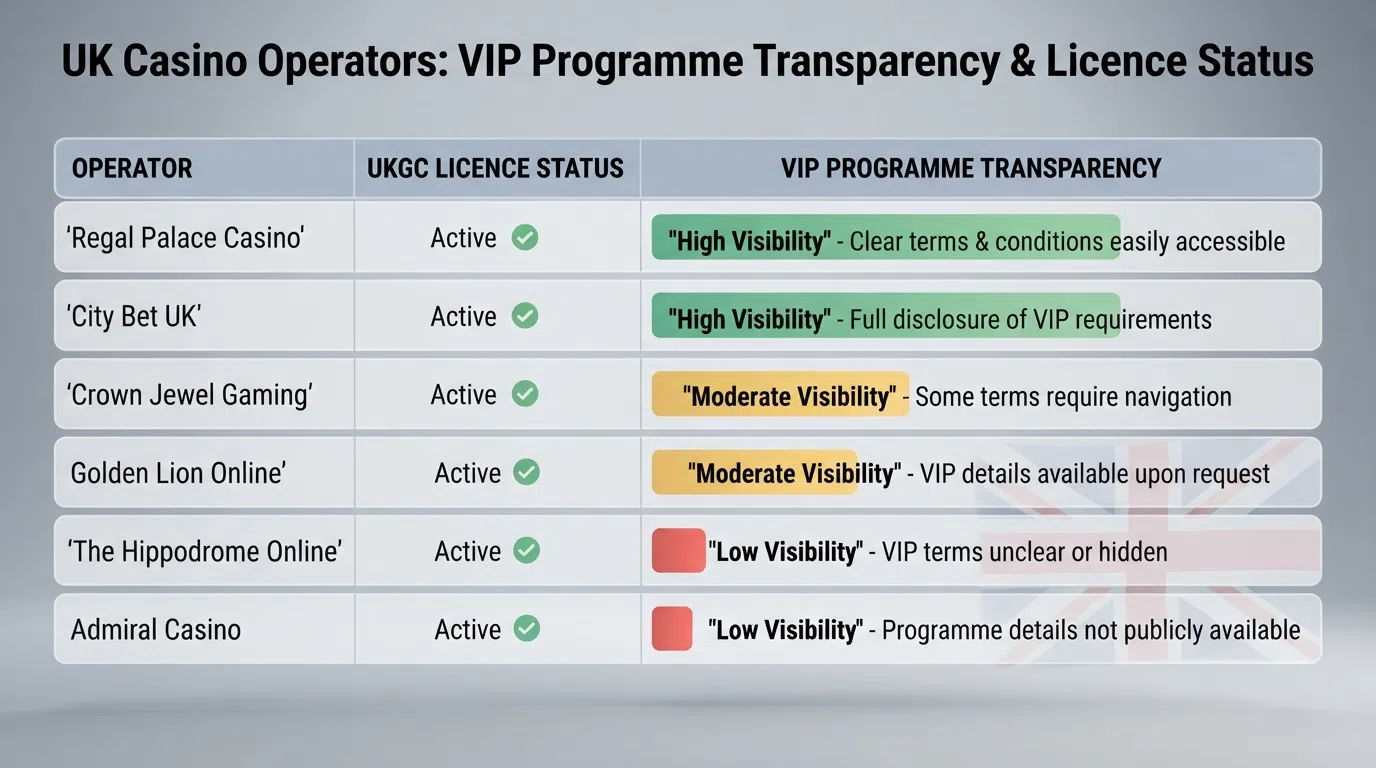
A ranked operator list only carries weight if the reader can see what the ranking rests on. This page’s comparison is built from two sources: the UK Gambling Commission’s public register, which confirms each operator’s licence status, and primary operator pages, which is where the VIP programme terms should live if they are public. Most of the ten operators below do not publish their VIP programme terms in a place primary research can surface. That absence is itself a finding, and the table makes it visible.
| Casino | UKGC Licensed | Public VIP Programme | What the Operator Discloses |
|---|---|---|---|
| bet365 | Yes | Not published | VIP programme terms not surfaced from primary operator pages |
| William Hill | Yes | No (Plus is a retail-linkage scheme) | William Hill Plus is online-to-retail, not a VIP tier scheme |
| Sky Bet | Yes | Not published | VIP programme structure not surfaced in primary research |
| Ladbrokes | Yes | Not published | VIP programme structure not surfaced in primary research |
| Paddy Power | Yes | Not published | VIP programme structure not surfaced in primary research |
| Coral | Yes | Not published | VIP programme structure not surfaced in primary research |
| Betfred | Yes | Not published | VIP programme and dedicated host not confirmed in primary research |
| Virgin Games | Yes | Yes — V Points plus Virgin Games Plus | V Points loyalty scheme and invitation-only Virgin Games Plus VIP tier described in surfaced sources |
| Betway | Yes | Referenced in comparison sources | Betway Plus scheme referenced in third-party comparisons; primary terms not captured |
| 32Red | Yes | Historical loyalty features only | Review sources describe historical loyalty features; no current primary terms |
Regulatory Overview: VIP and High-Roller Metrics
| Metric | Detail |
|---|---|
| Max Slot Stake (25+) | £5 |
| Max Slot Stake (18-24) | £2 |
| Wagering Cap on Incentives | 10× |
| Financial Vulnerability Threshold | £150 net/30 days |
| Statutory Gambling Levy | 6% |
The table’s most important column is the third. Of ten UK-licensed operators, one — Virgin Games — has a publicly named VIP tier with any surfaced detail. The rest keep their programme terms private, and a few — William Hill in particular — have a customer scheme that is not a VIP programme at all. The transparency gap is not unique to this set; it is the state of the UK VIP market. The BGC code of conduct does not require operators to publish programme terms, and the cost of publishing — a hard threshold that players chase — is the reason most keep the criteria vague.
bet365
bet365’s GB licence is confirmed by the UKGC. Specific licence or permit dates on the register detail page were not confirmed within this research budget. The gap that matters here is on the VIP side: bet365’s public-facing material covers its broader loyalty and rewards ecosystem, but a published VIP programme terms page was not surfaced from primary operator sources in this run. What is public is the operator’s general approach to in-play and pre-match pricing, its editorial coverage, and its account-management features. What is not public is a tiered VIP structure with named perks. A player who wants confirmation of bet365’s VIP offering will need to ask the operator directly, which is the same answer the table gives for most of this set.
For a player whose primary concern is whether the operator is UK-licensed and large enough to be here in two years’ time, bet365 is a robust choice. If you require explicit VIP terms to be public before joining, you may find the lack of visible documentation frustrating.
William Hill
William Hill’s GB licence is validated by the UKGC. The point of the scheme is to connect online play with retail betting-shop rewards; it is not a tiered programme of the type this page covers. A player who arrives at William Hill expecting a Virgin Games Plus or a private host will find a different product. That mismatch is worth naming, because it is the kind of thing an affiliate page buries in a paragraph.
If you are already a regular at William Hill shops, William Hill Plus is a logical step to link your accounts. However, those specifically seeking a high-tier online VIP programme featuring cashback and a personal host will likely find this service does not meet those particular expectations.
Sky Bet
Sky Bet’s GB licence is validated by the UKGC. A VIP programme structure was not confirmed in this run’s primary research. The absence is the same shape as the other major UK sportsbooks: a programme is likely to exist in some form, and the operator’s customer-base scale supports one, but the terms do not live on a page primary research can surface. A player who wants Sky Bet’s VIP terms will need to ask the operator, and the question is worth asking — a Sky Bet VIP, if it exists, will be tied to the Sky account ecosystem and may carry non-cash benefits a sportsbook-only player does not get elsewhere.
The verdict here is light because the evidence is light: the licence is solid, the brand is large, and the programme is not on the public page.
Ladbrokes
Ladbrokes’ GB licence is held with the UKGC, and the operator sits inside the Entain group, alongside Coral. A standalone Ladbrokes VIP programme structure remains opaque. Group-level player programmes may apply across the Entain brands, and a player who holds VIP status at one Entain brand may find it extends to a sibling — but this is the shape of a guess, not a published term, and the published surface of Ladbrokes does not confirm it. The page is honest about that gap.
For a player already inside the Entain ecosystem, Ladbrokes is one route; Coral is the other. The decision between them is not made on VIP terms, because neither brand publishes them in a place primary research can reach. It is made on product preference.
Paddy Power
Paddy Power’s GB licence is treated as confirmed via UKGC register surfacing for Ladbrokes and Coral group trading names, with Paddy Power itself not independently surfaced in the register snippet set this run; re-checking the register detail page is the prudent next step. A VIP programme structure was not confirmed in this run’s primary research. Paddy Power’s public stance on responsible-gambling marketing is among the more visible in the UK sector, and the brand has been the subject of ASA rulings on its promotional material — a fact that shapes how visible any VIP programme is likely to be in public terms. A Paddy Power VIP, if it exists in the form this page covers, will not be marketed loudly. It will be offered.
Paddy Power maintains a significant public profile, particularly regarding its responsible-gambling messaging, which may influence how they approach VIP marketing. If you are specifically hunting for a public VIP tier list, you will find no such detail, and interested players are encouraged to reach out to the operator directly.
Coral
Coral’s GB licence is confirmed via the UKGC public register, and the operator sits alongside Ladbrokes in the Entain group. A standalone Coral VIP programme structure was not confirmed in this run’s primary research. The group-level rewards framework that may apply across Entain brands is the same shape as the Ladbrokes situation, and the page’s verdict on that is the same: the evidence is light, and the choice between Coral and Ladbrokes is more a product preference than a VIP-terms preference.
Coral, as part of the Entain group, shares a similar operational profile to Ladbrokes. The lack of publicised VIP terms across these sibling brands suggests that loyalty perks are handled discreetly, making it difficult for new players to compare VIP incentives before committing to a specific account.
Betfred
Betfred’s GB licence is confirmed via the UKGC public register, and Betfred is the UK-headquartered independent of this set — a fact that matters because it is the only operator in the top ten that is not inside a major multi-brand group. A VIP programme structure and dedicated-host status were not confirmed in this run’s primary research. An independent operator with Betfred’s retail footprint will run a programme of some form, and the question is whether it is published.
For a player who values a UK-owned independent and the retail-shop footprint that comes with it, Betfred is a fit. For a player who needs to see the VIP terms in advance, the answer is the same as for the rest: ask, and the absence of a public page is not the absence of a programme.
Virgin Games
Virgin Games is the only featured operator with a publicly named VIP tier. The GB licence is treated as confirmed in the licensed-market ecosystem surfaced this run, with a direct UKGC register business-search snippet not captured in this run; register verification on the detail page is the prudent next step. The programme is a two-layer structure: a V Points loyalty scheme on the open side, and an invitation-only Virgin Games Plus tier on the private side. The exact qualification criteria and published terms for the Plus tier were not surfaced from a primary operator page in this run, but the existence of a named, public VIP tier is itself a differentiator in a market where most operators keep theirs private.
For a player who values published tier naming, Virgin Games is the one brand on this list that has named the product. For a player who needs the qualification criteria, the answer is still to ask, but the question is shorter here than elsewhere.
Betway
Betway’s GB licence is treated as part of the GB-licensed operator set surfaced in comparison sources, with a direct UKGC register snippet not captured in this run. The Betway Plus scheme is referenced in surfaced comparison sources as a loyalty programme, with primary-operator terms not captured in this run. The “Plus” naming convention is common in the UK sector — William Hill Plus, Virgin Games Plus, Betway Plus — and the schemes vary widely. Some are retail-linkages, some are tier-based, some are points ladders. The published surface does not always disambiguate.
For a player who knows Betway from sportsbook or casino product and wants to see the loyalty terms, the answer is to ask the operator. The risk is that “Plus” turns out to be a points ladder rather than a tiered VIP programme, and a player expecting a host is at a product named the same as a points scheme.
32Red
32Red’s GB licence is treated as part of the GB-licensed operator ecosystem surfaced this run, with a direct UKGC register snippet not captured in this run. Historical loyalty features are described in surfaced review sources, but no primary-operator VIP programme terms page was captured in this run. 32Red is the longest-standing brand in this set for online casino loyalty, and the historical surface suggests a programme that has been simplified or rebranded over time. The current shape of the programme is not in the public record that primary research can surface.
For a player who values a heritage brand with a long UK presence, 32Red is worth asking. For a player who needs the current VIP terms in advance, the gap is wider here than at Virgin Games.
Why Your 2026 VIP Bonus Is Smaller Than It Looks
The 10× wagering cap, in force from 19 January 2026, is the single biggest constraint on UK VIP bonus design in the current cycle. A bonus that once carried 35× or 50× wagering now carries a maximum of 10×, and the cap applies to VIP incentives as much as to standard ones. The arithmetic compresses the bonus’s effective value: a £100 bonus at 10× requires £1,000 of qualifying play, and the value of the bonus after the wagering is cleared is a function of the RTP of the qualifying game. A high-volatility slot that the marketing presents as the qualifying game will eat most of the bonus’s face value before the wagering clears. A low-volatility slot or a table game will preserve more of it.
A sample illustration makes the cost visible. A £100 VIP bonus at 10× wagering requires £1,000 of qualifying play. Played at a £5 per-spin stake — the maximum allowed for an over-25 at a UK-licensed casino — the bonus requires 200 spins. At the statutory minimum spin speed of 2.5 seconds per cycle, those 200 spins take 500 seconds, or about 17 minutes, of pure spin time. The expected loss across the play, at a typical slot RTP of 96%, is £40. So the bonus’s headline value of £100 has an expected cost of £40, and the net expected value to a player is £60 — before any cap on winnings, any maximum cashout, or any contribution weighting that disqualifies table games. That is the shape of a UK VIP bonus under the current cap. A player who would historically have cleared a 50× bonus at the same unit stake would have spent five times as long and lost five times as much on a purely volumetric basis, but the bonus’s face value was typically much larger to compensate.
The opt-in direct-marketing requirement, in force from 1 May 2025, adds a second constraint. A VIP host cannot push a bonus to a customer who has not opted in to direct marketing for the relevant product, on the relevant channel. The rule was designed to stop bonus-driven reactivation, and it falls hardest on programmes that built a relationship on proactive outreach. A UK VIP player in 2026 should expect a host who waits to be asked.
Welcome Bonuses, No-Deposit Offers and Free Spins for VIPs
A VIP welcome-bonus structure under the 10× cap looks like a smaller version of a standard welcome offer with a tier overlay. The face value may be higher, but the wagering cap binds the structure: a 10× multiple on a £200 VIP welcome is £2,000 of qualifying play, and the expected loss across that play at 96% RTP is £80. A no-deposit VIP bonus is rarer, because no-deposit offers are the marketing tool most constrained by the cap and most exposed to the bonus-cost arithmetic — a £10 no-deposit bonus at 10× is £100 of qualifying play, and the expected loss is £4, which leaves a £6 net value to a player. None of the ten featured operators on this page were confirmed to carry a no-deposit VIP bonus in the current research. The plain statement is that a player who is offered a no-deposit VIP bonus should treat the face value with the same scepticism the math deserves.
Free-spin packages are the cleanest illustration of the cap’s bite. A 50-free-spin welcome at £0.10 per spin is a £5 bonus-equivalent. At 10×, that requires £50 of qualifying play — which is satisfied immediately by the 50 spins at the face value — and the expected loss is £2, leaving a £3 net value. The cap changes free-spin offers less than it changes cash bonuses, because free-spin offers are already small. The cap changes the upper end of the bonus market, where face values were large enough to absorb a 35× multiple.
Cashback, Reload Bonuses and Recurring VIP Rewards
Recurring VIP rewards are where the cap is least visible and where the value proposition still holds. Cashback at a weekly or monthly cadence, paid in cash and carrying no wagering, is the form of reward that survives every constraint the regulator has added since 2025. A 10% weekly cashback on net losses, paid in cash, is a £100 return on a £1,000 week and costs the player nothing in qualifying play. The BGC code’s description of “individualised bonuses, benefits” includes cashback as one of the individualised benefits subject to ongoing review, and a well-run programme will keep cashback rates stable across tiers even as other perks vary.
Reload bonuses — a deposit-gated bonus issued to a returning player — are constrained by the same 10× cap as welcome offers, but their face values are typically smaller, so the cap binds less aggressively. A £50 reload at 10× is £500 of qualifying play, with an expected loss of £20 at 96% RTP and a net value of £30. A weekly or monthly birthday bonus sits in the same range. The cap has not killed these products; it has compressed their headline values and pushed operators toward cashback as the recurring reward that is cleanest to administer under the rule.
VIP Bonus Visibility — Why So Few Operators Publish Terms
The transparency gap is the second-order problem the cap has not fixed. Most UK operators do not publish VIP bonus terms, and the gap is widest on the high-value incentives where the player’s risk is largest. A player who has been offered a bespoke bonus by a host has been offered something with a wagering multiple, a maximum cashout, a contribution weighting, and probably a game restriction, but the terms are not on a page the player can show a friend or an accountant. The BGC code does not require publication, and the cost of publication — a hard set of terms that can be compared publicly — is one the operators are not paying.
The reasonable defence is that bespoke bonuses vary by player and that a published template would not represent the actual offer. The reasonable complaint is that a player cannot price an offer they cannot see. The practical move is to ask a host for the terms in writing before accepting a bespoke bonus, and to walk away from an offer whose terms are not put in writing. A host who will not put terms in writing is a host whose programme is not a programme the player should be inside.
VIP Gaming — Slots, Live Tables and High-Stakes Play
The slot stake cap has shifted VIP slot play from a high-stakes game to a high-volume one. A player who would historically have placed £20 per spin on a high-volatility title is now limited to £5 for over-25s and £2 for 18-to-24s. The cap applies to the total staked within the game cycle, so it cannot be split across parts of a spin. The session that results is longer, more rounds, lower variance per round, and the same total session cost requires more play. The earn rate on VIP point accumulation is tied to turnover rather than per-spin size, so the same session cost earns the same points — the cap changes the shape of the play, not the loyalty credit.
The live-casino VIP experience is where the cap matters less. Live-dealer tables carry their own stake ceilings, which are higher than the slot cap and are set by the operator rather than by statute. A VIP live table may carry a £5,000 or £10,000 maximum bet on roulette, against a standard table’s £500 or £1,000. The VIP table is also where the host relationship is most visible: a named dealer, a private room for high-tier players, and a faster resolution of side-bet disputes. Table-game play contributes to VIP point accumulation at a lower rate than slots in most programmes, because the house edge is lower and the operator’s revenue per unit turnover is smaller. The earn-rate disparity is real, and a player who prefers low-house-edge tables pays for that preference in slower tier progression.
VIP Slots — High-Stakes Spins and Exclusive Titles
A high-roller slot session inside the £5 cap is a high-volume session, and the slot titles that suit it are medium-volatility, high-hit-rate games rather than the high-variance titles that the marketing copy associates with VIP play. A player who chases a 10,000× max win on a high-volatility title at £5 per spin needs a session budget that supports the variance, and that budget is the same as a 50p-per-spin player chasing the same title — only the rounds are different. Exclusive or higher-RTP slot titles offered to VIP players do exist in the market, but they are not standard in the UK VIP market, and the public surface rarely confirms them. The session display rules — total losses and wins, time played during a slots session — give the player a real-time view of the cost, which is a feature the regulator added in 2021 and which most players now take for granted.
VIP Live Casino, Roulette, Blackjack and Table Games
VIP live tables are the strongest part of a UK VIP programme, and the place where the value proposition is cleanest. A higher table maximum, a named dealer, a private room, and a faster dispute-resolution path are the perks that survive every regulatory change since 2025. Reverse withdrawals — the practice of allowing a player to withdraw winnings and then reverse them back into play — are permanently banned in the UK, so a VIP player who wants to lock in a win must withdraw it and wait for it to clear. The rule cuts both ways: it removes a player-protection gap, and it removes a discretionary perk a VIP host might once have offered. The standard withdrawal process is the only withdrawal process.
Table-game play contributes to VIP tier qualification at a lower earn rate than slots in most programmes. The disparity is the price of a lower house edge: a player who plays £1,000 of blackjack at a 0.5% house edge costs the operator £5 in expected revenue, against a slots player at 4% who costs the operator £40 on the same turnover. The slots player earns more points per pound staked, and the tier progression reflects that. A player who prefers table games will reach a tier more slowly, and the cashback or host perk they unlock at the top of that tier is the same perk the slots player unlocks at the same tier — the earn rate differs, the destination does not.
Faster Cashouts and Higher Limits — What VIP Status Unlocks
Withdrawal speed and transaction ceilings are the most measurable everyday advantage of VIP status. A standard UK online casino clears withdrawals in hours to days depending on method; a VIP withdrawal at a top tier clears within the hour during business hours, and some operators extend weekend cover. Per-transaction and daily withdrawal limits are higher for VIP accounts, and the host can authorise exceptions where a one-off withdrawal is large. The advantage is operational, not promotional, and it is the perk that most reliably pays for the relationship.
The interaction with the mandatory deposit-limit prompt is where VIP status bumps up against the new rules. From 31 October 2025, every first-time depositor must be prompted to set a financial limit, and the limit must be easy to review and change. A VIP player who wants a higher deposit ceiling can set one, and the prompt allows a higher number than the default. The host cannot set the limit for the player — the rule requires the player to set it themselves, and the operator must action a decrease request immediately. From 30 September 2026, the standardised gross deposit limit takes precedence: only a limit based on money paid into the account may be called a “deposit limit”, and it must be given equal prominence to other financial limits. The phrase “deposit limit” no longer belongs to a product feature; it belongs to a specific calculation. A player who wants a higher limit can still set one, but the wording is standardised across operators.
The UK’s ID-verification-before-deposit rule interacts with VIP onboarding in a way that closes a gap. Identity must be verified before first deposit or gambling, so a player cannot deposit first and verify later. The verification step is the same step the host will use to confirm the customer’s identity when onboarding into a VIP tier, and the source-of-funds conversation that follows is the same conversation the LCCP financial vulnerability check at the £150 net-deposit threshold would trigger. A UK VIP onboarding is a regulated process by design, and the speed advantage at the withdrawal end is not matched by a speed advantage at the onboarding end.
VIP Casino Play on Mobile — Same Perks, Smaller Screen
The mobile VIP experience is, for most major UK operators, a smaller window on the same programme. The account-management features — host contact, withdrawal initiation, bonus claiming, points balance — are accessible in the mobile app or the mobile browser, and the operator’s customer-service infrastructure does not split between mobile and desktop. The practical difference is in the play itself: a high-stakes live-casino session is harder to manage on a phone screen, a multi-table slots session is harder to monitor on a phone, and a long session is harder on the eyes. A player who plays primarily on mobile and who is choosing a VIP programme for the live-casino experience should expect a desktop session as the default and a mobile session as a stopgap.
None of the ten featured operators in this page’s research was confirmed to carry a dedicated VIP mobile app beyond the standard casino app, and the gap is the same shape as the rest of the page’s transparency gap: the absence of a published feature does not mean the feature does not exist, but a player who needs the feature in writing will have to ask the operator. The honest answer for a mobile-first player is that the UK VIP market does not currently differentiate on mobile experience; the operators that have full-featured desktop VIP programmes have full-featured mobile access to the same programmes, and the operators that do not have a clear desktop programme do not have a clear mobile one either.
Crypto and VIP Status — What UK Players Need to Know
Crypto casino VIP programmes exist, and they sit almost entirely outside the UK licensed market. The headline perks are real: higher deposit and withdrawal limits, instant crypto withdrawals, bespoke bonuses, and host relationships that UK operators cannot match under the post-2025 rulebook. A UK player who wants those perks has to leave the GB-licensed market, and the trade-off is the trade-off this page has to name.
A UKGC-licensed casino cannot accept credit-card payments, including credit-card-funded e-wallet routes through Skrill, Neteller or PayPal — the rule is in force from 14 April 2020. Anonymous play is not possible at a licensed GB site because identity must be verified before first deposit or gambling. A crypto deposit at a UK-licensed casino is, in practice, not available, because the credit-card ban and the verification requirement make the route unusable. A UK player who wants to use crypto for VIP status is using a non-GB-licensed operator, and the consequences are the consequences the regulator has documented: no GAMSTOP coverage, no Gambling Commission complaints route, no approved ADR. A self-exclusion that the player set up via GAMSTOP does not apply at an offshore site, and an exclusion set up at the offshore site does not apply at a GB-licensed one.
The honest framing is that an offshore VIP programme is a different product, with different perks and different protections. A player who chooses it is choosing the perks and forfeiting the protections. A player who wants both needs to stay inside the GB-licensed market and accept the smaller perks. There is no third option that combines the UK protections with the offshore headline figures.
The UK Rules That Shape Every VIP Programme
The UKGC framework does not ban VIP programmes — it constrains them. The constraints are dense, and they are the reason the page’s comparison table is mostly empty in the “Public VIP Programme” column. The Gambling Commission is the single statutory regulator, sponsored by the Department for Culture, Media and Sport, and the framework rests on the Gambling Act 2005 and the Gambling (Licensing and Advertising) Act 2014, with working obligations in the Licence Conditions and Codes of Practice (LCCP) and the Remote Gambling and Software Technical Standards (RTS). Britain cites sections of an Act and codes, not §, and the licensing objectives under section 1 of the Gambling Act 2005 are the three tests the regulator applies to every high-value-customer incentive: preventing gambling from being a source of crime or disorder, ensuring gambling is conducted in a fair and open way, and protecting children and other vulnerable persons from being harmed or exploited by gambling.

The post-2026 regulatory timeline is dense. The slot stake cap took effect on 9 April 2025 for over-25s and 21 May 2025 for 18-to-24s. The financial vulnerability check at the £150 net-deposit threshold took effect on 28 February 2025. The statutory gambling levy took effect on 6 April 2025. The opt-in direct-marketing requirement took effect on 1 May 2025. The mandatory deposit-limit prompt took effect on 31 October 2025. The 10× wagering cap took effect on 19 January 2026. The standardised gross deposit limit takes effect on 30 September 2026, originally due 30 June 2026. Each of these is a constraint on what a VIP programme can offer, and the constraints compound.
The UK framework compares to the offshore alternative on player-protection terms in a way the regulator has documented. A Curaçao, Maltese or Gibraltar licence is not a substitute for a GB licence at the point of consumption, and the UK-specific consequence for players using unlicensed sites is loss of protection — no GAMSTOP coverage, no Commission complaints route, no approved ADR — rather than an established player-side criminal penalty. The MGA, Curaçao and Gibraltar regimes each have their own compliance standards, and they overlap with the UK framework on parts of the player-protection stack, but they do not replicate it. A player who moves offshore for VIP perks is trading a known protection set for a different one.
UKGC Licensing and What It Requires of VIP Programmes
The specific LCCP obligations that constrain how a UK-licensed casino designs, markets and delivers its VIP programme are dense and worth listing. Social Responsibility Code 3.4.4 requires financial vulnerability checks at the net-deposit threshold: a light-touch check using publicly available data applies once a customer crosses £500 in a rolling 30-day period from 30 August 2024, then £150 from 28 February 2025. The checks are not income-based affordability checks, but they are the trigger for a source-of-funds conversation that in turn is the trigger for a VIP host’s full onboarding.
Financial risk assessments — the “affordability checks” of the press — are not mandatory today. The UKGC’s July 2026 Board decision announced staged thresholds for future rollout, but the start date of Stage 1 is not established in the current source set. The page writes them as announced but not yet commenced. A player who reads about a “£500 affordability check” in a news article is reading about a future rule, not a current one, and the distinction matters.
The BGC code of conduct on High Value Customer VIP Reward Programmes describes the operator’s obligations: ongoing review of VIP customers, additional benefits subject to the licensing objectives, hospitality as an individualised benefit, dedicated account manager as a named role, individualised bonuses/benefits/gifts, and source-of-funds understanding. The code is self-regulatory, but the Gambling Commission’s guidance makes clear that high-value-customer incentives must be consistent with the licensing objectives, and a breach of the code is evidence in a Commission enforcement case.
The statutory gambling levy, in force from 6 April 2025, replaced voluntary contributions and is collected by the Gambling Commission at rates set by licence category as a percentage of the leviable amount. The levy funds treatment and research, and a player who benefits from a treatment service is, in part, funded by the levy the operator paid. The connection is worth naming because the page’s safer-gambling section points to services the levy pays for.
Offshore VIP Casinos vs UK-Licensed — What You Lose
The player-protection gap between a UKGC-licensed VIP programme and an offshore one is the gap the regulator’s enforcement record documents. GAMSTOP, the national multi-operator online self-exclusion scheme, is mandatory for every GB online operating licence since 31 March 2020. Exclusion periods are six months, one year, five years, or five years with auto-renewal. The exclusion cannot be cancelled early, and if the person does not contact GAMSTOP after the minimum period expires, the exclusion continues for up to a further seven years from that expiry date. A self-exclusion set up at a UK-licensed casino does not apply at an offshore site, and the offshore site’s self-exclusion does not apply at a UK-licensed one. A player who has self-excluded and is gambling at an offshore site has bypassed a protection that exists specifically to keep them out.
The Commission’s enforcement against unlicensed provision is disruption-led, not ISP-blocking. The approach is cease-and-desist notices, search-engine referrals, and payment-provider action. For April 2024 to June 2025, the Commission reported 3,140 disruption notices and large-scale URL referrals and removals; for October 2024 to September 2025, it reported 208,088 enforcement actions on illegal online gambling, with the largest category being search-engine referrals. The scale of the action is the answer to a player who assumes offshore operators are lightly regulated: the Commission treats unlicensed provision as a major enforcement priority, and the action runs at hundreds of thousands of actions a year.
The honest framing for a UK player is that an offshore VIP programme is a real product, with real perks, and with a real cost in lost protections. The cost is not theoretical. GAMSTOP is the protection that stops a player who has self-excluded from playing at every UK-licensed site at once; an offshore site breaks that protection. A Commission complaints route is the path for a player who cannot resolve a dispute with a UK-licensed operator; an offshore operator has no equivalent obligation. An approved ADR is the backstop for a player whose dispute a UK-licensed operator has not resolved; an offshore operator has no approved ADR in the UK system. A UK player who values the protections gives them up by leaving the licensed market, and the trade-off is the trade-off the regulator has named.
Safer Gambling When You Are a High Roller
VIP programmes are a documented harm vector — that is the language the regulator and the BGC code use, and the language the BGC code’s ongoing-review obligation is built around. The mechanism is that bespoke incentives can intensify spend, that a host relationship can become a reason to deposit, and that hospitality can become a reason to keep playing at a level the player would not otherwise choose. A player who is in a VIP programme is the player the harm-prevention guidance is written for, and the tools that exist are the tools this section lists.
The self-exclusion infrastructure is GAMSTOP. Exclusion periods are six months, one year, five years, or five years with auto-renewal. The exclusion cannot be cancelled early, and if the person does not contact GAMSTOP after the minimum period expires, the exclusion continues for up to a further seven years from that expiry date. The post-expiry continuation rule is the part of the system most players do not read, and it is the part that matters most at the point a player is considering returning to play. A player who self-excludes for five years and does not contact GAMSTOP at the end of year five is excluded for up to a further seven years — a twelve-year total — without having made a fresh decision. The rule is designed to prevent impulsive return, and it works.
The help infrastructure is the National Gambling Helpline, run by GamCare, on 0808 8020 133, available 24 hours a day. The line routes to advisers who can signpost local treatment, support a player through a self-exclusion decision, or take a call from a family member. The GambleAware gambling harms self-assessment tool is a structured way to gauge where a player’s own play sits on a harm spectrum, and the tool does not require registration or contact with a treatment service. The NHS gambling-addiction support pathway signposts the helpline, treatment services, and self-help resources, and the Gambling Commission’s “Organisations that can help” page, last updated 6 May 2026, names the National Gambling Helpline and the National Problem Gambling Clinic as primary routes.
The demand-side figure the safer-gambling guidance is built on comes from the GambleAware Annual GB Treatment and Support Survey 2024: almost 1 in 3 adults who gamble and are experiencing any level of problems want treatment, support or advice, rising to about 30% from 17% in 2020. The rising want-rate is the trend the help infrastructure is responding to, and it is the figure a player who is wondering whether to make a call should hold alongside the helpline number.
Deposit Limits, Loss Limits and Self-Exclusion for VIP Players
Every tool a UK-licensed casino must offer is on the page, and a VIP player has the same access as a standard player. The mandatory deposit-limit prompt fires before first deposit, from 31 October 2025, and a player can set a limit, change it, or remove it subject to the rule that a decrease request is actioned immediately. The standardised gross deposit limit takes effect on 30 September 2026 — originally 30 June 2026 — and only a limit based on money paid into the account may be called a “deposit limit”, with at least equal prominence to other financial limits. Reality checks and time-out tools are the session-level equivalents: a reality check is a prompt that appears during play and reports time and money spent; a time-out is a short self-exclusion that the player sets themselves, from 24 hours to several weeks. None of these tools is a VIP-only tool, and a player who is inside a VIP programme can use them in the same way as a player who is not.
The interaction between a GAMSTOP exclusion and an existing VIP status is the part of the system most affected by the rules. A player who self-excludes via GAMSTOP is excluded from every GB-licensed site at once, and the VIP status is suspended for the duration of the exclusion. The host relationship ends, the points balance is frozen, and the perks are not available. A player who returns after a six-month exclusion and does not contact GAMSTOP at the end of that period is excluded for up to a further seven years — the post-expiry continuation rule. The financial vulnerability check at the £150 net-deposit threshold, in force from 28 February 2025, is the early-warning system that fires before a player reaches a level that would justify a GAMSTOP conversation. Crossing the threshold triggers a light-touch check using publicly available data, and the check is the moment an operator is expected to take a closer look.
When VIP Treatment Becomes a Risk — Warning Signs
The BGC code’s ongoing-review obligation is the regulator’s way of saying that VIP status is not a one-time grant. The host is expected to monitor the customer’s play and step in where a pattern signals harm. The behavioural flags are concrete: chasing tier thresholds, depositing to maintain host contact, hiding spend from household members, escalating stakes or session length to recover losses, treating a bonus as a reason to play rather than a reward for play. Each of these is a signal the host is trained to recognise, and each is a reason a host is expected to step back from the offer rather than step it up.
Where to seek help is the part of the section that points outward. GamCare runs the National Gambling Helpline on 0808 8020 133, available 24/7. The NHS gambling-addiction support pathway signposts the helpline, treatment services, and self-help resources. The GambleAware gambling harms self-assessment tool is a structured way to take a first look at where a player’s own play sits. The Gambling Commission’s “Organisations that can help” page, last updated 6 May 2026, names the National Gambling Helpline and the National Problem Gambling Clinic as primary routes. GAMSTOP is the exclusion route for a player who has decided to stop. The combination is the safety net the licensed market provides, and the reason a player who is reading this section should be reading it before, not after, the harm arrives.
How We Evaluate VIP Casino Programmes
The evaluation rests on two sources. The UKGC public register is the primary verification source for each operator’s licence status; a business search was conducted for each of the ten operators in this comparison, and per-operator licence and permit dates on the register detail pages were not confirmed within this research budget — the page names the register and the search method, and the dates remain to be verified on the detail pages. The second source is primary operator material: programme terms pages, help-centre articles, and operator-published conditions. Where primary material does not exist, the page reports the absence rather than inferring the content from a comparison site or affiliate summary.
The criteria are licence status, public programme transparency, documented VIP perks, and responsible-gambling infrastructure. Licence status is the first filter; an operator without a GB licence is not in the comparison. Public programme transparency is the second filter; an operator whose programme terms are not publicly documented is ranked on what is documented, and the absence of documentation is itself a finding. Documented VIP perks are the third filter; an operator whose perks are described in primary material is ranked on the description, and an operator whose perks are not described in primary material is ranked on the absence. Responsible-gambling infrastructure is the fourth filter; an operator with a strong safer-gambling surface is ranked above one without, all else equal.
What this methodology cannot say is that the absence of published VIP terms means a programme does not exist. It does not. The absence means a programme is not publicly documented in the source set the research budget could reach. A player who wants to know whether a programme exists at a specific operator should ask the operator directly, and the page’s verdict on operators whose programmes are not publicly documented is the same: ask. The BGC code expects ongoing review, and a host who is doing the review will answer the question; a host who is not doing the review is a host the player should not be in a relationship with.
What a UK VIP Casino Programme Is Worth in 2026
A UK VIP programme in 2026 is worth what it always was — a faster withdrawal, a higher limit, a named contact, and a tier of perks that are not on the public website — minus what the post-2025 rulebook has taken away. The 10× wagering cap has shrunk the headline value of a VIP bonus, and the slot stake cap has shrunk the unit of risk a high-roller session is built from. The mandatory deposit-limit prompt has not changed the deposit ceiling, but it has changed the moment a player sets one, and the standardised gross deposit limit will tighten the language around it from 30 September 2026. The opt-in direct-marketing requirement has changed the shape of the host relationship, and a UK VIP player in 2026 should expect a host who waits to be asked.
The transparency gap is the trade-off that has not been fixed. Most UK operators do not publish their VIP programme terms, and the gap is widest where the player’s risk is largest. The honest answer for a player who is comparing VIP programmes is that the published surface of the UK market is mostly empty, and the comparison the table makes is mostly a comparison of licences, not of perks. The honest answer for a player who has already been offered a VIP programme is that the offer’s terms should be put in writing before the offer is accepted, and a host who will not put terms in writing is a host whose programme is not a programme the player should be inside.
The trade-off between UK-licensed protection and the higher headline perks of offshore programmes is the trade-off the page has named. The UK protections are real: GAMSTOP coverage, a Commission complaints route, an approved ADR, the source-of-funds conversation, the ongoing-review obligation, the financial vulnerability check at the £150 threshold. The offshore perks are real: higher limits, instant crypto withdrawals, bespoke bonuses, a larger headline. A UK player cannot have both. The choice is the player’s, and the page’s job is to make the choice visible, not to make it for the reader.
The one action that costs nothing and returns the most is to ask a host what the programme actually gives, in writing, before committing. A player who asks the question has spent five minutes and learned more than the comparison table can teach. A player who does not ask is the player the BGC code is written about, and the player the safer-gambling section is written for. The choice between a UK VIP programme and the alternative is the player’s. The choice to ask before accepting is the one this page recommends.
Promotions – realmoney-onlinecasinos-uk
Content created by the «realmoney-onlinecasinos-uk» team