
Casinos That Accept Bank Cheques in the UK
 Available in GB
Bank cheque deposits at UK online casinos sit in an unusual position in 2026. The method is legal, regulated, and accepted at four confirmed UKGC-licensed operators. It is also in structural decline. Cheque volumes in the UK fell to 91 million in 2024, down 17% year on year, and now represent just 0.2% of all payments made in the country. The number of UK adults who made or received a cheque payment in the previous twelve months has slipped from 34% in 2022 to 30% in 2024. Most casinos have quietly dropped the lane; the ones that still take it tend to bury it in their banking pages rather than advertise it.
This page covers what remains. It explains how a bank cheque actually reaches an online casino, how long the money takes to land, which of the ten featured UKGC-licensed operators accept cheques (and which do not), what the UKGC’s rules mean for any cheque deposit a player sends, and what the modern alternatives look like for someone who wants the paper-trail feel of a cheque without the wait.
*Current as of September 8, 2026; licence and bonus claims verified against the Gambling Commission’s public register and operator banking pages.*
Bank Cheque Gambling in the UK: A Payment Method Past Its Prime
The bank cheque was once a default payment instrument in British life. It is no longer. The 2024 figure of 91 million cheques represents a year in which the UK economy ran on cards, direct debits and faster payments; cheques now sit alongside cash as a residual instrument that some people still use and most do not. The decline is steady rather than sudden. The FCA’s Financial Lives survey found that 30% of UK adults had made or received a cheque payment in 2024, down from 34% in 2022.
A player who searches for a casino that takes cheques is not looking for a mainstream product. They are looking for one of three things: a method that does not require sharing bank credentials online, a way to convert a physical cheque they already hold into casino credit, or a paper trail that an instant payment does not create. All three reasons are legitimate. None of them requires the cheque lane to be the best lane. It just has to be available.
The clearing infrastructure is faster than most players expect. Under the Image Clearing System, a cheque paid in before a bank’s cut-off time typically has funds available by 11:59 PM on the next working day. The bottleneck at a casino is not the bank; it is the casino’s own processing of an envelope that arrived in the post.
How Your Bank Cheque Deposit Reaches an Online Casino — and How Long It Takes
The end-to-end journey of a cheque deposit is longer than the cheque-clearing infrastructure suggests. The bank-side process — paying the cheque in and waiting for it to clear through the Image Clearing System — takes one working day under modern rules. The casino-side process — receiving the envelope, logging it against the player’s account, banking the cheque and crediting the balance — adds days to weeks on top.
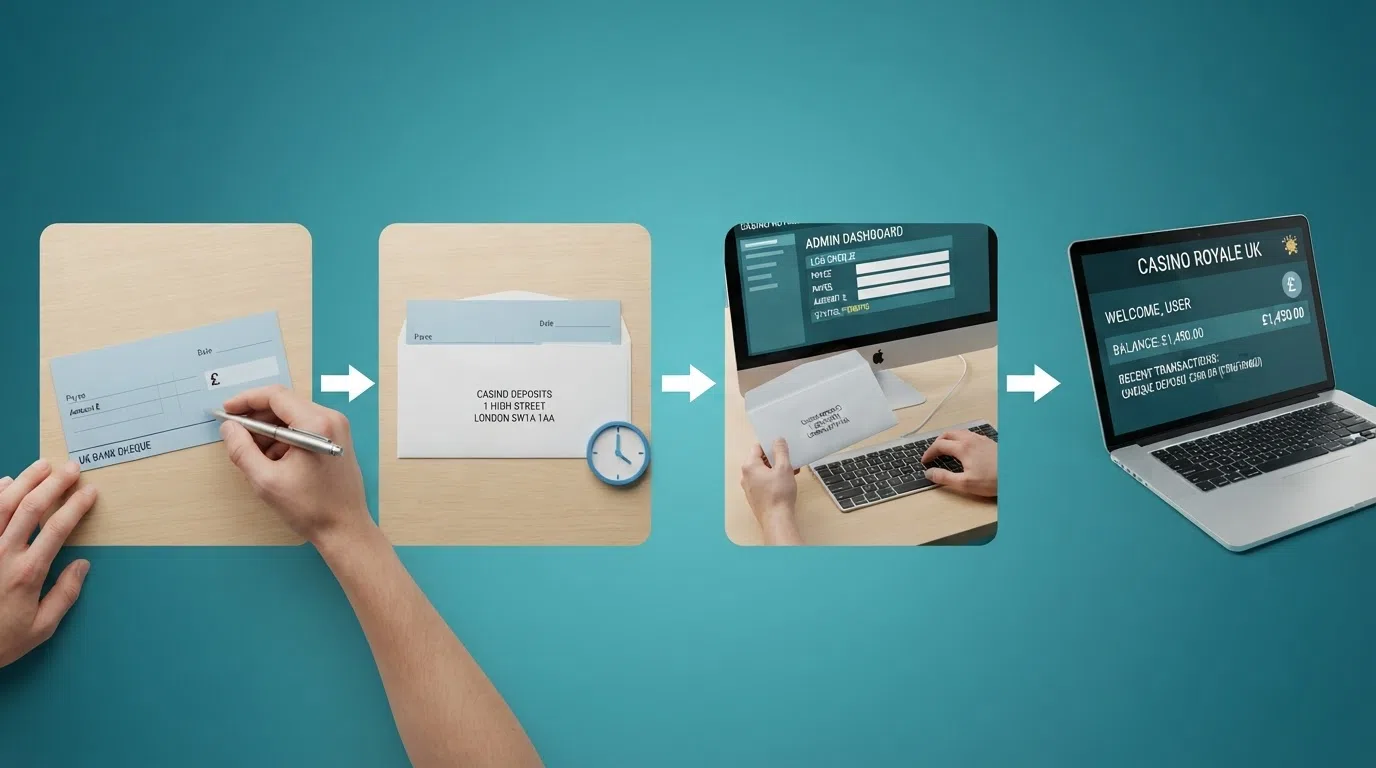
At William Hill, the total processing time from receipt to playable balance runs to approximately ten days. At Ladbrokes, deposit processing runs from 1 to 21 days depending on the queue. At Betfair, the cheque clears in about three days on the deposit side, but a cheque withdrawal from Betfair can take up to thirty days. The variance is not random; it reflects how each operator staffs its payments team, how often it batches cheques for banking, and how thoroughly it checks the cheque against its anti-fraud rules.
A player who sends a cheque on a Monday morning should not expect to play with the funds that week.
How to Deposit by Bank Cheque: The Step-by-Step Process
The practical sequence at any UKGC-licensed operator runs in four steps.
Step one is identity verification, and it has to happen before any deposit. Since 7 May 2019, a GB remote licensee must verify a customer’s name, address and date of birth before they can deposit a penny or place a bet. The pre-2019 grace period — seventy-two hours to send documents after first deposit — is gone. A cheque sent before verification will sit in the operator’s processing queue until the verification is complete.
Step two is to write the cheque payable to the operator’s stated payee. The payee name will be in the cashier or on the operator’s banking page; it is usually a corporate entity rather than a trading name. A reference — typically the player’s account number — should be written on the back of the cheque so the operator can match the payment to the right account.
Step three is to post or courier the cheque to the operator’s processing address. Standard post is acceptable; recorded delivery or courier gives the player a tracking number and a paper trail in case the envelope goes missing. The operator’s banking page should state the address; a player who cannot find it should ask the operator’s customer support before posting anything.
Step four is to wait. The envelope has to reach the operator; the operator has to log it; the operator has to bank it; the cheque has to clear through the Image Clearing System; and the balance has to be credited. At William Hill the total is approximately ten days; at Ladbrokes it can run to twenty-one; at Betfair it is closer to three. Waiting for clearance is the standard price of this paper-based lane.
Cashing Out by Cheque: Withdrawing Your Winnings the Same Way
Withdrawal by cheque takes longer than deposit by cheque, for two compounding reasons. The first is the closed-loop principle: most UKGC licensees prefer to return funds to the originating payment method, which means a cheque depositor may also face a cheque withdrawal. The second is internal approval cycles — the operator’s payments team has to authorise the withdrawal, queue it for batching, prepare the cheque and post it — plus postal delivery to the player.
At Ladbrokes, a cheque withdrawal takes 1–3 days from the point the operator dispatches it. At Betfair, the same process can take up to 30 days. The variance reflects how each operator handles its withdrawal queue and how often it cuts cheques.
Reverse withdrawals — the practice of letting a player cancel a pending withdrawal and return the funds to their playable balance — were permanently banned by the UKGC in October 2021. A player who requests a cheque withdrawal cannot un-request it once it has been processed.
### Comparison of Modern Payment Alternatives
| Payment Method | Typical Deposit Time | Typical Withdrawal Time | Primary Feature |
|---|---|---|---|
| Debit Card | Instant | 1–3 days | Universal acceptance |
| Bank Transfer | 2–10 days | 3–10 days | High-limit transactions |
| Open Banking | Seconds | Minutes | Instant processing |
Bank transfer is the closest like-for-like replacement. It moves the same kind of money — bank-mediated, no card required — through a faster channel. The minimum at most UK casinos is £100; the maximum is £50,000; deposits clear in 2–10 days; withdrawals take 3–10 days. The lane is slower than a debit card but faster than a cheque.
Alternative funding lanes are now the priority. Trustly, TrueLayer and Volt facilitate bank-mediated payments that are both instant and secure, supporting identity verification directly through the player’s own bank. The UK recorded more than 350 million such payments during 2025, representing significant year-on-year growth, according to analysis by Gamblers Connect in 2026. This method is functionally superior to cheques in every dimension except the niche case of a player who does not want to share bank account details digitally — and even there, authorisations are read-only by design; the player approves each payment rather than handing over credentials.
Betfred is a useful example of where the lanes have moved. The operator removed PayPal and other e-wallets in January 2026 and now accepts debit card, Apple Pay, Open Banking and bank transfer only. A cheque-seeking player at Betfred has been redirected to Open Banking without anyone saying the word “cheque”.
The Casinos That Still Take Bank Cheques in 2026 — and the Ones That Do Not
The ten operators on this page were drawn from the UKGC public register of licence holders and cross-checked against competitor pages and operator banking pages for cheque-specific data points. Each entry below carries the licence status verified against the register, the cheque terms where confirmed, the welcome offer with its wagering and bonus-eligibility conditions, and the alternative deposit lanes a cheque-seeking player can use where the cheque lane itself is not available.
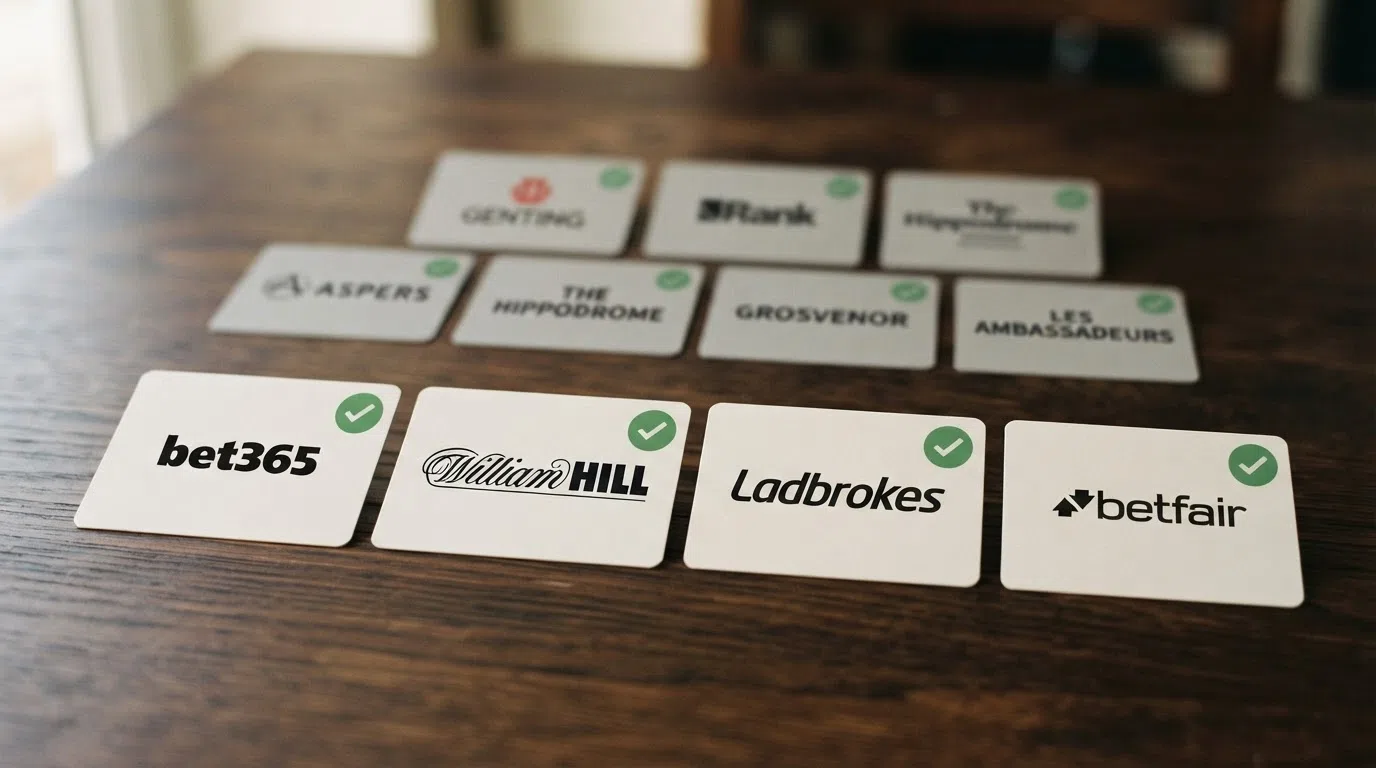
The split the table reveals is real: four confirmed cheque acceptors and six where the method is either not confirmed or actively absent.
| Casino | Cheque deposits accepted? | Welcome bonus | Wagering requirement | Fastest deposit method |
|---|---|---|---|---|
| bet365 | Yes (£500 cap UK) | Bet £10 Get £30 (sports) or up to 100 Free Spins (casino) | 1× sports; no wagering on casino free spins | Debit card |
| William Hill | Yes (£25–£100,000) | Bet £10 Get £30 (sports) or 100% up to £300 (casino) | No wagering on sports free bet winnings; 30× casino | Debit card |
| Ladbrokes | Yes (£10 minimum) | Play £10 Get 100 No Wagering Free Spins (casino) | 0× on free spin winnings | Debit card |
| Betfair | Yes (£5 minimum) | Bet £10 Get £30 (sports) | Varies by offer | Debit card |
| Betfred | Not confirmed | Stake £10 Get 200 Wager Free Spins (casino) | 0× on free spins | Open Banking |
| Coral | Not confirmed | Play £5 Get 100 Free Spins + £10 Bonus (casino) | 10× on bonus (max stake £2) | Debit card |
| 888 Casino | Not confirmed | 100% up to £100 (slots) | 10× | Debit card |
| Sky Vegas | Not supported | Deposit and stake £10 Get 200 Free Spins | 0× on free spins | Debit card |
| BoyleSports | Not confirmed | 500% Casino Bonus on £10 wager | 40× on bonus (max redeemable £500) | Debit card |
| 32Red | Canada-only reference | 150% up to £150 (casino) | 50× (varies by offer) | Debit card |
The fastest deposit method column is uniformly debit card, because that is what bonus eligibility typically requires. The column a cheque-seeking player actually wants to read is the second one. Of the ten, four say yes.
bet365 — Cheque Deposits Confirmed, but the Minimum Is High
bet365 accepts bank cheques, with a cap of approximately £500 per transaction for UK customers and an international minimum of £1,500. The UK figure is unusual: it positions the cheque as a mid-range deposit method rather than a high-roller lane, which is the opposite of how most operators treat it.
The welcome offer at bet365 is a Bet £10 Get £30 in Free Bets on the sports side, or up to 100 Free Spins on the casino side (offer-dependent). Sports free bets carry 1× wagering. Casino free spins carry no wagering, with winnings added to the withdrawable balance. Bonus validity runs to 30 days.
The catch is bonus eligibility. The qualifying deposit for the welcome bonus requires a debit card. PayPal, Apple Pay, Google Pay and Paysafecard are excluded unless full ID verification has been completed. A cheque deposit, even with ID verified, will not trigger the welcome offer.
For the player who wants to deposit by cheque at bet365, the brand offers 100+ game providers including Playtech, NetEnt, Microgaming, Pragmatic Play and Evolution. The operator accepts Visa/Mastercard debit, Apple Pay, Google Pay, PayPal, Paysafecard, bank transfer and Trustly as alternatives, so the cheque lane sits inside a wider banking menu rather than as the only option.
William Hill — The Widest Cheque Deposit Window (£25–£100,000)
William Hill offers the broadest cheque deposit range of any confirmed operator on this page: a £25 minimum and a £100,000 maximum, processed in approximately ten days, with zero fees. The ceiling matters for high-roller players who want to fund their account by paper instrument; the floor matters for the player who has a £25 cheque from somewhere and wants to use it.
The welcome offer runs two ways. The sports side is Bet £10 Get £30 in Free Bets with no wagering on winnings and a 7-day window. The casino side is 100% up to £300 with 30× wagering on the bonus. Sports free bets at William Hill are unusually clean: what the bet wins is what the player keeps.
Bonus eligibility requires a Visa/Mastercard debit, Apple Pay or Google Pay deposit. Cheque deposits are excluded from bonus qualification. The 30× casino wagering requirement exceeds the 10× regulatory cap on bonus wagering requirements introduced in December 2025. A player comparing William Hill’s casino bonus against another operator’s should be aware that the current regulatory standard caps wagering at 10×.
Alternative payment methods at William Hill include Visa/Mastercard/Maestro debit, PayPal, Apple Pay, bank transfer, Trustly, Paysafecard and Neosurf. The provider mix runs to Playtech, NetEnt, IGT, Evolution and Blueprint.
Ladbrokes — No-Wagering Free Spins and Cheque Deposits from £10
Ladbrokes combines confirmed cheque acceptance with one of the rarer welcome offers in the UK market: 100 free spins at £0.10 per spin on selected games, with no wagering on free spin winnings. The player gets to keep what the spins win, and the 0× wagering sits below the 10× regulatory ceiling by a wide margin.
The cheque terms are competitive. Minimum £10; deposit processing 1–21 days; cheque withdrawals 1–3 days; zero fees. The £10 minimum is the lowest among the Entain-group operators on this page.
Bonus eligibility requires Visa/Mastercard debit, Apple Pay or Google Pay. A cheque deposit will not trigger the welcome offer. The free spins must be accepted within 48 hours and are valid for 7 days once accepted.
For the player who wants to deposit by cheque at Ladbrokes and then play the welcome offer, the two do not meet. The cheque gets the funds in; the welcome offer wants a different lane. That is the structural mismatch most cheque-accepting operators present: the method that lets you fund slowly is rarely the method that triggers the bonus.
Betfair — The Lowest Cheque Deposit Hurdle at £5
Betfair sets the lowest cheque deposit minimum in the confirmed set: £5. The friendliest entry point on this page sits beside the least friendly exit: cheque withdrawals from Betfair can take up to 30 days, which is longer than any other confirmed operator’s withdrawal window.
The welcome offer is a sports Bet £10 Get £30 (varies by offer) with wagering that varies and a 7-day validity. Bonus eligibility typically requires a debit card deposit.
The structural trade-off at Betfair is between entry speed and exit speed. A £5 cheque deposit clears in about three days; a cheque withdrawal can take a month. A player who plans to deposit, play and withdraw by cheque needs to budget for the asymmetry.
Betfair’s alternative payment methods include Visa/Mastercard debit, Apple Pay, PayPal, bank transfer and Paysafecard. The provider mix runs to Playtech, NetEnt, IGT, Evolution, Red Tiger and Blueprint.
Betfred — No Confirmed Cheque Option, but Open Banking Fills the Gap
Betfred removed PayPal and other e-wallets in January 2026 and now accepts debit card, Apple Pay, Open Banking and bank transfer only. Cheque acceptance is not explicitly confirmed from search results; the cashier simply does not list it.
The welcome offer is Stake £10 Get 200 Wager Free Spins on the casino side, with 0× wagering on free spin winnings and a 30-day window to stake. On the sports side it is Bet £10 Get £50 in Free Bets. Bonus eligibility requires a debit card, Apple Pay or Open Banking deposit — bank transfer does not qualify.
For a cheque-seeking player at Betfred, the practical recommendation is Open Banking (Instant Bank Transfer). The lane delivers the bank-mediated funding the player wanted from a cheque, without the envelope, without the postal delay, and as a qualifying deposit for the welcome offer.
Coral — Entain’s Other Casino, Cheque Status Unconfirmed
Coral sits in the same Entain group as Ladbrokes, where cheque acceptance is confirmed. Cheque status at Coral is not confirmed from search results. The group may support it; the brand has not published the lane in a form this research run could verify.
The welcome offer is Play £5 Get 100 Free Spins and a £10 Bonus on the casino side. Wagering is 10× on the bonus with a max stake of £2; the offer must be accepted within 14 days and used within 30 days. Bonus eligibility requires Visa/Mastercard debit, Apple Pay or Google Pay.
The 10× wagering sits at the regulatory ceiling, so Coral’s bonus is now constrained by the same hard cap as every other GB-licensed operator’s bonus. A player comparing Coral’s offer against the market is comparing it against a ceiling rather than against operator choice.
888 Casino — A Premium Slots Destination Without Confirmed Cheque Support
888 Casino’s welcome offer is a 100% bonus up to £100 on slots, with 10× wagering, claimable within 48 hours of deposit and wagerable over 90 days. The provider mix includes NetEnt, Evolution, Playtech, Red Tiger, Pragmatic Play and 888 proprietary titles, which makes the casino a strong fit for a slots-focused player who does not need the table-game depth of an Evolution-heavy live casino brand.
Cheque acceptance is not confirmed from search results. The alternative payment methods are Visa/Mastercard debit, Apple Pay, PayPal, bank transfer, Paysafecard and Trustly. A cheque-seeking player can use bank transfer as the slow-payment analogue; Trustly (Open Banking) as the instant alternative.
Sky Vegas — No-Wagering Free Spins, No Cheque Deposit Listed
Sky Vegas offers 200 no-wagering free spins on its welcome offer, with 30 days to deposit and stake and a 7-day free spin expiry. The wagering on free spin winnings is 0×, which is a meaningful contrast to most casino welcome offers that route free-spin winnings through a wagering requirement.
Cheque deposits are not supported. Sky Vegas accepts debit cards, Apple Pay, PayPal and Trustly (Open Banking) only; no bank transfer or cheque is listed in the cashier. A player who wants the no-wagering free spins and the modern payment equivalent of a cheque should look at Trustly here.
The Flutter-group sibling structure means Sky Vegas shares ownership with Betfair, where cheques are confirmed. The decision not to list cheques at Sky Vegas is a brand-level choice, not a group-level constraint.
BoyleSports — A Big Welcome Bonus, Cheque Acceptance Unconfirmed
BoyleSports advertises a 500% casino bonus when a player wagers £10, plus 100 free spins on selected slots when the player stakes £20 (credited next day, 72-hour expiry). The wagering on the casino bonus is 40×, with a maximum redeemable amount of £500, and opt-in is required for selected UK and Irish players.
The 40× wagering exceeds the 10× regulatory cap that came into force on 19 December 2025 under LCCP Social Responsibility Code 5.1.1. A player who encounters a BoyleSports bonus advertised at 40× wagering in 2026 is looking at an offer that pre-dates the cap, and the operator is likely in the process of revising the terms — a player should verify the current terms with the operator before staking.
Cheque acceptance is not confirmed from search results. The alternative payment methods include Visa/Mastercard debit, Apple Pay, Google Pay, PayPal, Neteller, Skrill and Paysafecard.
32Red — Canada-Focused Cheque Option, Not Confirmed for UK Players
32Red’s banking page mentions “Instant Cheque (Canada only)” as a bank statement descriptor, which suggests the option is a Canadian feature and not a UK deposit method. A UK player who sees “cheque” referenced in the cashier should verify before sending anything through the post.
The welcome offer is a 150% bonus up to £150 on the casino side, with 50× wagering that varies by offer. The provider mix includes Microgaming, NetEnt, Evolution, Pragmatic Play and IGT. Alternative payment methods include Visa/Mastercard/Maestro debit, Apple Pay, Google Pay, Revolut, Trustly, bank transfer and Instant Bank Transfer.
For a UK cheque-seeking player at 32Red, the realistic lane is bank transfer or Trustly (Open Banking). The “Instant Cheque” descriptor should be treated as a Canada-only signal.
Is Your Cheque Deposit Legal? The UKGC Rules That Protect Casino Payments
Bank cheque deposits are legal at any UKGC-licensed operator. The Gambling Commission has not banned cheques, has not restricted them, and has not set any specific rule that disadvantages them against bank transfers or Open Banking. A cheque deposit is treated as a payment instrument like any other, and the same regulatory framework that governs debit card deposits applies.
What the UKGC has done is build a regulatory framework around any payment method a casino offers, and several of those rules materially shape the cheque experience.
The UKGC Licence: Why It Matters for Your Cheque Deposit
A GB licence is the single non-negotiable gate. Under section 33 of the Gambling Act 2005, providing facilities for gambling without the required GB licence is a criminal offence, carrying up to 51 weeks’ imprisonment, an unlimited fine, or both. A Curaçao, MGA or Gibraltar licence is not a substitute at the point of consumption; the 2014 Gambling (Licensing and Advertising) Act extended the GB regime so that any operator serving GB customers needs a GB licence regardless of where it is incorporated.
Section 1 of the Gambling Act 2005 sets three licensing objectives: preventing gambling from being a source of crime, ensuring gambling is conducted fairly and openly, and protecting children and vulnerable persons. Every condition the UKGC imposes on a licensee — payment-method rules, bonus rules, identity verification, self-exclusion — flows from these three objectives.
A player can verify any operator’s licence on the UKGC’s public register of licence holders, searchable by business name, trading name, domain or account number. The register is updated continuously and is the single source of truth for who is licensed to take GB customer money. Verification is a mandatory step that guarantees the operator’s legitimacy.
The Laws That Shape Your Cheque Deposit: Identity, Credit and the Closed Loop
Three rules directly shape what happens when a player posts a cheque to a casino.
Identity verification before deposit. Since 7 May 2019, a GB remote licensee must verify a customer’s name, address and date of birth before they can deposit or gamble. The pre-2019 seventy-two-hour grace period is gone. A cheque sent before verification sits in the operator’s queue until the verification is complete, which is a delay the player imposes on themselves.
The credit card ban. Since 14 April 2020, LCCP licence condition 6.1.2 has prohibited GB-licensed operators from accepting payment for gambling by credit card. The prohibition extends to credit-card-funded e-wallet payments. A cheque drawn on a credit-card-funded account is not the kind of deposit the rule was drafted to catch, but a player funding a gambling account through any credit-card-mediated path is in a regulatory grey area.
The closed-loop withdrawal policy. Most UKGC licensees prefer to return funds to the originating payment method, which means a cheque depositor may also face a cheque withdrawal. Reverse withdrawals — letting a player cancel a pending withdrawal and return the funds to their playable balance — were permanently banned in October 2021 under LCCP social responsibility code provisions. The combination of closed-loop and no-reverse-withdrawal means a cheque deposit locks the player into a cheque withdrawal lane.
Player Protections That Apply Regardless of Payment Method
A UKGC licence guarantees a set of player protections that apply to every deposit method, including cheques.
Online slots stake caps. The UK statutory maximum stake per game cycle for online slots is age-banded: £5 for players aged 25 and over (in force 9 April 2025) and £2 for players aged 18–24 (in force 21 May 2025), imposed by SI 2025/215. A “game cycle” covers the period from initiation to loss or payout, and the cap applies to total staked within that cycle. The rule applies to every GB-licensed casino and to every payment method.
Game-design rules. Auto-play is banned; spin speed carries a 2.5-second minimum; features that speed up play are banned; losses disguised as wins are banned; operators must display total losses, wins and time played during a slots session. The rules shape the product, not the payment method, but a player depositing by cheque is still playing under them.
The bonus cap. Wagering requirements at GB-licensed operators are capped at 10× from 19 December 2025 under LCCP Social Responsibility Code 5.1.1. Mixed-product promotional offers are banned — no “bet on football, get free spins” packages. The cap applies regardless of how the player funded their account.
Enforcement. The UKGC published disruption enforcement figures for April 2024 to June 2025: 3,140 disruption notices issued, 447,778 URLs referred to search engines, 287,961 URLs removed, and an average 32% fall in engagement across 160 disrupted sites. The Commission has no statutory ISP or DNS blocking powers; its enforcement is disruption-based, through cease-and-desist notices, search-engine referrals, domain registrar action and payment-provider referrals.
Responsible Gambling When Your Deposit Moves at Postal Speed
A payment method that takes days to clear creates a specific responsible-gambling profile. The cheque is not dangerous in the way a credit card was — credit cards are banned for gambling for exactly that reason — but the slower feedback loop between “decide to deposit” and “funds are playable” cuts both ways. It gives a player who has just self-excluded time to think; it also gives a player who has just decided to chase a loss more time to send another envelope.
The UK safety net for both directions is built around three layers.
GAMSTOP and the Cheque Depositor: What Self-Exclusion Actually Blocks
GAMSTOP has been mandatory for every GB-licensed online operator since 31 March 2020. A player can self-exclude for 6 months, 1 year, 5 years, or 5 years with auto-renewal. None of those periods can be cancelled early.
GAMSTOP is payment-method-agnostic. It blocks the player account at the operator level, not the payment instrument at the bank level. A cheque sent to an operator where the player is self-excluded through GAMSTOP will not be honoured. A cheque sent to an unlicensed operator falls outside GAMSTOP’s reach entirely, which is one reason the licensing framework matters: the protections follow the licence, not the payment method.
Deposit Limits and Financial Vulnerability Checks: The Rules That Kick In
From 31 October 2025, operators must prompt customers to set a financial limit before their first deposit, and must action any request to decrease a limit immediately. A gross deposit limit must be offered with at least equal prominence to other financial limits; only that form may be called a “deposit limit”. The original commencement date was 30 June 2026; it was extended to 30 September 2026 under RTS 12.
The financial vulnerability check threshold sits at £150 net deposit in a rolling 30-day period, from 28 February 2025, under LCCP SR Code 3.4.4. The check uses publicly available data only — bankruptcy orders, county court judgments, individual voluntary arrangements, debt relief orders. A cheque deposit counts toward the £150 threshold the same way any other deposit does.
Financial risk assessments — the broader affordability checks — are announced but not yet commenced. The thresholds are £5,000 net deposits in 24 hours (25+) or £2,500 (under 25) at stage 1, and £1,000/£3,000 (25+) or £750/£2,000 (under 25) at the final stage. The start date is not confirmed, and the rules are politically sensitive; a player who encounters an operator describing itself as already running affordability checks at these thresholds is encountering marketing rather than a live regulatory requirement.
Where to Get Help: The UK Safety Net in 2026
The National Gambling Helpline, run by GamCare, is free, confidential and available 24/7 on 0808 8020 133. The helpline made 996 referrals to treatment and peer-based support services in January 2026, up from 674 in January 2025 — a 48% year-on-year increase. GamCare’s own assessment of the trend, reported in 2026, is that “People are moving from ‘help-seeking’ to ‘treatment-starting’ faster. The proportion of target calls converting into treatment has increased markedly, suggesting callers are more ready to engage in structured support.”
The treatment numbers sit behind the helpline. The National Gambling Support Network treated 11,960 clients in Great Britain in 2024/25, an 11% increase on the previous year; 50% of clients had their first appointment within six days; 93% of clients who completed treatment saw improvement.
The broader picture frames who the safety net is for. Around 0.5% of the adult English population experience problem gambling; 3.8% are at elevated risk; an estimated 7% of the British population are negatively affected by someone else’s gambling. In 2026, 81.5% of National Gambling Helpline contacts disclosed online forms of gambling — a five-year high, up from 72.9% in 2022. The cohort that needs the helpline is increasingly the cohort that found this page.
NHS gambling harm clinics operate in England, Scotland and Wales. Gamblers Anonymous runs peer support meetings. GamCare offers online self-assessment tools, live chat, WhatsApp and counselling in addition to the helpline. A player who recognises any of the patterns above in their own behaviour, or in someone close to them, has a route to free, confidential help that does not require a deposit or a cheque.
How We Chose and Ranked Every Casino on This Page
The ten operators on this page were drawn from the UKGC’s public register of licence holders, then cross-checked against competitor pages and the operators’ own banking pages for cheque-specific data points. The register is searchable by business name, trading name, domain or account number and was last updated in 2026; each operator on this page is GB-licensed unless otherwise stated.
The evaluation framework had four criteria. First, licence status on the UKGC register — every operator on the page is verified active. Second, confirmed cheque acceptance from a public source — where a cheque is not confirmed, the operator’s best documented alternative is described instead. Third, welcome-offer terms including wagering multiplier, bonus validity and bonus eligibility by payment method. Fourth, the availability of Open Banking as the modern replacement lane for a cheque-seeking player.
This page does not weight criteria numerically. It does not accept payment for placement. It does not rank an operator above another for having a commercial relationship with this site. The split between the four confirmed cheque acceptors and the six where cheque status is unconfirmed or unsupported reflects what the public sources say, not an editorial preference.
Bank Cheque, Bank Transfer or Open Banking: What Should You Actually Use in 2026?
The verdict the data supports is not the verdict most players arrive expecting.
The cheque case is narrow. Four UKGC-licensed operators confirm bank cheque deposits; the minimums run from £5 (Betfair) to £25 (William Hill) and the maximums run to £100,000 (William Hill); the processing windows run from 3 days (Betfair) to 21 days (Ladbrokes) on deposits and up to 30 days on withdrawals. The method is slower than any other lane on this page, and none of the confirmed cheque acceptors make cheque deposits bonus-eligible.
The bank transfer case is the closest like-for-like replacement. Typical limits are £100 minimum and £50,000 maximum; deposit clearing takes 2–10 days and withdrawal clearing takes 3–10 days. The lane is broadly supported and broadly bonus-ineligible at most operators, but it does not carry the postal handling cost of a cheque.
The Open Banking case is the lane the data points toward. Pay by Bank via Trustly, TrueLayer or Volt deposits in seconds, withdraws in minutes, and grew to more than 350 million UK payments in 2025. It is bonus-eligible at Betfred and Sky Vegas among the operators on this page, and functionally superior to a cheque in every dimension except the niche case of a player who does not want to share bank account details digitally.
For the majority of players who searched for “casinos that accept bank cheque,” Open Banking delivers the outcome they actually want — bank-mediated funding that clears fast, supports the welcome offer, and works at most of the featured operators. The four confirmed cheque-accepting casinos remain a valid choice for the player who has a specific reason to use a paper instrument, and the figures and timelines above are what that choice actually costs.
Frequently Asked Questions
What is the minimum amount I can deposit by cheque at a UK casino?
The lowest confirmed cheque minimum on this page is £5 at Betfair. Ladbrokes accepts cheques from £10, and William Hill from £25. bet365’s UK cheque cap sits at approximately £500 per transaction with an international minimum of £1,500. A player should always verify the current minimum with the operator before posting, as the cashier figure is the one that governs.
Are cheque deposits eligible for welcome bonuses at UK online casinos?
No confirmed cheque-accepting operator on this page makes cheque deposits bonus-eligible. William Hill, Ladbrokes and Betfair all require Visa/Mastercard debit, Apple Pay or Google Pay to qualify for the welcome offer. bet365 requires a debit card. A player who wants both the cheque deposit lane and the welcome bonus has to pick one — they cannot have both at the same operator.
Is it safe to send a bank cheque to an online casino?
Yes, provided the operator is UKGC-licensed and the cheque is sent by recorded delivery or courier to the address published in the cashier. The UKGC public register is searchable by business name or domain and is the place to verify a licence before sending funds. A player who sends a cheque to an unlicensed operator loses all UKGC protections, including GAMSTOP coverage and the dispute-resolution route.
Why are fewer UK casinos accepting cheque deposits?
Three costs: operational headcount to receive, log and bank envelopes; fraud exposure from bounced or stolen cheques; and the existence of Open Banking, which delivers the same bank-mediated funding without the postal handling. UK cheque volumes fell to 91 million in 2024, down 17% year on year, representing just 0.2% of all payments. The trend in cheque-using casinos follows the trend in cheque-using Britain.
What happens if my cheque deposit bounces at an online casino?
The operator’s payments team will reverse the credit to the player’s account, typically after the cheque returns through the Image Clearing System. The bounce may trigger a fraud review on the player’s account, and repeated bounces can lead to account closure. A player whose cheque is at risk of bouncing should not post it; the closed-loop and no-reverse-withdrawal rules mean there is no easy recovery path once a cheque has been accepted and bounced.
What is the best alternative to cheque deposits at UK online casinos?
Open Banking, in the form of Pay by Bank via Trustly, TrueLayer or Volt. Deposits are instant, withdrawals are near-instant, and the lane is bonus-eligible at several featured operators including Betfred and Sky Vegas. The UK recorded more than 350 million Open Banking payments in 2025. The lane is the modern equivalent of a cheque for a player who does not have a specific reason to use paper.
What Is a Bank Cheque Casino Deposit?
A bank cheque casino deposit is a physical cheque — drawn on the player’s own bank account, made payable to the operator’s stated payee — sent through the post or via courier to the operator’s processing address. It is not a wire. It is not an instant payment. It is a paper instrument that the operator banks on receipt, after which the standard cheque-clearing cycle takes over.
The distinction matters because players routinely confuse a bank cheque with a bank transfer. They are different lanes. A bank cheque is a paper instrument cleared through the Image Clearing System; a bank transfer is an electronic credit routed through Faster Payments, BACS or SWIFT, and arrives without any envelope. The two have different minimums, different maximums and different processing windows. At William Hill, for example, a bank cheque runs from a minimum of £25 to a maximum of £100,000, with processing time of approximately ten days and zero fees. A bank transfer at a typical UK casino runs from a minimum of £100 to a maximum of £50,000, with deposit times of 2–10 days and withdrawal times of 3–10 days. The cheque has the higher ceiling and the wider entry point; the bank transfer is the faster lane once the envelope is out of the picture.
A player who believes they have sent a “bank cheque” and is actually expecting a Faster Payments credit will wait weeks for funds that never arrive through the channel they imagined. The two methods are not interchangeable.
Why Would Anyone Deposit by Cheque at an Online Casino in 2026?
Three reasons recur. The first is the player who does not want to share bank credentials digitally. Open Banking integrations — Pay by Bank via Trustly, TrueLayer or Volt — require the player to authorise a connection between the casino and their bank. A bank cheque, by contrast, requires only a chequebook, a pen and an envelope. The bank never sees the casino and the casino never sees the bank login.
The second is the player who already holds a physical cheque. Someone who has been paid by cheque, or who has won a prize paid by cheque, may want to convert that paper instrument into online casino credit without first banking it themselves. Posting it to the operator cuts out the intermediate step.
The third is the player who distrusts instant deposits and prefers the paper trail a cheque creates. A cheque carries a serial number, a date, a payee and a drawer. A Faster Payments credit is a row in a statement. For a player who treats gambling money the way they treat any other significant outflow, the audit trail of a cheque is part of why they chose it.
None of these reasons is irrational. The 30% of UK adults who still engage with cheques in 2024 represent a real population, and 350 million Open Banking payments in 2025 represent a different real population. The choice between them is a choice about what kind of payment instrument the player wants to use, not a question of which one is “better” in the abstract.
Bank Cheque vs Debit Card vs Bank Transfer: What Is Each One Actually Worth?
A UK casino player who wants to fund their account has four realistic lanes. Each is worth something different, and a player who reaches for a cheque without knowing what the other three deliver will be paying for a feature they could have got elsewhere.
Debit card is the baseline. Deposits are instant; withdrawals take a few hours to a few days; the method is universally accepted and almost universally bonus-eligible. The lane does not exist for credit cards: since 14 April 2020, LCCP licence condition 6.1.2 has prohibited GB-licensed operators from accepting payment for gambling by credit card, and that prohibition extends to credit-card-funded e-wallet payments. A player with only a credit card has no gambling deposit lane at all from a UKGC-licensed operator.
Bank transfer is the slower high-limit lane. A bank transfer deposit at a typical UK casino runs from £100 to £50,000, clears in 2–10 days, and a withdrawal by the same method takes 3–10 days. The lane suits a player who is moving four-figure sums and does not mind waiting.
Open Banking is the new instant lane. Pay by Bank via Trustly, TrueLayer or Volt deposits in seconds, withdraws in minutes, and supports identity verification through the player’s own bank. The lane grew to more than 350 million payments across the UK in 2025. It is functionally superior to a bank cheque in every dimension except the niche case of a player who does not want to share bank credentials digitally.
Bank cheque is the outlier. Of the ten featured operators in this guide, only four have confirmed cheque acceptance from public sources. The cheque has a higher minimum than a debit card, a slower clearance time than Open Banking, a higher entry point than a debit card and a wider ceiling than a bank transfer. It is the lane for a player with a specific reason to use it.
Which UK Online Casinos Still Accept Bank Cheque Deposits?
Four of the ten featured UKGC-licensed operators have confirmed bank cheque acceptance from public sources. The other six have either dropped the lane, never offered it publicly or have not been verified for it during this research run.
The four confirmed cheque-accepting operators, with their cheque-specific terms:
- bet365 — cheque deposits confirmed; UK cap of approximately £500 per transaction; international minimum £1,500. Welcome bonus requires a debit card deposit.
- William Hill — bank cheque deposits from £25 minimum to £100,000 maximum, approximately ten days processing, zero fees. Cheque deposits excluded from bonus qualification.
- Ladbrokes — bank cheque deposits from £10 minimum; deposit processing 1–21 days; cheque withdrawals 1–3 days; zero fees. Welcome bonus requires debit, Apple Pay or Google Pay.
- Betfair — bank cheque deposits from £5 minimum; three-day deposit processing; cheque withdrawals up to thirty days; zero fees. Welcome bonus typically requires a debit card.
The six featured operators where cheque acceptance is not confirmed from public sources — Betfred, Coral, 888 Casino, Sky Vegas, BoyleSports, 32Red — each offer bank transfer, Open Banking or both as their slow-payment or bank-mediated lanes. Betfred removed PayPal and other e-wallets in January 2026 and now accepts debit card, Apple Pay, Open Banking and bank transfer only. Sky Vegas accepts debit cards, Apple Pay, PayPal and Trustly only, with no bank transfer or cheque listed. 32Red’s banking page mentions “Instant Cheque (Canada only)” as a bank statement descriptor, which suggests the option is Canadian, not British. Coral and BoyleSports sit in groups that may support cheques but have not published the lane in a form that this research run could verify.
The pattern is consistent. Operators in the Entain group (Ladbrokes, Coral) and the Flutter group (Betfair, Sky Vegas) diverge on whether cheque is listed publicly: Ladbrokes and Betfair publish it; Coral and Sky Vegas do not. The decision appears to be per-brand rather than per-group, and the brand that bothers to keep the cheque option in the cashier is the exception.
The reason so few operators still take cheques comes down to three costs. The first is operational: cheques require a payments team to receive envelopes, log them, batch them and bank them, and most operators have concluded that the player volume does not justify the headcount. The second is fraud: a cheque can bounce, can be reported stolen, can carry a forged drawer’s signature, and each of those cases generates a dispute that costs the operator time. The third is the existence of Open Banking, which delivers the same outcome — bank-mediated funding without a card — without any of the postal handling.
Payments – realmoney-onlinecasinos-uk
Content created by the «realmoney-onlinecasinos-uk» team